


The best LiDAR robot lawn mower reads your lawn with a spinning laser instead of a buried wire or a satellite signal, so most mowers on this page need no sky view and no buried loop; the LUBA 3 adds an RTK station that needs open sky. I keep the lawns around a 3.7-acre apricot and plum orchard, and I check every mower’s rating against a quarter-acre house lawn before I trust it.
I ranked seven LiDAR mowers by lawn size, slope and edge work. My first pick is MOVA LiDAX Ultra 1000 Wire-Free LiDAR Robot Mower, which suits a level quarter-acre lawn and needs no RTK pole. Below you will find each mower’s limits, the sensor trade-offs and the safety steps that apply to all of them.
Best LiDAR Robot Lawn Mower Reviews 2026 for Wire-Free Lawns
These seven mowers all navigate with LiDAR and cover lawns from a quarter acre to 0.87 acre. Each block below gives the maker’s limits for that exact model, so you can match a mower to your slope, your edges and your budget.
1. MOVA LiDAX Ultra 1000 Wire-Free LiDAR Robot Mower Best Overall
The MOVA LiDAX Ultra 1000 is the LiDAR mower I recommend first for a lawn of about a quarter acre. It maps with a 360 degree LiDAR and an AI camera, so it needs no boundary wire, no RTK pole and no clear view of the sky. It sits in the lowest price tier of the seven mowers on this page, and its sound-power figure of 57 dB(A) is the lowest of the seven too.

WHY I CHOSE THIS ✓
I put it first because it asks the least of the buyer. No wire to bury, no RTK pole to site and no sky-view rule leave a charging tower, a map and a PIN, so the setup is short. It also has a lift alarm, a child lock, a rain pause and a frost pause. That balance of outlay, noise and setup is why I rank it as the best LiDAR robot lawn mower for a first purchase on a level quarter acre.
MOVA LiDAX Ultra 1000 Wire-Free LiDAR Robot Mower Specs
Key Features:
- 360 degree LiDAR with an AI camera: the mower fixes its position without satellites or a wire, so a clear sky view is not part of the setup.
- Dual Map: two lawns the robot cannot drive between are kept as two separate maps.
- UltraTrim blade disc: the disc moves to the side along the boundary to cut closer to the edge.
- Motorized cutting height: you set 1.2 to 3.9 in from the app or the display.
- TrueGuard video and patrol: the front camera shows a live view and can patrol chosen spots through the app.
- PIN, lift alarm and child lock: lifting the robot locks it until the PIN is entered, and the body has a compartment for an AirTag.
- Rain and frost pause: the mower returns to its station when it rains, and pauses below 43 F until it is above 52 F.
MOVA rates the mower for 1,000 sq m, about a quarter acre. Its own lab figures are 800 sq m a day in standard mode and 1,200 sq m in efficient mode, so I treat the rating as a ceiling. On my quarter-acre house lawn, with its shade trees, I plan around the 800 sq m standard-mode day and not the 1,000 sq m rating. The slope limit is 45%, or 24 degrees, inside the mowing area, and the manual advises staying under 25% for a better cut.
MOVA does not publish a run time in minutes, only area per day, and charging takes about 60 minutes to reach 85%. The robot weighs 30.2 lb with its battery. According to MOVA it drives on the rear wheels only, and traction drops on wet or loose ground. It cannot cross a step higher than 1.6 in, so a raised paver edge between two lawns needs a ramp.
The edge is where the extra work sits. The UltraTrim disc moves sideways along the boundary, and MOVA claims an uncut strip under 2 in. Along the gravel yard I plan a trimmer pass after the UltraTrim disc. Lawns joined by a stone path work as two zones linked by a drawn path, and any gap narrower than 23.6 in must be set as a path as well.

Cut grass taller than 3.9 in first, and keep the battery above 50% for mapping. I drew the border by remote control beside the vegetable plot, within 5 m (16 ft) behind the robot, because auto detection needs a clear edge in daylight.
Before you tip it over to change blades, press STOP, switch the robot off, wait for the blade disc to stop and put on protective gloves. Fit the LiDAR protective cover first, and replace all three blades together.
Plan on new blades every 6 to 8 weeks and a new cleaning brush each year. Wipe the LiDAR with a lint-free cloth, because a dirty or blocked sensor stops the robot, and hose the housing only with the robot off and the LiDAR covered. For winter, charge it fully, clean it, fit the LiDAR cover, store it indoors above 32 F and unplug the station. With the mower parked by the open machinery shed, the PIN, lift alarm and child lock were what I relied on, because this model has no 4G, no GPS and no off-map alarm.
Buy it if your lawn is level, about a quarter acre or smaller, and you want a wire-free mower in the lowest price tier with a quiet motor. Skip it if you need 4G tracking, if your ground is soft loam, or if the lawn runs past 1,000 sq m.
FINAL VERDICT
The MOVA LiDAX Ultra 1000 gives a quarter-acre lawn a wire-free, quiet and affordable LiDAR mower, and the trade is traction and security features that sit below the dearer machines. Choose it when you want the simplest setup and the lowest outlay.
It is the quiet LiDAR mower I recommend for a level quarter acre.
2. Mammotion LUBA 3 AWD 3000 LiDAR Robot Lawn Mower Best Premium
The Mammotion LUBA 3 AWD 3000 is what I recommend when the lawn is big, steep or shaded and the budget allows the top price tier. It reads the yard with a 360 degree LiDAR, AI vision and an RTK reference station together, drives all four wheels and cuts a 15.7 in swath. Mammotion rates it for 0.75 acre.
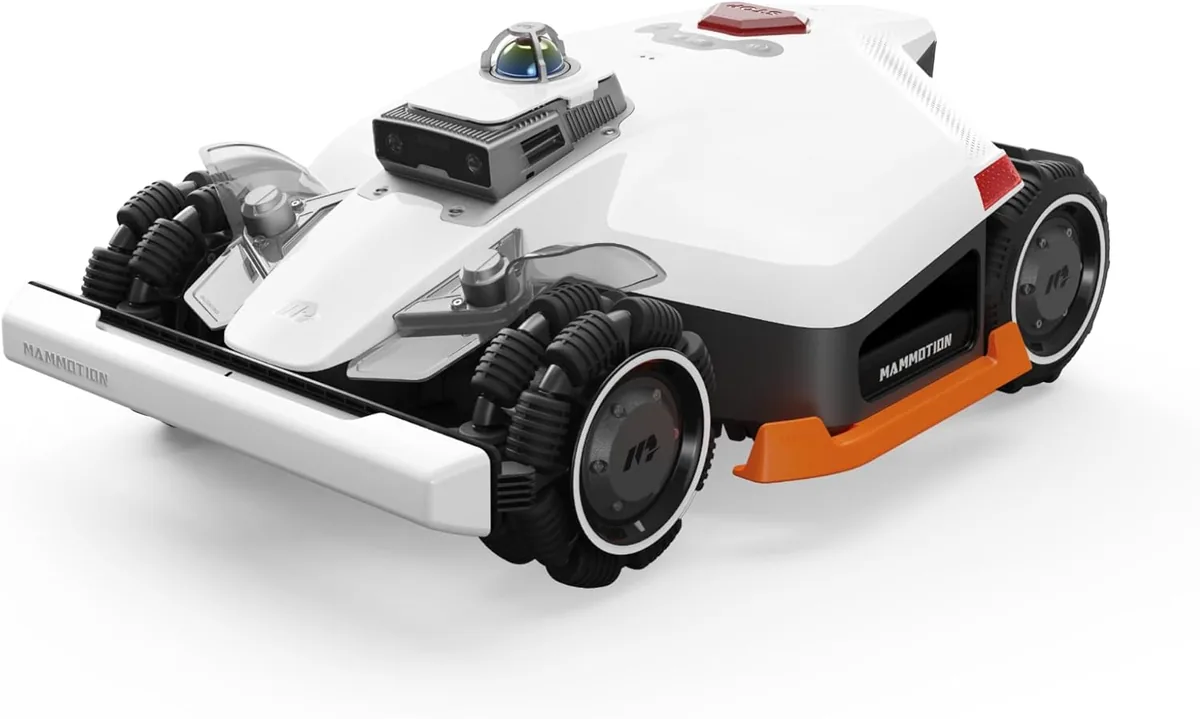
WHY I CHOSE THIS ✓
I place it second because it is the machine I choose for ground that punishes a cheaper mower. Three sensors, four driven wheels and a stated edge slope are what the extra money buys, along with 3 years of free 4G data. That is a lot of machine for one lawn. It is the best premium robot lawn mower on this page, and the price tier is the reason it is not first.
Mammotion LUBA 3 AWD 3000 LiDAR Robot Lawn Mower Specs
Key Features:
- Three sensors together: the LiDAR and the AI vision handle obstacles, and the RTK reference station corrects the position, so the map holds across a wide lawn.
- NetRTK over 4G: in select North American regions the corrections arrive from the cloud, so a lawn with no good station spot may not need the local station.
- All-wheel drive: it passes obstacles up to 2 in high, and Mammotion rates it for 80% slopes in the task area and 40% at the edge.
- 80% slope inside the task area, 40% at the edge: both limits are in the manual, so you can check a border against the right number.
- 15.7 in cutting width: two discs mean fewer passes across a 0.75-acre lawn.
- 30 zones: the app manages up to 30 mapped zones, which suits a yard of separate lawns.
- 3 years of free 4G data: Mammotion lists the 4G service as optional, and the warranty runs 3 years on the main parts.
The manual gives 80%, or 38.6 degrees, inside the task area and 40%, or 21.8 degrees, at the edge. A bank that falls away at the border has to pass the 40% limit, so on any border bank check that figure first and the 80% second. The manual advises mowing in dry weather, because wet grass sticks and the robot can slip on a slope. The app offers Perimeter Only, Stripes and Grid patterns, plus text and image patterns.
Mammotion lists 150 minutes of mowing from 100% to 15% and 105 minutes to charge back to full. The 12 Ah battery is not user-replaceable, and opening the compartment voids the warranty. Lift the robot only by its handle, switched off, with the disc turned away from your body. The 4G service is free for 3 years with no published price for year four, and the app sends a geo-fence alert when the robot strays more than 50 m (164 ft) from its task area.
RTK needs open sky, and Mammotion places the reference station in the open, at least 10 ft from any wall or tree. I kept the station off the orchard alleys, where fruit trees in leaf close the sky, and put it on the open corner of the house lawn. The LiDAR carries the obstacle work. Check Mammotion’s NetRTK coverage for your area first, because the manual lists it only for select North American regions, and keep the station site in mind when you plan the lawn.
Do not move the RTK station after mapping, or delete the map and map again. The one-off DropMow mode for unmapped areas is a Beta feature in the app. On a lawn bordered by gravel or pavement, set obstacle detection to Sensitive, which treats those surfaces as non-grass.
Before lifting, cleaning or touching the blades, press STOP, switch the robot off with a long press of the power button, remove the security key, wait until the cutting disc has stopped and put on protective gloves. Never use an electric screwdriver on the blade screws.
Mammotion asks for new blades every 3 months or after 150 hours, sooner in thick grass, and for all blade screws to be replaced together. The Wildlife Safety setting slows or stops night mowing, and I ran it in daylight with Wildlife Safety on. For winter, charge it to at least 80% before storage and again every 90 days, and bring the robot indoors when it falls below 14 F. The RTK station comes indoors below -4 F.
Choose it for a lawn that is large, hilly or full of separate zones, when you can site the RTK station in the open or live in a NetRTK area. Skip it if your lawn is a quarter acre, if you want the lowest outlay, or if you need a cutting height above 2.7 in.
FINAL VERDICT
The Mammotion LUBA 3 AWD 3000 is the mower for ground that is big and steep enough to defeat a lighter machine. Choose it when the slope or the size is the problem and the premium tier is acceptable.
It is the all-terrain LiDAR mower I recommend for big, hilly lawns.
3. ECOVACS GOAT O1000 LiDAR PRO Robot Lawn Mower Best Value
The ECOVACS GOAT O1000 LiDAR PRO is the quarter-acre mower that trims its own edges. A string trimmer module sits on the chassis, so the machine handles the strip a blade disc leaves along walls, fences and gravel. It maps with LiDAR, needs no wire and no RTK station, and ECOVACS rates it for 1,000 sq m.

WHY I CHOSE THIS ✓
It is the best value robot lawn mower for a quarter-acre lawn with hard edges. The trimmer does a job I would otherwise do by hand after every mow, and LiDAR mapping leaves no wire in the lawn and no antenna to site. Value here means the trimmer and the setup, not the lowest price. It is also weak in two places: a 90 minute run time, the joint shortest published with the Sunseeker, and a 17% limit at the boundary.
ECOVACS GOAT O1000 LiDAR PRO Robot Lawn Mower Specs
Key Features:
- HoloScope dual LiDAR: a 360 degree rotating LiDAR fixes the position and a 3D-ToF sensor watches the ground 3 to 4 m ahead for obstacles.
- TruEdge trimmer: a string trimmer module on the chassis cuts to the edge, where ECOVACS lists about 0 in uncut and 3.54 in for the blade alone.
- 45% slope in the work area: the limit holds inside the lawn, and the manual keeps the virtual boundary off slopes above 17%.
- Motorized cutting height: 1.2 to 3.2 in from the app, with an electric height adjustment.
- Animal protection schedule: the default non-working period runs from 19:00 to 7:00 and can be changed in the app.
- PIN at every start: the PIN is needed each time the mower is switched on or leaves the map, and 0000 is refused.
- Narrow passages: the manual allows paths wider than 0.8 m (2.6 ft), which suits a lawn split by a bed.
The trimmer is the reason this mower earns its place. The blade alone leaves about 3.54 in at the edge, according to ECOVACS, and the trimmer closes that gap. Along the gravel yard and the tool shed wall the trimmer finished the strip I would normally do by hand, so the second job disappeared. The cost is a spinning line at 8,500 r/min and 81 dB(A) sound power while it runs, against 61 dB(A) for the mower alone.
ECOVACS lists 90 minutes of mowing per charge and 70 minutes of charging. Its own efficient-mode rate is about 180 sq m an hour, so one charge covers roughly 270 sq m, and a full quarter acre is several runs across the day. Rating, run time and speed are ECOVACS figures. The mower weighs 28.7 lb with its battery.
The manual asks for the LiDAR to be wiped every week, the camera and ToF sensor every 1 to 2 weeks, the trimmer line and brush to be replaced every 4 to 8 weeks and the blades every 4 to 6 weeks. The weekly LiDAR wipe was the chore I noticed first, and the line and brush are the running cost of the trimmer. At the drainage ditch I set the no-entry zone 30 cm (11.8 in) back and enclosed it with a no-grass strip wider than 50 cm or a fence higher than 15 cm, the manual’s rule for ponds and cliffs.
Cut the grass to 3.9 in or less first. I mapped by remote control within 6 m with someone watching, as the manual asks for a first mapping.
The trimmer line is a hazard of its own. Before you touch the line, press STOP, power the mower off, wait for the blades and the trimmer to stop and put on protective gloves; keep 2 m (6.6 ft) away while it trims, and never trim at night.
ECOVACS says to clean the blade disc and wheels with a brush and wipe the rest with a dry cloth, with no sprays, detergents or high-pressure sprinkler. For winter, charge it fully, power it off, fit the LiDAR cover and unplug the adapter from the station. Mark the station spot, because the manual says the station must return to its exact original position or the mower can lose its map. There is no 4G or GPS tracker on this model.
It fits a lawn of about a quarter acre with walls, fences or gravel edges, where you want the machine to finish them. Skip it if the lawn has many low roots, hoses or wires, if the boundary runs along a steep slope, or if you do not want a spinning string trimmer near the lawn.
FINAL VERDICT
The ECOVACS GOAT O1000 LiDAR PRO is worth its price tier when the edges are the problem and the lawn is a quarter acre. Choose it if you would otherwise string-trim every edge by hand.
It is the quarter-acre mower that trims its own edges.
4. DREAME A3 AWD Pro 3500 LiDAR Robot Lawn Mower Best for Large Lawns
The Dreame A3 AWD Pro 3500 covers the most ground of the seven mowers on this page. Dreame rates it for 3,500 sq m, or 0.87 acre, and its two discs cut 15.7 in at a pass. That makes it the best robotic lawn mower for large lawns here, short of a full acre.
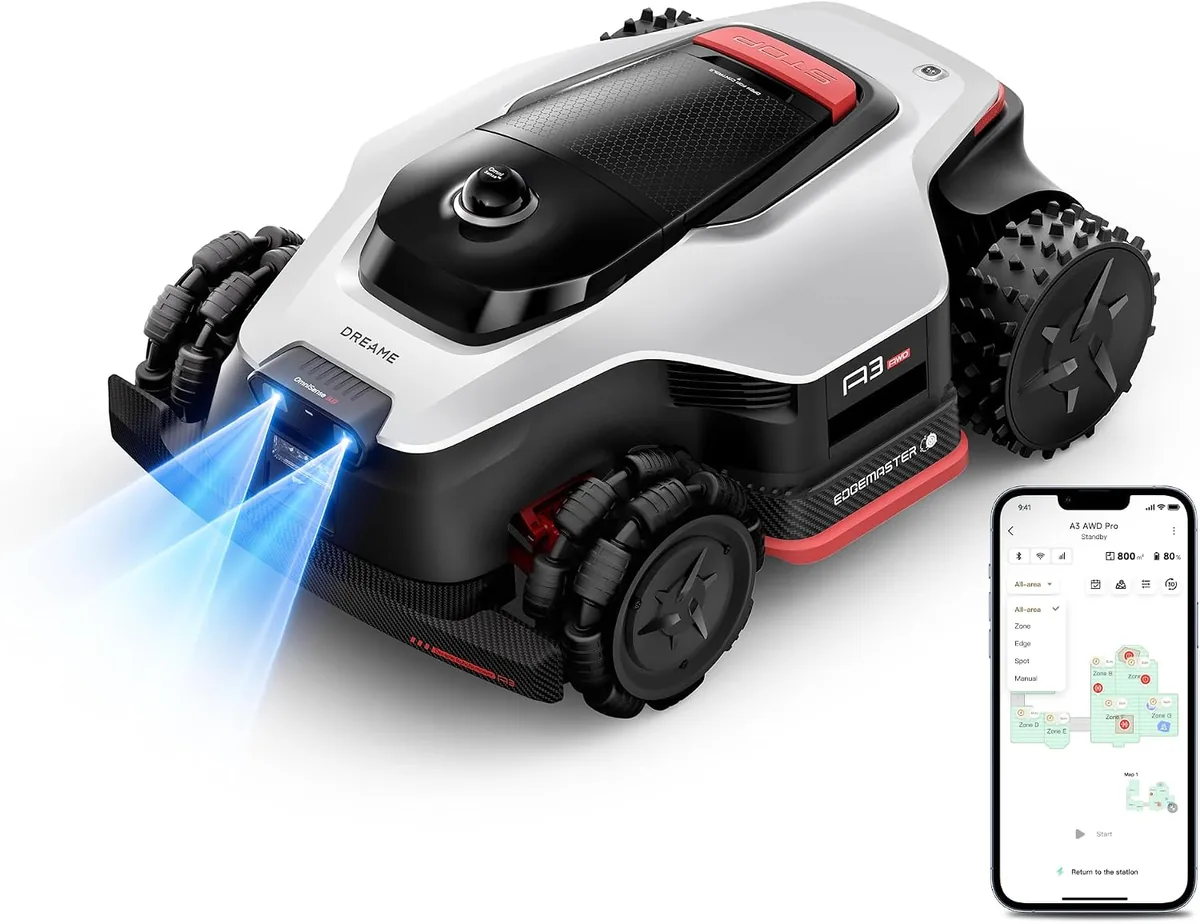
WHY I CHOSE THIS ✓
At 0.87 acre it is the largest rated area of the seven, and the cut matches the widest on the page. Slope is the limit to respect. I plan on the 36% advice, and treat the 80% as a maximum.
DREAME A3 AWD Pro 3500 LiDAR Robot Lawn Mower Specs
Key Features:
- Hub-motor all-wheel drive: each drive wheel has its own motor, and the robot crosses objects up to 2.2 in high.
- 80% slope limit, 36% advised: Dreame gives both figures, so you can plan for the lower one.
- EdgeMaster 2.0: the discs extend outward at the edge to leave under 3 cm, or 1.2 in, between disc and edge.
- Security set: lift alarm, off-map alarm, live location in Google Maps, PIN and child lock.
- 18 spare blades in the box: six holders and a lint-free cloth come with them.
The 3,500 sq m rating is a ceiling. Dreame’s rows give 2,500 sq m per 24 hours in standard mode and 3,500 in efficient mode. Walking the lawn for holes before the first run was the step that mattered, because the manual lists holes and grass above 4 in as the causes of a trapped robot. The rating only pays off on a lawn nearing an acre, and past an acre it is the wrong tool. My Dreame A3 AWD Pro review covers how the 3500 handled rough lawns.
Dreame does not publish minutes per charge, only 85 minutes of charging for a 7.5 Ah battery. Lifting it for the first time, I noticed the 53.6 lb it weighs with its battery. The manual says to carry it by the rear handle, switched off, with the blade disc away from your body.
I measured the gap by the gravel against the 80 cm path rule before mapping. Areas narrower than 80 cm are set as paths, and a lawn edge more than 5.5 cm above the ground beside it needs the robot kept 10 cm away from that edge. Pre-cut grass taller than about 4 in before the first run.
Before clearing a blockage, cleaning or changing blades, press STOP, switch the robot off by holding the power button for 2 seconds, wait for the blade disc to stop and put on protective gloves. Fit the LiDAR protective cover before you turn it over.
Dreame asks for new blades every 6 to 8 weeks, and the app tracks the time left. I followed the app’s blade countdown, which tracks the interval, and the 18 spare blades in the box cover that routine. The 4G Link service has a free period that depends on the configuration you buy, and Dreame publishes no fee afterward. The manual advises turning off the local web service after setup, which matters for your home network.
The lawn it suits runs between half an acre and 0.87 acre of open to moderately complex ground, for an owner who wants no wire and no base station. Skip it if the lawn is a quarter acre, if you cannot lift 53.6 lb, or if the banks run near 80%.
FINAL VERDICT
The Dreame A3 AWD Pro 3500 is the LiDAR mower for a big, open lawn that a small machine would take all day to cover. Choose it when the lawn runs past half an acre.
It is the big-lawn LiDAR mower for open ground up to 0.87 acre.
5. Segway Navimow i215 LiDAR Robot Lawn Mower Best Run Time
The Segway Navimow i215 LiDAR runs about 160 minutes on a charge, the longest published run time of the seven mowers here, and it needs no antenna to do it. It navigates with LiDAR and a camera, so there is no wire and no satellite signal to manage. Segway rates it for about 0.37 acre.

WHY I CHOSE THIS ✓
The run time earns it fifth place, and Segway gives it with its test conditions. With no antenna, the shed walls beside my work pad matter for obstacle sensing and not for a satellite view. The 25% edge limit is the weak spot.
Segway Navimow i215 LiDAR Robot Lawn Mower Specs
Key Features:
- LiDAR and camera fusion: the LiDAR measures the lawn and the camera spots non-grass objects, so no wire or antenna is needed.
- About 160 minutes per charge: Segway’s figure is for standard cutting speed on a fresh-cut lawn.
- Edge Sense and a low-cutting kit: a lab setting in the app mows as close to the edges as possible, and the box holds a low-cutting kit.
- Weather settings: the app sets a reaction to rain, snow, heat, frost and wind, stopping or delaying the task.
- Lift alarm, geofence alarm and PIN: the alarms need a 4G network, and Apple’s Find My can locate the mower.
On the maker’s own capacity figure of 4,585 sq ft an hour, one 160-minute charge covers roughly 12,000 sq ft, about 0.28 acre. On a quarter-acre lawn one charge should be enough on Segway’s figures, and a lawn near the 0.37-acre rating may need a recharge, since the 160 minutes is Segway’s test on a fresh-cut lawn at 25 C. The mower returns to its station when the battery runs low.
The slope figure comes in two parts, 45% inside the lawn and 25% at the boundary. I checked the border first, because the 25% boundary limit is lower than the 45% lawn figure. The drive is not all-wheel. It weighs 32.4 lb with its battery. My Navimow i215 LiDAR review covers this wire-free mower for lawns with shade and walls.
At the gravel by the work pad, a VisionFence-off zone let the mower cross, and I stayed close because obstacle avoidance is off in that spot. A channel between lawns must be wider than 1 m (3.3 ft).
Before lifting or working on the mower, press STOP, enable the safety lock on the screen, power it off, wait for the blades to stop and put on protective gloves. Never use an electric screwdriver on the cutting disc, and never reuse the screws.
Replace all blades and screws every 1 to 2 months. Wipe the LiDAR and the camera lens with a clean cloth. For winter, charge to at least 85%, hibernate the mower from the app and take out the blades. Segway publishes no fee for 4G after the free term, so check the app’s expiry date.
A third-acre lawn with trees or walls that rule out an RTK mower, and an owner who values long runs between charges, is the fit. Skip it if the border drops above 25%, if you need all-wheel drive, or if the lawn is half an acre.
FINAL VERDICT
The Navimow i215 LiDAR suits a third-acre lawn where long runs and no antenna count most. Choose it when the borders are gentle and run time is your priority.
It is the long-running LiDAR mower for a third-acre lawn.
6. Sunseeker S4 3D LiDAR Robot Lawn Mower Best for Small Yards
The Sunseeker S4 weighs 24.3 lb with its battery, the lightest of the seven mowers on this page, and it maps with 3D LiDAR and a camera instead of satellites. Sunseeker rates it for 1,000 sq m, about a quarter acre. That weight makes it the best robot lawn mower for small yards where you lift the mower onto a shed shelf every winter.

WHY I CHOSE THIS ✓
Weight and size earn it sixth place on a small yard. It is a quiet, light mower, and I pick it for a quarter-acre lawn with trees. Its limits are the 42% slope and the 80 cm passages.
Sunseeker S4 3D LiDAR Robot Lawn Mower Specs
Key Features:
- 3D LiDAR and a camera: the app maps the lawn automatically along its edge or by remote control, with no wire and no base station.
- Light body: at 24.3 lb it is easy to carry to the shed in winter.
- Daylight schedule: the recommended schedule follows local sunrise and sunset, and the mower will not leave the station outside daytime hours.
- Up to 100 zones: the manual allows 100 zones, with a corridor between them so the mower can find its way home.
- PIN and lift sensor: a lifted or tilted robot faults until you press a button, and the PIN stops others from starting it.
The 1,000 sq m rating is the maker’s ceiling, and the 42%, or 22 degree, slope limit applies to the work area. A figure such as 60 dB(A) is sound power at the machine, and the 52 dB is what reaches the operator’s ear. Next to my old gas mower it was far quieter to stand beside, which fits the 52 dB at the operator’s ear, and I keep that apart from the 60 dB(A) sound power. Grass packed onto the wheels cuts its grip on a slope, so use the brush.
The manual sets two layout rules. Passages narrower than 80 cm cannot be passed, and corners sharper than 90 degrees make a clean cut hard. A corner sharper than 90 degrees is the first problem to plan for, and at a gravel crossing check the 80 cm width first. Run time and charge time come from Sunseeker’s store.
Cut the grass to 3.1 in or less before the first use, and keep the grass around the charging station under 2.4 in. Map by remote control where the border has steps or drops.
Before inspecting or servicing the blades, press STOP, set the mower to OFF, wait for the blades to stop and put on thick gloves. Never touch a rotating blade, and wear long trousers and work shoes.
Replace blades and screws together every 1 to 2 months if you mow often, and never reuse the screws. The manual asks you to leave the mower alone during a firmware update, and the update needs the station and a battery above 30%. For winter, charge it fully, clean it and store it dry and frost-free on all four wheels. Lifting it onto the shed shelf was easy at 24.3 lb. The GPS and 4G module is an optional extra, so a stock unit has no cellular tracking.
It suits a lawn of a quarter acre or less with shade trees, for a buyer who wants a light, wire-free mower. Skip it if you have banks over 42%, a gravel crossing narrower than 80 cm, or a need for built-in cellular tracking.
FINAL VERDICT
The Sunseeker S4 is a light and quiet mower for a small, gently sloping yard. Choose it when weight and size matter more than climbing ability.
It is the light LiDAR mower for a small yard.
7. Mammotion LUBA mini 2 AWD 1500H LiDAR Robot Mower Best for Small Hilly Yards
The Mammotion LUBA mini 2 AWD 1500H is the small-lawn mower that climbs. Its manual gives 80% slope inside the task area and 40% at the edge, with all-wheel drive on a 0.37-acre rating. A second, fixed disc cuts along the edge.

WHY I CHOSE THIS ✓
It ranks seventh because it solves one problem well. It is a small mower with real slope figures, and along the gravel and the beds the 120 mm edge disc cut close, though I still trimmed a short strip. Its limit is area: 0.37 acre, with no stated maximum.
Mammotion LUBA mini 2 AWD 1500H LiDAR Robot Mower Specs
Key Features:
- Two cutting discs: a 200 mm main disc and a 120 mm edge disc with its own height of 65 mm.
- All-wheel drive: the mower passes obstacles up to 2.9 in high.
- 80% inside, 40% at the edge: two slope limits that match how a lawn is built, with a bank at the border.
- Removable battery: the manual’s bottom view lists a removable battery of 6.1 Ah.
- 20 zones and 3 years of free 4G data: Mammotion lists the 4G service as optional.
Mammotion gives two slope limits. 80% is 38.6 degrees inside the task area, and 40% is 21.8 degrees at the edge, so a border bank has to pass the second one. Check the border bank first, because the 40% edge figure is the one it must pass. That is why I call it the best robot lawn mower for hills on a small lot. The main disc cuts 2.2 to 4 in on the 1500H, so this version is wrong for a lawn kept at 1.5 in. I cover the 1500H AWD model for small lawns and slopes in my Mammotion LUBA mini 2 review.
Mammotion lists 150 minutes of mowing and 150 minutes of charging, and does not publish the area covered per charge. The charging station needs flat, clear ground 4.9 ft on the left, right and front, and good light helps the vision side navigate. I docked it at the tool shed wall, which has a light, as the manual asks for a well-lit station.
Obstacle detection has three levels: Sensitive treats pavement and gravel as non-grass, Standard is the default and Off is for controlled places only. DropMow, the one-off mowing mode, is not for steps, drop-offs, ditches or poor light.
Before lifting, cleaning or touching the blades, press STOP, switch the robot off with a long press of the power button, remove the security key, wait for the disc to stop and put on protective gloves. Never use an electric screwdriver on the blades.
Replace blades every 3 months or after 150 hours, with all screws changed together. Wipe the LiDAR and the lens with a microfiber cloth, and take care when you turn the robot over, because the LiDAR is easy to damage. Before storage, charge to at least 80% and charge again every 90 days. The Wildlife Safety setting slows or stops night mowing.
A lawn under 0.37 acre with a bank or border slope, and a buyer who wants a compact all-wheel-drive mower, is the fit. Skip it if the lawn is larger, if you keep grass shorter than 2.2 in, or if you need a published run time per area.
FINAL VERDICT
The LUBA mini 2 AWD 1500H takes slopes that stop a lighter mower on a small lot. Choose it when the border is steep and the lawn is under 0.37 acre.
It is the compact all-wheel-drive mower for a small hilly lot.
How to Choose the Best LiDAR Robot Lawn Mower
Every mower here is a wire free robot lawn mower, so a mapped boundary replaces the buried loop. What separates them is the sensor mix, the ground they handle and the edges they leave. These eight factors decide which one fits. I compare nine models in my best robot lawn mower without perimeter wire roundup.
What LiDAR, RTK and Vision Each Need
LiDAR measures distance with laser pulses and builds a map of the lawn, the house and the trees, so a LiDAR robot lawn mower needs no view of the sky. RTK positioning uses satellites and a reference station, and canopy hurts it. A survey-grade receiver on a forest harvester under mature spruce reached 8 mm precision for 86% of observations, yet canopy cover raised the share of inaccurate positions (1).
| Method | What it needs | Where it struggles |
|---|---|---|
| LiDAR and camera | A clean sensor, and a map drawn by walking behind the mower | A dirty or blocked sensor stops the robot |
| LiDAR, camera and RTK | An open-sky site for the reference station, set well away from walls and trees | Trees in leaf and tall walls near the station |
| Camera vision | Good light on the lawn and the dock | Low light and glare |
Pro Tip
I check the sky over the dock before I check the price. On my orchard alleys the fruit trees are in leaf from spring, so a mower that depends on a satellite link starts with a handicap there.
Rated Area Is a Ceiling
Makers print one area figure, and some add a lab figure per day for standard and efficient modes. The daily standard figure runs lower than the rating. I treat the rating as the most the mower will cover and plan around the standard figure. My best robot lawn mower roundup covers small lawns, big yards and steep hills.
- Up to a quarter acre: a 1,000 sq m rating leaves little margin, so choose by edges and noise. For lawns of that size, I rank nine wire-free picks in my best robot lawn mower for 1/4 acre roundup.
- A third of an acre: look for a longer run time and a recharge plan.
- Half an acre and up: the maker’s area figure for the exact model matters more than any label. My best robot lawn mower for 1/2 acre roundup compares five wire-free models with room to spare.
Slope Inside the Lawn and at the Edge
A slope rating is the maker’s figure for that exact model, and many give two: one inside the lawn and a lower one at the edge. The best robot mower for steep slopes is the one whose edge figure still passes your border. Wet slopes are outside every manual I read for these models. Five climbers compared by slope rating sit in my best robot lawn mower for steep slope list.
| Percent | Degrees |
|---|---|
| 17% | about 10 |
| 25% | about 14 |
| 40% | about 22 |
| 45% | about 24 |
| 80% | about 39 |
I convert every percent to degrees before I judge it. A 45% limit sounds steep and is 24 degrees, which is a gentle field bank.
Drive and Traction
An all-wheel drive robot lawn mower drives every wheel, which helps on slopes and soft ground, while rear-wheel designs drive two. Weight matters too, because a heavy mower digs in on wet soil and is harder to lift. I pick the drive layout by the softest part of the lawn, not by the slope alone. I compare seven AWD and tracked picks in my best robot lawn mower for hills roundup.
Edges, Passages and Obstacles
Edge work depends on the cutting system and the boundary. In a study of seven greenspaces from 200 to 9,000 m2, all seven needed manual finishing along curbs and walls, and some mowers got stuck on shallow tree roots (2). Plan a trimmer pass even with an edge disc, because offset and edge discs can still leave a strip; ECOVACS claims its built-in trimmer closes the edge, depending on your boundary layout. My best robot lawn mower for uneven terrain roundup compares seven models for bumps, roots and ruts.
- Passages: the manuals differ by model, from paths of 80 cm (2.6 ft) to channels wider than 1 m (3.3 ft), so measure your narrowest gap against the manual of the model you buy.
- Steps: ECOVACS asks for a ramp above 3 cm (1.2 in) and MOVA above 4 cm (1.6 in), while Dreame says it cannot cross objects higher than 5.5 cm (2.2 in); a maker’s obstacle-passing rating is a separate figure.
- Gravel: a gravel crossing between lawns must be mapped as a path, because the robot reads gravel as non-grass.
Noise in Sound Power and Sound Pressure
Makers print two figures. Sound power is the noise the machine gives off. Sound pressure is what reaches the operator’s ear at a stated distance. The mowers on this page list 57 to 65 dB(A) sound power and 49 to 56 dB sound pressure, and the ECOVACS trimmer lists 81 dB(A) sound power and 73 dB(A) sound pressure while it runs, and I only compare numbers on the same measure.
Security, 4G and Subscriptions
A PIN and a lift alarm are the minimum. Some mowers add 4G, GPS tracking and a geofence alarm with a free data period, and others have no cellular module at all. Read what stops working when the free period ends. On a farm yard with open sheds I look at the anti-theft features before the cutting width.
Wildlife, People and Daily Safety
In collision tests with hedgehog cadavers, none of 18 robotic mower models detected juveniles under 200 g, and every model had to touch the animal to detect it (3). A later test of 19 models found that some injured the cadavers and others did not (4). I run mowers in daylight and keep the lawn clear of pets and children while they work.
Safety First
Before you lift, clean or touch the blades, press STOP, switch the mower off as the manual says, wait for the blades to stop and put on protective gloves. Clear stones, toys, hoses and fallen fruit before every run, and never let a child ride or play with the mower.
What a LiDAR Mower Changes in Daily Use
A robot mower cuts a little every day. On tall fescue, an autonomous mower gave higher shoot density, 3.2 against 2.1 shoots per cm2, and higher turf quality than a gasoline mulching mower (5). In a companion trial, creeping weeds such as white clover grew larger under the autonomous mower (6).
I would draw my flowering strips of phacelia, white clover and buckwheat as no-go zones before the first run, so the mower leaves them alone. A mapped no-go zone around a drip line does the same job for the irrigation.
My Overall Verdict
Seven LiDAR mowers cover lawns from a quarter acre to 0.87 acre, and the right one depends on size, slope and edges. My comparison of the GOAT and LiDAX Ultra 1000 puts two of these LiDAR mowers side by side.

1. MOVA LiDAX Ultra 1000 Wire-Free LiDAR Robot Mower Best Overall
A level quarter-acre lawn that needs a short setup and a quiet motor.
2. Mammotion LUBA 3 AWD 3000 LiDAR Robot Lawn Mower Best Premium
A large, steep or multi-zone lawn where LiDAR, RTK and all-wheel drive earn the premium.

3. ECOVACS GOAT O1000 LiDAR PRO Robot Lawn Mower Best Value
A quarter-acre lawn with walls and fences, where the built-in trimmer finishes the edges.
I run daylight schedules, I draw no-go zones first and I wipe the LiDAR on a routine, whichever mower I choose. For most buyers with a lawn of about a quarter acre, the MOVA LiDAX Ultra 1000 is the best LiDAR robot lawn mower on this page.
Why MOVA LiDAX Ultra 1000 Wire-Free LiDAR Robot Mower Might Be the Best Choice
I put the MOVA first because it asks the least of the buyer. It maps with LiDAR and an AI camera, so there is no wire to bury and no RTK pole to site, and its 57 dB(A) sound-power figure is the lowest of the seven. My LiDAX Ultra 1000 review covers this wire-free LiDAR mower for quarter-acre lawns.
It drives on its rear wheels only, it has no 4G or GPS module, and MOVA does not publish a run time in minutes, so it suits a level lawn and not soft ground or steep banks.
Here is what the MOVA gives you for that trade:
✓ A wire-free LiDAR map with no RTK pole and no sky-view rule.
✓ The lowest price tier of the seven.
✓ A 57 dB(A) sound-power figure, the lowest on this page.
✓ Motorized cutting height from 1.2 to 3.9 in.
✓ A PIN, lift alarm, child lock and a rain and frost pause.
Frequently Asked Questions
What is the top rated robotic mower?
My top pick among the robotic mowers on this page is the MOVA LiDAX Ultra 1000, a wire-free LiDAR model for level lawns of about a quarter acre and a mid-range price tier. It needs no RTK station and no boundary wire, while a larger or steeper lawn calls for the bigger all-wheel-drive machine ranked second.
Do robot mowers work on hills?
Robot mowers work on hills within the slope limit the maker prints for the exact model, and that limit often differs between the open lawn and the edge. The mowers on this page range from 42% to 80% inside the lawn, so check the border figure and the drive layout before you buy.
How long do robot mowers last?
How long robot mowers last depends on the battery, the blades and parts support, and the warranties on this page run from 12 months to 3 years. A warranty term is not a service life, so check how the maker handles battery replacement, repairs and parts before you buy it.
How much is a robot lawn mower?
A LiDAR robot lawn mower costs from the lower end of the mid-range tier up to the premium tier, and the price follows lawn size, slope rating, drive layout and how much 4G service is included. The lowest tier here suits a level quarter acre, while the 0.75-acre all-wheel-drive models sit at the top.
Do all robot lawn mowers need a boundary wire?
Robot lawn mowers do not all need a boundary wire, and every mower on this page maps its lawn without one, using LiDAR and in some cases RTK. Older wire-guided models still exist, so read the navigation row of any mower you consider before you buy it, and ask what it needs.
References
- Lopatin E, Väätäinen K, Kukko A, et al. Unlocking Digitalization in Forest Operations with Viewshed Analysis to Improve GNSS Positioning Accuracy. Forests. 2023;14(4):689. doi:10.3390/f14040689
- Sportelli M, Martelloni L, Orlandi A, et al. Autonomous Mower Management Systems Efficiency Improvement: Analysis of Greenspace Features and Planning Suggestions. Agriculture. 2019;9(6):115. doi:10.3390/agriculture9060115
- Rasmussen SL, Schrøder A, Mathiesen R, Nielsen JL, Pertoldi C, Macdonald DW. Wildlife Conservation at a Garden Level: The Effect of Robotic Lawn Mowers on European Hedgehogs (Erinaceus europaeus). Animals. 2021;11(5):1191. doi:10.3390/ani11051191
- Rasmussen SL, Schrøder BT, Berger A, Sollmann R, Macdonald DW, Pertoldi C, Alstrup AKO. Testing the Impact of Robotic Lawn Mowers on European Hedgehogs (Erinaceus europaeus) and Designing a Safety Test. Animals. 2023;14(1):122. doi:10.3390/ani14010122
- Grossi N, Fontanelli M, Garramone E, et al. Autonomous Mower Saves Energy and Improves Quality of Tall Fescue Lawn. HortTechnology. 2016;26(6):825-830. doi:10.21273/horttech03483-16
- Pirchio M, Fontanelli M, Frasconi C, et al. Autonomous Mower vs. Rotary Mower: Effects on Turf Quality and Weed Control in Tall Fescue Lawn. Agronomy. 2018;8(2):15. doi:10.3390/agronomy8020015
Safety Note: A robot mower has sharp blades. Keep hands and feet away from them. Do not run it with children, other people or animals on the lawn; stop it and park it or switch it off if they come onto the lawn. Never ride on it or let children play with it. Clear toys, hoses, sticks, stones and fallen fruit before a run, and do not mow while sprinklers run. Never lift or tip it while it runs or while it sits in its charging station. Before you lift it, clean it or touch the blades, press STOP, switch it off exactly as your manual says, wait until every blade has stopped, and wear protective gloves. Daytime schedules reduce encounters with animals that come out at night, though animals can be on the lawn by day too. Plug the power supply into a covered outdoor GFCI outlet, keep its cable out of the mowing area, and follow your manual for installation, slopes, charging and storage.