


The best string trimmer for thick weeds matches its line size, swath and power to the stand in front of you. I run a 3.7 acre orchard, and the fence lines, the ditch bank and the hedgerow bases around it grow dense fast, so I put these nine trimmers to work there.
My top pick is DeWalt FLEXVOLT 60V MAX 15-Inch String Trimmer DCST970X1, which has a switch for heavy growth. Below you get the nine picks, how to choose, what a trimmer cannot cut and the safety rules that matter.
Best String Trimmer for Thick Weeds 2026: 9 Models I Put to Work
These nine trimmers are my picks for dense, weedy growth: five battery kits and four gas machines. I ranked them by what they do on fence lines, ditch banks and hedgerow bases. Each block gives the maker’s figures and the limits its manual sets.
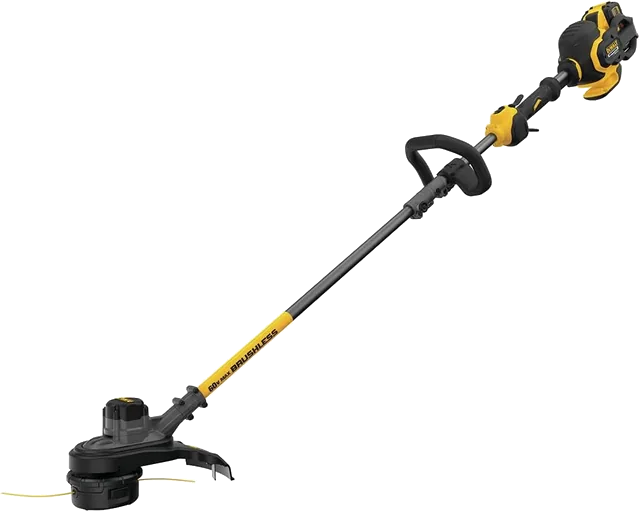
1. DeWalt FLEXVOLT 60V MAX 15-Inch String Trimmer DCST970X1 Best Overall
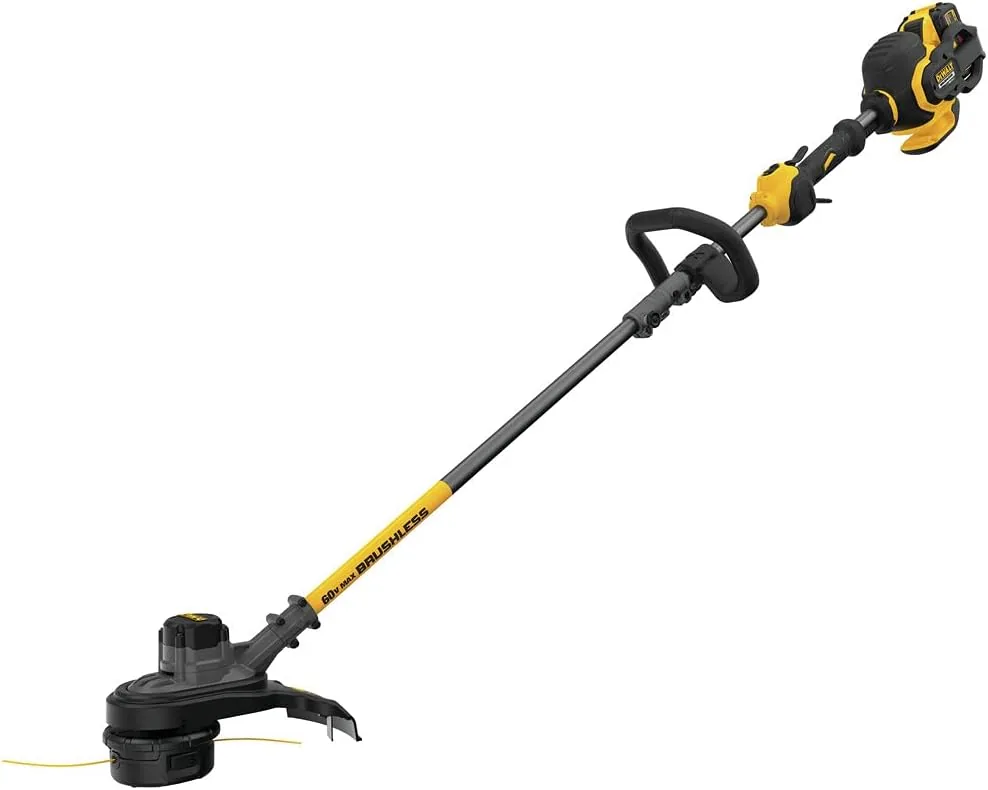
The DeWalt DCST970X1 is the trimmer I reach for when a fence line has outgrown the mower. A switch on the tool sets the motor to LO for longer runs or HI for heavier growth, and the variable trigger works inside both settings. It is my pick as the best string trimmer for thick weeds when the job is a long, dense edge rather than one tangled corner.
WHY I CHOSE THIS ✓
it puts the heavy-growth control on the tool itself, a LO/HI switch and a variable trigger on a brushless 60V MAX motor. The trade-off is real: DeWalt gives no weight or run time, so I judge the pack by the job.
DeWalt FLEXVOLT 60V MAX 15-Inch String Trimmer DCST970X1 Specs
Key Features:
- LO/HI speed switch: LO stretches the pack on larger jobs, and HI is for heavier growth, as the manual puts it.
- Variable trigger: I set the speed inside either mode, so thin grass does not get full power.
- Brushless 60V MAX motor: DeWalt describes a high-efficiency brushless motor with a gear drive.
- 15 in swath: One pass covers the width of a strip edge.
- Two line sizes: The head carries 0.080 in line, and the operation section allows 0.095 in.
- Spiral line: DeWalt’s line has smooth round edges, and the manual asks for DeWalt line only.
- Professional use named: The manual lists professional trimming as the intended use.
On the fence line I flip to HI and cut from the top down, taking no more than 12 inches of height at a time, which is the manual’s limit for long growth. HI runs the pack down faster, DeWalt says so plainly, so I drop back to LO as soon as the growth thins out. The trigger lets me feather the speed beside the posts, where a full-speed head would chew line. Beside a wire fence the line wears and can snap, as the manual warns, so I stop a hand short of the wire and clear the last inches with hand shears.
DeWalt gives no run time for the 3.0 Ah pack, so I plan by the job and keep a second pack charged for the long edges. The pack is the FLEXVOLT type, and the manual says it also runs DeWalt 20V MAX tools. That helps if you already own some, and it is the one battery detail worth checking before you buy.
Along the gravel yard edge the line meets stone, and the manual says stone and brick walls, curbs and wood wear the line fast, so I check the line length more often there and keep the guard the 24 inches from my feet that the manual asks for. What surprised me is the bystander distance: 100 feet in the manual, twice the 50 feet many makers give, so on a small yard I stop the tool whenever anyone walks in. The DeWalt is not an edger either, because the manual says not to tilt it to a right angle to the ground, so I keep the line parallel and cut a crisp edge with a spade.

Keep the guard on and let its cut-off blade set the line length for the 15 inch swath, because line cut longer harms runtime and motor life. When the guard blade dulls, switch off, wait for the head to stop and take the battery out, then touch it up with a file, as the manual says.
Never lock the trigger on or run it without the guard. When stems wrap the head, release the trigger, wait for the head to stop and take the battery out before you touch it. The manual also wants ANSI Z87.1 eye protection whenever the battery is in, hearing protection and heavy long pants.
DeWalt says to charge between 40 and 104 F, with the best life at 65 to 75 F, so the charger lives indoors and not in my cold shed. The manual wants the air vents blown out with clean, dry air at least once a week, battery out and eye protection on, and no water or hose near the tool. Spare line goes in a sealed bag with a tablespoon of water so it does not dry out. The head carries 0.080 in line and the manual also allows 0.095 in, and DeWalt asks for its own spiral line only.
Buy it if your edges run long and the growth runs dense: fence lines, hedgerow bases, rough corners behind the sheds. It suits an owner who already has DeWalt 20V MAX or 60V tools. Skip it if you want attachments, a published weight or run time, or the lowest price tier. The 100 foot bystander distance is the manual’s own figure, so it also suits a property where the work happens well away from the house and the neighbors.
FINAL VERDICT
The DCST970X1 is the heavy-growth trimmer I recommend first, because the LO/HI switch, the 15 in swath and the 0.095 in line option fit a fence line that has got away from you. Add a second pack if your edges are long.
It is the trimmer I recommend for fence lines that have got away from the mower.
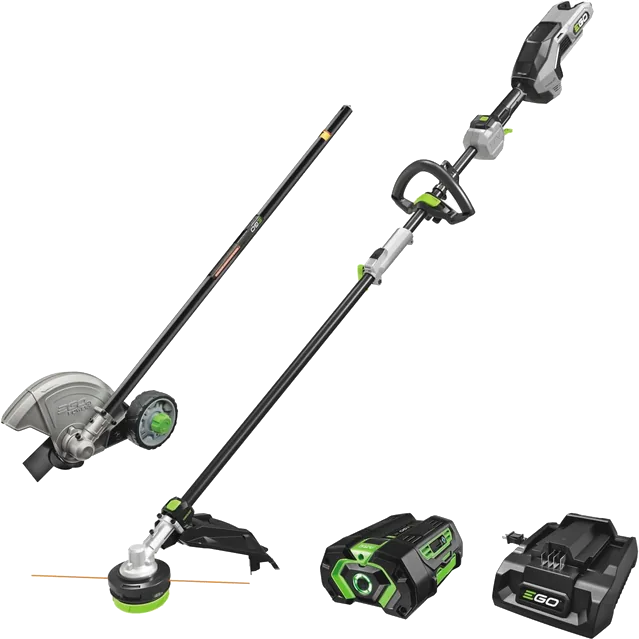
2. EGO Power+ MHC1603 16-Inch Multi-Head Combo Kit Best Premium
The EGO MHC1603 is the trimmer kit that grows into a tool system. One 56V power head carries a 16 inch trimmer for the weeds and an 8 inch edger for the lawn borders, and among the best string trimmers for thick weeds it is the premium kit I build the rest of the yard tools around. It suits an owner who wants one battery platform to do more than trim.

WHY I CHOSE THIS ✓
one battery and one power head cover the trimming and the borders, and the head takes more of EGO’s attachments later. The price is a premium kit, and the weight with the pack is not published.
EGO Power+ MHC1603 16-Inch Multi-Head Combo Kit Specs
Key Features:
- One power head, many tools: The PH1420 takes the trimmer and edger in the box, and EGO’s list adds a brush cutter, hedge trimmer and pole saw, sold separately.
- 16 inch swath: A wide cut for long edges, on 0.095 in line.
- POWERLOAD: A button winds the line onto the spool, and EGO says a full spool takes about 12 seconds.
- Two speed modes: Low gives more control and a longer run, high is for heavier growth, and the trigger is variable.
- Carbon fiber shaft: Straight, with a coupler that releases the attachment at the press of a button.
- Shoulder strap in the box: EGO packs a strap with the kit.
- Long tool warranty: Five years on the tool and three on the battery, per EGO, for residential use.
Thick growth along the drainage ditch is where the high mode earns its place. EGO says to cut tall grass from the top down, no more than 8 inches per pass, so I take it in layers. The head is a bump head, and EGO warns that tapping it in tall grass can overheat the motor, so line feed waits for bare ground. EGO caps the line at 0.095 inches and says heavier line overloads the motor, so I never load a thicker size for a thick stand.
The trimmer set weighs about 9.6 pounds without the battery, 6.2 for the power head and 3.36 for the attachment, and EGO gives no weight with the 4.0 Ah pack. EGO’s figure of up to 45 minutes of trimming comes with no test conditions, and its 75 minute figure is for the edger on low. A shoulder strap comes in the box.
For the lawn border by the house I swap heads: I release the trigger, wait for the head to stop, take the battery out, loosen the wing knob, press the shaft-release button and pull the trimmer shaft out. I push the edger on until it clicks, tighten the knob and refit the battery. Its 8 inch blade stays off the yard edge, because the manual says not to use it on or near gravel. If its guard clogs in wet or tall grass, I release the trigger, wait for the blade to stop, take the battery out and clear it. EGO asks for 50 feet around the tool, so the border work waits until the yard is empty.
To reload, I release the trigger, wait for the head to stop and take the battery out, thread a 13 foot piece through the eyelet and refit the battery, because POWERLOAD runs from the pack, then hold the button until about 7.5 inches is left on each side. EGO says a full spool takes about 12 seconds, which makes a reload on the ditch bank a short stop, and do not run the winder again and again, because EGO says that can damage the motor.
Fit only attachments on EGO’s list for the PH1420. Treat the edger blade as a blade: with the battery out, replace a cracked or worn one at once, because the manual says it can shatter at high speed.
EGO’s page calls the kit weather resistant, yet the manual says not to use it in rain or wash it with a hose, so I take the battery out, wipe it down and store it indoors. The trimmer attachment is rated for 32 to 104 F, so I do not start it on a frost morning. POWERLOAD works only on the PH1420 head, which is the head in this kit. The warranty is for home use, and EGO gives one year for commercial use.
This kit suits an owner who wants one platform for the trimmer, the edger and later attachments, and who is happy to pay a premium tier for it. Skip it if you want the lightest and cheapest trimmer, if you need a blade for woody stems in the box, or if the work is commercial, since the warranty drops to one year there.
FINAL VERDICT
The MHC1603 is the kit for a property with long edges and a lawn to border, because one pack and one head cover both jobs. Choose it when you want a platform to build on, not a single-job trimmer.
It is the premium kit I build the yard around.
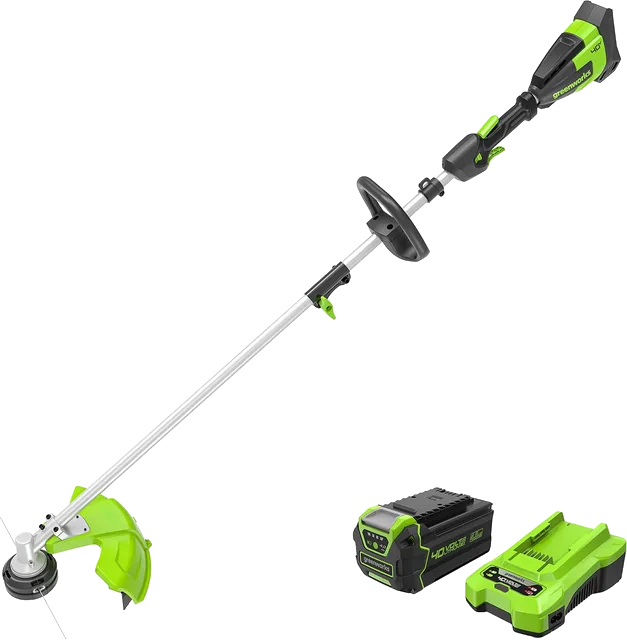
3. Greenworks 40V 16-Inch Attachment-Capable String Trimmer ST40L414 Best Value
The Greenworks ST40L414 is the trimmer I recommend when you want a heavy line and a wide swath without paying for a premium kit. A 16 inch cutting path, 0.095 inch line and a two-speed switch sit on a 40V brushless tool in the mid-range tier. It is the value pick for tall grass and heavy weeds along fences, with a shaft that accepts Greenworks attachments later.

WHY I CHOSE THIS ✓
It combines a 16 inch swath, a heavy 0.095 inch line and two speeds at a mid-range tier, and it leaves room for attachments later. The value is in that combination, and the weight and the slow charge are the cost.
Greenworks 40V 16-Inch Attachment-Capable String Trimmer ST40L414 Specs
Key Features:
- 16 inch swath: The manual says 16 inches gives a larger cutting area and the 14 inch setting gives more runtime.
- Heavy 0.095 inch line: The manual allows 0.095 inch nylon line and nothing heavier.
- Two speeds and a trigger: A switch sets low or high, and the variable trigger works inside both.
- Brushless 40V motor: Greenworks’ page states a brushless motor with a 4.0 Ah pack.
- Easy Wind bump head: You tap the head on the ground to feed line, and the guard blade trims it.
- Attachment-capable shaft: Greenworks lists an edger, a hedge trimmer, a pole saw, a cultivator and a blower for it.
- Shoulder strap: The manual covers a strap with a carabiner, and it calls for the harness and two hands.
Along the fence line I use the high setting and cut as the manual describes: from the top down, no more than 8 inches in each pass, so the grass does not wind round the head. When the motor labors in a thick patch, the manual says the load should come off the motor, and I move the head in and out of the grass until it recovers. That in-and-out rhythm saves more cuts than pushing harder. The 0.095 inch line is the reason this trimmer goes through dense stems that thin line frays on.
The weight is 8.8 pounds without the battery, and Greenworks gives no figure with the 4.0 Ah pack. The manual calls for the shoulder strap and two hands on the tool. Greenworks says up to 60 minutes of runtime with no conditions, and it lists 120 minutes to recharge on the 2A charger, so on a long fence I carry a second pack instead of waiting. The 4.0 Ah pack in the kit is the larger of the two kits Greenworks offers on this model.
The cutting width changes a day’s work. I run 16 inches on the open stretches of tall growth, and for 14 inches I switch off, wait for the motor to stop, take the battery out and turn the cut-off blade 180 degrees, which gives the longer runtime the manual promises there. The attachment shaft is what makes me pick this trimmer for a property that may grow new jobs: Greenworks lists a cultivator for the tilled strips under the trees, a hedge trimmer and a pole saw, all of them sold separately. Wire and picket fences wear the line, and stone, brick walls and curbs wear it quickly, so I check the line length after every wall.
Switch off, wait for the motor to stop and take the battery out before you load line, and load no more than 15 feet of nylon line at a time. Advance the line when the motor runs faster than normal or the cut gets ragged, and keep the guard on, because the machine stops cutting without it.
The manual says no blade of any kind on this machine. Switch off, wait until the motor has stopped, then remove the battery before you clear the head, change line or store it, and only then touch the head.
Charge between 39 and 104 F and store the pack between 32 and 113 F, as the manual gives them. The tool should not be used in rain or damp conditions. Keep the vents clear, and with the battery out clean with a moist cloth and neutral detergent, never spraying water on the motor. The manual’s safety glasses line asks for side shields marked ANSI Z87.1 and recommends rubber gloves and substantial footwear, and I add hearing protection every time because a trimmer is loud. The warranty is 3 years for personal use and excludes commercial work.
The ST40L414 suits an owner with tall grass and heavy weeds along fences who wants a wide swath, heavy line and a mid-range price, and who may add Greenworks 40V tools later. Skip it if you want a light trimmer, a fast charger or a blade for woody stems. It is also not an edger, because the tool has no edging mode and the edger is a separate attachment.
FINAL VERDICT
The ST40L414 is the value pick for fence-line weeds when a 16 inch swath and 0.095 inch line matter more than weight. Choose it with a second pack if your edges are long.
It is the mid-range trimmer for heavy fence-line weeds.
4. Husqvarna 130L 28cc Gas String Trimmer, 18-Inch Best Gas
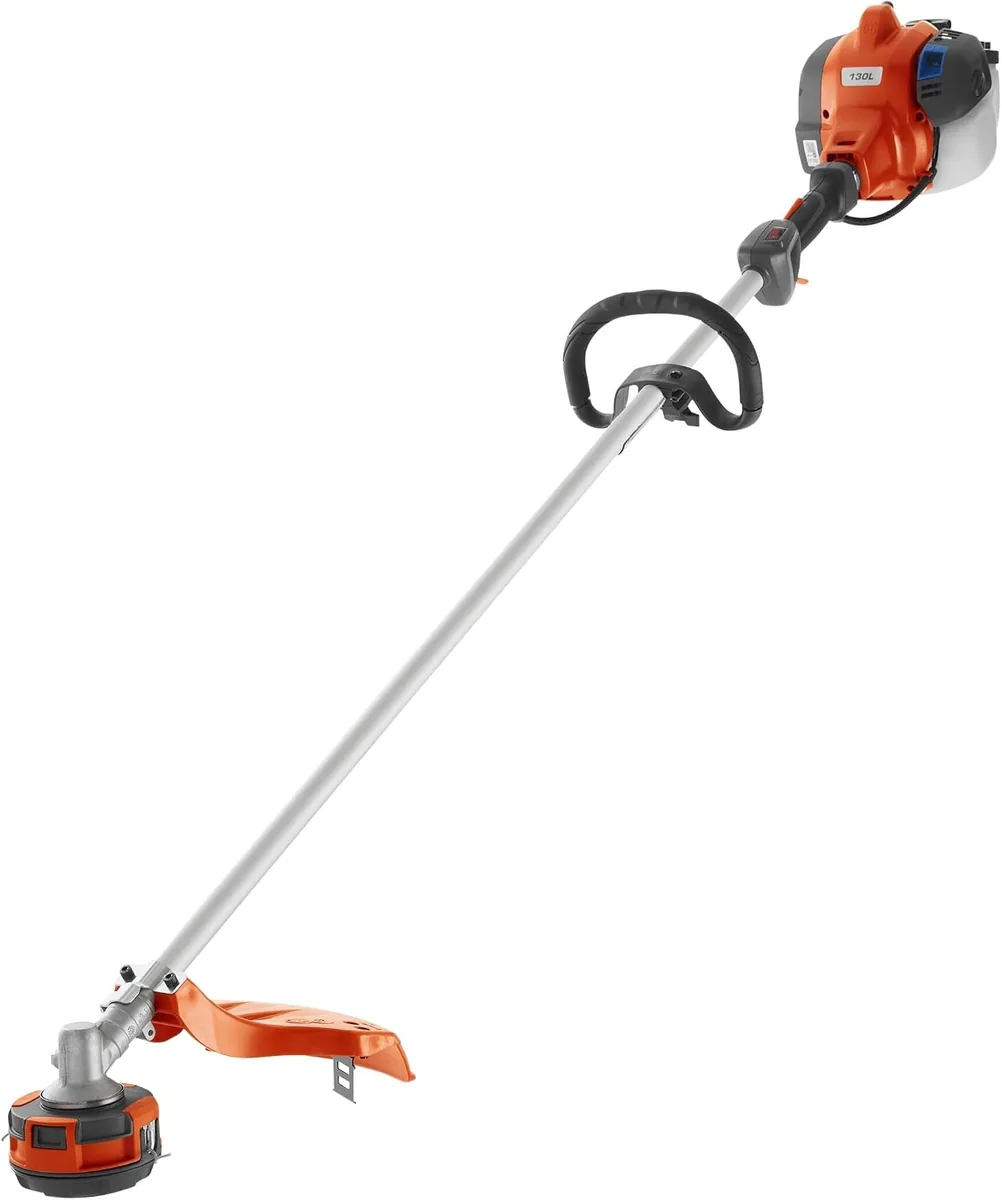
The Husqvarna 130L is the trimmer for the stretch of weeds that no pack will finish. A 28 cc two-stroke engine drives an 18 inch swath on a straight shaft, and a tank of fuel replaces a spare battery. It is my best gas string trimmer pick on this page for open ground and long fence lines.
WHY I CHOSE THIS ✓
It is the plain gas trimmer for open ground, and fuel is quicker to add than a recharge. Its weight and its hand vibration are the price.
Husqvarna 130L 28cc Gas String Trimmer, 18-Inch Specs
Key Features:
- 28 cc engine: The manual rates it at 0.7 kW, with a catalytic converter muffler.
- 18 inch swath: Husqvarna’s page gives the cutting width, which covers a wide strip in one pass.
- RapidReplace head: With the engine off and the spark plug cap pulled, you push a 22 foot piece of line through and wind it, with no disassembly.
- Straight shaft with a loop handle: The reach goes under a hedgerow base or along a fence.
- Purge bulb and choke: The bulb primes the carburetor, and a cold start follows the manual’s choke steps.
A tank is quick to top up, so a dense strip does not end on a flat pack. The manual says to hold the head just above the ground with the line parallel to it, to run at 80 percent throttle near objects and to cut at full throttle in the open. Tall grass is the catch: the line cannot be tapped in it, so I switch off, wait for the head to stop, let the engine cool and pull the spark plug cap before I pull out more line by hand.
The unit weighs 11.0 pounds without fuel, the guard and the cutting attachment, and the tank holds 0.5 L. Husqvarna’s page lists 95.4 dB(A) at the operator’s ear and rear-handle vibration of 8.93 m/s2, so after a long job on the ditch bank my hands feel it. I wear ear protection every time and take breaks, and if my fingers tingle or go numb I stop work, because the manual says to stop and see a doctor.
After a winter in the shed the first start follows the manual to the letter: ten pushes of the purge bulb, full choke, three firm pulls on the rope, then half choke, and never the throttle trigger while starting. A hot engine can refuse a restart, and the manual’s cure is to cool the unit for 20 minutes and press the bulb for 10 to 15 seconds.
Fuel goes in outdoors with the engine off and cool. Start the engine at least 10 feet away from the fuel spot, never run it in a shed or a garage, even with the door open, and wear what the manual lists: ANSI Z87.1 goggles, hearing protection, gloves, heavy long pants, long sleeves and heavy slip-resistant steel-toe boots.
I measure the mix at 50:1, which is 2 1/2 fluid ounces of oil per US gallon, and never mix more than a month of fuel at a time. Before you clear a wound head, change line, clean or carry the tool, stop the engine, wait for the head to stop, let it cool and pull the spark plug cap. The manual says the bevel gear and the muffler stay hot after you stop, so give them time before any maintenance.
The 130L suits an owner with a long fence line or a big open edge who is happy to mix fuel and wear ear protection. Skip it if you want a light tool, an attachment system or a blade, or if noise is a concern at the house. I take a closer look at this 28cc trimmer and its 18-inch swath in my review of the Husqvarna 130L.
FINAL VERDICT
The 130L is a gas trimmer that does one job: dense growth across open ground. Pick it when a pack will not last the edge and you accept the fuel and the noise.
It is the gas trimmer for the long open edge.
5. EGO Power+ 16-Inch Line IQ String Trimmer ST1623T Best Auto Feed
The EGO ST1623T is the trimmer where I never stop to tap the head. Line IQ senses when either end of the line has worn shorter than 7 inches and releases more by itself, so the 16 inch swath holds steady through a thick stand. It is the auto feed string trimmer I pick for owners who dislike stopping to feed line.

WHY I CHOSE THIS ✓
It feeds its own line, and the swath stays at 16 inches without a tap. The price is a premium tier and one more mechanism to look after.
EGO Power+ 16-Inch Line IQ String Trimmer ST1623T Specs
Key Features:
- Line IQ feed: The head releases line when an end is under 7 inches, and the guard blade trims the excess.
- POWERLOAD: A button winds line onto the spool, and EGO says a full spool usually takes about 12 seconds.
- Two speeds and a trigger: The switch shows one light for low and two for high, and low gives longer runtime.
- Height-adjustable carbon fiber shaft: A clamp sets the length, and the front handle moves to suit.
- 4.0 Ah kit: The pack, the 320W charger and the trimmer come in one box.
With a bump head I stop in the middle of a thick stand to tap line out, and the swath narrows before I notice. With Line IQ the head feeds itself, and a slight tremor in the head tells me it is releasing line, which surprised me the first time. EGO says to cut grass over 8 inches from the top down in small steps, and the high setting handles the lower layers.
The manual gives 7.67 pounds and does not say whether a battery is counted, so I do not set it against any other trimmer’s weight. EGO claims up to 60 minutes with the 4.0 Ah pack and states no conditions, so I plan my work in blocks and keep the low setting for the edges. The manual says low speed gives longer runtime. My EGO ST1623T versus Greenworks ST60L413 comparison sets it beside another 16 inch trimmer.
Trim only dry growth, as the manual says, and keep the line parallel to the ground. Do not tap the head to feed line, because Line IQ does that work.
The manual says line wears fast on stone, brick, curbs and wood and breaks on wire fences, and the line strips bark off young trunks. Keep the head away from the thin bark of the young trees, and release the trigger, wait for the head to stop and take the battery out before you touch it.
The head is more complex than a bump head. Before you open it, release the trigger, wait for the head to stop and take the battery out; if the line is pulled into it, the lower cover comes off and the line is reloaded by hand, and a replacement head needs an impact wrench and gloves, per the manual. Do not run POWERLOAD repeatedly, because the motor can be damaged. Use only the 0.095 inch line the manual names.
The ST1623T suits an owner who hates stopping to feed line and works dense, dry growth on medium to large yards. Skip it if you want attachments, a blade or the cheapest kit, or if you cannot work on a head with more moving parts. The full kit, the 4.0 Ah pack and Line IQ get their own write-up in my review of the EGO ST1623T.
FINAL VERDICT
The ST1623T is the trimmer for steady swaths in dry, dense growth, with no tapping. Choose it if line feeding is what slows you down.
It is the trimmer that feeds its own line.
6. Milwaukee M18 FUEL 14-16 Inch String Trimmer Kit 2825-21ST Best for M18 Owners
The Milwaukee 2825-21ST is the trimmer for an owner who already works on, or is moving to, the M18 system. It brings an 8.0 Ah XC8.0 pack, a QUIK-LOK power head that takes Milwaukee’s other attachments, a 14 to 16 inch swath and a choice of 0.080 or 0.095 inch line. That suits long edges for an M18 owner.

WHY I CHOSE THIS ✓
the M18 pack and the QUIK-LOK head fit an owner who already works on Milwaukee’s system, and its own attachments give it room to grow. The missing weight and run time are the cost.
Milwaukee M18 FUEL 14-16 Inch String Trimmer Kit 2825-21ST Specs
Key Features:
- XC8.0 battery: The kit pack is an 8.0 Ah M18 REDLITHIUM pack that also fits other M18 tools.
- Two speed ranges: Milwaukee lists 0 to 4,900 rpm on low and 0 to 6,200 rpm on high, set by a button and the trigger.
- 14 to 16 inch swath: Turn the line cut-off blade 180 degrees to change it.
- Two line sizes: The manual allows 25 feet of 0.080 inch or 20 feet of 0.095 inch spiral line.
- QUIK-LOK system: Milwaukee lists an edger, an articulating hedge trimmer and a pole saw for the power head.
The manual says low speed is for larger jobs where battery life matters and high is for dense growth, and it tells you to make multiple passes in long growth. At the hedgerow base I run high and cut in layers, and I load the 0.095 inch line for that work. Beside the tree-row strip I switch off, take the battery out and turn the cut-off blade for the 14 inch swath, and in the open I turn it back to 16. The manual also asks for at least 12 inches between the head and any part of my body, which is easy to forget when the growth is tall.
Milwaukee publishes neither a weight nor a run time for this kit, so the 8.0 Ah figure tells me capacity and nothing about the day. The manual says to use the shoulder strap with larger packs, and the strap is an accessory that you buy separately.
Release the trigger, wait for the head to stop and take the battery out before you load line, then bump the spool on the ground rather than dragging the cover. I load 25 feet of 0.080 inch line for the house lawn edge and 20 feet of 0.095 inch for the fence. Do not use a blade or a brush cutting wheel on this attachment, because the manual rules both out.
This is not an edger, and the manual says not to tilt it to a right angle to the ground. Keep the head and the line parallel to the ground, and stay away from young trunks, shrubs and siding. I hold the head well off the thin bark of the young plum trees.
Milwaukee says the gearcase of the attachment needs up to 0.4 ounces of Type Y grease after about 50 hours of use. The manual says to send the tool, the battery and the charger for inspection after six months to a year, depending on use. Store it indoors, dry, away from fertilizer and chemicals. Switch off and take the battery out before any greasing or cleaning. The manual asks for ANSI Z87.1 eye protection, hearing protection, heavy long pants, long sleeves, boots and gloves.
The kit suits an owner on the Milwaukee M18 system, or one entering it, who wants a large pack and an attachment system. Skip it if you need a published weight or run time, an edging trimmer, a blade or a lower price tier. My EGO ST1623T versus Milwaukee 2825-21ST comparison puts this kit next to the EGO.
FINAL VERDICT
The 2825-21ST is the cordless trimmer for an M18 workshop and a long edge. Pick it if you want one battery platform behind your trimmer and your later attachments.
It is the M18 trimmer for a Milwaukee workshop.
7. Echo PAS-225VP 21.2cc Gas Trimmer and Edger Kit Best 2-in-1 Edger
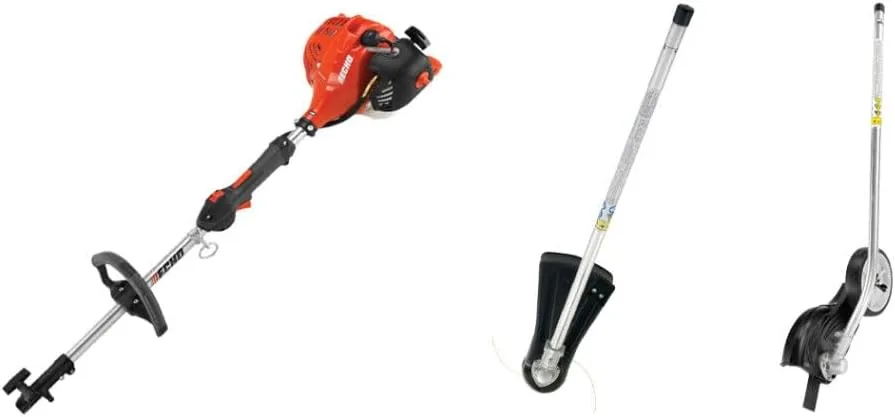
The Echo PAS-225VP is the power head that turns into other tools. One 21.2 cc engine runs a 17 inch line trimmer and a curved shaft edger in the box, and Echo lists 12 attachments for the head. That makes it the 2-in-1 pick on this page for a gas owner who also edges lawns and paths.
WHY I CHOSE THIS ✓
It runs a trimmer and an edger from one engine, and Echo lists 12 attachments for the head. The kit is premium and the weights add up.
Echo PAS-225VP 21.2cc Gas Trimmer and Edger Kit Specs
Key Features:
- 21.2 cc engine: Echo calls it professional grade, with a purge pump and an automatic rewind starter.
- Tool-less coupler: You change attachments without tools.
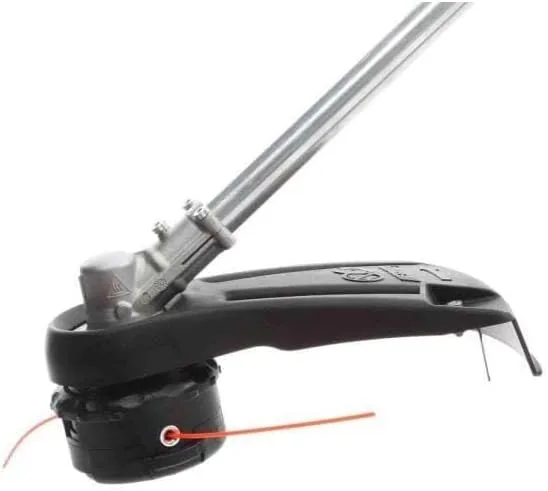
- Speed-Feed 400 head: You tap it on the ground to advance line and reload without taking it apart.
- Curved shaft edger: It brings its own 7.75 inch blade and an open, clog-resistant shield.
- 12 listed attachments: Echo’s list includes a brushcutter and a hedge trimmer, with exclusions Echo names.
The line trimmer is the tool for the dense edges, and the head must stay below knee height as the manual says. I tilt the head down on the right so the debris goes away from me, feed line gradually and keep it off wire fences. For weeds along the machinery shed I stop the engine, wait for the head to stop, pull the spark plug lead and swap to the edger for the concrete pad. When I edge a path with the line head I hold it at a steep angle, as Echo describes for edging and scalping, so stones do not ricochet back at me.
The power head is about 9.3 pounds dry, and each attachment adds its own weight: about 11.6 pounds for the trimmer set and about 14.5 pounds with the edger, both figures dry and derived from the manual. Echo recommends a shoulder harness for trimmer use and gives no run time per tank.
Echo’s brushcutter attachment is a separate purchase with its own manual and blade rules. Never put a blade on the trimmer attachment, because the manual says blades need a brushcutter setup.
Refuel outdoors with the engine off and cool, and never run the engine in a shed or a garage. Before clearing the head, changing line or any maintenance, stop the engine, wait for the head to stop and remove the spark plug lead, and keep your hands off the hot muffler and cover.
Fuel is fresh 89 octane gasoline with up to 10 percent ethanol, mixed at 50:1 with oil that meets ISO-L-EGD and JASO FD. Echo says the wrong oil can void the engine warranty. For storage over 30 days the manual lists drain the tank, run the engine dry and put 7 cc of fresh two-stroke oil into the cylinder, which is longer than most makers ask, so I drain the tank and run the engine dry before it goes into the shed for winter. Never use the straight shaft edger, ProSweep, ProPaddle or Bed Redefiner on this head, because Echo does not recommend them.
The kit fits an owner with a trimming job and a path or bed edging job who wants one engine and room for Echo attachments. Skip it if you want one light trimmer, a blade in the box or a battery tool.
FINAL VERDICT
The PAS-225VP is the gas system for an owner with more than one yard job. Choose it for the attachments and accept the weight, the fuel and the premium tier.
It is the gas power head that changes jobs.
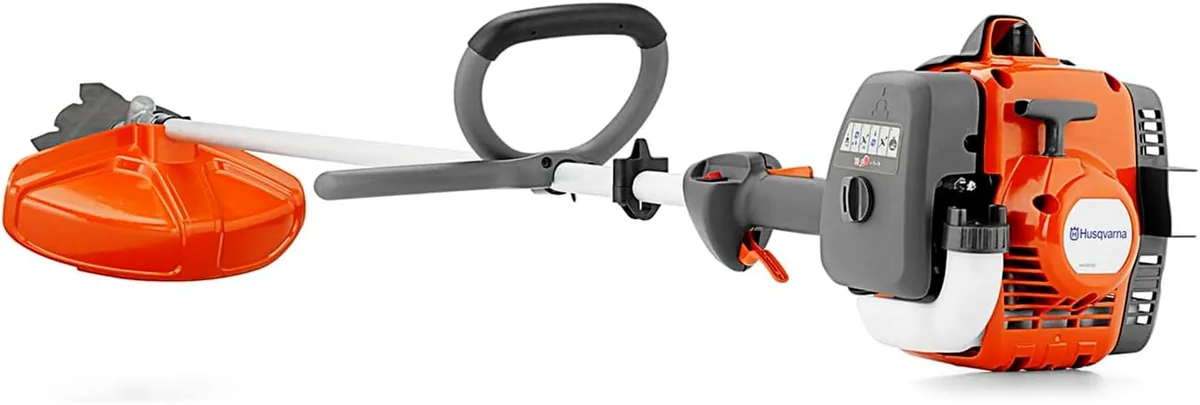
8. Husqvarna 122RJ 21.7cc Gas Trimmer with Grass Blade Best With Blade
The Husqvarna 122RJ is the only kit on this page supplied with a grass blade, so coarse grass and tall weeds get a second cutting tool in the same box. The kit holds a line head, a 9.8 inch Grass 255-4 blade, a harness and a J-handle with a barrier bar. The manual says the blade is for grass and never for woody stems, so this is a tool for rank weeds, not for saplings.
WHY I CHOSE THIS ✓
It is the only kit here supplied with a grass blade, and the blade is Husqvarna’s tool for rough or coarse grass. It does not cut woody stems, and the harness is part of the deal.
Husqvarna 122RJ 21.7cc Gas Trimmer with Grass Blade Specs
Key Features:
- Grass blade: The Grass 255-4 is a 250 mm blade for rough or coarse grass, with its own guard.
- Trimmer head: The T25 head takes 0.080 to 0.095 inch line for ordinary trimming.
- Harness and J-handle: The harness hook rides near the right hip, and the barrier bar sets the hands.
- Manual noise and vibration figures: 85 dB(A) with the head and 90 dB(A) with the blade at the ear.
- Catalytic converter muffler: The 21.7 cc engine is EPA III rated.
With the blade fitted I clear coarse growth with a sideways swing, right to left as the clearing stroke, with the left part of the blade doing the cutting. The manual says to work at full throttle and to avoid cut material on the return stroke, so the grass does not wind round the blade. Husqvarna wants the harness on every time, with its hook level with the right hip.
The manual gives 10.6 pounds without fuel, the attachment and the guard, and the fuel tank holds only 0.3 L, so a long job needs a refuel stop. Husqvarna gives no run time per tank. The manual lists 2.95 and 2.66 m/s2 of hand vibration with the head and 2.76 and 2.88 with the blade, and 90 dB(A) at the ear with the blade against 85 with the head, so I wear hearing protection whichever I fit.
Before you touch the blade, stop the engine, wait until the blade has completely stopped, let the tool cool and pull the spark plug cap, and wear protective gloves. At every start I check that the blade stays still at idle, and fit the transport guard and remove the spark plug cap before you carry it.
Blade thrust is a stated hazard: the tool can jump sideways when the blade hits something it cannot cut. Never use a blade that is blunt or damaged, wear the head protection the manual requires with the grass blade along with heavy long pants, long sleeves and heavy slip-resistant boots, and keep the cutting attachment below waist height. I stop at the first stem that feels like wood and cut it by hand.
Mix the fuel at 50:1 and mix no more than a month at a time. Husqvarna says refuel on a cool engine outdoors and move 10 feet from the fuel spot before starting. The bevel gear stays hot after the engine stops, and the manual says to empty the tank before long storage.
The 122RJ fits an owner with tall, coarse grass and rank weeds who accepts a harness and a blade’s hazards. Skip it if you want a light tool, a battery tool or a blade for saplings and brambles.
FINAL VERDICT
The 122RJ is the gas trimmer for coarse grass that line cannot clear. Choose it when blade work suits the job and woody stems are not part of it.
It is the harness trimmer for rank, coarse grass.
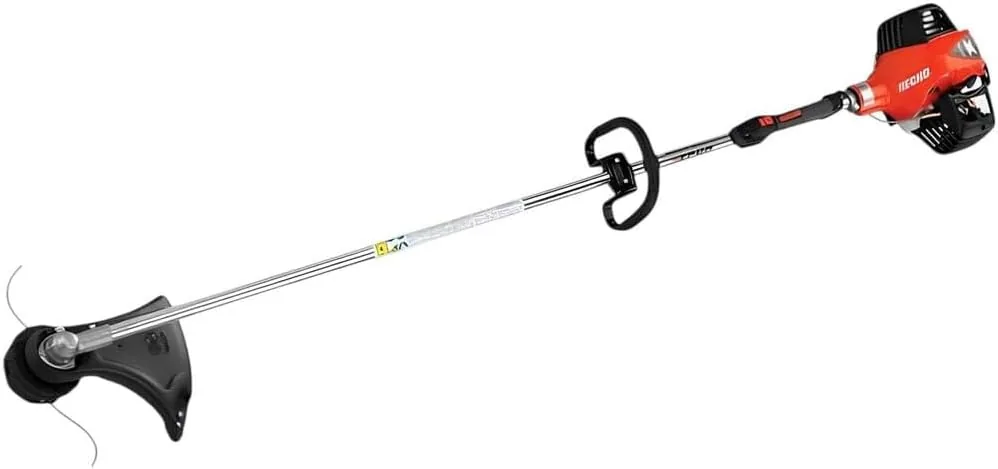
9. Echo SRM-3020T 30.5cc Gas String Trimmer, 20-Inch Best Heavy Duty
The Echo SRM-3020T has the widest swath on this page: a 20 inch cut from a 30.5 cc two-stroke. That makes it my best heavy duty string trimmer for large, open stands of weeds, where fewer passes matter more than weight. It is a dedicated trimmer, with no attachments and no blade.
WHY I CHOSE THIS ✓
It has the widest swath here, so it is the one I pick for open ground. The weight and the premium tier are what you pay.
Echo SRM-3020T 30.5cc Gas String Trimmer, 20-Inch Specs
Key Features:
- 30.5 cc engine: Echo lists 1.8 hp from the air-cooled two-stroke, and its manual gives the T a 2.07:1 gear case.
- 20 inch swath: The widest cut on this page, on a Speed-Feed 500 LH head.
- Large tank: 0.71 L (24 fluid ounces) gives a longer stretch between refuels.
- Straight shaft: A one-inch aluminum tube carries a flexible drive shaft to the head.
- Rubber front grip: The D-loop handle carries a rubber anti-vibration grip.
The 20 inch swath is the reason I pick this trimmer for a wide strip of dense growth: the edge along the orchard fence needs fewer passes. You tap the head on the ground while it runs at normal speed to advance the line. To reload without disassembly, stop the engine, wait for the head to stop and pull the spark plug lead, then align the arrows with the eyelets, push 20 feet of line through and wind until about 5 inches shows on each end.
The manual lists 12.3 pounds dry without the cutter head, and Echo’s page gives 13.9 pounds with the head and no harness, both before fuel, so the weight tells by the end of a long strip. The straight one-inch aluminum tube carries a flexible drive to the head, and the D-loop handle has a rubber grip, so the head reaches under the hedgerow base and along the fence. I wear hearing protection and gloves and rest my hands.
Fill with fresh 89 octane gasoline mixed 50:1, bought within the last 30 days. Use oil that meets ISO-L-EGD and JASO FD, because a wrong oil can void the engine warranty.
The model takes no blade, and Echo says never to install one. Never use wire or wire rope in place of line, because it can break off and fly out. Keep bystanders 50 feet away.
The muffler and the cover get hot, so keep the exhaust area clear of dry debris. With the engine stopped and the spark plug lead off, clear grass and dust from the cylinder fins, because build-up overheats the engine. For storage over 30 days the manual says to drain the tank, run the engine dry and oil the cylinder. The warranty does not cover failures from poor maintenance, blocked cooling fins or the wrong oil, and the tool never runs in a shed or a garage.
The SRM-3020T fits an owner with big open areas, fences and borders who wants a wide swath, an engine that handles dense stands and has no use for attachments. Skip it if you want a light tool, a blade, a battery tool or a lower price tier. My Husqvarna 130L versus Echo SRM-3020T comparison sets its 20 inch swath against the 130L’s 18 inch one.
FINAL VERDICT
Choose the SRM-3020T when swath and power outrank weight and fuel mixing, and the stands you cut are wide and dense.
It is the big-engine trimmer for open ground.
How to Choose the Best String Trimmer for Thick Weeds
A heavy duty string trimmer is one whose power, line size and swath fit dense growth, and each manual sets the limits. These seven factors decide the buy, and I name the mistakes I see most on weedy edges.
Battery or Gas String Trimmers for Heavy Growth
Gas gives engine power for as long as you refuel, and a battery gives quiet and no fuel mixing. In a NIOSH sampling of 80 landscaping workers, fuel-powered leaf blowers, string trimmers and chainsaws gave significantly more noise and carbon monoxide exposure than battery versions (1). That is a reason to prefer a battery tool near the house, and hearing protection stays on with either.
| Question | Battery trimmer | Gas trimmer |
|---|---|---|
| Fuel or charge | Charge within the maker’s temperature range | Mixed fuel, refuelled outdoors on a cool engine |
| Long jobs | A second pack | A refuel stop |
| Starting | Lock-off and trigger | Purge bulb, choke and rope |
| Noise and fumes | No exhaust | Exhaust, so never indoors or in a shed |
A battery trimmer also suits owners who already have tools on that maker’s battery platform. I keep the gas machines for the long open stretches, and the best gas string trimmers earn their place when a pack would not last the job.
Line Diameter and Heavy Duty String Trimmer Line
Heavy duty string trimmer line is the heaviest size your head’s manual allows, and no heavier. Most heads here take up to 0.095 inch, and one maker says heavier line overloads the motor. Read the manual section on the head, because some manuals name one size in one section and another in a second.
- 0.080 inch: lighter growth and lawn edges.
- 0.095 inch: the heavy size on most heads here, for fence lines and dense stands.
- Heavier than the manual allows: stalls the motor or fails to feed.
A thick line is a poor fix for a weak motor. For the heaviest stands I look for a head and a motor that carry 0.095 inch line, and I stock heavy duty trimmer string only in the size my manual names.
Cutting Swath and the Number of Passes
The swath is the circle the line cuts, and it runs from 14 inches on some battery trimmers to 20 inches on the widest gas model here. A wider swath means fewer passes along an edge, and it also loads the motor harder. Line that extends past the guard’s cut-off blade overloads the motor, so let the blade trim it. For a bigger property, I compare long-run options in my “best string trimmer for large yard” roundup.
| Swath | What it does | Where I use it |
|---|---|---|
| 14 inches | More runtime on trimmers whose manuals say so | Strip edges and tight corners |
| 16 inches | A larger cutting area per pass | Open fence lines |
| 18 to 20 inches | Fewer passes, more weight on a gas machine | Wide open stands of weeds |
When the growth is dense I settle on the widest swath the tool carries without stalling and I take it in layers.
Speed Settings and Torque
A two-speed switch lets you spend battery only where you need it. One manual says its low speed extends runtime and its high speed is for heavier growth, and high drains the pack faster. A heavy duty electric string trimmer is one whose manual lists the growth you plan to cut, and a speed setting counts only as the maker ties it to a job: voltage, motor type and engine size do not rate cutting strength, so I read what each maker states. Gas trimmers use the throttle, with one manual asking for 80 percent throttle near objects.
Pro Tip
Start on the low setting and switch up only when the head slows in the stand. A head that bogs down is a motor under load.
Feed Type in Tall Growth
A bump head feeds line when you tap it on bare ground while it runs. One gas manual says the line cannot be tapped in tall grass, so you stop the engine, wait for the head to stop, let it cool and pull the spark plug cap before you pull more out, and a battery manual says tapping in tall grass can overheat the motor. An automatic feed head releases line when it senses the line has worn short. For overgrown ground, my best string trimmer for tall grass picks show what holds up when the stand is high.
- Bump or tap feed: simple, and it needs a bare patch to tap.
- Automatic feed: no tapping, but a more complex head.
- Powered reload: a button winds new line onto the spool, which saves hand-winding during a reload and does not feed line while you cut.
I pick the feed type for the job: a bare yard edge suits tap feed, and a long stand of weeds suits automatic feed. A good heavy duty string trimmer head also reloads without a full strip-down.
Weight, Shaft and Harness
Weight is stated on different bases: with or without the battery, with or without fuel, with or without the cutting head. Compare only like with like. In a laboratory study, gloved hand vibration was 3.5 to 5.8 m/s2 for a grass trimmer and 1.1 to 2.0 m/s2 for a backpack blower, and the gloves tested reduced hand vibration (2). The study used two participants and one set of gloves, so I take it as a reason to wear gloves and rest my hands, as the manuals advise. My lightweight string trimmers list compares weight only on the maker’s stated basis.
- Straight shaft: reaches under hedgerow bases and along fences.
- Harness or strap: moves the load from the wrists to the shoulder on a long edge.
- Gloves and breaks: the manuals warn about numb, tingling fingers after long use.
Warranty and Battery Platform
Warranty coverage and length depend on the model: several makers here give home users a long term and commercial users a shorter one, and one excludes commercial work. A battery fits that maker’s listed tools and chargers, so check the list before you count on one pack for a second tool. The best electric string trimmer for you is often the one on the platform you already own. My battery string trimmers list sorts the cordless options by yard size and budget.
Key Takeaway
Match the line, the swath and the power to the stand, and let the manual’s limits decide what the tool may cut.
What a String Trimmer Can and Cannot Cut
A string trimmer cuts grass and soft weeds at ground level, and its manual says so. One maker lists grass, light weeds and similar vegetation, and excludes hedges, shrubs, bushes and flowers. Woody stems and brambles belong to a brush cutter with a blade the maker rates for that work.
| Growth | Tool |
|---|---|
| Grass and soft weeds | Line trimmer |
| Coarse, tall grass | Line head, or a grass blade only where the maker lists one for that tool |
| Woody stems and brambles | A brush cutter with a rated blade, outside this list of trimmers |
A blade changes the hazard. In an emergency department series of 171 brush cutter accidents, 90 percent of the injuries were to the lower extremity and 75.4 percent involved tendon damage (3). A grass blade can also thrust sideways when it meets something it cannot cut. I fit only the blade and guard the maker lists for that exact tool, and I leave woody growth at the hedgerow base to loppers.
How I Cut Thick Weeds Without Stalling the Head
The best weed eater for thick weeds still fails when it is worked wrongly, and the method is the same with every trimmer here: work the stand in layers and keep the guard between you and the debris.
- Walk the edge first and look for wire, stones, drip lines and young trunks.
- Cut from the top down in layers, taking no more height per pass than your manual allows, which is 8 inches in two of the manuals here.
- Hold the line parallel to the ground, use the tip of the line and swing so the debris goes away from you.
- If stems wrap the head, stop the motor or engine, wait for the head to stop, let a gas engine cool, then remove the battery or the spark plug cap before you touch it.
- Rest your hands at every break, and check the line length only with the tool off, the head stopped and the battery out or the spark plug cap off.
I cut the edge of the flowering strips and leave the strip itself standing, so the line never needs to push into a stand I want to keep. A US emergency department sample covering 2000 to 2009 estimated 81,907 lawn trimmer injuries were treated, and the eye accounted for 42.5 percent of them (4). Among seven brush cutter operators wearing mostly nylon mesh face protection, objects of 1 to 4 mm still entered from the side or through the mesh (5).
Safety Before You Start
Wear eye protection marked ANSI Z87.1, hearing protection, long pants, sturdy boots and gloves every time, and head protection when a manual requires it with a blade. Where a manual asks for more, such as heavy long pants, long sleeves and steel-toe boots, follow the manual. Keep bystanders and pets at the distance the manual gives, commonly 50 feet, and stop when someone comes closer.
- Gas: refuel with the engine off and cool, outdoors, and never run it in a shed or garage.
- Battery: use the maker’s charger and battery only, within the temperature range in the manual.
- Every machine: switch off, wait for the head to stop, then remove the battery or spark plug cap before cleaning, clearing, changing line or carrying it, and let a gas engine cool first.
My Overall Verdict
Thick weeds ask three things of a trimmer: enough power, a line the head can carry and a swath that finishes the edge. These three picks meet them best.
1. DeWalt FLEXVOLT 60V MAX 15-Inch String Trimmer DCST970X1 Best Overall
For long fence lines and dense edges, with a LO/HI switch on a brushless 60V MAX motor.
2. EGO Power+ MHC1603 16-Inch Multi-Head Combo Kit Best Premium
For an owner who wants a trimmer and an edger on one premium platform.
3. Greenworks 40V 16-Inch Attachment-Capable String Trimmer ST40L414 Best Value
For a 16 inch swath and 0.095 inch line at a mid-range tier, with room for attachments.
Start with the DeWalt if your edges run long, keep a second pack charged and leave woody stems to a brush cutter. For a fence line that has got away from the mower, the DeWalt is the best string trimmer for thick weeds I can recommend. I cover the 60V FLEXVOLT kit and its 15-inch swath in my DeWalt DCST970 review.
Why DeWalt FLEXVOLT 60V MAX 15-Inch String Trimmer DCST970X1 Might Be the Best Choice
I put the DeWalt first because it is a dedicated trimmer built for demanding work: its manual names professional trimming as the intended use, and the other two top picks are attachment systems. The LO/HI switch, the variable trigger and the 0.095 inch line option all sit on a tool with nothing else to carry.
The trade-off is plain: DeWalt gives no weight or run time for the kit, and it takes no attachments, so I plan a second pack and check the line often along walls and wire. My DeWalt DCST970X1 versus EGO MHC1603 comparison shows how it stacks up against another cordless kit.
Here is why it ranks first on this page:
✓ Built for professional use: the manual names professional trimming as the intended use.
✓ Speed control on the tool: a LO/HI switch plus a variable trigger.
✓ Heavier line allowed: 0.095 inch beside the fitted 0.080 inch line.
✓ Brushless 60V MAX motor: a gear drive, as DeWalt describes it.
✓ Clear warranty: 3 years, with 1 year of free service.
Frequently Asked Questions
What is the best grass trimmer on the market?
The best grass trimmer on the market for thick weeds among these nine is the DeWalt DCST970X1, because DeWalt sets its LO/HI switch for heavier growth. Match the line size and swath your own manual allows to the stand, and leave woody stems to a brush cutter with a rated blade.
How to cut through thick weeds?
Cut through thick weeds from the top down in layers, taking no more height per pass than your manual allows, which is 8 inches in two of the manuals on this page. Before you clear a wrapped head, stop the motor or engine, wait for the head to stop, then remove the battery or the spark plug lead.
What is the thickest trimmer string?
The thickest trimmer line any manual on this page allows is 0.105 inch, and most battery heads stop at 0.095 inch. Check your own manual before you load a heavier size, because the wrong line can overload the motor, fail to feed or damage the head, so the size your manual names is the only safe choice for that tool.
Does a strimmer get rid of weeds?
A strimmer, the British name for a string trimmer, cuts weeds off at the surface but leaves the roots, so most weeds regrow. It also cannot clear woody stems, which need a brush cutter with a blade the maker rates for that work, so match the tool to the growth before you start.
What size string trimmer do I need?
You need a string trimmer whose swath suits the job, because width trades coverage against load and control. The trimmers on this page cut from 14 inches up to 20 inches, and a wider swath means fewer passes but a heavier load on the motor, so match the width to the stand and your arms.
References
- Alexander BM, Graydon PS, Pena M, Feng HA, Beamer BR. Hazardous exposures and engineering controls in the landscaping services industry. Journal of Occupational and Environmental Hygiene. 2025;22(3):189-202.
- Oh J, Chen N, Boyd C. Laboratory evaluation of occupational exposure to hand-arm vibration (HAV) during grounds maintenance equipment operations. Ann Agric Environ Med. 2023;30(2):384-389.
- Altuntas M, Celik A. Analysis of brush cutter-related accidents: describing an extraordinary kind of agricultural injury. J Emerg Med. 2022;62(1):9-15. doi:10.1016/j.jemermed.2021.07.056
- Leinert J, Griffin R, Blackburn J, McGwin G. The epidemiology of lawn trimmer injuries in the United States: 2000-2009. J Safety Res. 2012;43(2):137-139. doi:10.1016/j.jsr.2012.03.001
- Gau M, Meier P, Wiedemann P. Penetrating and perforating eye injuries with foreign bodies during motorized brush-cutting while wearing head protection gear [in German]. Klin Monbl Augenheilkd. 1999;215(5):311-314. doi:10.1055/s-2008-1034720
Safety Note: Read your manual first. A string trimmer or brush cutter throws debris with force, so clear stones, glass and wire from the area before you cut. Wear impact-rated eye protection with side coverage that meets ANSI Z87.1, hearing protection, gloves, heavy long pants, long sleeves and sturdy slip-resistant boots (steel-toe where your manual says so). Keep people and pets at least as far away as your manual says (50 feet in some manuals, 100 feet in others), and stop if anyone comes closer. Keep the correct guard fitted, use only the cutting attachments, handles and harness the maker approves for your exact tool, and never replace trimmer line with wire. A blade can kick sideways when it hits a stump or a thick stem, so fit the handlebar and harness your manual requires for blade work, hold both handles firmly and keep secure footing. Before you clear a jam, clean the tool or change line, a blade or an attachment, switch it off, wait for all movement to stop, then remove the battery, unplug the cord or disconnect the spark plug wire. Refuel a gas model outdoors with the engine off and cool, away from flames or sparks, and move away from the fueling spot before starting, as far as your manual says (often 10 to 30 feet); never run it in a garage, shed or other closed space. For a battery model, use only the maker’s battery and charger, charge it within the temperature range in your manual and never use a damaged or swollen pack. For a corded model, use a GFCI outlet, keep the cord clear of the cutting line and avoid wet conditions.