

The best corded electric chainsaw is the one you can run safely within a cord’s reach of an outlet, and every saw here is judged on its brake, its bar and the cord it needs. I am Mirko Lekić, an agricultural engineer who keeps a 3.7-acre orchard and the sheds and lawns around the family house, and I put each saw to work on small limbs and logs near the shed outlet.
My top pick is the Oregon CS1500 18 in 15 Amp Self-Sharpening Corded Chainsaw, because its manual spells out the brake test and it sharpens its own chain. Read the cord and wet-weather rules before you plug anything in.
Best Corded Electric Chainsaw Reviews 2026 With 5 Plug-In Saws I Put to Work
Five rear-handle saws made my list, all for small limbs and logs near an outlet. I compare each on its bar, brake, oiling and the cord it needs, and I say where each one falls short. I recommend them for supported limbs and logs, not for felling.
1. Oregon CS1500 18 in 15 Amp Self-Sharpening Corded Chainsaw Best Overall
The Oregon CS1500 is the corded saw I recommend to anyone who wants no fuel, no battery and no file in the shed. It runs on 15 amps and 1,800 W, carries an 18 in bar and sharpens its own chain: you lift a lever with the saw at full speed for 3 to 5 seconds, according to Oregon’s manual. It suits small limbs and small logs within a cord’s reach of an outlet.

WHY I CHOSE THIS ✓
I put the CS1500 first because it is the only saw on this page that sharpens itself, and it still hands a homeowner the brake test, the cord table and the bystander rule in plain steps. If your cutting stays within a cord’s length of an outlet, this is the saw to start with.
Oregon CS1500 18 in 15 Amp Self-Sharpening Corded Chainsaw Specs
Key Features:
- PowerSharp sharpener: a built-in stone hones the chain when you lift the lever, so a dull edge gets 3 to 5 seconds of attention instead of a file. It works only with PowerSharp chain and Oregon’s genuine stone.
- 15 A, 1,800 W motor: Oregon’s rating at 120 V.
- 18 in bar, 17 in effective cut: the manual caps the diameter of any cut at that 17 in.
- Chain brake with a stated test: the front hand guard stops the motor and the chain, and the manual gives a test you run on a flat surface before cutting.
- Tool-free tension ring: adjusts by hand with no tool, but only after you stop the saw: release the trigger, engage the chain brake if the saw has a brake lever, switch the motor off and wait until the chain has stopped, then pull the plug from the outlet by the plug, not the cord, and put on gloves before touching the chain; release the chain brake only when the exact manual’s procedure requires it.
- Automatic oiler with a window: a 4.7 oz tank and a sight window, and the manual says never to run the saw unless oil shows there.
- Cord strain relief: bend the extension cord into a U, pass it through the hole in the rear handle and slide the loop over the hook.
Before the first cut I switched the saw on for a moment on the flat concrete pad and rolled my left wrist forward into the hand guard. The chain stopped at once, which is the brake test Oregon describes. On dead plum limbs and fruit-tree wood in carrying lengths, the 15 A motor handled the work. Oregon calls the saw designed for occasional light-duty use, so a thick trunk is not its job.
The cord decides where this saw works. Oregon allows an extension of up to 100 ft: 14 AWG wire up to 50 ft and 12 AWG from 51 to 100 ft. I run the cord from the shed outlet, bend it into a U and slide the loop over the hook on the rear handle, so a tug does not pull the plug.
A second job showed what PowerSharp does and what it asks of you. When dry plum wood began throwing fine dust instead of chips, which Oregon’s manual lists as a sign of a dull chain, I lifted the lever for the stated 3 to 5 seconds and the chips returned. Sparks fly while it works, so keep it away from gasoline and acetylene, as the manual warns. The system is closed: it takes PowerSharp chain and the genuine stone only, replaced together, and the saw refuses to run until you pull the hand guard back toward the front handle.
Know where the cord lies before you squeeze the trigger, and keep it behind you for the whole cut. Oregon’s manual says the chain cuts any cord it meets, and a cut or damaged cord means you stop and disconnect it from the mains at once.
Before the plug goes in, use an outdoor-rated extension cord of the gauge your manual gives for its length, plug into GFCI-protected power, never use the saw in rain or wet conditions (GFCI protection does not make that safe), keep the cord away from the chain, and unplug it before any work on the chain. Keep a 20 ft circle free of bystanders, children and pets.
A little oil seeps from the bar when the saw sits, and Oregon says so. I keep the bar cover on and an absorbent pad under the bar on the shed shelf; a dark patch on the shelf after the first night showed me why. Bar and chain oil is not in the box, and the manual asks for Oregon’s own brand, and the first fill needs the manual’s priming steps: with the saw unplugged you remove the bar and chain, then run it about two minutes with the side cover installed and check for oil on the bar pad.
The CS1500 suits a homeowner who cuts small wood near an outlet and wants a saw that looks after its own edge. Skip it if the work is far from power, if the logs run thicker than 17 in, or if you want ordinary chain without removing the sharpener. It is not for wet conditions or commercial use.
FINAL VERDICT
The CS1500 takes the top spot by doing the dull parts of chainsaw ownership for you. It sharpens and oils itself, tension is a ring you turn by hand, and its manual spells out the brake and the cord. Pick it for light work close to an outlet.
It is the corded saw that looks after its own edge.
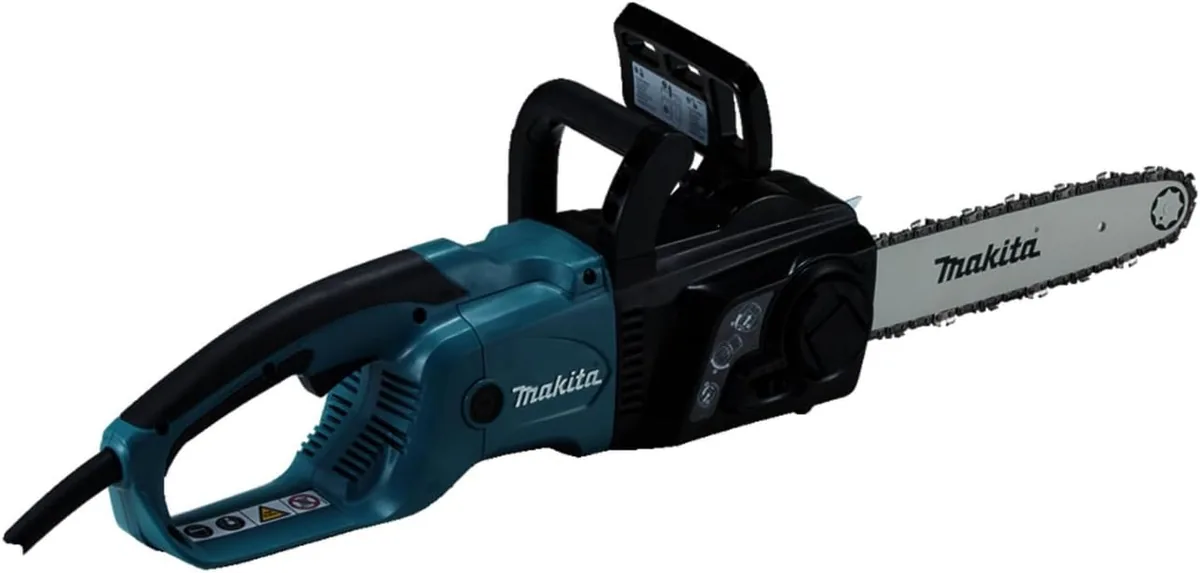
2. Makita UC4051A 16 in Corded Electric Chain Saw Best Premium
The Makita UC4051A is the corded saw for the buyer who cuts at home often and wants the longest list of documented safety devices among the five saws here. A front hand guard brake stops the chain within 0.15 seconds, according to Makita, and a separate run-down brake stops it when you let go of the trigger. It sits in the premium price tier and cuts 14 in of wood with its 16 in bar.
WHY I CHOSE THIS ✓
I rate the UC4051A second, as the premium pick, because it documents every safety device with a way to check it: the brake, the run-down brake, the trigger lock-off, the chain catcher and the hand guards. If a corded saw will see weekly use, that list matters more than a longer bar. I accept the 14 in cutting length as the price.
Makita UC4051A 16 in Corded Electric Chain Saw Specs
Key Features:
- Hand guard chain brake: push the front guard forward with the back of your hand and the chain stops within 0.15 s, according to Makita, with the motor power cut.
- Run-down brake: release the trigger and the chain stops on its own, and Makita’s own check is that it must stop within a second.
- Lock-off button plus trigger: press the button first, then squeeze, so the trigger alone does not start the saw.
- Sprocket-nose bar: a 16 in bar with a 14 in cutting length and a bar-nose bearing you can grease.
- Adjustable automatic oiler: a pump with a feed screw underneath and a level sight, made for biodegradable chain oil.
- Dial tension: adjusts with no tool, but only after you stop the saw: release the trigger, engage the chain brake if the saw has a brake lever, switch the motor off and wait until the chain has stopped, then pull the plug from the outlet by the plug, not the cord, and put on gloves before touching the chain; release the chain brake only when the exact manual’s procedure requires it; then loosen the cover lever lightly, lift the bar tip and turn the dial.
- Replaceable carbon brushes: you change them at the limit mark, and a new set needs about 10 minutes of no-load running to bed in.
On a plum log lying on a stand I rested the spike bumper on the wood and pivoted the saw on it, the way Makita’s manual shows for bucking. The 16 in bar cuts 14 in of wood, so I size every log to the smaller number. Makita lists the saw for cutting wood only and rules out felling and limbing standing timber, because a mains cable does not give the mobility and safety that work needs.
Oil is the thing to set up properly. Makita’s check is to hold the running chain about 6 in above the ground or a trunk and look for a light oil trace, and I do it over the concrete pad, never over the tree rows. Makita asks for biodegradable chain oil with an adhesion agent, bans mineral oil and tells you to empty the tank before long storage, because old oil can harm the pump.
Weight shows up late in a session. Makita’s net weight is 12.3 lb on its EPTA procedure, and at the end of a long afternoon, held at arm’s length, it felt more than that number suggests. Upkeep asks more of you than on the other saws here: Makita says to grease the bar-nose bearing at least weekly with frequent use, to turn the bar over at each chain change and to have the brakes inspected regularly by an authorized service center. That is the routine of a saw made to be serviced, and the premium tier pays for it.

Run two or three chains in rotation, as Makita advises, so that a sharp chain is always ready when the one on the saw goes dull, and the bar wears evenly between changes.
For the cord, use an outdoor-rated extension cord of the gauge your manual gives for its length, plug into GFCI-protected power, never use the saw in rain or wet conditions (GFCI protection does not make that safe), keep the cord away from the chain, and unplug it before any work on the chain. Makita’s table caps a 12 to 16 A saw at 50 ft of cord, with 14 AWG up to 25 ft and 12 AWG up to 50 ft, and you read the saw’s rating plate to find your row.
After use some oil leaks for a while, which Makita calls normal, so I store the saw level with the bar cover on, unplugged, in a dry locked room and never outdoors. Release the trigger and watch the run-down brake stop the chain before every session; it took a moment to trust, and it never failed. Read the warranty on the listing before you buy.
Choose the UC4051A if you cut small and medium wood near an outlet often, and you want a brake you can test and a service network behind the saw. Pass on it if you want the most bar for the money, if your cord run passes 50 ft, or if you want the amp and wattage figures on the box. It is a saw for wood on a stand, never for trees.
FINAL VERDICT
I pay extra for the UC4051A when a saw gets weekly use. Its brake, run-down brake and chain catcher all come with checks, and the upkeep is clearly laid out. For a few cuts a season, a cheaper saw does the job.
It is the premium corded saw for frequent work at home.
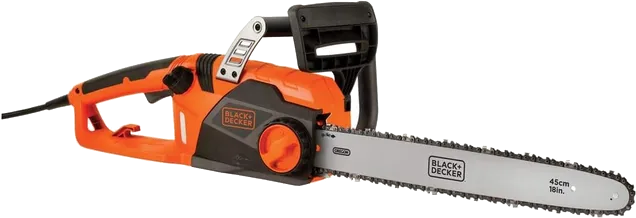
3. BLACK+DECKER CS1518 18 in 15 Amp Corded Electric Chainsaw Best Value
The BLACK+DECKER CS1518 is the value pick for anyone who wants an 18 in bar and a documented chain brake at a budget to mid-range price. The front hand guard doubles as the brake lever, and the manual gives a test you run before every use. It comes with a two-year home-use warranty from a maker that runs service centers.

WHY I CHOSE THIS ✓
I rank it third, as the value pick, because it gives an 18 in bar, a brake with a stated test and a two-year home-use warranty for less than the saws above it. Its limits are plain: it is the saw on this page that tells you the least about itself.
BLACK+DECKER CS1518 18 in 15 Amp Corded Electric Chainsaw Specs
Key Features:
- Front hand guard brake: the guard doubles as the brake lever, and in a kickback your left hand pushes it forward and the tool stops.
- A brake you set by hand: with the saw unplugged you pull the guard back to the set position, and the manual says to set it before cutting.
- Tool-free tension: an assembly on the bar turns by hand, but only after you stop the saw: release the trigger, engage the chain brake if the saw has a brake lever, switch the motor off and wait until the chain has stopped, then pull the plug from the outlet by the plug, not the cord, and put on gloves before touching the chain; release the chain brake only when the exact manual’s procedure requires it.
- Automatic oiler with a level indicator: refill with the saw unplugged once the level drops below a quarter.
- Reduced-kickback bar: a small-radius tip, with a low-kickback chain that met ANSI B175.1-1991, according to the manual.
- Cord retainer: a retainer in the switch handle holds the extension cord so a tug does not pull it free.
- Lock-off button and bar scabbard: press the button, then squeeze the trigger, and the scabbard covers the bar between jobs.
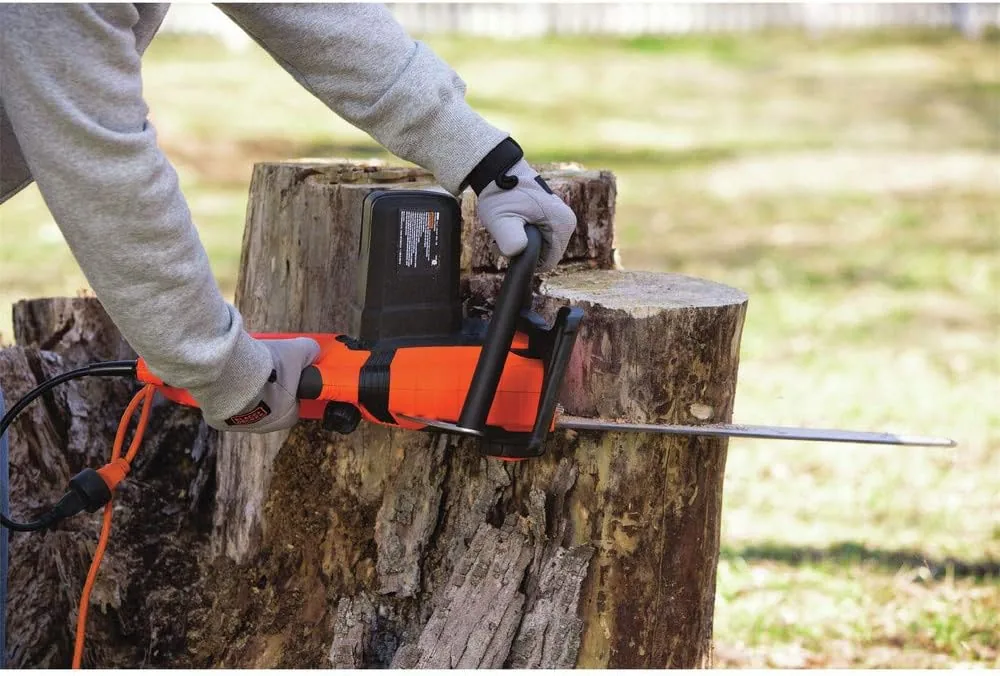
I reset the brake to the set position after the test the first day, and the first time I forgot, the saw sat silent when I squeezed the trigger. That is the habit this saw teaches: test the brake with the back of the hand, stop and unplug the saw, pull the guard back to set, then plug in and cut as the manual describes. The manual calls the saw ideal for pruning applications and small logs, and I kept it to that on branches laid across a stand beside the shed.
BLACK+DECKER recommends vegetable-based bar and chain oil when you prune trees and does not recommend mineral oil. I buy the vegetable kind for work near the drip lines and keep the bottle capped when I walk away from the saw. Where it trails the rest of this page is in what the manual tells you: it gives no extension cord table, so I read the rating plate on the saw and choose an outdoor-rated cord heavy enough for those amps.
A second job put the 18 in bar against the biggest plum limb I cut, and the bar was longer than the wood, so I never needed its full reach. A new chain stretches, so BLACK+DECKER says to check tension often in the first two hours, unplugged. The cutters dull the moment they touch the ground or a nail, so I keep the work off the dirt.
Order replacement chain by BLACK+DECKER’s part number, RC1800. The manual names it for this saw, and only the chain and bar the maker approves belong on it.
On cord and power: use an outdoor-rated extension cord of the gauge your manual gives for its length, plug into GFCI-protected power, never use the saw in rain or wet conditions (GFCI protection does not make that safe), keep the cord away from the chain, and unplug it before any work on the chain. BLACK+DECKER’s manual says not to cut above chest height.
The chain and bar come packed separately in the carton, and you assemble them yourself; bar oil is not in the box. The warranty is a Full Two-Year Home Use Warranty and does not cover commercial use. At the end of the day I unplug the saw, put the scabbard on and leave it on the shed shelf, out of reach of the children.
This is the saw for the buyer who wants a long bar and a brake without paying for the top tier, and who cuts limbs and small logs near an outlet. Skip it if the logs are large, if the work is wet or commercial, or if you want a cord chart printed in the manual.
FINAL VERDICT
The CS1518 is the best value on this page for a corded saw with an 18 in bar and a documented brake. Test the brake, unplug the saw to set the guard, then plug in and keep the cord behind you, and it handles the light work well.
It is the 18 inch corded saw I pick when budget leads.
4. Oregon CS1400 16 in 15 Amp Corded Electric Chainsaw Best 16-Inch 15-Amp
The Oregon CS1400 is a 16 inch corded electric chainsaw with a 15 A, 1,800 W motor, a brake you can test and ordinary chain that a file or a dealer can sharpen. It suits a buyer who wants those 15 amps on a handier bar, for occasional light-duty cutting.

WHY I CHOSE THIS ✓
I place the CS1400 fourth because it is the one saw here with a published 15 A rating on a 16 in bar. It does not sharpen itself.
Oregon CS1400 16 in 15 Amp Corded Electric Chainsaw Specs
Key Features:
- 15 A, 1,800 W motor: Oregon’s rating at 120 V, with a 48.1 ft/s no-load chain speed.
- 16 in bar, 15 in effective cut: the specification table says 15 in.
- Chain brake with a stated test: the front hand guard stops the motor and chain; roll the left wrist forward on a flat surface to test it.
- Tool-free tension ring: turns by hand, but only after you stop the saw: release the trigger, engage the chain brake if the saw has a brake lever, switch the motor off and wait until the chain has stopped, then pull the plug from the outlet by the plug, not the cord, and put on gloves before touching the chain; release the chain brake only when the exact manual’s procedure requires it.
- Automatic oiler with a window: 4.7 oz tank; never run the saw unless oil shows in the window.
The 15 in cutting length is the number I plan every cut around, whatever the 16 in on the bar suggests. Oregon rules out large trees and tree service for this saw.
Oregon says to watch tension for the first half hour. My new chain needed a small turn of the ring after the first cuts, and the tool-free ring made that quick. One damp morning the shed outlet’s GFCI tripped and the saw went silent, so I cut nothing and reset the outlet only after the cord and the wood had dried.

Take a dull chain to an Oregon dealer if you doubt your filing. The manual recommends a dealer for sharpening, and a depth gauge filed too low raises the risk of kickback.
Two rules for the cord: use an outdoor-rated extension cord of the gauge your manual gives for its length, plug into GFCI-protected power, never use the saw in rain or wet conditions (GFCI protection does not make that safe), keep the cord away from the chain, and unplug it before any work on the chain. Oregon’s table asks for 14 AWG up to 50 ft and 12 AWG to 100 ft.
Oregon rates the saw at 1,800 W at 120 V, so ignore a larger wattage in a listing headline. Store it unplugged with the bar cover on, in a dry place out of reach of children and pets.
The CS1400 fits the buyer who cuts small limbs and short logs near an outlet and prefers ordinary chain to a built-in sharpener. Leave it if you want the sharpener, if your logs pass 15 in, or if the work is wet.
FINAL VERDICT
The CS1400 is a plain corded saw with a strong motor and a brake you can test. Pick it for small jobs where a 15 in cut is enough, and take the chain to a dealer when it dulls.
It is the 16 inch corded saw with the 15 amp motor.
5. WEN 4017 16 in 12 Amp Corded Electric Chainsaw Lowest Price
The WEN 4017 is the lowest-priced saw on this page: 12 amps, a 16 in Oregon bar and tool-free tension at the budget tier. WEN’s manual describes no chain brake, though its parts list names a brake handle, so ask WEN to confirm the brake and its test before the first cut. When the lowest price on this page decides it, this is the best corded electric chainsaw for the money.

WHY I CHOSE THIS ✓
I rank the WEN last on the page and first on price, because it is the lowest-priced working corded saw here, and I say what you give up for it. You give up a documented brake. Get the brake confirmed first, and for occasional work the money you save is real.
WEN 4017 16 in 12 Amp Corded Electric Chainsaw Specs
Key Features:
- 12 A motor, 44.2 ft/s chain: WEN’s no-load chain speed on 120 V, 60 Hz.
- 16 in Oregon bar and chain: WEN lists part 4017-088 for the chain and 4017-089 for the bar.
- Tool-free tension wheel: turns by hand, but only after you stop the saw: release the trigger, engage the chain brake if the saw has a brake lever, switch the motor off and wait until the chain has stopped, then pull the plug from the outlet by the plug, not the cord, and put on gloves before touching the chain; release the chain brake only when the exact manual’s procedure requires it; then loosen the bar locking knob one turn and turn the wheel.
- Automatic oiler with a level indicator: a 3.4 oz tank.
- Cord strain relief notch: loop the doubled extension cord around it.
This saw wants you at the oil window and the chain every 10 minutes. WEN says one filling lasts roughly 10 minutes of cutting, asks for a tension check at that interval and says to slacken the chain after work.
The oil window surprised me on the first hedgerow job: the level was at a quarter sooner than I expected, so I unplugged the saw and refilled. I looped the doubled extension cord around the notch under the trigger, and the plug stayed in when the cord tugged. The saw is light to carry back across the yard, lighter than the old gas handheld I used to carry.

Press the safety button, then squeeze the trigger, and let go of the button once the chain runs.
Cord first: use an outdoor-rated extension cord of the gauge your manual gives for its length, plug into GFCI-protected power, never use the saw in rain or wet conditions (GFCI protection does not make that safe), keep the cord away from the chain, and unplug it before any work on the chain. WEN’s 12 A table gives 16 AWG up to 50 ft and 14 AWG at 100 ft.
Check the listing before you order: the page is shared with another WEN saw that has an 18 in bar, and the warranty holds only when you buy from a direct WEN vendor. Buy replacement chain by part number 4017-088 and match the pitch, gauge and drive links WEN specifies.
The WEN is for the buyer on a tight budget who cuts small wood near an outlet now and then. Pass if you need a documented chain brake, if the cord run is long, or if you cut for hours. My comparison of the WEN 4017 and Oregon CS1500 puts the two corded saws side by side.
FINAL VERDICT
The WEN 4017 does small corded jobs for the lowest price on this page, and its manual leaves the brake undocumented. Buy it only after WEN confirms the brake and its test, and check the saw yourself every time.
It is the lowest-priced corded saw for small jobs.
How to Choose the Best Corded Electric Chainsaw
A plug-in saw trades the battery and the fuel for a cord. The cord, the brake and the bar length decide whether it fits your jobs, and these seven factors are the order I check them in.
Motor Amps and Real Power
The motor rating is an electrical input rating in amps at 120 V, and volts times amps gives input watts. A rating plate is the figure to trust, because makers print amps, watts or neither on the box, and I read the plate on the saw before I read the headline.
| Motor rating | Input watts |
|---|---|
| 10 A | 1,200 W |
| 12 A | 1,440 W |
| 15 A | 1,800 W |
Pro Tip
A 15 A saw on a 120 V outlet draws up to 1,800 W, which is the rating Oregon gives its 15 A saws. A bigger wattage in a listing headline is advertising, not the saw’s rating.
Amps describe what the motor draws, not what reaches the wood, and a higher draw also means more current through the extension cord. A chain speed in ft/s is a no-load figure, so compare it only with another maker’s no-load figure.
Bar Length and Cutting Length
A bar is sold by its called length, and the wood it cuts is shorter. Size every log to the cutting length, because some manuals cap a cut at that figure. I choose a saw for the biggest piece I will cut and no more, since a longer bar is more weight at arm’s length.
| Bar in the box | Cutting length |
|---|---|
| 16 in | 14 in (one maker) or 15 in (another) |
| 18 in | 17 in |
- Limbs and small logs: a corded saw suits wood you can lift onto a stand.
- Felling and tree service: Oregon calls its saws unsuited to large trees, Makita rules out felling and limbing standing timber, and BLACK+DECKER and WEN say felling is for trained people.
- Overhead work: it is a job for a pole saw or a professional, never a chainsaw held up high.
Safety Note
Never cut at or above shoulder height, and never cut from a ladder or a roof. Felling is the most dangerous chainsaw job. Never work alone, keep everyone at least two tree lengths away, and plan and clear two escape routes angled back from the direction of fall before any felling cut. A large, leaning, dead or hung-up tree, or a trunk or limb under tension after a storm, is a job for a certified arborist. A standing dead tree is the arborist’s job, and wood already on the ground is a homeowner’s.
Chain Brake and Kickback
A chain brake stops the chain when the front hand guard is pushed forward or when kickback throws the saw back, and the test for it differs from saw to saw. Four of the five saws on this page come with a brake and a test written in their manuals. The fifth describes no brake, and its block says so. In laboratory tests on gas saws, correct chain tension, anti-kickback links and a quickly activated brake all influenced kickback (1).
If the upper part of the bar tip touches wood or another object, the bar can kick back up and toward you (rotational kickback). Wood pinching the chain on the top of the bar pushes the saw straight back at you (pushback), and wood pinching the bottom pulls it forward, away from you (pull-in). A low-kickback chain, a chain brake and a correct grip reduce these risks; none removes them.
Hold the saw with both hands, right hand on the rear handle and left hand on the front handle, thumbs and fingers wrapped around the handles, with your body to the left of the chain line and firm footing. I treat the brake as a second line of defense and keep the bar tip clear of everything.
Before Every Cut
Before each use, inspect the saw as its manual describes: test the chain brake by the manual’s method, and check the throttle trigger lockout, the stop switch, the chain catcher, the guards and the chain’s sharpness, tension and condition; on a gas saw the chain must not move at idle. If any check fails, do not use the saw until it is repaired, and never disable a safety device.
Oiling, Chain Tension and Upkeep
Every saw here oils its own chain, and the oil level in the sight window is the first thing I look at before each session. A new chain stretches, so tension needs frequent checks at first, with the saw unplugged and the chain cool. Replacement chains and bars must match the pitch, gauge, drive links and part numbers the manual approves, and a low-kickback chain stays on a homeowner saw.
Stop first, then make the saw safe, in this order:
- Release the trigger, engage the chain brake if the saw has a brake lever, switch the motor off and wait until the chain has stopped.
- Pull the plug from the outlet by the plug, not the cord.
- Put on gloves before touching the chain.
- Release the chain brake only when the exact manual’s procedure requires it, and never force a locked chain or cover.
- Oil: a visible level before the saw runs.
- Tension: a chain that snaps back when lightly pulled from the bar, as the manual states.
- Cutters: fine dust in place of chips means a dull chain, so I stop and deal with it.
Cord, Outlet and GFCI
The cord is the part most buyers forget. A saw that must stay within a cord’s length of an outlet suits a shed, a yard and a stack, and it does not suit a field. A thin extension cord starves the motor, so the gauge and the length come straight from the manual.
| Total cord length | Wire gauge |
|---|---|
| 0 to 50 ft | 14 AWG |
| 51 to 100 ft | 12 AWG |
Other makers print different tables, so read the table for your saw: one maker caps a 12 to 16 A saw at 50 ft with 12 AWG, and another gives 16 AWG to 50 ft for a 12 A saw. I check the insulation along the whole cord before each session and lay it out behind me in a straight line.
Cord Safety
Use an outdoor-rated extension cord of the gauge your manual gives for its length, plug into GFCI-protected power, never use the saw in rain or wet conditions (GFCI protection does not make that safe), keep the cord away from the chain, and unplug it before any work on the chain.
Weight, Vibration and Fatigue
The weights on this page run from about 10 lb to 12.9 lb, and each is stated on its own basis, so I do not rank the saws by them. A saw that feels light at minute five feels heavy at minute thirty, and a tired operator makes mistakes. In a study of southeastern US groundskeepers, chainsaws gave the highest tool vibration the researchers measured, 8.0 m/s2 at the right hand, against 1.9 m/s2 for handheld blowers (2). Lighter saws for limbs and small logs are in my best lightweight chainsaw roundup.
I take breaks before my hands ask for them. Stop when your hands tingle or go numb, and see a doctor if it persists.
Protective Gear and Training
US emergency department data for 2006 to 2016 show that power saws caused 89 percent of 18,250 saw and axe injuries, mostly lacerations to the fingers and hand, and most happened at home (3). In an Irish survey of 62 domestic chainsaw accidents, only 3 percent of the injured users wore any protective gear, and most injuries were to the legs (4). In a 41-patient series of leg injuries, the left foot was hurt most often, usually because it sat in the path of the saw (5).
Wear impact-rated safety glasses with side protection marked Z87+ (a mesh face screen adds to them but never replaces them), hearing protection, chainsaw chaps or chainsaw trousers used within their maker’s stated limits (some are not designed to stop a battery or corded saw’s chain, and no clothing guarantees protection), work gloves and sturdy boots with ankle support, plus a hard hat when you fell a tree or anything can fall from above.
Hearing protection matters on a corded saw too: in a medical evaluation of 107 chainsaw operators, noise exceeded the legal limit and 3.74 percent had bilateral hearing loss (6). Read the manual, get hands-on training before the first cut, and begin on small cuts in wood lying on the ground. I do not work alone.
My Overall Verdict
A corded saw gives you a steady start with no fuel and no battery to charge, and it asks in return for an outlet, a good cord and respect for the brake. These three cover the range of buyers on this page. If you have not settled on a cord yet, I compare corded, battery and gas saws in my roundup of the best chainsaws of every type.

1. Oregon CS1500 18 in 15 Amp Self-Sharpening Corded Chainsaw Best Overall
For small limbs and small logs near an outlet, with a self-sharpening chain and a brake test written out.

2. Makita UC4051A 16 in Corded Electric Chain Saw Best Premium
For frequent use at home, when the premium tier buys a run-down brake, a chain catcher and a serviceable design.
3. BLACK+DECKER CS1518 18 in 15 Amp Corded Electric Chainsaw Best Value
For an 18 in bar and a documented brake at a budget to mid-range price, with a two-year home-use warranty.
Measure the cord run to your work first, then pick the saw whose brake and cord rules you will follow every time. That habit, more than any feature, makes the best corded electric chainsaw a safe tool on your own land.
Why Oregon CS1500 18 in 15 Amp Self-Sharpening Corded Chainsaw Might Be the Best Choice
I pick the Oregon CS1500 for the homeowner who cuts small wood near the shed. It sharpens its own chain, the manual writes out the brake test, and the cord table covers runs up to 100 ft.
The trade-off is the closed sharpening system: only PowerSharp chain and the genuine stone fit, and Oregon rates the saw for occasional light-duty use.
Here is what you get with the CS1500 near the sheds:
✓ Self-sharpening: lift the lever for 3 to 5 seconds, per Oregon.
✓ 15 A motor: 1,800 W at 120 V, with an 18 in bar.
✓ Brake test in the manual: start briefly on a flat surface and roll the left wrist.
✓ Tool-free tension and auto oiling: a ring turned by hand and a 4.7 oz tank with a window.
✓ Cord and bystander rules: wire gauge to 100 ft and a 20 ft circle kept clear.
Frequently Asked Questions
Are electric corded chainsaws any good?
Corded electric chainsaws are good for small limbs and small logs near an outlet, because they start without fuel or a battery and run on a steady 120 V supply. They are a poor fit for felling, for work far from power and for wet weather, so match the saw to the job before you buy.
What is the best corded electric chainsaw in 2026?
The best corded electric chainsaw in 2026 on this page is the Oregon CS1500, a 15 A saw with an 18 in bar, a self-sharpening chain and a brake test written out in its manual. The Makita UC4051A suits frequent use at home, and the BLACK+DECKER CS1518 suits a tighter budget.
What is the best most reliable electric chainsaw?
Reliability comes from how you use a saw as much as from the model, so the most reliable electric chainsaw for you is one you keep within its manual’s limits and check before every use. My pick on that basis is the Oregon CS1500, whose manual spells out the brake test, the oiler priming and the cord gauge.
What’s the best electric chainsaw you can buy?
The best electric chainsaw you can buy depends on how far you work from an outlet: a corded saw suits small jobs near power, and a battery saw suits work away from it. For corded use my pick is the Oregon CS1500, and for work away from an outlet a battery saw is the tool to look at.
Is there such a thing as an electric chainsaw?
An electric chainsaw is a real tool, and it comes in two forms: a corded saw that plugs into a 120 V outlet and a cordless saw that runs on a battery. This page covers the corded kind, which keeps running as long as it has power and needs an outdoor-rated extension cord for any distance.
References
- Dąbrowski A. Reducing kickback of portable combustion chain saws and related injury risks: laboratory tests and deductions. Int J Occup Saf Ergon. 2012;18(3):399-417.
- Chen N, Yang S, Oh J. Evaluation of hand-arm vibration (HAV) exposure among groundskeepers in the southeastern United States. Annals of Work Exposures and Health. 2025;69(1):81-95.
- Sritharen Y, Hernandez MC, Zielinski MD, Aho JM. Weekend woodsmen: overview and comparison of injury patterns associated with power saw and axe utilization in the United States. Am J Emerg Med. 2018;36(5):846-850.
- Doyle YG, Conroy RM. Prevention of timber felling and chainsaw-related accidents in the Republic of Ireland. Accid Anal Prev. 1989;21(6):529-534.
- Gemci Ç, Imerci A, Aydogan NH. Lower extremity injuries due to chainsaw during four-year periods. Cureus. 2023;15(8):e44058.
- Iftime MD, Dumitrascu AE, Ciobanu VD. Chainsaw operators’ exposure to occupational risk factors and incidence of professional diseases specific to the forestry field. Int J Occup Saf Ergon. 2022;28(1):8-19.
Safety Note: Read your saw’s manual first and get hands-on training before your first cut. A chainsaw can react faster than you can: if the upper part of the bar tip touches wood or another object, the bar can kick back up and toward you; wood pinching the top of the chain can push the saw straight back at you, and wood pinching the bottom can pull it forward. Keep the bar tip out of contact and watch for wood closing on the bar. A low-kickback chain and a chain brake reduce these risks but never remove them. Before each use, inspect the saw as your manual describes: test the chain brake, and check the throttle lockout, the stop switch, the chain catcher, the guards and the chain. On a gas saw the chain must not move at idle. If any check fails or a part is missing or damaged, do not use the saw until it is repaired, and never disable a safety device. Wear impact-rated safety glasses with side protection marked Z87+ (a mesh face screen adds to them but does not replace them), hearing protection, chainsaw chaps or chainsaw trousers, work gloves and sturdy boots with ankle support, and a hard hat when you fell a tree or when anything can fall from above. Use leg protection within its maker’s stated limits: some chaps are not designed to stop the chain of a battery or corded saw, and no clothing guarantees protection. Hold the saw with both hands, right hand on the rear handle and left hand on the front handle, thumbs and fingers wrapped around the handles, and keep your body to the left of the chain line with firm footing. Never cut one-handed with a rear-handle saw, never cut at or above shoulder height, and never cut from a ladder or a roof. Top-handle saws are made for trained tree workers: follow that saw’s manual. Keep children, bystanders and pets well away while you cut. Never work alone. Start a gas saw with the chain brake engaged, on the ground or held firmly as the manual shows, never by drop-starting it, and at least 10 feet from where you fuelled it. Refuel outdoors with the engine off and cool, with no smoking, flames or sparks nearby, wipe up spills, and use only the fuel mix and ethanol content your manual allows. Exhaust contains carbon monoxide, which can kill: never run a gas saw indoors or in a garage, shed or other enclosed space. Before you touch the chain, clear a jam, adjust the tension or sharpen: release the trigger, engage the chain brake, stop the engine or motor and wait until the chain has stopped. Then, on a gas saw, let the engine and muffler cool and pull the spark plug cap off; on a battery saw, take the battery out; on a corded saw, unplug it by the plug. Put on gloves before you touch the chain, and release the chain brake only when your manual’s procedure calls for it. To carry the saw, stop it, take out the battery or unplug it, keep the chain brake engaged and the bar pointing behind you, and fit the bar cover for transport. Use a corded saw only with an outdoor-rated extension cord of the gauge your manual gives, plugged into GFCI-protected power. Never use it in rain or wet conditions: GFCI protection does not make that safe. Keep the cord away from the chain. Use only the chains and bars your manual approves. Felling trees is the most dangerous chainsaw job. Before any felling cut, keep everyone at least two tree lengths away, and plan and clear two escape routes angled back from the direction of fall; when the tree starts to fall, follow your manual’s retreat steps (release the trigger, stop the saw and set it down as it describes) and move away along that route; never delay escape to cool, unplug or cover the saw. A large, leaning, dead or hung-up tree, a trunk or limb under tension after a storm, and any tree near a house or a road are jobs for a certified arborist. Power lines are a separate danger: treat every downed line, and anything touching it, as live, stay well away and call the utility; before any work near a power line, contact the utility and leave that work to its qualified line-clearance crews. Stop when you are tired, and take breaks if your hands tingle or go numb.