

The best generator for camping is the lightest unit whose running watts still cover your camp loads, and for a tent weekend that means a small inverter or a battery station. I have run both kinds on the gravel pad and in the yard at the farm, loaded the way a camp loads them: lights, a fridge and chargers.
I rank nine, from a 39 lb inverter to a solar-ready battery unit, led by the WEN 56235i 2,350-Watt Inverter Generator. After the reviews I cover watts, noise at distance and where to put the unit so the exhaust stays away from your sleeping area.
Best Generator for Camping 2026 With 9 Picks for Tents and Trailers
These nine cover the camps a generator can serve: a tent weekend, a car camp, a trailer on a 30 A cord and a base camp that stays for days. Six burn fuel and three run on a battery, and every review says who should skip the unit.
1. WEN 56235i 2,350-Watt Inverter Generator Best Overall
I carried the 56235i from the car to the gravel pad in one hand, and that is the test a camping generator has to pass first. WEN lists it at 39 lb and 1,900 running watts, which covers lights, phone chargers and a small cooler fan for a tent weekend or a small trailer. It is my best generator for camping because weight, output and a modest price meet in one machine, and it has no carbon monoxide shutoff, so the outdoor distance and a battery CO alarm stay essential.

WHY I CHOSE THIS ✓
I chose it as number one because a camp generator is carried far more often than it is run. At 39 lb it goes in and out of the car without a thought, and 1,900 running watts is more than the camp loads need. I do not rank it first for any single spec. I rank it first because it has no weak spot that a camper cannot work around.
WEN 56235i 2,350-Watt Inverter Generator Specs
Key Features:
- 39 lb frame: One person lifts it in and out of a car boot without a wheel kit or a second pair of hands.
- 1,900 running watts: Enough for a camp fridge, string lights, a laptop and phone chargers at the same time, with room to start a small fan.
- Eco mode: The engine speed follows the load, and the manual says to keep it on below 1,000 W for less fuel and a quieter note.
- 12 V and USB outlets: A 120 V duplex with two sockets is joined by a 12 V port and two USB ports for the small gear that camps run on.
- Fuel-off position: The engine switch has a fuel-off setting that lets the carburetor run dry before you pack it away.
- Low-oil shutdown: The engine stops and will not restart when the oil is low, which protects a unit that is easy to forget to check.
- Parallel port: WEN sells a parallel kit that links two WEN units for a bigger site, and the kit is not in the box.
At camp, the load list decides everything. According to WEN’s manual chart a refrigerator or freezer runs on 800 watts and starts on 1,200, so a cooler-sized fridge, the lights and a charging bench sit comfortably inside 1,900 watts. I start the biggest load first and add small ones one at a time, because the manual says nothing may be plugged in while the engine starts. A kettle and a hair dryer together will trip the overload light, so I boil water on a stove.
Eco mode is the setting that matters after dark. I switch it on when only lights and chargers are running, and the engine note falls to a low hum that does not carry across a field. The manual limits eco mode to loads under 1,000 W, so I switch it off when a bigger motor joins. WEN gives 51 dB at a quarter load without a distance, so I read that figure as a comparison within the unit and place the machine far from the tents, not as a promise about what a neighbour hears.
The 5.7 hours at half load comes from a tank of 1.06 gal, and that sets the shape of a camp day. One fill covers an evening of lights and charging, and a second fill covers a morning. I refuel only after the engine has stopped and cooled for at least two minutes, outdoors, as the manual says, and I wipe any spill and move at least 30 ft from it before I start. The manual also asks for a 20 to 30 minute run every month in storage, and a gas can with fresh fuel beats a half-empty one from last summer.

Check the oil on level ground before every start. The unit ships without oil, takes 15 fl oz, and the low-oil sensor will stop a start rather than warn you.
This model has no carbon monoxide sensor, and the manual says to run it outdoors only, never in a tent, a garage or a partly enclosed space. Stand it at least 20 ft from where anyone sleeps, the distance the CPSC gives for a house, with the exhaust pointing away, and keep a battery CO alarm in the camper or cabin.
Living with it means a recoil pull and the monthly run. The cord pulls slowly to resistance and then fast, and the manual warns against letting the handle snap back. For a long cord from the unit to the camp table, the manual’s table allows #12 wire up to 100 ft at 15 A, and a thinner cord has to be shorter. Above 2,000 ft the manual asks for an altitude kit, which matters for mountain campsites.
Buy the 56235i if you tent camp, tailgate or pull a small trailer and want one person to move it. It also keeps a fridge, lights and a router alive during a power cut at home. Skip it if you need a 30 A RV outlet, a 240 V pump or a built-in CO sensor. It has 120 V sockets only, and WEN gives no sound figure with a distance.
FINAL VERDICT
The 56235i is the generator I hand to a first-time camper. It carries easily and powers the loads a campsite has, and it has no CO shutoff, so the outdoor distance and a CO alarm are not optional. Pick it when weight and cost matter more than a CO sensor.
It is the light inverter I load first for a camp weekend.
2. Honda EU2200i 2,200-Watt Inverter Generator Best Premium
Honda built the EU2200i for the camper who wants a built-in carbon monoxide shutoff in a frame one person can lift, and will pay for it. Honda lists 48 dB(A) at a quarter load, with no distance stated, and the CO-MINDER sensor stops the engine when carbon monoxide builds near the unit. It earns Best Premium because the premium tier here buys that shutoff and a 47.4 lb dry frame, and it is the best Honda generator for camping for a buyer with a short list of small loads.

WHY I CHOSE THIS ✓
I rank it second because the money buys a second layer of safety and a stated light-load sound figure rather than extra output. A sensor that stops the engine is worth paying for, and it never changes where the unit stands. I do not buy it for a pump or an air conditioner, and I do not pretend it replaces a bigger machine.
Honda EU2200i 2,200-Watt Inverter Generator Specs
Key Features:
- CO-MINDER: A sensor stops the engine when carbon monoxide builds near the unit, and a flashing light warns when the sensor is wearing out.
- Eco-Throttle: The engine slows at light load for less fuel and less noise, and the manual says to switch it off when large loads start together.
- Oil Alert: The engine stops when the oil is low, with 14 oz of 10W-30 in the sump.
- Two 20 A outlets: Two 125 V duplex receptacles run a camp fridge, lights and chargers.
- Parallel option: Honda’s own cable links it to a second compatible Honda for more output.
- 47.4 lb dry weight: One person lifts it from the car to the site, though a full tank adds to that figure.
- Recoil start: A pull cord starts it with no battery to charge or carry.
The 1,800 rated watts are a small number, and a camp keeps inside it without effort. A fridge, a string of lights, a laptop and a phone charger fit, but a motor start can trip the Overload alarm. When the heater and the kettle came on together, the alarm lit and the output cut, which taught me to plug in the largest load first and add the rest one at a time. The manual also says to switch Eco-Throttle off when several large loads start together, and I do that before a heavy start.
The 0.95 gal tank sets the rhythm of a camp day. Honda gives 3.2 hours at rated load and 8.1 hours at a quarter load, so the box figure is the light-load one. With only lights and chargers running, one fill carries an evening. At full load I refuel about every three hours with the engine stopped and cool, and I move the unit at least 10 ft from the fuelling spot before I start it, as the manual says.
The CO-MINDER is the feature I value most and trust least. A sensor light flashing every 4 seconds means 6 to 12 months of life left, and every 2 seconds means 6 months or less, so I read the light before a trip. Honda still says to run the unit in the open, away from windows, doors and vents, and never to cover it with a tent or a board. I treat the sensor as a backup and never as a reason to stand the unit closer.

Check the oil on level ground before every run, because Oil Alert stops the engine and blocks a restart when the level is low. Keep 3 ft of clear space around and above it, since the muffler stays hot after the engine stops.
Stand it outdoors on open ground, at least 20 ft from your tent, camper and their openings, because the CPSC and CDC set that distance for a house. A carbon monoxide shutoff is a second line of defense, and a battery-powered CO alarm belongs where you sleep.
Before the season ends I put stabilizer in the tank and follow the storage section of the manual, which covers draining the carburetor. The first oil change comes at 20 hours, and Honda allows no more than 10 percent ethanol in the fuel. The engine is quiet at light load and loud at full load, so I run it as far from the tents as the cords allow. A second unit on Honda’s parallel cable raises the output, provided both are compatible models, but it doubles the cost and the fuel stops.
The EU2200i suits a tent or small trailer camper who values a sensor and a light frame over output, and it keeps a fridge and lights alive in a power cut. Skip it for a 30 A RV outlet, a 240 V pump, central air conditioning or a budget purchase. The outlets are 20 A only, and the unit sits at the premium end of the tiers for its size.
FINAL VERDICT
For a short list of small loads, the EU2200i gives a built-in CO shutoff and a quiet note at light load in a frame one person can lift. Its limit is the 1,800 rated watts. Choose it when everything you plan to run fits under that number.
It is the small Honda with the built-in CO shutoff.
3. A-iPower SUA2301iD 2,300-Watt Dual Fuel Inverter Generator Best Value
The SUA2301iD runs on propane from a cylinder you already own, and that is why it takes the Best Value spot for camping. A-iPower puts the propane hose, the 30 A RV adapter and a parallel cable in the box, so a buyer adds nothing before the first trip. It is the best budget generator for camping among the dual fuel units here, and it suits a camper who wants propane’s long storage life and a CO shutoff at a budget tier.

WHY I CHOSE THIS ✓
I put it third as the value pick because the box holds what a camper would otherwise buy later. A hose, an RV adapter and a parallel cable come with a CO sensor and wheels at a budget tier. I rank it below the first two for one reason: a small tank, recoil start only and a noise figure without a distance.
A-iPower SUA2301iD 2,300-Watt Dual Fuel Inverter Generator Specs
Key Features:
- Fuel Sense: With the propane valve open it runs on propane, and it moves to gasoline by itself when the cylinder runs empty or the valve is closed.
- CO Watch-Guard: A sensor shuts the engine off on rising carbon monoxide, and the manual says it does not replace a CO alarm.
- 30 A twist-lock outlet: Next to two 20 A duplex sockets, it takes an RV cord with the adapter that ships in the box.
- Low Idle button: Engine speed, fuel use and noise drop at light load, and the manual says to switch it off for surge loads.
- Telescoping handle and wheels: Flat-free 3 inch wheels roll it over a campsite path that a 44 lb carry would make tiring.
- LED data center: It shows voltage, power, fuel level, run hours and overload or low-oil lights, so a camper reads the unit at a glance.
- Parallel cable included: Two identical units pair for more output, with 20 inches between them so exhaust heat cannot melt the other shell.
Propane changes the camp routine. I open the cylinder valve, and Fuel Sense runs the engine on propane until the cylinder is empty, when it hands over to gasoline. The price is watts: running watts fall from 1,800 on gasoline to 1,600 on propane, so I size the camp load for the lower number. A fridge, string lights and a laptop fit, and a hair dryer does not.
The first five hours are break-in. The manual asks to stay at or below 50 percent of running watts, 900 W on gasoline, and to change the oil at five hours, so I ran my first hours on lights and phone chargers only. After that the Low Idle button earns its place at night: engine speed drops with a small load, and the note drops with it. A-iPower gives 62 dBA as the lowest figure, with no distance or load, so I treat it as a label for the unit and keep it away from the tents.
The tank is where the money was saved. It holds 0.9 gal, and A-iPower quotes up to 9 hours at 25 percent load, with no propane figure published, so a long trip suits a spare cylinder better than a spare can of fuel. Hose care matters: the manual wants an upright OPD-valve cylinder, a soap-and-water leak check at the joints and the valve closed with the hose off when the unit is idle. Propane is heavier than air, so I keep the cylinder clear of low spots.
The manual asks you to start with no load and wait a few minutes before you plug in. Then connect the largest load first.
Run it outdoors only, on open ground, and keep it 20 ft from the tent or camper, the distance the CPSC gives for a house, with a battery CO alarm where you sleep. CO Watch-Guard is a backup, never a reason to move closer, and it can trip from another engine’s exhaust pointed at it, so I move it and restart.
Gasoline needs the usual care: fresh fuel, the carburetor drained before a month of storage, and a 30 minute run every 30 days if it sits. Oil goes in at 10W-30, 11.8 fl oz, and gets changed at five hours, again at 25 hours or the first month, then every 100 hours or six months, and monthly under heavy load or heat. The recoil start is plain, and the manual warns that cord kickback can break bones, so I pull to resistance and then fast.
Tent and small trailer campers on a budget get the most from it, as do tailgaters and buyers who want propane for storage. Skip it for an RV air conditioner, a 240 V load, electric start or a unit with a sound figure that has a distance. It is also my weakest pick for noise information, since A-iPower gives 62 dBA with no distance.
FINAL VERDICT
Buy the SUA2301iD when the camp load stays under 1,600 watts and propane matters. It sits at a budget tier and ships with what a camper needs. Skip it if the load is bigger or the noise at a quiet site is the main worry.
It is the budget propane inverter I keep for camp trips.
4. EcoFlow RIVER 2 Pro Portable Power Station Best Battery Generator
The RIVER 2 Pro is a battery unit, not a fuel generator, and that is why a camper picks it: no engine, no exhaust and no fuel can to carry. EcoFlow rates it at 768 Wh and 800 W of AC output, enough for lights, a laptop and a small fridge. It is the best battery generator for camping on this page for a car camper who wants to sleep beside the power source with no fumes.
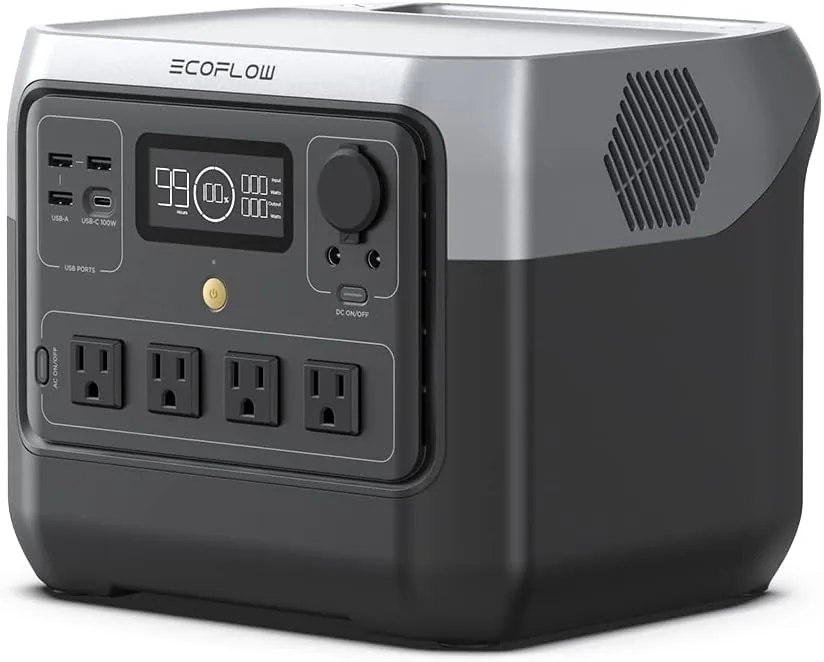
WHY I CHOSE THIS ✓
It sits fourth because it gives a night beside the tent with no exhaust and no engine note. The price is capacity, since 768 Wh is a small tank, but for a car camper with lights, a laptop and a fridge it is the unit I pack.
EcoFlow RIVER 2 Pro Portable Power Station Specs
Key Features:
- LiFePO4 battery: EcoFlow rates it at 3,000 cycles to 80 percent capacity, enough for many seasons of trips.
- 70 minute wall recharge: EcoFlow says it fills from empty in about 70 minutes on a household socket, so a stop at home resets it.
- Four AC outlets, USB-C and a car port: USB-C delivers up to 100 W, and the 12 V port suits camp lights and a cooler.
- X-Boost: It lets a resistive load rated up to 1,600 W run, but EcoFlow says it does not suit equipment that needs full voltage.
- Solar input to 220 W: One panel in good sun recharges it in about 4.5 to 9 hours, a range EcoFlow gives.
A battery unit changes what a night at camp sounds like. There is no engine note, only a fan that EcoFlow says can reach 62 dB at high wattage, and with a router, lights and a phone charger the fan stayed quiet for me. A kettle ended that peace: it asked for more than the 800 W the unit holds, the AC output cut and the overload icon flashed.
The unit holds 768 Wh, and as a rough estimate the AC outlet delivers about 85 percent of that after inverter losses, near 650 Wh. A fridge that averages 100 W could run about 6.5 hours, and a 20 W router runs over a day. The compressor cycles, so the average draw sits far below the label, which is why the fridge lasted longer than I expected. I put this station against the Jackery Explorer 1000 v2 in EcoFlow versus Jackery, watt-hour by watt-hour.
EcoFlow’s manual says a fridge can make the AC output shut off during its power swings, and the app has a Never Turn Off setting for that.
A battery unit burns nothing, so the carbon monoxide rules for fuel generators do not apply, but water and cold do. Keep it dry and its air vents clear, because EcoFlow’s manual warns against rain and humidity and it will not charge below 32 F.
At 17.2 lb it carries easily, though a gravel path still tires my wrist. The manual asks for storage at 20 to 30 C and a recharge to 60 percent every three months.
It suits car camping, a van or a tent where phones, lights, a laptop and a small fridge are the load. Skip it for a heater, an air conditioner, a 240 V tool or any trip longer than a day or two without a recharge.
FINAL VERDICT
The RIVER 2 Pro is the quiet choice for a short list of small loads, with no fuel to carry and no exhaust to place. Choose it when your camp runs on lights, chargers and one fridge.
It is the engine-free battery I pack for car camping.
5. Anker SOLIX C1000 Portable Power Station Best Solar Generator
Two 200 W panels and the C1000 make a camp that never needs a fuel stop. Anker accepts up to 600 W of solar input, the highest panel limit on this page, and the box holds the station only, with no panel. It is a battery unit, not a fuel generator, and it is my best solar generator for camping for a site with sun, 1,056 Wh of storage and 1,800 W of output.

WHY I CHOSE THIS ✓
A solar camp needs sun and room for the panels, and where those exist this is the station I set up for a base camp that stays put for several days. The weight and the cost of panels are the price.
Anker SOLIX C1000 Portable Power Station Specs
Key Features:
- 600 W solar input: An 11 to 60 V MPPT port takes panels, and Anker gives 3.6 hours with two 200 W panels in strong sun.
- 1,800 W output: Six AC sockets, two USB-C ports and a car port run a coffee maker, a laptop and lights together.
- Up to 1,300 W wall charging: Anker’s Ultra Fast mode fills it in about an hour, and 90 minutes is the default.
- LiFePO4 cells: Anker rates it at more than 3,000 cycles to 80 percent capacity.
- App control: The Anker app limits the AC charge rate for a small generator used as the charging source.
Sun does the recharging, and sun is never certain. Anker’s table gives 6.1 hours with two 100 W panels and 1.8 hours with two 400 W panels, both in ideal light, so I treat those as the best day. On a clear day I set the panels on the south side of the shed, and a cloudy day gave far less, which is why I carry the wall cable too.
Anker’s rule is capacity times 80 percent, divided by watts. For 1,056 Wh that gives about 845 Wh at the outlet, so a fridge that averages 100 W lasts roughly 8.5 hours. I split the loads: lights and the router run from the station overnight, and the freezer stays on another source. A 1,500 W heater would run about 34 minutes. I compare this SOLIX C1000 with the Explorer 1000 v2 in my Jackery and Anker comparison.
Switch off the AC, USB and car outputs when they are idle, because Anker says a switched-on output draws a little power with nothing plugged in.
Anker rates discharge between minus 4 and 104 F and charging only between 32 and 104 F. A frosty night or a hot car can block the recharge, so I keep the unit out of a closed vehicle on a summer afternoon.
At 28.44 lb the flat top gives a poor grip for a long carry. Anker says motors with a high start-up current, such as pumps and saws, may exceed the 1,800 W rating. The maker publishes no water rating, so I keep it under a roof or a tarp.
A base camp with sun, an off-grid weekend or a van with a roof panel is where it pays off. Skip it if you move camp every day, need a heater, run a pump or carry the gear far on foot.
FINAL VERDICT
The C1000 pays off when panels are part of the plan. It stores a day of small loads and recharges from the sun between trips. Choose it for a camp that stays put and has room for two panels.
It is the solar-ready station for a stay-put base camp.
6. WEN 56360i 3,600-Watt RV-Ready Inverter Generator Best for Camping Trailer
The 56360i steps up from tent loads to a camping trailer, because it carries a 30 A TT-30R outlet for an RV cord and 2,900 running watts behind it. WEN lists 3,600 starting watts and a 46.3 lb frame, light enough for one person to move to the site. It is the best generator for camping trailer owners on this page, for a camper whose rig needs more than a small inverter gives and who does not want a heavy open-frame unit.
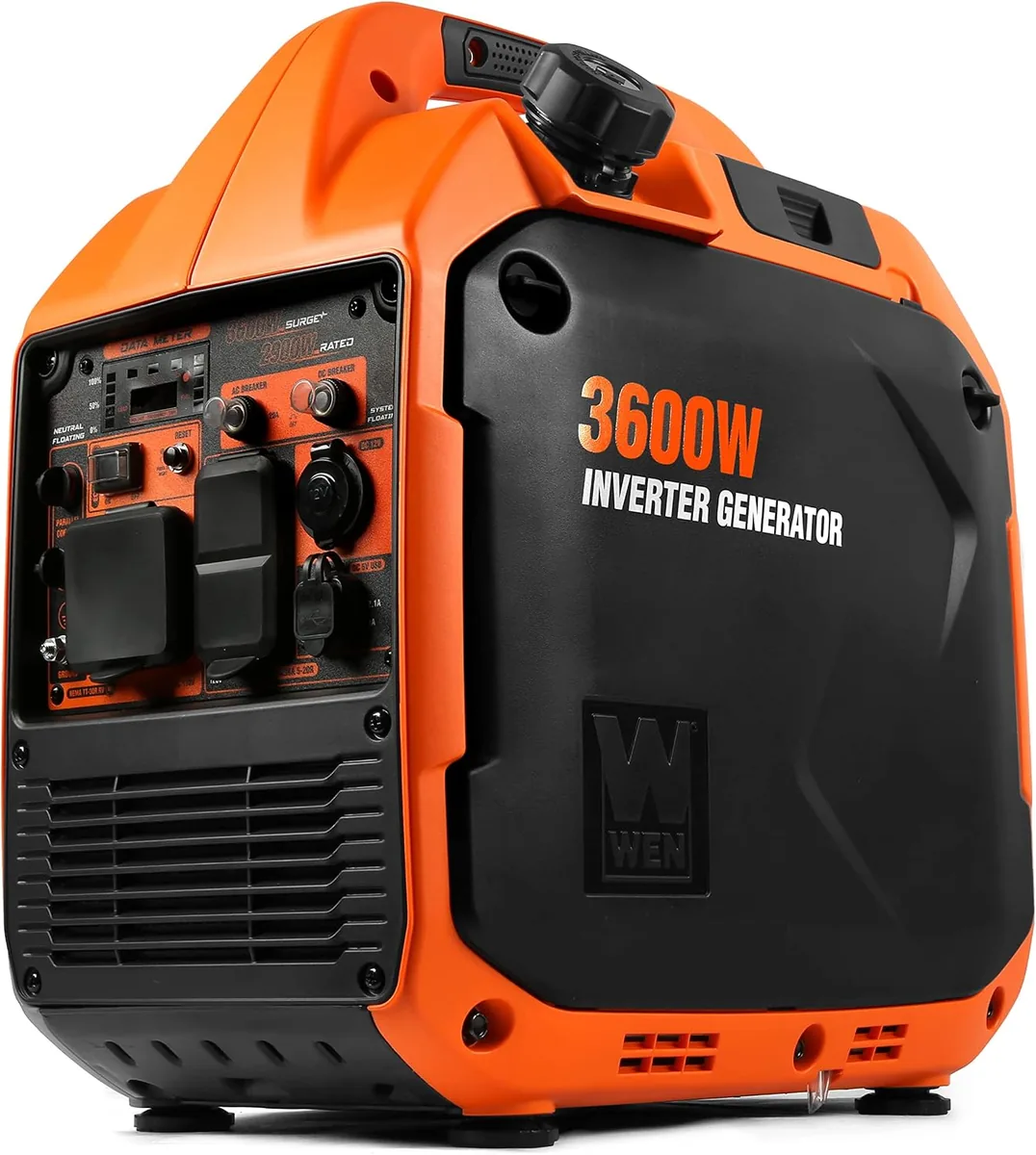
WHY I CHOSE THIS ✓
The trailer outlet is the reason to own it. A buyer with a tent has no use for 2,900 watts. A rig on a 30 A cord gets the output a small inverter cannot give.
WEN 56360i 3,600-Watt RV-Ready Inverter Generator Specs
Key Features:
- TT-30R RV outlet: A 30 A straight-blade RV socket takes a trailer cord, next to two 20 A duplex sockets, a 12 V port and two USB ports.
- 2,900 running watts: Headroom for a trailer’s lights, fridge and fans, and for one small appliance on top.
- Data meter: It shows load, fuel level, voltage, frequency and run hours, so you read the unit instead of guessing.
- Eco mode: The engine drops from 4,000 to 3,000 rpm, and the manual allows it only below 1,000 W.
- Parallel port: A WEN kit, sold separately, links two WEN generators for a bigger rig.
The outlet decides how you use it. The two 20 A sockets stop at 1,900 W on a single unit, and the full 2,900 W comes through the TT-30R. WEN’s manual chart lists a refrigerator at 800 W running and 1,200 W to start. I plug the heaviest load into the TT-30R first and add the small ones afterward.
The data meter surprised me. Reading fuel level and watts on the panel told me when to refill, and a flashing red light told me to unplug one load. The tank holds 1.53 gal and WEN states 5 hours at half load, so a long night means a refill. I stop the engine, wait at least two minutes for it to cool, and fill outdoors.
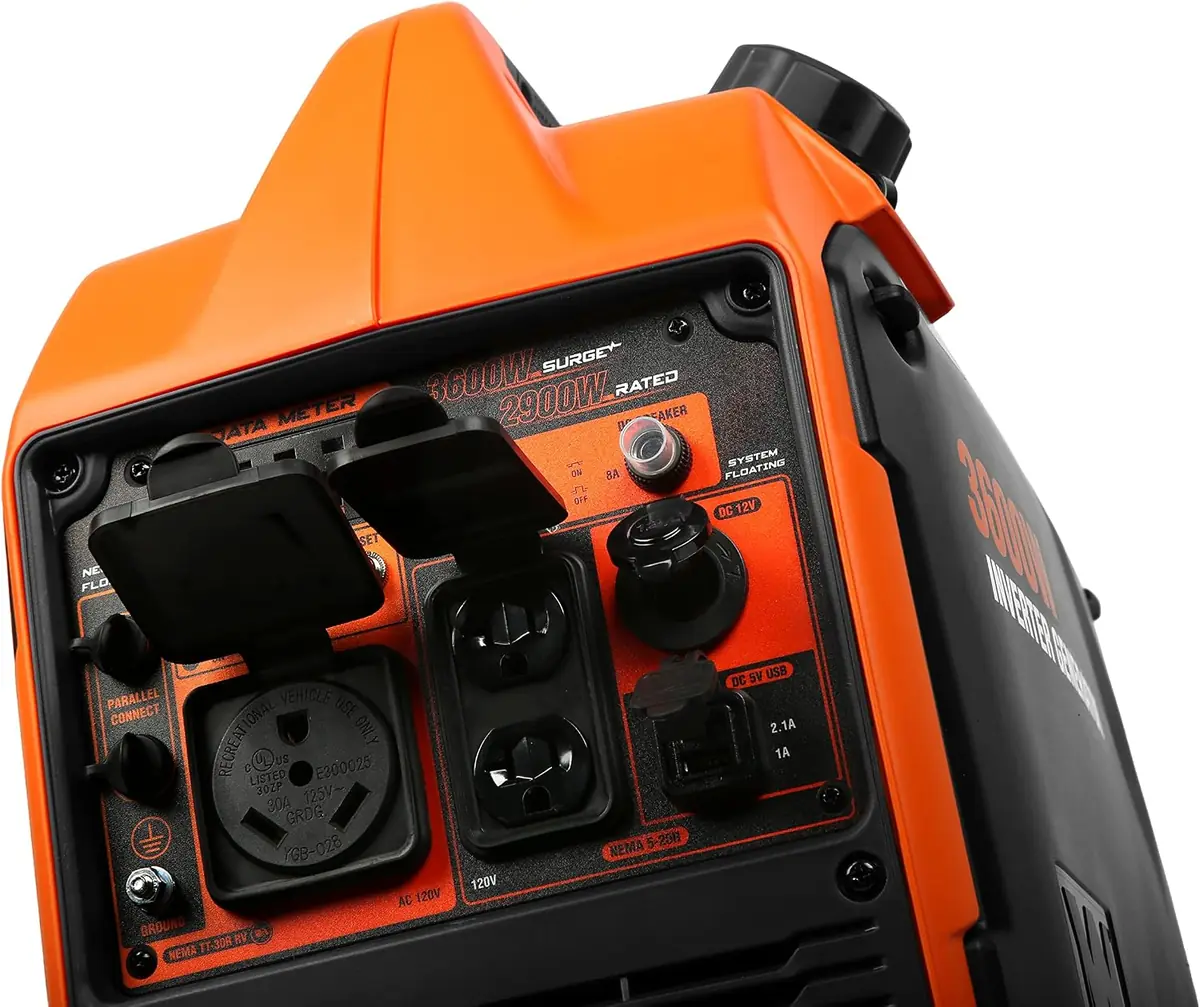
Start with the Eco switch off, the 4-in-1 switch on CHOKE, and nothing plugged in. Let it run several minutes before you add loads.
This model has no carbon monoxide sensor, and WEN sells a separate version with one. Place it at least 20 ft from the trailer and its windows, the distance the CPSC gives for a house, with the exhaust pointing away; a fan or an open window does not make an enclosed space safe.
For a long run to the camp, WEN’s cord table gives #8 wire up to 150 ft at 25 A, so I pick the cord by the load and the distance. The manual wants a 20 to 30 minute run every month. The warranty runs 3 years or 500 hours, whichever comes first, and the unit ships without oil.
A camping trailer or a small RV on a 30 A cord is the job for it. Skip it for a tent weekend, which needs far less, for a 240 V pump, or if you want a sound figure with a distance. WEN gives 65 dB at a quarter load and no distance.
FINAL VERDICT
The 56360i fits a camping trailer that a small inverter cannot run, with a 30 A outlet and 2,900 running watts. Pick it when the rig needs that outlet, and give the placement rule the care a missing CO sensor demands.
It is the mid-size inverter for a trailer on a 30 amp cord.
7. Champion 201317 2,500-Watt Ultralight Inverter Generator Best for Tent Camping
Champion gives the 201317 a sound figure with a distance, and that matters at a tent site: 53 dBA from 23 feet, according to Champion, with the load not stated. It weighs 39.7 lb, carries a CO Shield shutoff and lists 1,850 running watts. It is the best generator for tent camping on this page for a camper who wants a small unit with a carbon monoxide shutoff and three years of warranty.
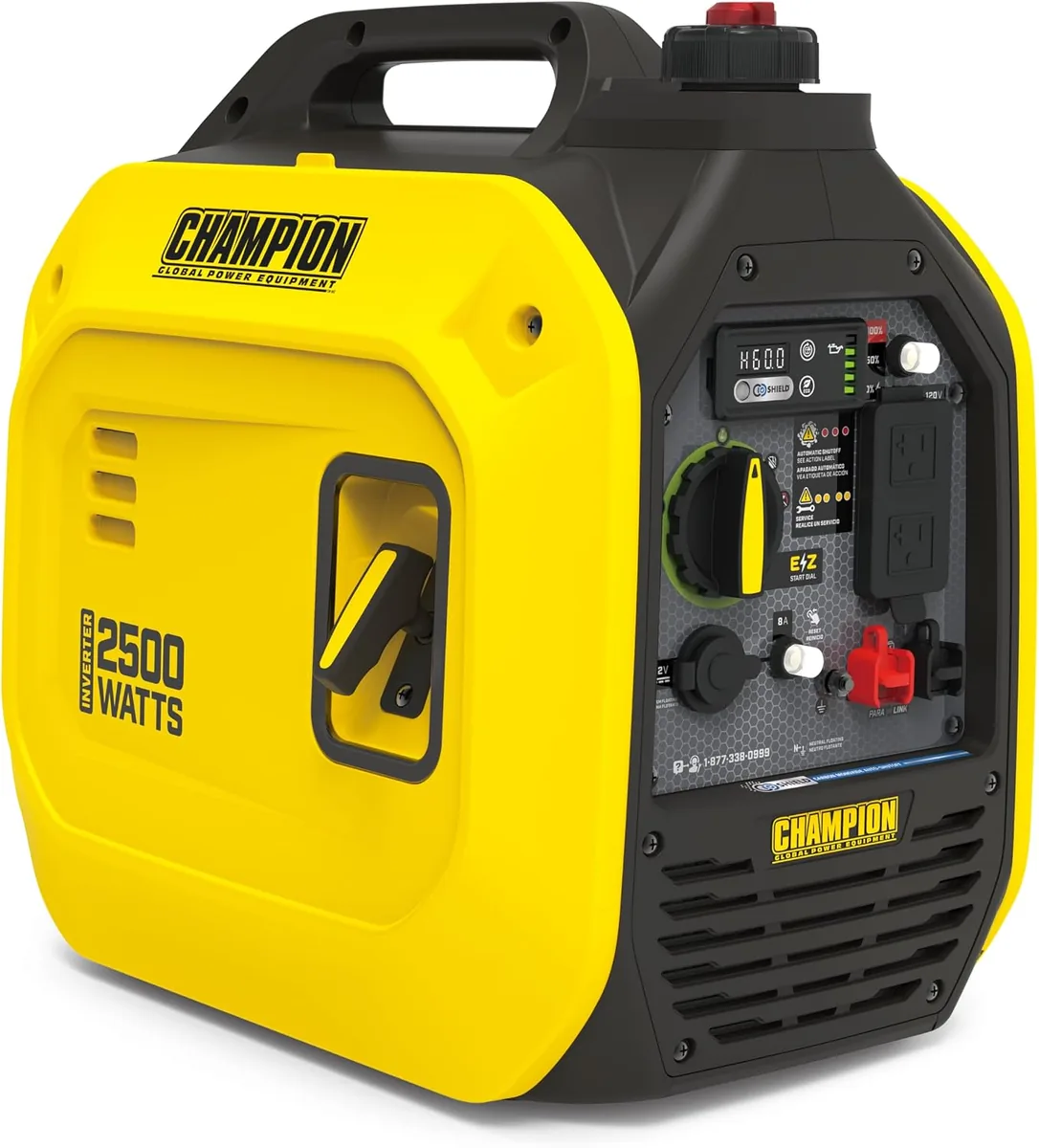
WHY I CHOSE THIS ✓
A noise figure with a distance is rare on a small unit, and 53 dBA at 23 ft tells a camper more than a bare decibel number does. The CO Shield adds a second layer of protection, and the 20 ft rule stays. Champion does not state the load behind the figure, so I read it as a guide for this unit.
Champion 201317 2,500-Watt Ultralight Inverter Generator Specs
Key Features:
- CO Shield: A sensor shuts the engine off when it detects unsafe carbon monoxide, and tampering with it voids the warranty.
- Eco Mode: The engine idles when no load is connected and speeds up when you plug something in.
- Intelligauge panel: It shows output power, session run time and total run time, so you read the load on the panel.
- 12 V outlet: An 8 A DC port sits next to the 120 V duplex socket and charges a vented lead-acid battery.
- Parallel ready: Champion’s optional kit links a second compatible Champion for more output.
The 1,850 running watts cover a camp fridge, string lights and a laptop on one 120 V circuit, and the single duplex socket forces an honest load list. The 12 V port charges a vented lead-acid battery only, and the manual says never to start a vehicle while connected. I plug phone chargers into a small adapter, since the unit has no USB port. I set this model against the Honda EU2200i in my Champion versus Honda generator comparison.
The EZ Start dial runs RUN, CHOKE, FUEL OFF and STOP. On a cool morning I set CHOKE, pull slowly to resistance and then fast, and move to RUN as the engine warms. The manual asks for three to five minutes of running before a load goes on. Champion quotes up to 11.5 hours at 25 percent load on the 1.05 gal tank and gives no figure for a heavier load.
After a CO Shield shutoff, move the unit into open outdoor air.
CO Shield is a backup, and the manual says in capitals that it is no substitute for an indoor CO alarm or for outdoor operation. Run it outdoors, 20 ft from the tent, the CPSC distance for a house, never in a truck bed, under a stairwell or beside a wall, and never covered by a tent.
The CO Shield can trip when another engine’s exhaust points at it, and a bad spot keeps shutting it off. When the tractor idled nearby, mine stopped, and moving it clear fixed that. For storage past 30 days, Champion asks for stabilizer made for ethanol blends, a ten minute run, then fuel off until it runs to starvation.
Tent camping, tailgating or a small trailer suits it when a quiet figure with a distance and a CO shutoff matter. Skip it for a 30 A RV outlet, a 240 V load or a propane option. It runs on gasoline only, and Champion gives no run time above a quarter load.
FINAL VERDICT
The 201317 suits a tent camper who reads sound figures and wants a shutoff on the engine. Choose it when the camp runs on a fridge, lights and a laptop.
It is the compact Champion I set far from the tent.
8. Champion 201050 4,000-Watt Dual Fuel Inverter Generator Best Dual Fuel
A 20 lb propane cylinder is what makes the 201050 a long-stay camp unit. Champion quotes up to 25 hours at 25 percent load on one cylinder, and up to 10 hours on its 1.54 gal gasoline tank, with a TT-30R RV outlet and an LPG hose in the box. It is the best dual fuel inverter generator for camping on this page for a big trailer or a base camp, and at 51.8 lb dry it is too heavy for a tent site.

WHY I CHOSE THIS ✓
It asks for more room and more weight than a tent camp has. For a trailer on a 30 A cord and a long stay, a propane cylinder does what a gasoline can cannot. A camper with a smaller rig should pass it by.
Champion 201050 4,000-Watt Dual Fuel Inverter Generator Specs
Key Features:
- Dual fuel: Gasoline or propane runs it, and the gasoline start needs the LPG hose disconnected.
- TT-30R outlet: A 25 A RV socket joins a 20 A duplex and an 8 A 12 V port, so a trailer cord plugs straight in.
- CO Shield: The engine shuts off when it detects unsafe carbon monoxide, and tampering with the module voids the warranty.
- EZ Start dial: One dial sets OFF, RUN and CHOKE, and a cold start follows the manual’s choke step.
- Parallel ready: Champion’s kits link two compatible units for more output.
Propane trims the watts. Running power drops about 10 percent, from 3,000 W on gasoline to 2,700 W on propane, while the starting figure stays at 4,000 W. I size a camp load for 2,700 W, so a trailer’s fridge, lights and a fan sit comfortably. The manual says to start with no load and add the largest load first. I cover this 4,000-watt dual-fuel inverter in my review of the Champion 201050.
Cold air is the weak point of propane. Champion’s manual warns that ice on the cylinder valve, the hose or the regulator weakens the flow, and it advises swapping to a fresh cylinder. On a frosty morning I look for ice on the valve and hose before I blame the engine.
The manual wants an upright OPD-valve cylinder at ground level, never in the path of the muffler exhaust.
Run it outdoors on a flat, level surface, with 3 ft of clearance on every side and 5 ft from anything that burns. CO Shield is no replacement for a battery CO alarm or for distance, so keep the unit 20 ft from the trailer, the CPSC figure for a house, and point the exhaust away.
Break-in takes the first 5 hours at or below 1,500 W, and then the oil gets changed. Oil is 0.5 qt of 10W-30. The recoil pull is the only start, and the manual warns that rapid cord retraction can hurt a hand or an arm, so I take the cord slowly at first and then firmly. I compare the 201050 with the iQ5200DF in my Generac versus Champion generator comparison.
It fits a camping trailer, a base camp or a long stay where propane is easy to carry and the rig uses a 30 A cord. Skip it for a tent weekend, for a 240 V load or for electric start. It has no GFCI receptacles, so a damp area needs a separate GFCI. The manual forbids use in rain or snow and allows only a fire-retardant canopy with open exhaust ventilation.
FINAL VERDICT
The 201050 is the big, long-running choice for the trailer camper. Choose it when the trailer needs 2,700 watts and you can spare the weight.
It is the dual fuel inverter for a long trailer stay.
9. BLUETTI AC180 Portable Power Station Best Electric Generator
The AC180 refills fast enough to charge between a morning errand and an afternoon trip. BLUETTI lists 0 to 80 percent in 45 minutes at 1,440 W of wall input, and 1,152 Wh of storage with 1,800 W of output. It is an electric unit with a battery and no engine, not a fuel generator, and it is the best electric generator for camping on this page for a camper who wants an app-managed base station with an expansion option.

WHY I CHOSE THIS ✓
A base station should recharge fast and stay put, and this one does the first well. The weight, the app and the ECO shutoff ask more of a camper, which is why it sits last. A camper who values the fast refill and the expansion will still like it.
BLUETTI AC180 Portable Power Station Specs
Key Features:
- 1,440 W wall input: Turbo charging fills 80 percent in 45 minutes, and the app can slow it to a quieter Standard or Silent mode.
- 500 W solar input: Panels from 12 to 60 V connect through MC4 plugs, and the box holds the station only, with no panel.
- 20 ms switchover: Pass-through charging lets it sit between the wall and a load as a small backup supply.
- USB-C 100 W and a wireless pad: Phones, a laptop and a car port run from the same unit.
- Expandable: BLUETTI sells extra battery modules that raise the capacity beyond 1,152 Wh.
The manual’s arithmetic is 1,152 Wh times 90 percent depth of discharge times 85 percent inverter efficiency, which leaves about 880 Wh at the outlet. A 40 W fridge lasts about 17 hours, the manual’s example. ECO mode cut my router off overnight, because the unit shuts AC output after a set time on a load of 10 to 30 W. I turned ECO off for small always-on loads.
The 2,700 W lift mode suits a kettle or a heater, but only resistive loads, and it switches off while the unit charges from the wall. A compressor or pump can start at two to four times its running watts and overload the unit. I keep the AC180 for lights, a fridge and electronics.

BLUETTI says charging power falls as the cells warm or fill, so 45 minutes is the fast part of the curve.
It makes no exhaust, so the carbon monoxide rules for fuel generators do not apply. Keep it dry and its vents clear, since BLUETTI gives no water rating, and expect charging to stop below 32 F. Above 86 F the maximum output falls to 1,500 W.
At about 35 lb the weight is the battery, and the manual says to use mechanical help for a long carry. I carry it with both hands from the car to the picnic table. For long storage the manual asks to power off, unplug everything and charge to 80 percent every three months.
A base camp, a van or a cabin with wall power near enough to refill it is the right home for it. Skip it for a 240 V tool, a pump or any trip where you carry the gear on foot.
FINAL VERDICT
The AC180 refills quickly and expands, and it asks for care with the ECO setting and the weight. Choose it when the camp has a wall socket nearby and a table to put it on.
It is the fast-charging base station for a camp with wall power nearby.
How to Choose the Best Generator for Camping
Six checks sort a camping generator, and the first is the sum of what you plug in. I work through them in this order, because the weight you carry and the noise you live with both follow from the watts you need. The best portable generator for camping is the one that passes all six.
Running Watts for Camp Loads
Running watts are what a unit holds for hours, and starting watts are a short peak for a motor. Add the running watts of everything that must run together, then add the extra start-up watts of the largest motor. The best inverter generator for camping is the smallest one that clears that sum, because every extra watt is weight you carry and fuel you burn.
| Load | Running watts | Starting watts |
|---|---|---|
| Refrigerator or freezer | 800 | 1,200 |
| Window air conditioner | 1,200 | 1,800 |
| Microwave | 1,000 | Not listed |
Other makers print different charts, and the nameplate on your own gear settles the number. I write the load list on paper before I look at a single spec sheet.
- Tent weekend: lights, chargers and a cooler-sized fridge sit well inside the 1,800 to 1,900 running watts of the small inverters here.
- Trailer on a 30 A cord: a TT-30R or twist-lock socket, which three of the fuel units here carry, with 2,700 to 3,000 running watts on the two larger ones.
- Battery units: the three stations here give 800 to 1,800 watts of continuous output, and the stored watt-hours set how long they run.
Pro Tip
Start the largest motor first, then add small loads one at a time. Several manuals give this order.
Weight and the Carry From Car to Site
Makers state weight on different bases, dry, with fuel or unit alone, and the basis is not always given. On the makers’ figures the fuel inverter generators here run from 39 to 51.8 lb, and the three battery units run from about 17 to about 35 lb. The best small generator for camping is one you lift without help, so I lift a unit twice before I trust its weight figure.
A wheel kit or a telescoping handle helps on a campsite path, though neither climbs steps, so the carry from the car to the site still decides the weight you can accept. The best small quiet generator for camping adds a sound figure with a distance to that low weight.
Fuel, Tank Size and Run Time
Gasoline is easy to buy and goes stale in a carburetor, so manuals ask for fresh fuel and a drained carburetor before storage. A dual fuel generator lets you carry a propane cylinder instead of a fuel can, and the best propane generator for camping ships with its hose in the box. A battery unit needs no fuel and stops when the cells are empty.
| Source | Exhaust | What you carry | Care between trips |
|---|---|---|---|
| Gasoline | Yes, outdoors only | A fuel can | Fresh fuel, drained carburetor |
| Propane | Yes, outdoors only | An upright cylinder and a hose | Leak check at the joints, valve closed |
| Battery | None | Cables and, for solar, panels | Partial charge, cool and dry |
Run time depends on the load. One maker lists 3.2 hours at rated load and 8.1 hours at a quarter load on the same tank, so the box figure is the light-load one. The best gas generator for camping has a tank that matches the load you will actually run.
Outlets for Tents, Trailers and Cars
Read the plug on your gear before you read the generator. A 120 V unit cannot run a 240 V tool, and none of the nine here gives 240 V. Match the socket to the cord you own. If you need a unit for home backup as well as camping, I compare broader options in my roundup of the best generator picks.
- 20 A duplex sockets: ordinary household plugs, chargers and a camp fridge.
- 30 A RV socket: the best generator for RV camping needs one that matches the rig’s cord, or an adapter that ships in the box.
- 12 V port and USB: camp lights and phones without an adapter, on the units that carry them.
Carbon Monoxide, Shutoff and Placement
Carbon monoxide is the hazard that kills, and it has no color or smell. The CPSC says to run a portable generator outside only, at least 20 feet from the house, with the exhaust pointed away, and I keep the same distance from a tent or camper. After four hurricanes struck Florida in 2004, misplaced portable gasoline generators, indoors, in garages or outdoors near windows, caused nearly all of the CO exposures in a CDC analysis (1).
After a major Maine ice storm, locating a generator in a basement or an attached structure such as a garage was the strongest risk factor for poisoning (2). Alarms matter as much as distance: after a 2002 ice storm in North Carolina, 96.2 percent of the severe poisonings occurred in homes with no reported working CO alarm (3). A battery CO alarm belongs in the camper or cabin where you sleep.
- A built-in CO shutoff is a backup that never justifies a closer spot, and four of the six fuel units here carry one.
- Never run a fuel generator in a tent, camper, vehicle, garage or any partly enclosed space, even with doors and windows open.
- Move it clear if a shutoff trips, because another engine’s exhaust can set it off.
Safety Warning
A fuel generator runs outdoors only, never inside a tent, camper or vehicle, even with the doors and windows open.
Rain, Cords and Refuelling
OSHA says to keep a generator dry and, if needed, to protect it with a canopy, and the maker’s manual says which cover it allows. Run a grounded, undamaged, outdoor-rated cord straight from the unit to the gear, and let the manual’s cord chart set the length. Refuel only with the engine off and cool, outdoors, and keep the fuel can away from the unit. On a dry camping trip with no hookups you refuel more often, so the best generator for dry camping is also the one that is easy to refuel safely.
Campground Quiet Hours and Generator Noise
Campgrounds and parks set their own generator hours and noise limits, so I read the rules before I book and run the unit only in the hours they allow. A decibel figure means little without its distance and load. The best quiet generator for camping is the one whose maker states both, and few do.
| Unit | Maker’s figure | Distance and load |
|---|---|---|
| Champion 201317 | 53 dBA | 23 ft, load not stated |
| Champion 201050 | 64 dB(A) | 23 ft, load not stated |
| Honda EU2200i | 57 and 48 dB(A) | Rated load and 1/4 load, distance not stated |
| WEN 56235i | 51 dB | 1/4 load, distance not stated |
| WEN 56360i | 65 dB | 1/4 load, distance not stated |
| A-iPower SUA2301iD | 62 dBA | Distance and load not stated |
| EcoFlow RIVER 2 Pro | Up to 62 dB | High wattage, distance not stated |
| Anker SOLIX C1000 | 50 to 60 dB | Full load, distance not stated |
| BLUETTI AC180 | Not published | Not published |
I read each row on its own terms and never rank across brands, because the figures use different loads and distances. In a field test of lawn equipment, the combined sound fell from 102.4 dB(A) at the machines to 57.3 dB(A) at 800 ft, and from 50 ft out to 800 ft the unweighted level stayed 11 to 12 dB higher, which shows that low-frequency sound carries (4). Distance helps more than any quiet label, so I place the unit as far from the tents as the cord allows.
Gas Generator or Battery Station for Camping
A battery station makes no exhaust and no engine note, so it suits a tent pitched beside the power source, and the best solar powered generator for camping starts from a portable power station like this one. A fuel generator runs as long as the tank holds out, and a station runs until the cells are empty. Neither replaces the other at the same size, and the choice follows your loads and your nights.
The best battery generator for camping is a station sized to your watt-hours. EcoFlow’s RIVER 2 Pro stores 768 Wh. If I allow roughly 15 percent for inverter losses, an estimate and not a maker rating, about 650 Wh reach the outlet, so a fridge that averages 100 W could run about 6.5 hours. The best electric generator for camping is the one whose output covers your largest load, and a kettle or heater needs far more than a small station gives.
Sun can refill a station, though not on a schedule. Anker’s table lists 6.1 hours with two 100 W panels, and every maker’s solar hours assume ideal light. The best portable solar generator for camping is the one you can carry and still lay panels beside.
A hot car or a frosty night also matters, and BLUETTI cuts the AC180’s maximum output to 1,500 W above 86 F: lithium-ion batteries lose lifespan above 40 C and fade at low temperatures (5), and a lithium iron phosphate cell ages faster when it is warm and stored full (6). I keep a station cool and dry between trips and follow the storage schedule in its own manual, because Anker, BLUETTI and EcoFlow each ask for a different charge level.
My Overall Verdict
I ranked these nine by what a camp needs: light weight, running watts that cover the loads, a stated noise figure and a safe way to place the unit. The top three suit three different campers.

1. WEN 56235i 2,350-Watt Inverter Generator Best Overall
For tent and car campers who want one person to carry it and 1,900 running watts for lights, a fridge and chargers.

2. Honda EU2200i 2,200-Watt Inverter Generator Best Premium
For a camper who wants a built-in CO shutoff in a light frame and a quarter-load sound figure from Honda.

3. A-iPower SUA2301iD 2,300-Watt Dual Fuel Inverter Generator Best Value
For a budget camper who wants propane, a CO sensor and an RV adapter in the box.
Add up the running watts of what you plug in, check the weight you will carry and read the sound figure with its distance. Then place the unit 20 feet from where anyone sleeps and keep a battery CO alarm in the camper or cabin. The best generator for camping is the one that passes all four checks. If the same unit must also power household loads, I compare options in my picks for a generator for home backup.
Why WEN 56235i 2,350-Watt Inverter Generator Might Be the Best Choice
I put the WEN 56235i 2,350-Watt Inverter Generator first because a camp generator is carried more often than it runs. At 39 lb it goes from the car to the site in one hand, and 1,900 running watts is more than lights, chargers and a fridge ask for.
The trade is the missing CO shutoff. I stand it 20 feet from the tents with the exhaust pointed away and keep a battery CO alarm where I sleep. I cover this 39 lb camping inverter in my review of the WEN 56235i.
What puts it first:
✓ Weight: 39 lb per the manual, light enough to carry alone.
✓ Output: 1,900 running watts and 2,350 starting watts.
✓ Eco mode: engine speed follows the load below 1,000 W.
✓ Outlets: two 120 V sockets, a 12 V port and USB.
✓ Warranty: 2 years limited for home use.
Frequently Asked Questions
What’s the best generator to buy for a camper?
The best generator to buy for a camper is a small inverter generator or a battery station whose running watts cover your loads, and my pick on this page is the WEN 56235i. A trailer on a 30 A cord needs a larger inverter with an RV socket, and a tent camper can pick a lighter unit.
What can a 3.5 kW generator run?
A 3.5 kW generator runs the loads whose running watts add up to less than its rating, and the start-up peak of the largest motor must fit too. One maker’s chart lists a refrigerator at 800 running watts and a window air conditioner at 1,200, so both fit easily within that rating.
Which is better for camping, an inverter or a generator?
An inverter generator is better for camping than an open-frame generator for most trips, because it is lighter, runs quieter at light load and gives cleaner power. An open-frame unit gives more watts for the money but weighs much more, and all six fuel units on this page are inverters.
What are the different types of generators?
The different types of generators are open-frame portables, inverter generators, dual fuel and tri-fuel units, battery power stations and standby units that a licensed electrician installs. Camping calls for the light end of that list: an inverter generator, a dual fuel inverter or a battery station, depending on your loads.
What generator is best for camping?
The generator best for camping is a light inverter unit whose running watts cover your camp loads, with a sound figure that has a distance and a CO shutoff where you can get one. A battery station fits a tent that needs quiet and no fumes at night, and a dual fuel inverter suits a long trailer stay.
References
- Centers for Disease Control and Prevention. Carbon monoxide poisoning from hurricane-associated use of portable generators – Florida, 2004. JAMA. 2005;294(12):1482. doi:10.1001/jama.294.12.1482
- Daley WR, Smith A, Paz-Argandona E, Malilay J, McGeehin M. An outbreak of carbon monoxide poisoning after a major ice storm in Maine. J Emerg Med. 2000;18(1):87-93. doi:10.1016/S0736-4679(99)00184-5
- Centers for Disease Control and Prevention. Use of carbon monoxide alarms to prevent poisonings during a power outage – North Carolina, December 2002. JAMA. 2004;291(14):1691. doi:10.1001/jama.291.14.1691
- Walker E, Banks JL. Characteristics of Lawn and Garden Equipment Sound: A Community Pilot Study. J Environ Toxicol Stud. 2017;1(1).
- Lyu P, Liu X, Qu J, Zhao J, Huo Y, Qu Z, Rao Z. Recent advances of thermal safety of lithium ion battery for energy storage. Energy Storage Mater. 2020;31:195-220. doi:10.1016/j.ensm.2020.06.042
- Schimpe M, von Kuepach ME, Naumann M, et al. Comprehensive modeling of temperature-dependent degradation mechanisms in lithium iron phosphate batteries. J Electrochem Soc. 2018;165(2):A181-A193. doi:10.1149/2.1181714jes
Safety Note: Generator exhaust contains carbon monoxide, which can kill in minutes. Run a fuel generator outdoors only, never in a home, garage, basement, shed or other enclosed or partly enclosed space, even with doors or windows open. The CPSC says to place it at least 20 feet from your home and other buildings, with the exhaust pointed away from doors, windows and vents. Install battery-operated or battery-backup carbon monoxide alarms on every level of the home and outside sleeping areas. Never plug a generator into a wall outlet: connect it to a house only through a transfer switch or interlock installed by a licensed electrician. Refuel only with the engine off and cool, and read the manufacturer’s manual, including for a portable power station.