

The best gas snow blower is a two-stage machine whose intake and engine match your deepest, wettest snow. I clear a long farm lane, a concrete pad and the paths between my sheds, and I have worked gas machines on that ground.
I rank five two-stage models, led by the Ariens Deluxe 28 SHO (921048) Two-Stage Gas Snow Blower, and each review says who should buy it and who should skip it. After the reviews I show how to match width, drive, starting and fuel to your own drive.
Best Gas Snow Blower Reviews 2026: 5 Top Two-Stage Models for Heavy Snow
These are the best gas powered snow blower models I recommend for heavy snow. Every one is a two-stage machine with electric start, and the clearing widths run from 24 in to 31.9 in.
1. Ariens Deluxe 28 SHO (921048) Two-Stage Gas Snow Blower Best Overall
The Ariens Deluxe 28 SHO (921048) Two-Stage Gas Snow Blower is the gas two-stage I recommend first to anyone with a long drive and a mixed surface, because it balances a 28 in bucket, a 306 cc engine and a 21 in intake without the cost of a tracked machine. That balance earns it Best Overall on this page. Its manual even gives a gravel set-up, so it suits a lane that is half stone and half pavement.

WHY I CHOSE THIS ✓
I put the Ariens first because it does the heavy jobs without a tracked, premium price. The 28 in bucket cuts the passes on a long lane, the 306 cc engine carries wet snow, and Ariens backs the machine for 3 years at home and the gearcase for 5. It is the one I match to a lane that wanders between gravel and pavement.
Ariens Deluxe 28 SHO (921048) Two-Stage Gas Snow Blower Specs
Key Features:
- 306 cc Ariens AX engine: Ariens rates its gross torque at 15.0 lb-ft, which is the twist the 14 in steel auger leans on when the snow is packed.
- 120 V electric start: You press a button after a cold night, using a grounded, outdoor-rated cord of 13 amps or more, and a recoil handle covers the day the cord is not out.
- Auto-Turn steering: The axle locks on a straight pass and frees in a turn, so a heavy frame comes round without a wrestling match.
- Six forward and two reverse speeds: You crawl through deep snow, speed up over a thin stretch and back out of a corner without stopping the engine.
- 200 degree chute with an in-dash deflector: You aim the throw and set its height from the operator’s position.
- Gravel set-up in the manual: Two 7/8 in spacers under the scraper ends and skid shoes lowered to touch lift the scraper above the stones.
- Shear bolts and a clean-out tool: Two shear bolts protect the auger, two spares come in the box, and the clearing tool clips to the auger housing.
What I noticed first was the bend where my lane meets the yard. Auto-Turn frees the axle in a turn, so the 267.5 lb frame came round with a light push on the handles instead of a fight against a locked wheel, and on a straight pass the axle locks and the machine holds its line. Wet snow near freezing is the snow I judge by, and the 306 cc engine kept the 14 in auger turning through it. According to Ariens, the chute throws up to 55 ft in the best case, and wet snow and wind both cut that.
The tank holds 3.2 qt and Ariens publishes no run time per tank, so on a long lane I plan a refill stop and do not count on a set run time. Fuel is fresh unleaded of 87 octane or higher with no more than 10 percent ethanol, because Ariens voids the warranty above that. I add stabilizer to every can, then run the engine outdoors for the five minutes Ariens asks for, so the treated fuel reaches the carburetor.
The soft edge of my lane, where grass creeps into the gravel, is the part that tests the auger. A frozen clod there once broke a shear bolt, which is the design working: with the engine off and the key in my pocket I fitted one of the two spares from the box, and only an Ariens bolt goes in. For the stone itself, Ariens gives a set-up of two 7/8 in spacers under the scraper ends, then the skid shoes lowered until they touch, so the scraper rides above the stones. A thin layer of packed snow stays behind, and the same manual says to use extreme caution on gravel, so I clear boards, toys and loose stones first and keep people and windows out of the throw.
On a hard-frost morning, run the manual’s frozen-impeller check before you plug in the cord: key off, engage the attachment clutch and pull the recoil handle. If the handle will not pull, the impeller is frozen, so roll the machine somewhere warm until it thaws.
Run it outdoors only, never in the shed with the door open, because the exhaust carries carbon monoxide, and put hearing protection on before the first pull, as the decal on the machine tells you.
This listing sells the 921048, the generation Ariens has since replaced with a newer Deluxe 28 SHO that carries other figures, so match the number on your machine to its manual before you order parts. Each season, or every 25 hours, the manual calls for lubrication, a tire pressure check and a look at the gearcase oil, and the engine oil grade sits in the separate engine manual. At 267.5 lb it needs real floor space in the shed, and heated grips cost extra.
Buy it for a long drive or lane, a gate where a plow leaves a ridge, a mix of gravel and hard surface, or wet snow too deep for a single-stage. Skip it for a short paved drive that sees an inch of powder, for a shed with no floor space for 267.5 lb, or if you want a quiet machine with no fuel to manage. Check the seller, the delivery terms and the return policy on the listing before you order something this heavy.
FINAL VERDICT
Choose the Deluxe 28 SHO when a long, mixed-surface drive and wet snow have outgrown a shovel or a small machine and you want gas power without paying for tracks. The 28 in bucket and 306 cc engine do the heavy work, and the manual’s gravel set-up covers a stone lane. Pass if your drive is short.
It is the wheeled gas machine I recommend first for a lane that mixes gravel and pavement.
2. Honda HSS1332AATD Track Drive Two-Stage Gas Snow Blower Best Premium
The Honda HSS1332AATD Track Drive Two-Stage Gas Snow Blower is built for a wide, long, hard-surfaced drive: a 31.9 in bucket, a 389 cc Honda GX390 engine and rubber tracks that hold a line in settled snow. Everything on it is aimed at cutting passes on a big job, from the 21.7 in intake to the remote chute joystick. It is not a machine for gravel, and Honda’s manual says so.

WHY I CHOSE THIS ✓
I rank the Honda second because everything on it is sized for the large job. The 31.9 in bucket, the torque sensor and the tracks are what a premium price should buy, and Honda covers it for 3 years at home. I recommend it to a buyer who has the drive, the shed door and the budget.
Honda HSS1332AATD Track Drive Two-Stage Gas Snow Blower Specs
Key Features:
- 31.9 in clearing width: One pass clears a path wide enough to cut the trips down a long drive.
- Torque sensor and shear bolts: On an overload the sensor shuts off the auger and the engine and lights a red auger-lock indicator, and the shear bolts stay as a second guard.
- Hydrostatic drive: One lever sets any speed forward or in reverse, and ground speed does not change auger speed.
- Rubber tracks with steering clutches: Honda describes them as made for inclines and icy ground, within the manual’s limit of 20 degrees.
- Thumb-lever auger height: Three marked zones let you lower the housing for hard snow, use the middle for normal work and raise it for deep snow.
- Remote electric chute joystick: You turn the chute through 198 degrees and tilt the deflector from the handles, with an LED work light for early starts.
- Hour meter: It shows total engine time in tenths of an hour, so the first oil change and the 100 hour service are easy to track.
The job that showed me the machine was a deep drift packed hard along the hedgerow. I raised the auger with the thumb lever for the first pass and dropped to the middle zone for the base, taking it in layers, top first, as Honda advises for snow deeper than the auger. When I pushed too fast into the hard crust, the engine stopped and a red light blinked on the panel, which is the torque sensor doing its work. I stopped the engine, waited for the auger to stop, pulled the spark plug cap and cleared the crust with the clearing bar before I restarted, and Honda puts the best-case throw at up to 56 ft.
Starting has a routine that Honda’s manual spells out: shift lever in neutral, fuel valve on, choke closed in cold weather, throttle on fast, then let the engine warm for several minutes. Then squeeze the drive clutch lever in neutral for about 30 seconds to warm the transmission. The electric starter runs from the machine’s own battery, so no cord is involved, but it must not crank for more than 5 seconds at a time. The tank holds 1.5 gal, and Honda publishes no run time per tank.
The 32.9 in overall width was a squeeze through my shed door, so I measure the opening before I roll it out and park it with room to turn. I keep it off the crushed-stone yard, because Honda’s manual says never to use the machine to clear a gravel road or driveway, and I shovel the stone section by hand. Pulling both steering levers frees the machine to roll by hand, though the levers only cut power to the tracks and do not act as a brake, so I never trust them on a slope.

When the snow is hard or deep, slow the ground speed with the hydrostatic lever and leave the engine on fast. Honda’s manual says the engine speed stays up for best performance.
Clear a clog in Honda’s order: stop the engine, wait until every rotating part has stopped, pull the spark plug cap, then use the snow clearing bar, never a hand, because an obstructed auger can move suddenly. The engine runs outdoors only, since the exhaust carries carbon monoxide.
Honda calls for the first oil change at the first month or 20 hours and then every 100 hours, with SAE 5W-30, and I use the hour meter to keep that count. Fuel is unleaded of 86 octane or higher with no more than 10 percent ethanol, and it can go bad in as little as 30 days, so I keep stabilizer in the can. Valve clearance, belts and cables are dealer jobs. At 298 lb the machine needs a ramp and a loading plan.
It fits a wide or long hard-surfaced drive, a plow ridge you want gone in fewer passes, or an icy slope within the manual’s 20 degree limit. It is my pick for a large driveway. Skip it for any gravel or dirt drive, a narrow gate or shed, a small paved drive with light snow, or a tight budget, and think about who will load 298 lb. Check the seller and the delivery terms on the listing before you order.
FINAL VERDICT
Choose the HSS1332 AATD when your drive is large and paved, your shed door is wide enough and the premium price is no obstacle. The wide bucket, the torque sensor and the tracks are built for that job. Pass if any part of your drive is gravel.
It is the track-drive gas machine I pick for a wide paved drive.
3. PowerSmart 24-Inch 212cc Two-Stage Gas Snow Blower Best Value
The PowerSmart 24-Inch 212cc Two-Stage Gas Snow Blower is the cheapest way onto this page into a two-stage gas machine with electric start: a 24 in path, a 212 cc engine and 6 forward and 2 reverse speeds. It suits a mid-length drive or farm road, and it is the plainest machine here on controls, so I judge it by its price and its gears.
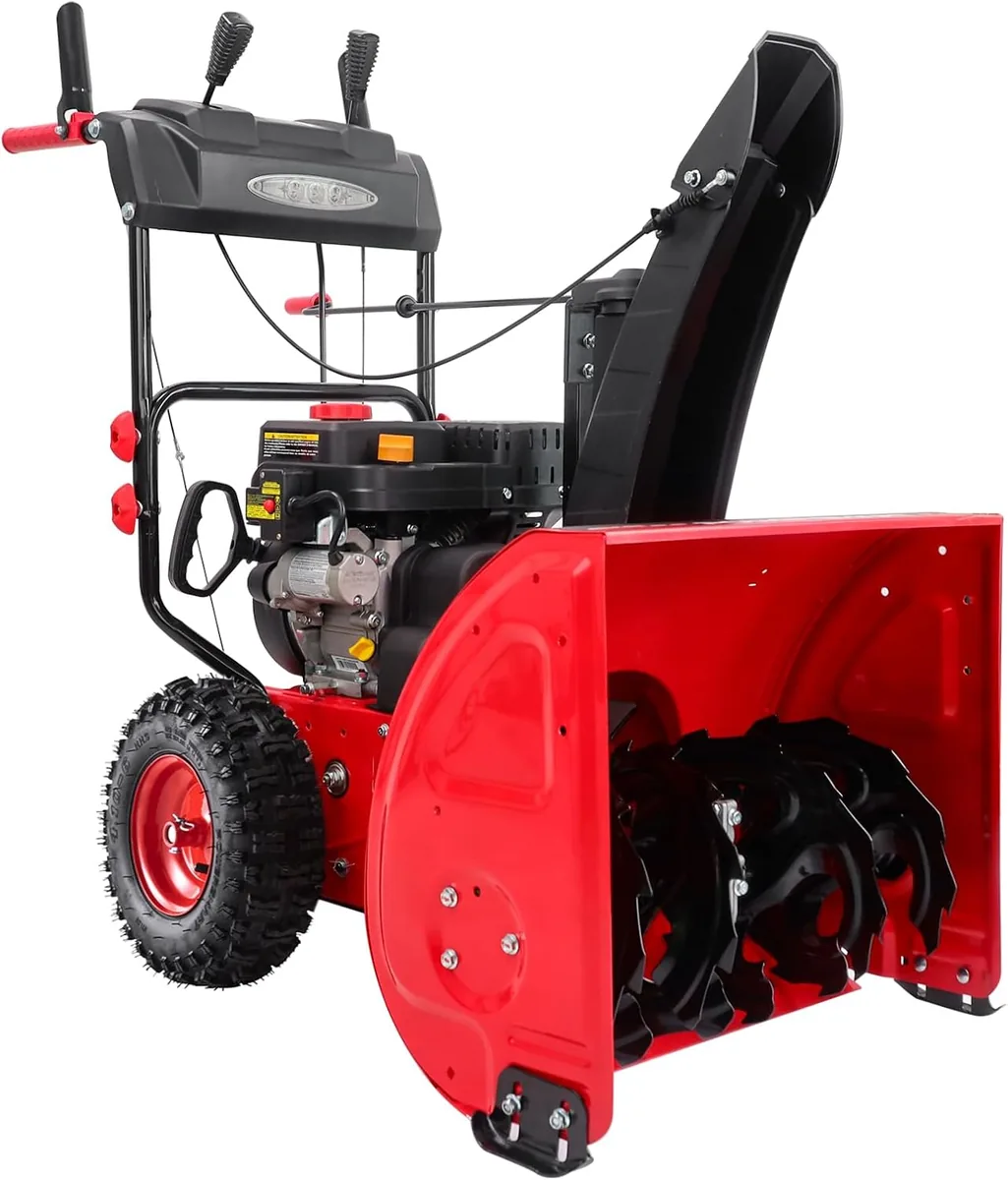
WHY I CHOSE THIS ✓
I picked it as the best gas snow blower for the money here because it gives a two-stage gas machine with electric start at the lowest price on the page. The six forward gears cover the depth from a dusting to a heavy fall, the clean-out tool and spare pins come in the box, and PowerSmart covers it for 2 years at home. Its limits are real: no power steering, no heated grips and a plastic chute.
PowerSmart 24-Inch 212cc Two-Stage Gas Snow Blower Specs
Key Features:
- 212 cc engine with electric start: You prime three times, plug in the cord and hold the button for 2 to 3 seconds, and a recoil handle is there as backup.
- Six forward and two reverse speeds: A slow gear for deep snow, a faster one for a thin stretch, and two reverse gears for backing out of a corner.
- 24 in path with a steel auger and impeller: The two-stage layout takes snow the manual rates up to the 21 in intake, and deeper snow goes in narrower, overlapping layers.
- 180 degree chute with crank and deflector lever: You aim the stream and set its height without leaving the handles.
- Skid shoe and shave plate settings for gravel: The manual has you lower the shoes and keep the shave plate slightly above the ground, higher for larger stones.
- Clean-out tool and spare shear pins: The tool clips to the auger housing, and the pins break on purpose when the auger hits something hard.
- LED light and 13 in tires: One LED on the front panel helps with early starts, and the manual sets tire pressure at 20 to 24 psi.
Wet, heavy snow is where a small machine gets tested, and the manual is blunt about it: that snow tends to clog and stick to the augers and chute, and for snow too wet or packed there may be no complete fix. On the wet turn-around beside my machinery shed I kept the auger engaged and dropped to a low gear, and the chute stayed clear where it would have packed if I had hurried. According to PowerSmart, the machine moves up to 2,400 lb of snow a minute, a best-case figure that depends on the snow.
The first start after summer was rough on old fuel, and the fix was fresh gasoline. The manual asks for fresh lead-free fuel of 87 octane or higher, used within 30 days of purchase, with no oil mixed in, and it does not print an ethanol limit, so the engine manual is the place to check. Fuel stabilizer can go in the can, and the tank holds 0.5 gal, so a long road means a refill stop.
Engine vibration loosens hardware, and the manual asks you to check the bolts before and after every use. I walk around the machine with a wrench before the first pass and again when I put it away, which takes a few minutes and catches a loose bolt early. On a stone surface the manual has you lower the skid shoes and keep the shave plate slightly above the ground, higher for large stones, and stones can still be thrown. Shifting while the drive lever is held can damage the drive and void the warranty, so I let go of the lever first, and PowerSmart asks for an annual dealer inspection that the warranty does not cover.

Before the cord comes out, close the choke, press the primer bulb three times and put the safety key in. Wait 10 seconds between starter tries, as the manual says, so the starter does not overheat.
Run it outdoors only, because the exhaust carries carbon monoxide, and keep people and pets at least 75 ft away while the engine is running. Never put a hand in the chute: clear a jam with the engine stopped, the safety key out and every moving part at rest.
PowerSmart sells near-identical 24 in machines, so match the model number on your machine to its manual before you order parts. It is heavy for its class at 187 lb on the manual figure, so a slope or a small shed makes it harder to live with. Hearing protection stays on while it runs, because a gas engine this size is loud.
Pick it for a mid-length drive or farm road, household snow that runs from light to heavy, and a budget that rules out the premium machines. Skip it if you want power steering or heated grips, if you have a steep slope, or if your shed is small. Check the seller, the delivery terms and the return policy on the listing before you order a machine this heavy.
FINAL VERDICT
Choose the PowerSmart when you want a two-stage gas machine with electric start for a mid-length drive and the price matters most. It is the plainest machine on this page, and it earns its place on gears and cost. Pass if you need steering assist, heated grips or a long track record.
It is the entry-price gas two-stage for a mid-length drive.
4. Honda HSS928AATD Track Drive Two-Stage Gas Snow Blower Best for Seniors
The Honda HSS928AATD Track Drive Two-Stage Gas Snow Blower makes the starting and the controls easy. It starts from its own battery with a key, one hydrostatic lever sets any speed with no gear to find, and a joystick turns the chute. It is a 28 in, 276 lb track machine for paved drives, and it is not for gravel; my Honda HSS928 review gives my full verdict.

WHY I CHOSE THIS ✓
I gave it Best for Seniors because the starting and the controls ask for little: no cord to drag, no gears to shift and a chute that turns with a thumb. Honda gives it a 3-year residential warranty. I rate it the best gas snow blower for seniors who have paved ground and can steer a 276 lb track machine.
Honda HSS928AATD Track Drive Two-Stage Gas Snow Blower Specs
Key Features:
- Electric start from its own battery: You turn the key with no extension cord, and the battery wants a charge if it reads under 12.9 V.
- Hydrostatic drive: One lever gives any speed forward or in reverse, and ground speed does not change auger speed.
- Remote chute joystick: You turn the chute through 198 degrees and tilt the deflector from the handles.
- Rubber tracks with steering clutches: Honda made them for inclines and icy ground, within the manual’s 20 degree limit.
- Thumb-lever auger height: Three marked zones suit hard snow, normal work and deep snow.
Pulling both steering levers frees the machine to roll by hand even with the engine off, and I use that beside the machinery shed, where a 276 lb frame has to be parked in a tight spot. On the concrete pad the tracks held their line, and the hydrostatic lever let me creep through a heavy patch and speed up again without a gear change. According to Honda, it throws up to 52 ft in the best case.
The auger-height lever has a trap. If you lift the handlebar while holding the lever down, the auger drops to the ground, and Honda allows that only on a very smooth, ice-covered surface because it can damage the auger teeth. I went back to the middle zone for normal passes. Steering is the other thing to learn: on asphalt or concrete the manual says it is subtle and may need extra force.

Treat the steering levers as fully on or fully off. Honda says they cut power to the track and do not brake the machine, so on a slope plan your stop early.
Clear a clog in Honda’s order: stop the engine, wait for every rotating part to stop, pull the spark plug cap and use the snow clearing bar, never a hand. Run it outdoors only, because of carbon monoxide.
Honda says never to use this machine on a gravel road or driveway, so I keep it to the pad. It weighs 276 lb, the tank holds 1.3 gal and no run time is published. Fuel can go bad in as little as 30 days, so use stabilizer.
It suits a paved or packed drive, a buyer who wants simple starting and controls, a shed that takes 276 lb and the strength to steer it on asphalt or concrete. Skip it for any gravel or dirt drive, a tight budget, or a very large drive that wants a wider bucket.
FINAL VERDICT
Choose the HSS928 AATD when your drive is paved, your hands and back want fewer jobs and the premium price fits. Pass if any part of the drive is stone.
It is the track-drive gas machine that keeps the controls simple.
5. Husqvarna ST224 24-Inch Two-Stage Gas Snow Blower Best 24 Inch
The Husqvarna ST224 24-Inch Two-Stage Gas Snow Blower is the narrow gas two-stage with the most control for the money: a 24 in path, power steering triggers and a remote deflector lever. It is the best 24 inch gas snow blower here for turning at the end of a pass.
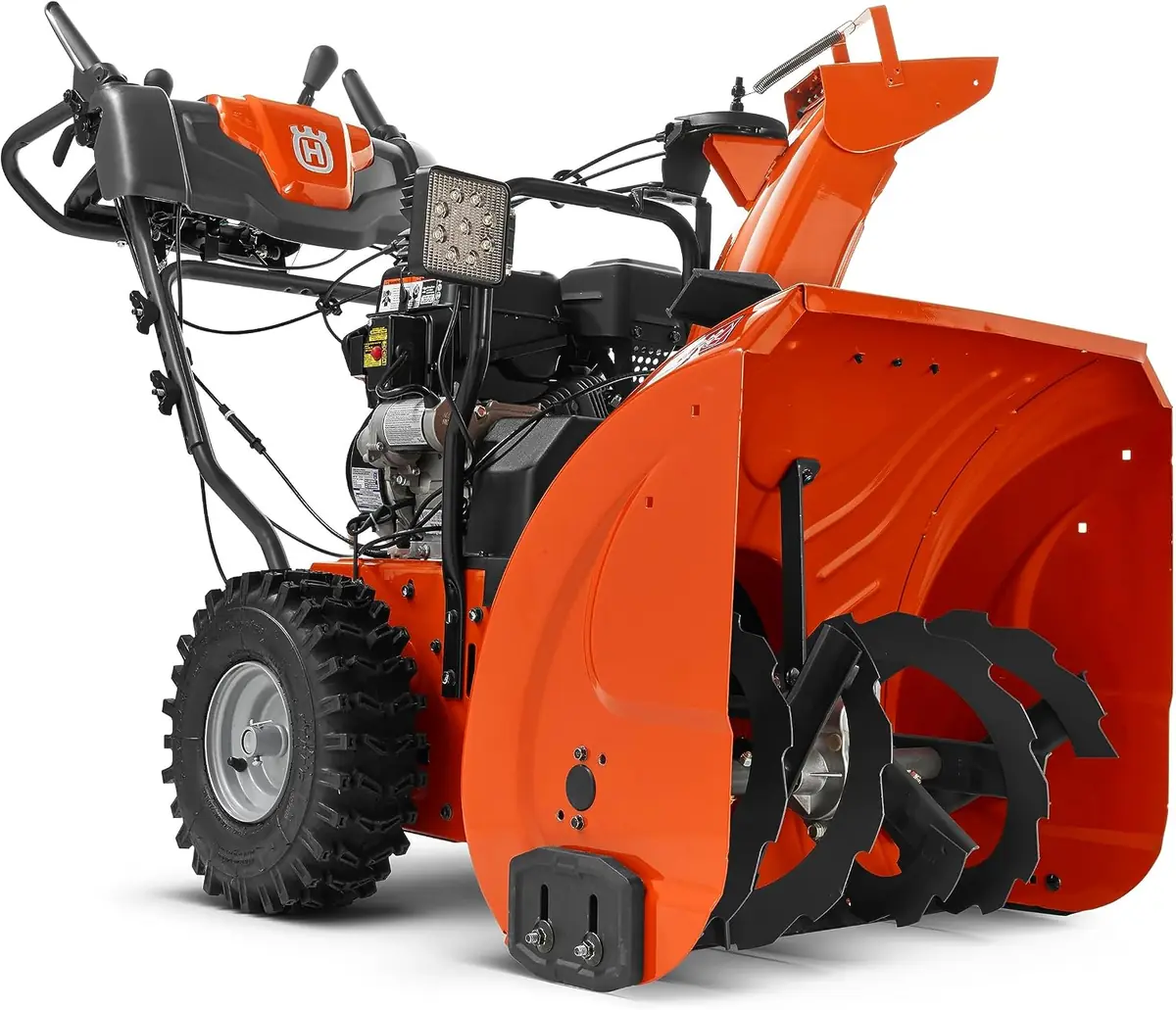
WHY I CHOSE THIS ✓
I gave it Best 24 Inch because it puts the most control into a narrow frame: power steering triggers and a remote deflector. Husqvarna rates the engine at 5.90 hp and the sound at the ear at 88.4 dB(A), which tells me what I am buying. It is the one I match to a drive that is narrow or has tight turns.
Husqvarna ST224 24-Inch Two-Stage Gas Snow Blower Specs
Key Features:
- Power steering triggers: You hold the left trigger to turn left and the right one to turn right, so the turn at the end of a pass takes less muscle.
- Remote deflector lever: Down shortens the throw and up lengthens it, so you set the distance from the handles.
- Electric start and pull rope: A button starts it from a grounded 120 V circuit, and the rope covers a day without a cord.
- Noise and power ratings: Husqvarna rates the sound at the operator’s ear at 88.4 dB(A) and the engine at 5.90 hp.
- Six forward speeds and one reverse: You set ground speed with the drive lever and keep the engine at full throttle.
Turning is where this machine pays off. At the narrow turn-around by the machinery shed I squeezed the left trigger and the frame came round with far less pull than I expect from 201 lb. Husqvarna rates the engine at 5.90 hp and the sound at the operator’s ear at 88.4 dB(A), so hearing protection goes on before I start it.
With the key in, the fuel switch on, the throttle on fast, the choke full and the primer pushed three times, I plug in the cord and hold the button for no more than five seconds, then wait a minute before another try. I let the engine idle for two to three minutes before the first pass, as the manual asks. The tank holds 0.69 gal.
With the deflector remote I set the throw low along the orchard edge, so the snow lands on the open strip and not on the lane I just cleared. Down shortens the throw.
To clear the chute, release the auger and drive levers together, wait 10 seconds, stop the engine, then use a clean-out tool at least 15 in long, never a hand. Run the engine outdoors only, because the exhaust carries carbon monoxide.
Fuel is unleaded of 86 octane or higher with no more than 10 percent ethanol, and the manual rules out E85, E20 and E30. Move the machine at least 10 ft from the filling spot before you start it. Check the warranty term on the listing before you buy.
It fits a narrow or winding drive and tight turns, with a grounded 120 V outlet and a suitable cord for the electric start. Skip it if you want heated grips as standard, a very wide bucket or a drive steeper than 20 degrees.
FINAL VERDICT
Choose the ST224 when your drive is narrow, your turns are tight and you want gas power with steering help. Pass if you need a wide bucket or heated grips from the box.
It is the narrow gas two-stage that turns easily.
How to Choose the Best Gas Snow Blower
Gas two-stage machines share one layout, so a few choices decide the winter. I check eight things, starting with the width and the intake, since they set how many passes a drive takes.
Clearing Width and Intake Height
Clearing width is the path one pass cuts, and intake height is the height of snow the housing takes in at once. Snow taller than the intake is cleared in layers, top first. Across the five machines here the widths run from 24 in to 31.9 in, and four of them print an intake of 21 in to 21.7 in. Independent testing puts a two-stage gas machine at about 16 in of snow at a time, so the intake figure is a limit on the housing and not a promise for any one storm. My best snow blower for heavy snow list ranks the machines built for deep, packed drifts.
| Width | Suits | Watch for |
|---|---|---|
| About 24 in | A narrow drive, a path to the door and tight turns | More passes on a long or wide drive |
| About 28 in | A long drive or a farm lane | Shed floor space and turning room at the end of a pass |
| 30 in and up | A wide, hard-surfaced drive | The width of the gate and the shed door |
A 24 in model is the best small gas snow blower for a narrow drive and tight turns, and a wider bucket pays off only when the gate and the shed door let it through. I count how many passes my farm road takes once, because that lane is the longest job of a snow day. My best snow blower for large driveway list works through the same trade-off for long, wide drives.
Engine Size and Torque
Displacement in cc is the size of the engine, and it only compares inside one brand, since design and tuning differ between makers. Rated gross torque is the twisting force the engine maker rates, and net power in horsepower is a different figure again. The five machines come from four makers and print different numbers, so a bigger cc figure from one brand tells you little about another.
- Same brand: compare cc, since the larger engine in one lineup gives the auger more to lean on.
- Different brands: compare width, intake and weight, and treat engine figures as a hint.
- Printed ratings: give more weight to a figure that names how it was rated.
I give more weight to a figure that names its rating method, because I have run farm engines long enough to know that a bigger number can come with a smaller promise. Among the best gas snow blower brands, check for a dealer near you and for parts in the manual, since a machine you cannot get serviced is a risk all winter.
Wheels or Tracks and the Drive
Wheels with directional snow tread and a friction disc drive suit packed snow and hard surfaces on a lighter frame. Rubber tracks with a hydrostatic lever hold a line on a slope and in settled snow, at a higher price and weight, and my best snow blower for steep driveway list compares tracked and wheeled models for slopes. A self-propelled drive does not free both hands, since one hand keeps the drive or auger lever engaged, and each manual says which.
- Wheels: gears set the pace, and one manual warns that shifting with the drive lever held damages the drive.
- Tracks: one hydrostatic lever gives any speed, and the steering levers cut power to a track without braking it.
- Slopes: two manuals set the limit at 20 degrees, so check yours before you buy for a hill.
On the slope toward the ditch I find out what a machine’s steering is worth, and I plan my stop before I need it.
Electric Start and Cold Starting
The best gas snow blower with electric start is the one whose starter suits your set-up: it runs from a button or a key, and the power comes from either a cord to a 120 V outlet or a battery on the machine. Every machine here also keeps a pull rope as backup. Starting sequences, cranking limits and waits between tries differ by model, from 10 seconds to a minute, so follow your own manual. Ariens, for example, has you close the choke, prime three times and press the button in bursts of 5 seconds; my Ariens Deluxe 28 SHO review gives my verdict on the machine for wet snow.
| Starter | What it needs | Watch for |
|---|---|---|
| 120 V plug-in | An outlet and a grounded, outdoor-rated cord | Cord reach and a tripped breaker |
| Onboard battery | A charged battery and the key | A drained battery if the switch stays on with the engine stopped |
| Pull rope | Your arm | A frozen rope on a hard-frost morning |
Pro Tip
Start the machine once in October on a dry day, so a drained battery or stale fuel shows up before the storm does.
I run that October test every year, since the first start of the season is where a gas machine tells me what the summer did to it.
Weight, Storage and Slopes
Manual weights for the five run from 187 lb to 298 lb, and floor space matters as much as the number, because a two-stage needs room to turn inside the shed. Makers state their weights on different bases, so I use the figures to size the shed and not to rank the machines. Slips and falls caused 13.3 percent of emergency department visits linked to snow blowers from 2003 to 2018 (1), so footing at the end of a pass counts as much as grip. If the drive is short and narrow, my best snow blower for small driveway list is the place to start.
- Fuel: two manuals say never to store the machine with fuel in the tank inside a building near a water heater, space heater or dryer.
- Floor plan: keep a clear path from the shed door to the open lane.
- Loading: a heavy machine needs a ramp, and one maker gives a loading section in its manual.
Before the season starts I stand where the machine will be parked and walk the route to the lane once, with the engine off.
Chute Control, Lights and Hand Warmers
Chutes turn by a crank through 180 to 200 degrees or by an electric joystick through 198 degrees, and a deflector lever or remote sets the throw height. One LED light is common, and heated grips are optional on several machines and absent from the manual of another. Choose the controls you can reach with gloves on, since you work them for the whole job.
Never a Hand
Stop the engine, take out the key or pull the spark plug cap as your manual says, wait until every moving part has stopped, then use the clean-out tool. An obstructed auger can move suddenly when the blockage lets go.
In a series of 52 patients at one trauma center, 83 percent of snow blower hand injuries happened while unclogging the machine (2). In US emergency department data for 2009 to 2017, about 22 percent of the hand injuries from clearing a clog were amputations (3). Honda adds one step, the spark plug cap, and I keep the clean-out tool where I can see it before I start.
Gravel, Skid Shoes and Scraper
Skid shoes are the pads on each side of the housing, and they set how high the scraper bar rides. Gravel works only where the manual allows it, and my best snow blower for gravel driveway list compares five two-stage options for stone drives. One maker gives a spacer set-up, one has you lower the shoes, and one rules gravel out in plain words. A two-stage auger stays off the ground, yet stones can still be thrown.
- Hard surface: the scraper sits close to the pavement.
- Gravel the manual allows: lower the shoes so the scraper rises above the stones, and expect a thin layer of snow left behind.
- Gravel the manual forbids: keep the machine on hard ground and shovel the stone by hand.
Where a manual forbids gravel I shovel the stone and keep the machine on the pad.
Two-Stage Gas or Single-Stage Gas
The best two-stage gas snow blower earns its weight on snow deeper than a single-stage can take, because an auger breaks the snow and a separate impeller throws it. My best two-stage snow blower list covers the gas and battery options.
| Question | Single-stage | Two-stage |
|---|---|---|
| Depth by independent testing | About 9 in | About 16 in |
| Where the work happens | One auger scoops and throws | Auger breaks, impeller throws |
| Best fit | A short paved drive with light snow | A long drive, a ridge, deep or wet snow |
A single-stage gas machine stays on pavement and handles about 9 in at most by independent testing, so the best single-stage gas snow blower is a light-snow tool, and I rank none of them on a page about heavy snow.
Key Takeaway
Buy for the heaviest snow you clear in a bad week, because the average snowfall never tests a machine.
What a Gas Snow Blower Still Does Better Than Battery
A gas two-stage works for as long as you keep fuel in the tank, so a long job needs a refuel stop with the engine off and cool, outdoors, instead of a pack swap. That makes it the best gas snow blower for heavy snow when the job runs longer than your charged packs. Wet snow still clogs any machine, and an overload stops the engine, so performance depends on the model and the snow. Browse my other snow removal equipment pages if a battery machine fits your drive better.
| Question | Gas | Battery |
|---|---|---|
| Depth by independent testing | About 16 in | Best under 12 in, some to 16 in |
| How long it runs | Until the tank is empty, then you refuel with the engine off and cool | Until the packs are empty, then you swap in charged packs |
| Starting | Choke or primer as the manual says, then a button or key, with a pull rope as backup | A key or button, with output that drops in the cold |
| Upkeep | Fresh fuel, stabilizer, oil and a plug | Charging, and packs stored indoors |
| Noise and exhaust | Loud, with exhaust, outdoors only | Quieter, with no exhaust |
The long idle between storms is what I count against gas, since fuel left in a tank over a quiet summer is the usual reason a gas machine will not start. Every gas manual here bars running the engine in a closed or enclosed space, so I roll the machine out before I start it. If you are weighing gas against battery, my SNT2807 versus Ariens 28 SHO comparison sets a 28 in battery two-stage beside the Ariens.
A gas engine is loud as well. In NIOSH sampling of landscaping workers, noise and carbon monoxide exposure were significantly higher with fuel-powered leaf blowers, string trimmers and chainsaws than with their battery versions (4). Only one of the five machines has an ear-level figure, 88.4 dB(A) from Husqvarna, and NIOSH recommends 85 dBA over an eight-hour day and half the time for every 3 dBA more (5), so I wear hearing protection with all five.
Best Gas for a Snow Blower and How to Store It Over Winter
The best gas for snow blower use is fresh regular unleaded, and Ariens, Honda and Husqvarna each cap ethanol at 10 percent. PowerSmart asks for fresh fuel used within 30 days of purchase and sends you to the engine manual for the ethanol limit. The table gives one line per maker, and your own manual has the final word.
| Maker | Fuel | Oil |
|---|---|---|
| Ariens | Unleaded, 87 octane or higher, 10 percent ethanol at most | See the engine manual |
| Honda | Unleaded, pump octane 86 or higher, 10 percent ethanol at most | SAE 5W-30, first change at one month or 20 hours, then every 100 hours |
| Husqvarna | Unleaded, 86 or higher, 10 percent ethanol at most, no E85, E20 or E30 | SAE 5W30, changes at 20, 50 and 100 hours |
| PowerSmart | Fresh lead-free, 87 octane or higher, used within 30 days of purchase; no ethanol limit printed | 5W-30 recommended |
Stabilizer is the other half. Ariens asks for a quality stabilizer in all fuel and five minutes of running outdoors after you add it. Honda says fuel can go bad in as little as 30 days: for one to three months of storage it asks for fresh fuel with stabilizer and a drained carburetor, and beyond three months it asks you to drain the tank and the carburetor, then run the engine outdoors for 10 minutes after adding stabilizer. PowerSmart says never to store the machine for a long time with fuel in the tank or carburetor; my PowerSmart gas snow blower review gives my assessment of its 24-inch two-stage model.
I buy fuel in small amounts, add stabilizer to the can and do not carry last winter’s gasoline into this one. If you prefer to skip fuel, my battery snow blower list compares five machines by pack size, runtime and cold-weather suitability.
My Overall Verdict
I ranked these five on width, intake, engine, drive and what each manual says about gravel. The top three suit three different drives. If gas is not settled for you, my snow blower picks cover gas, battery and corded machines.

1. Ariens Deluxe 28 SHO (921048) Two-Stage Gas Snow Blower Best Overall
For a long drive or farm lane that mixes gravel and pavement, with a 28 in bucket and a 306 cc engine.

2. Honda HSS1332AATD Track Drive Two-Stage Gas Snow Blower Best Premium
For a wide, paved drive where a 31.9 in bucket and tracks justify the premium, and never for gravel.
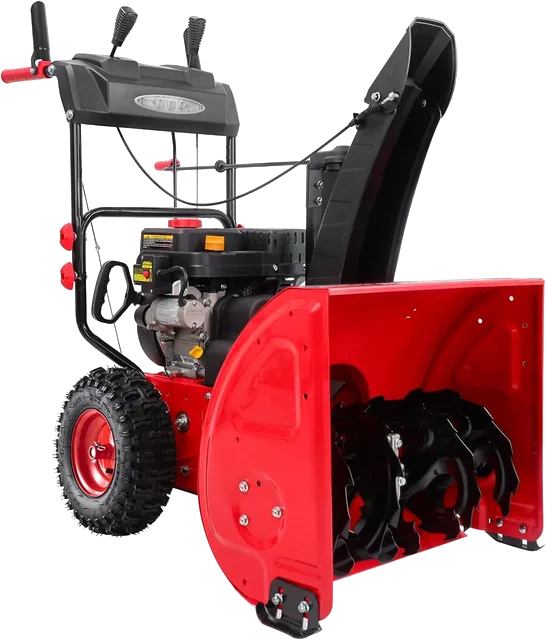
3. PowerSmart 24-Inch 212cc Two-Stage Gas Snow Blower Best Value
The best budget gas snow blower here, for a mid-length drive that wants electric start and plenty of gears.
Measure the gate and the shed door first, then buy for the deepest snow you clear. The Ariens pairs a 28 in bucket with a manual that gives a gravel set-up, which makes it the best gas snow blower for most long, mixed-surface drives.
Why Ariens Deluxe 28 SHO (921048) Two-Stage Gas Snow Blower Might Be the Best Choice
I put the Ariens Deluxe 28 SHO (921048) Two-Stage Gas Snow Blower first because it does the heavy jobs without a tracked, premium price. A 28 in bucket cuts the passes on a long lane, and a 306 cc engine carries wet snow, the job my wet snow blower list is built around.
The trade is weight and age. At 267.5 lb it needs floor space in the shed, and the listing sells the 921048, the generation before the newer model, so match the number on your machine to its manual before you order parts.
What puts it first:
✓ Width: 28 in per pass cuts the trips down a long lane.
✓ Intake: the housing is 21 in tall, and deep or packed snow goes in slower, narrower passes or in layers.
✓ Gravel: the manual gives a set-up with spacers and lowered skid shoes.
✓ Start: electric start from a household outlet, with a recoil handle as backup.
✓ Spares: two shear bolts and a clean-out tool come in the box.
Frequently Asked Questions
What is the best kind of snow blower?
The best kind of snow blower for deep, wet or packed snow and long drives is a two-stage gas machine, because its auger breaks up the snow and a separate impeller throws it. A single-stage suits light snow on pavement, so match the kind to your deepest snow and your surface.
What is a 3 stage snow blower?
A 3 stage snow blower is a two-stage design with an extra accelerator between the augers and the impeller, a term one maker uses for its heaviest machines. It adds weight and cost to the machine, and all five picks here are two-stage, so none of them has that extra part.
What is the best month to buy a snowblower?
The best month to buy a snowblower is the one before your first storm, usually early autumn, because you can still choose a model and wait for a freight delivery. A price drop is never dependable, so buy for stock and delivery date, and check the seller and return terms on the listing.
What is a two-stage snow blower?
A two-stage snow blower is a walk-behind machine with an auger that breaks up the snow and a separate impeller that throws it out of the chute. The auger rides above the pavement on skid shoes, so these machines suit deep, packed or wet snow, long drives and gravel where the manual allows it.
How does electric start work on a snowblower?
Electric start on a gas snow blower runs a starter motor from a button or a key, powered either by a cord from a 120 V outlet or by a battery on the machine. A cold engine still needs its choke or primer as your manual says, and the pull rope stays as backup.
References
- Loder RT, Solanki D. Events Due to Snowblower Use Seen in US Emergency Departments From 2003 Through 2018. Cureus. 2020;12(12):e11836.
- Curtin P, Flood MG, DeFazio MW, et al. Snowblower Injuries to the Hand: A Longitudinal Study. J Occup Environ Med. 2026;68(1):63-65.
- Hammig B, Jones C. Hand injuries associated with reaching into a snow blower to clear clogged snow. Am J Emerg Med. 2020;38(4):785-788.
- Alexander BM, Graydon PS, Pena M, Feng HA, Beamer BR. Hazardous exposures and engineering controls in the landscaping services industry. Journal of Occupational and Environmental Hygiene. 2025;22(3):189-202.
- National Institute for Occupational Safety and Health. Noise-Induced Hearing Loss. Noise and Hearing Loss. Centers for Disease Control and Prevention; 2024.
Safety Note: Snow blowers throw snow, ice and hidden objects with force. Never reach into a clogged chute or auger. Shut the machine off first: stop the engine on a gas model, unplug a corded model, or remove the safety key and every battery pack from a battery model. Wait at least as long as your manual says, often 10 seconds, and until every moving part has stopped, then remove the key and disconnect the spark plug wire where your manual says so, and clear the clog with the clearing tool. Keep people and pets out of the discharge path, run gas models outdoors only, and read the manufacturer’s manual.