

The best handheld spreader is the one whose carry, hopper and allowed materials fit your job. In large-scale production, I verified seed drill calibration on weighing trays and checked sprayer nozzle output with calibration cylinders, so I read each model’s printed figures against its manual before I trust them.
Affiliate Disclosure: Garden Power Scout is a proud participant in the Amazon Services LLC Associates Program. As an Amazon Associate, we earn from qualifying purchases, at no extra cost to you.
I keep a 3.7-acre orchard, so I judged these seven models on how they carry and what each maker allows in the hopper. My top pick, SOLO 421 20-Lb Portable Chest-Mount Spreader, is a chest-mount crank model with a strap. Below are the other six and the safety steps that every spreader needs.
Best Handheld Spreader 2026: 7 Crank and Battery Models I Put to Work
These seven cover a chest mount, a bag, hand-held crank models and two battery kits. Each section gives what the maker prints, what I noticed in use and who should skip it. Read the safety section near the end before you fill any of them.
1. SOLO 421 20-Lb Portable Chest-Mount Spreader Best Overall
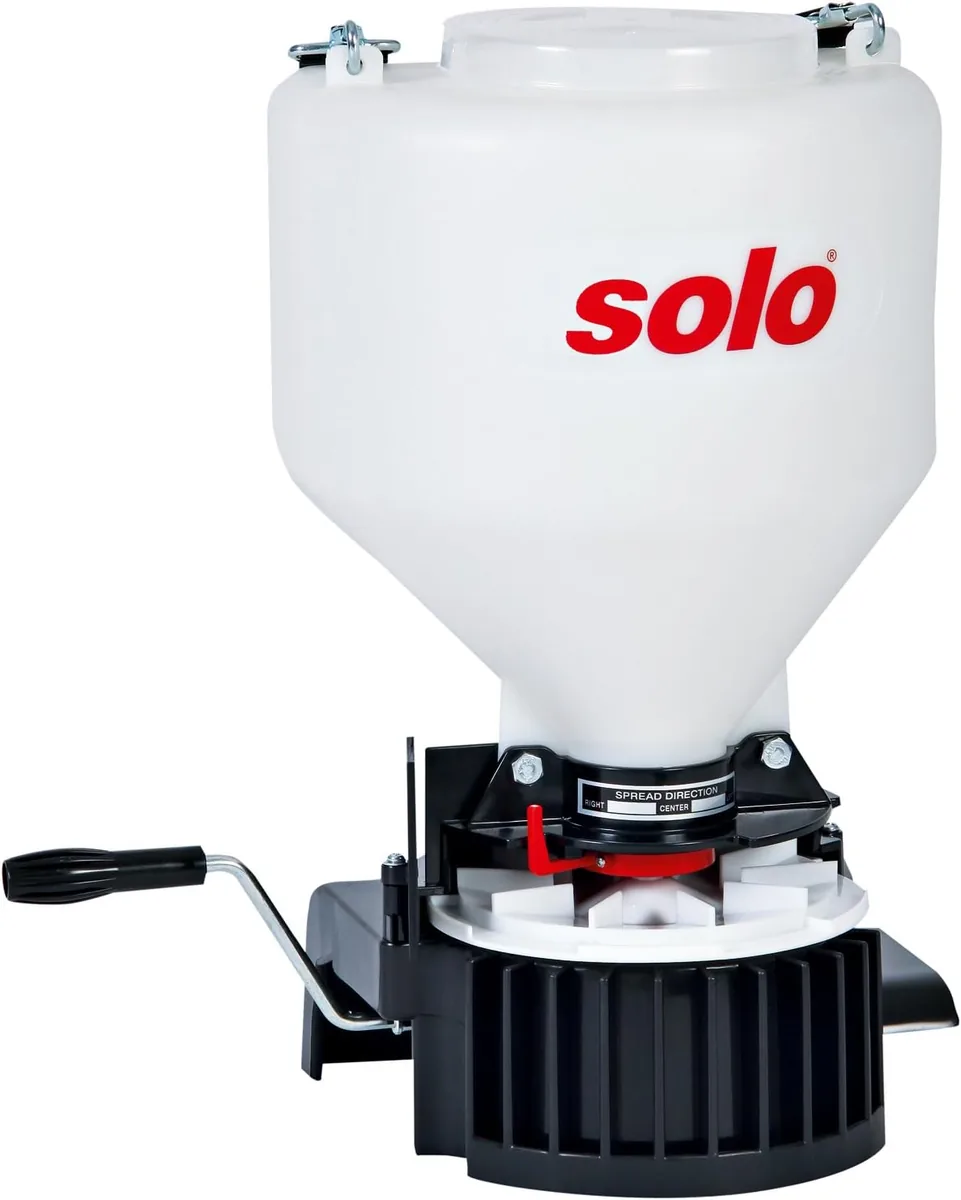
The SOLO 421 is the hand spreader I carry down a plum row, because it hangs on a cross-shoulder strap and leaves no wheel to catch on uneven ground. A 20 lb printed hopper, a flow lever, a directional lever and a deflector shield sit on one chest-mounted body, and the manual names a longer list of hopper materials than any other model on this page. It is a mid-range crank spreader for a reader whose spot jobs are bigger than a pocket-size handheld handles.
WHY I CHOSE THIS ✓
I put the 421 first because it solves the hardest part of a hand spreader, which is carrying it. A strap, three lever positions and a deflector shield give me control over where the throw goes, and SOLO prints a 20 lb hopper. It is the crank spreader I pick when the job has no wheel-friendly ground.
SOLO 421 20-Lb Portable Chest-Mount Spreader Specs
Key Features:
- Cross-shoulder strap: the hopper rides at chest height and the crank turns at your right side, so you walk a bed edge or a plum row without a frame in front of you.
- Directional lever: three positions (center, left, right) let you point the throw to one side of your path, as SOLO’s manual describes them.
- Deflector shield: SOLO says it widens or narrows the spread, and its manual shows it adjustable through 180 degrees.
- Flow rate lever and limiter stop: the lever shuts the flow at zero, and a brass stop nut sets the limit of its travel.
- Built-in agitator: SOLO says it turns steadily while you crank, which keeps the product moving toward the impeller.
- Metal worm gear drive: the gear case is sealed and has an oil hole, so lubrication is a maintenance step you follow from the manual.
- Screw-on lid: SOLO says it keeps spills and dust away from you, and it is the part you refit after every fill.
I started at the shed bench with the crank threaded on clockwise and the jam nut tight. The part that surprised me was how much the left hand does: the right hand cranks while the left works the flow lever, so the job asks for both hands and a steady stance. The deflector shield and the directional lever let me point the throw away from a path, though that is SOLO’s description and the result depends on the product and on you.
The manual lists what the hopper may hold: ice melters, seed, bird seed, sand, salt, fertilizers, pelletized lime and feed stock. That list is wider than the other models here print, but your product’s label still decides what goes in, and the manual says to use the spreader only as it describes. Set the gate from the label and the manual, and calibrate before you apply.
Along the tilled strips under the plum trees a wheeled spreader would struggle, and the 421 goes wherever your feet go; SOLO says it spreads more conveniently than a wheeled spreader over irregular ground. The cost is your shoulder: the manual prints 5.5 lb empty and 20 lb capacity, and says never to load the hopper while you carry it. Fill it set down on a flat surface, after the stop and make-safe steps in the safe-state box in the safety section below. In wind, plan the route so the wind is behind you, as the manual advises.

Before you fit or adjust the strap or the crank, complete the stop and make-safe steps in the safe-state box in the safety section below; then set the strap to the longest reach and crank to check the height.
SOLO’s manual says to wear safety glasses or eye shields, closed-toe shoes with good traction, snug long sleeves, non-slip gloves and a respirator if appropriate for the material, and never to let a child use the spreader. Ask SOLO for the current manual, because the manual for this SOLO chest-mount spreader is the 10/2000 edition with no warranty term, and read the product label too.
Before you clean, lubricate or store the 421, complete the stop and make-safe steps in the safe-state box in the safety section below. Then the manual says to move the flow lever to zero, crank the handle several times to see that no residue clings to the impeller, wash the unit with soap and water, dry it and store it in a safe place. Handle the wash water as the product label directs, lubricate the gear case where the manual directs and check the bolts, nuts and screws at the manual’s intervals. What annoyed me was the assembly: the crank and strap come inside the hopper, so the first job is building the carry.
Buy it if you spread across beds, strips and rough ground where a wheeled spreader would not roll, and you can carry a loaded hopper. It suits a reader who wants lever control over the direction of the throw. Skip it if you want a spreader that comes assembled, or if shoulder strain would end your job early.
FINAL VERDICT
The SOLO 421 is the spreader I pick for hand work across rough ground, with a strap, direction control and a printed 20 lb hopper. The assembly and the carry are what you pay for that.
It is the chest-mount spreader I take along the plum row.
2. EarthWay 2750 25-Lb Nylon Bag Seeder Spreader Best Premium
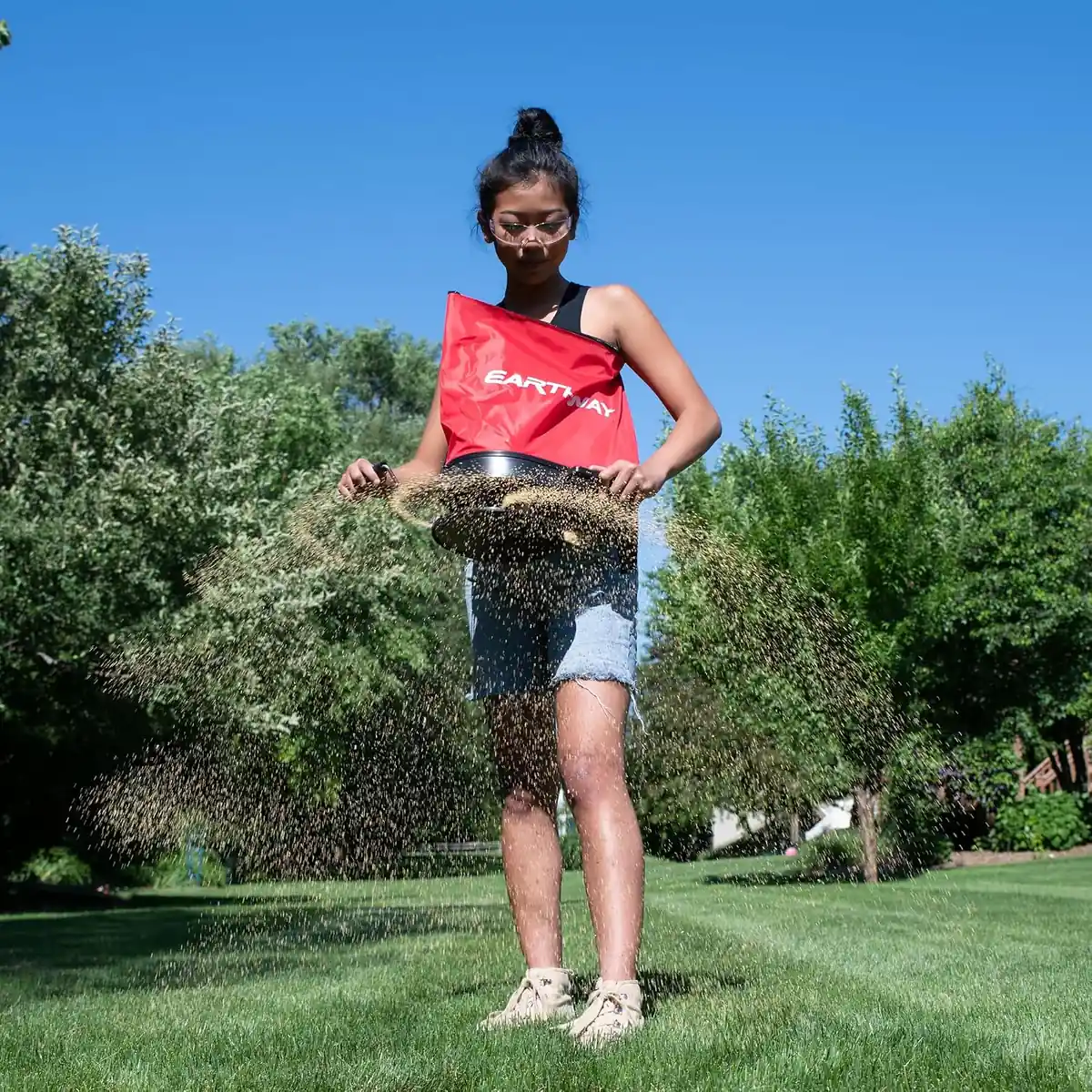
The EarthWay 2750 swaps the rigid hopper for a nylon bag that hangs from a shoulder strap and stands on its own leg when you set it down. That bag is the whole idea: it zips shut, it carries at your hip, and a feed slide opens and closes with one lever. It is a mid-range crank spreader whose price sits above the budget handhelds on this page, and it suits a reader with a long strip to seed or feed on foot.

WHY I CHOSE THIS ✓
The 2750 takes second place because it carries like a bag and shuts like a gate. A zippered bag, a stand and a spring-close slide make it easy to stop, set down and start again, and the crank needs no wrench. It is the hand spreader I pick for long walks with several stops.
EarthWay 2750 25-Lb Nylon Bag Seeder Spreader Specs
Key Features:
- Zippered nylon bag: EarthWay says the 600 denier bag is tear and weather resistant, and the zipper top closes the load when you walk.
- Shoulder strap: the strap is adjustable for a large or small operator, so the bag hangs at your hip with the crank on the side.
- Built-in stand: a leg at the back props the unit upright when you stop, so the bag does not tip over on a path.
- Feed slide lever: pull the lever back to open, push it up and the slide trips closed, as EarthWay’s instructions describe.
- Setting indicator and chart: a wing nut holds the indicator against a rate chart on the underside, and the product label tells you where to start.
- Rocking agitator: EarthWay says it helps fine seed keep flowing, and you can see it through the open bag.
- Sloped floor and sealed gearbox: EarthWay says the floor empties the bag completely and that the gearbox is lubricated and sealed.
What I did not expect was a crank with no wrench in the story. EarthWay’s instructions say to turn the crank onto the crankshaft and leave it, because it tightens itself as you use it. The bag supports are the other parts you attach, and the rest comes assembled. The first thing I checked at the shed door was the feed slide: it moves back to open and trips shut when you push it up.
Before you fill the bag, complete the stop and make-safe steps in the safe-state box in the safety section below. EarthWay’s instructions say to fill the bag about one half to two thirds full, with the slide closed, and the listing names 25 lb for the hopper, so fill only to the level the instructions allow. They also say to start walking and turning the crank before you open the feed slide, which fits the gate rule in the safety section below. The strap adjusts for a large or small operator, so set it before the first fill and leave the bag shut until you are ready to walk.
Around my vegetable plot the packed-soil paths and wood-chip mulch rule out a wheeled spreader, so the bag rode at my hip and the stand kept it upright when I stopped to read the label. The rocking agitator moves inside the bag as you crank, and EarthWay says it helps fine seed flow. The limit is the carry, since the strap puts the load on one shoulder.
Before you move the setting indicator, complete the stop and make-safe steps in the safe-state box in the safety section below; the rate chart under the unit is EarthWay’s starting point, and the product label comes first.
The product label and the safety section below carry the cautions: read the product label before you open the bag, and keep children and pets away while you fill and spread.
Before you empty, clean or store the bag, complete the stop and make-safe steps in the safe-state box in the safety section below. Then empty the bag, clean the unit only by a method the product label permits and keep wash water out of drains; EarthWay says the gearbox is lubricated and sealed. Store the bag empty and dry, with the zipper closed, and keep children and pets away from it. Wear the equipment the product label requires whenever you fill, clean or clear a jam, and follow every step of the instructions in the order they give it.
Choose it if you spread along paths, strips and plots on foot and want a bag you can set down on its own stand. It suits a reader who likes a lever gate that shuts with a push. Skip it if you want a hard hopper with a printed pound capacity from the maker’s manual, or a model with a printed list of hopper materials.
FINAL VERDICT
The EarthWay 2750 is the bag-style hand spreader for long walks with stops, with a stand, a zipper and a slide that shuts. One shoulder carries the whole load, so plan your fills.
It is the bag spreader I set down on its own stand.
3. Scotts Whirl 71060 Hand-Powered Handheld Spreader Best Value
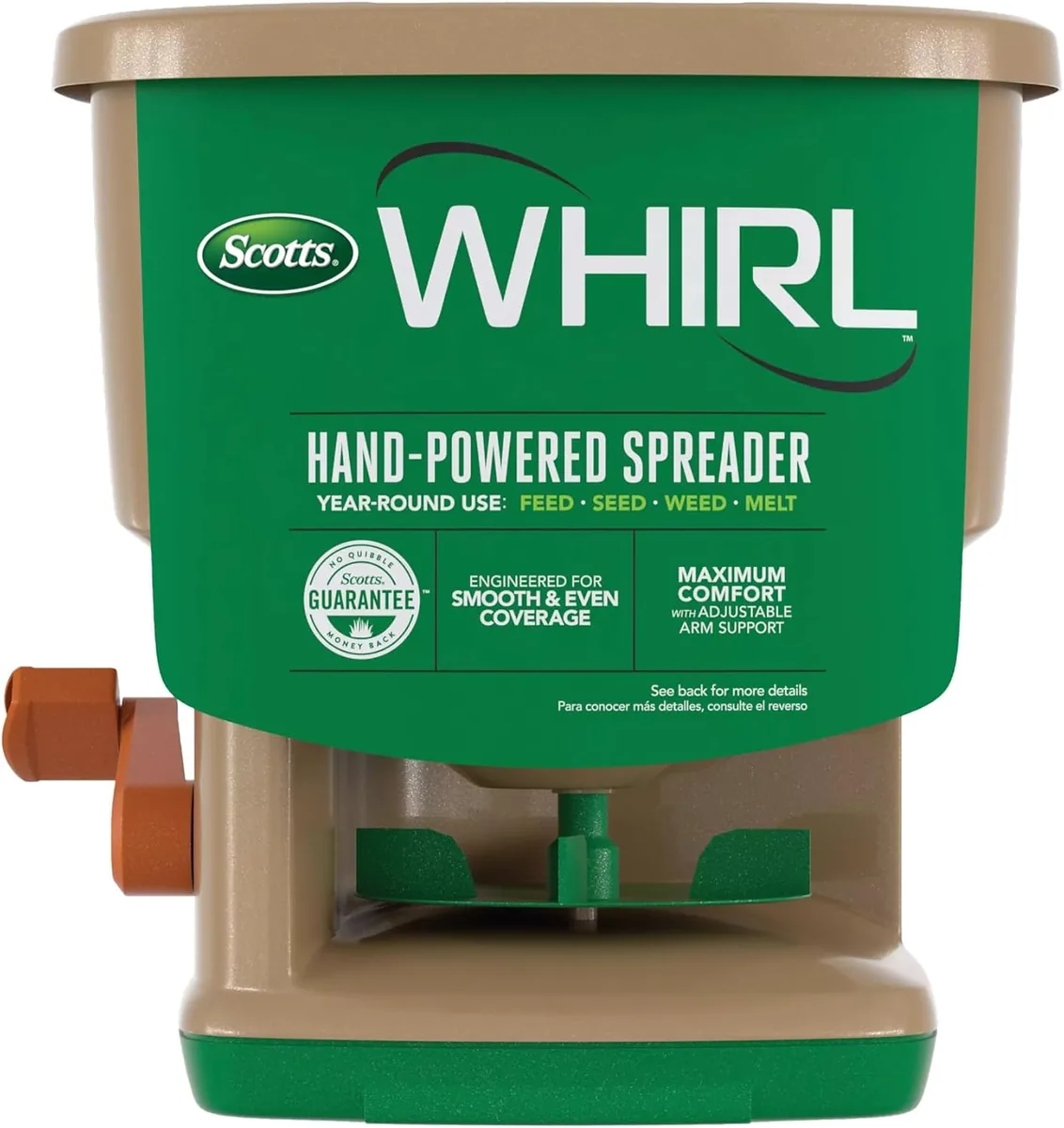
The Scotts Whirl is the handheld I reach for when the job is a patch, not a lawn. It comes assembled, you pull a trigger to open the gate and turn a crank with the other hand, and an adjustable arm support helps you hold it. It is a budget model, the lowest priced on this page, and it is the one I hand to a reader who spreads in small, quick jobs.
WHY I CHOSE THIS ✓
I give the Whirl the value spot because it asks the least of your budget and your time. A trigger, a dial and an arm support are all it has, and there is nothing to assemble. It is the best value on this page for small spot jobs, and the weakest here for anyone who wants a printed capacity or swath.
Scotts Whirl 71060 Hand-Powered Handheld Spreader Specs
Key Features:
- Comes assembled: Scotts says the Whirl arrives ready to use, so you check that the crank turns and the trigger moves before the first fill.
- Trigger gate: you pull the trigger and turn the crank clockwise together, as Scotts’ four-step placard shows.
- Orange setting dial: a numbered dial sits on top of the hopper, and the placard’s chart is Scotts’ own starting point for its products.
- Adjustable arm support: Scotts says the looped support adds comfort, and photos show it holding the spreader at waist height.
- Poly body and crank: the hopper and crank are plastic, which keeps the listed weight low.
- Fill-over-pavement step: the placard says to set the spreader over pavement when you fill, so spilled product can be swept up.
- Label-first prompt: the placard tells you to read and follow the directions on the label of the product you apply.
I checked the Whirl the way I check anything small: crank turning, trigger moving, dial clicking. Nothing needed building, which sets it apart from the models here that come with a strap or a crank to attach. The orange dial sits on top of the hopper where I can reach it, and the crank is on the left side. This Scotts handheld spreader prints no capacity in pounds, so the product label sets your amount.
Scotts’ placard says application rates vary with crank and walking speed, which is why the dial is a starting point and not an answer. I keep the crank pace steady, and the label of the product in the hopper has the final say. The placard also says to know the size of your lawn before you begin and not to overapply. The chart pairs dial positions with product types, and I never copy a position, because your bag’s label and your own check decide.
Under the shade trees by the house lawn a push spreader has to turn tight, and a handheld just walks in. The Whirl felt light in the hand, and the arm support meant my wrist was not doing all the holding; the crank turned under my right hand while the left held the loop, a two-handed job, though a light one. Scotts prints no pound capacity and no swath, which makes it a tool for short jobs, and how often you refill depends on the label and the fill level your product allows.

Before you fill, complete the stop and make-safe steps in the safe-state box in the safety section below, then set the spreader over pavement, as the placard says, so any spilled product can be swept up.
Scotts’ placard is short, so the label of your product and the safety section below carry the cautions: wear the equipment the label requires before you open the bag, and never spread while you turn or stop. Keep children, pets and other people away while you fill and spread, and store the bag and the filled spreader where they cannot reach them.
Before you empty, clean or store the Whirl, complete the stop and make-safe steps in the safe-state box in the safety section below. Then empty the hopper, clean the spreader only by a method the product label permits and let it dry; handle any wash water as the label directs. Store it empty and dry, out of reach of children and pets, and keep people away while you fill and spread.
Get it if you spread on small areas, patches and beds and want the cheapest way into a handheld that comes assembled. It suits a reader who spreads a few times a year and wants a quick, light tool, or who wants a second tool for edges and beds beside a larger push spreader. Skip it if you want a printed hopper capacity in pounds, a strap to carry a bigger load or a swath figure from the maker.
FINAL VERDICT
The Scotts Whirl is the budget handheld for small, quick jobs, with a trigger, a dial and an arm support. Its limits are a coverage rating in place of a capacity and no printed swath.
It is the budget handheld I hang on the shed wall.
4. WORX WG869 20V Cordless Handheld Broadcast Spreader Kit Battery and Charger Included
The WORX WG869 kit is the battery handheld that arrives with everything it needs: the spreader, a 2.0 Ah battery and a charger share the box. A trigger starts the spinner, a dial sets its speed and an edge-control deflector sits on the body. It is a mid-range kit for readers who want a motor.

WHY I CHOSE THIS ✓
I gave the WG869 fourth place because it is the only model here with a removable battery and a charger in the box. A kit, a deflector and a 3-year warranty make the buying decision simple. It sits below the crank models because a battery is one more thing to charge.
WORX WG869 20V Cordless Handheld Broadcast Spreader Kit Specs
Key Features:
- Battery and charger in the box: the kit holds a 2.0 Ah pack and a 2 A charger, so you charge it before the first fill.
- Edge-control deflector: WORX’s manual says you set the width with the speed dial and the deflector together.
- Speed-control dial: the manual says to use a lower spinner speed for larger material.
- Agitator: WORX says it spins at the bottom of the tub while the tool runs.
- Removable battery: a release button frees the pack, which WORX says fits its PowerShare family.
Charge the pack fully before first use, as WORX says; before you charge or change it, follow the emergency exception and the stop and make-safe steps in the safe-state box in the safety section below. I found the trigger under the forefinger of the loop handle, and holding it down is all the motor asks of that hand. Releasing it switches the tool off, but the wheel can still be turning.
WORX prints 2.27 lb without the battery and about 3.1 lb with it, so the pack is a quarter of the total. The speed dial sits above the grip where my thumb reaches it. Along the path to my house door I used the deflector as the manual describes.

Check the manual’s temperature ranges before a cold morning.
WORX’s manual says to use safety glasses, to use a face or dust mask if the work is dusty, to keep children away and not to operate the tool when tired, and it recommends rubber gloves and substantial footwear outdoors. Never use it in rain or damp places.
Before you clean, adjust, service or move the spreader, complete the stop and make-safe steps in the safe-state box in the safety section below; WORX says to remove the battery pack first. Then wipe it clean with a dry cloth and store it in a secure, dry place out of the reach of children. The manual says not to leave a pack on prolonged charge; your product’s label decides what goes in the tub.
Look at it if you want a motor to turn the spinner and a kit with the battery and charger already in the box. It suits beds, edges and short paths. Skip it if you want a spreader that works in damp weather or never needs charging.
FINAL VERDICT
The WORX WG869 kit is the battery handheld with the battery and charger included. Its limits are the charging routine and a ban on use in rain or damp places.
It is the battery handheld that comes ready to charge.
5. WORKPRO X Series 7.2V Cordless Seed and Fertilizer Spreader Built-In Rechargeable Battery
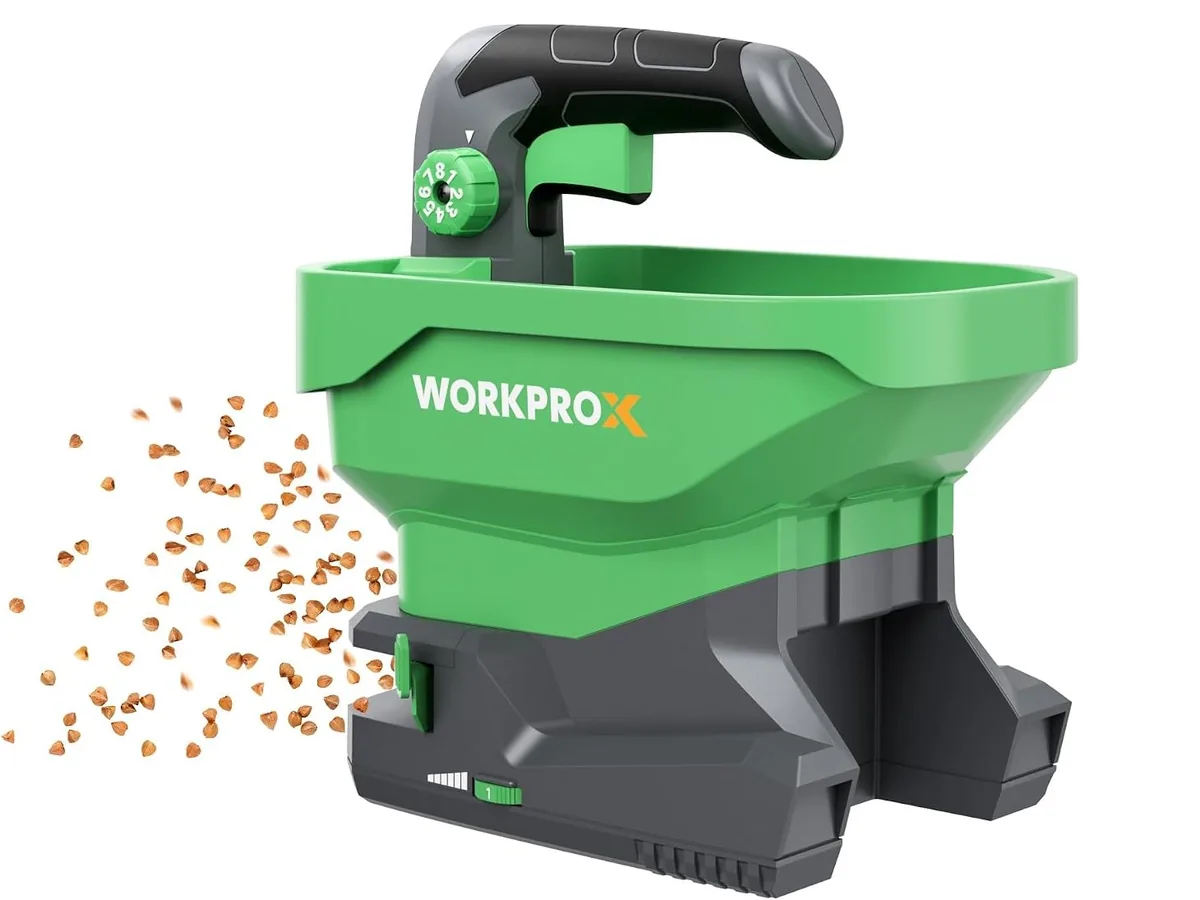
The WORKPRO X is the battery handheld with the pack built in, charged through its USB-C cable from a 5 V DC supply, as its manual specifies. Its manual is the strictest on this page about what goes in the hopper, which makes it a seed and fertilizer tool.
WHY I CHOSE THIS ✓
Fifth place goes to the WORKPRO X because the battery cannot go missing: the pack is built in and a 5 V USB supply fills it. A strict seed and fertilizer manual settles the label question early. It sits below the kit with a charger because it cannot take a spare pack.
WORKPRO X Series 7.2V Cordless Seed and Fertilizer Spreader Specs
Key Features:
- Built-in pack with USB-C charging: the manual specifies a 5 V DC USB supply, and a red LED turns green when the pack is full.
- Throw width lever: a lever on the body sets the throw width.
- Flow and speed knobs: one knob meters the flow and another sets the wheel speed.
- Manual’s material list: it names seed, fertilizers, animal feed, deicers and rock salts.
- Protection listed: the manual calls for eye and hearing protection and a face filter mask with fertilizers.
I read the manual’s chemical line before I touched the dial, because it decides which bag may go in at all. WORKPRO says the spreader must not be used for chemicals, pesticides, herbicides, liquids or powder, so weed killers and weed-and-feed products do not belong in it. The trigger is the only switch, and the flow knob, the speed knob and the throw width lever all sit on the body where my free hand reaches them. I fill the 2.5 L hopper on a flat, stable surface, as the manual says.
Before you charge the pack, follow the emergency exception and the stop and make-safe steps in the safe-state box in the safety section below. WORKPRO’s manual says to charge only from a 5 V DC USB supply, to keep the charging device away from moisture and out of the open, to charge in a ventilated place away from flammable materials, to stay with it and not to charge below 4 or above 40 degrees Celsius.
Keep it out of rain and damp, as WORKPRO says.
The manual calls for full eye and hearing protection, heavy long trousers, boots and gloves, a face filter mask with fertilizers and dusty product and head protection where objects may fall, and it says never to let children or untrained people use it when tired or ill.
Before you clean or store it, complete the stop and make-safe steps in the safe-state box in the safety section below for a built-in battery, and never open the battery compartment. WORKPRO says to use a soft-bristled brush and a damp cloth, never running water or cleaning agents, and to dry it thoroughly to prevent rust.
It suits you if you spread seed or fertilizer on small areas and want a built-in pack on a USB charge. Skip it if you spread weed and feed or any pesticide, or if you want to swap packs.
FINAL VERDICT
The WORKPRO X is the built-in battery handheld for seed and fertilizer, charged with a USB-C cable. Its limits are a manual that rules out chemicals and a pack you cannot swap.
It is the built-in battery handheld I charge from a phone adapter.
6. Brinly 5-Lb HHS3-5BH All-Season Handheld Spreader Contoured Scoop Lip
The Brinly HHS3-5BH is the crank handheld with the contoured scoop lip: Brinly says the reinforced lip is shaped for scooping product straight into a funnel-shaped poly hopper that holds 5 lb. A knob adjusts the flow gate, a trigger handle sits under your hand and the crank is extra long. It is a budget model for a reader who wants a plain handheld.

WHY I CHOSE THIS ✓
The Brinly lands sixth for one reason: it is the handheld here built around a scoop lip. A contoured lip, a funnel hopper and a printed 5 ft ceiling are the features I can point to. It sits near the bottom because Brinly lists no agitator and no warranty term.
Brinly 5-Lb HHS3-5BH All-Season Handheld Spreader Specs
Key Features:
- Printed 5 ft spread width: Brinly prints it as a ceiling for the product, and what lands where depends on your product and your pace.
- Funnel-shaped hopper: Brinly says the funnel keeps material moving toward the gate until the hopper is empty.
- Contoured lip: the reinforced lip is shaped for scooping product straight into the hopper.
- Knob-adjusted flow gate: a knob at the front of the hopper changes how much material flows, and the product label is your starting guide.
- Extra-long crank and trigger handle: the crank sits at the left of the housing and the trigger handle under the other hand.
I noticed the lip first. Brinly shapes it for scooping product straight in, so fill it set down on a hard surface, after the stop and make-safe steps in the safe-state box in the safety section below. The knob at the front adjusts the gate, and the crank sits on one side with the trigger handle on the other, so I hold the handle and turn the extra-long crank with my free hand.
Brinly also prints a spread width: it says the variable flow spreads material up to 5 ft, and I treat that as a ceiling and not what it will do on your lawn. The funnel shape is Brinly’s answer to material hanging up, and the maker says it keeps product flowing until the hopper is empty.

Before you adjust the knob, complete the stop and make-safe steps in the safe-state box in the safety section below; the product label is your starting guide.
Follow the safety section below and your product’s label for cleaning and storage, and wear the equipment the label requires whenever you fill.
I carried it along an orchard alley where a bare patch needed seed, and the poly hopper and plated hardware took the walk well. Before you empty, clean or store it, complete the stop and make-safe steps in the safe-state box in the safety section below. Then empty the hopper, clean it only by a method the label permits, keep the wash water out of drains and let it dry before storage.
Take it if you want a plain crank handheld with a hopper you can scoop full. It suits a reader with beds, patches and alley edges. Skip it if you want a printed warranty term.
FINAL VERDICT
The Brinly HHS3-5BH is the plain handheld built around a contoured scoop lip and a funnel hopper. Its page lists no warranty term, which is the one thing to weigh.
It is the plain handheld with the scoop lip.
7. Chapin 8700G TurfPRO Chest-Mounted Spreader Chest-Mount Harness
The Chapin 8700G TurfPRO is a chest-mounted crank spreader built around its harness: a padded, adjustable strap with a quick release, a cushioned side handle and cushioned crank grips. A translucent hopper under a large green cap sits against your chest, and a spring-return gate lever sits on the right. It is a mid-range chest-mount for a reader who values comfort on a long strip.

WHY I CHOSE THIS ✓
The 8700G ranks last because it is the narrowest tool here: Chapin lists sand, lime, pelletized lime and rock salt as not recommended. A quick-release strap, cushioned grips and a spring-return gate are what earn it a place, and the harness is the best padded of the chest mounts.
Chapin 8700G TurfPRO Chest-Mounted Spreader Specs
Key Features:
- Padded strap with quick release: the manual says to put the strap over your shoulder, snap the buckle into the base and set the unit on your chest.
- Cushioned handle and crank grips: Chapin adds padding where your hands stay for the whole pass.
- Spring-return gate lever: you lower the lever into a slot to select the gate opening, and flipping it up lets a spring close the gate.
- Side baffle: the manual says to adjust it as needed, and Chapin’s listing says it helps control the width.
- Large fill opening: a wide green cap sits on top of the hopper, with a cable running down to the gate.
I started at the bench with the crank. The manual has you attach the handle with a 14 mm wrench, so have one ready. The strap is the second step: over the shoulder, buckle into the base, then adjust it so the unit rides on your chest.
The gate is the part I like: lower the lever into a slot and the opening is set, flip it up and the spring closes it. The manual says to make sure the gate is closed before you fill the hopper, and to crank at a steady pace once you walk. Chapin’s manual also has a setting chart marked for reference only, and the label of your product and your own check come first.
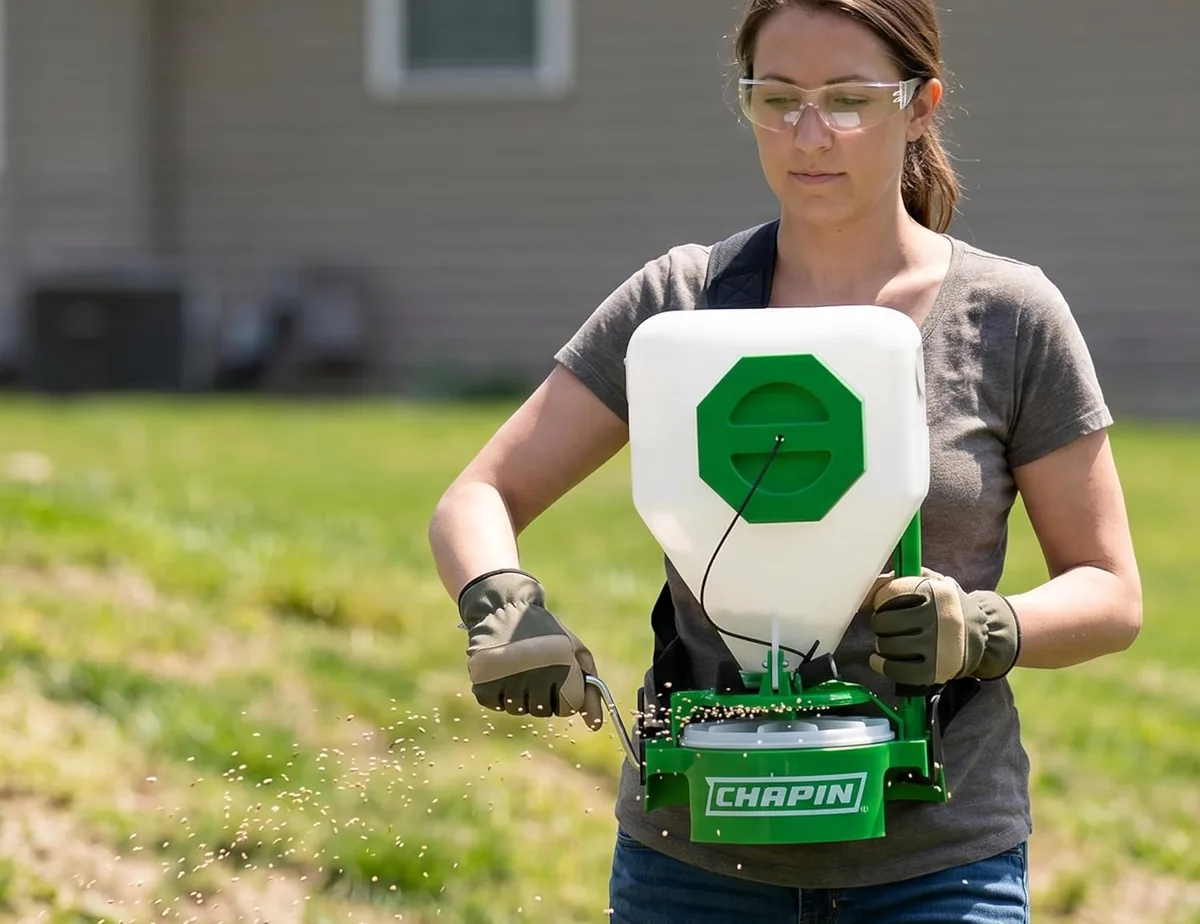
Chapin says this model is not recommended for sand, lime, pelletized lime and rock salt, so read that line before you buy.
The safety section below and your product’s label carry the cautions, and wear the equipment the label requires before you open the bag, as the label says.
I walked the grass margin beside the gravel yard with it, and a chest mount kept both feet on firm ground and both hands on the controls; Chapin asks you to register for its 1-year limited warranty. Before you empty, clean or store it, complete the stop and make-safe steps in the safe-state box in the safety section below. Then empty the hopper, clean it only by a method the label permits, dry it and keep the wash water out of drains. Check the quick-release buckle before every strap-on.
It fits you if you want a chest-mounted crank spreader with a padded strap and a lever gate. It suits seed and fertilizer strips where comfort matters. Skip it if you want a spreader for lime, sand or rock salt.
FINAL VERDICT
The Chapin 8700G is the chest-mount with the padded harness and a spring-return gate. Its limits are a list of materials Chapin does not recommend and a single quick-release buckle to keep an eye on.
It is the chest-mount with the padded harness.
How to Choose the Best Handheld Spreader
A handheld spreader asks four things of you: you carry it, you fill it, you set its gate and you clean it. These seven factors settle most of the decision, and none of them needs a number from your lawn.
Handheld Broadcast Spreader Forms for Crank, Chest-Mount and Battery Models
A handheld broadcast spreader throws product from a spinning plate, and the form decides how you carry it and what turns the plate. Pick the carry first, because it shapes every other choice. A crank model is turned by your hand, a chest mount or bag hangs on a strap, and a battery model has a motor and a pack to look after. I compare wheeled and handheld options in my best broadcast spreader roundup, which covers push, tow-behind and handheld models.
| Form | How you carry it | What turns the plate | What to check |
|---|---|---|---|
| Hand-held crank | One hand holds a grip or loop, the other turns the crank | Your hand | Arm support or grip, hopper size as printed |
| Chest mount or bag | Strap over the shoulder, hopper at chest or hip | Your hand | Strap, stand or harness, filling it set down |
| Battery handheld | One hand holds a trigger handle | A motor and a pack | Charger in the box or built in, what the manual allows |
I keep the three forms apart because each tires a different part of you: a crank tires the turning arm, a chest mount tires the shoulder and a battery model adds the weight of the pack to the wrist. The common mistake is buying the biggest hopper and finding it too heavy to carry for the whole job.
Carry, Strap and Arm Strain
A full hopper is a load you hold or hang, so the carry decides how long you can work. A hopper that rides on a strap spares the arm, and a grip-held one does not. A 1979 study of a hand-operated spinner spreader found that carry position changes how it spreads, with the best results when the spinner was directly in front of the operator and the crank slightly to the right (1). It was an old study of one design, so I read it as a reason to check how a spreader sits when carried, not as a rule for any model.
- Strap: padded, adjustable and quick to release is what to look for on a chest mount or bag.
- Arm support: a looped support helps a grip-held model sit at waist height.
- Set-down stand: a stand or a flat base lets you stop to refill without tipping it.
- Both hands busy: most crank models need the second hand for the gate or the grip.
I judge a carry by how it feels at the end of the strip rather than at the start.
Pro Tip
Adjust the strap while the hopper is empty. Before you fill, complete the stop and make-safe steps in the safe-state box in the safety section below, and set the spreader down on a flat surface. SOLO’s manual says never to load the hopper while you carry it, and any model’s manual sets the level you may fill to.
Hopper Size as the Maker Prints It
Makers print capacity three ways: pounds, liters or gallons, and a coverage rating in square feet. Only the first two describe the hopper itself. A coverage rating is the maker’s own claim for its products, and it does not tell you how many refills your job takes.
| What the maker prints | What it tells you | What it leaves out |
|---|---|---|
| Pounds | The weight the hopper is rated to hold | Which product it is, and how the load feels on your shoulder |
| Liters or gallons | The volume of the hopper | How much a given product weighs in that volume |
| Coverage rating | The maker’s claim for its own products | The hopper’s real size and your product’s label directions |
A bigger hopper means fewer refills and more weight to carry, so match it to the job you do most. I never compare a figure printed in pounds with one printed in liters, because they describe different things. Filling to the brim is the mistake to avoid: your manual says how full to go. The best handheld broadcast spreader is the one whose full hopper you can still carry. Hopper size sets the order in my best spreader for large lawn roundup for bigger jobs.
Gate, Dial and Setting Charts
The gate meters the product, and a dial, knob or slide sets how far it opens. Every maker’s scale belongs to that maker, so a number on one dial means nothing on another. Kentucky Extension says the setting on the bag is a starting point because spreaders differ, and that you recalibrate for each new product (2). Clemson Extension adds that walking pace changes the rate, with a faster pace lowering it and a slower one raising it (3).
Key Takeaway
The product label gives the application directions, so read it before you set the gate. A setting listed for your exact spreader and product is a starting point, not proof of the amount delivered: follow the spreader’s manual and calibrate for the product, the spreader and the person using it before you apply. Never exceed the label’s application rate.
I keep my pace steady and never copy a setting from one spreader to another. The mistake that costs most is trusting a setting chart as a measurement.
Battery Kits and Electric Handheld Spreader Rules
An electric handheld spreader swaps your arm for a motor and gives you a pack to look after. Check whether the charger is in the box. Some kits put a removable pack and a charger together, and others build the pack in and charge it over a USB cable. Battery models sit beside hand and push types in my best spreader for small lawn roundup.
- Removable pack: you can charge it away from the spreader and keep it apart while you work.
- Built-in pack: nothing to lose, though you cannot swap it and the stop steps follow the maker’s own off steps.
- Charger in the box: confirm that the pack and the charger are the ones the maker lists.
- Rain and damp: the battery manuals I read rule out use in rain or damp conditions.
Before you charge or change a battery, follow the emergency exception and the applicable stop and make-safe steps in the safe-state box in the safety section below. I read the charging lines in the manual before I read the spec table, because a pack is the part that can fail.
Battery Check
Use only the battery and charger the maker lists for your exact spreader. A model with a built-in pack follows its own manual’s off and storage steps, and you never open the battery compartment.
What the Manual Allows in the Hopper
Makers differ on what may go in a handheld hopper. One manual lists seed, fertilizers, pelletized lime, sand, rock salt and ice melters, another names seed, fertilizers and deicers only, and a third rules out chemicals, pesticides and herbicides altogether. A handheld seed spreader is a match only when its maker names seed among its materials. I sort models for seed work by type, hopper size and budget in my best grass seed spreader roundup.
| Question | Who answers it | Where to look |
|---|---|---|
| May this product be used at all? | The product label | Directions for use |
| May this spreader hold it? | The spreader’s manual | Materials and cautions |
| How do I set the gate? | Both, as a starting point | The bag’s chart and the manual’s chart |
| What if the two disagree? | The two manufacturers | Do not use that combination |
I read the materials line in a manual before anything else, because it settles which bags the spreader may hold. Assuming a handheld fertilizer spreader also suits a weed killer is the mistake to avoid.
Cleaning Access and Storage
A handheld lawn spreader you cannot clean stays dirty, and a dirty plate is where trouble starts. NC State Extension says to wash a spreader, dry it fully and lubricate it as the manual says (4). Before you clean the spreader, complete the stop and make-safe steps in the safe-state box in the safety section below.
- A wide fill opening: your hand and a brush reach the inside of the hopper.
- Parts you can reach: the plate and gate are visible without taking the spreader apart.
- Cleaning methods differ: one battery manual says to wipe with a dry cloth, and another says to use a soft brush and a damp cloth and never running water, so follow your own manual and the product label.
- Dry before storage: store it empty, clean and dry, with the gate closed.
I look at how easily the hopper empties before I look at anything else about cleaning. Putting a spreader away with product still in the hopper is the mistake to avoid.
Safety Before You Spread
A handheld spreader is a hopper with a gate over a spinning plate, turned by a hand or a motor, and the product in it can harm people, pets and water if it is spilled, thrown or left. Only what your exact manual and your product’s label say applies to you, and you follow both.
Only an adult who has read the manual and the label and understands the controls should operate a spreader: never a child, and never anyone tired or impaired. The SOLO manual says never to let children use it, the WORX manual says to stay alert and not to operate the tool when tired, and the WORKPRO manual says not to let children or untrained people use it, or to use it when tired, ill or under the influence of alcohol, drugs or medication.
Full Safe-State Box
Emergency first, for a spreader with a battery: if a battery becomes unusually hot, swells, hisses, gives off an unusual odor or smokes, stop using the spreader without handling or removing the battery, keep people away and follow the battery manual’s emergency instructions; if it smokes, burns or presents immediate danger, move away and call 911 or the fire department without finishing the routine steps.
- Stop and make safe before you fill or unload the hopper, reach into the hopper, clear a clog, clean or rinse the spreader, lubricate it, adjust the gate or the pattern, change a part, charge or change a battery, move it, store it or leave it. Keep your hands, feet, hair and loose clothing away from the plate, the agitator and the gears while anything can turn. During normal spreading, walk only as your manual and the product label permit; walking while you spread is operation, not transport.
- Hand-crank spreader, chest mount or bag: close the gate, then stop walking or cranking, and wait until the impeller, plate, agitator and wheels have stopped turning.
- Battery spreader: release the trigger or close the gate as your manual directs, switch the spreader off, wait until all moving parts have stopped, then remove the battery as the manual directs (on a model with a built-in battery that cannot be removed, such as the WORKPRO X, follow that manual’s own off and storage steps instead, and never open the battery compartment) and keep a removed battery away from the spreader while you work. Follow any additional isolation steps in the exact manual.
Then Finish Only as Your Manual Says
Keep the gate closed while you fill. Wear all the protective equipment the product label and your manual require while you fill, clean or clear a jam. Clear a clog only with the method in your exact manual. Follow every applicable safety step in your manual, in the order it specifies. Refit every guard and cover, and check that the gate opens and closes before product goes back in.
Label, Protective Equipment and Filling
The product label and the spreader’s manual both apply, and these sentences are the baseline for a handheld spreader of any form.
- Label: Read the product label before you open the bag. Follow its directions for the permitted use, the application amount, protective equipment, weather, watering in, access by people and pets, storage and disposal.
- Pesticides: Using a registered pesticide in a way its label does not allow is against federal law. Follow the spreader’s manual too. If the product’s instructions and the spreader’s instructions cannot both be followed, do not use that combination; ask the manufacturers for guidance.
- Protective equipment: Wear all the protective equipment the product label and your spreader’s manual require, and put it on before you open the bag. Wear it every time you fill the hopper, clean the spreader or clear a clog. Protective equipment lowers your exposure; it does not make handling a lawn product safe.
- Model-specific equipment: SOLO’s manual says to wear safety glasses or eye shields, closed-toe shoes with good traction, snug long sleeves, tightly cuffed or cuffless pants, non-slip gloves and a respirator if appropriate for the material. WORX’s manual says to use safety glasses and a face or dust mask if the work is dusty, and recommends rubber gloves and substantial footwear outdoors. WORKPRO’s manual says to wear full eye and hearing protection, heavy long trousers, boots and gloves, a face filter mask with fertilizers and dusty product, and head protection where objects may fall. The product label’s requirements come on top of these.
- Filling: Before you fill or unload the hopper, complete the stop and make-safe steps for your spreader in the safe-state box, and keep the gate closed. For fertilizer, fill on a hard surface where spilled granules can be swept up, away from drains and water (5).
- Handling: Follow the product label’s handling and ventilation directions, and wear all the protective equipment the label and your manual require. Fill only to the level your manual allows, and secure the hopper cover or lid if your spreader has one. Keep children and pets away, and never leave a filled spreader where they can reach it.
- Amounts: The product label gives the application directions, so read it before you set the gate, whether you are applying fertilizer or seed. Follow the spreader’s manual and calibrate for the product, the spreader and the person using it before you apply.
- Hygiene: Wash your hands before eating, drinking, smoking or using the restroom when you work with pesticides. Change your clothes and wash your hands immediately after you apply a product that contains a pesticide, and follow the label’s additional washing and clothing instructions.
Spills, Runoff and Rinse Water
Scattered granules and spilled product are the usual way a lawn product reaches a drain, so these steps matter as much as the spreading.
- Spills: Keep people and pets away from a spill. Follow the product label and its safety data sheet for collecting, reusing and disposing of spilled product, and wear the protective equipment they require.
- Never wash it away: Never hose or wash granules into a street, a gutter, a drain, a ditch or water, and do not pile spilled product onto the lawn or return contaminated material to the bag.
- Big spills: If you cannot manage the spill safely, stay away and call the emergency number on the label. Call Poison Control (America’s Poison Centers) at 1-800-222-1222 if anyone is exposed, and call 911 for a fire or immediate danger.
- Runoff: Keep fertilizer off pavement and out of drains and surface water. If scattered plain fertilizer lands on a sidewalk, a driveway or a patio, sweep it back onto the lawn before you water, without going over the label rate; collect a concentrated spill instead. For pesticide granules, follow the label’s cleanup instructions.
- Buffers and weather: Follow any buffer requirement that applies and keep fertilizer out of those areas. EPA advises against fertilizing before windy or rainy days, and Purdue advises against fertilizing drought-stressed, dormant or frozen turf (6). Follow the product’s weather and watering directions too.
- Cleaning: Before you clean the spreader, complete the stop and make-safe steps in the safe-state box, and wear the protective equipment the product label and your manual require. Handle leftover product, cleaning water and residues as the product label directs.
- Rinsing and drying: Clean the spreader only by a method both the label and the manual permit, and rinse it only where they permit it, keeping product and contaminated wash water out of drains and water supplies. Dry the spreader completely, and lubricate it as its manual directs. If you change products, follow both products’ cleaning requirements: a rinse alone does not show that all residue is gone.
Gate, Children, Pets and Clogs
- Gate at stops and turns: Close the gate before you stop, before you slow down to turn, and whenever you pause, and open it again only after you are walking at the steady pace your manual describes. Do not spread while you turn.
- Children and pets: Keep children, pets and other people away from the area while you fill and spread, and keep them off the treated area for as long as the label says. Store the bag and the filled spreader where they cannot reach them.
- Clogs: Never push, kick or dig product out of the gate or off the plate while anything can turn. If product clumps or bridges in the hopper or the gate clogs, stop and complete the stop and make-safe steps in the safe-state box first, then clear it only with the method in your manual.
Battery, Ice Melt, Lime and Storage
A battery model, a salt job or a lime job each adds a rule, and storage ends every job.
- Battery: Use only the batteries the maker specifies for your exact spreader, and charge, store and handle them only as your manual describes. Recharge rechargeable batteries only with a charger the manual approves, and never recharge disposable cells.
- Before you service a battery model: Before you fill the hopper, clear a jam, clean the spreader or change the battery, follow the emergency exception and the applicable stop and make-safe steps in the safe-state box.
- Lithium-ion: Lithium-ion batteries can overheat and catch fire (thermal runaway), so do not use a damaged battery or charger. If a battery becomes unusually hot, swells, hisses, gives off an unusual odor or smokes, stop using it without handling or removing it, keep people away and follow the battery manual’s emergency instructions; if it smokes or burns, move away and call 911 or the fire department.
- Ice melt and salt: Use ice melt or salt only when both the product’s directions and your spreader’s manual permit it. Salt-based deicers can damage metal, so follow your model’s cleaning instructions after use. Before you clean the spreader, complete the stop and make-safe steps in the safe-state box. Rinse only if the manual permits it, and dry the spreader as the manual directs. Do not use lawn fertilizer to melt ice. Keep deicing products away from children and pets.
- Lime: Use a soil test to decide whether the lawn needs lime. For lawn liming, do not use hydrated lime or quicklime: they are caustic and are a hazard to handle. Follow the lawn lime product’s label and your spreader’s manual for the materials the spreader may hold and the protective equipment to wear.
- Storage: Before you store the spreader, complete the stop and make-safe steps in the safe-state box. Store it empty, clean and dry, as your manual describes, with the gate closed. Keep products in their original labeled containers, securely closed, under the storage conditions their labels give, and away from children and pets.
- Pesticides and containers: Lock pesticides away, apart from fertilizer, food and animal feed, and never put any product into a food or drink container. Store a battery as the battery manual describes.
- Exposure: If someone swallows or is exposed to a lawn product, follow the first-aid section of the product label and call Poison Control (America’s Poison Centers) at 1-800-222-1222, and keep the product label with you. Call 911 in an emergency.
When a Handheld Is Not Enough
A printed hopper is a limit, and a handheld reaches it quickly. When you fill it again and again, your shoulder and your time are the cost. Walk-behind models are compared by frame and wheels in my push spreader picks.
That is the point to look at a push or tow-behind spreader, which this page does not cover. Beds, edges, strips and patches suit a handheld, and a job that turns into a long walk with many refills is the point to look at something with wheels.
My Overall Verdict
I judged each handheld on how you carry it, what its hopper holds as the maker prints it and what its manual says may go inside. A model you can carry for the whole job beats a clever feature you cannot sustain. If you spread salt, my best spreader for ice melt roundup covers driveways, walks and steps.

1. SOLO 421 20-Lb Portable Chest-Mount Spreader Best Overall
For long strips and rough ground on foot, the chest mount with a strap, three lever positions and a 20 lb printed hopper.

2. EarthWay 2750 25-Lb Nylon Bag Seeder Spreader Best Premium
For a bag at your hip that stands on its own leg and shuts with a push of the slide.

3. Scotts Whirl 71060 Hand-Powered Handheld Spreader Best Value
For small patches and beds on a budget, with a trigger, a dial and nothing to assemble.
The other four are a kit with a battery and charger, a built-in pack charged over USB-C, a crank model with a contoured scoop lip and a padded chest-mount harness.
Match the carry and the hopper to your job, read the label and the manual, and you have the best handheld spreader for your own garden. My lawn spreader picks set push and handheld models side by side on hopper and gate.
Why SOLO 421 20-Lb Portable Chest-Mount Spreader Might Be the Best Choice
I put the SOLO 421 first because it solves the hardest part of a hand spreader, which is carrying it. A strap takes the load off your arm, and SOLO prints a 20 lb hopper.
The trade-off is plain: the 421 comes in pieces and prints no warranty term, and its manual is the 10/2000 edition, so I ask SOLO for the current manual and follow the product’s label before the first fill.
Here is why it earns the top place:
✓ Strap carry: the hopper rides at chest height, with no wheel to carry over rough ground.
✓ Direction control: three lever positions and a deflector shield, as SOLO describes them.
✓ 20 lb printed hopper: SOLO prints the capacity, and the product label and the fill level your manual allows decide how often you refill.
✓ Widest materials list: SOLO’s manual names the longest list of hopper materials here, and your label still decides.
✓ Metal worm gear drive: a sealed gear case with an oil hole you lubricate as the manual directs.
Frequently Asked Questions
What is the best handheld spreader?
The best handheld spreader for most readers is the SOLO 421, a chest-mount crank model with a strap, three lever positions and a 20 lb printed hopper. Choose a lighter model only if your jobs are small, or a battery kit if you want a motor to do the turning.
What is the best handheld spreader for fertilizer?
The best handheld spreader for fertilizer is one whose maker names fertilizer among its materials, like the SOLO 421, and whose gate you can close before every fill. The product label and the spreader’s manual decide what goes in the hopper, how you set the gate and what protective equipment you wear.
What is the best handheld seed spreader?
The best handheld seed spreader is one whose manual names seed among its materials, such as the SOLO 421 for a crank or the WORKPRO X, whose manual calls it a cordless seed spreader. Read the manual’s materials line and the seed label before you buy, because the two together decide whether a model suits your job.
Are Scotts handheld spreaders any good?
Scotts handheld spreaders such as the Whirl suit small spot jobs, with a trigger gate, a numbered dial and an adjustable arm support in a budget-tier body. Scotts prints a coverage rating in place of a pound capacity, so check the printed hopper size against the job you plan to do before you buy it.
Are hand held seed spreaders any good?
Hand held seed spreaders are a good fit for small areas, patches and edges where a push spreader is awkward, and the models here turn the plate by crank or by motor. For a long strip, a strap and a larger hopper matter more, and the seed label decides the setting.
References
- Wolf DD, Smith ES. Uniformity of seed and fertilizer distribution with a hand-operated spinning spreader. Trans ASAE. 1979;22(4):761-762.
- Munshaw G. Calibrating Fertilizer Spreaders for the Home Lawn. AGR-211. University of Kentucky Cooperative Extension Service; 2014.
- Ballew J. Calibrating Spreaders. HGIC 1657. Clemson Cooperative Extension; revised 2019.
- Miller G, Kerns JP, Billeisen T. Organic Lawn Care: Composting and Spreaders. AG-562. NC State Extension; 2026.
- UC Statewide Integrated Pest Management Program. How to apply fertilizer. In: UC Guide to Healthy Lawns. University of California Agriculture and Natural Resources; 2017.
- Bigelow CA, Tudor WT, Nemitz JR. Facts About Phosphorus and Lawns. AY-334. Purdue University Extension.
Safety Note: Read the product label and your spreader’s manual before handling product. Follow both; if their instructions cannot both be met, do not use that combination. Registered pesticide use must comply with its labeling. A listed spreader setting is a starting point; calibrate as the manual directs and never exceed the label rate. Wear all protective equipment required by the label and manual before opening the container and during filling, cleanup and jam clearing. Wash your hands before eating, drinking, smoking or using the restroom when working with pesticides. After application, change your clothes and wash your hands immediately, and follow the label’s additional washing and clothing instructions. Keep children, pets and other people away during handling and application and off treated areas for as long as the label requires. Emergency first: if a battery becomes unusually hot, swells, hisses, smells unusual or smokes, stop using the spreader without handling or removing the battery. Keep people away and follow the battery manual’s emergency instructions. If it smokes, burns or presents immediate danger, move away and call 911 or the fire department. Otherwise, complete the applicable stop and make-safe sequence before filling, unloading, reaching into the hopper, clearing a jam, cleaning, lubricating, adjusting, changing parts or batteries, hitching, unhitching, transporting, storing or leaving the spreader. Walk-behind or hand-crank: close the gate, stop walking or cranking, and wait for all moving parts to stop. Tow-behind: close the gate, stop the vehicle, set the parking brake, switch off the engine and remove the key as the vehicle manual directs, and wait for the wheels, impeller and agitator to stop before reaching into the hopper or touching the impeller. Battery spreader: release the trigger or close the gate, switch off, wait for moving parts to stop, then remove the battery as the manual directs and keep it away while working. Follow any additional isolation steps in the exact manual. Keep hands, feet, hair and loose clothing away from moving parts. Clear jams only by the manual’s method. Refit guards and covers and check the gate before refilling. With the spreader made safe and the gate closed, fill fertilizer on a hard surface where spills can be collected, away from drains and water. Follow the label’s handling and ventilation directions and the manual’s fill limit. Keep people and pets away from spills. Follow the label and safety data sheet for collection, reuse and disposal; do not spread concentrated spills onto the lawn or return contaminated product to its bag. Sweep scattered plain fertilizer from pavement onto the intended lawn before watering only without exceeding the label rate. Follow the label’s cleanup instructions for pesticide granules. Never wash product into streets, gutters, drains, ditches or water. Observe applicable buffers. EPA advises against fertilizing before windy or rainy days; Purdue advises against fertilizing drought-stressed, dormant or frozen turf. Close the gate before stopping or turning, as the manual directs. Follow both towing manuals for hitching, turning, slopes, speed and load limits; never ride on the spreader or carry passengers on it. Use only batteries specified for the model. Recharge rechargeable batteries only with a charger approved for them, as the manual directs; never recharge disposable cells. After completing the applicable shutdown, handle leftover product, cleaning water and residues according to the product label. Clean only by methods permitted by both label and manual, keeping contaminated water out of drains and water supplies. Rinse only if permitted, then dry and lubricate as directed. A rinse does not establish that all pesticide residue is gone. Use salt or ice melt only when the product directions and spreader manual permit it. Salt-based deicers can damage metal; follow the model’s cleaning instructions. Do not use lawn fertilizer to melt ice. Store the spreader empty, clean and dry as its manual directs. Keep products securely closed in their original labeled containers under their labels’ storage conditions, away from children and pets. Lock pesticides away, separate from fertilizer, food and feed; never use food or drink containers. For human exposure, follow the label’s first-aid instructions, call Poison Control at 1-800-222-1222 and keep the label available. Call 911 for immediate danger.