

The best heavy duty earth auger for a homeowner is the one with the biggest engine you can control, a bit you can use and a handlebar you can hold with both hands. I keep a 3.7-acre apricot and plum orchard and the yard around the family house, and I ran seven gas machines through their start-up and handling steps with that ground in mind.
Affiliate Disclosure: Garden Power Scout is a proud participant in the Amazon Services LLC Associates Program. As an Amazon Associate, we earn from qualifying purchases, at no extra cost to you.
My pick is the NEO-TEC 72cc Gas Earth Auger with 8 in Bit, a 72cc kit with an 8 in bit in the box. Each review below says what is in the box, which figures the maker gives and who should skip the machine.
Best Heavy Duty Earth Auger 2026: 7 Gas Models I Put to Work
Heavy duty here means engine size and bit width: gas machines from 52cc to 72cc with bits that reach 10 in or 12 in. No marketing word earns a place. Each machine is ranked by what is in the box and what its maker puts in writing.
1. NEO-TEC 72cc Gas Earth Auger with 8 in Bit Best Overall
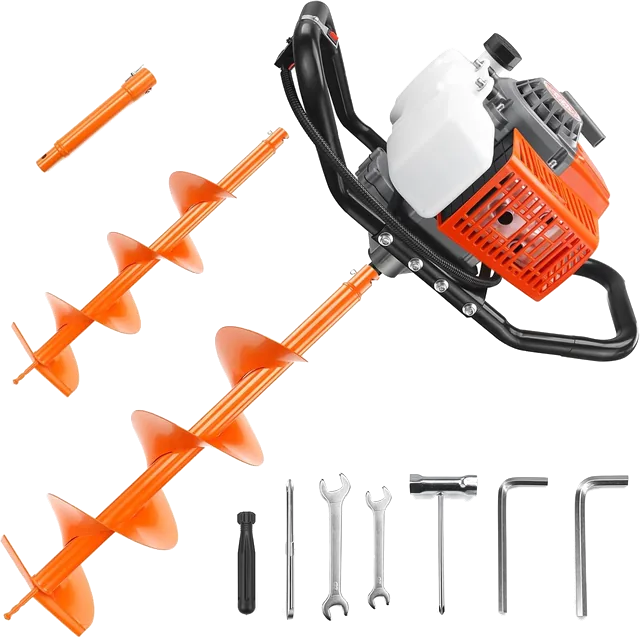
The NEO-TEC 72cc is a 72cc complete kit: a 72cc 2-cycle power head, an 8 in bit and an extension bar in one box. I put it first for the homeowner with a long run of holes who wants displacement in the box and will read the manual before the first pull. NEO-TEC sells it as a gas earth auger for fence posts and planting, and the figures below are NEO-TEC’s own.

WHY I CHOSE THIS ✓
NEO-TEC takes first place on the complete package at the largest engine size: 72cc, an 8 in bit, an extension bar, a tool kit and a listed throttle lock in one box. The trade is California, since NEO-TEC says the machine cannot be sold or shipped there.
NEO-TEC 72cc Gas Earth Auger with 8 in Bit Specs
Key Features:
- 72cc engine: NEO-TEC lists a 72cc air-cooled 2-stroke, tied for the largest displacement among the seven machines here, which matters when you plan a long row of wide holes.
- 8 in bit in the box: the title names an 8 in drill bit, so the first hole needs no second purchase.
- Extension bar: it adds reach to the bit you fit and never promises a depth.
- Side-mounted throttle with a safety lock: NEO-TEC lists it, and the manual in the box describes how the lock works.
- Recoil starter: an easy-pull recoil start, so there is no battery or cord to bring to the hole.
- Translucent fuel tank: you read the fuel level through the wall of the tank without opening the cap.
- 7/8 in round shaft connection: the shaft size to match when you shop for a second bit.
Standing the machine upright beside a gate post, the 8 in bit read as a very wide hole, and the engine head sat well above my belt. Every auger can twist when the bit binds, so I set my feet and my grip before the bit touches the ground, with both hands fully around the handlebar. Hard clay, rock, roots and frozen ground bind a bit whatever the engine size, and no maker on this page prints a result for any of them. Before the first pull I also read where the manual says to stand, because a long row of wide holes starts with one good stance.
Start-up on a recoil 2-cycle follows the manual in the box, and NEO-TEC’s listing names a 25:1 mix of gas and oil, so I write the ratio from the manual on the can in marker before I pour a drop. Before I fuel it, the full shutdown steps are in the shutdown box further down this page. I mix in a separate clean container, outdoors, with the engine cool.
The translucent tank lets me see the fuel level through its wall without opening the cap. Before you lift, load or move the machine, the full shutdown steps are in the shutdown box further down this page. I then lift it by the handlebar and never by the bit. NEO-TEC’s listing also says the machine is not CARB certified and cannot be sold or shipped to California, so check your address before you order.

Plan your stance before the first pull. I rehearse where my hands and feet go if the bit stops, then release the throttle at once if it binds, as the safety steps further down say. I keep the extension bar on the bench until a hole calls for it, so I never carry more steel to the hole than the job needs.
Hearing protection goes on before the first pull, with eye protection, gloves and boots as the protective gear box below lists, and the muffler stays hot after the engine stops. Before I touch anything near the exhaust or the bit, the full shutdown steps are in the shutdown box further down this page.
The manual in the box is the only page written for this exact machine, and upkeep starts there. Before any assembly or bit work, the full shutdown steps are in the shutdown box further down this page. The tool kit in the box, with wrenches, a spark plug wrench, a screwdriver and hex keys as the photo shows, covers the first assembly, and I lay it out on the bench before I start. The shopping for a second bit is the chore: the 7/8 in round shaft is the connection to match, and I read that size before I order anything.
Buy it if you have a run of holes to dig and want 72cc and an 8 in bit in one box, and you will read the manual before the first start. Skip it if you want a printed digging depth, a printed warranty term, a weight to compare or a machine that can ship to California.
FINAL VERDICT
The NEO-TEC is the best heavy duty earth auger on this page for a buyer with many holes and an 8 in bit in mind. Match the shaft before you buy a second bit, and keep the safety steps in front of you.
It is the big-engine kit for a long run of holes.
2. Earthquake Dually 10310 Gas Earth Auger Powerhead Best Premium
The Earthquake Dually is the power head I pick for the buyer who chooses the bit: a 52cc 2-cycle engine with a roll-cage handlebar and a five-year term on the power head, sold with no bit in the box. Earthquake’s listing says it fits bits from 2 in to 10 in wide, so 10 in is the listed ceiling for the widest hole you can ask of it. It is the higher-priced pick on this page, and the bit is a second purchase.

WHY I CHOSE THIS ✓
The Dually takes second place on the engine and drive numbers Earthquake prints: 52cc, 62 ft-lb at the output shaft, a mix and a term in writing. I give it the higher-priced slot because the buyer who already knows the bit width gets the most from it. The trade is plain: the bit is another order, and the manual prints no bit size or digging depth.
Earthquake Dually 10310 Gas Earth Auger Powerhead Specs
Key Features:
- Power head only: the listing says bits are not included, so the first purchase after the Dually is a bit that fits its 7/8 in output shaft.
- Listed bit range: the listing says it fits bits 2 in to 10 in wide, and Earthquake’s manual prints no bit sizes of its own.
- 62 ft-lb output shaft torque: the manual’s specification table prints it with a 285 rpm maximum shaft speed, a maker figure and never a digging result.
- 32:1 gear ratio: the manual prints it beside a 0.3 gallon tank, so a long run of wide holes means refuelling stops.
- Roll-cage handlebar with two throttle controls: Earthquake says an operator can run it from a single or a two-person position, and its manual describes no second-operator method.
- Centrifugal clutch: the listing names one, and the manual says the auger should not rotate while the engine idles.
- Five-year power head term: the manual excludes the engine, augers, blades, extensions, shocktops and grips from it.
Earthquake’s manual puts its working rule in one sentence: do not overload the machine by drilling too deep at too fast a rate. That line matters more with a wide bit, and the bit width is yours to pick. The manual also says never to operate the machine in wet grass, to keep a firm hold on the handle and to walk, never run, so I pick the footing before I pick the spot.
Starting is a sequence I follow as printed: prime until the primer hose fills, choke to CHOKE, switch ON, a slow pull until the cord stiffens, then a full-arm stroke, and half choke once it runs. The manual says to run at full throttle when possible and to avoid long idling, so I plan holes in a row. Before I add fuel, the full shutdown steps are in the shutdown box further down this page, and the mix is 50:1 in a separate container, never in the tank.
Before you assemble the machine or attach or change any bit, the full shutdown steps are in the shutdown box further down this page. The manual’s assembly step joins the output shaft to the ShockTop with a 3/8-16 x 1.5 in bolt and lock nut, using two 9/16 in wrenches, and I lay both wrenches out before I start. The 0.3 gallon tank is small beside a wide bit, so on a long day I count refuelling stops into the plan, and the manual says to carry the power head by the handle bars only, never by the auger.
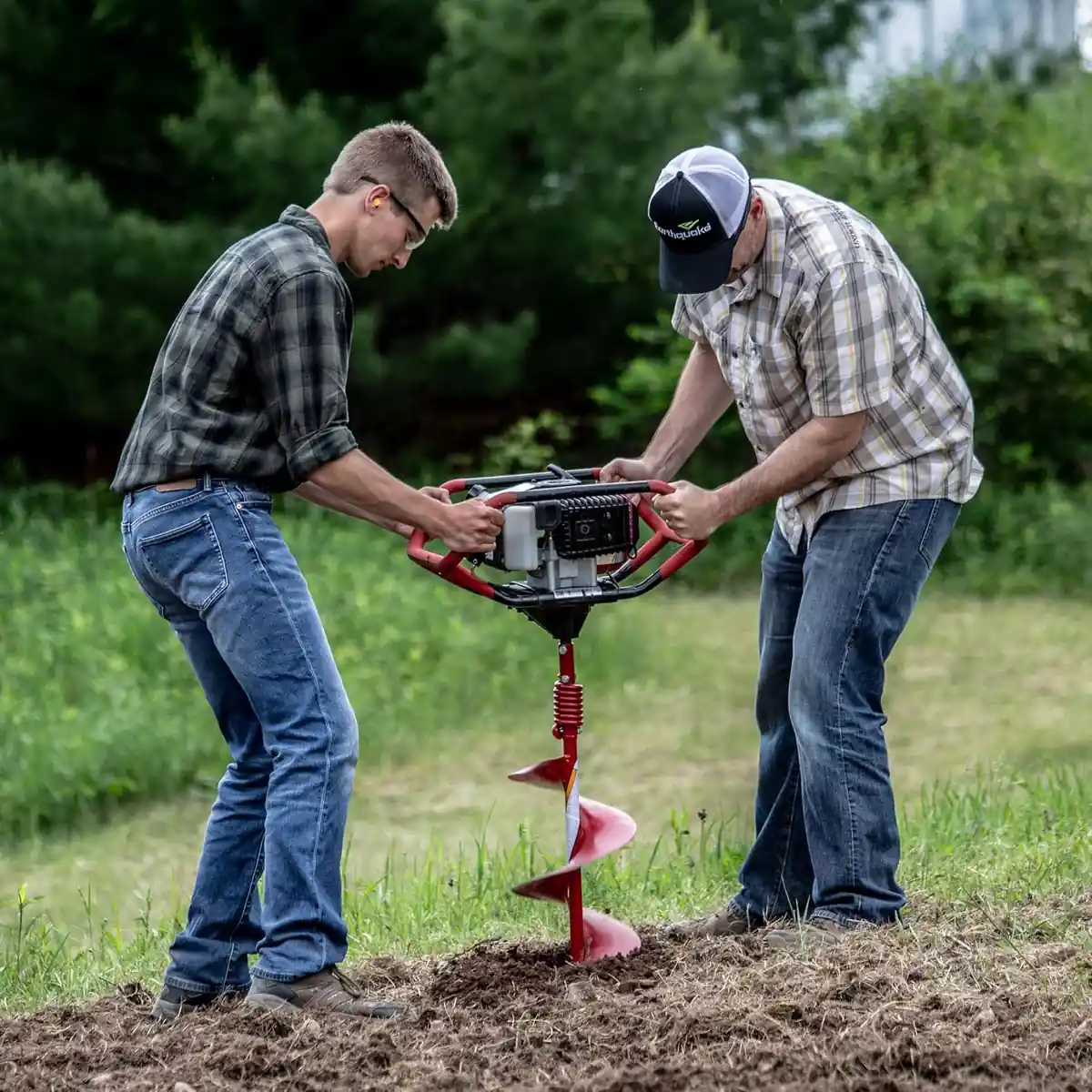
Register it within 30 days. The five-year term needs online registration or a warranty card inside that window, and it excludes augers, blades, extensions, shocktops, grips, cables and filters.
The manual says to always wear a protective hearing device, safety goggles or glasses with side shields, work gloves, sturdy footwear, a long-sleeved shirt or jacket and long trousers, and never shorts, sandals, sneakers or bare feet. The muffler and nearby areas may pass 150 F, and before I touch anything near the exhaust, the full shutdown steps are in the shutdown box further down this page.
Upkeep is printed: the air filter every three months or 20 hours, 4 fl-oz of grease in the gear case checked once a year, and the spark plug at the start of each season. Before you service any of it, the full shutdown steps are in the shutdown box further down this page. For a long rest the manual says to add fuel stabilizer, remove the auger from the power head, grease the output shaft and store it upright.
This is the machine for the buyer who knows the bit width and would rather choose the steel, and who will register the warranty. Skip it if you want a complete kit, a printed bit size or depth, or a manual that explains a two-person method.
FINAL VERDICT
The Dually is the power head I recommend when the bit is your choice. Buy the bit that fits the 7/8 in shaft, register the machine and keep the safety steps in front of you.
It is the power head for a buyer who picks the bit.
3. DC HOUSE 52cc Gas Earth Auger Two-Bit Kit Best Value
The DC HOUSE 52cc is the lowest-priced kit on this page with a 10 in bit in the box: the listing puts a 6 in and a 10 in bit in the box beside a 52cc 2-cycle power head and a fuel mixing bottle. It is my value pick for wide planting holes and small posts. Its weak spot is paperwork, because the manual and the listing give different figures for fuel mix, power and warranty, and I follow the manual.

WHY I CHOSE THIS ✓
Third place and the value label rest on two bit sizes at the lowest price on the page and a manual with real safety lines, including a bystander radius and a helper position. I do not hide the trade: where the manual disagrees with itself on fuel mix and warranty, I ask the maker, and I do not guess.
DC HOUSE 52cc Gas Earth Auger Two-Bit Kit Specs
Key Features:
- Two bits in the kit: the listing includes a 6 in and a 10 in bit, while the manual sells bits as a separate accessory.
- 10 in bit: the widest bit in the kit, for wide planting holes and small posts.
- Throttle trigger lockout: the manual puts a stop switch, a throttle trigger and a lockout lever on one handle, and the trigger will not work until the lockout is engaged.
- Lower support handle: the manual describes a helper position that uses the support handle only.
- Purge bulb and decompression button: both are in the manual’s parts list, and both are there to ease a cold start.
- Automatic centrifugal clutch: the manual names it as the power transmission method.
- Printed bystander radius: the manual says to keep children and animals no nearer than 3 m (10 ft) while the unit is in use.
The manual asks for a shaving action under light downward pressure, and it says not to put excessive body weight on the unit. With a 10 in bit that is the whole technique: squeeze the trigger slowly to engage the clutch, let the weight of the machine do the work and raise the auger now and then to clear the debris, as the manual describes. It also says not to operate the unit in excessively rocky ground.
Before you fit or check the bit, the full shutdown steps are in the shutdown box further down this page. The manual wants the bit secured in the socket with the pin and the R-pin, so I check both pins with my fingers every time. It says to hold the throttle handle and the support handle with thumbs and fingers tightly encircling them, and never to run the unit with the handles above chest height. The manual prints 10.4 kg net with no basis, so I lift the machine by the handlebar frame and guess nothing about what the figure includes.
The manual describes an operator who grips the throttle handle and the lower hand grip, and a helper who guides from the support handle only, and it says holes six inches across or larger may be easier with two people on opposite sides. The helper needs the same protective gear and a plan both of you know before the bit touches the ground. After a long run the manual says to let the engine idle for several minutes so the heat can leave, and before you touch anything near the exhaust, the full shutdown steps are in the shutdown box further down this page.
Confirm the fuel ratio with DC HOUSE before the first tank. The manual and the listing give different mix ratios, so I tape the confirmed number to the can lid and mix one tank at a time.
The manual asks for eye protection that meets ANSI Z87.1 or CE requirements whenever you operate the unit, hearing protection, sturdy no-slip rubber work gloves, long sleeves and long pants, never shorts, and sturdy non-slip shoes, never bare feet. It says not to stand on slippery, uneven or unstable surfaces, and to beware of underground hazards such as electrical, gas, water and telephone lines, so the 811 steps below apply to every hole.
DC HOUSE says not to store a unit with fuel in its tank, and the manual limits mixed fuel to 30 days, or 90 with stabilizer. Before you drain the tank, move the machine or do any storage work, the full shutdown steps are in the shutdown box further down this page. For storage over 30 days the manual adds a longer procedure: purge the line, run the engine dry outdoors and put a few drops of oil in the cylinder through the spark plug hole, with the full shutdown completed again after the engine-running step and before the oil step, any further hands-on work or storage.
It fits a buyer who wants wide planting holes and small posts from one budget gas kit and you will confirm the fuel mix with the maker. Skip it if you want an 8 in bit in the box, a clear one-person rating, a reverse or a manual that agrees with itself.
FINAL VERDICT
The DC HOUSE is the best value earth auger here for the buyer who needs a 10 in bit on a budget. Confirm the ratio, keep the helper plan simple and respect the bystander radius.
It is the budget two-bit kit for wide holes.
4. PROYAMA 54cc Gas Earth Auger Four-Bit Kit Four Bits in the Box
The PROYAMA 54cc is the kit with four bits in the box: PROYAMA’s listing names bits of 4 in, 6 in, 8 in and 12 in, two extension rods of 12 in and 20 in, and a 54cc 2-cycle engine on a welded steel handle frame. I put it fourth for the buyer who wants one purchase to cover small stake holes and a wide 12 in hole.

WHY I CHOSE THIS ✓
I rank it fourth for one plain fact: four bits and two rods in a single box, which no other kit on this page offers. The trade is that it prints no digging depth and no warranty term, so the manual in the box is where I check anything that matters.
PROYAMA 54cc Gas Earth Auger Four-Bit Kit Specs
Key Features:
- Four bits: 4 in, 6 in, 8 in and 12 in, so one box covers stake holes and wide planting holes.
- Two extension rods: 12 in and 20 in rods add reach to whichever bit you fit and promise no depth.
- Welded steel handle frame: PROYAMA’s listing describes a U-shaped steel frame that suits single or two-person operation.
- Gearbox: the listing describes ball-bearing shafts and alloy gears in the gearbox.
- Emergency switch: PROYAMA’s seller notes name one, so the engine has a stop within reach of the handles.
Laid out smallest to largest on the lawn, the four bits read as a staircase of hole widths, and the 12 in bit is the one that gives the engine real work. Before you fit or change a bit, the full shutdown steps are in the shutdown box further down this page. Fit the bit the job needs and leave the others in the box: a 12 in bit on a 54cc engine is a lot of steel to turn.
PROYAMA’s listing says the frame allows single or two-person operation, so the manual in the box settles the number of people, and I follow that count and nothing else. I lay the two rods beside the bits before I decide how much reach a job needs.
Choose the bit first, then the rod. I fit the narrowest bit that gives the hole the job asks for, because the job decides the bit.
Hearing protection, eye protection, gloves and sturdy boots go on before the first pull, as the protective gear box below lists. The muffler stays hot after the engine stops, and before I touch anything near it, the full shutdown steps are in the shutdown box further down this page.
Before I clean, wipe or store any bit, the full shutdown steps are in the shutdown box further down this page. Then I wipe each of the four so soil does not sit on the flights. Bookkeeping is the chore: four bits and two rods are six pieces to keep together, and upkeep otherwise follows the manual in the box.
Choose it if you want several hole widths from one box and will read the manual before the first start. Skip it if you want a printed power figure, a printed weight or a printed warranty term.
FINAL VERDICT
The PROYAMA earth auger is the kit for a buyer who wants the most bit choice in one box. Fit one bit at a time, treat the rods as reach only and keep the safety steps in front of you.
It is the four-bit kit for mixed hole sizes.
5. XtremepowerUS 55cc Gas Earth Auger 12 in Bit Kit Single 12 Inch Bit Kit
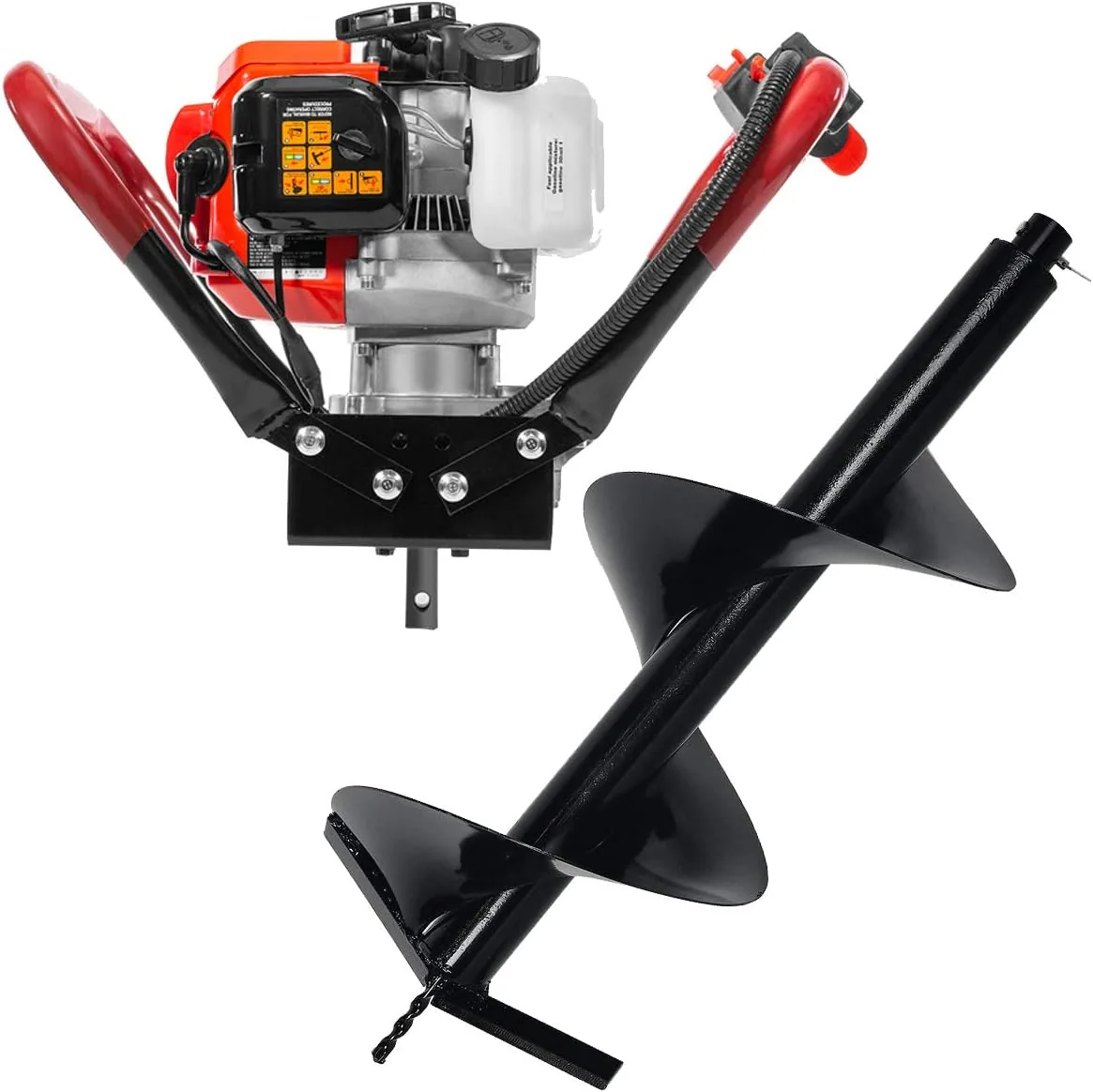
The XtremepowerUS 55cc is the single-bit 12 in kit: a 55cc 2-stroke power head and one 12 in x 28 in bit, as XtremepowerUS lists it, which ties the widest bit listed in any kit on this page. I put it fifth for the buyer who needs one 12 in hole size more than a spread of small bits, and who accepts a single bit in the box. XtremepowerUS lists it as a one-person unit.
WHY I CHOSE THIS ✓
I rank it fifth for one 12 in bit in the box, a single-bit kit that goes straight to the widest hole. The trade is that it comes alone: one bit size, no rods and no spread of widths, so the hole you want has to be a 12 in hole.
XtremepowerUS 55cc Gas Earth Auger 12 in Bit Kit Specs
Key Features:
- 12 in x 28 in bit: a single large auger bit sits in the box, and its 12 in width ties the widest bit listed on this page.
- 55cc 2-cycle engine: a single-cylinder, air-cooled engine with a recoil start.
- Centrifugal clutch: the listing names the clutch type.
- Anti-shock spring: the listing names an anti-shock absorption spring.
- CARB and EPA certified: XtremepowerUS lists both on the page.
Stood upright with the 12 in bit fitted, the bit reached roughly to my knee, and the 12 in flight looked wide beside the handlebar. A 12 in bit moves a great deal of soil on a hand-held unit, so I set my feet and both hands before the bit touches the ground. Hard clay, rock and roots bind a bit, and no maker prints a result for any of them.
A 12 in bit moves a great deal of soil, so I plan where it goes before I start: a tarp or a clear patch of ground, not a flowerbed. Before you attach, change or clear the bit, the full shutdown steps are in the shutdown box further down this page. I take the fuel ratio from the manual in the box and write it on the can before I mix.

Clear the spot of stones first. A wide bit finds every stone in its path, and I walk the ground and pick out what I can find before the engine starts.
The muffler stays hot after the engine stops. Before I touch anything near the exhaust or the bit, the full shutdown steps are in the shutdown box further down this page, and hearing protection stays on until then, with eye protection, gloves and boots.
XtremepowerUS sells this machine in 6 in, 8 in and 12 in versions, so confirm the 12 in bit before you pay, and follow the manual in the box for upkeep. The long bit is the nuisance: a 28 in bit needs a place in the shed where nothing leans against the flights.
Reach for it when you need a 12 inch auger bit in the box and will use the machine for wide holes only. Skip it if you want a spread of bit sizes, extension rods in the kit or a printed weight basis.
FINAL VERDICT
The XtremepowerUS 55cc is the choice when the hole is wide and the bit is the point. Plan where the soil goes and keep the safety steps in front of you.
It is the wide-bit kit for one big hole size.
6. VEVOR D52-F 52cc Gas Earth Auger with Three Extension Rods Most Extension Rods
The VEVOR D52-F is the kit with three extension rods in the box: a 52cc 2-stroke engine, a 6 in and a 10 in bit and three rods, all listed on VEVOR’s parts list. I put it sixth for the buyer who wants an earth auger extension in the box without a second order. VEVOR’s manual prints no digging depth, so the rods add reach and nothing more. I go through this exact kit in my VEVOR 52cc digger review.

WHY I CHOSE THIS ✓
It sits sixth because of three rods in the box, a count the manual’s parts list and the listing share. The trade is a short manual: no weight, no operator count, no warranty term and no underground-line warning, so the safety section below does that work.
VEVOR D52-F 52cc Gas Earth Auger with Three Extension Rods Specs
Key Features:
- Three extension rods: the manual’s parts list and the listing agree, and each rod joins with a pin and clip.
- Two bits: a 150 mm and a 250 mm bit, 800 mm long, listed as 6 in and 10 in.
- Safety switch and trigger: you hold the safety switch, then pull the trigger to build speed.
- Printed bystander radius: VEVOR says to keep everyone at least five meters (about 16 ft) from the work area.
- Sound and vibration table: the manual prints values for idle and operation.
The manual says to hold the drill vertically with the rod against the ground, build speed gradually with the safety switch and trigger, and once the rod has gone 10 cm into the ground, grasp the frame strongly and push down harder.
Before you fit a rod, change a bit or lay the machine down, the full shutdown steps are in the shutdown box further down this page. Laid out on the grass, the 150 mm and 250 mm bits read as two clear hole widths, with the three rods stacked beside them. Each rod joins with a pin and a clip, and lining up the holes and closing the clip took no tools. The manual says to carry the tool by the handle, never by the drill.
Read the stuck-bit line before the first hole. VEVOR’s manual describes releasing the accelerator back to idle to loosen a stuck bit, which is VEVOR’s own method for this model, and before any hands-on work the full shutdown steps are in the shutdown box further down this page.
VEVOR says to wear a helmet, a protective mask, ear protection, gloves, non-slip footwear and protective clothing, and calls the machine for private domestic use only. It says not to work in rain, damp places, on slippery surfaces or on steep slippery slopes. Before I touch anything near the exhaust, the full shutdown steps are in the shutdown box further down this page.
Before you maintain or fuel it, the full shutdown steps are in the shutdown box further down this page. The maintenance table says to clean the air filter each season or every 50 hours, and the mix is 40:1 with no ethanol or methanol. With the machine upright, the red rocker sat under my left thumb and the START-tagged pull handle fell within reach of my right hand.
Choose it if you want an earth auger extension in the box and two bit sizes, and you will read a short manual twice. Skip it if you want a printed warranty, a weight or an operator count.
FINAL VERDICT
The VEVOR D52-F is the kit for a buyer who wants reach in the box. Lay out the rods, read the stuck-bit line and respect the five-meter radius.
It is the kit with the rods already in the box.
7. Baotree 72cc Gas Earth Auger with 6 in and 8 in Bits Only 6 and 8 Inch Bit Pair
The Baotree 72cc is a 72cc engine with a 6 in and an 8 in bit. Baotree’s title names those two bits and extension rods, and the engine is a 72cc 2-stroke on a rectangular handlebar with a pull start. I put it seventh for the buyer who wants a big engine and a 6 inch earth auger bit for planting holes, with an 8 in bit beside it.

WHY I CHOSE THIS ✓
I seat it seventh for the 6 in and 8 in pair on a 72cc engine, the only pair of those two sizes on this page. The trade is a kit I count piece by piece against the manual in the box.
Baotree 72cc Gas Earth Auger with 6 in and 8 in Bits Specs
Key Features:
- 72cc 2-stroke engine: a big displacement for a long run of holes.
- 6 in and 8 in bits: the title names both, one for planting holes and one for wider ones.
- Extension rods: the title lists rods for more reach, and they promise no depth.
- Dual-handle grip: Baotree’s listing describes a dual-handle grip with a quick-release throttle.
- Tool bag with funnel and mixing bottle: the photo shows the bag with its tools, a fuel funnel and a mixing bottle.
Side by side, the 6 in and 8 in bits make an easy pair to understand, and the 8 in is plainly the one that gives a 72cc engine something to do. A 72cc engine on a small bit is not a reason to push harder, and I let the weight of the machine do the work. Hard clay, rock and roots bind a bit whatever the engine size.
Baotree’s listing recommends a 25:1 gas and oil mix, and I treat that as a question for the manual in the box, not the answer. Before I fuel it, the full shutdown steps are in the shutdown box further down this page. The tool bag helps: I lay out the funnel and the mixing bottle on the bench before the fuel can comes out.
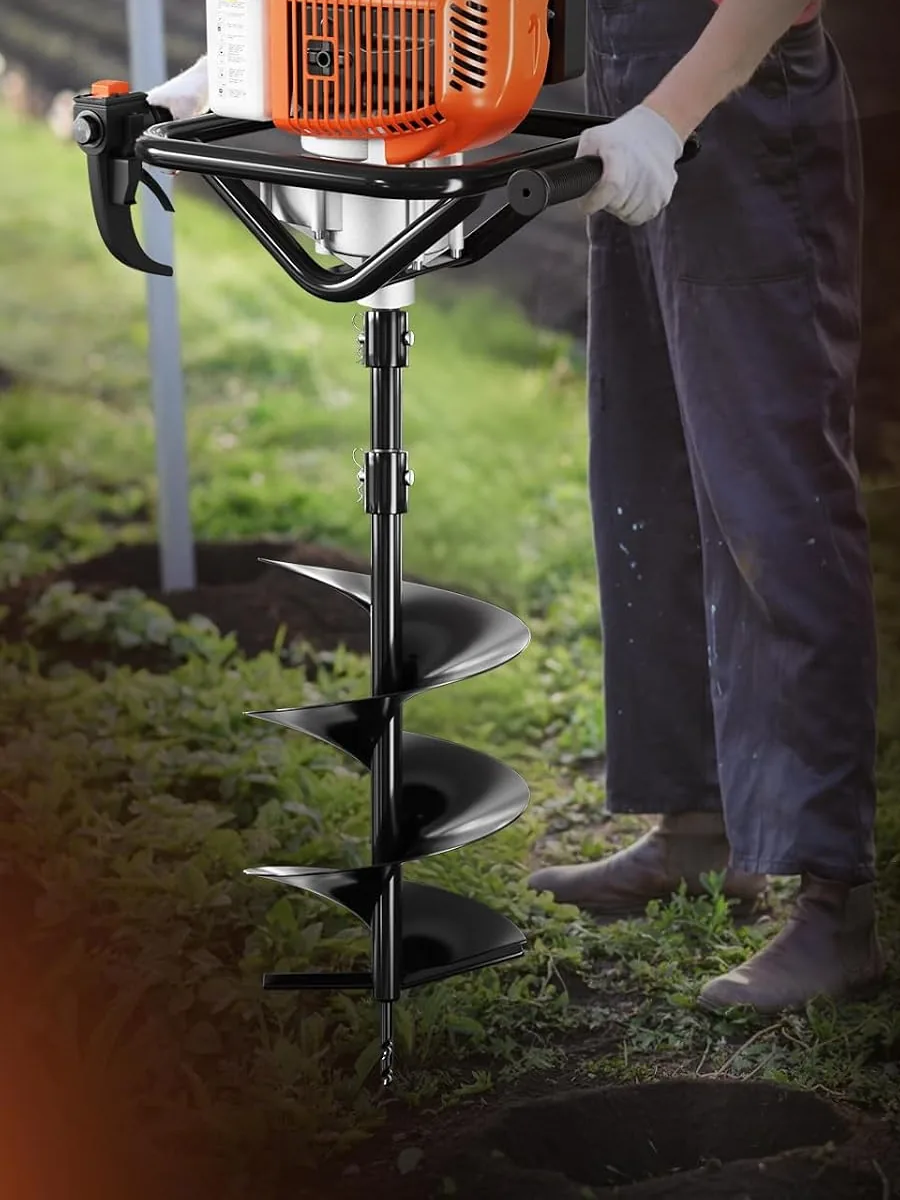
Count the pieces before you start. I lay out every bit and rod from the box and match them to the manual before the first pull.
Hearing protection, eye protection, gloves and boots go on before the first pull. The muffler stays hot after the engine stops, and before I touch anything near it, the full shutdown steps are in the shutdown box further down this page.
Before you lift, load or store the machine, the full shutdown steps are in the shutdown box further down this page. The listing shows 37.6 lb with no basis, so I guess nothing about what it includes and lift the machine by the handlebar, never by the bit. Upkeep follows the manual in the box. Small parts are the nuisance: rods and bits go missing in a shed.
Choose it if you want a 72cc engine and a 6 in and an 8 in bit in one box. Skip it if you want a printed weight basis, a warranty term or an operator count.
FINAL VERDICT
The Baotree 72cc suits a buyer who wants displacement and a planting-sized bit. Count the pieces, read the manual in the box and keep the safety steps in front of you.
It is the 72cc kit with a planting-size bit.
How to Choose the Best Heavy Duty Earth Auger
A heavy duty gas auger is a bigger engine turning a wider bit, so the choice turns on engine size, bit width, the box contents, weight, handling and fuel. I read the manual first, because it is the only page written for the machine in your hands.
Engine Size for a Gas Powered Earth Auger
Engine size is the first sign of a heavy duty machine, and it is the maker’s number. The machines here run from 52cc to 72cc on a 2-cycle engine, and displacement says how big the engine is, never how it digs. A heavy duty post hole auger still binds in rock, roots and frozen ground, and no maker prints a result for any of them.
| Engine size | What it tells you |
|---|---|
| 52cc to 55cc | A mid-size 2-cycle engine, the bottom of this page |
| 72cc | The largest displacement on this page |
| Any size | A maker’s figure for the engine, not a result in your soil |
- Read the cc: it is printed by the maker, so compare it only with other cc figures.
- Skip the horsepower claims: a 2-stroke earth auger sells on cc and bit size, and watts or horsepower on a listing are marketing.
- Match the engine to the job: a long row of wide holes asks more of an engine than one stake hole.
I stand by one rule: any engine is a reason to plan, never a reason to push, and I let the weight of the machine do the work.
Bit Width and Extension Reach
A bit’s width sets the hole, and its length is not a digging depth. The widest bit in any kit here is a 12 inch auger bit, and several kits include a 10 in bit. None of the makers here prints a maximum digging depth. For footing holes, my roundup of the best auger for deck footings covers seven gas, battery and corded machines.
- Diameter: a printed size, never a target for a post or a tree.
- Length: the steel’s length, never a promised depth.
- Extensions: an earth auger extension adds reach to the bit you fit, and the depth your post or footing needs comes from local rules or your extension office.
I lay a tape beside any bit I am weighing, so the printed diameter becomes a width I can see against a gate post.
Power Head Only or Complete Kit
A power head is the engine and gearbox, and a kit adds the bit. One machine on this page ships without a bit, so its first hole needs a second purchase that fits the output shaft. The others include one to four bits, and some add extension rods. Any heavy duty post hole digger sold as a kit tells you its bit count in the title.
| Form | What you get | What you still buy |
|---|---|---|
| Power head only | Engine, gearbox and handlebar | A bit that fits the output shaft |
| Kit with one bit | Power head and one bit | Other sizes and extensions |
| Kit with several bits | Power head and bits in more than one width | Extensions, if none are in the box |
| Kit with rods | Bits and extension rods | Nothing for reach |
- Shaft fit: match the bit to the output shaft size in your manual.
- Bit count: each extra width is a job you can start without another order.
- Extensions: rods and bars add reach and promise no depth.
Before I look at an engine size, I read the line that says what the box holds.
Weight and Carrying Between Holes
A weight is only useful with its basis. Makers print a net weight, a weight of unit, a weight with the bit or a figure with no basis, and figures on different bases cannot be set against each other. Bits, extensions and a full tank add weight to any gas post hole auger.
| Basis | What it tells you |
|---|---|
| Net weight | A label alone; it does not say whether fuel or the bit is counted |
| With bit | The machine plus the steel you carry to the hole |
| With fuel | The machine plus a full tank |
| No basis printed | A guide only; do not compare it with a weight that has one |
- Carry by the handlebar: the manuals say never to carry the machine by the bit.
- Ask what it counts: the bit, the fuel and the handlebar may or may not be in the figure.
- Plan the walk: many holes mean many lifts and many walks between them.
Before I buy, I picture lifting the machine from the shed floor to the truck bed, since the bit and a full tank may not be counted in a printed figure.
Handles, Torque Reaction and Operator Count
The handlebar decides how the machine twists in your hands. Any auger can put torque into your wrists and forearms whenever the bit meets a root or a stone, so a stance you can hold matters more than a spec line. A one man post hole auger puts one set of hands on the bar and leaves nobody to call a stop for you.
Makers differ on how many people run a machine. A two man post hole auger needs a second person who knows the plan, holds the unit as the manual describes and stays clear of the bit, and the DC HOUSE manual describes exactly that helper for holes of 6 in or wider. Use the number of people your exact manual specifies, and never add a helper to a one-person machine unless the manual says so. My roundup of one-person earth augers lists the models you can run alone.
Key Takeaway
The operator count is the maker’s statement for that exact model. Earthquake sells the Dually for one or two people, yet its manual describes no second-operator method, so follow the manual for your machine and nothing else.
Before I judge a handlebar, I stand with the machine upright on the shed floor and set my elbows on it in the stance a dig needs. The best post hole auger for your hands is the one you can hold without leaning your weight on the engine.
Fuel Mix, Warranty and Upkeep
A 2-cycle engine runs on fuel mixed with oil, and the ratio is the maker’s. A gas powered auger post hole digger asks for a fresh mix every outing. Ratios differ by maker: Earthquake prints 50:1 and VEVOR prints 40:1 for its D52-F, and the NEO-TEC and Baotree listings say 25:1. DC HOUSE’s manual and listing disagree, so confirm that ratio with the maker, and use the number in your own manual. A wrong ratio or straight gasoline can harm any 2 stroke earth auger. My roundup of the best gas earth auger ranks five gas models, and each manual sets its own ratio.
- Mix in a clean container: stir it well before it goes in the tank, and never mix in the tank.
- Mixed fuel ages: the DC HOUSE manual limits it to 30 days, or 90 with stabilizer.
- Warranty terms: Earthquake lists five years on the Dually power head with the engine excluded and registration within 30 days; the VEVOR manuals print no term.
Pro Tip
Register on the day the machine arrives and keep the receipt with the manual. Earthquake lists the air filter every three months or 20 hours and a gear case check once a year, so write the dates on the manual’s cover.
I mix one tank at a time in a marked bottle, so old mix never sits in the shed.
Safety Rules and the Full Shutdown Steps
An earth auger drives a steel bit that screws into the ground and can bind on a root, a rock or a buried object. When it binds, the machine can twist violently in your hands, strike you or anyone near you, and throw you off balance. The shutdown box below is the one every product review points to, and it applies to every task. Read your own manual first, because makers differ on bystander distance, underground lines and how to free a stuck bit.
Shutdown Before You Touch the Bit
Shutdown before you clear or free the bit, change or attach the bit, free a stuck bit, adjust, check or add oil or fuel, clean, load, move, store or leave the auger. Never reach toward the bit while it turns, and never clear it or free it with the machine running. Gas auger: release the throttle, trigger or control, turn the engine off, wait until the bit and every moving part have stopped completely, then disconnect the spark plug wire (a spark plug cap on some makes) and secure it away from the plug. Let the engine and muffler cool before you touch the bit or anything near the exhaust. Only then free a stuck bit or clear wrapped material, using only the method your manual specifies (gloves do not make grabbing sharp wire or cutting edges safe), and check the bit and guards for damage. Do not handle unidentified wire, cables or pipes. Do not use reverse or run the engine to back the bit out unless your manual expressly authorizes it for this task, with both hands on the designated handles and everyone clear of the bit; complete the full shutdown again before any further hands-on work. Add every step your manual gives, in its order, and refit every guard and shield before you restart.
Protective Gear
Wear safety glasses with side shields or goggles meeting your manual’s specification, including ANSI Z87.1 where required, and add a face shield where required. Wear hearing protection with gas engines and wherever your manual requires it. Wear long pants and sturdy, closed footwear with secure traction, plus any additional protection your manual specifies. Tie back long hair, remove jewelry and secure drawstrings; do not wear loose clothing or loose gloves. Use the gloves specified for the task and keep hair, clothing, gloves, hands and feet away from moving parts.
A systematic review of 18 articles found that workers exposed to both hand-arm vibration and noise had greater hearing loss than non-exposed workers (1). It covered agricultural and forestry work, mostly chainsaws, so it supports hearing protection and says nothing about the loudness of any auger. I lay out glasses, ear protection, gloves and boots on the shed bench before my hand goes near the primer.
Clear the Area
Before you start, walk the spot and remove rocks, sticks, wire, hose, stakes and anything else the bit could catch or throw. Identify irrigation lines, drip lines, cables and sprinkler heads before you start, and take loose garden hoses out of the work area. Do not handle or move unidentified cables, pipes or utility lines: keep the auger away from them and contact the utility if their location is uncertain.
Buried Lines
Contact 811 before digging and include every planned hole in the locate request. Wait the required state notice period and confirm responses from every notified utility, including markings or a clear/no-conflict response for the work area. Resolve missing or conflicting responses before digging. Follow state ticket-validity and tolerance-zone rules, preserve markings, and keep augers outside the required clearance area. Near marks, use careful hand digging or another locating method permitted by state rules and the utility; obey any stricter auger-manual prohibition. Arrange separate locating for private services that 811 does not cover (irrigation lines, cables). Do not dig where a service’s location remains uncertain, and a larger machine is no workaround. No marking makes any augering depth safe above a buried service.
According to PHMSA, every state runs a one-call center and the call is free, and the notice period is set by state law. Damaging buried utilities brings considerable safety risks to workers and substantial cost, as a trial of utility workers noted (2). The Earthquake Dually manual says not to drill above underground utilities, the DC HOUSE manual says to beware of underground hazards, and the VEVOR manual prints no underground-line warning, so the 811 steps above apply to every model here.
Bystanders
Keep children, pets and other people out of the work area and at least the distance specified in your exact manual. Stop if anyone enters that area. DC HOUSE prints 3 m (10 ft) for its unit, and VEVOR prints at least five meters for the D52-F. The Earthquake Dually manual prints no distance. Baotree’s listing says to keep bystanders 15 feet away, which is a listing line and not a manual figure, and it never makes a distance safe. NEO-TEC, PROYAMA and XtremepowerUS give no distance, so keep everyone well clear of the work area, as your manual describes. No distance makes a work area safe on its own: keep watching it.
Binding and Torque Reaction
If the bit hits a root, a rock or a buried object, it can bind and the machine can twist or kick. Keep firm, balanced footing and hold the designated handles with both hands. Keep hands and feet away from the bit; never grasp or brace the bit or shaft. Release the throttle or trigger immediately if the bit binds or control is threatened, then complete the full shutdown in the shutdown box and inspect for damage before restarting. Use reverse only where your manual authorizes it for your model.
A lab study of simulated tool torque reaction on a handle found very high wrist muscle activity even though the torque pulses were short (3). It used small threaded-fastener tool profiles, not augers, so I take only the general point that torque reaction loads the wrist, and with a bigger engine I keep both hands on the handles from the first turn.
Stuck Bit
If the bit sticks in the hole or material wraps around it, do not force it and do not reach for the bit. Stop and complete the full shutdown in the shutdown box before touching or inspecting it. Use only the freeing or clearing method specified in your exact manual; gloves do not make grabbing sharp wire or cutting edges safe. Do not handle unidentified wire, cables or pipes. Powered reverse is permitted only when your manual expressly authorizes it for that task, with both hands on the designated handles and everyone clear of the bit. Complete the full shutdown again before any subsequent hands-on work. If your manual gives no procedure, obtain manufacturer or qualified service guidance.
Slopes and Footing
On a slope or uneven ground, slow down, keep firm footing and follow only the slope or footing rule in your own manual. If your manual gives no such instruction, obtain guidance from the manufacturer before using the auger on a slope.
Soil Condition
Do not dig in frozen or rock-hard ground or in ground full of roots and stones: the bit can bind and the machine can twist or kick.
Refuelling
Before refuelling, complete the full gas shutdown in the shutdown box. Refuel outdoors on the ground, not in a truck or trailer, with the engine cooled. Follow your exact manual’s precautions for ignition sources, filling the tank and dealing with spilled fuel. Mix fuel and oil only as the exact manual says.
Carbon Monoxide
Never start or run a gas auger indoors or in a garage or shed, even with the doors open. Start and run it outdoors: the exhaust contains deadly carbon monoxide, which has no color, taste or smell.
A medical examiner reviewed carbon monoxide cases from small engines run in poorly ventilated spaces and stressed that responders need to know these sources exist (4). A gas-powered earth auger belongs outdoors only, and a cooled machine with an empty tank is the only kind I store indoors.
Lifting and Transport
Before you lift, load, carry or move the auger, complete the full shutdown in the shutdown box. Load and unload only as your manual describes, and refuel a gas unit on the ground, not in the truck bed. Follow the manual’s lifting and handling instructions. Earthquake says fuel left in the tank travels in an open vehicle in an upright position and never in an enclosed space, and DC HOUSE says not to store a unit with fuel in its tank and gives a longer procedure for storage over 30 days.
Fatigue and Vibration
Digging with an auger is heavy, jarring work that twists your arms and back. Take breaks, stop when you are tired or your attention slips, and use the gloves your manual recommends.
A pooled analysis of studies of vibration-induced white finger found that the standard’s exposure-response relation gives a conservative estimate of when white finger is likely to begin (5). Those studies covered mixed vibrating tools, so I treat them as a reason to take breaks, never as a measure of any auger.
When a Rental or Contractor Machine Is the Better Call
A homeowner gas auger cuts workable soil, and it does not cut rock. Hard clay, roots and rock-hard ground bind a bit, and no maker here prints a result for any of them. Frozen ground waits for a thaw.
- Many holes: a long row of wide holes asks for more fuel stops and more lifts than one machine on one tank.
- Wide bits: check the largest bit your manual supports before you plan the job.
- Deep holes: an extension adds reach and promises no depth, and the depth you need comes from local rules.
For many holes, wide bits or deep holes, an earth auger rental or a contractor may be the better call. None of that changes the buried-line steps above, which apply to every machine, rented or owned. A buyer who needs a machine for one weekend can rent an earth auger and skip the storage, while a few wide holes in workable soil suit the machine you will use again. For fence work, I compare seven gas, corded and battery models in my roundup of augers for fence posts.
My Overall Verdict
Seven gas augers made this page, and the NEO-TEC 72cc leads it as a 72cc complete kit, with an 8 in bit and an extension bar in the box. The Dually takes the higher-priced place as a power head for the buyer who picks the bit, and the DC HOUSE takes the value place with two bit sizes.
1. NEO-TEC 72cc Gas Earth Auger with 8 in Bit Best Overall
For a buyer with a long row of holes who wants 72cc and an 8 in bit in one box.

2. Earthquake Dually 10310 Gas Earth Auger Powerhead Best Premium
For a buyer who knows the bit width and wants a manual-backed power head.

3. DC HOUSE 52cc Gas Earth Auger Two-Bit Kit Best Value
For a budget buyer who wants a 10 in bit and will confirm the fuel mix.
Match the box to the job, mix by the ratio in your manual and complete the full shutdown before you touch the bit. If nothing on your list pulls you elsewhere, buy the NEO-TEC, the best heavy duty earth auger on this page for a long row of holes. My roundup of seven earth augers covers gas, corded and battery models across more kinds of digging.
Why NEO-TEC 72cc Gas Earth Auger with 8 in Bit Might Be the Best Choice
I rank the NEO-TEC first because it answers the three questions a heavy duty buyer asks: how big is the engine, is there a bit and what does the box hold. The listing gives a 72cc engine, an 8 in bit and an extension bar, with a lock on the throttle.
The trade is California: NEO-TEC says the machine is not CARB certified and cannot ship there.
Here is what the NEO-TEC gives you:
✓ 72cc engine: the largest size on this page.
✓ 8 in bit: named in the title, in the box.
✓ Extension bar: adds reach and promises no depth.
✓ Throttle lock: a side-mounted throttle with a safety lock.
✓ Recoil start: nothing to charge or plug in.
Frequently Asked Questions
How to dig deep post holes?
Dig deep post holes by fitting the extension your machine takes and clearing the hole as your manual describes, while the depth itself comes from your local rules or extension office. VEVOR includes three rods and PROYAMA lists two, yet no maker on this page prints a maximum digging depth.
What makes an earth auger heavy duty?
An earth auger is heavy duty when its engine and bit sizes are built for bigger holes, and the proof is what the maker prints. The engines here run from 52cc to 72cc and the bits reach 10 in or 12 in, yet no maker prints a result in hard soil, rock or roots.
Is a heavy duty earth auger too big for a homeowner?
A 72cc engine suits a homeowner only when that person can hold the handlebar with both hands and stay balanced if the bit binds. Binding and torque reaction are hazards of every model, so match your manual’s machine, bit and operator rules to the job and keep to the shutdown steps above.
What size bit can a heavy duty post hole auger turn?
A heavy duty post hole auger turns the bit sizes its maker prints or lists, and they differ by machine. XtremepowerUS lists a 12 in bit, DC HOUSE and VEVOR include a 10 in bit, Earthquake’s listing says its Dually takes bits up to 10 in, and NEO-TEC names an 8 in bit.
Do heavy duty earth augers need two people?
Heavy duty earth augers need the number of people their manual specifies, and the makers here differ. The DC HOUSE manual describes an operator and a helper, Earthquake sells the Dually for one or two people, and XtremepowerUS lists its 55cc as a one-person unit, while the NEO-TEC listing names no count.
References
- Thaper R, Sesek R, Garnett R, Acosta-Sojo Y, Purdy GT. The combined impact of hand-arm vibration and noise exposure on hearing sensitivity of agricultural/forestry workers: a systematic literature review. Int J Environ Res Public Health. 2023;20(5):4276.
- Gallagher AG, Hart M, Cleary D, et al. Proficiency based progression simulation training significantly reduces utility strikes: a prospective, randomized and blinded study. PLoS One. 2020;15(5):e0231979.
- Armstrong T, Bir C, Foulke J, Martin B, Finsen L, Sjogaard G. Muscle responses to simulated torque reactions of hand-held power tools. Ergonomics. 1999;42(1):146-159.
- Hyson BE, Friedman BM, Spear B, Bishop-Freeman SC. Lethal carbon monoxide generated from small internal combustion engines. J Anal Toxicol. 2024;48(8):625-629.
- Scholz MF, Brammer AJ, Marburg S. Exposure-response relation for vibration-induced white finger: inferences from a published meta-analysis of population groups. Int Arch Occup Environ Health. 2023;96(5):757-770.
Safety Note: Only an adult who has read the manual and understands the controls should use an earth auger or post hole digger, never a child or anyone tired or impaired. Use the number of people your manual specifies, and keep everyone else out of the work area. The rotating bit can catch hair, clothing and gloves, and it can bind on a root, a rock or a buried object: the machine can then twist or kick in your hands. Stand with firm, balanced footing and hold the designated handles with both hands. Keep hands and feet away from the bit; never grasp or brace the bit or shaft. Never wrap the power cord around your hand, arm or body. If utility contact or a gas leak is suspected, stop work immediately. Do not touch, inspect, free or move the auger or exposed service, and do not attempt the normal hands-on shutdown or disconnect electrical connections in the suspected leak area. Leave the area, keep others away and contact the utility from a safe location; call 911 for a suspected gas leak or immediate danger. Otherwise, release the throttle or trigger immediately if the bit binds or control is threatened, then follow the shutdown procedure. On a two-person unit, both operators must understand the controls and agree on start and stop signals before starting; stop whenever either operator calls stop. Use reverse only where your manual expressly authorizes it. Never touch or clear the bit while it turns. Before you clear or free the bit, change or attach the bit, adjust, check or add oil or fuel, clean, load, move, store or leave the auger, complete the shutdown for its power type. Corded electric: release the switch or trigger, wait until the bit has stopped completely, then unplug it from the outlet by the plug, not the cord; before transport or storage, also let the motor cool. Battery: release the switch or trigger, wait until the bit has stopped completely, then remove the battery, and the switch key where the model has one. Gas: release the throttle, trigger or control, turn the engine off, wait until the bit and every moving part have stopped completely, then disconnect the spark plug wire and secure it away from the plug, and let the engine and muffler cool before touching the bit, engine, muffler or anything near the exhaust. For a drill-driven bit or any attachment system, follow the shutdown instructions in both the bit or attachment manual and the power-head or drill manual. If the bit sticks or material wraps around it, stop and complete the full shutdown before touching or inspecting it. Use only the freeing or clearing method specified in the exact manual; gloves do not make grabbing sharp wire or cutting edges safe. Do not handle unidentified wire, cables or pipes. Powered reverse is permitted only when the exact manual expressly authorizes it for that task, with both hands on the designated handles and everyone clear of the bit. Complete the full shutdown again before any subsequent hands-on work. Wear safety glasses with side shields or goggles meeting the manual’s specification, including ANSI Z87.1 where required; add a face shield where required. Wear hearing protection with gas engines and wherever the manual requires it. Wear long pants and sturdy, closed footwear with secure traction, plus any additional footwear protection the manual specifies. Tie back long hair, remove jewelry and secure drawstrings; do not wear loose clothing or loose gloves. Use the gloves specified for the task and keep them, clothing, hair, hands and feet away from moving parts. Contact 811 before digging and include every planned hole in the locate request. Wait the required state notice period and confirm that every notified utility has responded with markings or a clear/no-conflict response for the work area. Resolve missing or conflicting responses before digging. Preserve the marks and follow your state’s ticket-validity and tolerance-zone rules. Keep the auger out of the required clearance area; near marks, use careful hand digging or another locating method permitted by state rules and the utility. Follow any stricter prohibition in the auger’s manual. Marks do not show a safe drilling depth. Arrange to locate private irrigation lines, cables and other services that 811 may not cover. If a line’s location remains uncertain, do not dig there. Do not handle or move unidentified cables, pipes or utility lines. Before you start, remove rocks, sticks, wire and loose hoses, and identify irrigation lines, drip lines and sprinkler heads. Keep children, pets and other people out of the work area and at least the distance your exact manual specifies. Stop if anyone enters that area. If your manual gives no number, keep everyone well clear of the work area as it directs. No single distance is safe for every auger. On a slope or uneven ground, slow down, keep firm footing and follow only your manual’s rule. Do not dig in frozen or rock-hard ground. Before refuelling, complete the full gas shutdown described above. Refuel outdoors on the ground, not in a truck or trailer, with the engine cooled. Keep fuel away from smoking, flames, sparks and other ignition sources. Use an approved fuel container, avoid overfilling, secure the cap and follow the manual’s spill-cleanup and restart-location instructions; do not start with a fuel leak. Use the specified fuel and oil arrangement for that engine. Never start or run a gas auger indoors, in a garage or shed, or in an enclosed or poorly ventilated area, even with doors open. Operate outdoors where exhaust cannot accumulate or enter occupied spaces through doors, windows or air intakes. Exhaust contains deadly carbon monoxide. For a corded auger, inspect the cord and extension cord before use and do not use damaged cords or plugs. Use an outdoor extension cord meeting the exact manual’s gauge, length, plug and grounding requirements, and follow its GFCI instructions. Keep connections dry and the cord clear of the bit, heat, oil and sharp edges. Never carry the auger by its cord or wrap the cord around your body. Do not use it in rain or wet conditions prohibited by the manual. Use only manufacturer-approved batteries and chargers for the exact model. Complete the battery shutdown before removing or changing a battery, and keep the switch off and fingers off the trigger when installing one. Do not use damaged or modified batteries or chargers. Keep loose battery terminals away from metal objects, and follow the battery and charger manuals for moisture exposure, charging temperature, cooling and storage. Load and unload only as your manual describes, and store the auger dry and out of children’s reach. Take breaks and stop when you are tired.