

The best gas chainsaw is the one that matches the wood you cut, and gas wins when the log is big, the day is long and no outlet is near. I run a 3.7-acre apricot and plum orchard, so my chainsaw jobs are dead stems, big limbs and storm wood, and I ran these five saws on that wood.
Below are five rear-handle gas saws, from a household saw with a 12 in log limit to my pick, the Husqvarna 455 Rancher 20 in 55.5 cc Gas Chainsaw with its 20 in bar. Each comes with its limits, because a chainsaw is the most dangerous tool I recommend.
Best Gas Chainsaw Reviews 2026 and the 5 Saws I Put to Work
These are the five gas saws I recommend, ranked by how well they cover real yard and orchard wood, with the limit of each one stated. All five are two-stroke rear-handle saws that need mixed fuel and two-handed use.
1. Husqvarna 455 Rancher 20 in 55.5 cc Gas Chainsaw Best Overall
The Husqvarna 455 Rancher is the best gas chainsaw here for anyone who cuts wood already lying on the ground and wants one powerhead for limbs, trunk lengths and storm wood. Its 55.5 cc engine pulls a 20 in bar, and the manual approves bars from 15 to 24 in, though bars over 20 in are professional-grade territory and a homeowner stays at 20 in or under. It is built for forest work, which means two hands, the full protective kit and real training before you ask it for anything beyond cutting wood on the ground.

WHY I CHOSE THIS ✓
I chose the 455 as my top gas saw because it pairs a 20 in bar with two ways to stop the chain, a decompression valve and an oiler I can set with a screw. Husqvarna approves bars up to 24 in on the same powerhead, though I stay at 20 in or under at home. It asks more of you than a battery saw: a measured mix, fresh fuel and a clean cooling area. That is a fair trade when the wood is thick and the day is long.
Husqvarna 455 Rancher 20 in 55.5 cc Gas Chainsaw Specs
Key Features:
- 55.5 cc engine: Husqvarna rates it at 3.5 hp at 9000 rpm, which is the power a 20 in chain needs to keep moving through a log cut.
- Two ways to stop the chain: push the front hand guard forward by hand, or let the inertia release act in a kickback. The manual gives a separate test for each.
- Decompression valve and air purge bulb: both sit in the manual’s start steps, so a cold start follows a fixed order and not a guess.
- Automatic, adjustable oiler: a pump feeds chain oil on its own and a screw sets the flow. The manual’s check is a clear oil line after one minute at 3/4 throttle.
- Three vibration damping units: they isolate the handles from the engine, which counts most late in a long cutting session.
- Approved bars from 15 to 24 in: a different approved bar means a new bar and chain, not a new saw. Bars over 20 in are professional-grade, so a homeowner stays at 20 in or under.
- Fuel runs out before chain oil: the manual says the saw is built so the chain keeps its lubrication to the end of the tank.
On dead plum limbs and trunk sections the 455 held its speed through the cut. The 20 in bar was the right length for the biggest piece I cut, and I never wanted more bar than that. Husqvarna says to run full throttle in the cut and drop to idle after it.
At 13.2 lb for the powerhead without bar and chain, you feel this saw at arm’s length late in a session, and the bar, chain, fuel and oil add weight that Husqvarna does not publish. Fuel is a 50:1 mix, 2 1/2 US fl oz of two-stroke oil per gallon, with no more than 10 percent ethanol. The manual says not to mix fuel for more than a month at a time.
Resin was the surprise. Gum from cut stone fruit wood built up around the brake band and clutch drum, and Husqvarna says dirt there can reduce the brake’s function, so I brush that area clean. Cold changes the routine too: at 0 C (32 F) or colder the manual has you remove the plug in the cylinder cover, at minus 5 C (23 F) or colder fit the winter cover on the starter housing, and take both off again as it warms. The extended warranty program excludes agricultural use, so read its terms before you count on it for farm work.
Go easy on a new saw: the manual says not to run extended full throttle without load during the first 10 hours. Full throttle belongs in the cut.
For any chain, bar or clutch-cover job, this is the order: Release the trigger, engage the chain brake, switch the engine off and wait until the chain has stopped, then let the engine and muffler cool and pull the spark plug cap off. Put on gloves before touching the chain. Release the chain brake only when the exact manual’s procedure requires it (for example to remove the clutch cover or check that the chain moves freely), and never force a locked chain or cover.
Weekly, I clean the cooling system, the air filter and the carburetor area. Monthly, the brake band gets a check against the 0.6 mm minimum, and the spark plug gets cleaned. Turning the guide bar over each day extends its life. What annoyed me was the chain: it stretches, and every adjustment needs the combination wrench.
Buy it if you cut limbs, storm wood and firewood lengths on the ground and want a 20 in saw with a documented bar range. Skip it if you want the lightest saw, a tool-free tensioner or a quiet saw for a few small branches beside the house.
FINAL VERDICT
The 455 is the saw I trust for thick wood and long work. It gives you a 20 in bar, two ways to stop the chain and a documented bar range. Choose it when you will keep up the mix and the maintenance a two-stroke needs.
It is the 20 in gas saw I reach for when the wood is thick.
2. ECHO CS-590 Timber Wolf 20 in 59.8 cc Gas Chainsaw Best Premium
The ECHO CS-590 Timber Wolf has the widest bar choice on this page: the manual approves 16, 18, 20, 24 and 27 in bars on one 59.8 cc powerhead, and a 20 in bar comes in the box; bars over 20 in are professional-grade, so a homeowner stays at 20 in or under. It carries Best Premium here on engine size, bar range and a 5 year consumer warranty that ECHO lists on its product page, while its price sits in the upper mid-range. Buy it for firewood lengths and limbs on the ground, and plan for a fuel routine with firm limits.

WHY I CHOSE THIS ✓
I put the CS-590 second because it gives you the most bar choices and a 59.8 mL engine to run them. The optional Kick Guard is a fair answer for a buyer who is new to saws. The price is a strict fuel rule and a tensioner that needs tools. If your wood runs from limbs to thick logs, that choice matters more than the extra care.
ECHO CS-590 Timber Wolf 20 in 59.8 cc Gas Chainsaw Specs
Key Features:
- 59.8 mL engine: ECHO publishes displacement and no horsepower, so 3.65 cu in is the engine figure to go by.
- Bars from 16 to 27 in: the manual’s table allows them on one powerhead, though a homeowner stays at 20 in or under.
- Lever and kickback-energy brake: the manual lists a hand lever that locks the chain for starting and a brake that acts on kickback energy.
- Optional Kick Guard: this bar nose guard is sold separately and is not on the bar at purchase. ECHO’s manual calls it especially recommended for beginners, homeowners or chainsaw novices.
- Decompression device and purge bulb: both sit in the manual’s start steps, with a fast-idle latch for the first seconds of running.
- Side-access tensioner: you turn the adjuster on the side of the saw, then tighten the sprocket guard nuts to 20 to 23 N-m (175 to 200 lbf-in).
- Adjustable automatic oiler: the pump is clutch-driven, so ECHO says it feeds oil only while the chain moves.
The chain came off the bar at the first knot of a dead plum limb, and I had heard the saw change its note just before it jumped. The tension had drifted, and ECHO’s manual says a loose chain can jump out of the guide bar rail slot and damage metal engine parts. It also says all chains need frequent adjustments, which I now treat as a rule of this saw. Once tension was right the 59.8 mL engine pulled through the same limb without any fuss.
Fuel is where this saw is strictest. ECHO calls for 89 octane unleaded bought within the last 30 days, up to 10 percent ethanol, no E15 or E85, and a certified two-stroke oil at 50:1, which is 2.6 fl oz per gallon. The manual warns that skipping certified oil can void the engine warranty, and it limits mixed fuel to what you will use in 30 days, or 90 days with a stabilizer.
A saw that sat with old mix would not start for me until I put in fresh mix and a clean air filter, and then it caught on the third pull. Before cutting a dead stump close to the drip line, I staked the line so the saw and the cut pieces stayed clear of the emitters. Sap needs attention as well: ECHO says some tree sap and resins are corrosive, so the bar, sprocket guard and sprocket area get cleaned after every use. At 13.2 lb dry without bar and chain, this is a heavy saw by the end of an afternoon.

Start a gas saw with the chain brake engaged, on the ground with the bar clear of anything or held firmly as the manual shows, never by drop-starting it, and at least 10 feet from where you fuelled it. On this saw, squeeze and release the throttle the moment the engine starts to free the fast-idle latch, because ECHO warns of severe brake damage if you do not.
Wear impact-rated safety glasses with side protection marked Z87+ (a mesh face screen adds to them but never replaces them), hearing protection, chainsaw chaps or chainsaw trousers used within their maker’s stated limits (some are not designed to stop a battery or corded saw’s chain, and no clothing guarantees protection), work gloves and sturdy boots with ankle support, plus a hard hat when you fell a tree or anything can fall from above.
Living with the CS-590 means a fuel routine you keep. I mix only what I will use inside 30 days and label the can with the date. The saw is loud, and ECHO publishes no sound figure, so hearing protection goes on before the pull. What annoyed me was the brake and latch order, which ECHO repeats three times for a reason.
The CS-590 is the best gas chainsaw on this page for bar choice, so buy it if you cut limbs and thick logs on the ground and may want a shorter or longer bar within the homeowner range. Skip it if you want the lightest saw, a published horsepower or sound figure, or a saw that forgives stale fuel.
FINAL VERDICT
Choose the CS-590 when the wood varies and you want bar choices from 16 to 20 in. Add the Kick Guard if you are new to chainsaws, and keep the fuel fresh.
It is the saw with the most bar options on this page.
3. Husqvarna 130 16 in 38 cc Gas Chainsaw Best Value
The Husqvarna 130 is the gas saw I recommend when you want Husqvarna’s dealer network and a manual with every part number, without paying for a big engine. It has a 38 cc engine and a 16 in bar, and the manual gives it a usable cutting length of 13 to 15 in. That makes it a saw for small limbs and short logs on the ground, and its 38 cc engine is the smallest on this page.
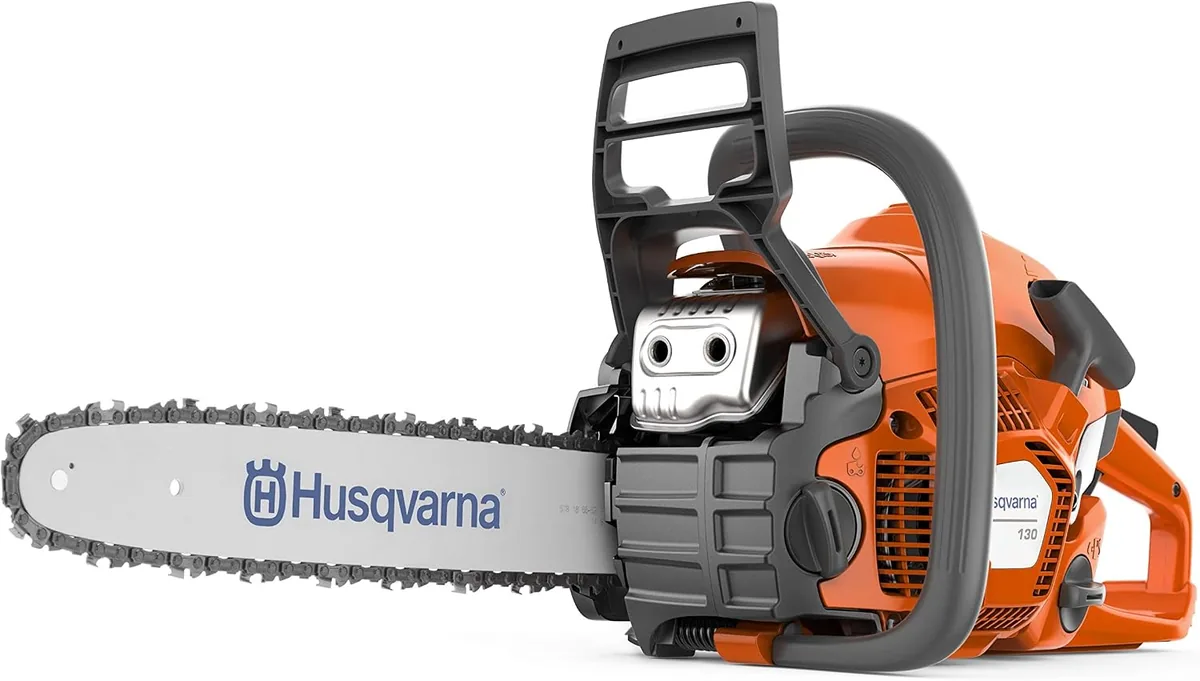
WHY I CHOSE THIS ✓
I chose the 130 as best value because it is a low-cost way into a saw with a dealer network and a full manual. Husqvarna names every part, from the bar to the file, and states a 2 year standard consumer warranty. I rank it third on value for small jobs, and its weak point is plain: 38 cc is the smallest engine on this page. If your wood is limbs and short logs, it is enough saw.
Husqvarna 130 16 in 38 cc Gas Chainsaw Specs
Key Features:
- 38 cc engine at 2.0 hp: Husqvarna’s figure at 9000 rpm, matched to a 16 in bar and a 3/8 in pitch chain.
- Two ways to stop the chain: the manual says the brake engages by your left hand or by the inertia release.
- Air purge bulb: the cold start is choke out, six pushes on the bulb, then the pull, and the manual describes no decompression valve to learn.
- Spring-return stop switch: it goes back to the start position by itself, so the saw is ready for the next start.
- Vibration damping system: the manual lists it between the body and the handle unit, and Husqvarna markets it as LowVib.
- Automatic oil pump: the manual’s check is a line of oil after one minute at 3/4 throttle with the bar about 8 in above a light surface.
- Published parts list: bar 578186656, S93G chain and a 5/32 in file are named, so replacements are easy to match.
On small plum and apricot limbs the 130 cut cleanly, and the usable 13 to 15 in cutting length is the number I worked to. Husqvarna says the usable length is usually about an inch under the bar’s called length. Full throttle goes into the cut and idle comes after it, because the manual warns that long full throttle with no load can damage the engine. The manual also warns of a high accident risk when you limb.
The 130 is light for a gas saw at 10.3 lb, and the manual does not say what that weight includes, so treat it as the powerhead. It is loud: Husqvarna’s manual lists 102 dB(A) at the operator’s ear, so hearing protection is part of the saw. Fuel is a 50:1 mix, 2 1/2 US fl oz of oil per gallon, with no more than 10 percent ethanol and mix no older than one month.
I lifted each log onto a stand so the chain stayed out of the dirt, as the manual advises. Dull work shows itself fast: when the pile turned to fine dust and I had to push the saw, the chain was done. I ran the oil check on a light board before the first cut, and a clear line showed. The hedgerow stems that had gone thick were the second job, and anything past 15 in of wood is beyond what this bar cuts in one pass.
Mixed fuel keeps for a month at most, so mix small and measure the oil. Husqvarna warns that small errors change the ratio a lot when you mix small quantities.
Before each use, inspect the saw as its manual describes: test the chain brake by the manual’s method, and check the throttle trigger lockout, the stop switch, the chain catcher, the guards and the chain’s sharpness, tension and condition; on a gas saw the chain must not move at idle. If any check fails, do not use the saw until it is repaired, and never disable a safety device. Husqvarna recommends the brake check each time before use, and the exact test for the 130 is in its manual.
Living with it is simple, if you accept a two-stroke. The manual wants the brake band at least 0.6 mm thick and wood dust and resin brushed off the brake and clutch drum. Chains need frequent tension checks until they are run in, and the manual says to avoid long full throttle without load for the first 10 hours. What bothered me was the release step: after the engine starts, the manual has you release the brake only with a secure two-handed grip, and the chain moves when you do.
For small limbs and short logs on the ground, this is the best gas chainsaw for the money here. Skip it if you cut logs wider than 13 to 15 in, want a longer bar than the manual approves or need a quiet saw.
FINAL VERDICT
The 130 earns third place on value. It gives a small-wood gas saw with a full manual and a standard 2 year warranty. Pick it for limbs and short logs, and nothing thicker.
It is the small gas saw I recommend for limbs and short logs.
4. ECHO CS-4510 18 in 45 cc Gas Chainsaw Best 18 Inch Gas Chainsaw
The ECHO CS-4510 is the mid-size saw for a buyer who wants an 18 in bar without stepping up to a 55 cc engine. Its 45 cc engine drives a 0.325 in pitch chain, and ECHO lists 5 years of consumer warranty. It is my best 18 inch gas chainsaw on this page because no other saw here ships with an 18 in bar.

WHY I CHOSE THIS ✓
I put the CS-4510 fourth. It is the only saw here with an 18 in bar in the box. Its 45 cc engine, 18 in bar and 11.02 lb dry weight suit limbs and short logs, and a bigger saw suits thicker wood.
ECHO CS-4510 18 in 45 cc Gas Chainsaw Specs
Key Features:
- 18 in bar in the box: the manual’s bar table lists 16, 18 and 20 in for this engine, and 18 in is the one that ships.
- Automatic band brake and lever: the brake works on kickback by itself, and the lever locks it by hand for starting.
- Purge bulb and choke: a cold start uses three to four presses of the bulb, then the choke and a fast-idle latch.
- Optional Kick Guard: ECHO sells this bar nose guard as a separate part.
- Adjustable automatic oiler: a 330 mL tank feeds the chain, and the flow can be set.
The chain brake caught earlier than I expected when my wrist rolled, which taught me where the front hand guard sits. The bar began to smoke once the oil tank ran low, so I check the 330 mL tank at the start of every session. On small pruning limbs the saw was much faster than my hand saw, and much louder.
Fuel follows ECHO’s usual rules: 89 octane unleaded, a 50:1 mix, no E15 or E85, and fuel bought within the last 30 days. The dry weight of 11.02 lb is without bar and chain, so the saw is heavier in your hands than that number.

Mix only what you will use inside 30 days, or 90 days with a stabilizer.
If the upper part of the bar tip touches wood or another object, the bar can kick back up and toward you (rotational kickback). Wood pinching the chain on the top of the bar pushes the saw straight back at you (pushback), and wood pinching the bottom pulls it forward, away from you (pull-in). A low-kickback chain, a chain brake and a correct grip reduce these risks; none removes them.
The upkeep is the usual two-stroke list: a measured mix and a clean air filter. Start a gas saw with the chain brake engaged, on the ground with the bar clear of anything or held firmly as the manual shows, never by drop-starting it, and at least 10 feet from where you fuelled it.
Choose it for bucked limbs and small logs on the ground when you want an 18 in bar on a mid-size saw. Skip it if you want a longer bar or a published horsepower figure.
FINAL VERDICT
The CS-4510 is a sensible mid-size gas saw for an 18 in bar. Pick it over a bigger engine when the wood is limbs and short logs, and add the Kick Guard.
It is the 18 in gas saw for bucking limbs and small logs.
5. Troy-Bilt TB4216 16 in 42 cc Gas Chainsaw Best Gas Chainsaw for Home Use
The Troy-Bilt TB4216 is the gas saw whose own manual says what it is for: occasional household use. That makes it my pick for the best gas chainsaw for home use when the wood is small, and the manual sets a firm ceiling of logs and trees up to 12 in across. The box holds a 16 in bar, a bar cover, a combination tool and a first bottle of two-stroke oil.
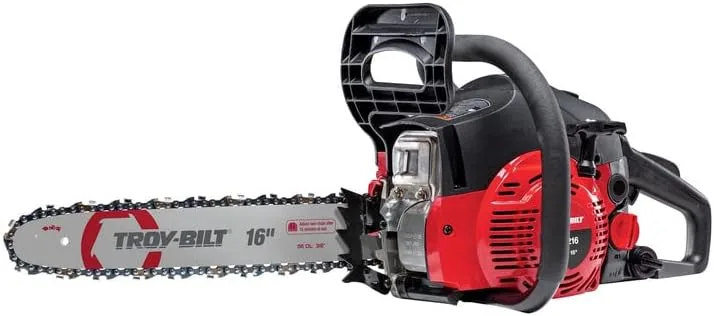
WHY I CHOSE THIS ✓
I chose the TB4216 for home use because it states its limits in writing: occasional use, 12 in logs, and a 2 year household warranty. It sits fifth because 12 in is a modest ceiling and Troy-Bilt lists no horsepower or chain speed.
Troy-Bilt TB4216 16 in 42 cc Gas Chainsaw Specs
Key Features:
- Written use class: the manual says occasional household use, UL Class 1C, infrequent use.
- Small-wood limit in print: logs and trees up to 12 in across.
- Kit with oil and tool: the box has the bar cover, the combination tool and a 3.2 fl oz bottle of 2-cycle oil.
- Hand lever and automatic brake: the chain stops by lever or by the automatic release on kickback.
- Automatic oiler with a screw: the 6.5 fl oz reservoir is empty from the factory, and the manual says to keep it above half full.
I used the TB4216 on a dead plum tree cut into carry-size pieces. It handled small limbs and short pieces, and the 12 in limit never got in my way. The manual says a new chain can need readjusting after as few as five cuts.
This saw runs on a 40:1 mix, 3.2 fl oz of two-cycle oil per gallon, with fuel less than 30 days old. The manual says fuel above 10 percent ethanol can damage the engine and void the warranty. The start routine is long: ten primer presses, two choke positions, several pulls and a 30 to 60 second warm-up.

Practice on a sawhorse or cradle before any other cut, as the manual says.
Hold the saw with both hands, right hand on the rear handle and left hand on the front handle, thumbs and fingers wrapped around the handles, with your body to the left of the chain line and firm footing.
Starting has its own setup. Start a gas saw with the chain brake engaged, on the ground with the bar clear of anything or held firmly as the manual shows, never by drop-starting it, and at least 10 feet from where you fuelled it. For this saw, use 30 feet: Troy-Bilt’s manual asks for at least 30 feet from the fuelling source and site. Oil seeped onto my shed floor after the saw lay on its side overnight, so I now store it upright on a tray.
It fits a household that cuts small limbs and short pieces up to 12 in a few times a year on a budget. Skip it if your farm earns income, since the warranty falls to 90 days, or if you cut logs over 12 in.
FINAL VERDICT
The TB4216 is a small-wood saw with its limits printed on the box. I recommend it for a household that cuts occasionally and plans to practice on a sawhorse first.
It is the household saw for small wood and occasional jobs.
How to Choose the Best Gas Chainsaw
A gas chainsaw is a trade of power and range for fuel, noise and upkeep. Choose by the biggest wood you cut, how long you work, how the maker counts weight and which safety features the manual documents.
Engine Size and Bar Length
Engine size sets how much wood the chain can pull through, and bar length sets how much wood fits in one pass. According to Alabama Cooperative Extension, a light saw with a bar between 8 and 15 in suits small limbs and trees, a midweight saw with a 16 to 20 in bar suits frequent cuts in thick limbs and trunks, and bars over 20 in are professional-grade and not recommended for homeowners. I do not pay for bar length I will not use.
| Bar length | Typical work |
|---|---|
| 8 to 15 in | Light duty: small limbs and small trees |
| 16 to 20 in | Frequent cutting of thick limbs and trunks |
| Over 20 in | Professional-grade, not recommended for homeowners |
The best small gas chainsaw for a yard usually carries a 16 in bar, and the called length is longer than the wood the saw cuts through. One maker lists a 16 in bar with a usable cutting length of 13 to 15 in, and says the usable length is usually about an inch under the nominal length.
A 20 in bar is where a gas saw starts to need a bigger engine, and the manual’s list of approved bars decides how far you can go. The best 20-inch gas chainsaw also weighs more, so it earns its place only if you cut thick wood often. If most of your cutting is logs, my best chainsaw for firewood list sorts saws by the wood you buck at home and on the farm.
Weight and How the Maker Counts It
Makers count weight on different bases, so two numbers can look comparable and mean different things. A measured study of 40 loggers found heart rate rose as the chainsaw got heavier (1). I check what a weight includes before I trust it, the way I check what a sprayer nozzle chart counts.
- Powerhead without bar and chain: the lightest figure, and the one makers often print.
- Dry, with fuel and oil tanks empty: adds nothing for liquids. ECHO’s dry figures also leave out the bar and chain; for another maker, check whether they are in.
- With bar, chain, fuel and oil: the weight you hold, and one several makers do not publish.
Never set a powerhead weight against a weight with a different basis. If a maker gives no basis, keep the basis unspecified and leave that figure out of direct comparisons.
Chain Brake, Low-Kickback Chain and Kickback
If the upper part of the bar tip touches wood or another object, the bar can kick back up and toward you (rotational kickback). Wood pinching the chain on the top of the bar pushes the saw straight back at you (pushback), and wood pinching the bottom pulls it forward, away from you (pull-in). A low-kickback chain, a chain brake and a correct grip reduce these risks; none removes them. In laboratory kickback tests, proper chain tension, anti-kickback chain links, sliding-end guide bars and a quick chain brake all influenced kickback (2).
- Chain brake: a hand lever, an inertia release or both. Test it by the exact manual’s method, because makers differ.
- Throttle trigger lockout and stop switch: each must work before every start.
- Chain catcher and guards: they catch a broken chain and shield the hand, and they stay on the saw.
Before Every Use
Before each use, inspect the saw as its manual describes: test the chain brake by the manual’s method, and check the throttle trigger lockout, the stop switch, the chain catcher, the guards and the chain’s sharpness, tension and condition; on a gas saw the chain must not move at idle. If any check fails, do not use the saw until it is repaired, and never disable a safety device.
I treat a saw that fails one check as a saw I do not use until it is fixed.
Fuel Mix, Ethanol and Starting
Every gas saw here is a two-stroke, so fuel and oil go into one tank in a ratio set by that saw’s manual. The mix, the octane and the ethanol limit differ by maker, so read the manual of the saw you buy; the table gives one documented example for each of three makers.
| Maker | Mix | Fuel limits |
|---|---|---|
| Husqvarna | 50:1, 2 1/2 US fl oz of oil per gallon | Up to 10 percent ethanol, 90 RON or 87 AKI, mix no older than a month |
| ECHO | 50:1, 2.6 fl oz per gallon | 89 octane bought within 30 days, up to 10 percent ethanol, no E15 or E85 |
| Troy-Bilt | 40:1, 3.2 fl oz per gallon | Fresh fuel under 30 days old; more than 10 percent ethanol can damage the engine and void the warranty |
Start a gas saw with the chain brake engaged, on the ground with the bar clear of anything or held firmly as the manual shows, never by drop-starting it, and at least 10 feet from where you fuelled it. Troy-Bilt’s manual asks for at least 30 feet from the fuelling source and site, so use 30 feet with that saw. I mix only what I will use inside a month, in a measured bottle.
Never Run a Gas Saw Indoors
Exhaust contains carbon monoxide, so never run a gas saw indoors or in a garage, shed or other enclosed space. Two-stroke exhaust raised loggers’ carboxyhemoglobin above the biological exposure index in heavy timber (3).
Price Tier and Warranty
Price decides how much engine and bar you get, so a budget saw is a fair choice for small jobs, and the best budget gas chainsaw gives up engine size and bar length for the lower price. For the money, pick the saw whose limits match your wood and check what it gives up in the manual’s technical table.
- Husqvarna: a standard 2 years for consumer use, extendable to 3 or 5 years if you buy its fuel or oil on the same receipt and register within 30 days.
- ECHO: 5 years consumer and 1 year commercial on its product page, with service through an authorized dealer.
- Troy-Bilt: 2 years limited for household use and 90 days for rental, commercial or income-producing use.
On a family farm I read the commercial and agricultural exclusions first, because the longest warranty on paper is the one that excludes your kind of work.
Home Use or Farm Use
Alabama Cooperative Extension says homeowner saws are inexpensive and designed for intermittent use, while professional-grade saws withstand everyday use at a premium price. The best gas chainsaw for home use is the one whose manual permits the work you plan, household or income-producing, and I read that line before I look at power. My best chainsaw for homeowners ranking adds more saws with a chain brake for yard cleanup.
Most power saw and axe injuries in a US emergency department series happened at home, and the most common injury was a laceration to the fingers and hand (4). The best homeowner gas chainsaw is therefore the one you will use with the full protective kit every time.
Safety Kit, Training and Limits
Recommended training comes first: Clemson and Alabama Extension both advise a chainsaw safety course, and a beginner starts on small, simple cuts of wood lying on the ground. No manual or article replaces that course. Hold the saw with both hands, right hand on the rear handle and left hand on the front handle, thumbs and fingers wrapped around the handles, with your body to the left of the chain line and firm footing.
Wear impact-rated safety glasses with side protection marked Z87+ (a mesh face screen adds to them but never replaces them), hearing protection, chainsaw chaps or chainsaw trousers used within their maker’s stated limits (some are not designed to stop a battery or corded saw’s chain, and no clothing guarantees protection), work gloves and sturdy boots with ankle support, plus a hard hat when you fell a tree or anything can fall from above. Husqvarna’s manuals specify gloves with saw protection and boots with saw protection, a steel toe cap and a non-slip sole.
NIOSH sampling of 80 landscaping workers found significantly more noise and carbon monoxide exposure with fuel-powered leaf blowers, string trimmers and chainsaws than with battery versions (5). In an Irish survey of 62 domestic chainsaw accidents, only 2 injured users wore any protective gear, and both wore steel-capped boots unsuited to chainsaw protection (6).
Shutdown Orders
Stopping (every saw, first step of everything below): release the trigger, engage the chain brake, switch the engine off and wait until the chain has stopped. Maintenance (touching the chain, clearing a jam, adjusting tension, sharpening, changing the bar or chain): stop as above, then let the engine and muffler cool and pull the spark plug cap off. Put on gloves before touching the chain. Release the chain brake only when the exact manual’s procedure requires it (for example to remove the clutch cover or check that the chain moves freely), and never force a locked chain or cover. Refuelling: stop as above, let the engine cool, refuel outdoors with no smoking, open flame or sparks nearby, wipe spills, and move at least 10 feet away before starting. Troy-Bilt’s manual asks for at least 30 feet from the fuelling source and site. Carrying and transport: stop as above, chain brake engaged, bar pointing behind you, bar cover on for transport.
Never cut at or above shoulder height, and never cut from a ladder or a roof.
Felling is the most dangerous chainsaw job. Never work alone, keep everyone at least two tree lengths away, and plan and clear two escape routes angled back from the direction of fall before any felling cut. A large, leaning, dead or hung-up tree, or a trunk or limb under tension after a storm, is a job for a certified arborist. Husqvarna’s manuals ask for at least 2 1/2 tree lengths, and Troy-Bilt asks children, bystanders and pets to stay outside a 50 foot radius during ordinary operation.
Treat every downed power line, and anything touching it, as live: stay well away and call the utility. Before any work near a power line, contact the utility and leave that work to its qualified line-clearance crews; a general arborist is not automatically qualified for it.
I keep a chainsaw for the big cuts on my own land and leave the standing dead tree, the hung limb and the storm tangle to people with the training for them. For a comparison of power sources, I rank nine battery, gas and corded saws in my best chainsaw guide.
My Overall Verdict
Five gas saws made this list, and the Husqvarna 455 Rancher leads it because it matches the wood most yard and orchard owners cut: limbs, trunk lengths and storm wood on the ground. Every saw here is a two-stroke that needs measured fuel, two hands and the full protective kit. I compare the 455 with the ECHO CS-590 in my Husqvarna 455 Rancher vs ECHO CS-590 guide.
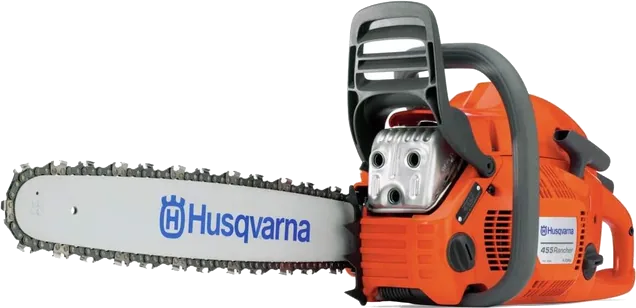
1. Husqvarna 455 Rancher 20 in 55.5 cc Gas Chainsaw Best Overall
For anyone who wants a 20 in bar, two ways to stop the chain and a documented bar range.
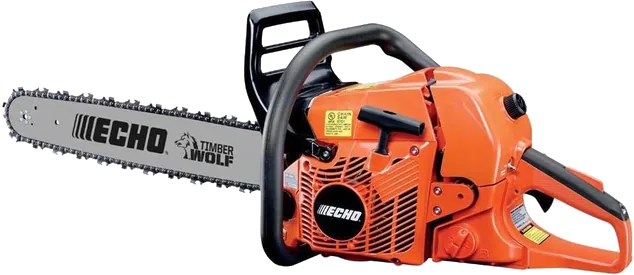
2. ECHO CS-590 Timber Wolf 20 in 59.8 cc Gas Chainsaw Best Premium
For buyers who may change between 16 and 20 in bars and will keep a strict fuel routine.

3. Husqvarna 130 16 in 38 cc Gas Chainsaw Best Value
For small limbs and short logs on a tight budget, with a 13 to 15 in cutting length.
If you cut thick wood or work long afternoons, take the 455 and keep up with its upkeep. If your wood stays small, the 130 or the household saw in fifth place costs less and still stops the chain two ways. The Husqvarna 455 Rancher is the best gas chainsaw for the wood most orchard and yard owners cut.
Why Husqvarna 455 Rancher 20 in 55.5 cc Gas Chainsaw Might Be the Best Choice
I run the 455 on the orchard’s dead limbs and storm wood, and it is the saw I reach for when the wood gets thick.
The trade is upkeep. A gas saw needs a measured 50:1 mix, fresh fuel and a clean cooling area, and Husqvarna’s extended warranty excludes agricultural use.
Here is what the 455 gives you:
✓ 20 in bar on a powerhead whose approved bars run from 15 to 24 in; over 20 in is professional-grade.
✓ Two ways to stop the chain: a hand lever and an inertia release.
✓ Decompression valve and air purge bulb in a fixed start order.
✓ Automatic oiler you can adjust with a screw.
✓ Three vibration damping units between the handles and the engine.
Frequently Asked Questions
Who makes the best gas chainsaw?
The best gas chainsaw makers on this list are Husqvarna and ECHO, because both publish a full manual with a chain brake test and a list of approved bar and chain parts for each saw. Troy-Bilt makes the household-use saw in this list, which suits small wood and occasional jobs around the house.
What is the best gas powered chainsaw?
The best gas powered chainsaw on this list is the Husqvarna 455 Rancher, a 55.5 cc saw with a 20 in bar, an inertia brake and a decompression valve. It suits trunk lengths and storm limbs on the ground, and Husqvarna’s manual asks for two hands, the full protective kit and chainsaw training before use.
What is the best gas chainsaw for the money?
The best gas chainsaw for the money is the Husqvarna 130, a 38 cc saw with a 16 in bar and a usable cutting length of 13 to 15 in. It sits in the budget tier, which fits small limbs and short logs on the ground, and Husqvarna’s manual lists the bar, chain and file part numbers for it.
What is the best gas to use in a chainsaw?
The best gas to use in a chainsaw is fresh unleaded gasoline with no more than 10 percent ethanol, mixed with good two-stroke oil at the ratio in that saw’s own manual. Husqvarna calls for 50:1, ECHO bans E15 and E85, and Troy-Bilt asks for 40:1, so check your own manual.
Which gas chainsaw is the most reliable?
A gas chainsaw stays reliable through upkeep: fresh mix, a clean air filter, correct chain tension and oil in the tank keep any of these saws starting and cutting well. For warranty length, Husqvarna and Troy-Bilt state 2 years for consumer use, and ECHO lists 5 years on its product page.
References
- Masci F, Spatari G, Bortolotti S, et al. Assessing the impact of work activities on the physiological load in a sample of loggers in Sicily (Italy). Int J Environ Res Public Health. 2022;19(13):7695.
- Dąbrowski A. Reducing kickback of portable combustion chain saws and related injury risks: laboratory tests and deductions. Int J Occup Saf Ergon. 2012;18(3):399-417.
- Bünger J, Bombosch F, Mesecke U, Hallier E. Monitoring and analysis of occupational exposure to chain saw exhausts. Am Ind Hyg Assoc J. 1997;58(10):747-751.
- Sritharen Y, Hernandez MC, Zielinski MD, Aho JM. Weekend woodsmen: overview and comparison of injury patterns associated with power saw and axe utilization in the United States. Am J Emerg Med. 2018;36(5):846-850.
- Alexander BM, Graydon PS, Pena M, Feng HA, Beamer BR. Hazardous exposures and engineering controls in the landscaping services industry. Journal of Occupational and Environmental Hygiene. 2025;22(3):189-202.
- Doyle YG, Conroy RM. Prevention of timber felling and chainsaw-related accidents in the Republic of Ireland. Accid Anal Prev. 1989;21(6):529-534.
Safety Note: Read your saw’s manual first and get hands-on training before your first cut. A chainsaw can react faster than you can: if the upper part of the bar tip touches wood or another object, the bar can kick back up and toward you; wood pinching the top of the chain can push the saw straight back at you, and wood pinching the bottom can pull it forward. Keep the bar tip out of contact and watch for wood closing on the bar. A low-kickback chain and a chain brake reduce these risks but never remove them. Before each use, inspect the saw as your manual describes: test the chain brake, and check the throttle lockout, the stop switch, the chain catcher, the guards and the chain. On a gas saw the chain must not move at idle. If any check fails or a part is missing or damaged, do not use the saw until it is repaired, and never disable a safety device. Wear impact-rated safety glasses with side protection marked Z87+ (a mesh face screen adds to them but does not replace them), hearing protection, chainsaw chaps or chainsaw trousers, work gloves and sturdy boots with ankle support, and a hard hat when you fell a tree or when anything can fall from above. Use leg protection within its maker’s stated limits: some chaps are not designed to stop the chain of a battery or corded saw, and no clothing guarantees protection. Hold the saw with both hands, right hand on the rear handle and left hand on the front handle, thumbs and fingers wrapped around the handles, and keep your body to the left of the chain line with firm footing. Never cut one-handed with a rear-handle saw, never cut at or above shoulder height, and never cut from a ladder or a roof. Top-handle saws are made for trained tree workers: follow that saw’s manual. Keep children, bystanders and pets well away while you cut. Never work alone. Start a gas saw with the chain brake engaged, on the ground or held firmly as the manual shows, never by drop-starting it, and at least 10 feet from where you fuelled it. Refuel outdoors with the engine off and cool, with no smoking, flames or sparks nearby, wipe up spills, and use only the fuel mix and ethanol content your manual allows. Exhaust contains carbon monoxide, which can kill: never run a gas saw indoors or in a garage, shed or other enclosed space. Before you touch the chain, clear a jam, adjust the tension or sharpen: release the trigger, engage the chain brake, stop the engine or motor and wait until the chain has stopped. Then, on a gas saw, let the engine and muffler cool and pull the spark plug cap off; on a battery saw, take the battery out; on a corded saw, unplug it by the plug. Put on gloves before you touch the chain, and release the chain brake only when your manual’s procedure calls for it. To carry the saw, stop it, take out the battery or unplug it, keep the chain brake engaged and the bar pointing behind you, and fit the bar cover for transport. Use a corded saw only with an outdoor-rated extension cord of the gauge your manual gives, plugged into GFCI-protected power. Never use it in rain or wet conditions: GFCI protection does not make that safe. Keep the cord away from the chain. Use only the chains and bars your manual approves. Felling trees is the most dangerous chainsaw job. Before any felling cut, keep everyone at least two tree lengths away, and plan and clear two escape routes angled back from the direction of fall; when the tree starts to fall, follow your manual’s retreat steps (release the trigger, stop the saw and set it down as it describes) and move away along that route; never delay escape to cool, unplug or cover the saw. A large, leaning, dead or hung-up tree, a trunk or limb under tension after a storm, and any tree near a house or a road are jobs for a certified arborist. Power lines are a separate danger: treat every downed line, and anything touching it, as live, stay well away and call the utility; before any work near a power line, contact the utility and leave that work to its qualified line-clearance crews. Stop when you are tired, and take breaks if your hands tingle or go numb.