
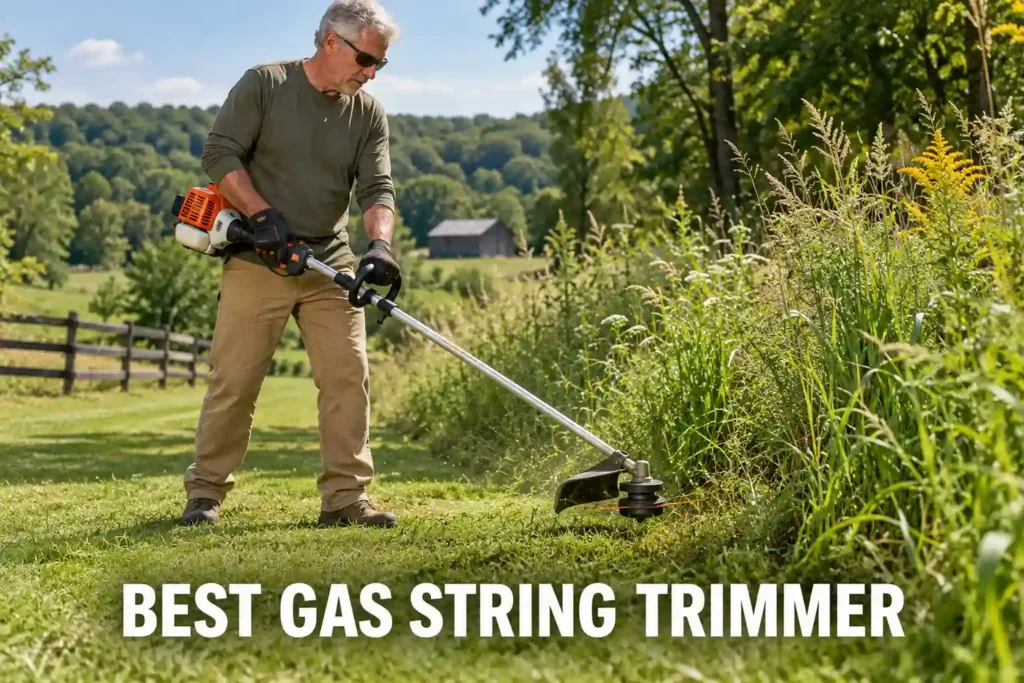
My pick for the best gas string trimmer is the Husqvarna 130L 28cc Gas String Trimmer, a 28 cc straight shaft model with an 18 in swath for long edges, fence lines and corners. On my 3.7-acre orchard that means the strip under the plum rows and the fence lines around the yard, and I used these machines on that land.
I rank five machines for different jobs, from edges and fences to wide open ground, a light kit that can grow and a budget kit with a blade, led by the Husqvarna 130L 28cc Gas String Trimmer. After the reviews I cover how to choose one, the fuel each takes and who should stay with battery.
Best Gas String Trimmer Reviews 2026 With 5 Models I Put to Work
These five cover the work a gas engine does best: long edges, fence lines and overgrown corners where a cord or a battery runs out of reach. Each review says what the machine does well, where it falls short and who should skip it.
1. Husqvarna 130L 28cc Gas String Trimmer Best Overall
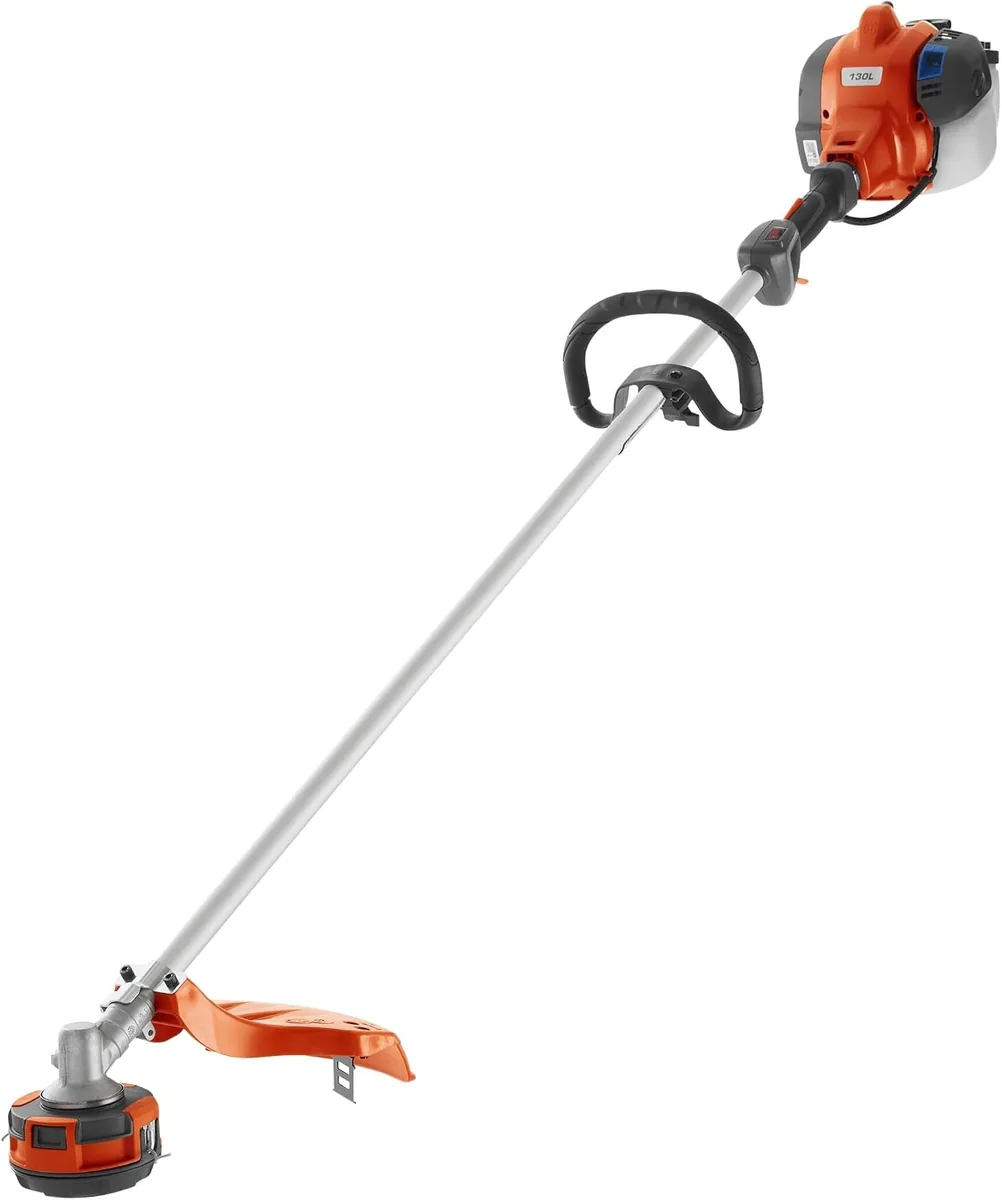
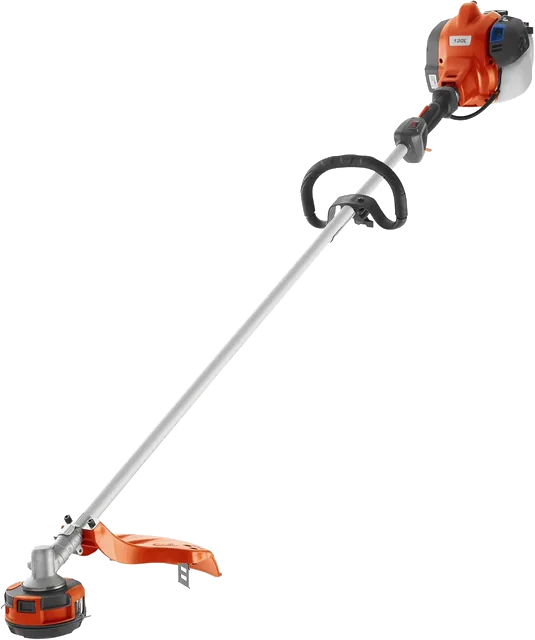
The Husqvarna 130L is the gas trimmer I recommend to most owners, because a 28 cc engine behind an 18 in swath clears fence lines, tree-row edges and overgrown corners without a blade or an attachment system to look after. It is a straight shaft trimmer with a bump-feed head and nothing else to learn. It suits a property with real trimming to do and a fuel can in the shed.
WHY I CHOSE THIS ✓
It does the most ordinary trimming work well and asks for nothing extra, and that decides it. An 18 in swath on a 28 cc engine covers the edges of a house lawn and the fence lines beyond it. It is a grass tool and it stays one, so a buyer who needs brush clearing or add-on tools should skip it.
Husqvarna 130L 28cc Gas String Trimmer Specs
Key Features:
- 28 cc engine: The two-stroke engine makes 0.7 kW (1.0 hp) at 8,000 rpm, according to the manual, and that is the power behind the full swath.
- 18 in swath: Husqvarna lists an 18 in cutting width, so a long strip under the trees takes fewer passes than a narrow head needs.
- RapidReplace head: After you stop the engine, wait for the head to stop and pull the spark plug cap, you line up the holes, push one 22 ft piece of line through and wind it by turning the head, so a reload stays short.
- Bump feed: You tap the head on firm, flat ground at full speed and more line comes out, with no button to press.
- Catalytic muffler: The engine uses a catalytic converter muffler and is listed as EPA III in the manual.
- Cold-start aids: An air purge bulb, a choke lever and a starter rope handle the start, and the manual asks for 10 pushes of the bulb on a cold engine.
- Spring-back stop switch: Husqvarna’s page says the stop switch resets itself to ON after use, so the trimmer is ready for the next start.
The engine and the swath work together on the long edges: the fence line and the corner behind the shed. I hold the head just above the ground at an angle with the line parallel to it, and near a post or a trunk I drop to about 80 percent throttle, as the manual says. The tool cuts grass and weeds and nothing woody. It will not clear brambles or saplings, because Husqvarna lists no blade for it.
The bump head asks for firm ground. Husqvarna says to tap the head on a hard, flat surface to release line, so in tall grass the line will not advance by tapping on the grass. I stop the engine, wait for the head to stop, let the machine cool, pull the spark plug cap and only then draw more line out by hand. At 11.0 lb dry, and more with fuel and the head, I plan a rest between long runs.
The first start of the year tests how I stored it. The manual’s cold start is 10 pushes of the purge bulb, full choke, three firm pulls with the unit held on the ground, half choke, more pulls until it runs, then 10 seconds before the choke comes off. Husqvarna says to start the engine at least 3 m (10 ft) from where you refuelled, so I carry the trimmer at least 10 ft away from the fuel spot before I start it. The bevel gear at the head stays hot after a stop, and I leave it alone until it cools.
Soak the line in water for two days before you load it. Husqvarna says that makes the line last longer, and a coil in a bucket by the shed door costs nothing.
Wear ANSI Z87.1 eye protection, hearing protection, protective gloves, heavy steel-toe boots, long pants and long sleeves every time, and keep people and pets at least 50 ft (15 m) away, the distance Husqvarna gives, and take the spark plug cap off whenever you leave the machine unattended, because the spring-loaded stop switch lets even a child start it with little force, according to the manual.
Husqvarna’s support page lists 95.4 dB(A) at the operator’s ear and handle vibration of 5.66 m/s2 at the front and 8.93 m/s2 at the rear, so my hands tell me when a long job is done. Husqvarna calls it a tool for occasional operation, and it tells you to stop and see a doctor if your fingers change color, tingle or go numb. The fuel is a 50:1 mix of unleaded gasoline and air-cooled two-stroke oil, and the manual limits a mix to one month. I run it outdoors only, and before storage I empty the tank, fit the transport guard and keep the spark plug cap off.
Buy it for lawn edges, fence lines, ditch banks and the strip under the trees, where a wide swath and a real engine pay off. Skip it if you want attachments, a blade for woody stems, a light tool, a quiet one or no fuel at all.
FINAL VERDICT
The 130L is the gas trimmer that earns its place by doing one job with a big swath and a plain layout. The price you pay is mixed fuel, vibration and a bump head that wants firm ground. Pick it when most of your work is grass and weeds over long edges.
It is the gas trimmer I recommend to most owners.
2. ECHO SRM-3020T 30.5cc High-Torque Gas String Trimmer Best Premium
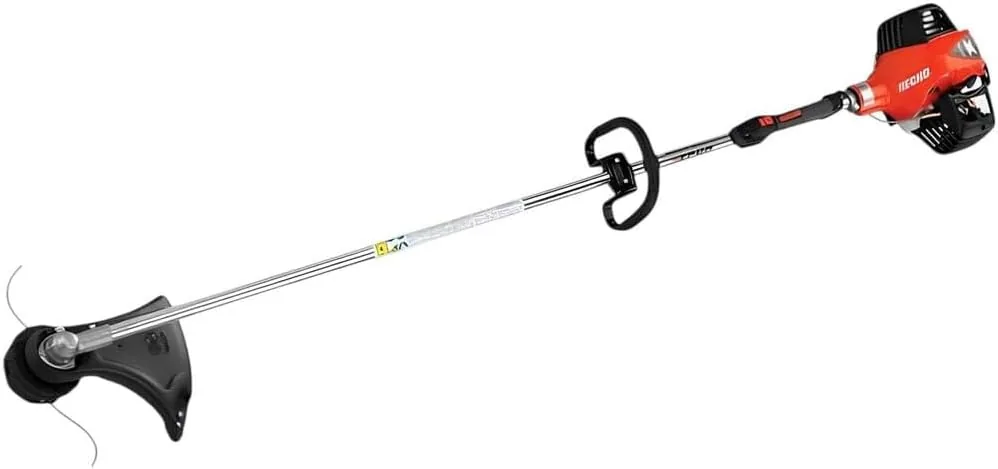
On the long strip under the plum row, the first thing you notice with the Echo SRM-3020T is the 20 in swath: each pass lays down a wider band than a narrower head does. A 30.5 cc engine and a high-torque gear case drive it, and it is my premium pick for a buyer who trims large open areas and wants the biggest engine on this page.
WHY I CHOSE THIS ✓
It is the premium trimmer for large open ground: the biggest engine, the widest swath and a 5-year consumer warranty, per Echo, on one straight shaft. You pay for it in weight and in fuel discipline. If your edges are short, a smaller machine does the same work.
ECHO SRM-3020T 30.5cc High-Torque Gas String Trimmer Specs
Key Features:
- 30.5 cc engine: The two-stroke engine turns 10,700 rpm at wide-open throttle, according to the manual, which is the power behind the wide swath.
- 20 in swath: Echo’s page lists a 20 in cutting width, so a long fence line or tree-row strip takes fewer passes.
- High-torque gear case: The gear case has a 2.07:1 ratio, which is what the T in the name stands for, and it keeps the head turning under load.
- Speed-Feed 500 LH head: You tap it on the ground while it spins to advance line, and once the engine is off, the head has stopped and the plug lead is off you reload without taking it apart.
- 0.71 L tank: The 24 US fl oz tank means fewer refuelling stops on a long edge.
- Rubber vibration parts: A rubber cushion sits on the engine mount and a rubber grip on the front handle, as the manual lists.
- Wear indicators: Marks at the bottom of the head show when the cover or the head needs replacing, once they wear smooth or holes appear.
On the gravel yard edge I tilt the head down on the muffler side, the way Echo’s manual describes, so stones and clippings leave away from me instead of toward my legs. The manual also says to keep the cutting head below knee height, to feed line gradually and to avoid fences. This is a line trimmer for grass and weeds, and Echo says not to install a blade on the T.
The fuel rules are stricter than on a small trimmer. Echo wants fresh 89 octane unleaded gasoline bought within the last 30 days, mixed 50:1 with two-stroke oil that meets ISO-L-EGD and JASO M345-FD, and the manual says the wrong oil can void the engine warranty. I write the buying date on the can with a marker. The 0.71 L tank is the reward, since one fill goes a long way down a fence line.
Starting surprised me, because Echo’s cold start has you fully depress the throttle trigger to wide open and pull the rope rapidly, up to five pulls, and the head starts turning as soon as the engine fires. I lay the unit flat on the lawn with the head clear of my boots and the shed wall. Line changes are simple once you stop the engine, wait for the head to stop and pull the spark plug lead: a 20 ft piece goes through the eyelets and the knob winds it until about 5 in shows at each end. Echo lists 13.9 lb dry with the head, before fuel, so this is a trimmer for a strong back.
Brush the grass and dust off the cylinder fins after a dusty job. Echo says the build-up insulates the engine and causes overheating, and a failure from lack of maintenance is not covered by the warranty.
Wear eye protection that meets ANSI Z87.1, hearing protection, gloves, sturdy non-skid shoes, long pants and long sleeves, and keep bystanders at least 15 m (50 ft) away, because thrown objects remain a risk outside that zone. Refuel outdoors with the engine off and cool, move the unit away from the fuel spot before you start it, and before clearing wrapped grass stop the engine, wait for the head to stop and take off the spark plug lead.
Echo publishes no noise or vibration figure for this model, so I wear hearing protection every time and give my hands a break on long jobs. The muffler and the cover around it get very hot, and I keep the exhaust area clear of dry grass. The service intervals in the manual are maximums: grease for the flexible drive shaft and the gear housing, and a yearly look at the fuel filter and cap gasket. For storage past 30 days I follow the manual: drain the tank, run the engine dry, and oil the cylinder through the plug hole.
Buy it if you trim large open areas, long fence lines or wide tree-row strips and want a warranty that runs 5 years, per Echo. Skip it if your edges are short, if you want attachments or a blade, a light tool, a quiet one or a battery machine.
FINAL VERDICT
The SRM-3020T earns its premium only on large, open edges, where the swath and the engine save real passes. On a small yard, its weight and its fuel rules cost more than the extra width returns.
It is the big-engine gas trimmer for open ground.
3. Husqvarna 122LK 21.7cc Detachable Gas String Trimmer Best Value
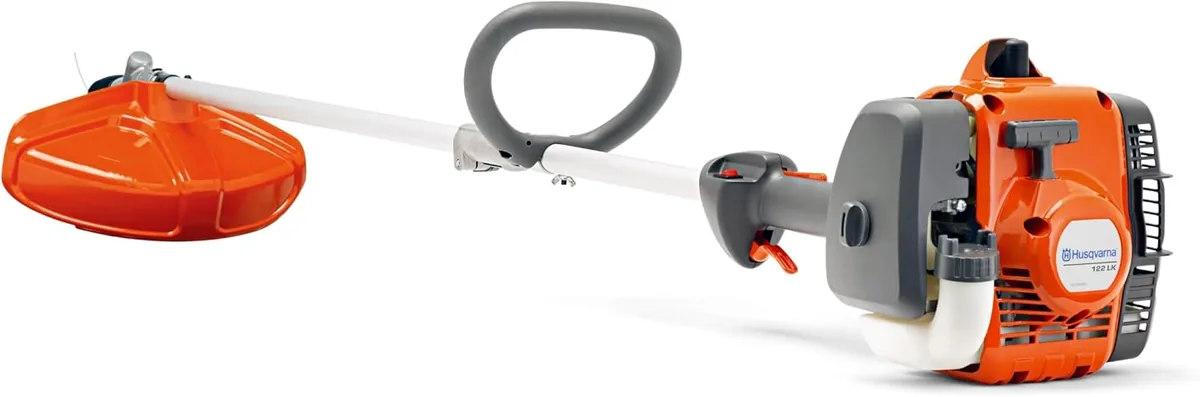
A gas trimmer whose shaft comes apart is why the Husqvarna 122LK earns the value spot. The detachable shaft lets one 21.7 cc power unit take the eleven attachments Husqvarna lists, from an edger to a pole saw, each sold separately. It suits a buyer who wants one gas engine for several jobs and a unit that weighs 10.6 lb dry.
WHY I CHOSE THIS ✓
The value pick is for one gas engine that can grow into a kit: a light power unit, a mid-range price and a coupling that takes an edger or a hedge trimmer later. It is the weakest on this page for long runs on heavy growth, because of the 21.7 cc engine and the 0.3 L tank. Buy it for house lawn edges and fence lines.
Husqvarna 122LK 21.7cc Detachable Gas String Trimmer Specs
Key Features:
- Detachable shaft: After you stop the engine, wait for the attachment to stop and pull the spark plug cap, you turn the coupling knob, push the shaft in until it clicks and tighten the knob again, with no tools.
- Eleven listed attachments: Husqvarna’s manual names an edger, a hedge trimmer, a pole saw, a cultivator, a sweeper and a blower among them, each bought separately.
- T25 tap advance head: It takes 2.0 to 2.4 mm line and releases more when you tap it on firm ground.
- Light power unit: The manual gives 10.6 lb dry, without fuel, head and guard, which helps at the end of a long edge.
- Printed vibration figures: Husqvarna’s manual lists 3.6 m/s2 at the left handle and 3.5 m/s2 at the right with the trimmer head.
- Purge bulb and choke start: The manual asks for 10 pushes of the bulb, and after a cold start the engine runs for 60 seconds to warm.
- Gear drive: Husqvarna’s page lists a 1.46 gear ratio and a 30 degree drive gear angle at the head.
The edges along the beds and the work pad after the mower are where this trimmer feels right. Husqvarna says to hold the head just above the ground at an angle, to use about 80 percent throttle near objects, and to use full throttle with a side to side movement to cut. It is a line trimmer for grass and weeds. Husqvarna’s page says metal grass blades and saw blades are not supported on this model.
The tank is small. It holds 0.3 L, Husqvarna publishes no run time, and a refill comes sooner than on a bigger machine. At the hedgerow base I stop, shut the engine off and let it cool, refuel outdoors, and walk 10 ft away from the fuel spot before I start again, which is the distance the manual gives. The 21.7 cc engine pulls less line through thick growth than a larger one would, and I slow down for it.
The coupling is where this unit differs from a one-piece shaft, so stop the engine, wait for the attachment to stop, let the unit cool and pull the spark plug cap before you touch it. To detach an attachment you then turn the knob three turns or more, push and hold the button, hold the engine end and pull straight out, and to fit one you line the tab up with the arrow until it clicks and tighten the knob fully. I tighten it fully every time and check it before the next job. Attachments weigh more and change the balance, and each has its own manual and hazards, so I read that manual before the first cut.
After a cold start, push the throttle lightly and let the engine run for 60 seconds before you cut. That is the manual’s warm-up, and it saves the cough you get when you rush it.
Wear eye protection that meets ANSI Z87.1, hearing protection, gloves, heavy slip-resistant boots, long pants and long sleeves, and keep people and animals at least 50 ft (15 m) away. Before you clear wrapped grass or change line, stop the engine, wait for the head to stop, let it cool and disconnect the spark plug cap, and carry the trimmer only with the transport guard on and the cap off.
Husqvarna’s manual lists 90 dB(A) at the operator’s ear and a sound power of 108 dB(A), so ear protection stays on for the whole job. It calls the 122LK a tool for occasional use, since regular long use can cause white finger, and it tells you to stop and see a doctor if your fingers change color, tingle or go numb. The fuel is a 50:1 mix of unleaded gasoline and two-stroke oil for air-cooled engines, and I mix only what the month needs. The bevel gear stays hot after a stop, so I do not touch it.
Buy it for house lawn edges, fence lines and a yard where you may want an edger or a hedge trimmer on the same engine later. Skip it if you cut thick or tall growth for long stretches, want a blade for woody stems, expect attachments in the box or want no fuel.
FINAL VERDICT
Pick the 122LK for value when you expect one engine to do more than one job. Pass on it when your work is long runs of heavy growth that a small tank and a small engine cannot keep up with.
It is the light gas trimmer that can grow into a kit.
4. ECHO SRM-2620 25.4cc Gas String Trimmer Best Lightweight Commercial
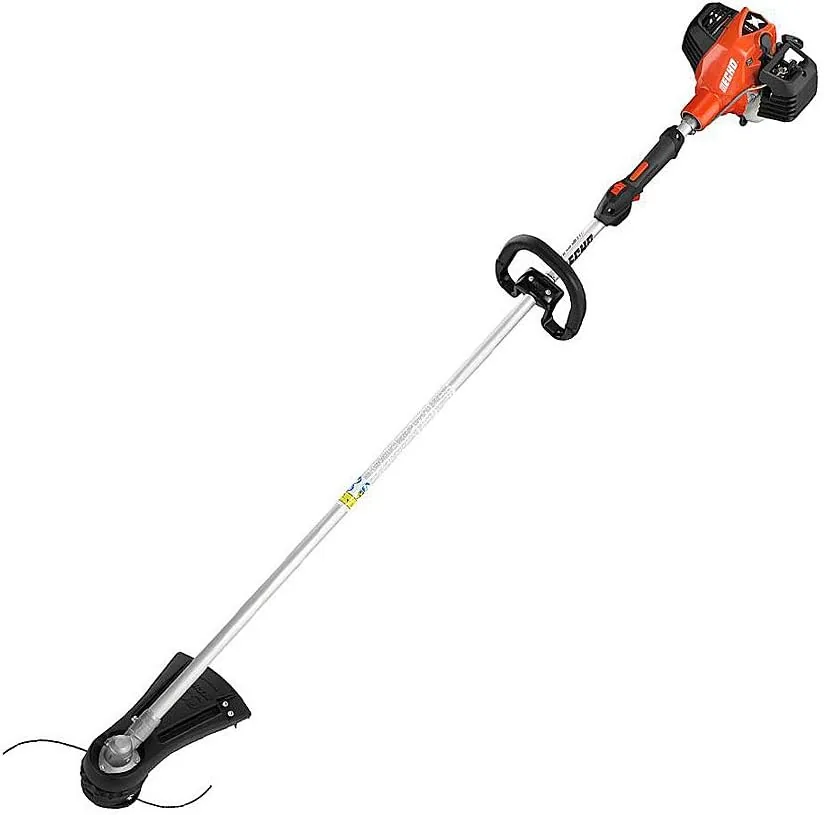
The Echo SRM-2620 is a 25.4 cc straight shaft gas trimmer for owners who trim often. Echo lists a 59 in shaft, a Speed-Feed 400 head and a 17 in swath. The box holds the trimmer only, so harness, fuel and oil are yours to buy.
WHY I CHOSE THIS ✓
It is the lightweight gas string trimmer with commercial cover: Echo gives it a 2-year commercial warranty, and at 11.5 lb dry without the head it is the lighter of the two Echo models with that term (12.3 lb for the other). The lightest on the page is another unit, and this one stays a grass trimmer.
ECHO SRM-2620 25.4cc Gas String Trimmer Specs
Key Features:
- 25.4 cc engine: The air-cooled two-stroke runs on a 50:1 mix of fresh 89 octane gasoline and certified oil, per the manual.
- 17 in swath: A narrow strip along a fence or under a hedge takes few passes.
- Speed-Feed 400 head: You tap the spinning head on the ground to release line, and Echo says a reload needs no disassembly.
- 59 in straight shaft: The straight tube slides under low branches and along the foot of a fence.
- Two-part air filter: A foam pre-filter and a main filter, which Echo says come out without tools.
The long shaft shows its value at the hedgerow base. I keep the head low and the line level, and the straight tube reaches under the first branches without crouching. The manual rates the line head for grass and light weeds only. At the strip edge I lift or mark the drip lines before I trim, because a spinning line takes tubing as readily as grass.
Line feed asks for bare ground. Echo says the line advances only while the head spins at normal speed and is tapped on the ground, so I do it on the path, not in tall grass. I tilt the head down on the right side so clippings leave away from me. The manual allows 0.080 or 0.095 in line.
After you stop the engine, wait for the head to stop and pull the spark plug lead, wind the line until about 5 in of each end stays out.
Wear ANSI Z87.1 eye protection, hearing protection, gloves, long pants and sturdy boots every time, and keep people and pets at least 50 ft (15 m) away, as Echo’s manual says. Before you clear a wrapped head or change line, stop the engine, wait for the head to stop, then pull the spark plug lead.
Echo gives no noise or vibration figure, so judge it by how your hands feel at the end of a long edge. Refuel outdoors with the engine off and cool, and carry the trimmer at least 10 ft from the fuel spot before you start it. Never run it in a shed. Blade work needs Echo’s conversion kit, which is not in the box.
Pick it for lawn edges, fence lines and hedge bases you trim every week. Skip it if you want attachments, a quiet machine, brush cutting out of the box or a no-fuel tool.
FINAL VERDICT
The SRM-2620 suits the owner who works the same long edges all season and values a longer commercial warranty. The cost is mixed fuel, vibration and a bare box. Choose it for steady grass and light weed work.
It is the gas trimmer for owners who trim every week.
5. AMERISUN 26cc 3-in-1 Gas Weed Eater (AM-4532P) Best Budget
The AMERISUN AM-4532P is a budget gas trimmer and brush cutter in one box: a 25.4 cc two-stroke engine, a line head, a 10 in metal blade, a blade shield and a shoulder harness.

WHY I CHOSE THIS ✓
It earns the best budget gas string trimmer label because a line head, a 10 in blade and a harness come in one box at the lowest price tier here. The trade is weight at 18.7 lb net and a short warranty: one year for home use, 60 days for commercial use, with the trimmer head excluded.
AMERISUN 26cc 3-in-1 Gas Weed Eater (AM-4532P) Specs
Key Features:
- 25.4 cc engine: The air-cooled two-stroke runs on a 50:1 mix of fresh unleaded gasoline and oil, per the manual.
- 10 in metal blade: The manual allows only its 255 mm 3-blade, for brush and weeds up to 3/4 in thick.
- 16 in line head: The same machine takes a line head for grass work.
- Handle and harness: The box lists a handle and a shoulder harness, and the manual says blade work needs the handlebar and a properly adjusted strap.
- Blade shield: It ships with the blade, and the guard stays on in storage.
The blade is the reason to look at this machine. On the ditch bank and at the hedgerow base I want a metal blade for brambles and woody regrowth, and a line head only rubs against them. The manual says to approach brush from right to left so a hidden stem pushes the blade away, and it limits the cut to stems of 3/4 in.
At 18.7 lb net, I work the bank in short runs and let the harness carry the load between them. The manual says blade work needs the handlebar and a properly adjusted shoulder strap, so check that the handle in your box matches the manual’s blade setup. I set the strap before the first cut, because the quick-release latch drops the whole machine off your body.

Along the fence line the 0.095 in line wears down fast, so I carry a spare length and keep the head off the wire.
Wear ANSI Z87.1 eye protection, hearing protection, gloves, long pants and sturdy boots every time, and keep people and pets at least 50 ft (15 m) away. The blade can thrust sideways on a hard object, so stop the engine, wait for the blade to stop, then pull the spark plug cap before you touch it.
The fuel is 50 parts fresh unleaded gasoline to 1 part two-stroke oil, with no ethanol or methanol, used within a month. At the gravel edge I keep the line head’s shield on, because the manual says shields cannot stop every ricochet. Wait 2 minutes after a stop before you open the cap, and run it outdoors only, never in a shed.
Choose it for a modest yard with thick grass, weed patches and some brush, at a budget. Skip it if you want a light or quiet tool, a published run time, heavy saplings cut or commercial use.
FINAL VERDICT
The AM-4532P is the budget answer for an owner who needs line and blade from one engine. You accept a heavier machine and a short warranty. Buy it for occasional work on grass and brush, and send heavier jobs elsewhere.
It is the budget gas trimmer with a blade in the box.
How to Choose the Best Gas String Trimmer
Seven checks sort the gas field, and the first is how long your edges are. I run them in this order, because the answer to the first sets the engine size and swath, and the rest decide whether you enjoy owning the machine. If gas is not settled for you, my best string trimmer picks cover every power type.
Choosing the Best Gas Powered String Trimmer by Engine and Swath
Engine size and swath decide how long a job takes. The five trimmers I rank run from 21.7 cc to 30.5 cc, with cutting widths of 16 to 20 in, according to the makers. A wider swath cuts more grass per pass, yet Husqvarna’s manual says a long line loads the engine more than a short one, so the engine has to keep up.
- About 22 cc with a 17 in swath suits lawn edges and short fence lines.
- About 25 to 28 cc with a 16 to 18 in swath is the middle size for a yard with a mix of edges and open grass.
- About 30.5 cc with a 20 in swath belongs on large open ground, where fewer passes save real time. For big plots, see my best string trimmer for large yard roundup.
I measure the strip under the plum row against the swath before I buy anything. A swath wider than the strip puts the line on the trunks, and line strikes strip the bark of young trees.
Pro Tip
Measure your narrowest strip and your longest edge first, then pick the swath and the engine that fit both.
Weight and the Best Lightweight Gas String Trimmer
Makers print weight on different bases, so two numbers from two makers cannot be set side by side. Husqvarna’s manual gives the dry unit without fuel, cutting attachment and guard, and Echo’s manual gives the dry unit without the cutting head. Read what the figure leaves out before you compare. I compare seven models by their stated weights in my lightweight string trimmers roundup.
| Basis | Leaves out | Where it appears |
|---|---|---|
| Dry, without fuel, head and guard | Fuel, trimmer head, guard | Husqvarna manual |
| Dry, without cutting head | Fuel and the head | Echo manual |
| Dry, with head, harness excluded | Fuel and the harness | Echo product page |
| Net weight, fuel not stated | Not stated by the maker | AMERISUN manual |
Fuel adds weight on top of every dry figure, and the tanks on the five I rank run from 0.3 L to 0.71 L. AMERISUN prints 18.7 lb net without saying whether fuel is in it, so I do not set that figure beside a dry one. Within one maker’s basis the figures do compare: Husqvarna’s manual gives 10.6 lb for its smaller unit and 11.0 lb for its larger one. The number tells me where to start, and the end of a long edge tells me the rest.
Feed Head and Line Size
Four of the five use a bump or tap advance head, and you tap it on firm, flat ground while it spins, and more line comes out. In tall grass that tap does not work, so you stop the engine, wait for the head to stop, let it cool, take off the spark plug cap and only then pull line out by hand. The best gas string trimmer for a fence line is the one whose head you can reload quickly, and Echo’s manual and Husqvarna’s manual for its larger head describe a short push-through and wind. For overgrown ground, I compare nine picks in my best string trimmer for tall grass roundup.
- Husqvarna’s larger head takes 0.080 to 0.105 in line, according to its manual.
- Echo’s Speed-Feed heads take 0.080 or 0.095 in line, about 20 ft per reload.
- Husqvarna’s smaller head takes 0.080 to 0.095 in line.
- AMERISUN’s head takes 0.095 in line, according to its manual.
I run the thinner line on lawn edges and the thickest line the head accepts along the fence, where weeds are tougher and posts wear the line. For tougher growth along the fence, my best string trimmer for thick weeds roundup compares nine battery and gas picks.
Key Takeaway
Use only the line diameter your manual lists for your head. A thicker line overloads the engine, and a thinner one wears out fast.
Fuel Mix, Starting and Storage
All five trimmers I rank are two-stroke engines that run on a 50:1 mix of gasoline and oil, and the details differ by maker. Echo wants fresh 89 octane gasoline bought within the last 30 days and oil that meets ISO-L-EGD and JASO M345-FD. Husqvarna wants unleaded gasoline with no more than 10 percent ethanol, and it limits a mix to one month. AMERISUN wants unleaded gasoline with no ethanol or methanol.
Starting differs too: one manual asks for 10 pushes of the purge bulb, another for the bulb until fuel flows in the clear return line plus five more, and a third for 7 to 10 primer pushes.
| Gasoline | Two-stroke oil |
|---|---|
| 1 US gal | 2 1/2 fl oz |
| 2 1/2 US gal | 6 1/2 fl oz |
| 5 US gal | 12 7/8 fl oz |
Read the chart in your own manual, since the amounts and the oil rules are the maker’s. I mix in a clean can with a measuring cap and label it with the date. Engine exhaust holds carbon monoxide, and in EPA testing of gasoline lawn and garden engines, string trimmers included, operators had short-term exposures above 120 ppm for some equipment (1).
Outdoors Only
Run a gas trimmer outdoors only, never in a shed or a garage, even with the door open, and refuel with the engine off and cool.
Storage steps differ as well. Husqvarna says to empty the tank, fit the transport guard and keep the spark plug cap off, and Echo adds a longer routine for 30 days or more: drain the tank, run the engine dry and oil the cylinder. AMERISUN asks for an empty tank, a dry carburetor and the blade guard on.
The Best Gas String Trimmer With Attachments and Its Coupling
A detachable shaft lets one engine drive an edger, a hedge trimmer or a pole saw, each sold separately and each with its own manual. Only one of the five I rank is sold with that coupling and a list of attachments, and a trimmer without it has one less part to keep tight. Attach only what the maker lists for that power unit.
- List: ask the maker for the attachments it names for your model.
- Weight: each attachment changes the balance of the whole machine.
- Hazards: an attachment brings its own cutting tool and its own manual.
A metal blade is a different job from line. It clears brambles and woody stems that line only frays, and it thrusts sideways on a hard object. Use only the blade and guard the maker lists for that exact tool, and fit the harness and handle the manual names.
I count the jobs I know I will do before I pay for a coupling: an edger for the work pad and a hedge trimmer for the hedgerow. If I cannot name two, a dedicated trimmer is the simpler machine. If edging is your job, my best string trimmer for edging roundup shows which models have a real edge mode.
Noise, Vibration and Eye Protection
Eye injuries lead the trimmer injury record. In an estimate of 81,907 lawn trimmer injuries treated in US emergency departments from 2000 to 2009, the eye alone made up 42.5 percent (2). Seven brush cutter operators in head protection, mostly nylon mesh visors, still had penetrating eye injuries from objects 1 to 4 mm across, which is why the authors add eye protection glasses (3).
Noise is the second hazard. Two petrol grass trimmer engines measured about 100 and 105 dB(A) at the operator, above recommended limits for an 8-hour day (4). Makers print noise on different measures: one manual lists 90 dB(A) at the operator’s ear and, separately, a sound power of 108 dB(A), and the two cannot be compared.
- Eyes: protection that meets ANSI Z87.1, worn every time.
- Ears: hearing protection for the whole job.
- Body: gloves, sturdy slip-resistant boots, long pants and long sleeves.
- Distance: people and pets at least 50 ft (15 m) away, the distance the makers give.
Vibration reaches the hands. In a laboratory test with two participants, gloved hand vibration on a grass trimmer measured 3.5 to 5.8 m/s2, the highest of the tools tested (5). I wear gloves and take a break when my hands tell me to.
Before You Touch the Head
Stop the engine, wait for the head to stop, let it cool and take off the spark plug cap before you clear wrapped grass or change line.
Warranty, Upkeep and When Battery Is the Better Call
Echo’s page lists a 5-year consumer warranty, and Husqvarna’s page lists 2 years residential for its larger unit, extended to 5 with qualifying premixed fuel bought at the time of sale. AMERISUN gives 1 year for home use and 60 days for commercial use.
A long term matters most on the machine that works hardest, so weigh it with the engine size. The best gas string trimmer for the money is the one whose size matches the work you do most. Upkeep means a clean air filter, a good spark plug, clear cooling fins and fresh fuel.
Gas also costs noise and exhaust. NIOSH sampling of landscaping workers found significantly more noise and carbon monoxide exposure with fuel-powered string trimmers than with battery versions (6). I weigh a fuel tank against carrying a spare pack, and on a long fence line the tank wins. For short lawn edges near the house I prefer a battery tool, and my best battery string trimmer picks show which ones suit different yards.
- Gas wins on long runs far from an outlet and on thick growth.
- Battery wins on short, quiet jobs near the house.
My Overall Verdict
I ranked these five on engine size, swath, weight on the maker’s basis and how plainly each one starts and stores. They suit different yards and budgets, so read the line that matches yours.
1. Husqvarna 130L 28cc Gas String Trimmer Best Overall
For lawn edges, fence lines and overgrown corners where a wide swath and a real engine pay off.

2. ECHO SRM-3020T 30.5cc High-Torque Gas String Trimmer Best Premium
For large open ground, where the biggest engine and the widest swath save passes.

3. Husqvarna 122LK 21.7cc Detachable Gas String Trimmer Best Value
For a light, attachment-ready gas unit on house lawn edges and fence lines.
Pick the machine that fits your longest edge, mix the fuel exactly as its manual says and wear the protection every time. For most owners that makes the Husqvarna 130L the best gas string trimmer to start with. I set it against the Echo in my comparison of Husqvarna 130L vs Echo SRM-3020T.
Why Husqvarna 130L 28cc Gas String Trimmer Might Be the Best Choice
The Husqvarna 130L 28cc Gas String Trimmer comes first because it does the ordinary work of a gas trimmer without extras: lawn edges, fence lines and the overgrown corner behind the tool shed. Its 28 cc engine drives an 18 in swath, and a RapidReplace head keeps a line change short.
The trade is a bump head and a bare layout. It takes no attachments and no blade, and tall grass means stopping to pull line by hand. I go through its trade-offs in more detail in my Husqvarna 130L gas trimmer review.
What puts it first:
✓ Engine: 28 cc two-stroke, 0.7 kW (1.0 hp), per the manual.
✓ Swath: 18 in cutting width.
✓ Head: RapidReplace line reload.
✓ Layout: straight shaft with a loop handle.
✓ Weight: 11.0 lb dry, without fuel, head and guard.
Frequently Asked Questions
What’s the best gas string trimmer?
The best gas string trimmer on this page is the Husqvarna 130L, a 28 cc straight shaft model with an 18 in swath and a bump-feed head. Choose the Echo SRM-3020T for a 20 in swath on large open ground, or the Husqvarna 122LK for a detachable shaft that takes attachments.
What’s better, a gas or battery weed eater?
A gas weed eater is the better choice for long edges and thick growth far from an outlet, and a battery weed eater is the better choice for short, quiet jobs near the house. Gas brings mixed fuel, a pull cord and more noise, so pick it only when you cut for long stretches.
What is the most powerful weed eater available?
Among the five gas trimmers on this page, the Echo SRM-3020T has the largest engine, 30.5 cc, and the widest listed swath, 20 in, though displacement alone does not rank output power. Compare each maker’s output figure where it is published, and match engine size to the heaviest growth you cut.
How to mix gas for a weed eater?
To mix gas for a weed eater, use fresh unleaded gasoline and two-stroke oil in the ratio and with the oil your manual names, which is 50:1 for all five trimmers here, and mix outdoors away from sparks. Follow your machine’s manual for the amounts and for how much fuel to mix at a time.
Who makes the best gas string trimmer?
Husqvarna makes the best gas string trimmer on this page, the 28 cc 130L, and its 122LK adds a detachable shaft for attachments at a lower cost of entry. Echo’s advantage is the premium SRM-3020T, with a 30.5 cc engine, a 20 in swath and a 5-year consumer warranty, according to Echo, for large open ground.
References
- Baldauf R, Fortune C, Weinstein J, Wheeler M, Blanchard F. Air contaminant exposures during the operation of lawn and garden equipment. J Expo Sci Environ Epidemiol. 2006;16(4):362-370. doi:10.1038/sj.jes.7500471
- Leinert J, Griffin R, Blackburn J, McGwin G. The epidemiology of lawn trimmer injuries in the United States: 2000-2009. J Safety Res. 2012;43(2):137-139. doi:10.1016/j.jsr.2012.03.001
- Gau M, Meier P, Wiedemann P. Penetrating and perforating eye injuries with foreign bodies during motorized brush-cutting while wearing head protection gear [in German]. Klin Monbl Augenheilkd. 1999;215(5):311-314. doi:10.1055/s-2008-1034720
- Mallick Z, Badruddin IA, Khaleed Hussain MT, Salman Ahmed NJ, Kanesan J. Noise characteristics of grass-trimming machine engines and their effect on operators. Noise Health. 2009;11(43):98-102. doi:10.4103/1463-1741.50694
- Oh J, Chen N, Boyd C. Laboratory evaluation of occupational exposure to hand-arm vibration (HAV) during grounds maintenance equipment operations. Ann Agric Environ Med. 2023;30(2):384-389.
- Alexander BM, Graydon PS, Pena M, Feng HA, Beamer BR. Hazardous exposures and engineering controls in the landscaping services industry. Journal of Occupational and Environmental Hygiene. 2025;22(3):189-202.
Safety Note: Read your manual first. A string trimmer or brush cutter throws debris with force, so clear stones, glass and wire from the area before you cut. Wear impact-rated eye protection with side coverage that meets ANSI Z87.1, hearing protection, gloves, heavy long pants, long sleeves and sturdy slip-resistant boots (steel-toe where your manual says so). Keep people and pets at least as far away as your manual says (50 feet in some manuals, 100 feet in others), and stop if anyone comes closer. Keep the correct guard fitted, use only the cutting attachments, handles and harness the maker approves for your exact tool, and never replace trimmer line with wire. A blade can kick sideways when it hits a stump or a thick stem, so fit the handlebar and harness your manual requires for blade work, hold both handles firmly and keep secure footing. Before you clear a jam, clean the tool or change line, a blade or an attachment, switch it off, wait for all movement to stop, then remove the battery, unplug the cord or disconnect the spark plug wire. Refuel a gas model outdoors with the engine off and cool, away from flames or sparks, and move away from the fueling spot before starting, as far as your manual says (often 10 to 30 feet); never run it in a garage, shed or other closed space. For a battery model, use only the maker’s battery and charger, charge it within the temperature range in your manual and never use a damaged or swollen pack. For a corded model, use a GFCI outlet, keep the cord clear of the cutting line and avoid wet conditions.