

The best electric pressure washer is the one whose manual you can follow, because a corded washer puts a high-pressure stream and mains electricity in the same yard. I look after the lawns, gravel yard and sheds of a family orchard, and I read these manuals as closely as a plant protection label.
Affiliate Disclosure: Garden Power Scout is a proud participant in the Amazon Services LLC Associates Program. As an Amazon Associate, we earn from qualifying purchases, at no extra cost to you.
Below are nine corded models with the pressure, flow, cord and detergent details their makers print, led by the Sun Joe SPX3000 Electric Pressure Washer. Each block says what its manual says, and the safety section follows the products.
Best Electric Pressure Washer 2026: 9 Corded Picks Ranked
These are my nine corded picks, each one plugged into a household outlet and each one printing its own pressure and flow figures. I rank them by what the manual lets a household do safely. The best corded electric pressure washer for you depends on your outlet, your detergent habits and your storage.
1. Sun Joe SPX3000 Electric Pressure Washer Best Overall
The Sun Joe SPX3000 is the corded washer I recommend first because it carries two detergent tanks and a selection dial, so the cleaning product is the part of the machine you control. According to Sun Joe, it is a 14.5 amp washer with a 35 ft GFCI cord, a 20 ft hose and five Quick-Connect nozzles. It suits a household that washes a few outdoor jobs in a season and wants one machine to handle all of them.

WHY I CHOSE THIS ✓
The SPX3000 is first on my list because it puts the choice in the dial, not in a pile of accessories. Two tanks, one dial and a centre position cover most of what a household wants to do with detergent, and the manual explains each step plainly. It is the washer I hand to a neighbour first, though the neighbour should read the manual before the first start.
Sun Joe SPX3000 Electric Pressure Washer Specs
Key Features:
- Two detergent tanks: you fill two removable tanks and switch between them with one dial, so a second product waits ready.
- Selection dial with an off position: the centre (O) position draws from neither tank.
- Quick-Connect nozzles: five nozzles snap onto the collar and come off when the collar is pulled back, after the stop steps in the safety section below.
- 35 ft GFCI cord: the GFCI is built into the plug end, and the long lead means fewer jobs call for an extension cord the manual does not recommend.
- Total Stop System: according to Sun Joe, releasing the trigger stops the water and switches the motor off.
- Thermal sensor: the manual says the machine stops if it overheats and restarts after a few minutes of cooling.
- Onboard storage: the nozzles, a needle clean-out tool, the hose and the cord all have a place on the body.
I judge a washer by how it handles the cleaning product, and this is where the SPX3000 earns its place. Before you fill a tank, complete the stop and make-safe steps in the safety section below. Then load one tank, turn the dial to it and fit the black soap nozzle, since Sun Joe says detergent is drawn only through that nozzle. The limit is the cleanup: the manual says to put the suction tube into 1.3 gal (5 L) of fresh water and siphon at low pressure for one minute, and that skipping it clogs the injection system.
The second thing I weigh on a corded washer is the lead. Sun Joe prints a 35 ft power cord with the GFCI built into it and a 20 ft hose, and the body has a holder for each. The manual does not recommend an extension cord: if you use one, it must not exceed 25 ft, the combined length must stay at or under 60 ft, and it must be 14-gauge or heavier. The plug and socket joint must be watertight.
What I looked at next was the machine in the shed. Before you move or store it, complete the stop and make-safe steps in the safety section below. At 27.6 lb net on two wheels it tips back and rolls across a gravel yard like a small suitcase, and the nozzle storage means nothing rattles loose in the bag. Sun Joe says freeze damage is not covered by the warranty, the machine must never be stored outdoors and must not be used below 32 F. It also prints a sound power level of 96 dB(A) and asks for eye, hearing and head protection, safety footwear, snug clothing and gloves.

After detergent work, flush the injection system as the manual describes, with the suction tube in fresh water, and then set the dial to the centre position. Before you handle the tubes or the tanks, complete the stop and make-safe steps in the safety section below.
Sun Joe says the machine is not suitable for connection to the potable water mains and must never be connected to a hot water supply.
Living with the SPX3000 means a little assembly and a little housekeeping. The handle goes on with four large screws, the detergent bottles snap into grooves and the holders take small screws. After detergent, the flush takes a minute, and the thermal sensor can pause the machine for a few minutes if it overheats. None of that annoyed me enough to change my pick, and the hearing protection reminder is the one I follow before the first start.
I recommend the SPX3000 as the best electric pressure washer for anyone who wants a single corded machine for a house and its outbuildings and will read the manual once. Skip it if you need a hose longer than 20 ft out of the box or a machine that stores in a cold shed, because Sun Joe says it must be kept above 32 F.
FINAL VERDICT
For almost any household, the SPX3000 is where I start. Its two tanks, GFCI cord and nozzle storage make a complete kit, and the manual is clear about its limits.
It is the corded washer I recommend to most households.
2. Westinghouse WPX3400e Electric Pressure Washer Best Premium
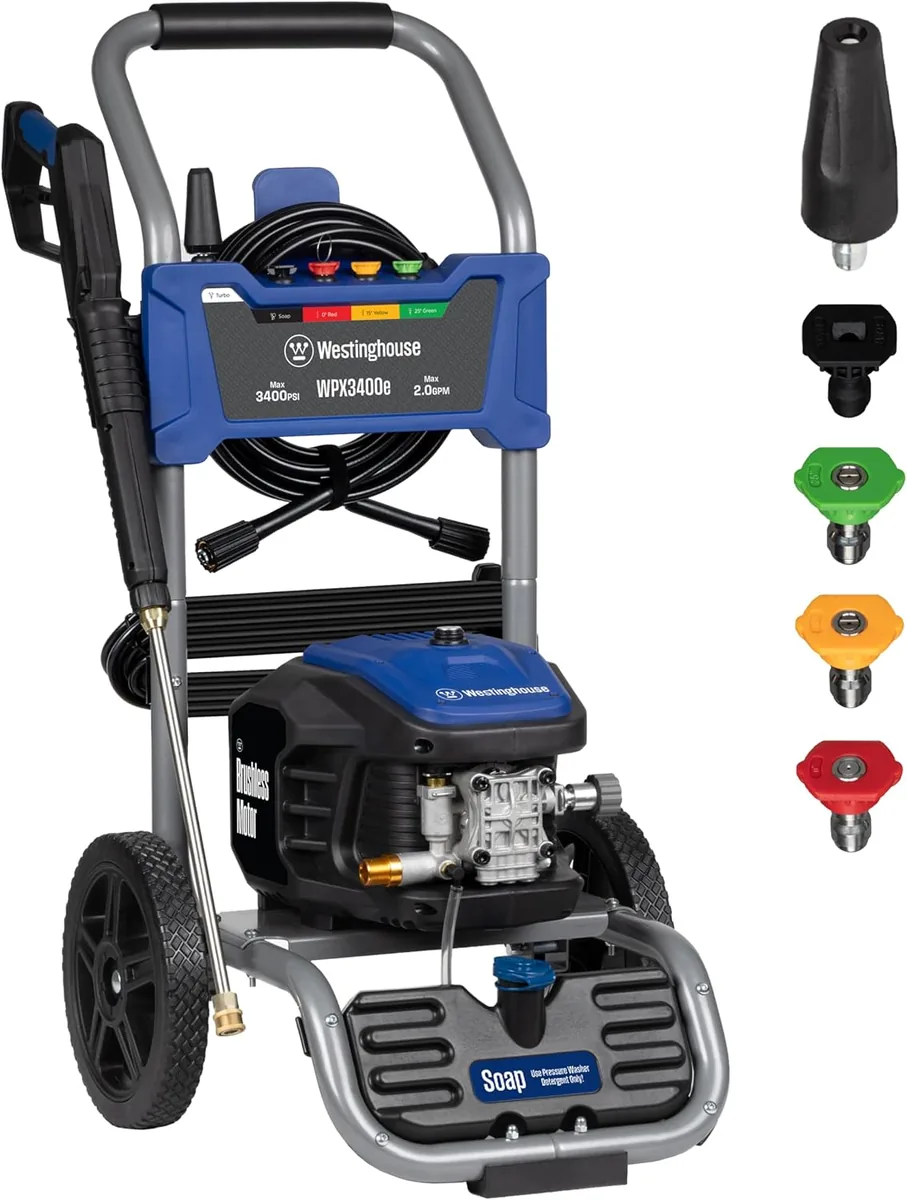
I pressed the start button on the Westinghouse WPX3400e, heard the pump run for a few seconds and stop, and took it for a fault until I read that this is the auto-start pump working as designed. It is the highest-priced washer on this page, with a wheeled steel frame, a push-button start and an onboard soap tank. Westinghouse prints 3400 PSI max and 3000 PSI rated, with 2.0 GPM max and 1.1 GPM rated, each on its own basis. It suits a buyer who wants the fullest kit and will read two sets of numbers.
WHY I CHOSE THIS ✓
The WPX3400e earns Best Premium because it brings the fullest kit on the page: a wheeled steel frame, a push-button start, an onboard soap tank and a GFCI with its own buttons. I did not pick it for a number; I picked it for a manual that counts honestly. The costs are assembly and no published weight.
Westinghouse WPX3400e Electric Pressure Washer Specs
Key Features:
- Auto-start pump: the push-button start primes the pump, which runs a few seconds and stops until the trigger is squeezed.
- Two published bases: 3400 PSI max beside 3000 PSI rated, and 2.0 GPM max beside 1.1 GPM rated, each on its own basis.
- Wheeled steel frame: the manual lists wheels, axles and hitch pins, so the machine rolls to the job.
- Onboard soap tank: detergent goes through the soap nozzle only, at low pressure, as the manual says.
- GFCI in the plug: the manual describes TEST and RESET buttons and asks for a monthly test.
- Turbo nozzle in the set: the manual lists a turbo nozzle beside the 0, 15, 25 degree and soap nozzles.
- Cord retainers: the body holds the cord and hose when the machine is stored.
Westinghouse prints two sets of numbers, and the gap between them is the first thing I read. Westinghouse prints a 3400 PSI maximum and a 3000 PSI rated pressure, and a 2.0 GPM maximum and a 1.1 GPM rated flow. I treat the maximums as a ceiling the maker states, not as the pressure you will see at the nozzle, and the rated line is the better guide. Before you connect hoses or fill the soap tank, complete the stop and make-safe steps in the safety section below.
The gun and the frame come next. Westinghouse says to hold the trigger handle and lance with two hands until you get used to the recoil, and to use the trigger lock even when spraying stops for a moment. The frame needs assembly with wheels, axles, hitch pins and bolts, and the manual warns about pinch points. Westinghouse requires eye protection and says never to operate the washer in bare feet, sandals or open-toed shoes. On gravel the wheels matter more than the pump, and I noticed the frame rolled straight once the axles were pinned.
The cord is where this model asks the most of you: the August 2025 manual says the washer is not recommended with an extension cord, and that if one must be used it needs a wire gauge of at least 14 for a cord of 25 ft or less. An older edition of the same manual forbids extension cords outright, so check the edition in your box. The GFCI in the plug has TEST and RESET buttons, so test it before each use as its instructions direct, and Westinghouse also asks for a monthly test. I pressed TEST and heard the click it describes.

Westinghouse says the pump should not run more than a minute after the water supply is off, and that the unit should be turned off after five minutes of inactivity.
Westinghouse says detergent goes only through the soap nozzle and that thick or gel detergents, dish soap and laundry soap clog the bottle nozzle. It adds that detergent can be harmful to skin, eyes and lungs.
Living with it means assembly, a monthly GFCI test and an indoor spot for storage. The manual says water left in the pump can freeze and crack it, recommends a pump saver that is not in the box and prints no minimum storage temperature. It also asks for the hose O-rings to be lubricated with a non-water-soluble grease, which I found easy to forget. Before you grease the O-rings or put the washer away, complete the stop and make-safe steps in the safety section below. The weight is not published, so I cannot say how it compares to a lighter frame.
I recommend the WPX3400e to a buyer who wants the fullest corded kit on this page and has an indoor place to store it. Skip it if you cannot plug it straight into a GFCI-protected outlet within the cord’s reach, because Westinghouse does not recommend an extension cord.
FINAL VERDICT
The WPX3400e earns Best Premium with the fullest kit on this page and a clear manual. Buy it when the job list is long and the outlet is close to the work.
It is the fully equipped corded washer for a long job list.
3. Westinghouse ePX3100 Electric Pressure Washer Best Value
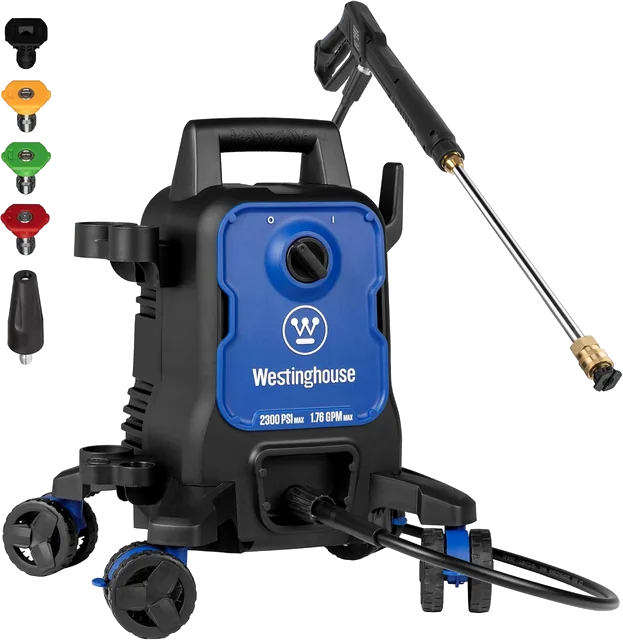
A first corded washer does not need to cost a lot, and the Westinghouse ePX3100 is the lowest-priced machine on this page, in the budget tier. It still comes with a GFCI plug, an onboard soap tank, five nozzles and a manual that tells you how to use them. It is my best budget electric pressure washer for a household with a few small outdoor jobs and an outlet close to the work.

WHY I CHOSE THIS ✓
The ePX3100 takes Best Value because the budget tier here does not strip the safety basics: the plug carries a Class A GFCI, the manual is thorough and the kit includes a soap tank. Its value is scoped to small household jobs near an outlet, and it is the weaker choice for anyone who needs reach from the cord or a printed weight.
Westinghouse ePX3100 Electric Pressure Washer Specs
Key Features:
- Budget tier: it is the lowest-priced washer here and still has a GFCI plug, a soap tank and a full nozzle set.
- Class A GFCI: the manual names the plug’s GFCI and describes its TEST and RESET buttons.
- Auto-start pump: according to Westinghouse, the motor stops until the trigger is squeezed.
- Onboard soap tank: detergent goes through the soap nozzle at low pressure, as the manual says.
- Hose and cord retainers: the body holds both leads when the machine is put away.
- Casters: the manual lists casters on the frame for moving it.
- Extension cord rule with numbers: the manual gives a gauge for a stated length instead of a flat ban.
The numbers on the ePX3100 are modest and honestly labelled: Westinghouse prints 2300 PSI max and 1900 PSI rated, with 1.76 GPM max and 1.2 GPM rated. I read the rated pair as the fair description of the machine, and the maximums as the ceiling. The manual says to use cold water only, from a mains supply at no more than 150 PSI, and never from a lake, pool or pond. Before you connect a hose or fill the soap tank, complete the stop and make-safe steps in the safety section below.
Assembly is the real cost of a budget washer. The manual has you fit the casters, gun holsters, hose retainer and cord retainer, and it warns that damaged threads on the collars could make the unit leak in use. I counted four separate jobs with screws or collars and none needed more than the tools in a home kit. A screwdriver is the only thing I reached for beyond the box.
The cord is the part I plan around. Westinghouse says the washer is not recommended with an extension cord, and that if one must be used it should be at least 16 gauge for 50 ft or less. I do not stretch that: I move the machine to the outlet instead. The manual also says do not store the machine where the temperature could drop below 40 F (4.5 C), a higher line than I expected from an electric washer.

Before you fill the soap tank, complete the stop and make-safe steps in the safety section below. Fill it only with a detergent made for pressure washers, and keep dish soap and laundry soap out because Westinghouse says they are too thick and will clog the nozzle of the detergent bottle. The warranty heading says three years, but the terms give one year of parts and labor, two years of parts only and, at Westinghouse’s discretion, certain replacements to three years.
Westinghouse says never to disconnect the high-pressure hose while the system is pressurized, and a label warns that the spray gun kicks back and needs two hands. The label asks for safety goggles with side shields.
Living with the ePX3100 is plain: the GFCI test is a TEST press followed by a RESET press, before each use and monthly as Westinghouse also asks, and the manual says water in a frozen pump will crack it. Westinghouse asks you to turn the washer off after five minutes of inactivity and to run the pump no more than a minute once the water supply is off. The hose and cord lengths and the soap tank size are listing figures, and the weight is not in the manual at all. What annoyed me was finding no weight to plan lifting around, which a budget machine you carry up steps should state.
I recommend the ePX3100 to a first-time buyer who washes small outdoor jobs close to an outlet and wants the best electric pressure washer for the money at the low end of this page. Skip it if you plan to carry it often, since no weight is printed, or if you need reach beyond the cord and a short extension.
FINAL VERDICT
For the money, the ePX3100 gives a corded washer a full kit, a GFCI plug and a clear manual. Choose it for small jobs near an outlet and expect to read the manual closely.
It is the budget corded washer for small jobs near an outlet.
4. Sun Joe SPX3000-XT1 XTREAM Electric Pressure Washer Best With Foam Cannon
Detergent on this machine arrives as foam: the Sun Joe SPX3000-XT1 is the only washer on this page that ships with a foam cannon bottle in the box, per Sun Joe’s carton list. The bottle holds 33.8 fl oz and has a foam-volume knob, and two brushes come with it. It suits a household that wants a cannon and brushes included from the first day. I go through that kit in my Sun Joe SPX3000-XT1 review.

WHY I CHOSE THIS ✓
The XT1 earns its place for the one thing it brings that a soap nozzle cannot: a cannon and two brushes in a single box. The cannon and the brushes mean one box covers detergent and scrubbing, though the bottle is the only way detergent reaches the stream.
Sun Joe SPX3000-XT1 XTREAM Electric Pressure Washer Specs
Key Features:
- Foam cannon bottle: snaps onto the lance collar and holds 33.8 fl oz, with a foam-volume adjustable knob.
- Two brushes in the box: a utility bristle brush and a wheel and rim brush, with a transfer adapter.
- Steel-reinforced hose: Sun Joe prints a 20 ft steel-reinforced hose and a stainless steel lance.
- 35 ft GFCI cord: the GFCI sits in the plug, and the manual spells out its extension cord limits.
- Thermal sensor: the manual says the machine can stop for a few minutes while it cools.
The cannon changes how you handle detergent: Sun Joe lists no soap nozzle for this model, so the bottle on the lance collar is the only detergent route. Before you fill the bottle or clip it on, complete the stop and make-safe steps in the safety section below. Sun Joe’s manual says to use only detergents made for pressure washers and lists bleach, chlorine products, solvents, ammonia and acid-based products as never to be used.
I turned the foam-volume knob through its range before any detergent went in; it moved freely under my thumb. Before you empty the cannon, complete the stop and make-safe steps in the safety section below. Emptying it before storage goes on my list beside the hoses and the pump, as the manual directs.

The manual recommends a pump protector for cold-weather storage, and the warranty does not cover freeze damage.
Sun Joe says an extension cord is not recommended; if one is used it must be an outdoor type, 14 gauge or heavier, 25 ft or less, and the combined length must stay at or under 60 ft.
At 28.4 lb net on two wheels the XT1 rolls to the job once you have completed the stop and make-safe steps in the safety section below, and a handle, a wand protector and holders go on with screws. The thermal sensor can pause the motor; Sun Joe prints a sound power level of 96 dB(A) and asks for eye, hearing and head protection, safety footwear and gloves. The manual says never to store the machine outdoors. The stainless steel lance and steel-reinforced hose, according to the manual, are what I liked on the shelf.
I rate the XT1 the best electric pressure washer for foam cannon use here, with brushes in the box and a clear detergent list. Skip it if you want onboard tanks or a soap nozzle, since this model has neither.
FINAL VERDICT
The XT1 earns its place for its complete foam kit. It asks only that you handle detergent through the cannon and store it above freezing.
It is the corded washer that ships with its foam cannon.
5. Greenworks 3000 PSI Brushless Electric Pressure Washer GPW3002A Only Printed Thermal Relief Valve
The Greenworks GPW3002A is the only washer on this page whose manual describes a thermal relief valve, and it prints a 3000 PSI maximum beside a 1.1 GPM rated flow. According to the Greenworks listing it is a brushless model with a metal gun and a 25 ft hose. It suits a buyer who wants a built-in detergent tank and a plain statement of what the pump does when it heats up.

WHY I CHOSE THIS ✓
My reason for the GPW3002A is what its manual prints about heat, not for a pressure number. The relief valve is a named part, with a stated opening temperature, which is rarer than it should be. If you worry about a pump running warm in summer, this is the one that describes its protection.
Greenworks 3000 PSI Brushless Electric Pressure Washer GPW3002A Specs
Key Features:
- Thermal relief valve: the manual says the pump has a thermal protector that releases a small amount of water at 140 F.
- Built-in detergent tank: detergent goes through the black soap tip, and the manual says it cannot be applied at high pressure.
- Quick-connect collar: the tips and the turbo nozzle, which the manual describes as a zero-to-15-degree pattern, fit one collar.
- Hose hook and cord arms: the frame holds the hose and the cord.
- Two figures for flow: Greenworks prints 2.0 GPM max and 1.1 GPM rated, so both can be read.
The relief valve is the feature a spec sheet misses. Greenworks says it protects the pump from heat by releasing a small amount of water at 140 F, and that is a printed manual feature, not a promise about any job. I looked for where that water would drain, and found it described in section 4.7 of the manual. Before you connect hoses or fill the tank, complete the stop and make-safe steps in the safety section below.
Set-up takes more than most: wheels, frame, upper panel, hose hook, gun holder and cord arms, and the manual says not to power the machine on before assembly is complete. A screwdriver is not in the box. The manual asks for at least 10 ft of free hose between the inlet and the supply.

Greenworks says to use only outdoor-rated extension cords marked with a rating not less than the washer’s, and it recommends a drip loop at the connection.
The manual calls for goggles or safety glasses with side shields and, as necessary, a full-face shield, and says to hold the gun with both hands when the machine is on.
Daily use is tidy: before you hang the hose or wrap the cord, complete the stop and make-safe steps in the safety section below. Then I hang the hose on its hook, wrap the cord on the arms, and the tank is built in. The manual prints no weight, and I treat the 25 ft hose and 35 ft cord as Greenworks’ listing figures. Inlet water must not exceed 104 F, and the manual says to store the machine dry in a frost-free area.
Pick the GPW3002A for a stated heat protection and a built-in tank, if you will assemble it. Skip it if you need a printed weight to plan around or want to rely on a stated GFCI test routine, since the manual describes none. My Greenworks 3000 PSI pressure washer review covers this model in more detail.
FINAL VERDICT
The GPW3002A is a solid, documented corded washer with a rare feature. Take it when heat protection and a built-in tank matter more than a short assembly.
It is the corded washer that explains its own heat protection.
6. CRAFTSMAN CMEPW2100 2100 PSI Electric Pressure Washer Longest Hose Printed in Its Manual
The CRAFTSMAN CMEPW2100 prints its own lengths in the manual’s specification table: a 25 ft high-pressure hose and a 35 ft power cord, the longest hose any manual on this page prints. It is a 13 amp corded washer with a removable soap tank and a GFCI in the plug. It suits a buyer who wants the reach written down by the maker.

WHY I CHOSE THIS ✓
The CMEPW2100 stands out for the printed hose and cord lengths and the hearing protection line, which many manuals leave out. It is a washer whose reach and protective equipment are in writing, and its weakness is a manual that gives two answers on extension cords and no weight.
CRAFTSMAN CMEPW2100 2100 PSI Electric Pressure Washer Specs
Key Features:
- 25 ft hose in the specification table: Craftsman prints the hose and cord lengths in the manual, not only on the listing.
- Removable soap tank: the manual shows the tank lifting out of the unit for filling and cleaning.
- Hearing protection line: the manual names ANSI S12.6 hearing protection and ANSI Z87.1 eye protection.
- GFCI in the plug: the manual says GFCI protection is built into the plug and not to use the washer if its test fails.
- Trigger lock-off: the manual names the lock-off and says to secure the gun by locking the trigger when not in use.
The manual prints a 25 ft hose and a 35 ft cord side by side. Before you fill the soap tank or connect a hose, complete the stop and make-safe steps in the safety section below. The manual says to use only approved pressure washer cleaners and names bleach, chlorine and acid cleaners as never to be used. It also says to test a detergent in an inconspicuous area before use.
The manual gives two answers on the lead. Safety rule 25 and the troubleshooting table say not to use an extension cord with this washer, while a later section prints an extension cord table. I follow the ban and plug straight into an outlet, and the manual says to place the washer as far from the cleaning site as possible. It asks for protective clothing and footwear against accidental spraying, ANSI Z87.1 eye protection and ANSI S12.6 hearing protection.

Before you clean the vents, complete the stop and make-safe steps in the safety section below. Craftsman asks you to blow dirt and dust out of all air vents with clean, dry air at least once a week.
Craftsman says never to operate or store the washer below 4 C, and that freeze damage is not covered by the warranty.
Living with it starts with assembly: the carton is not fully assembled, and the manual has you fit wheels, the lower frame and kickstand, the handle and the hose and cord storage. The kickstand lets the frame stand on its own by the shed wall, and the trigger lock-off sits on the gun, where I check it each time I hang the gun on its storage hook. Before you move or store it, complete the stop and make-safe steps in the safety section below. I park it with the hose on its storage hook and the cord on its cord storage. Craftsman names soap and turbo nozzles in its nozzle table.
Buy the CMEPW2100 if you want the hose and cord lengths in the maker’s own document and a clear protective equipment line. Skip it if you want a printed weight, or a manual that states one extension cord rule without contradiction. My Craftsman CMEPW2100 review takes a longer look at this washer.
FINAL VERDICT
The CMEPW2100 earns its place with printed reach and a thorough safety list. Pick it when the lengths matter and the outlet is near.
It is the corded washer that prints its own reach.
7. WORX WG605 13 Amp 1800 PSI Electric Pressure Washer Printed Soap Tank Capacity
The WORX WG605 puts a soap tank capacity in writing: the manual prints 0.6 gal, the only onboard tank capacity any manual here states. It is a 13 amp corded washer with a 35 ft cord, a 20 ft hose and an onboard tank. It suits a buyer who likes a spec sheet that answers how much detergent the machine holds.

WHY I CHOSE THIS ✓
The WG605 gets its slot for a manual that states its tank size, so I know what the machine holds. Its weak spot is the 17.2 lb machinery weight, printed without its basis, and a short stop order.
WORX WG605 13 Amp 1800 PSI Electric Pressure Washer Specs
Key Features:
- Printed tank size: the manual states 0.6 gal (2.3 L) for the onboard soap tank.
- Soap nozzle in the box: the manual says the soap nozzle is the only one that applies detergent.
- GFCI with test and reset: the manual shows both buttons and asks for a monthly test.
- Declogging needle: a needle comes in the accessory list for the nozzle.
- Onboard nozzle storage: the body holds nozzles, wand and lance.
The tank figure is the thing I check first, because capacity decides how often you stop to refill. Before you fill the tank or fit the soap nozzle, complete the stop and make-safe steps in the safety section below. WORX says to install the soap nozzle before operation and that other nozzles cannot soap. The manual lists no allowed or forbidden chemicals, so I follow the detergent label and the line that the machine is designed for the cleaning agent WORX supplies or recommends.
The lead needs care. For a washer whose cord carries a GFCI, the manual says not to use extension cords, and in another place it says an extension cord is not recommended. It prints no cord gauge or length. The 35 ft cord means I plan the outlet, and the GFCI wants a TEST press and a RESET press before each use, with a monthly test as WORX also asks.

WORX says not to connect the washer to water supplies that are dirty, rusty, muddy or corrosive, including window cleaning liquids, plant foods and fertilizers.
WORX says eye protection must be goggles or a face shield, and that safety glasses do not give full protection.
Living with the WG605 is light work on the lead and hose, and the cord winds on its clip. WORX gives its own stop order: release the trigger, switch to O, close the water tap, push the lock-out up until it clicks, pull the trigger to drain the wand before the hose is unscrewed, and pull the plug before any adjustment or servicing; where it differs from the safe-state box, follow WORX. The lock-out clicks into its slot when I push it up, and I push it down into the trigger only when I am ready to spray. Before you do any of this, complete the stop and make-safe steps in the safety section below. The manual says to store the machine in a frost-free area.
Take the WG605 if the tank size and a short cord-and-hose set suit your jobs, and you will read the manual’s extension cord lines before plugging in. Leave it if you want a weight with a stated basis or a written pressure-release procedure.
FINAL VERDICT
The WG605 is a straightforward corded washer with a documented tank. It suits someone who values that detail over extras.
It is the corded washer that prints its tank size.
8. Ryobi RY141612 1600 PSI Electric Pressure Washer Only Siphon Soap Injection Hose
A washer with no onboard tank looks like a gap until you read the manual: the Ryobi RY141612 uses a soap injection hose with a filter that drops into your own detergent container. No other washer on this page works that way. The 13 amp corded unit has a carrying handle and no wheels, and it suits a buyer who wants to choose the container the detergent comes in.

WHY I CHOSE THIS ✓
The RY141612 is here for the hose that draws from my own container, since there is no onboard tank to fill. A siphon hose still needs the manual’s flush: the hose goes into a bucket of clean water and the washer sprays until the bucket is empty, with a second bucket if detergent remains. Before you handle the hose, complete the stop and make-safe steps in the safety section below. The ladder warning in the manual is a bonus I mention to anyone working near a wall.
Ryobi RY141612 1600 PSI Electric Pressure Washer Specs
Key Features:
- Soap injection hose with filter: the hose goes into your own detergent container and works with the soap nozzle.
- Carrying handle: the manual says the washer has a carrying handle and lists no wheels.
- Hook-and-loop strap: the strap stores the hose and the cord against the body.
- GFCI with test and reset: the manual describes both buttons and a monthly test.
- Ladder line: the manual says not to stand on a ladder, rooftop or other unstable support.
Siphon injection changes what you buy: no tank to fill, and a container you pick. Before you connect the hose or set the injection hose in a container, complete the stop and make-safe steps in the safety section below. Ryobi says to use only detergents made for pressure washers and never to use acids, alkalines, solvents, flammable material or bleaches. The soap nozzle activates the injector, and the detergent label and the manual decide the rest.
The wheels are the other difference. There are none in the manual, so I carry the washer by its handle, and that suits stairs and tight corners. I noticed that the strap holds the hose and the cord tight to the body, so nothing trails when I lift it. Ryobi also warns that warm air from the motor could discolor spots on grass, which I keep in mind when I set it on a lawn edge.

Ryobi’s manual says never to start the machine if ice has formed in any part of the equipment, and to use a pump protector below freezing.
The manual asks for eye protection with side shields marked to comply with ANSI Z87.1, two hands on the trigger handle and a clear area around the work.
Daily use is simple: before you lift it, complete the stop and make-safe steps in the safety section below. Then handle, strap, a hose that unclips and a GFCI that wants a monthly test. The manual’s extension cord chart lists 14 gauge up to 25 ft, 12 gauge to 50 ft and no cord at 100 ft, and any extension cord goes into a GFCI protected outlet. The cord must also be marked for outdoor use, and the pump has no user-serviceable parts.
The RY141612 suits a buyer who carries the washer to the job and picks the detergent container. Skip it if you want a built-in tank or wheels, or if the outlet is more than a short run away. I go through that model on its own in my full Ryobi RY141612 review.
FINAL VERDICT
For people who prefer a siphon hose to an onboard tank, the RY141612 is the one. It trades a tank for the freedom to choose the container.
It is the carry-by-handle washer with a siphon hose.
9. Karcher K1700 Cube Electric Pressure Washer Only Foot-Pedal On/Off
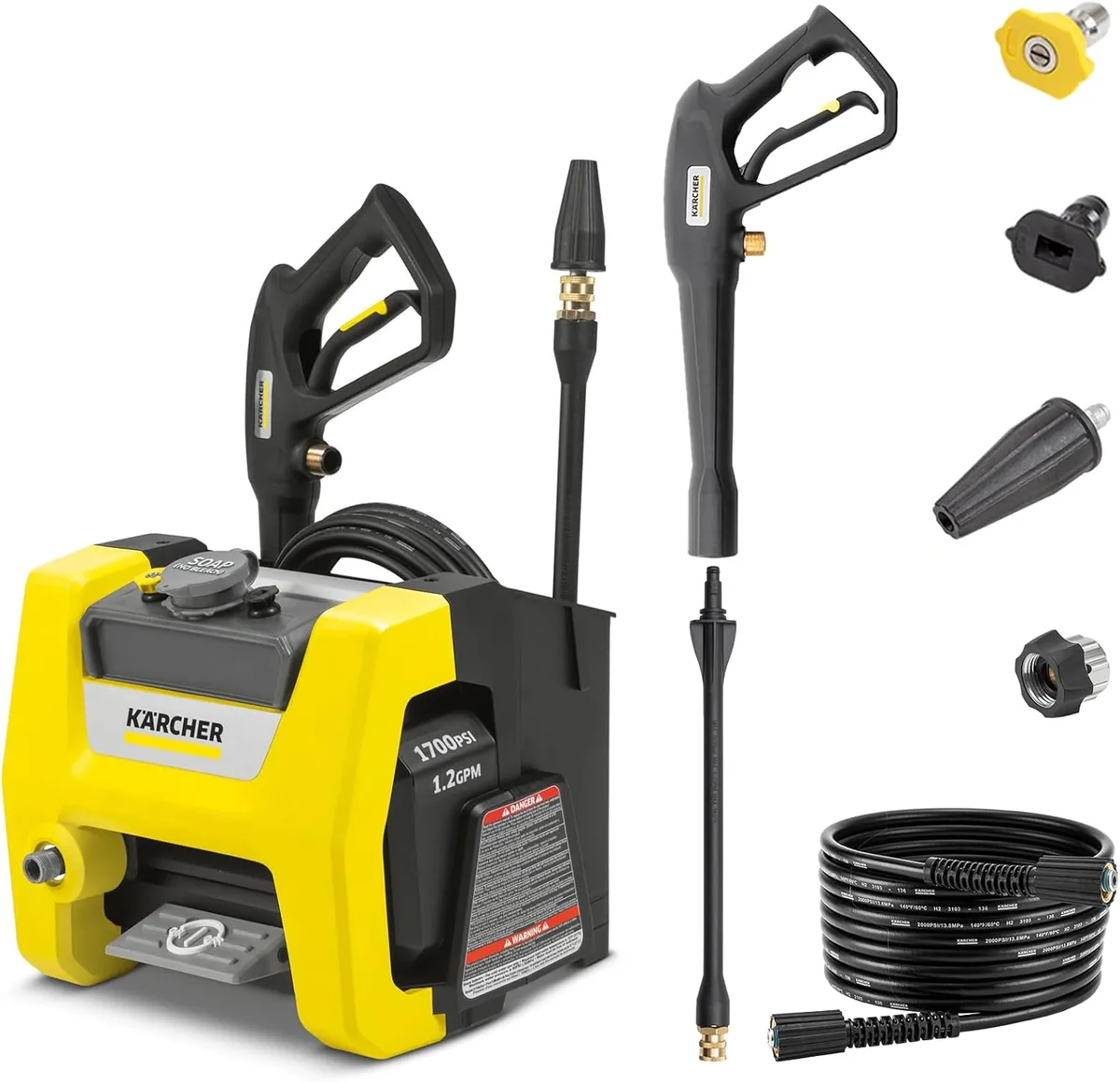
The Kärcher K1700 Cube is the only washer on this page you start with a foot pedal: the manual says to turn on the machine by stepping down on the pedal, and the motor then runs when the trigger is pulled and stops when it is released. It is a compact cube body with a 13 amp motor and a detachable detergent tank, for a buyer who wants a small corded unit with a documented water-supply line.
WHY I CHOSE THIS ✓
The K1700 Cube is here for the foot pedal and the stated water-supply line, which describe how the machine wants to be fed. The pedal is the odd one out, and the supply line is strict. A compact unit with a clear supply spec is what I recommend to a buyer short on space.
Karcher K1700 Cube Electric Pressure Washer Specs
Key Features:
- Foot-pedal on/off: the machine switches on by stepping on the pedal, and the trigger runs the motor.
- Cube body: the compact housing carries a detachable detergent tank on top, according to Kärcher’s listing.
- Water-supply line: the manual asks for at least 2 GPM, a hose at least 5/8 inch and water no hotter than 104 F.
- Trigger lock: the manual says the lock must be on when replacing nozzles or when not in use, and that it does not lock the spray on.
- GFCI in the plug: the manual names the interrupter in the power cord plug.
The pedal is the first thing I tried, and it makes the gun feel different because the on switch is under your foot. Before you fit a nozzle or fill the tank, complete the stop and make-safe steps in the safety section below. Kärcher says the trigger lock does not lock the spray on, so the pedal and the trigger share the job of starting the stream. I press the pedal only once the gun points at the work area.
The water supply is the line I read twice. Kärcher says the supply must not fall below 2 GPM, the garden hose must be at least 5/8 inch, the water must not exceed 104 F and a water filter should be used. A tap that cannot deliver 2 GPM is outside the manual, and I stay inside that line. The manual says detergents go through the machine at low pressure only.
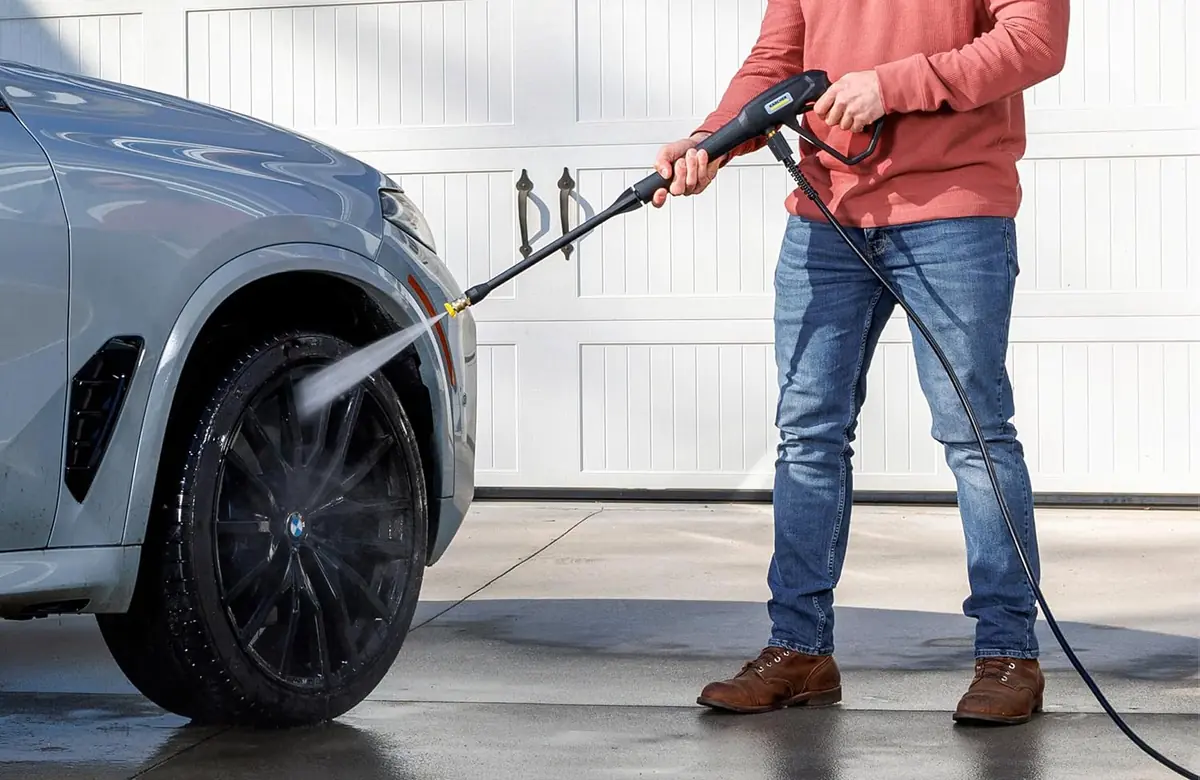
Kärcher says not to use an extension cord and to connect the washer to an individual branch circuit only. Kärcher also asks you to keep the operating area clear of all persons.
Kärcher asks for goggles or a face shield and ear protection, and says the gun kicks back, so hold it with both hands.
Living with it means no extension cord, because the manual forbids one. The manual recommends Kärcher’s own detergent line and says other detergents may affect operation and void the warranty. It also prints a long list of things never to use. Hose length, weight and warranty term are not listed.
The K1700 Cube suits a buyer with limited storage space, an outlet near the work and a tap that meets the 2 GPM line. Skip it if you need an extension cord, since the manual forbids one, or if you want printed lengths and a weight. The foot pedal gets a longer look in my full K1700 Cube review.
FINAL VERDICT
The K1700 Cube is a small corded washer with an unusual start and a firm supply spec. Choose it for tight storage and a short run to the outlet.
It is the compact corded washer you start with your foot.
How to Choose the Best Electric Pressure Washer
A corded washer asks for three decisions before it asks for a price: which figures to trust, how the cord reaches the outlet and what the detergent system needs afterwards. I work through six factors in the order I check them on any machine. The safety section after them covers the steps every washer needs. My best pressure washer roundup widens the field to gas and battery models.
Read Max and Rated Figures on Their Own Basis
Makers print PSI and GPM with a basis word beside each figure, and the word matters more than the number. A maximum is the ceiling the maker states, a rated figure is its number for typical operation, and some makers add the test standard behind the number. I read each maker’s pair together and compare nothing across makers, because the bases differ.
- Basis word: look for max, rated, operating or at initial discharge beside every figure.
- The pair: read the PSI and the GPM from the same manual as one statement.
- The title: a product title can print a different figure from the manual, and the manual wins.
- The ceiling: a printed maximum is what the maker states, not what reaches your work.
Pro Tip
I read the maximum as a ceiling and the rated line as the fair description of the machine, and I plan from the rated line.
Plan the Outlet, the GFCI and the Cord Reach
CDC says to test the ground fault circuit interrupter first and to have an electrician check a unit that trips a breaker (1). Plug a corded washer into a GFCI protected outlet, as its manual specifies.
Most corded washers carry the GFCI in the plug, so the cord decides how far the machine can sit from the outlet. I stand at the outlet and walk the route to the work before I buy, because several manuals advise against an extension cord.
- Cord length: prefer a length the manual prints.
- GFCI controls: look for test and reset buttons the manual describes.
- Extension cord rule: the manual gives a gauge and a length, advises against one or bans it.
- Outlet: the outlet must be GFCI protected, as the manual specifies.
Check Hose and Cord Lengths Where the Manual Prints Them
Hose and cord lengths turn up in three places: the manual’s specification table, a product page, or nowhere. A length in the manual is the one to plan around, and a length that appears only on a product page is the seller’s claim. I mark the route on the ground before I trust either.
| Where it appears | How I treat it |
|---|---|
| Manual specification table | I plan the job around it. |
| Product page only | I treat it as the maker’s claim. |
| Not printed anywhere | I plan for a shorter reach. |
Pick a Detergent System You Will Flush and Empty
Detergent reaches the stream in one of three ways: an onboard tank or tanks, a siphon hose that draws from your own container, or a foam cannon bottle on the lance. Each one has a cleanup the manual describes, and each one has a list of detergents it may and may not run. I read that list before I buy, not after.
| System | What to read |
|---|---|
| Onboard tank or tanks | Printed capacity, which nozzle applies detergent, and the flush step. |
| Siphon hose | The container and filter, and which detergents the manual allows. |
| Foam cannon bottle | Bottle volume and what the manual says about emptying it before storage. |
Detergent Rules
The detergents a washer may run are the manual’s and the label’s to name, and the full detergent sentence sits in the safety section below.
Weight, Wheels and Winter Storage
A weight means little without its basis: net weight, machinery weight and a weight with no basis are three different figures. A washer with wheels rolls over gravel, and one with a carrying handle climbs stairs, so I walk the route from the shed to the work before I choose. The manuals I read say the pump can be damaged by freezing, so the storage room matters as much as the machine. If the carry route is your main worry, my portable pressure washer picks rank nine models for moving around the property.
- Basis: net, machinery or unstated; compare only equal bases.
- Wheels or handle: match it to the route you walk.
- Storage: a frost-free room, as your manual says.
- Pump protector: if the manual recommends one, check whether the box holds it.
Warranty Terms and What They Exclude
Household warranties on corded washers run from one year on parts and labor to three years, and the exclusions matter as much as the term. The manuals in this group exclude commercial or rental use, and one excludes products bought from unauthorized sellers and another says freeze damage is not covered. I read the exclusions list before I look at the term. If you are comparing household options, my best pressure washer for home use roundup covers nine corded and battery models.
Electric Pressure Washer GFCI, Cord and Spray Safety
A corded washer has two hazards that a yard tool does not: a stream that can cut and inject, and electricity near water. The steps below apply to every washer on this page, and each product block adds only what its own manual adds. Read the box first, because every hands-on task starts there.
Stop and Make Safe: The Full Safe-State Box
Stop and make safe before you connect or disconnect a hose, change a nozzle, wand or accessory, clear a clogged nozzle, clean a filter, add detergent, drain the washer, move it, store it or leave it. Release the trigger and engage the trigger lock on the spray gun. Turn the washer off with its power switch and wait until all moving parts have stopped. Then follow your manual’s water-supply shutdown and pressure-relief procedure. Point the gun away from people, pets and electrical equipment at a discharge location your manual and the detergent label permit. Disengage the trigger lock, squeeze the trigger to relieve the trapped pressure as the manual directs, then engage the lock again. Then unplug the washer by the plug, not by the cord, with dry hands. Do not disconnect hoses or change nozzles before the pressure is relieved. If the manual’s procedure does not release the pressure, stop and get service; do not loosen a fitting to release it. Only then disconnect hoses or change nozzles. Where your manual gives a different order for these steps, follow your manual’s order. Follow every applicable step in your manual, in the order it specifies, and check that every hose, fitting and nozzle is attached and undamaged before water or power goes back on.
Electricity and Water
Read the pressure washer’s manual before you connect water or power, and follow it. Its warnings, its operator rules and its steps for your exact model come before anything in this article.
Use the electrical supply and the GFCI protection your manual specifies, and test the GFCI before use according to its instructions. If the washer trips a GFCI or a circuit breaker while you use it, stop using it and have a qualified repair person examine it before you use it again; do not keep resetting it and carry on. Where the washer has a grounding prong, connect it to a properly grounded receptacle and never remove the prong. Never cut or splice a power cord or an extension cord.
Wear closed, rubber-soled footwear that gives some electrical insulation, plus any additional footwear the manual requires; footwear does not replace GFCI protection or the other electrical precautions. Use an extension cord only if your manual permits it, and then only the type and length it names. Keep every plug and cord connection dry, out of standing water and away from runoff and the area you are washing, and keep the spray away from outlets, wiring and electrical equipment. Do not use a damaged cord or plug.
Each manual sets its own electric pressure washer extension cord limits, so the table gives the line each one prints. Follow the manual in your box, which may be a different edition.
| Washer | What the manual says | Gauge or length printed |
|---|---|---|
| Sun Joe SPX3000 | Not recommended; plug and socket watertight | 14 gauge or heavier; 25 ft or less; 60 ft combined |
| Sun Joe SPX3000-XT1 | Not recommended; outdoor type with a rating not below the washer’s | 14 gauge or heavier; 25 ft or less; 60 ft combined |
| Westinghouse ePX3100 | Not recommended | At least 16 gauge for 50 ft or less |
| Westinghouse WPX3400e | Not recommended (August 2025 edition) | At least 14 gauge for 25 ft or less |
| Greenworks GPW3002A | Outdoor type with a rating not below the washer’s | None printed |
| CRAFTSMAN CMEPW2100 | Safety rule 25 and troubleshooting say not to use one | A later table; no gauge relied on |
| WORX WG605 | Do not use with a GFCI cord; elsewhere not recommended | None printed |
| Ryobi RY141612 | Outdoor-marked cord into a GFCI protected outlet | 14 gauge to 25 ft; 12 gauge to 50 ft; none at 100 ft |
| Kärcher K1700 Cube | Do not use an extension cord | None |
The Spray, Your Eyes and Your Hands
Never point the spray at yourself, another person, a pet or any part of the body. Keep your hands and feet away from the nozzle and the stream. Get medical care without delay for a spray wound, even if it looks minor at first. Tell the clinician that a pressure washer caused the injury.
US emergency department data show that pressure washers are the most common source of hand injection injuries from high-pressure equipment (2). A case report describes a washer injury that can lead to infection, compartment syndrome and sometimes amputation (3). A case series of three patients reports serious eye injuries from pressure washers with poor visual outcomes (4).
Wear safety glasses or goggles and closed footwear when you operate the washer, and put them on before you start; where your manual requires goggles, side shields or a face shield, that requirement replaces the minimum here. Follow the manual’s additional protective-equipment requirements, including hearing protection where the manual requires it, and the detergent label’s requirements when you handle detergent. Keep your hands and feet away from the spray. Protective equipment does not make contact with the stream safe.
If someone is hit by the stream, get medical care without delay, even if the wound looks small. Should someone swallow a cleaning product or get it in the eyes, follow the label’s first-aid section and call Poison Control (America’s Poison Centers) at 1-800-222-1222. Call 911 for a fire or immediate danger.
Trigger Lock, Footing and Ladders
Engage the trigger lock on the spray gun whenever you stop spraying, even for a moment, before you set the gun down, and before you walk away or change position. Disengage the lock only for controlled spraying or for the manual’s pressure-relief procedure, with the gun pointed in a safe direction.
Hold and brace the spray gun as your manual instructs, keep firm footing on a surface that is not slippery, and follow your manual’s warning about the push of the gun when you squeeze the trigger. Start the stream away from your feet and from anyone else, and never swing the gun toward people or pets as you turn. The Westinghouse, Greenworks, Craftsman, Ryobi and Kärcher manuals print a two-hand or kickback line.
Do not use a pressure washer for a task at height, such as from a ladder, unless your manual expressly permits the equipment and the method. Ryobi’s manual says not to overreach or stand on a ladder, rooftop or other unstable support.
Water Supply, Nozzles and Detergent
Before you inspect parts or connect hoses, complete the stop and make-safe steps in the safe-state box above. Inspect the high-pressure hose, the spray gun and every fitting before each use, as your manual describes, and do not use a damaged part. Replace a damaged high-pressure hose; never repair or patch it. Connect the hoses and turn on the water before you start the machine, and purge and start it in the order your manual specifies.
Some manuals give their own order. Westinghouse says to turn the washer off, release the pressure in the spray gun and lock the trigger before removing or installing a nozzle, and to unplug the washer before maintenance. WORX says to release the trigger, switch to O, close the water tap and pull the trigger to drain the wand before the hose is unscrewed. Where your manual’s order differs from the box, follow your manual.
Use only the nozzles and accessories your manual permits, following its instructions for the job. Never direct any nozzle at skin, people or animals. Before you change a nozzle, complete the stop and make-safe steps in the safe-state box above. A nozzle that gives a weak, uneven or pulsing stream may be blocked, so clear it only with the tool and the method your manual describes, and never look into the nozzle or point it at anyone to check it.
Before you add detergent or connect or adjust a detergent accessory, complete the applicable stop and make-safe steps in the safe-state box above. Use only the detergents your manual allows, through the detergent system the manual describes, and read the detergent label before you open it. Wear the protective equipment the detergent label requires, and avoid contact of detergent with your eyes and skin. Do not run a detergent that your manual does not name through the pump.
Runoff, Children, Cleaning and Storage
Before you wash, plan how to keep wash water, detergent and debris out of streets, storm drains, ditches and streams, because a storm drain carries what enters it to local waters without treatment (5). Check with your city or county stormwater office about collecting and disposing of the wash water for the job. Send wash water to landscaping only where local rules and the detergent label permit it and the soil can absorb it without runoff or contamination. Otherwise contain and collect it for an approved disposal route.
Keep children, pets and other people away from the work area while the machine runs, and never let a child use the machine. Store the washer where children cannot reach it. Before you clean the machine, check or clean the inlet filter, or do any other maintenance, complete the stop and make-safe steps in the safe-state box above, and do the maintenance your manual describes, in the order it describes it.
Before you store the pressure washer, complete the stop and make-safe steps in the safe-state box above. Drain and store it as your manual directs, in a place the manual allows and away from children.
My Overall Verdict
I recommend three of these washers by name, and they cover most households that need a corded machine. The choice comes down to the detergent system, the cord’s reach and how closely the manual fits the job. If your main job is a deck, my pressure washers for decks roundup picks corded electric models for that work.

1. Sun Joe SPX3000 Electric Pressure Washer Best Overall
Best Overall, for the household that wants two detergent tanks, a 35 ft GFCI cord and nozzle storage in one kit.

2. Westinghouse WPX3400e Electric Pressure Washer Best Premium
Best Premium, for the buyer who wants the fullest kit on this page and an outlet within the cord’s reach.
3. Westinghouse ePX3100 Electric Pressure Washer Best Value
Best Value, for a first washer on a small budget and jobs close to an outlet.
My own habit is to pick the washer whose manual I will follow and whose cord reaches the outlet, and that rule puts the SPX3000 first for most households. It is my choice as the best electric pressure washer for a house and its outbuildings.
Why Sun Joe SPX3000 Electric Pressure Washer Might Be the Best Choice
I picked the SPX3000 first because its manual explains the whole job: the detergent dial, the GFCI cord, the extension cord limit and the storage rule. A washer that tells you where its limits sit is easier to use safely.
The trade-off is housekeeping. Two tanks mean two fills and a flush after detergent, and the manual says skipping the flush clogs the injection system. I accept that for the control the dial gives.
What decided it for me:
✓ Two removable detergent tanks and a selection dial with an off position.
✓ A 35 ft GFCI power cord and a 20 ft hose, both printed by Sun Joe.
✓ Five Quick-Connect nozzles with onboard storage.
✓ An extension cord rule with a gauge and a length.
✓ A total stop system and a thermal sensor described in the manual.
Frequently Asked Questions
What is the best electric pressure washer?
The best electric pressure washer on this page is the Sun Joe SPX3000, picked for its two detergent tanks, its 35 ft GFCI cord and a manual that explains its limits. The right choice for you still depends on your outlet, your detergent system and the extension cord rule in your own manual.
Are electric pressure washers any good?
Electric pressure washers are a sound fit for household outdoor work near an outlet, as long as you follow the manual and use a GFCI-protected supply. Their limits are the cord’s reach, the pressure and flow figures the maker prints, and the need to store the pump where it cannot freeze.
Who makes the best electric pressure washer?
Sun Joe makes the best electric pressure washer on this page, the SPX3000, which pairs two detergent tanks with a 35 ft GFCI cord. Other makers win on one feature each: Westinghouse prints max and rated figures side by side, Greenworks describes a relief valve and Craftsman prints its hose length.
What gauge extension cord for electric pressure washer?
The extension cord gauge for an electric pressure washer is the one printed in that washer’s own manual, and some manuals advise against any extension cord. The Sun Joe SPX3000 manual says 14 gauge or heavier for 25 ft or less, and the Westinghouse ePX3100 manual says at least 16 gauge for 50 ft or less.
Do electric pressure washers need oil?
Electric pressure washers need oil only where the maker’s manual lists it, and each manual covers the maintenance for its own pump. The Westinghouse manuals on this page print no oil step and ask for the hose O-rings to be greased, and the Craftsman manual’s recurring step is clearing the air vents weekly.
References
- Centers for Disease Control and Prevention. Pressure washer safety. Natural Disasters. Published May 15, 2024. Reviewed August 26, 2026. Accessed October 31, 2026.
- Johnson C, Newton W, LaRochelle L, Allen J, Daly C. High-pressure injection injuries of the hand in community and industrial settings: incidence and trends. Hand (N Y). 2025;20(6):917-922. doi:10.1177/15589447231218404
- Funato N, Sugizaki Y, Ri Y, Ichibayashi R. High-pressure injection damage caused by a high-pressure washer. Cureus. 2024;16(1):e52498. doi:10.7759/cureus.52498
- Placide J, Yang MY, Gross AW, Crowell EL. Case series: traumatic ocular lacerations secondary to pressure washers. Am J Ophthalmol Case Rep. 2022;27:101612. doi:10.1016/j.ajoc.2022.101612
- US Environmental Protection Agency. Stormwater best management practice: vehicle maintenance and washing. EPA-832-F-21-032F. February 2023.
Safety Note: Read your pressure washer’s manual before you connect water or power, and follow it. Never point the spray at yourself, another person, a pet or any part of the body. Keep hands and feet away from the nozzle and stream. Get medical care without delay for a spray wound, even if it looks minor at first. Tell the clinician that a pressure washer caused the injury. Wear safety glasses or goggles and closed footwear before operating the washer, plus any additional protection required by the manual and the detergent label. Follow the manual’s instructions for the trigger lock, grip, footing and recoil, and engage the trigger lock whenever you stop spraying. Use only the nozzles, accessories and detergents the manual permits, and never point any nozzle at skin, people or animals. Do not perform a task at height without instructions expressly permitting the equipment and method in the exact manual. Gas models: operate outdoors, never inside a building or a partly enclosed space. Keep the engine at least 20 feet from any window, door or vent, following CDC’s pressure washer guidance and any stricter manual requirement. Exhaust contains carbon monoxide, which cannot be seen or smelled and can kill. Opening doors or windows does not make indoor operation safe. Refuel only with the engine off and cool, following the manual. Corded models: use the manual’s specified electrical supply and GFCI protection, and test the GFCI before use according to its instructions. After an operating GFCI or breaker trip, do not reuse the washer until a qualified repair person has examined it. Where the washer has a grounding prong, connect it to a properly grounded receptacle and never remove the prong. Wear closed, rubber-soled footwear that provides some electrical insulation, plus any additional footwear required by the manual; footwear does not replace GFCI protection or the other electrical precautions. Never cut or splice cords. Use an extension cord only as the manual permits. Keep connections dry and away from runoff, standing water and the washing area, and keep spray away from electrical equipment. Battery models: use only the battery and charger the maker specifies for your exact model. Emergency first: if you notice an unusual odor, a change in color, too much heat, a change in shape, leaking or odd noises from a lithium-ion battery, stop using the washer and follow your battery manual’s emergency instructions. Otherwise, complete the applicable stop and make-safe procedure before hose, nozzle, wand or accessory work, clearing a blockage, cleaning, maintenance, refueling, checking oil, adding detergent, battery changes or charging, draining, moving, transporting, storing or leaving the washer. Follow your exact manual’s procedure and order. Release the trigger and engage its lock. Gas: switch the engine off and wait for it to stop; disconnect the spark plug wire before service as the manual directs, and let hot parts cool before refueling, storage or contact. Corded: switch off and unplug by the plug with dry hands. Battery: switch off, remove a removable battery as the manual directs and keep it away while working; for a built-in battery, follow the manual’s isolation procedure and do not open the battery compartment. Complete the manual’s water-supply shutdown and pressure-relief steps: point the gun in a safe direction at a permitted discharge location, disengage the trigger lock, squeeze the trigger as directed to relieve pressure, then reengage the lock. Do not disconnect hoses or change nozzles until pressure is relieved. If pressure cannot be relieved by the prescribed procedure, obtain service without loosening fittings. Refit and inspect parts before restoring water or power. Replace a damaged high-pressure hose; never repair or patch it. Before you wash, plan how to keep wash water, detergent and debris out of streets, storm drains, ditches and streams, and check with your city or county stormwater office about collection and disposal. Send wash water to landscaping only where local rules and the detergent label permit it and the soil can absorb it without runoff or contamination. Keep children and pets away, and never let a child use the machine. Drain and store the washer as its manual directs. For exposure to a cleaning product, follow the label’s first-aid instructions and call Poison Control at 1-800-222-1222. Call 911 for a fire or immediate danger.