

The best hedge trimmer for large hedges covers a wide band on every pass and stays comfortable at arm’s length to the end of the row. I keep the perimeter hedgerow of a 3.7-acre apricot and plum orchard, the longest run on the property, and I put these trimmers to work along it. I put the same three tests to each one: how wide the cut is, which stems it will take and what it weighs at the last pass.
Below are nine battery and gas trimmers, all with blades of 24 in or longer. My top pick, the BLACK+DECKER 40V MAX LHT2436 24-Inch Cordless Hedge Trimmer Kit, gives a long hedge a 24 in blade, a battery and a charger in one box.
Best Hedge Trimmer for Large Hedges Reviews 2026 With 9 Models I Put to Work
These nine trimmers all have blades of 24 in or longer, because a large hedge is a job of passes, and a hedge trimmer for large bushes needs the same reach. Eight run on a battery and one on gas, and each is a tool for cutting from the ground at or below shoulder height.
1. BLACK+DECKER 40V MAX LHT2436 24-Inch Cordless Hedge Trimmer Kit Best Overall
The LHT2436 puts a 24 in dual-action blade, a 40V MAX battery and a charger in one mid-range box, which is why it leads this page for a long hedge cut from the ground. The blade takes in a wide band on every pass, and the four-light charge gauge on the pack tells you when to plan a stop. It is built for young, green growth up to the manual’s stem limit.

WHY I CHOSE THIS ✓
I rank the LHT2436 first because it asks the least of the buyer and still does the main job: a long blade, a pack and a charger, with a charge gauge that tells the truth. It is the best hedge trimmer for large hedges that a homeowner can start using the day the box arrives. I would hand it to a neighbor with a long green hedge and a modest budget.
BLACK+DECKER 40V MAX LHT2436 24-Inch Cordless Hedge Trimmer Kit Specs
Key Features:
- 24 in dual-action blade: BLACK+DECKER says dual-action blades cut branches fast with less vibration, and the longer bar means fewer passes along a big hedge.
- Four-light charge gauge: press the button on the pack and the LEDs show the charge level, so you know whether the next stretch is safe to start.
- Battery and charger in the kit: one LBXR36 pack and a charger come in the box, so nothing else needs buying before the first cut.
- Fast partial charge: the manual gives about 2 hours for a fully depleted pack and 80 percent in 1 hour.
- POWERDRIVE transmission: BLACK+DECKER credits it for the 3/4 in cut capacity on a trimmer this size.
- Soft-grip trigger and wraparound front handle: the full-length trigger lets you change your grip during a long pass, and both hands stay on the handles.
- Slide lock and sheath: you slide the lock button back before you squeeze, and the sheath fits over the blade for carrying and storage.
The 24 in bar suits the manual’s technique of a wide, sweeping motion that feeds the blade teeth through the twigs. On the long stretch of the perimeter hedgerow, young shoots went in cleanly and the swath behind the blade was wide. The limit is printed in the manual: stems greater than 3/4 in (19 mm) are off the menu, and a longer blade does not raise that number. Thicker stems go to loppers or a pruning saw before the trimmer comes out.
One 1.5 Ah pack feeds a 24 in blade, and the gauge is what I watched. The first pass went fast, then the lights dropped sooner on the thicker stretch. Run time depends on the growth, so I treat the gauge as the guide and plan a break to charge on a long hedge. A fully depleted pack takes about 2 hours on the standard charger, and 80 percent takes about an hour.
The house and sheds sit a long walk from the nearest row, and a cord would have been the wrong tool for that distance. The charging base is wall-mountable, so it hangs in the house where the outlet is, and I carry only the pack and the trimmer out. The manual warns against storing the tool and pack where the temperature can reach 105 F, such as outside sheds or metal buildings in summer, so the pack stays indoors between jobs. If the pack is hot from the hedge, the charger waits: it pauses until the pack has normalized and flashes its red light, then carries on by itself.

Stretch a string along the hedge at the final height. The manual uses it as the guide for a level top, and a crooked top shows on a 24 in cut.
The manual says never to lock the switch in the ON position, so the lock button is only ever used to release the trigger. The full shutdown steps are in the safety section below.
Upkeep is short: clean with a damp cloth and mild soap, then apply a film of light machine oil to prevent rust, and never immerse the tool. The manual says normal use does not need resharpening, and a nick from a wire fence, stones or glass can stay unless it interferes. Slow, noisy or hot blades usually mean dry or corroded ones, so lubricate. BLACK+DECKER prints no sound or vibration figure, and the 9.5 lb on its spec list comes with no basis, so I do not rank the trimmer by weight.
Buy the LHT2436 if your hedge is green, wide and long, you cut from the ground, and you want the whole kit in one box. It suits a homeowner with a property edge to keep and no desire to mix fuel. Skip it if your stems run thicker than 3/4 in, if you need a run time in minutes or a weight with a stated basis, or if you want a rotating handle.
FINAL VERDICT
The LHT2436 covers a long, leafy hedge with the fewest purchases and the clearest battery gauge on this page. Choose it when your stems stay under 3/4 in and the hedge is wider than a short shrub row.
It is the long-blade battery kit I recommend to most homeowners.
2. EGO Power+ HT2601 26-Inch Cordless Hedge Trimmer Kit Best Premium
The HT2601 carries the longest blade on this page, a 1.2 in stem limit and a five-position rotating rear handle, all in a kit that already holds the battery and the charger. That makes it the premium pick for a hedge that is both long and woodier than a young privet. It rewards the buyer who wants fewer passes and who will put in the work of oiling the blade.

WHY I CHOSE THIS ✓
I rank the HT2601 second because it is the one that makes a long, woody hedge feel manageable: the longest blade here, a 1.2 in stem limit and a handle that turns to the cut. I accept that it costs more and weighs more at arm’s length than its number suggests. It is my choice for a big hedge that has been left to thicken.
EGO Power+ HT2601 26-Inch Cordless Hedge Trimmer Kit Specs
Key Features:
- 26 in cutting length: the manual prints 660 mm, the longest blade of the nine models here, so a long run needs fewer passes.
- 1.2 in stem limit: the manual says the trimmer cuts stems less than 1.2 in (30.5 mm) thick, and it sends thicker stems to a hand saw or pruning saw.
- Five-position rear handle: a release lever turns the rear handle to 0, plus or minus 45 and plus or minus 90 degrees, and it locks at the nearest detent.
- Two-trigger start: you squeeze the front trigger with one hand, press the lock-off and squeeze the rear trigger with the other, and releasing either trigger stops the blade.
- Battery and charger in the box: one 56V 2.5 Ah pack and the standard charger come with the trimmer, so you can cut on day one.
- Hot-pack cutout: the motor will not run while the battery or the tool is too hot, so it protects the pack on a long afternoon.
- Carbon fiber rail: EGO says the rail on the blade bar carries a lifetime warranty when you register within 90 days of purchase.
The rotating handle suits the sides of the hedge, where the manual says to cut from the bottom up. The manual says to pivot the handle only after the full maintenance shutdown in the safety section below, and it says the handle locks itself at the nearest detent. For new growth, EGO tells you to use a wide sweeping action, and for older growth with thicker stems a back-and-forth motion.
At 6.92 lb without the battery and the blade guard, the HT2601 is a light tool on paper, but the weight at the first cut is not the weight at the last. By the end of a long row it felt heavier in my arms, and the pack adds more than the manual number shows. EGO publishes no weight with the battery, so I take breaks and change my grip instead of trusting the figure on the box.
The two-trigger start changed how I work. Both triggers have to be held to start the blade, and letting go of either one stops it, so the free hand cannot wander toward a stem. The base went thin on the first stretch where I had left the top wide, because a top wider than the base shades the lower leaves until they drop. On the next stretch I cut the sides from the bottom up, as the manual says, and kept the top slightly narrower, and the lower leaves held.

EGO wants light machine oil on the blades before and after each use, and on a long job it says to take a break and oil the blades again. The maintenance steps in the safety section below come first.
EGO’s own rule belongs here: operate the trimmer at ground level only, and never on a ladder, rooftop, tree or other unstable support. The full shutdown steps are in the safety section below.
Living with it means oiling and cleaning: EGO wants light machine oil on the blades before and after each use, a soft brush on the air intakes and the blade, and resin solvent for pitch, and it says never to wash the tool with water or a hose. The manual lists an operating range of 32 to 104 F. EGO prints no sound figure, so I wear hearing protection through the long afternoon sessions.
Buy the HT2601 if you cut a long hedge with some woody stems under 1.2 in, you want the rotating handle for side passes and you accept a premium price. Skip it if your hedge is a short shrub row where a lighter tool would do, if you need a stated run time or weight with the battery, or if your hedge stands above shoulder height and needs a pole tool.
FINAL VERDICT
The HT2601 is the long, capable premium kit on this page, and it earns the extra cost on a hedge that has grown woody. If your hedge is mostly soft growth, a cheaper kit does the same cutting.
It is the premium long-blade kit for a woody, wide hedge.
3. SKIL PWR CORE 40 HT4221-10 24-Inch Brushless Hedge Trimmer Kit Best Value
Choose the SKIL when you want a 24 in brushless trimmer with a five-year warranty and the battery and charger in the box for a mid-range outlay. It is my value pick for a long, green hedge cut from the ground, where a plain tool with no extras does the whole job. The trade-off is that its manual prints no weight and no run time, so you buy it for what it cuts rather than for numbers.

WHY I CHOSE THIS ✓
I rank the SKIL third because it pairs a brushless 24 in kit with a five-year warranty at a mid-range price, and that is the best value on this page for a hedge of soft or green growth. The trade-offs are a fixed handle and a stem limit of 17.5 mm. I would buy it for a plain, long hedge and nothing more.
SKIL PWR CORE 40 HT4221-10 24-Inch Brushless Hedge Trimmer Kit Specs
Key Features:
- 24 in cutting length: the manual prints 610 mm, the same reach per pass as the other 24 in kits here.
- Brushless 40V trimmer: the manual’s own title calls it a brushless 40V hedge trimmer, rated 40 V d.c., with a no-load speed of 3000 SPM.
- Battery and charger in the kit: one 2.5 Ah PWR CORE 40 battery and a charger come in the box, and the blade sheath rides with them.
- Lock-off button and trigger: you press the lock-off first and then squeeze the trigger, and the trimmer stops when the trigger is released.
- Hand guard: the manual lists a guard that protects the operator’s hands and deflects chips and debris away from them.
- Five-year warranty with registration: the original buyer who registers within 30 days gets 5 years, and the manual cuts it to 90 days for commercial use.
- Stem rule in plain words: the manual says to cut only stems or twigs less than 3/4 in thick and to use a hand saw or pruning saw on larger ones.
On a green hedge the SKIL does what the other 24 in trimmers here do: a wide sweeping action for new growth and a sawing movement for older stems, as the manual describes it. The manual allows only stems less than 3/4 in thick, and it prints the limit twice, once as 3/4 in and once as 17.5 mm, which is a little less. I cut to the smaller number, because a blade that stalls at the limit is a blade that binds. The manual also says not to trim too much at once, and not to force the trimmer through heavy shrubbery.
The kit has one 2.5 Ah battery and run time depends on the growth, so I plan stops. Before the first cut I take the blade guard off and check that the blade is not touching the ground or anything else, which the manual requires before you start. Then I press the lock-off and squeeze the trigger. SKIL prints no weight for the tool in the manual, so I make no weight claim for it.
One stretch had a few stems thicker than the limit. I cut those with loppers first and then ran the trimmer over the green growth, which is what the manual’s hand saw or pruning saw advice comes to in practice. Later the blade began to gum up with sap, so I stopped and oiled it with light machine oil, as the manual says to do on an extended job. The troubleshooting table points to dry or corroded blades for noise or vibration, and the oil answered that.

The manual says to trim the sides from the bottom up so the hedge ends slightly narrower at the top, which keeps the lower leaves in the light.
SKIL’s manual puts a rule on this trimmer that belongs with the others: never remove the battery pack at a high location, and never use it on a ladder, rooftop or tree. The full shutdown steps are in the safety section below.
Clean the tool with a soft brush on the air intakes and resin solvent for pitch, and never use water on it. File the teeth only as the manual describes, taking off as little material as possible and keeping the original angle, and do not run a dull or damaged blade. The warranty excludes blades as routine maintenance parts, and the manual says the trimmer cannot be used in rain or left outside in it. Compared with the corded trimmers in the workshop, the weight of the cord is gone and the weight of the pack has arrived.
Buy the SKIL for a long hedge of soft or mid-aged growth where cost matters and you will register the warranty within 30 days. It suits a homeowner with a property line of green hedge and loppers for the odd thick stem. Skip it if your stems are thicker than 17.5 mm, the smaller of the two limits its manual prints, or if you want a rotating handle.
FINAL VERDICT
The SKIL is a good-value 24 in kit with a long warranty and the basics done right. Pick it for a plain green hedge, and pick something else if your stems run near its limit.
It is the value 24 in kit for a plain green hedge.
4. Husqvarna 322HD60 24-Inch Gas Hedge Trimmer Best Gas
Gas suits a hedge that is long, an afternoon that is longer and an owner who does not want to watch a battery gauge. The 322HD60 is the only gas model on this page, with a 24 in double-sided blade, a 21.7 cm3 two-stroke engine and a rear handle that sets to three positions. It is the best gas hedge trimmer here for someone who accepts fuel mixing and ear protection.

WHY I CHOSE THIS ✓
The 322HD60 sits fourth because it gives a long hedge a steady engine and a handle that turns to the cut without a pack to watch. It is what I would keep for the stretch of hedge that outlasts any battery.
Husqvarna 322HD60 24-Inch Gas Hedge Trimmer Specs
Key Features:
- Double-sided blade: teeth on both edges, 4,400 cuts per minute in the manual.
- Three-position rear handle: release the handle lock and turn it for side cuts.
- Catalytic converter muffler: the manual still warns that the muffler and gearbox stay hot during and after use.
- Choke and purge bulb: you pull the choke, press the bulb about six times and pull the rope with the body held on the ground by your left hand.
- Idle screw: the manual says the blade must not move at idle and gives the adjustment that stops it.
The engine does not sag the way a draining pack does, so the 322HD60 holds a steady pace through a long, leafy hedge. Husqvarna prints no stem or branch capacity, only a 1.2 in teeth opening on its US page, and that is a gap between teeth, not a limit for a stem. Thick old wood goes to loppers or a saw.
The weight is the price of the engine. Husqvarna lists 11.5 lb without fuel, and the 24 in cutter pushes the load away from the body, so I hold it in front of me, as the manual says, and take breaks. Starting is a small ritual: pull the choke, press the purge bulb about six times and pull the rope with my left hand holding the body down on the ground. According to Husqvarna’s US page, the sound is 98 dB(A) at the operator’s ear and 102 dB(A) as sound power, so ear protection goes on before the first pull.

Husqvarna’s fuel rule is 50:1 with its two-stroke oil, and no more than one month’s worth mixed at a time.
The manual asks you to keep people and animals at least 15 m (50 ft) away while you work. The full maintenance and refuelling steps are in the safety section below.
Brush the cooling system weekly, because the air intake blocks easily with leaves, and grease the gearbox without filling the housing fully. The manual says never to run the trimmer indoors or in closed spaces, so it works outside and goes into the shed only after the fuel is emptied. I look through the hedge for a nest before I cut and leave that section alone if I find one.
Buy the 322HD60 if your hedge is long, you work for hours at a time and two-stroke fuel is no problem. Skip it if you want a quick start, if noise and fuel bother you, or if you need a stated stem capacity.
FINAL VERDICT
The 322HD60 is the gas answer for a long hedge where a battery is the wrong tool. Pick it only if you accept the weight, the noise and the fuel.
It is the gas trimmer for a hedge that outlasts a pack.
5. Husqvarna Hedge Master 320iHD60 24-Inch Battery Hedge Trimmer Kit Best Reverse Button
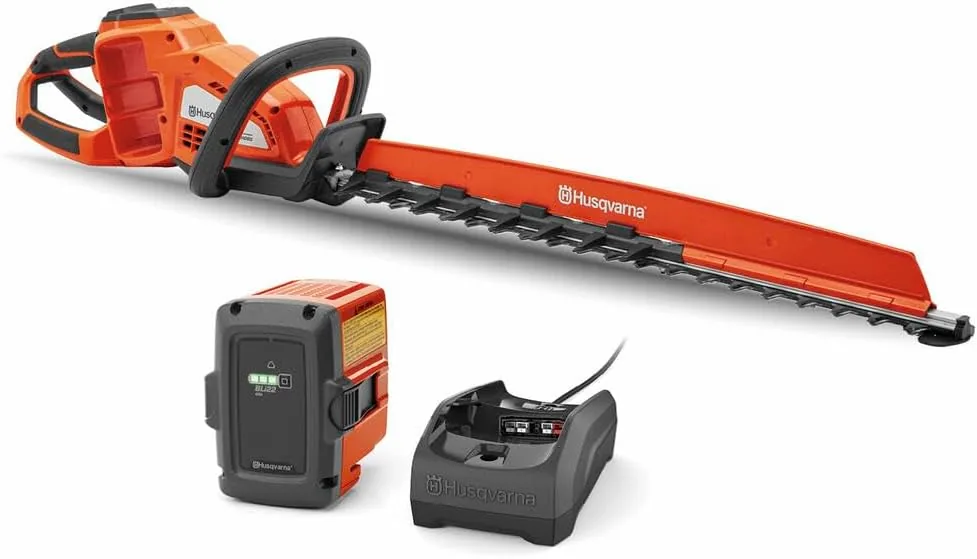
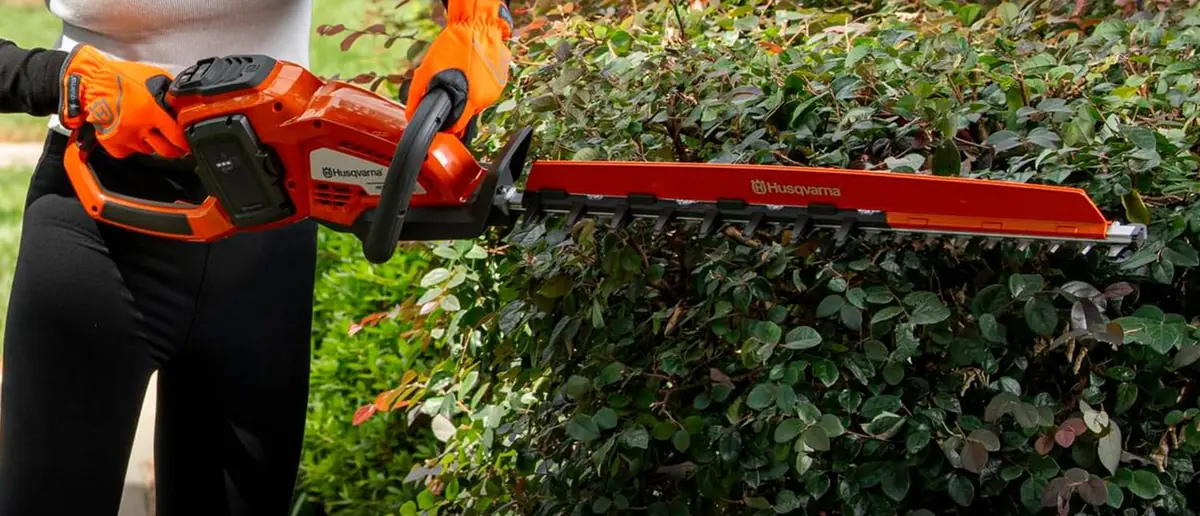
The 320iHD60 is the only trimmer on this page with a reverse button, and that control changes what a wedged blade costs you. Press it with the two triggers and the blade runs the other way for a moment, which the manual uses to clear wedged cuttings. For a leafy hedge it is the Husqvarna battery hedge trimmer I reach for, a brushless pro-line tool with a 24 in blade and a 4.0 Ah battery and charger in the kit.
WHY I CHOSE THIS ✓
Fifth place goes to the 320iHD60 because no other trimmer here lets you clear wedged cuttings with a button. The weight and the missing capacity figure are the cost. It is my pick for a leafy hedge that packs the blade.
Husqvarna Hedge Master 320iHD60 24-Inch Battery Hedge Trimmer Kit Specs
Key Features:
- Reverse button: press it and two triggers and the blade runs the opposite way momentarily, then press the triggers again for the usual direction.
- Boost button: hold it for maximum blade speed and release it to return to the set speed.
- Three rear handles: the manual says to use them to work at different angles, with a front handle for the other hand.
- Standard and extended positions: one trigger plus the lockout is standard, and two triggers is the extended range, which the manual says can make you tired.
- Automatic shutdown: the trimmer stops after 45 seconds without use, and the green start light goes off.
The reverse button earned its place on leafy growth, and I cover that feature in my Husqvarna 320iHD60 trimmer review. When cuttings wedged between the teeth, the reverse step cleared them in a moment, and I kept cutting. A hard jam is a different job: the full shutdown steps are in the safety section below, and they come before any reaching toward the blade. Sap and resin belong to the manual’s cleaning routine, with the anti-corrosion cleaning agent.
The manual gives 8.42 lb without the battery, and the 40-B140 pack is listed at 2.6 lb, so the tool is about 11 lb with the battery by simple addition. At arm’s length that adds up.
Husqvarna prints no stem capacity in the manual, only a 1 in teeth opening on its page, so feed the blade green and young growth and cut anything thick with loppers first.
Charge the pack indoors only, in good airflow and away from sunlight, between 41 and 104 F; the manual says not to charge the battery outdoors.
On a cold morning the pack cut out sooner than I expected. The manual gives a battery use range of 14 to 104 F and a warning light for temperatures outside it, so I now keep the pack indoors until the cut starts. Hidden fence wire nicked the blade once, and the manual does say to remove loose wire and string from the working area. For storage, it wants the pack at 30 to 50 percent charge, and it asks you to keep people and animals at least 15 m away.
Buy the 320iHD60 if you cut leafy growth that wedges in the blade and you can charge the pack indoors. Skip it if you want the lightest tool, a stated stem capacity or a rotating handle.
FINAL VERDICT
The 320iHD60 is the trimmer for a leafy hedge, because it has the button that clears wedged cuttings. If your hedge cuts clean, you are paying for a control you will rarely press.
It is the reverse-button trimmer for a leafy hedge.
6. Greenworks 40V 24-Inch Cordless Hedge Trimmer Kit Best Lightweight
Weight at arm’s length is the real cost of a big hedge, and this is where the Greenworks 40V earns its place. Its manual lists 6.0 lb without the battery, the lowest figure on this page on that basis, on a 24 in blade with a five-position rotating rear handle. If arm comfort matters more than the longest reach, it is the best lightweight hedge trimmer on this page.

WHY I CHOSE THIS ✓
The Greenworks comes sixth because it asks the least of my arms on a wide hedge, and that counts across a long row. It is the one I hand to someone who tires quickly.
Greenworks 40V 24-Inch Cordless Hedge Trimmer Kit Specs
Key Features:
- Rotating rear handle: the rotating button sets the handle to five positions, which the manual says makes the hedge easier to cut.
- Micro switch start: hold the front-handle switch with one hand, then press the trigger and safety lock button with the other.
- 2800 SPM no-load speed: the manual lists it for the 24 in blade.
- Kit with battery and charger: the 2.0 Ah pack and charger come in the box.
- Light oil after each session: the manual asks for a light layer of non-pollutant oil along the top edge of the blade.
The five handle positions are there for the sides, and the low weight kept my shoulder out of the job. The manual gives a capacity of 1.1 in without saying whether it means a stem, a branch or a gap, so I feed it green growth and treat anything that slows the blade as too thick. My Greenworks 40V hedge trimmer review goes through the kit and its rotating handle.
The 6.0 lb is without the 2.0 Ah battery, so add the pack to the load. The small battery and Greenworks’ 240 minute recharge suit short sessions better than all-day work. Run time varies with the growth, so I plan to stop and swap rather than push on.

Greenworks’ manual rules out cutting above shoulder level. A wide hedge suits it; a tall one needs a different tool.
The manual asks you to keep bystanders at least 15 m (about 49 ft) away and to wear non-slip, heavy-duty gloves. The full shutdown steps are in the safety section below.
The upkeep is a short routine. After each session I wipe the blade with a soft cloth and a brush, add a light layer of oil along the top edge and keep the vents free of leaves, because the manual ties both to fire risk. The taller rows along the orchard edge are beyond a handheld trimmer, so I leave those to a pole tool.
Buy the Greenworks for a wide hedge cut at or below shoulder height, if you can live with short sessions on one small pack. Skip it if your hedge is taller than your shoulders, if the stems run thick, or if you need a published run time before you buy.
FINAL VERDICT
The Greenworks is the light 24 in kit, and a wide hedge is the job it suits. Choose it for arm comfort, not for endurance.
It is the light trimmer I hand to tired arms.
7. EGO Power+ HT2501 25-Inch Cordless Hedge Trimmer Kit Best for Thick Branches
An overgrown hedge needs capacity more than reach, and the HT2501 prints the highest stem limit of the nine on this page: stems less than 1-1/4 in (33 mm) thick. That makes it the hedge trimmer for thick branches here, in a 25 in kit with a two-speed knob, a rotating handle, a battery and a charger. It is also the heaviest EGO of the set.

WHY I CHOSE THIS ✓
Seventh is where the HT2501 belongs, and it is the one I reach for when the hedge has been left alone for a season. Its stem limit is the biggest printed here. It earns its place on the thick stretch and nowhere else.
EGO Power+ HT2501 25-Inch Cordless Hedge Trimmer Kit Specs
Key Features:
- Two-speed knob: position 1 selects 2800 SPM and position 2 selects 3200 SPM.
- 1-1/4 in stem limit: the manual says to cut stems less than 1-1/4 in thick and sends larger wood to a hand saw or pruning saw.
- Rotating rear handle: five positions, and the manual says to keep the handle facing upwards while you work.
- Fuel gauge on the battery: the 2.5 Ah pack shows its charge, and a standard charger comes in the kit.
- Two-switch start: press the lock-off, press the rear switch and keep pressing the front lever; releasing either stops the blade.
On an overgrown stretch the manual’s sawing movement did the work, and I assess the kit as a whole in my EGO HT2501 trimmer review. EGO says not to force the trimmer through heavy shrubbery, and when the blade slowed near the limit I stopped pushing and cut that stem by hand. Wood thicker than 1-1/4 in goes to a hand saw or pruning saw.
The 8.38 lb is without the battery and the blade guard. The battery adds to the 8.38 lb, so I rest between stretches. Next to my old gas handheld it was quieter, but it never matched that engine’s endurance on a long run.

Choose the speed by the working conditions and the material: position 1 is the lower speed and position 2 the higher. Turn the rear handle only after the full maintenance shutdown in the safety section below, since it must not be adjusted while the tool runs.
The manual asks for eye protection, non-skid footwear and rubber gloves. The full shutdown steps are in the safety section below.
EGO wants light machine oil on the blades before and after each use, and resin solvent on pitch. Dull or damaged blades can overload the motor, so keep them sharp. A section of the hedge had grown thick after a season of neglect, and the HT2501 cut it back in stages that stayed under the limit.
Buy the HT2501 if you have an overgrown hedge with stems less than 1-1/4 in thick and you want two speeds and a rotating handle in one kit. Skip it if your hedge is soft and thin, if you want the lightest tool, or if you want a blade brake: the manual says the blades keep moving after the switch is released.
FINAL VERDICT
The HT2501 is the thick-growth trimmer on this page, and the weight is what you carry for it. Choose it when the stems are close to the limit, not for a light shrub row.
It is the thick-stem trimmer for a hedge left alone too long.
8. Milwaukee M18 FUEL 2726-20 24-Inch Hedge Trimmer, Tool Only Best 18V Tool-Only
The box holds the trimmer and nothing else: no battery and no charger, so you need M18 batteries and an M18 charger before the first cut. For a buyer already on that system, the M18 FUEL 2726-20 is the Milwaukee battery hedge trimmer to look at, a 24 in tool with a 3-year warranty and a manual that is unusually specific about technique.

WHY I CHOSE THIS ✓
The 2726-20 takes eighth place because it asks for a battery you may not own, and the manual’s technique advice is its strength. I recommend it to anyone who already has an M18 pack and charger on the shelf.
Milwaukee M18 FUEL 2726-20 24-Inch Hedge Trimmer, Tool Only Specs
Key Features:
- Tool-only M18 design: it runs on the 18 V M18 batteries you may already own.
- Flat-top technique in the manual: Milwaukee says to hold the tool at a 0 to 10 degree angle for a flat top and to stretch a string just below the cut height.
- Full-speed start rule: the manual says to let the motor reach full speed before you start to cut.
- Slower pace for thick wood: the manual says not to force the tool, since the blade will slow and could bind.
- Service interval: Milwaukee asks for an inspection of the tool, battery and charger after six months to a year, depending on use.
The manual’s technique notes are specific. It says to hold the tool at a 0 to 10 degree angle on a flat top, and with a string stretched just below the cut height, the top came out level. The 3/4 in figure is a branch diameter, and Milwaukee warns that the tool may stall or kick back above it, so thicker wood goes to a saw or loppers.
With no battery in the box, the run time depends on the M18 pack you fit. I let the motor reach full speed before the blade enters the hedge, as the manual asks, and I stop for a charge when the pack runs down.

Milwaukee’s own carrying rules add to the shell’s carrying steps: hold the tool by the front handle with the blade behind you, and never carry it by the trigger handle. The full carrying and shutdown steps are in the safety section below.
Milwaukee says to keep bystanders at least 15 ft away, since objects may be thrown, and to check the work area for wires and fencing. The full shutdown steps are in the safety section below.
The hedge beside the house sits with a window behind it, so I looked through it first instead of cutting blind. On a dewy morning I waited for the hedge to dry, since the manual forbids use in rain or wet locations. Milwaukee asks for light machine oil on both sides of the top blade before and after each use and before storing, and never a hose to clean the tool.
Buy the 2726-20 if you already own M18 batteries and a charger and want a 24 in trimmer on the same platform. Skip it if you have no M18 gear, or if your stems are thicker than 3/4 in.
FINAL VERDICT
The 2726-20 is the right 24 in tool for an M18 household and the wrong buy for anyone starting from nothing. Choose it for the platform and the clear technique advice.
It is the M18 tool for a household that already owns the batteries.
9. Ryobi 40V RY40601A 24-Inch Cordless Hedge Trimmer, Tool Only Best 40V Tool-Only
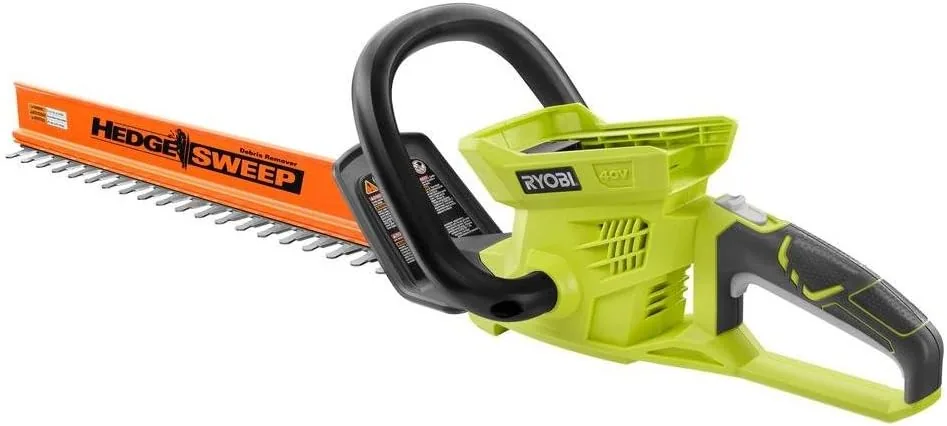
This Ryobi arrives as a bare tool: no 40V battery and no charger in the box, so you need both before the first cut. For a household already on Ryobi 40V packs it is a simple 24 in trimmer for a household already on Ryobi 40V batteries, with a 5-year household warranty and a Hedge Sweep that pushes cuttings off the hedge.
WHY I CHOSE THIS ✓
Ninth place suits the Ryobi, which assumes you own the batteries and cuts only to 3/4 in. It fits a household that already runs Ryobi 40V tools.
Ryobi 40V RY40601A 24-Inch Cordless Hedge Trimmer, Tool Only Specs
Key Features:
- Hedge Sweep debris remover: it rides on the blade guide and pushes cuttings off the hedge as you cut, and the manual says never to use it as a grip.
- Lock-out start: you press and hold the lock-out button, pull the trigger, release the lock-out and keep holding the trigger.
- 3/4 in stem rule: the manual says not to cut stems or twigs larger than 3/4 in and to use a hand saw or pruning saw for large stems.
- 3,200 cuts per minute: that is the manual’s figure for the blade speed.
- Household warranty of five years: it drops to 90 days for business or commercial use.
The Hedge Sweep is the feature you notice. It rides on the blade guide and pushes cuttings off the top of the hedge as you cut. The manual says never to use the Hedge Sweep as a gripping surface, and both hands stay on the handles. The cutting itself is a wide sweeping action on new growth and a sawing movement on older stems, with the 3/4 in rule as the limit.
A bare tool runs only as long as the pack you fit. The manual says to stop the motor whenever cutting is delayed and when walking from one cutting location to another, and I do. I release the lock-out as soon as the blade is moving and keep my grip on the trigger, as the manual’s start sequence says, and letting go of the trigger stops the blade and resets the lock-out.

Keep the unit clean of clippings, because the manual says they can lodge in the blades, and clean the motor vents with a small brush.
Ryobi’s symbol table asks you to keep the tool 50 ft from electrical lines and bystanders at least 50 ft away. This is a handheld trimmer, and the full shutdown steps are in the safety section below.
Clippings piled over a drip line after one pass, and the Hedge Sweep pushed them there, so I raked them off before the next row. Ryobi asks for light machine oil on the top blade before and after each use, and periodically on a long job. Sharpening needs a vise and an 8 in smooth round file, keeping the original tooth angle.
Buy the Ryobi if you already own Ryobi 40V batteries and want a 24 in blade with a household warranty. Skip it if you have no Ryobi packs, if your stems are over 3/4 in, if you want a rotating handle, or if you will use it for business, since the warranty falls to 90 days.
FINAL VERDICT
The Ryobi is the bare tool that makes sense in a Ryobi 40V household. Choose it for the platform and the Hedge Sweep, not for capacity.
It is the 40V bare tool for a Ryobi household.
How to Choose a Hedge Trimmer for a Large Hedge
A large hedge decides five things: blade length, cutting capacity, weight, what the kit includes and how you will keep the blade. I take them in that order, because the hedge settles the first two and the manual settles the rest.
Choose a Large Hedge Trimmer by Blade Length
Blade length is the called length the maker states, and it sets how wide a band each pass cuts. Every trimmer here has a blade of 24 in or longer, so a 24 inch hedge trimmer already takes in a band two feet wide, and a 26 in blade saves a pass on a long row. The price of length is weight at arm’s length. On the perimeter hedgerow I count the passes first and the state of my arms second.
Posture matters as much as length. A study of 120 garden workers pruning hedges in China found the trunk bent 40 to 50 degrees on horizontal cuts of short hedges, and the trapezius muscle at about 49 to 56 percent of its maximum when the arms were above shoulder height on high hedges (1). The authors link such postures to work-related muscle disorders, and two manuals on this page say not to cut above shoulder level.
Pro Tip
Stand on firm ground and keep the whole top of the hedge within easy reach. If you cannot reach it from the ground at or below shoulder height, you need a pole trimmer, not a ladder.
Read the Cutting Capacity in the Maker’s Words
Cutting capacity is not one measure. Makers print a stem diameter, a branch diameter or a gap between teeth, and one prints a number without saying which. The figures on this page run from 3/4 in to 1-1/4 in, and a hedge trimmer for large branches still stops at its printed limit. I explain cutting capacity in my best hedge trimmer for thick branches roundup.
| Kind of number | What it tells you |
|---|---|
| Stem diameter | The thickness of one stem the blade may cut. This is the number to match to your hedge. |
| Branch diameter | The same idea in another word. One manual adds that the tool may stall or kick back above it. |
| Teeth opening (gap) | The space between two teeth. It shows what can enter the blade, and it is not a rule for what the motor can cut. |
| Not stated | One manual gives 1.1 in without saying what it measures, and another prints no capacity at all. |
I read the label the way I read a nozzle chart: the number first, then what it measures. The manuals say not to force the trimmer through heavy shrubbery, and wood thicker than the limit goes to loppers, a pruning saw or a hand saw.
Weigh the Trimmer With Its Basis
Makers state weight on different bases, and a figure only helps when you know what it leaves out. A lightweight hedge trimmer is the one that stays light with the battery fitted, and that figure is rare. Add the pack to any figure that excludes it: one maker lists its 4.0 Ah battery at 2.6 lb. I add the pack myself before I compare two trimmers. My best lightweight hedge trimmer roundup compares trimmers on the weight basis each maker uses.
| Basis | What to add | Figures on this page |
|---|---|---|
| Without battery | The battery pack | 6.0, 6.92, 8.38 and 8.42 lb |
| Without fuel | The fuel | 11.5 lb |
| No basis stated | Ask what it includes | 9.5 lb |
Check Whether the Kit Holds the Battery and Charger
A cordless hedge trimmer with battery and charger in the box starts cutting the day it arrives, and a bare tool adds the cost of both. A 24-inch hedge trimmer sold as a bare tool can be the cheaper buy only if you already own the right battery platform. I count the pack and the charger before I count the trimmer.
- Ready to run: seven of the nine arrive complete, six with a battery and charger and one with an engine.
- Tool only: two of the nine are bare tools, so you add the batteries and a charger from the same platform.
- Battery size: the kit packs here run from 1.5 Ah to 4.0 Ah, and a higher Ah figure means more stored charge.
Pick the Handle and Switch Layout
A long hedge means long passes at awkward angles, and the handle decides how straight your wrist stays. A rotating rear handle turns the trimmer to the cut for vertical and side passes, and the manuals say to adjust it only when the machine is stopped, and EGO says to take the battery out first, so follow the maintenance shutdown below. I turn the handle for the sides before I start the blade, and I check that it has locked.
- Rotating rear handle: three models here set it to five positions.
- Two-switch start: on a trimmer built this way the blade runs only while both switches are held, which keeps the free hand on the handle.
- Reverse and boost buttons: one trimmer adds both, and they cost weight and a battery size you must match.
Plan the Blade Care and Read the Warranty
Almost every manual here asks for light machine oil on the blade before and after each use, and one asks for it after each work session. A blade that is oiled and clean cuts at the pace the motor was built for, and a dry blade gums up with sap. I keep a small can of oil with the trimmer for that reason.
- Oil: use the product and the interval your manual names.
- Household or commercial: two makers cut the warranty to 90 days for commercial use, and another says its trimmer is not for commercial use. Daily work is the job of my commercial hedge trimmer picks.
- Registration: one five-year warranty needs the buyer to register within 30 days.
Key Takeaway
Pick the blade length by the width of your hedge, the capacity by your stems, and then compare weights only on the same basis.
Hedge Trimmer Safety Before You Start
A hedge trimmer is two sharp reciprocating blades in a handheld tool. A hand that touches the blade is cut in a fraction of a second, and the blade keeps moving for a moment after the switch is released. The steps below apply to every trimmer on this page, and your own manual comes first wherever it asks for more. People with a pacemaker should consult their physician before they operate one (the EGO and Echo manuals say so).
Hands, Switches and Reach
Hold the trimmer with both hands on the handles, by the insulated gripping surfaces only because the blade can contact hidden wiring (the grips do not make the trimmer insulated or wire contact safe), whenever the blade is moving; one hand can cost you control of the tool. On a trimmer with two switches, both hands must be on the switches to start the blade, and the blade stops when you let go of either one. Keep your body parts clear of the blade and never remove cut material or hold the stem you are cutting while the blade moves.
Never hold a branch with your free hand or reach toward the blade, through the hedge or into any opening while the blade moves. On a gas trimmer never reach into any opening while the engine is running: a blade that has stopped in a jam does not stop the engine, so first complete the full maintenance shutdown. Do not overreach: keep your footing and balance, and trim only what you can see.
I work with someone within earshot and a phone in my pocket whenever a blade runs. Weight at arm’s length builds up over a long hedge: take breaks and stop when you are tired or your grip weakens.
Ladders and Tall Hedges
Do not use a hedge trimmer on a ladder, a roof, a tree or any unstable support; the manuals of EGO, Ryobi, Milwaukee and Echo ban it, and Husqvarna bans work from any raised position that is not fully secured. For a tall hedge, stay on the ground and use a pole or long-reach hedge trimmer, or hire a professional. In a US emergency department study of ladder injuries from 1990 to 2005, most injuries with a recorded location happened outside work, in places such as homes and farms (2).
Ladders
Makita does not ban ladders in words but calls overreaching, particularly from a ladder, extremely dangerous.
Before you start with a pole or long-reach trimmer, look for every overhead wire, including wires hidden in leaves. Keep yourself, the trimmer, the pole and any branch you cut or that could fall or swing at least 50 feet (15 m) from every overhead line, the distance Ryobi and Echo print in their pole hedge trimmer manuals, or farther if your own manual asks for more.
A pole hedge trimmer is not insulated, and electricity can jump through the air and travel through branches, especially wet ones. Treat every wire, including service drops and communication lines, and anything touching one, as live. If you cannot keep that distance the whole time, stop, and leave a hedge that has grown into or near a wire to the utility and its qualified line-clearance crews.
Wear head protection when you operate a pole or long-reach trimmer overhead, as the Ryobi RY40603, Husqvarna 520iHE3 and Echo DHCS and DHCA manuals require.
Hidden Wire, Cords and Nests
Before you cut, look through the hedge for fence wire, cable and cords, and for posts, stakes, hoses, irrigation and drip lines, loose stones, a cord on the ground, nests, and people and pets. Trim only what you can see, and never trim blind or by reaching through the hedge. Look for nests and leave a hedge where birds are nesting.
If the blade jams on a wire or a cord, do not touch the blade, the wire or the cord and do not try to free the trimmer: stopping the blade does not remove the electrical danger, so the electrical supply to the damaged line or cord must be disconnected first. Treat anything touching a wire as live, and if it is a utility line, never go back to the trimmer to switch it off or unplug it: follow the line contact steps below.
Line Contact
If the trimmer, the pole or a branch touches a wire, the trimmer, the branch, the wire and the ground around them can become live. Do not go to the trimmer or pick it up, touch nothing that is in contact with the line, keep everyone away, and call the utility at once, and 911 if anyone is hurt, a fire starts or a line comes down. Only the utility frees the trimmer.
Gear, Noise and Weather
Wear safety glasses with side shields marked ANSI Z87.1, and a face shield over them where your manual asks for one; hearing protection; sturdy work gloves; long pants and long sleeves with no loose clothing or jewelry (Echo says never wear shorts); and closed, non-slip shoes or boots. Wear a respirator when dust is present, as the DeWalt manual states.
Brazilian researchers who mapped the noise of a hedge trimmer at ear height, out to a 22 m radius, concluded that such a map helps in choosing a work regime and hearing protection (3). Husqvarna’s US page gives 98 dB(A) at the ear for its gas model, and the manuals of the battery models here print no figure, so I wear hearing protection for every long session.
Keep people, pets and helpers away from the work area, at the distance your manual gives, and stop trimming if anyone comes closer. Look behind you before you swing the tool. Never trim in rain, dense fog, strong wind, a storm or when lightning is possible, and trim only when the light lets you see the stems, any wire in the hedge and your footing clearly.
Battery, Fuel and the Pre-Use Check
Use only the maker’s battery and charger for your trimmer, charge and store them within the temperatures your manual gives and never in rain or wet places, never use or charge a damaged, swollen or leaking pack, and keep loose batteries away from metal objects such as keys, coins and nails that could short the terminals.
Refuel a gas hedge trimmer outdoors with the engine off and cool, with no smoking, flames or sparks nearby, wipe spills, and move at least 10 feet (3 m) from where you fuelled before you start it. Mix the fuel only in the ratio your manual gives, in an approved container. Never run a gas trimmer indoors or in a garage or shed: the exhaust contains carbon monoxide. Wear hearing protection; gas models are louder than battery models.
Before each use, check the trimmer as your manual describes: the blades sharp, undamaged and lubricated, the operating guards fitted, the blade cover removed before you start (it is for carrying and storage only), the switches and the lock-off working, every handle tight, and the battery or fuel system undamaged. If anything fails the check, do not use the trimmer until it is fixed.
Shutdown Orders
These are the orders for normal work and maintenance. One exception comes first: if the blade, the pole or a branch touches a utility line, follow the line contact steps above and never go back to the trimmer to switch it off or remove its battery.
- Stopping, every trimmer, the first step of everything below: release the switch (or both switches), switch the engine or motor off and wait until the blade has stopped completely; the blade keeps moving for a moment after the switch is released, and makers print different waits, so follow your manual.
- Maintenance and adjustment (clearing a jam, removing cut material, cleaning, lubricating, sharpening, changing or adjusting a blade, changing the head angle or fitting or removing an attachment): stop as above, then on a battery trimmer take the battery pack out; on a gas trimmer stop the engine, let the engine and muffler cool and pull the spark plug wire off. Put on gloves before you touch the blade. Check every lock and coupling before power goes back on.
- Refuelling a gas trimmer: stop as above, let the engine cool, refuel outdoors with no smoking, flames or sparks nearby, wipe spills, and move at least 10 feet (3 m) away before starting.
- Carrying, transport and storage: stop as above (motor or engine off, blade stopped completely), then battery out of a battery trimmer, or on a gas trimmer the engine and muffler cooled and the spark plug wire off, and the blade cover (scabbard) fitted (the cover is for carrying and storage only, never left on while trimming), carried by the handle with the blade pointing behind you, stored indoors in a dry place out of children’s reach, with fuel stored apart in an approved container.
- Blade jam: stop as above (switch the engine or motor off), then follow the maintenance order for the power type in full, and only then clear the jam. A blade that stops in a jam does not stop a gas engine (the Echo manual says the engine continues running even when the blades have stopped), so on a gas trimmer the engine must be off, cooled and the spark plug wire off before anyone reaches into the tool.
When to Call a Professional
A hedge too tall to reach from the ground, stems thicker than your manual’s stated capacity, a large overgrown hedge to cut back hard, and any work above shoulder height that your manual forbids are jobs for a professional or for a different tool. Anything near a power line goes to the utility and its qualified line-clearance crews. For a tall hedge you can reach from the ground, my pole hedge trimmer picks cover models with a long shaft.
Battery or Gas for a Large Hedge?
Eight of the nine trimmers on this page run on a battery, and the ninth is the only gas hedge trimmer that fits the page. The table sets them side by side, and the two paragraphs after it give the short version of the choice.
| Point | Battery kit | Gas |
|---|---|---|
| What you handle | A battery and a charger; no fuel, no exhaust | Mixed fuel, a pull cord, exhaust and a hot muffler |
| Weight on this page | 6.0 to 8.42 lb without battery, where printed | 11.5 lb without fuel |
| Noise | Lower exposure than gas in a field comparison of hedge-trimming crews | 98 dB(A) at the ear, per Husqvarna’s US page |
| Ends the job when | The pack runs down | The tank empties |
A battery trimmer suits most large hedges, because a pack and a charger take less looking after than fuel and a pull cord, and a field comparison of two hedge-trimming crews found the battery crew had significantly lower noise exposure than the gas crew (4). The orchard pruning takes the late-winter weeks, so I plan the hedge for after the orchard cuts, and a trimmer that starts on a squeeze fits a day split between jobs. My battery hedge trimmer picks go wider than the cordless kits on this page.
A gas hedge trimmer earns its place when the run is long and the work does not stop. It adds weight, noise and fuel mixing, and the manual sets the mix, so follow it and never use one ratio for every engine.
My Overall Verdict
Three trimmers lead this page, and the order follows how much each asks of you before the first pass. A long blade, a battery and a charger in one box come first. My hedge trimmer picks widen the field to corded and gas models.

1. BLACK+DECKER 40V MAX LHT2436 24-Inch Cordless Hedge Trimmer Kit Best Overall
The all-round pick for a long, green hedge, with a 24 in blade and the kit in the box.

2. EGO Power+ HT2601 26-Inch Cordless Hedge Trimmer Kit Best Premium
The premium pick for a woodier hedge, with the longest blade here and a rotating handle.

3. SKIL PWR CORE 40 HT4221-10 24-Inch Brushless Hedge Trimmer Kit Best Value
The value pick for a plain green hedge, with a brushless motor and a five-year warranty.
I measure every trimmer by how little it asks of you before the first cut, and the BLACK+DECKER 40V MAX LHT2436 24-Inch Cordless Hedge Trimmer Kit asks the least. It is the best hedge trimmer for large hedges that a homeowner can start using the day it arrives.
Why BLACK+DECKER 40V MAX LHT2436 24-Inch Cordless Hedge Trimmer Kit Might Be the Best Choice
The BLACK+DECKER 40V MAX LHT2436 24-Inch Cordless Hedge Trimmer Kit is my top pick as the best large hedge trimmer for a first buyer, because it asks the least of you before the first cut. A 24 in blade, a battery and a charger arrive in one box, and the gauge on the pack tells you when to stop.
The trade-off is the stem limit of 3/4 in, which a longer blade does not raise, so thicker stems go to loppers first. My BLACK+DECKER 40V trimmer review covers its specs and safety notes.
Here is what puts it at the top:
✓ Blade: 24 in, dual-action per the maker.
✓ Kit: a 40V MAX battery and a charger in the box.
✓ Gauge: four lights show the charge on the pack.
✓ Charge: about 2 hours from empty, 80 percent in 1 hour.
✓ Warranty: three years for home use in the manual.
Frequently Asked Questions
What is the best hedge trimmer for thick hedges?
The best hedge trimmer for thick hedges on this page is the EGO HT2501, whose manual rates it for stems less than 1-1/4 in (33 mm) thick. Anything thicker than the limit in your own manual goes to loppers or a pruning saw, so match the trimmer to the stems you actually have.
What is the best hedge trimmer for home use?
The best hedge trimmer for home use on this page is the BLACK+DECKER LHT2436, a 24 in battery kit with the charger in the box. Its manual says to use it for normal shrubbery around houses and buildings, and it cuts stems up to 3/4 in, so thicker wood goes to loppers or a pruning saw.
What is the best hedge trimmer for large branches?
The best hedge trimmer for large branches on this page is the EGO HT2501, though its manual limits it to stems less than 1-1/4 in (33 mm) thick. Anything thicker goes to loppers or a pruning saw, because forcing the blade through heavy shrubbery makes it bind and slow down.
What is the best tool for trimming thick hedges?
The best tool for trimming thick hedges is a hedge trimmer whose stem limit matches your stems, backed by loppers or a pruning saw for the thicker wood. On this page that trimmer is the EGO HT2501 at less than 1-1/4 in, or the EGO HT2601 at less than 1.2 in with a longer 26 in blade.
How to trim large overgrown hedges?
Trim large overgrown hedges in stages that keep every stem under your trimmer’s printed limit, and cut thicker wood first with loppers or a pruning saw. Cut the sides from the bottom up and keep the top slightly narrower than the base, as the EGO, SKIL and Ryobi manuals describe.
References
- Yang W, Li S, Li B, Liu W, Ning F, Gao S. Analysis of the effects of working position on muscle fatigue during hedge pruning: a cross-sectional study based on Chinese garden workers. J Mech Med Biol. 2023;23(2):2350027.
- D’Souza AL, Smith GA, Trifiletti LB. Ladder-Related Injuries Treated in Emergency Departments in the United States, 1990-2005. American Journal of Preventive Medicine. 2007;32(5):413-418.
- Silva MO, Yanagi Junior T, Schiassi L, Rossoni DF, Barbosa JA, Yanagi SNM. Spatial variability of the noise level of a hedge trimmer and backpack blower. Rev Bras Cienc Agrar. 2014;9(3):454-458.
- Beamer B, DiFrancesco J. Field Comparison of Gas-Powered vs. Battery-Powered Equipment for Grounds Maintenance – Hedge Trimming Operations. Inter-Noise 2019, 48th International Congress and Exposition on Noise Control Engineering (Madrid); Spanish Acoustical Society. 2019.
Safety Note: Only an adult who has read the manual and understands the controls should use a hedge trimmer, never a child or anyone tired or impaired. The blades are sharp, a hand that touches them is cut in a fraction of a second, and they keep moving for a moment after you release the switch. Hold the trimmer with both hands on the handles, by the insulated gripping surfaces only because the blades can contact hidden wiring (the grips do not make the trimmer insulated or wire contact safe), whenever the blades move; on a trimmer with two switches, both hands must be on the switches to start. Never hold a branch or reach toward the blades, through the hedge or into any opening while they move, and never reach into any opening of a gas trimmer while the engine is running, because a blade that stops in a jam does not stop the engine. Never overreach, and trim only what you can see. Before you start, look through the hedge for wire, fence wire, cords, posts, stakes, irrigation lines, nests, people and pets, and keep the cord or hose out of the blade’s path. If a blade jams on a wire or a cord, do not touch the blade, the wire or the cord: stopping the blade does not remove the electrical danger, so the electrical supply to the damaged line or cord must be disconnected first. Cut only stems up to the capacity your manual states, in the maker’s own wording, and leave thicker wood to loppers or a saw. Do not use a hedge trimmer from a ladder, a roof, a tree or any unstable support, so for a tall hedge stay on the ground and use a pole or long-reach hedge trimmer, or hire a professional. Power lines can kill. With a pole or long-reach hedge trimmer, look for every overhead wire, including wires hidden in leaves, and keep yourself, the trimmer, the pole and any branch that could fall or swing at least 50 feet (15 m) from every line, the distance Ryobi and Echo print in their pole hedge trimmer manuals, or farther if your manual asks for more. A pole hedge trimmer is not insulated, and electricity can jump through the air and travel through branches, especially wet ones. Treat every wire as live, and leave a hedge that has grown into or near a wire to the utility and its qualified line-clearance crews. If the trimmer, the pole or a branch touches a wire, treat the trimmer, the branch, the wire and anything touching them as live: do not go back to the trimmer to switch it off or unplug it, do not touch anything in contact with the line, keep everyone away and call the utility, which alone frees the trimmer, and 911 if anyone is hurt, a fire starts or a line comes down. Wear safety glasses with side shields marked Z87.1, a face shield over the glasses where your manual asks for one, hearing protection, sturdy gloves, long pants, long sleeves with no loose clothing or jewelry, and closed, non-slip shoes. Wear head protection when you work a pole or long-reach model overhead, as the Ryobi, Husqvarna and Echo pole manuals require, and a respirator when dust is present, as the DeWalt manual states; where a manual forbids cutting overhead, do not. Keep people and pets away at the distance your manual gives, and stop trimming if anyone comes closer. Never trim in rain, fog, strong wind, a storm or when lightning is possible, trim only in good light, and let the hedge dry first. Before each use, remove the blade cover (it is for carrying and storage only), and check the blades, the operating guards, the switches and every handle and pole coupling as your manual describes, and do not use a trimmer that fails a check. Before you clear a jam, remove cut material, clean, lubricate or touch the blades: release the switch, switch the motor or engine off and wait until the blades have stopped completely, then take the battery pack out, unplug a corded trimmer from the outlet by the plug, or on a gas trimmer let the engine and muffler cool and pull the spark plug wire off; put on gloves and check every lock and coupling before power goes back on. To carry or store the trimmer, release the switch, switch the motor or engine off and wait until the blades have stopped completely, then take the battery out, unplug a corded trimmer by the plug, or on a gas trimmer let the engine and muffler cool and pull the spark plug wire off; fit the blade cover, carry the trimmer by the handle with the blades pointing behind you, and keep it indoors, dry and out of children’s reach. Use only the maker’s battery and charger, charge and store them within the temperatures your manual gives and never in the wet, never use or charge a damaged, swollen or leaking pack, and keep loose batteries away from metal objects that could short the terminals. Use a corded trimmer only with an outdoor-rated extension cord of the gauge your manual gives, plugged into GFCI-protected power, with the cord behind you and away from the blades, and never in rain or wet conditions: GFCI protection does not make that safe; if the cord is cut or damaged, disconnect it at once by pulling the plug from the outlet by the plug, before you touch the cord or the blades. Refuel a gas trimmer outdoors with the engine off and cool, with no smoking, flames or sparks nearby, wipe up spills, move at least 10 feet from where you fuelled before you start it, wear hearing protection, and never run it indoors or in a garage or shed, because the exhaust contains carbon monoxide. Look for nests before you cut and leave a hedge where birds are nesting. Take breaks and stop when you are tired.