

The best portable power station is the one whose watt-hours and watts fit the load you run, and nine units earned a place on this page. I farm 3.7 acres of apricots and plums, and when the power is out my irrigation pump, my fridge and my workshop chargers set the list. I carried these stations across my gravel yard and ran lights, routers and fridges from them.
You get nine ranked picks, the watt-hour math and the care each one needs. My top pick is the Jackery Explorer 1000 v2 1070Wh Power Station, and the page ends with sizing for an outage.
Best Portable Power Station Reviews 2026 With 9 Models Sized by Watt-Hours
These nine are battery stations with no engine and no exhaust. Capacity runs from 768 Wh to 3,072 Wh and continuous output from 800 W to 3,600 W. I rank them on watt-hours and watts first, then weight, recharge and the warranty terms.
1. Jackery Explorer 1000 v2 1070Wh Power Station Best Overall
I carried the Jackery Explorer 1000 v2 from the kitchen to the machinery shed in one hand, and that settled where it ranks. It holds 1,070 Wh behind a 1,500 W inverter at 23.8 pounds, the lightest of the 1,000 Wh class units on this page. For a household that wants a station with no engine to keep the fridge, the router and the laptops alive, it is my pick.

WHY I CHOSE THIS ✓
One person can move it, and it covers the common jobs. It runs the router, the laptops and a fridge on 1,500 W with a 3,000 W peak, takes solar, and weighs 23.8 lb. I put it first because it asks the fewest compromises from a household with one 120 V fridge and no wish to haul fuel.
Jackery Explorer 1000 v2 1070Wh Power Station Specs
Key Features:
- Weight for the capacity: At 23.8 lb for 1,070 Wh, one person lifts it onto a shelf or into a car trunk without help.
- 1,500 W inverter: Three 120 V outlets share the total, and the 3,000 W peak covers the start of a normal fridge compressor.
- 100 W USB-C port: A laptop charges straight from USB-C2, so the inverter can stay off.
- Two solar ports: They take up to 400 W combined, so two 200 W panels fit.
- Pass-through with a 20 ms switch: Plugged into the wall, it feeds the router and takes over when the mains drop. Jackery says it is not a 0 ms switch.
- LiFePO4 cells: Jackery rates them at 4,000 cycles to 70 percent capacity.
- App modes: Quiet Charging trades charge speed for less noise, and Battery Saving trades usable capacity for cell life.
1,070 Wh through the inverter leaves about 910 Wh at the outlet by the usual 85 percent rule of thumb, since Jackery publishes no efficiency figure. A 20 W router then runs about 45 hours, and a kitchen fridge averaging 100 W runs about 9 hours, because the compressor cycles instead of drawing its nameplate all day. A home CPAP that draws 40 W would run about 22 hours, and the label on the machine settles the real figure. I read the fridge nameplate before I trust any station with it, because a 1,500 W ceiling does not stretch to a space heater.
Jackery gives about 1.7 hours for a full wall recharge at normal speed. Emergency Charging Mode, switched on in the app, cuts that to as little as an hour, though the manual itself tells you to use normal speed to protect the cells. Plugged into the wall, the station passes mains through and switches to battery within 20 ms, which is not a 0 ms switch, so a desktop computer may still restart and the manual says to test it first.
Season changes what the station can do. Jackery charges the cells between 32 and 113 F and discharges from 14 to 113 F, so a freezing shed will not take a charge until it warms. A panel leaned against the shed roof side refilled mine slowly on a clear day, which matches the manual’s line that solar charge times depend on the weather. Check a panel’s open-circuit voltage against the 60 V port limit first, and keep the station itself indoors, because the manual allows no rain, snow or wet places.
Energy Saving Mode is on by default and turns every output off after 12 hours when the AC load is 25 W or less. A router or a CPAP in low mode can fall under that line, so switch the mode off in the app before you leave a low-draw load plugged in.
The manual says indoor use only: keep it dry, away from rain, snow and bathrooms. Charge it fully at least once every 6 months, because the warranty leaves out the battery cell otherwise, and never store it empty for 3 to 6 months.
The app runs over Wi-Fi and Bluetooth, and what annoyed me was its five-minute window: if the app has not connected within 5 minutes of power-on, both radios switch off, and I missed it the first time. The screen sleeps after 2 minutes and the unit shuts off after 2 hours with nothing plugged in or drawing. Jackery quotes below 22 dB in quiet operation, with the conditions unstated, and owners hear fan whine at heavy loads. The 3-year warranty applies to purchases from Jackery’s own site, Jackery-branded platforms or authorized dealers, so check the seller on the listing before you buy.
Buy it if the job is keeping a fridge, a router and a few laptops running and you want to carry the station yourself. Skip it if you need 240 V for a well pump, a heater above 1,500 W, or a unit that stays outside in the weather. Compare the 3-year term with your seller before you order, because Jackery limits it to its own channels.
FINAL VERDICT
For a household with one fridge and a router to keep alive, this is the station I buy first. Check that the seller is one the warranty covers, and plan heavy heaters elsewhere. Buy it when you carry it alone and run it indoors.
It is the one-hand station I recommend to most households.
2. EcoFlow DELTA 3 Max 2048Wh Power Station Best Premium
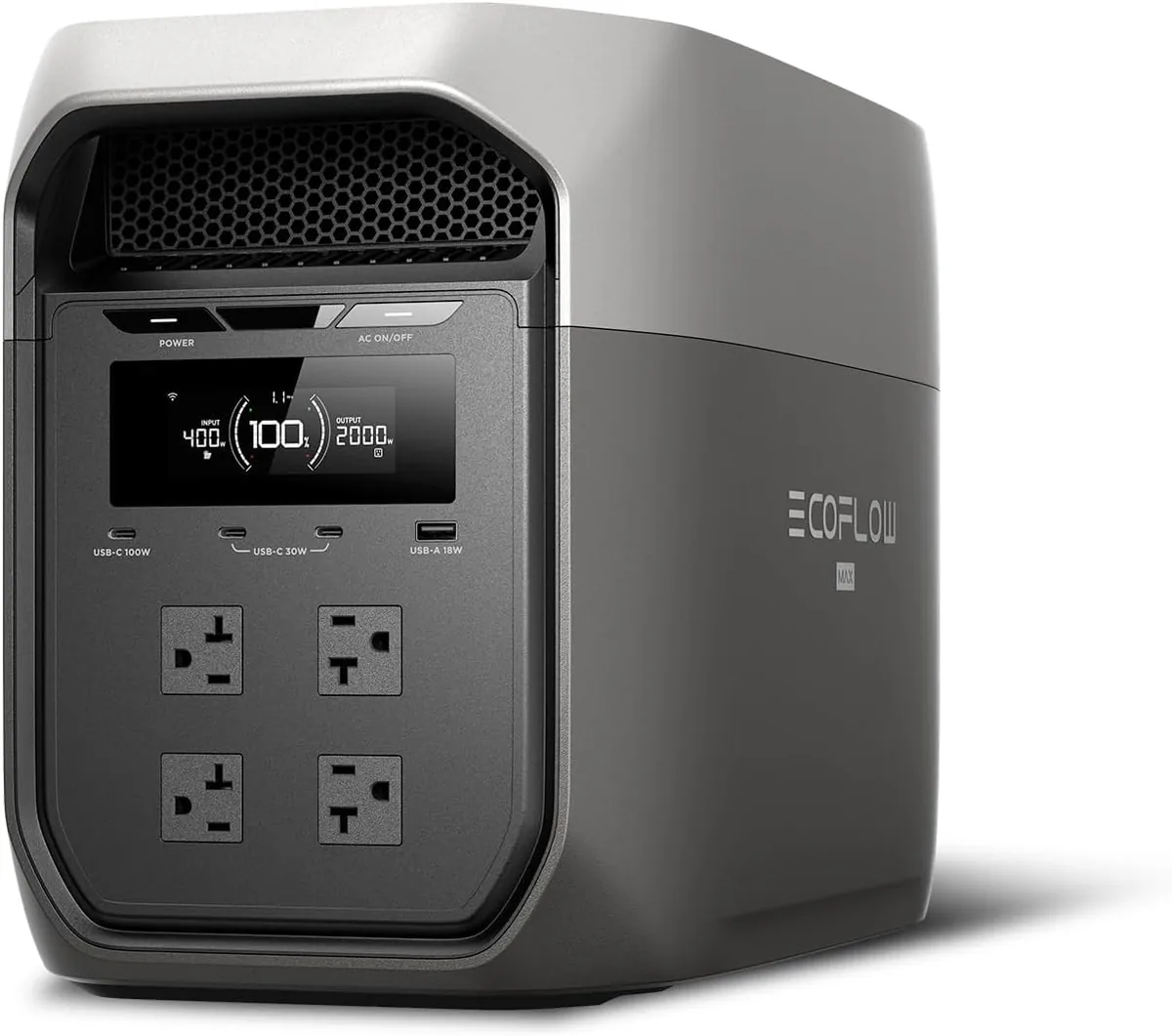
The EcoFlow DELTA 3 Max is the station I reach for when the load list includes a chest freezer. It stores 2,048 Wh behind 2,400 W of AC output, switches over in under 10 ms according to EcoFlow, and recharges from a wall outlet at up to 1,800 W. I rank it as the premium pick for anyone who can carry 44.8 pounds.
WHY I CHOSE THIS ✓
This is the premium pick because it carries a freezer’s worth of load through a night. 2,048 Wh, 2,400 W and a five-year term after registration put it in a different class from the compact units on this page. I accept the weight and the missing wheels for that.
EcoFlow DELTA 3 Max 2048Wh Power Station Specs
Key Features:
- 2,400 W across four outlets: Each outlet is 120 V at 20 A, so a freezer, a router and a corded tool share one box.
- X-Boost to 3,400 W: It lowers the output voltage so a resistive load such as a kettle above 2,400 W can run. EcoFlow says it does not suit precision electronics, and it is off while the station charges from AC.
- Fast wall recharge: 1,800 W input takes it from 0 to 80% in 68 minutes in EcoFlow’s optimal conditions.
- Under 10 ms switchover: In bypass mode it feeds a router or a desk from the wall and takes over when the wall drops.
- 500 W solar input: One XT60i port accepts 11 to 60 V at 13 A, with the cable sold separately.
- 25 dB claim at 600 W: EcoFlow states 25 dB or less at 1 m and 25 C with a 600 W load, and publishes nothing for higher loads.
- 100 W USB-C and a 12 V port: A laptop charges straight from USB-C, and the car port gives up to 126 W.
The usual 85 percent rule of thumb turns 2,048 Wh into about 1,740 Wh at the outlet, since EcoFlow publishes no inverter efficiency. A 100 W set of lights, router and laptop then runs about 17 hours, a steady 600 W load about 2.9 hours, and a 1,500 W heater about 1.2 hours. In the house, that heater and the kettle together tripped the overload icon, so now I plug in one heavy load at a time. The 2,400 W total is shared by all four outlets, and the 4,800 W surge figure comes from EcoFlow’s page, with no duration given.
The freezer ran far longer than a straight division of watts predicted, because its compressor cycles, but only after I set the AC timeout to never in the app. The manual warns that a fridge or air conditioner can trigger the idle cutoff, and it tells you to check the battery level regularly when a fridge is on the station. Local Bluetooth control works without internet, so the setting does not need the router.
Weight and cold show the limits. One freezing morning the station would not take a charge in the shed until I carried it into the house, which fits EcoFlow’s charge range of 32 to 113 F against a discharge range down to 14 F. I lifted it by both side handles, because the manual forbids lifting by one, and 44.8 lb with no wheels in the box turned the gravel yard into a two-handed job. Solar tops out at 500 W, so refilling 80 percent takes at least 3.3 hours before losses, and a roof-side panel rarely holds its label.

Bypass mode caps the AC output at 13 A, about 1,560 W, so keep the router and the desk gear on it and run the heavy loads from the battery path.
The unit is rated IP20, so keep it dry, in a waterproof bag if you work in rain, and EcoFlow says it is not intended for life-sustaining equipment such as hospital ventilators. Do not leave it uncharged or unused for more than 6 months or the warranty is void, and store it near 60 percent charge.
The EcoFlow app sets the AC timeout, the charge speed and the output states, and registering in it adds the last 2 years of warranty. The fan is loudest at high load, where EcoFlow publishes no figure. EcoFlow gives no cycle count for this model, so compare the LFP chemistry and the warranty instead. The box holds the station, an AC cable and the papers, with no panel, bag or wheels.
Choose it when the load list holds a chest freezer, a router and a few workshop tools, and you have a flat route for 44.8 pounds. Skip it for a 240 V well pump, central air, an RV with a 30 A inlet, or any plan to leave it out in the rain.
FINAL VERDICT
The DELTA 3 Max holds a freezer and a router through a night once the AC timeout is set to never. Give it a dry shelf and a flat route. Take it when 2,400 W and 2,048 Wh match your list and 44.8 pounds does not bother you.
It is the premium station I trust with the freezer.
3. BLUETTI AC180 1152Wh Portable Power Station Best Value
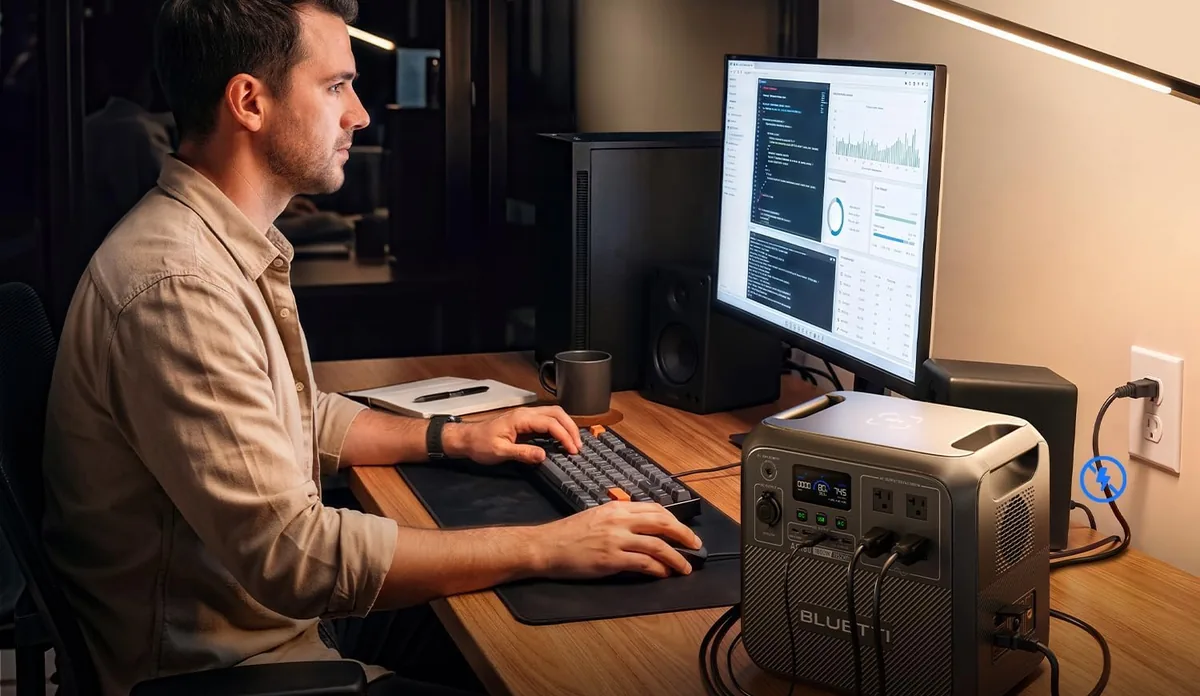
The BLUETTI AC180 ran my workshop battery chargers and work lights before I asked it for anything heavier, and it did that with 1,152 Wh and four 120 V outlets. It is the best value portable power station in the 1,000 Wh class on this page: 1,800 W, a 45 minute turbo recharge and a five-year term at the lowest cost per watt-hour of that class. The price of that value is weight, about 35 pounds.

WHY I CHOSE THIS ✓
It gives the most capacity for the money in the 1,000 Wh class on this page. The 1,152 Wh, the 1,800 W and the 45 minute turbo recharge come with a five-year term, and the add-on batteries leave room to grow. I rank it third because weight is the price of that value.
BLUETTI AC180 1152Wh Portable Power Station Specs
Key Features:
- Four 120 V outlets: They share 1,800 W, enough for a freezer, a router and a corded tool, with the heavy loads added one at a time.
- Constant power mode: BLUETTI lifts resistive loads such as a kettle up to 2,700 W, though the real output may be lower and the mode switches off while the unit charges from the wall.
- Turbo wall recharge: 1,440 W input takes it from 0 to 80% in 45 minutes according to BLUETTI, and Standard and Silent modes in the app trade speed for noise.
- 100 W USB-C and a wireless pad: Laptops and phones charge without a brick or an adapter.
- Pass-through with a 20 ms switch: The manual tells you to test it before you rely on it for a computer.
- 500 W solar input: It accepts 12 to 60 V open-circuit on MC4 connectors, and anything above 60 V damages the unit.
- Add-on batteries: BLUETTI lists extra packs that take the system up to 4,224 Wh.
BLUETTI’s own formula multiplies 1,152 Wh by 90 percent depth of discharge and 85 percent inverter efficiency, which leaves about 880 Wh at the outlet. The manual’s worked example is a 40 W fridge plus 15 W of self-consumption, about 17 hours, and a CPAP at 45 W would run about 15 hours on the same arithmetic, estimate included. In the workshop it ran the battery charger bench and two work lights first, and 880 Wh was plenty for that. Motor and compressor loads start at 2 to 4 times their rated power, so the manual warns they can overload it.
Turbo is the default, so a flat unit is back to 80 percent in about 45 minutes on a wall outlet at 10 to 30 C. The battery management system lowers the charge power as the cells warm or fill, so expect the last stretch to take longer. I plug it back in the moment the mains return, so the next cut finds it topped up.
Weight is where the value shows its cost. BLUETTI lists 35 to 37 pounds, so plan for 37, and the manual says to use mechanical help. Carried by its handle across the gravel yard it dragged my arm, and a hand cart suits the 150 feet of crushed stone. In heat the discharge is capped at 1,500 W between 86 and 104 F, and it will not charge below 32 F, though it discharges down to minus 4 F.
ECO mode is on a timer of 1 to 4 hours and cuts AC on loads of 10 to 30 W and DC on 5 to 10 W. Turn it off before you leave a router or a CPAP on low draw plugged in. The wall socket matters here, because the 1,440 W Turbo input is only as fast as the circuit behind it.
The manual lists no weather rating, so keep the unit away from liquids, in a ventilated space with nothing stacked on top. Do not run it above 1,800 W, leave headroom for motor starts, and keep a dry powder extinguisher in mind, because that is the type BLUETTI names.
The fan runs under load and while charging, and BLUETTI gives no noise figure for normal use, only Silent charging mode in the app. The app talks over Bluetooth for monitoring and control. For storage the manual says to power it off, unplug everything and charge it to 80 percent every 3 months, and I keep it between 32 and 104 F. Use only BLUETTI-approved accessories, because the manual says an unapproved one may void the warranty.
Pick it if you want the most watt-hours for the money and carry the unit once or twice a season. Skip it if you move it daily, need 2,000 W or more, or want a 240 V output, because the AC180 is 120 V only.
FINAL VERDICT
The AC180 gives the most capacity per dollar in its class and recharges to 80 percent in about 45 minutes. It weighs about 35 pounds and belongs on a shelf in the shed. Skip it if it must travel with you daily.
It is the value station I keep for the workshop.
4. BLUETTI Elite 200 V2 2073.6Wh Power Station Best for Home Backup
I read the nameplate on the irrigation pump head before I thought about plugging anything into the BLUETTI Elite 200 V2, and that habit shows what the station is for. It stores 2,073.6 Wh behind 2,600 W, and I call it the best portable power station for home backup when the job is a fridge, a freezer, the router and the lights. It is a 120 V unit that serves the cords you run to it, or selected circuits through a transfer switch or interlock that an electrician installs.

WHY I CHOSE THIS ✓
It earns its rank on the essentials. It holds 2,073.6 Wh and a 15 ms switchover in a box with app schedules and a five-year term. I split the load, with lights and the router on the station and the freezer left to another source.
BLUETTI Elite 200 V2 2073.6Wh Power Station Specs
Key Features:
- 2,600 W with four outlets: The four 120 V outlets share the total, which covers a fridge, a freezer and the router together.
- Power Lifting: It lets resistive loads rated 2,600 to 3,900 W run, while the output stays at 2,600 W.
- 15 ms switchover: UPS modes and schedules are set in the app, though BLUETTI says it is not for servers.
- 1,000 W solar input: Two MC4 inputs take 12 to 60 V, and AC plus solar can reach 2,400 W together.
- Wide temperature range: It discharges from minus 4 to 104 F and charges from 32 to 104 F.
The manual’s formula puts usable energy near 1,586 Wh, so a fridge averaging 60 W plus the station’s own 10 W runs about 22 hours, and a chest freezer at 80 W about 17. Those are sums, so read each nameplate. A motor can start at 2 to 4 times its rated power, and a 240 V pump cannot run from this 120 V box at all.
Out of the box it charged in Standard at 1,440 W, and what surprised me was that Turbo needed the app and a call to BLUETTI support before it switched on. Turbo then reaches 80 percent in about an hour at 10 to 30 C. ECO mode is on by default, so turn it off for loads under 60 W such as a fridge, because the unit also powers itself off after one minute with nothing running.
Connect it to a house only through a transfer switch or an interlock fitted by a licensed electrician, and never feed its output into a wall outlet.
BLUETTI forbids rain and high humidity and gives no weather rating, so keep it in the shed or the house. Unplug connected devices before any service, even with the AC output off, as the manual says.
At 53.4 pounds with no wheels it is awkward on gravel and steps, and I move it on a hand truck. BLUETTI quotes 16 to 50 dB with no test distance. For storage the manual says to hold it at 40 to 60 percent charge, below 95 F, and to cycle it fully every 6 months.
Pick it if you want a fridge, a freezer and the router to ride out a cut, with the house loads split by priority. Skip it if you need 240 V for a well pump or central air, if you move the unit often, or if the charge must run below freezing. My EcoFlow and BLUETTI head-to-head runs this model against the DELTA 3 Max on watt-hours, output and weight.
FINAL VERDICT
For backing up the essentials, the Elite 200 V2 holds enough energy and watts to matter. Read the nameplates and split the load by priority. It suits a list that stops at 120 V and lives indoors.
It is the home backup station I size by nameplate.
5. EcoFlow RIVER 2 Pro 768Wh Portable Power Station Best for Camping
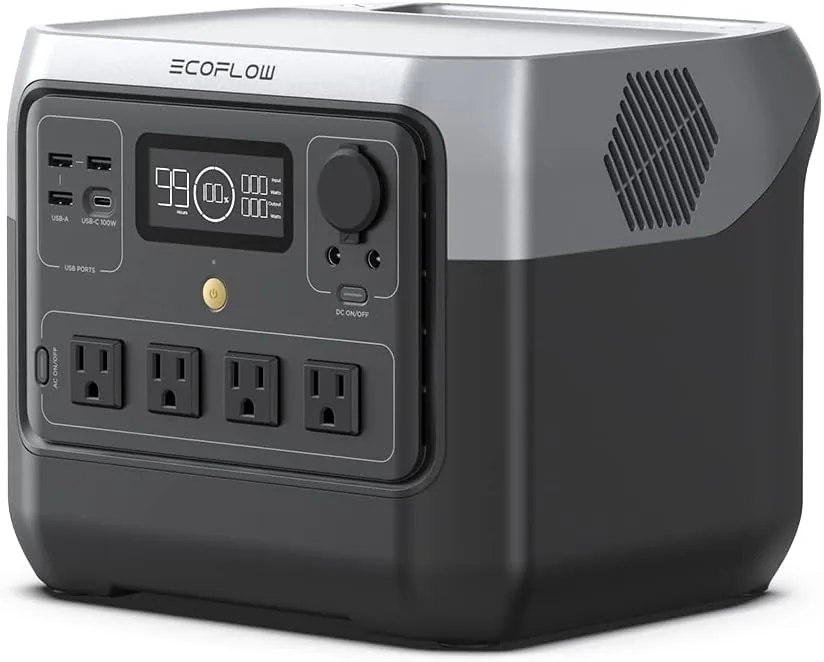
The EcoFlow RIVER 2 Pro is the best portable power station for camping on this page because one hand carries it. It holds 768 Wh behind 800 W at about 17 pounds, and on late-winter pruning days I took it to the far end of the plum rows for a radio, a phone charger and a laptop. It is the lightest unit here with AC outlets, and it gives up capacity for that.
WHY I CHOSE THIS ✓
The carry is the reason it ranks here. About 17 pounds and four AC outlets means it goes where a tent or a pruning crew goes, and the 70 minute recharge puts it back in service the same evening. I accept the small capacity.
EcoFlow RIVER 2 Pro 768Wh Portable Power Station Specs
Key Features:
- Four AC outlets: The 800 W total runs a laptop charger, lamps and a small fan at once.
- X-Boost to 1,600 W: Resistive loads such as a kettle or heater rated up to 1,600 W can run by lowering the output voltage, and EcoFlow says it does not suit precision electronics.
- 70 minute wall recharge: EcoFlow rates 0 to 100 percent at 940 W input, using the supplied cable on a wall socket.
- 100 W USB-C and a 12 V car port: A laptop charges directly, and the car port gives up to 126 W.
- Under 30 ms switchover: It works as a basic UPS for a router, though the manual says it is not for servers.
Take 85 percent of 768 Wh and you get about 653 Wh at the outlet. A router and two lamps, about 40 W together, lasted a whole night with room to spare, and a 100 W average fridge would run about 6.5 hours. A resistive heater rated above 800 W runs only through X-Boost, which lowers the output voltage, so it gives less heat and the runtime depends on its reduced draw.
EcoFlow rates the full recharge at about 70 minutes, and the manual asks for the supplied cable on a wall socket rated over 10 A, never an extension. In the machinery shed at full charging speed the fan surprised me, loud enough that I closed the door, and EcoFlow’s US page says up to 62 dB at high wattage. Solar tops out at 220 W, which EcoFlow puts at 4.5 to 9 hours in good sun.
If the unit runs a fridge, set the AC output to Never Turn Off in the app, because the compressor’s power swings can switch the output off.
The manual allows no rain or high humidity, so keep the unit dry, and EcoFlow says it will not charge below 32 F and resumes above 37 F. It is not for hospital equipment, and a home CPAP needs the battery level watched. Keep the fan inlet and outlet clear.
For storage the manual wants 68 to 86 F, with a recharge to 60 percent every 3 months, and the warranty excludes a unit left uncharged or undischarged for more than 6 months. The screen sleeps after 5 minutes. EcoFlow lists about 17 to 18 pounds, so I plan for 18.
Pick it when the plan is camping, a van, pruning days or a short cut, and you carry the unit yourself. Skip it for a 240 V pump, a fridge you must run all day, or any space heater load. I put the RIVER 2 Pro through a full head-to-head in my EcoFlow and Jackery comparison.
FINAL VERDICT
The RIVER 2 Pro travels easily and refills in about 70 minutes. Keep the loads small and the unit dry. Size up for anything longer than a weekend or a short cut.
It is the one-hand station I take to the far end of the rows.
6. Anker SOLIX C1000 1056Wh Portable Power Station Best for Power Outage
The Anker SOLIX C1000 earned its place when I plugged the router, a lamp and a phone charger into its six sockets and needed no extension strip. It is my pick as the best portable power station for power outage backup when the list is short: 1,056 Wh, 1,800 W and six AC sockets in one box, refilled in time for the next cut.

WHY I CHOSE THIS ✓
It suits a power cut because it comes back fast. Six sockets, a 20 ms switch and a 58 minute top-up mean it is ready for the next evening. When I topped it up from my old generator on the gravel pad, I lowered the limit in the app first.
Anker SOLIX C1000 1056Wh Portable Power Station Specs
Key Features:
- Six AC sockets: They share 1,800 W, so a router, a charger bench and a fridge need no strip.
- Ultra Fast recharge: Anker rates 1,300 W AC input at 58 minutes to full, against 90 minutes at the default 1,000 W.
- SurgePad: It runs a heating load rated up to 2,400 W at 1,800 W by lowering the voltage, and Anker says it does not suit motors.
- 600 W solar input: One XT-60 port accepts 11 to 60 V, and Anker gives 1.8 hours with two 400 W panels.
- 20 ms switchover: UPS mode supports up to 1,440 W, according to Anker.
Anker’s own rule is capacity times 80 percent, so 1,056 Wh gives about 845 Wh at the outlet. A 100 W average fridge then runs about 8.5 hours, a 40 W CPAP about 21 hours, and a router with lights drawing a combined 15 W about 56 hours, an estimate. A 1,500 W heater lasts about 34 minutes, which is why a heater never goes on this list.
The main button needs a 3 to 6 second hold to switch the unit on or off, and I first took that for a dead unit, though Anker says it is deliberate. Turning an output on draws a little power even with nothing plugged in, so I switch off AC, USB and the car port I am not using. The smart socket cuts AC within 15 minutes when nothing is plugged in and the load is under 15 W.
Set the AC charge limit in the app before you charge from a small inverter or a generator, because the 1,000 W default can overload the source.
Anker says compressor and pump loads such as water pumps and saws can exceed 1,800 W at start-up, so the drip pump and the shed compressor stay off it. The car port should not run motorized devices above 4 A. Anker publishes no water or dust rating, so I keep the unit dry and indoors.
Anker gives about 50 to 60 dB at full load with no distance stated. The unit charges only between 32 and 104 F, so a cold garage can block a recharge. For storage Anker says to check the charge weekly, top it up below 30 percent and charge it to 100 percent at least every 3 months.
It is right for a household that wants a short, reliable backup list of a fridge, a router and a few chargers. Skip it if you need 240 V, if the plan includes pumps or saws, or if you carry the unit every day. The full side-by-side is in my Jackery and Anker comparison of the two 1,000 Wh class stations.
FINAL VERDICT
A short list of outage loads is where the C1000 works, with many sockets, a fast refill and a 20 ms switch. Keep motors and heaters off it, and set the charge limit when you borrow generator power.
It is the six-socket station I keep ready for the next cut.
7. PECRON F3000LFP 3072Wh Portable Power Station Best for Solar Panels
The PECRON F3000LFP takes more solar than any other station on this page, 1,600 W through one XT60 port at 25 to 120 V, and that makes it my best portable power station with solar panels. Behind the input sits 3,072 Wh and 3,600 W at 120 V in 63.3 pounds, so it carries a fridge, a freezer and the shop lights through a long evening. PECRON is a smaller brand, so register the warranty and keep the receipt.

WHY I CHOSE THIS ✓
I picked it for the solar input. 1,600 W in and 3,600 W out is a larger envelope than the other stations here, and the XT120 port leaves room for another pack. It is a smaller brand, so I read the manual, and it is a clear one.
PECRON F3000LFP 3072Wh Portable Power Station Specs
Key Features:
- 1,600 W solar input: One XT60 port with a built-in MPPT controller takes 25 to 120 V, and PECRON gives about 2.3 hours at the full 1,600 W.
- 3,600 W output: Six 120 V outlets share a 30 A total, so a freezer and the shop lights run together.
- Wall recharge at 1,800 W: PECRON says about 2 hours, and the charge power can be set from 20 to 100 percent.
- 8 to 20 ms switchover: UPS protection covers loads under 1,800 W, one device at a time, and the manual excludes servers.
- Room to grow: An XT120 port accepts up to two PECRON expansion packs.
By the usual 85 percent rule of thumb, 3,072 Wh gives about 2,611 Wh at the outlet. With the station’s own draw of about 30 W counted, as the manual’s 40 W example does, a 100 W average load runs about 20 hours and a 1,500 W heater about 1.7 hours, both estimates.
Panels must match the 25 to 120 V window: series strings keep the total open-circuit voltage under 120 V and the operating voltage above 25 V, and mixing panel types can damage the unit. I tested the switchover the way the manual asks, with a lamp on the station and the wall plug pulled, and the lamp stayed lit.

Use the supplied cable, and lower the AC charge power in the menu, anywhere from 20 to 100 percent, when the circuit cannot carry the full 1,800 W.
The manual says the unit is not waterproof, so keep it out of rain and wet conditions and out of direct sun, with the vents clear. Use only PECRON accessories and expansion packs.
At 63.3 pounds it is a two-handed lift, and the cart is a separate option with no published weight. PECRON gives no noise figure, only the words ultra-quiet cooling. Unlike my old generator it needs no oil check and no fuel can, and the manual asks for a full charge at least every 2 months. I rank the light, quiet fuel options for a tent or trailer in my generators for camping list.
Choose it when panels are part of the plan and the unit stays in one place, such as a shed or a utility room. Skip it if you move it often, need 240 V, or want a brand with a long local service record. The extra 3 warranty years need registration inside 30 days.
FINAL VERDICT
Panels come first with the F3000LFP, with 1,600 W in and 3,600 W out. Register it within 30 days and keep the receipt. Look elsewhere if it must be carried more than a few feet.
It is the large solar-ready station I park in the shed.
8. OUPES Mega 1 1024Wh Portable Power Station Best for Refrigerator
A fridge asks for its biggest draw in the first second, and the OUPES Mega 1 is built with that in mind: 2,000 W continuous and a 4,500 W surge from a 1,024 Wh box of 27.8 pounds. OUPES does not publish how long the surge lasts, so I still read the compressor nameplate first. That headroom, the largest surge rating of the 1,000 Wh class units on this page, makes it my best portable power station for refrigerator work.

WHY I CHOSE THIS ✓
The fridge is why I chose it. A 4,500 W surge on a 1,024 Wh pack is the headroom a compressor start wants. Starting it takes one button, where my old generator wants a pull cord and a choke.
OUPES Mega 1 1024Wh Portable Power Station Specs
Key Features:
- 4,500 W surge: A compressor start or a corded tool start has headroom beyond the 2,000 W rating, with the duration unpublished.
- 2,000 W continuous: Four 120 V outlets share the total, with a bypass mode at 2,000 W.
- 800 W solar input: The MPPT window is 18 to 75 V at up to 14 A, with a 78 V open-circuit ceiling, and up to three 240 W panels fit in series.
- 100 W USB-C ports: Two PD ports charge laptops, beside four USB-A ports and a 12 V car port.
- Expansion batteries: OUPES lists two B2 packs that take the system to 5,120 Wh.
Applying the usual 85 percent, 1,024 Wh leaves about 870 Wh at the outlet. A fridge or chest freezer averaging 100 W then runs about 8.7 hours, because the compressor cycles instead of holding its nameplate. A 1,500 W heater fits the 2,000 W rating but empties the battery in about 35 minutes, so it is not an outage heater.
The unit cuts AC at about 2,100 VA, shown as error E027, while DC keeps working. In UPS mode the switch takes 20 ms, and the total of input plus output must stay under 2,000 W or the unit shuts down in 1 minute. I start the largest motor first and add the small loads one at a time, which keeps the shop tools inside the surge.
The app sets the idle shutdown, and by default AC and DC switch off after 6 hours with no load.
The unit is rated IP21, which is drip protection from above only, so I stand it under the shed roof, never in rain, and the manual forbids water and liquids. It cannot go on a plane.
OUPES gives no noise figure, so I cannot call it quiet. Support runs by email and chat. OUPES lists four 120 V NEMA 5-20R outlets for the US unit. The warranty is void the warranty if the unit is not charged or discharged for 6 months. For fuel-powered alternatives, I compare noise ratings and measurement distances in my quiet generator picks.
It is the right unit when you want to keep a fridge or chest freezer alive and run a few corded tools from one 120 V box. Skip it if you need 240 V, a unit that lives outside, or service with a local street address. Weigh the smaller brand against the surge headroom.
FINAL VERDICT
The Mega 1 carries the surge a compressor wants. Read the nameplate, keep it dry and register the warranty. A household whose first load is the fridge gets the most from it.
It is the surge-ready station I keep for the fridge.
9. DJI Power 1000 V2 1024Wh Portable Power Station Best 2000W
The DJI Power 1000 V2 charged my laptop straight from a USB-C port while the AC inverter slept, and that habit stretches its 1,024 Wh the furthest. DJI states 2,600 W of stable output in a lab at 25 C, while the 120 V model’s 20 A AC output works out to about 2,400 W combined, so I treat it as a 2,000 W class unit with room to spare. That makes it my best 2000W portable power station.

WHY I CHOSE THIS ✓
Output is the reason it made the list. 2,600 W per DJI on a 1,024 Wh LFP pack gives it headroom beyond a 2,000 W class, and the USB-C ports let a laptop skip the inverter. The weak points are the unpublished surge and the warranty wording.
DJI Power 1000 V2 1024Wh Portable Power Station Specs
Key Features:
- Two 140 W USB-C ports: They need a PD 3.1 device and an EPR cable, and a laptop charges without the inverter running.
- Fast Recharge: DJI rates a full charge at 56 minutes in a lab at 25 C. Grid input reaches 1,440 W only with the battery above 60 percent and 20 to 35 C ambient.
- 26 dB claim: DJI states 26 dB with no test conditions and no figure under load.
- Continuous AC hold: Holding the AC button keeps the output on for loads that cycle, such as a compressor.
- Expansion packs: Up to five DJI Power Expansion Battery 2000 units connect through the SDC port.
At 85 percent, 1,024 Wh leaves about 870 Wh at the outlet. A fridge averaging 60 W runs about 14 hours, a small chest freezer at 50 W about 17 hours, and a router with a laptop at 40 W about 21 hours. A 1,500 W heater empties it in about 35 minutes.
AC output switches itself off after 30 minutes with nothing drawing power, and the whole unit powers down 60 minutes after that. For a freezer I hold the AC button until the light stays solid, so the compressor’s off periods do not cut the output. DJI gives no surge figure, so a motor load is sized from its own nameplate against the 2,400 W combined AC limit.
Use Standard Recharge for daily top-ups, since DJI says it is quieter and kinder to the cells.
DJI calls the UPS function basic, with no 0 ms switching, so do not use it for medical equipment. The manual gives no rain rating, so I keep it dry and under cover.
For storage the manual wants about 60 percent charge, and every 6 months you discharge below 15 percent, leave it off for 2 hours and charge to 100 percent in Standard mode. I follow that on a calendar date. DJI states up to 5 years, subject to the purchase channel and conditions, so read the terms for your listing before you buy.
A strong 120 V output from a mid-size pack is the job it does. Skip it if you need a published surge figure, 240 V, or a warranty term you can read in one place. Solar needs DJI’s adapter, sold separately.
FINAL VERDICT
For 2,000 W class loads from a compact pack, the Power 1000 V2 does the work. Treat 2,400 W as the practical combined AC limit on a US unit, and confirm the warranty on your listing. Output matters more here than a published surge figure, so buy it on that basis.
It is the high-output station I charge my laptop from.
How to Choose the Best Portable Power Station
A portable power station is judged on six things: the energy it stores, the power it delivers, its cells, how fast it recharges, what it weighs and what the maker promises. I check them in that order, because the first two decide whether it runs your load at all.
Watt-Hours Set the Runtime
Watt-hours (Wh) are the energy a station stores, and watts (W) are the power it delivers at one moment. A 1,000 Wh unit can run a 100 W load for hours or a 1,500 W load for well under an hour. Inverter loss takes about 15 percent, so a 1,000 Wh unit puts roughly 850 Wh through the AC outlet, a rule of thumb because makers rarely publish the efficiency. I size every list in watt-hours first and check the watts second.
| Load | Example draw | Runtime |
|---|---|---|
| Router | 20 W | about 42 hours |
| Fridge or chest freezer | 100 W average | about 8.5 hours |
| Home CPAP | 40 W | about 21 hours |
| Space heater | 1,500 W | about 34 minutes |
The 1,000 Wh class is where most households start, and the best 1000wh portable power station for you is the one that covers three or four essential loads through a night. A fridge averages far below its nameplate because the compressor cycles, so the nameplate sizes the inverter and the average sizes the runtime.
Pro Tip
Read the label on each device, not the box of the station. The label and the manual give running watts; for a motor, ask the appliance maker for the start-up draw when the label does not list it.
Continuous Output, Surge and 120 V Limits
Continuous watts are the total the outlets deliver together, and surge watts are a short peak for starting a motor. Add up everything that runs at once and stay under the continuous figure. Several makers add a boost mode that lowers the output voltage so a resistive load such as a kettle can run above the rating, and the makers say it does not suit motors or sensitive electronics.
- Continuous watts: the total across all outlets, shared between them.
- Surge watts: a compressor or a pump can start at 2 to 4 times its running watts, so check the start-up rating. Makers seldom publish how long the surge lasts.
- Voltage: all nine stations here are 120 V, so a 240 V well pump, central air or an electric range needs other equipment.
- Plug type: an RV with a 30 A inlet needs a station that lists one, because an adapter adds no capacity.
My irrigation pump is a motor, so its nameplate decides before the box of any station does. If you shop for the best portable power station for rv use, check the outlet list first. I compare fuel-powered options by outlet, weight and noise in my generators for RV roundup.
Battery Chemistry and Cycle Life
All nine stations here use lithium iron phosphate (LFP) cells. In lab abuse tests on small commercial cells, LFP showed a significantly lower thermal response than cobalt-based laptop cells, though some LFP cells still went into thermal runaway under heating (1). Those were bare cells, so the result says nothing about the protection circuit of any one station.
Cycle counts need their end point. Makers rate a cycle to 70 percent capacity or to 80 percent, and one publishes no count at all, so a bigger number can mean a weaker promise. The best portable battery power station for years of use pairs LFP cells with a stated count, a stated end point and a warranty.
Key Takeaway
A rating of 4,000 cycles to 70 percent is a different promise from 3,000 cycles to 80 percent. Compare counts only at the same end point.
Recharge Speed and Solar Input
Wall input in watts sets how fast a station refills, and the quoted times mean different things. High charging currents reduce energy efficiency and cause faster capacity and power fade, according to a review written mainly with electric vehicle cells in mind (2), which is why makers add slower modes. Cold limits charging too: lab tests of two lithium chemistries found that higher internal resistance at subzero temperatures gives lower capacity and power (3), and every manual here bars charging below 32 F.
| The claim says | What to ask |
|---|---|
| 0 to 80 percent in under an hour | How long to 100 percent, since the last stretch is slower |
| 0 to 100 percent in about 70 minutes | How many input watts it needs from a wall outlet, and at what temperature |
| Solar up to 400 W | Which panels, at what voltage, and how much sun |
- Input window: the panel string’s open-circuit voltage must stay inside the port’s volt range, 60 V on several of these units.
- Input watts: the maximum runs from 220 W to 1,600 W across the nine, and a panel rarely delivers its label.
- Cable: check the box for the panel cable, because some makers sell it separately.
For solar charging, look for a wide voltage window and enough input watts to use it. I read the open-circuit voltage on the panel sticker before I plug anything in.
Weight, Size and Where It Lives
Unit weights on this page run from about 17 pounds to 63 pounds, and each maker’s figure is for the station alone. The best small portable power station is the one you can lift without help. On my gravel yard I treat 30 pounds as the line for a one-person carry.
- Wheels: several boxes include none, so a hand truck or a cart is a second purchase.
- Handles: use both side handles when a manual says not to lift by one.
- Weather: the manuals give an IP20 or IP21 grade, or none, or forbid rain and wet places outright, so plan a dry shelf.
Keep It Dry
Stand the station indoors or under a roof. A manual may allow indoor use because the unit burns no fuel, but a wet or damaged unit needs the maker, not a repair of your own.
Warranty, Support and Storage Terms
Base warranties on this page run 2 to 5 years, registration adds 1 to 3 more at some makers, and some makers cover only purchases from their own site or authorized dealers. The best portable power station brands state the term, publish a manual and give a support contact. Several void the warranty if a unit sits uncharged or unused for 6 months.
- Registration: note the deadline, such as 30 days at one maker.
- Seller: check the listing’s seller against the maker’s list of covered channels.
- Idle clause: put a date on the calendar for a charge and a discharge every few months.
I register a station the day it arrives and keep the receipt with the manual.
Best Portable Power Station for Power Outage Loads and What Runs First
An outage plan is a list of loads in order of need, with the watts and hours beside each. A review of 50 studies links power outages to health consequences from carbon monoxide poisoning to temperature-related illness, especially for people who rely on electricity-dependent medical equipment (4). Put that equipment first, and ask its maker before you rely on any station for it. When the outage runs for days, I add a fuel unit, and my review of the top generators for home backup lists the models I recommend for it.
| Load | Check on the label | Note |
|---|---|---|
| Medical equipment | The device maker’s guidance for battery power | Station makers say their units are not for life-sustaining equipment |
| Fridge and freezer | Running and start-up watts | Turn off idle timers that cut an intermittent load |
| Router and lights | Watts | Small loads can fall under an eco-mode threshold and switch off |
| 120 V sump pump | Running watts against the continuous rating, start-up watts against the surge rating | A 240 V pump cannot run |
| Space heater | 1,500 W | Empties a 1,000 Wh unit in about 34 minutes |
The fridge is the load worth sizing carefully. One modelling study of milk, chicken and fish found that longer power interruptions raise potential losses in domestic refrigerators (5). It is a model for India and gives no hours, so take the time limits from USDA food safety guidance.
A 120 V sump pump fits when its running watts sit inside the continuous rating and its start-up watts inside the surge rating, together with any other load, and that nameplate check is how I choose the best portable power station for sump pump duty. I put the router and two lamps on the station first, because they ask for little and tell me the mains are still out.
Never Backfeed
Never plug a station’s output into a wall outlet. A house connection goes through a transfer switch or an interlock fitted by a licensed electrician, as the BLUETTI manual says.
Portable Power Station Safety and Care
A station has no engine, so the carbon monoxide rules for a fuel generator do not apply to it, and a fuel generator still runs outdoors only. The risks of a station are heat, water, abuse and neglect, and each manual spells out its own limits. If you prefer fuel, my best generator picks weigh home backup, camping and job site power.
- Rated watts: never exceed the continuous rating, and leave headroom for motor starts.
- Heat and vents: keep the vents clear, out of direct sun and away from heat sources.
- Cold: most units will not take a charge below 32 F, though they discharge in colder air.
- Damage: stop using a unit that was dropped, swollen, wet or odd smelling, and call the maker.
- Fire: the makers differ on the extinguisher, with some naming water or water mist first and another a dry powder extinguisher, so read your manual.
Storage rules differ by maker, so follow your manual. Lab work on pouch cells of a different chemistry found that cells held full for nine months lost about 10 percent of capacity at 95 F and about 43 percent at 140 F, while cells held empty showed virtually no loss (6). Several makers here say to store near 60 percent, BLUETTI says 80 percent for the AC180, Anker says to keep the unit charged, and PECRON asks for a full charge at least every 2 months. I follow each station’s own schedule, such as Anker’s weekly charge check and PECRON’s full charge every 2 months.
My Overall Verdict
I ranked the nine on watt-hours and watts first, then on weight, recharge speed and warranty terms. The top three suit three different households.

1. Jackery Explorer 1000 v2 1070Wh Power Station Best Overall
For a household that wants a fridge, a router and a few laptops covered by a unit it can carry alone.

2. EcoFlow DELTA 3 Max 2048Wh Power Station Best Premium
For a household that wants a freezer’s worth of load through a night and can carry 44.8 pounds.

3. BLUETTI AC180 1152Wh Portable Power Station Best Value
For a shop or a shed that wants the most capacity for the money and will set the unit down and leave it.
Measure your load in watts first, add the hours, and leave a 15 percent margin for the inverter. Every station here is 120 V, so a 240 V well pump needs another plan. The Jackery Explorer 1000 v2 meets that test for most households, which is why I name it the best portable power station.
Why Jackery Explorer 1000 v2 1070Wh Power Station Might Be the Best Choice
One person can carry it and it runs the common loads. At 23.8 pounds for 1,070 Wh and 1,500 W, the Jackery Explorer 1000 v2 1070Wh Power Station moves from the kitchen to the shed in one hand, and it takes up to 400 W of solar.
The trade is the ceiling. It is 120 V and 1,500 W, so a well pump or a heater is out, and the manual allows indoor use only.
What puts it first:
✓ Weight: 23.8 lb for the station alone, the lightest of the 1,000 Wh class units here.
✓ Output: 1,500 W with a 3,000 W peak.
✓ USB-C: a 100 W port charges a laptop without the inverter.
✓ Solar: two ports take up to 400 W.
✓ Warranty: 3 years, plus 2 if you register.
Frequently Asked Questions
What is the strongest portable power station?
The strongest portable power station on this page is the PECRON F3000LFP, with 3,600 W of continuous output and 3,072 Wh of capacity at 120 volts. It still runs only 120 volt loads, so a 240 volt well pump needs other equipment, and its 63.3 pounds make it a unit that stays put.
How long will a Jackery 500 run a TV?
A Jackery 500 runs a TV for its rated watt-hours, less about 15 percent inverter loss, divided by the TV’s watts. A 60 W TV takes 60 Wh each hour, so 300 Wh of usable energy gives about 5 hours, and a 120 W setup halves that, so read your model’s capacity and the TV label.
What is better than a Jackery?
Something better than a Jackery depends on the job, because the EcoFlow DELTA 3 Max stores 2,048 Wh with 2,400 W of output and the PECRON F3000LFP takes 1,600 W of solar. The Jackery Explorer 1000 v2 stays ahead on weight, at 23.8 pounds for 1,070 Wh, and on being a unit you carry alone.
Is Bluetti or EcoFlow better?
Neither Bluetti nor EcoFlow is better on every measure, so match the unit to the load. The BLUETTI AC180 gives the most capacity for the money in the 1,000 Wh class, while the EcoFlow DELTA 3 Max adds 2,048 Wh and a switchover under 10 ms for a freezer overnight.
Who makes the best portable power station?
Jackery makes the best portable power station for most households, since the Explorer 1000 v2 combines 23.8 pounds, 1,500 W and a 3 to 5 year warranty. Choose EcoFlow for a freezer, BLUETTI for capacity per dollar, or PECRON for solar when those are the main jobs on your list.
References
- Larsson F, Mellander BE. Abuse by external heating, overcharge and short circuiting of commercial lithium-ion battery cells. J Electrochem Soc. 2014;161(10):A1611-A1617. doi:10.1149/2.0311410jes
- Tomaszewska A, Chu Z, Feng X, et al. Lithium-ion battery fast charging: A review. eTransportation. 2019;1:100011.
- Hossain Ahmed S, Kang X, Bade Shrestha SO. Effects of Temperature on Internal Resistances of Lithium-Ion Batteries. J Energy Resour Technol. 2015;137(3):031901.
- Casey JA, Fukurai M, Hernandez D, Balsari S, Kiang MV. Power outages and community health: a narrative review. Curr Environ Health Rep. 2020;7(4):371-383. doi:10.1007/s40572-020-00295-0
- Liddiard R, Gowreesunker BL, Spataru C, Tomei J, Huebner G. The vulnerability of refrigerated food to unstable power supplies. Energy Procedia. 2017;123:196-203. doi:10.1016/j.egypro.2017.07.238
- Mao Z, Farkhondeh M, Pritzker M, Fowler M, Chen Z. Calendar Aging and Gas Generation in Commercial Graphite/NMC-LMO Lithium-Ion Pouch Cell. J. Electrochem. Soc. 2017;164(14):A3469-A3483.
Safety Note: Generator exhaust contains carbon monoxide, which can kill in minutes. Run a fuel generator outdoors only, never in a home, garage, basement, shed or other enclosed or partly enclosed space, even with doors or windows open. The CPSC says to place it at least 20 feet from your home and other buildings, with the exhaust pointed away from doors, windows and vents. Install battery-operated or battery-backup carbon monoxide alarms on every level of the home and outside sleeping areas. Never plug a generator into a wall outlet: connect it to a house only through a transfer switch or interlock installed by a licensed electrician. Refuel only with the engine off and cool, and read the manufacturer’s manual, including for a portable power station.