

The best lawn dethatcher pulls the thatch your lawn really has without tearing out the grass beneath it, and I worked with nine machines at the family farm to rank them. I am an agricultural engineer, so I check what a machine does to the turf, not only what the box says. Each review says who should skip it.
My top pick is the WEN DT1516 16-Inch Corded Dethatcher and Scarifier. After the reviews I explain how to choose a machine and the safety steps I follow before every pass.
Best Lawn Dethatcher Reviews 2026 With 9 Machines I Put to Work
Nine machines made my list: five corded walk-behind units, one cordless kit, one attachment for an EGO power head and two tow-behind trays. I ranked them on the reels in the box, the depth steps, the bag, the warranty and the safety limits in each manual.
1. WEN DT1516 16-Inch Corded Dethatcher and Scarifier Best Overall
The WEN DT1516 is the dethatcher I recommend first, because one corded box holds a 24-tine dethatching reel and a 20-blade scarifier reel, and the manual says which of its five depth steps belongs to which job. It works a 16 in. path, which keeps the number of rows down on an open lawn. It suits a house lawn with an outlet in reach and a thatch layer that needs a proper clean once a season.

WHY I CHOSE THIS ✓
I put the DT1516 first because it is the complete corded kit: both reels, a depth chart that names the job for each step and a warranty whose limits are printed in plain words. It is my pick as the best lawn dethatcher for a lawn with an outlet in reach. The trade-off is the extension cord you have to supply and a bag size WEN does not print.
WEN DT1516 16-Inch Corded Dethatcher and Scarifier Specs
Key Features:
- Two reels in the box: the steel-tine reel lifts thatch and the blade reel cuts grooves into the soil, so one purchase covers a light pass and a harder renovation.
- Five depth steps with a chart: the manual gives +1/4 in. for thin thatch and -1/8 in. for dethatching a healthy lawn, and reserves the two deepest steps for scarifying.
- 16 in. working width: each row clears a wider strip, so an open lawn takes fewer rows.
- 15 amp motor: it turns 3,300 RPM with no load, and an overload cut-out stops it when material builds up around the reel.
- Two-action start: you press the safety lock button and squeeze the switch lever together, then hold the lever to the upper handle with both hands.
- Detachable thatch bag: it sits on a rack behind the machine, and the manual says to empty it often and never wait until it is full.
- Printed warranty limits: WEN states 2 years or 500 hours for personal use and 90 days for professional use, so you know what you buy.
On the house lawn I start on the -1/8 in. step, the one the chart gives for dethatching a healthy lawn, and I walk straight, slightly overlapping rows along one side first. I push slowly, because the manual warns that pushing hard overloads the motor and blocks the discharge. If the mat is still there after the first pass, I drop one step, and I never go to the last two, which the chart keeps for the blade reel.
The machine’s own cord is only 0.35 m long, and the manual says a proper extension cord is required, so plan the run before you buy. For this 15 amp motor the manual’s table asks for 14 gauge up to 25 ft and 12 gauge up to 50 ft, and it marks 100 ft and 150 ft runs as not recommended. I plug into the GFCI outlet on the machinery shed wall and keep the cord behind me, and I never pass the machine over it.
The second job is the blade reel. Changing reels means freeing the blade bracket with two hex screws, with gloves on, because the manual calls the tines and blades very sharp and says they become hot in use; I switch off, wait until the reel stops and unplug first. The two deepest steps pull live grass as well as thatch, and WEN itself says scarifying carries some risk of pulling up grass roots, so I keep them for a lawn that is growing strongly and has a thick mat. For timing, WEN says to choose a time when the grass is actively growing and the soil has some moisture.

Walk the lawn before the first pass. The manual wants it clear of stones, sticks and wire, with sprinkler heads and lights marked and hoses lifted, and it warns that the machine can jump if the tines hit packed soil or a buried stone or root.
WEN says the tines keep turning after you release the lever, so I release it, wait for the reel to stop, unplug the cord and put gloves on before I touch the tines, the blades or the bag. I wear eye protection with side shields, hearing protection, long pants and closed boots, and a dust mask when the lawn is dusty.
After every use I brush the underside of the tine guard and the motor housing and clear the vents. The manual says never to use a hose, to wipe the tines and shaft dry and to apply a light coat of oil, and it asks for a lubrication of the tines and shaft once a season. The bag annoyed me most: WEN prints no size, so I judge it by eye and empty it at the compost pile early. WEN prints no noise figure either, so ear protection stays on for the whole job.
Buy it if your lawn needs a thatch layer pulled, an outlet sits within cord reach and you want a tine reel and a blade reel in one box. Skip it if the lawn is far from power, if the ground is wet or full of buried stones and roots, or if you need a printed bag size or noise figure before you buy.
FINAL VERDICT
The DT1516 is the one to buy for a corded lawn with an outlet in reach: it carries both reels, a clear depth chart and a warranty with its limits in plain words. Budget for the extension cord and work only on dry ground.
It is the corded 2-in-1 I recommend to most homeowners.
2. Sun Joe 24V-X2-DTS15 Cordless Dethatcher and Scarifier Best Premium
The Sun Joe 24V-X2-DTS15 is the dethatcher for a lawn where the cord is the main problem: it runs on two 24V packs, so there is no outlet to find and no extension cord to drag behind you. The kit holds both packs, the charger, a spring-tine reel and a slicing-blade reel, and a 600 W brushless motor turns them. It is my premium pick for a buyer who accepts the highest price tier on this page and a heavy machine at 33 lb net.

WHY I CHOSE THIS ✓
Second place goes to the 24V-X2-DTS15 because it removes the cord, the outlet and the gauge table in one move, and it still carries both reels. It is my choice for the best cordless lawn dethatcher on this page. The trade-offs are the price tier, the weight and a run time Sun Joe does not publish.
Sun Joe 24V-X2-DTS15 Cordless Dethatcher and Scarifier Specs
Key Features:
- Cordless 48V max system: two 24V packs of 4.0 Ah work together, and the manual says one pack cannot power the tool, so you charge and fit both.
- Both reels in the box: a 24-tine spring steel raking reel for dethatching and a 7-blade reel for scarifying, each on its own depth table.
- Five depth positions per reel: the knob lines up with 1 to 5, and the manual lists a different depth for each reel at each position.
- 600 W brushless motor: it turns 3,000 rpm with no load, and an overload cut-out stops it when material builds up around the reel.
- Charge indicator on each pack: three LEDs mean high, two mean stop work soon, and one means stop at once and charge.
- 10.6 gal rear bag: the manual says to empty it at half full, because a full bag lowers performance.
- Charger in the kit: the two-port charger refills both packs, with a charge time of up to 1 hr 50 min.
Because the raking width is 14.2 in. on a 15 in. deck, I count my rows on the usable path, not on the deck. The depth tables are signed, and a negative number means the tines or blades work below the soil surface. The same knob number means a different depth on each reel, so I read the table for the reel I have fitted before I turn the knob, with both batteries out. The manual warns against dethatching too deep at too fast a pace, so I walk slowly.
Cordless freedom comes with a battery routine. Sun Joe does not publish a run time for this kit, so I read the charge LEDs and stop at two LEDs, where the manual says to stop work as soon as possible. A full recharge of both packs takes up to 1 hr 50 min, per the maker, so I charge both before the job. The packs show a lower charge right after use and recover a little at rest, as the manual explains.
The machinery shed has outlets, but the gravel yard lies between the shed and the house lawn, and the manual says to stop the tines and take extreme caution on gravel drives and walks. With no cord I can walk across it with the reel stopped and lift the machine only after it is switched off. At 33 lb it is the machine I feel in the arms, and the manual does not say whether the batteries are counted in that figure. The blade reel carries only 7 slicing blades, and a worn reel is replaced as a whole cylinder, so I check it before the season.
Charge the packs the evening before. The manual stores the packs charged in a cool, dry place and gives 41 to 105 F for the charger and the tool, and it says to use two packs of the same voltage and capacity, because mixed capacities damage them.
Before I touch the bag, the tines or the blades, I switch off, wait until the reel stops and take out both batteries, which replaces unplugging on this machine. I wear eye protection with side shields, hearing protection, long pants, closed boots and gloves, and I keep children and pets well away because the tines throw stones, sticks and soil.
Clippings stick to the reel in wet grass and heavy use and cause overheating, so I clean the reel after every use. The manual says to work only on dry grass and never to run the machine without the thatch bag securely fitted, because of flying debris, and I switch off, wait for the reel to stop and take out both batteries before I fit or empty the bag. I walk the lawn first and pick up stones, sticks, wire and toys, and I mark sprinkler heads and any buried line before the first pass.
The 24V-X2-DTS15 fits a lawn with no convenient outlet, an owner who is tired of dragging a cord and a budget that allows a premium kit. Skip it if you need the lightest machine, if money is tight or if the lawn is big enough that an unknown run time worries you.
FINAL VERDICT
The 24V-X2-DTS15 is the cordless dethatcher to buy when a cord rules a corded machine out. You pay for the freedom with price, weight and a battery routine, and Sun Joe leaves the run time unpublished.
It is the cordless dethatcher for lawns where a cord gets in the way.
3. Sun Joe AJ798E Corded Dethatcher and Scarifier Best Value
The Sun Joe AJ798E is a low-cost way into a corded machine that carries both reels: a spring-tine reel and a slicing-blade reel come in the box, and the whole machine weighs 21 lb net. It works a 12.6 in. path from a 12 amp motor. I recommend it as my value pick for a small, flat lawn, and I say plainly where it is the weakest machine on this page.

WHY I CHOSE THIS ✓
The AJ798E takes third place because it brings both reels at the budget price tier, with a weight a person can handle all afternoon. It is my pick for the best lawn dethatcher for the money on a small flat lawn. Bag size, path width and depth range are where it is weakest on this page, so buy it for the lawn it fits.
Sun Joe AJ798E Corded Dethatcher and Scarifier Specs
Key Features:
- Both reels in the box: a 21-tine spring steel reel for raking and a 22-blade reel for scarifying, so you do not buy a second machine for the harder job.
- Four depth positions: raking works from 0 to +0.2 in., scarifying from 0 to -0.4 in., and each position has a named use in the manual.
- 21 lb net weight: a light push for a corded machine with both reels, which matters when you turn at the end of every row.
- 12 amp motor: it runs at 3,000 rpm with no load, and an overload cut-out stops it when material builds up around the reel.
- Spare parts by name: Sun Joe lists replacement dethatcher tines and a replacement scarifier blade for this exact model.
- 8 gal rear bag: the manual says to empty it when it is half full, because a full bag cuts performance.
- Cord clear of the reel: a cord clip and a knot in the plug connection, which the manual shows, keep the extension cord from pulling out.
On a small flat lawn the AJ798E does the job without drama. With the cord unplugged I move the lever from the 0 mm step, which the manual gives for transport and storage, to +5 mm, which it gives for raking a healthy lawn, and then I make straight overlapping rows with the cord behind me. The reel works through the mat as long as I keep the pace slow, and the manual says why: dethatching too deep at too fast a rate overloads the machine. The two deepest steps are for scarifying, not raking.
The 12.6 in. path and the 8 gal bag set the size of lawn this machine suits. Every row clears a narrow strip, and the bag reaches half full soon, which is the point where the manual says to empty it. I tie the plug connection in a knot, the way the manual shows, so the extension cord does not pull out at the far end of a row. The manual’s cord chart asks for 14 gauge up to 50 ft and 12 gauge from 50 to 100 ft, and it forbids any cord over 100 ft.
Light weight is the second reason I rate it. At 21 lb net it is easy to turn, and when the reel has stopped and the plug is out, I can carry it to the shed without a struggle; what surprised me is how little there is to push. The depth range is short: the shallowest step is +5 mm, so there is no +10 mm step for thin thatch.

Buy from an authorized seller. The warranty covers 2 years of household use, but Sun Joe says it does not cover products bought from unauthorized sellers, and the tines are wearing parts that it excludes.
The tines keep turning after the motor is switched off, so I release the lever, wait for the reel to stop, unplug the cord and put gloves on before I touch the tines, the blades or the bag. I wear eye protection with side shields, hearing protection, long pants and closed boots, and I keep children and pets off the lawn while it runs.
Clippings stick to the reel in heavy use or wet grass and cause overheating, so I clean the reel after every use with a brush, never with water or solvents. The manual wants a GFCI outlet and an outdoor-rated extension cord, and it says to work only on dry grass. I walk the lawn first and pick up stones, sticks and wire before the first pass, and I never run it without the bag fitted, because the manual warns of flying debris. Sun Joe prints no noise value, so ear protection stays on.
A small flat lawn with an outlet in reach, a wish for both reels at a low price and a machine you can handle easily point to the AJ798E. Skip it if the lawn is large or if you want a bag that lasts several rows.
FINAL VERDICT
The AJ798E is the machine to buy when price and weight matter more than reach. It does the job on a small lawn with both reels, and a larger lawn needs a bigger machine.
It is the light corded 2-in-1 I recommend for a small lawn on a budget.
4. Agri-Fab 45-0294 40-Inch Tow-Behind Dethatcher Best 40-Inch Tow-Behind
If a riding mower or garden tractor already sits in your shed, the Agri-Fab 45-0294 is the cheapest honest way to dethatch with it: a 40 in. tray of spring tines with no engine, no cord and no depth knob. You hitch it behind the mower, lower the lift handle and drive. It pulls thatch up with light combing, and it cannot cut into the soil. I go through this 40 in. tray in my review of the Agri-Fab dethatcher.

WHY I CHOSE THIS ✓
The 45-0294 lands fourth because it is the lowest-cost way into dethatching for a rider-mower owner, and the one tow-behind with a 40 in. swath on this page. It is the tow behind lawn dethatcher I pick for a 40 in. swath. It does the combing job well and nothing beyond it.
Agri-Fab 45-0294 40-Inch Tow-Behind Dethatcher Specs
Key Features:
- Spring tines on a steel tray: the tines flex over the turf and lift dead grass without slicing the soil, so the action is gentle.
- 40 in. working width: a wide swath means a large lawn takes fewer passes.
- Lift handle: you lower it to work and raise it to cross a path or drive.
- Tine shield that takes weight: the manual says to add and tie down weight if the dethatcher jumps.
- Replaceable tines: the manual lists the spring tine as part 43783.
With no depth knob, the setup decides everything. The manual has you level the tine shield on flat ground so the front and rear tines both touch the turf, and then you vary the forward speed until the action looks right. A crisscross pattern gives the best result, and the manual starts you in first gear at low engine speed. Expect light raking, not renovation.
Assembly is a real job, with about two dozen steps and tools in three sizes. I checked every nut and bolt after the build, as the manual asks before each use, and pressed a tine by hand to feel it give and spring back.

If the dethatcher jumps, add weight and tie it down. Agri-Fab’s page gives 70 lb as the tray’s capacity, and the tractor’s manual sets the towing limits.
The manual calls the tine points sharp, asks for substantial footwear and says never to let anyone ride on the frame or the towing vehicle. Eye and hearing protection are my own rules for any work that throws debris, so I wear both and walk the lawn first to clear stones and sticks.
Agri-Fab says to stay off steep slopes, to tow at reduced speed on rough ground and to run up and down a slope, never across its face. Read both the dethatcher’s manual and the tractor’s before the first run. Upkeep is short: lubricate the wheels, touch rust with enamel paint and store the tool dry with a light coat of oil on the exposed metal.
A rider-mower owner with a rear hitch, a large lawn to comb and a low price in mind has a fit in the 45-0294. Skip it if you only own a push mower, or if the lawn has a thick mat that needs a reel that cuts into the soil.
FINAL VERDICT
The 45-0294 suits a rider-mower owner who wants the simplest tow-behind tool. It combs the lawn, it needs weight and care on slopes, and it leaves the heavy work to a powered reel.
It is the plain spring-tine rake for a rider-mower owner.
5. Westinghouse W16ADAC 16-Inch Corded Dethatcher and Scarifier Best Large Bag
On a lawn that drops a lot of dead material, the bag decides how often you stop, and the Westinghouse W16ADAC carries the biggest one on this page: 14.5 gal, according to Westinghouse. A 16 in. path, a 15 amp motor and both a rake blade and a scarifier blade come with it. I pick it for a larger lawn where emptying the bag is the chore.

WHY I CHOSE THIS ✓
Fifth goes to the W16ADAC because its bag is the largest on this page, and Westinghouse prints a 100 ft keep-away distance for bystanders. It is my pick when emptying the bag is the chore. The once-per-season limit is a real constraint.
Westinghouse W16ADAC 16-Inch Corded Dethatcher and Scarifier Specs
Key Features:
- 14.5 gal rear bag: each trip to the compost pile covers more rows.
- Five depth positions: +0.24 in. down to -0.47 in.
- Three handle heights: 37 in., 40.5 in. or 42.5 in. for the upper handle.
- Thermal overload protection: the motor shuts down under too much load, and the manual says to wait 15 minutes.
- Cord holder and clamps: they keep the extension cord out of the reel.
Westinghouse says the soil should be slightly moist and the grass 2 to 3 in. high, and that the machine is to be used no more than once per season. I pick a day when the soil holds a little moisture and the surface is dry, because the manual forbids wet or frozen soil. For timing, I go by my grass: late summer to early fall for a cool-season lawn, and active summer growth for a warm-season lawn.
A long, thin extension cord can trip the thermal protection, and the manual’s table for a 12.1 to 16 amp tool gives 14 gauge to 25 ft and 12 gauge to 50 ft. If the motor stops, I release the lever, wait until the tines stop and unplug the cord, then I clear the build-up, check the cord and wait the 15 minutes the manual gives before I go on. The big bag also means I walk to the compost pile less often than with the smaller bags I know.
Westinghouse asks you to keep bystanders, children and pets at least 100 ft away. On a quarter-acre lawn that means the family stays indoors until I finish.
The tines keep turning for a few seconds after the tool is switched off, so I release the lever, wait until they stop and unplug the cord before I clear, adjust or change a blade. I wear safety glasses with side shields marked ANSI Z87.1, hearing protection, heavy long pants, boots and gloves.
Clean it after every use and never with a hose: brush the underside of the tine guard and the motor housing, dry the tines and shaft and apply a light oil. I walk the lawn first and remove stones, sticks, wire and string. Store it indoors, dry and unplugged.
A larger lawn, a wish for fewer stops to empty the bag and one pass a season point to the W16ADAC. Skip it if you want to repeat the work later in the year or if the lawn is far from an outlet. I review this 16 in. corded unit on its own in my review of the Westinghouse dethatcher.
FINAL VERDICT
The W16ADAC suits the buyer who counts trips to the compost pile. You get a big bag and both blades, and you work once a season on dry, slightly moist soil.
It is the big-bag corded dethatcher for a larger lawn.
6. SENIX SCE13-M 15-Inch Corded Dethatcher and Scarifier Best Budget
A long warranty is rare at a budget price, and the SENIX SCE13-M carries 3 years limited in the maker’s manual, with a 24-tine reel and a 26-blade reel in the box. It is a 13 amp corded machine with a 15 in. path and a 13.2 gal bag. I recommend it to a buyer who wants both reels and cannot spend more.

WHY I CHOSE THIS ✓
The SCE13-M is sixth because it offers both reels and a 3-year warranty at the lowest price here, with a 15 in. path on top. It is my pick for the best budget lawn dethatcher. The price comes with a hex-key reel swap and a warranty that leaves out the cutting blades, so read the terms before you buy.
SENIX SCE13-M 15-Inch Corded Dethatcher and Scarifier Specs
Key Features:
- Both reels included: 24 spring steel tines for raking and 26 slicing blades for scarifying.
- Five depth positions: +10 mm to -10 mm, with the manual naming the steps for raking and for scarifying.
- 13.2 gal rear bag: the manual says to empty it at half full.
- Three handle heights: 37.4 in., 41.3 in. and 45.2 in. for the upper handle.
- 3-year limited warranty: the terms and exclusions are printed in the manual.
The manual gives +10 mm for pushing behind the machine and removing thin thatch, +5 mm for raking a healthy lawn and 0 mm for transport and storage. The two steps below zero are for scarifying only, and the manual says not to rake with them. A scale on the machine shows the setting, so I read it before I plug in.
The reel swap is not tool-free. The manual has you take off the bag, turn the machine on its side, loosen two locking bolts with the hex key and pull the reel off the shaft. I wear gloves for it, because the tines and blades are sharp, and I do it only with the cord unplugged and the reel at a standstill.

If I push too fast, the discharge blocks and the motor overloads, and slowing down clears it. If the tines catch in hard ground and the machine surges forward, the manual says to let go of the handlebars and the starting lever.
The cylinder keeps running after you release the lever, so I release it, wait until every moving part stops and unplug the cord before I clear the tines, empty the bag or change the reel. I wear eye protection with side shields, hearing protection, a dust mask in dusty conditions, long pants and closed boots.
Clippings stick to the reel and cause overheating, so I clean it after every use with a brush, never with water or solvents. I walk the lawn first and clear stones, sticks and wire, and I never run it without the bag and guards fitted. I use a GFCI outlet and an outdoor-rated cord, 14 gauge up to 50 ft and 12 gauge from 50 to 100 ft, never longer.
Pick it when you want both reels and a long warranty on a tight budget and your lawn sits near an outlet. Skip it if you need a noise figure, if your lawn is wet much of the year or if you are not comfortable swapping a reel with a hex key.
FINAL VERDICT
The SCE13-M is the low-cost machine that does not skimp on reels or warranty. Buy it for a lawn with an outlet in reach, and check what the 3-year terms exclude.
It is the budget corded 2-in-1 with a 3-year warranty.
7. Earthwise DT71613 16-Inch Corded Spring-Tine Dethatcher Best Spring-Tine Electric
Some lawns need only a gentle comb, and the Earthwise DT71613 is built for that job: it carries one spring-tine reel across a 16 in. path and no slicing-blade drum. I pick it for the owner who wants an electric lawn dethatcher with spring tines only.

WHY I CHOSE THIS ✓
The DT71613 sits seventh because it is the one spring-tine electric machine on this page, with no slicing-blade drum in the box. It is my pick as the electric lawn dethatcher for a light pass. A lawn that needs a blade reel needs another tool.
Earthwise DT71613 16-Inch Corded Spring-Tine Dethatcher Specs
Key Features:
- Spring tine raker: the single reel lifts thatch and loose debris, and the box holds no slicing blades.
- 16 in. working width: wide for a 13 amp corded machine.
- Five depth positions: a lever slides left or right to set -10 mm to +10 mm.
- Cord retainer: you loop the extension cord into it so the cord stays behind you.
- Folding upper handle: the manual says to fold it for storage.
Earthwise wants the lawn mowed to under 4 cm before you start, for the best result and a longer reel life. The depth lever sits on the side of the housing, where a gloved hand reaches it, and I set it with the reel stopped and the plug out. I never start it in long grass or on solid ground, as the manual tells you, and I keep an even pace, because staying in one place too long can damage the grass.
The 1.1 bushel catcher fills quickly under a 16 in. path, and Earthwise says to empty it when full to keep the reel from clogging and the motor from overloading. The cord is the other limit: for a 13 amp motor the manual’s 12 to 16 amp table gives 14 gauge to 25 ft and 12 gauge to 50 ft, and nothing longer. If the motor stops from overload, the manual says to wait about 15 minutes.

Next to a garden rake, the 16 in. path is the difference I feel in my back at the end of a lawn. The 30.4 lb figure comes from the listing, because the manual prints no weight.
The tines do not stop at once when you switch off, so I wait until they stop and unplug the cord before I clear the reel or empty the catcher. Earthwise says objects may be thrown at high speed, so I wear safety glasses with side shields marked ANSI Z87.1, hearing protection and gloves, and I never walk in front of the machine.
After every use I empty the catcher and brush the underside, and the manual says never to splash the machine with water. I fold the upper handle and wipe the metal with an oiled cloth at the end of the season. The manual wants a GFCI outlet and an outdoor-rated cord and forbids use in rain or damp conditions.
Pick it for a gentle electric pass over a lawn with a moderate mat and an outlet in reach. Skip it if the lawn needs a blade reel or the ground is wet.
FINAL VERDICT
The DT71613 suits a lawn that wants a comb and not a renovation. It is a tine-only machine with a wide path, and the depth lever still reaches below the surface, so set it with care.
It is the gentle spring-tine electric dethatcher.
8. EGO Power+ DA1400 14-Inch Dethatcher Attachment Best Attachment
The EGO DA1400 is an attachment, and the box holds no power head, no battery, no charger and no bag. It fits an EGO Multi-Head power head from the list in its manual (PH1400, PH1420 and PHX1600, and their -FC versions), and you buy the battery and charger separately. I pick it for an EGO owner who wants a 14 in. rake-tine dethatcher on the system.

WHY I CHOSE THIS ✓
The DA1400 is eighth because it is the only attachment on this page, and it lets an EGO owner dethatch without another motor. It is my pick for a dethatcher attachment. A buyer with no EGO power head should look elsewhere.
EGO Power+ DA1400 14-Inch Dethatcher Attachment Specs
Key Features:
- Fits the Multi-Head system: one power head and battery carry the dethatcher, so you pay only for the attachment.
- Three depth positions: 0, 0.4 in. and 0.8 in., set with a lever pulled out of its detent.
- 14 rake tines on a cylinder: replace one tine alone, or the whole cylinder with a 5 mm hex key.
- Deflector guard: it keeps debris moving away from you.
- Speed from the power head: with the PH1420 the cylinder turns 2,600 RPM on low and 3,000 on high.
To mount it, you take the battery out, loosen the wing knob, align the arrow on the shaft with the arrow on the coupler and push until it clicks. I check the three bolts before the first pass, because the manual says they must be fully tightened and checked periodically. I mow first, work in slow overlapping rows and keep off a wet lawn, since the manual says wet grass sticks to the deck and the tines.
There is no bag, so the tines lift the thatch onto the surface and you rake or sweep it up afterwards. The pile goes to the compost pile, and I count that second pass as part of the job. With the power head and battery on the shaft, the system weighs well above the 16.3 lb of the attachment, and my hands notice it. EGO publishes no run time, because it depends on the battery and the power head.
Hold the machine by the insulated gripping surfaces only. With the reel at the end of the shaft, I noticed how far it sits from my hands, so a turn at the end of a row needs a wide swing.
Before I mount it, adjust the depth, clear a jam or store it, I switch off, wait until every moving part has stopped and then remove the battery. I wear eye protection marked ANSI Z87.1, hearing protection, gloves, long pants and closed boots, and I remove stones, sticks and wire first.
The manual allows a slope of no more than 15 degrees, across the face and never near a drop-off or ditch. IPX4 means splash protection only, so it stays out of rain.
The DA1400 is for an EGO owner who already has a Multi-Head power head and battery and wants to dethatch with the same system. Skip it if you own none, want a scarifier drum or a bag, or need a run time figure.
FINAL VERDICT
The DA1400 is the right buy for an EGO owner who wants a dethatcher without another motor. Everyone else should buy a complete machine.
It is the dethatcher attachment for owners of an EGO power head.
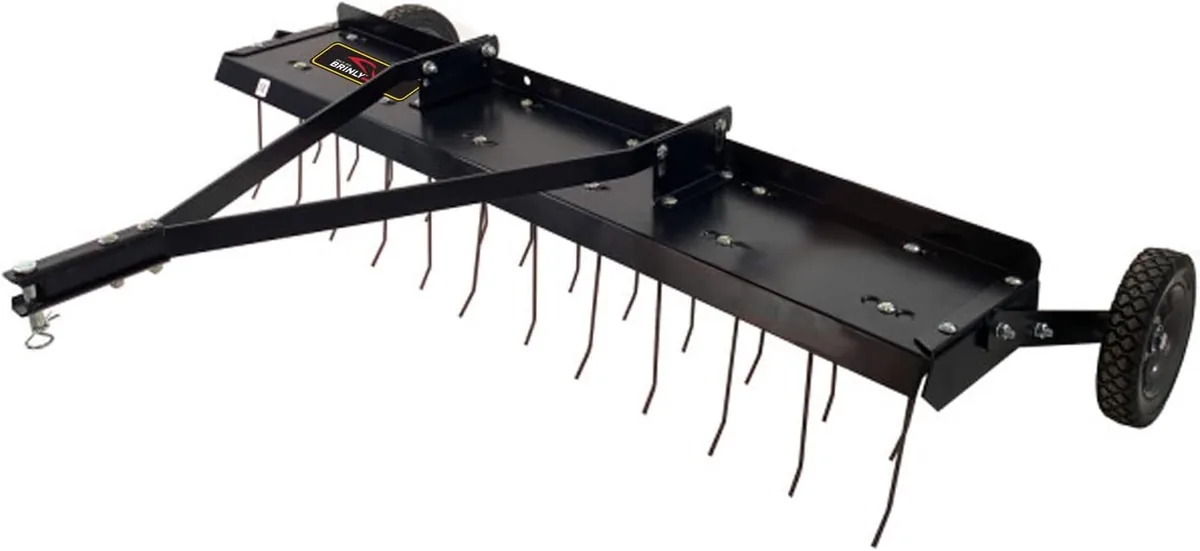
9. Brinly DT-480BH 48-Inch Tow-Behind Dethatcher Best for Large Lawns
Width is what a big lawn asks for, and the Brinly DT-480BH gives the most of it on this page: a 48 in. tray of spring tines that rides behind a lawn tractor, garden tractor, zero-turn or riding mower with a rear hitch plate. It has no motor and no bag. I pick it for a large lawn and a rider that can pull it.
WHY I CHOSE THIS ✓
The DT-480BH closes the list because it is the widest machine on this page, and a big lawn is where a 48 in. swath pays off. It is my pick for the best dethatcher for large lawns that a rider can pull. It does light combing and no more.
Brinly DT-480BH 48-Inch Tow-Behind Dethatcher Specs
Key Features:
- 48 in. working width: one pass covers more turf than any walk-behind machine.
- Two rows of spring steel tines: they flex back and flip the thatch forward.
- Fixed tine height: set once at assembly with a 1/2 in. shim, then fine-tuned in steps of no more than 1/4 in.
- Safety wires on the tines: two wires through the coils, and the manual says never to run it without them.
- Replaceable tines: Brinly sells a single tine or a pack of twelve.
The manual says the grass should be under 3 in. tall for proper tine action and the tines should flip the thatch forward. If they drag without flipping, the tray is too low, so raise it; if they stay in the free position, lower it, by no more than 1/4 in. at a time. Brinly says dethatching takes several passes.
The 48 in. tray has no lift handle and no transport position, so you tow it to the lawn with the tines down or load it. The wheels sit inline behind the tray and set the tine height, which struck me when I built it, and pressing a tine by hand showed it flex back and spring forward, the flip action the manual describes. I set the tines level on a 1/2 in. shim on the concrete work pad, which is the flat surface the manual wants for the build. The manual asks for a fastener check after the first 30 minutes of use.

Fit the two safety wires through the tine coils and bend them over, because a tine that comes loose can injure a person. The manual gives no weight tray and no ballast instruction, and it prints a maximum towed weight of 37 lb, the empty weight, so I add no ballast.
The manual says never to tow it behind a car or truck, on a highway or with riders, and to tow only in the vehicle’s tow mode or below 5 mph, with 3 mph or less as the best speed. The towing vehicle and operator together must outweigh the towed weight.
Tines break if they strike objects, and they carry a 90-day warranty, so walk the lawn first and clear stones and sticks. Keep feet and hands clear of the tine tips.
A large lawn, a rider with a rear hitch plate and light dethatching to do make the DT-480BH the right fit. Skip it if you own only a push mower, if the lawn is small or if the mat needs a reel that cuts the soil. I go through this 48 in. tray in my Brinly DT-480BH review.
FINAL VERDICT
The DT-480BH is the large-lawn answer for an owner with a rider. It is a combing tool with no bag, and you rake or sweep up after it.
It is the wide tow-behind comb for a large lawn.
How to Choose the Best Lawn Dethatcher
Seven checks sort a good dethatcher from a poor fit for your lawn. Start with the machine type, because it decides power, reach and cost. Then check the reel, the width and depth steps, the bag, the cord or battery, your thatch and grass, and the safety limits in the manual.
Corded, Cordless, Attachment or Tow-Behind Machines
Four kinds of machine are on this page, and the type you can power sets everything else. A corded walk-behind needs an outdoor extension cord and a GFCI outlet. A cordless kit swaps the cord for two batteries and a charger. An attachment borrows the motor of a power head you already own, and a tow-behind tray needs a riding mower or tractor. My best tow-behind dethatcher picks cover the tray option for a lawn tractor.
| Type | Power | What you still need | Suits |
|---|---|---|---|
| Corded walk-behind | Plug, 12 to 15 A | Extension cord, GFCI outlet | A lawn near an outlet |
| Cordless walk-behind | Two 24V packs, 48V max | Charging time before the next job | A lawn with no easy outlet |
| Attachment | A separate power head | Power head, battery and charger | An owner of that system |
| Tow-behind | None (towed) | A rider with a rear hitch | A large lawn, light combing |
I match the type to the lawn before I read a spec sheet. My quarter-acre house lawn sits within reach of a GFCI outlet on the shed wall, so a corded machine fits it. A manual lawn dethatcher, which is a hand rake, suits only a small patch and stays off this page, and a tow-behind tray belongs on a large lawn with a rider to pull it. For a lawn smaller than mine, I list compact, light machines in my best dethatcher for small lawn roundup.
Dethatcher Reel or Scarifier Reel
A lawn dethatcher and scarifier is one 2-in-1 machine with two reels. A dethatcher reel carries spring steel tines that comb dead grass out of the lawn. A scarifier reel carries slicing blades that cut grooves into the soil, and makers call that pass more intense, with some risk of pulling up grass roots. A pull behind lawn dethatcher is a light comb of spring tines and cuts no soil.
Extension guides describe vertical mowers that slice into the thatch with rotating blades and power rakes with wire tines, and extension guidance warns that removing more thatch than needed can severely thin the stand. In a five-year study on Meyer zoysia, annual vertical slicing cut thatch depth by 12 to 18 percent each year (1). A four-year study on Tifway bermudagrass home lawns found that vertical mowing twice a year cut thatch by 8 percent but hurt shoot density, and core aeration did not reduce thatch (2).
- Tine reel: the gentle pass for a lawn with a moderate mat.
- Blade reel: the deeper pass for heavy renovation, worked on the steps below zero on the depth scale. My best lawn scarifier roundup covers corded and cordless machines for moss and matted turf.
- Both reels in the box: the rule for a 2-in-1 dethatcher and scarifier, but one electric machine on this page carries tines only, so read the packing list. My roundup of dethatcher and scarifier machines lists models with both drums in the box.
I lead with the tine reel and reach for the blade reel only on a thick mat, because every deep pass costs turf.
Working Width and Depth Steps
Width sets how many rows you walk. The powered machines here work 12.6 in. to 16 in. paths, and the tow-behind trays work 40 in. and 48 in. Depth steps are signed: a negative number means the tines or blades work below the soil surface, and makers often mark the deepest steps for scarifying only. The scales differ, so read the chart of the exact model. If your yard is big, my roundup of the best dethatcher for large lawn looks at machines that reach more ground per pass.
| Scale | Steps | Range |
|---|---|---|
| One scale for both jobs | 5 | +1/4 in. to -1/2 in. |
| Separate raking and scarifying scales | 5 | +0.4 in. to -0.375 in. |
| Short scale | 4 | +0.2 in. to -0.4 in. |
| Attachment scale | 3 | 0 to 0.8 in. |
I start on the shallowest step that lifts thatch and go down one step only if the mat stays, because a deep step on thin turf scalps the crown.
Collection Bag and Weight
A dethatched lawn drops far more debris than a mowed one, so the bag decides how often you stop. The bags here run from 8 gal to 14.5 gal, one maker prints bushels, one prints no size and three machines have no bag at all. Makers say to empty the bag at half full, because a full bag cuts performance.
- Weights: corded machines run from 21 lb to about 30 lb, and the cordless kit is 33 lb net, so read the footnote on whether a battery is counted. I compare two cordless kits in Sun Joe against WORX WG855.
- Tow-behind and attachment: there is no bag, so the tines lift thatch to the surface and you rake or sweep it up.
I count trips to the compost pile, not gallons: the house lawn alone is a few trips, and I empty the bag before it fills.
Cord, Battery and Warranty
A corded machine gets its power through the cord, so the gauge and the length matter as much as the amps. The makers’ tables differ even for 13 amp motors, so look up the exact model and follow its manual. My best electric dethatcher roundup covers corded and cordless machines.
| Table group | 14 AWG | 12 AWG | Longer runs |
|---|---|---|---|
| Two manuals (12 A and 13 A motors) | Up to 50 ft | 50 to 100 ft | Not over 100 ft |
| Three manuals (13 A and 15 A motors) | Up to 25 ft | Up to 50 ft | Not recommended |
Cordless kits trade the cord for a pack routine, and my best cordless dethatcher roundup ranks five battery machines side by side. One maker needs both packs in the machine and says charging both takes up to 1 hr 50 min, and none of the cordless makers on this page prints a run time, so treat the lawn size you can finish on one charge as unknown.
- Term: warranties here run from 2 years to 5 years, most are 2 years, and the tines and tires of one tow-behind tray carry only 90 days.
- Hour limits and sellers: one warranty stops at 500 hours, and others cover only purchases from an authorized or direct vendor.
- Household use: most exclude commercial, professional and rental use.
I register a tool the day I unbox it, keep the receipt with the manual in the shed and read each exclusion before I rely on the terms.
Your Thatch, Your Grass and the Season
Check the thatch before you buy anything. Cut a plug and look at the brown layer between the green blades and the soil. Thatch is a layer of dead and living stems and roots that builds when the grass makes organic matter faster than it breaks down (3). Extension guidance says a layer over half an inch invites pests and disease, while some warm-season guidance waits until about an inch. My roundup of the best dethatcher for thick thatch lists machines for a matted lawn.
Timing follows the grass. Extension guidance puts cool-season lawns in late summer to early fall and warm-season lawns in the summer while the grass is actively growing. It also says power rakes should not be used on St. Augustinegrass or centipedegrass, which only produce above-ground stems.
Key Takeaway
Extension guidance calls mechanical dethatching very destructive to the lawn because roots live in the thatch, so work only the lawn that has a thatch problem.
I wait until the grass grows strongly and the soil is damp, not wet, and I leave a firm lawn alone, because a thin mat is no reason to put a reel through the turf. My roundup of the best dethatcher for Bermuda grass covers machines for dense warm-season turf.
Eye, Ear and Hand Safety
A dethatcher throws stones, sticks and soil. In a US study of lawnmower eye injuries from 2004 to 2023, 77 percent came from projectiles, mostly grass, dirt and rocks, and only 2 percent of the projectile injuries documented eye protection (4).
The powered walk-behind machines here print no noise figure. In a study of groundskeepers at North Carolina public universities, the maximum sound levels of equipment ranged from 76 to 109 dBA, with 82 percent above 85 dBA (5), and NIOSH recommends 85 dBA averaged over an eight-hour workday (6).
- Eyes: glasses or goggles with side coverage that meet ANSI Z87.1, every time.
- Ears and lungs: hearing protection, and a dust mask when the lawn is dusty.
- Body: long pants, gloves and sturdy closed shoes.
- Lawn: stones, sticks, toys, wire and dog waste removed, and sprinkler heads, drip lines and landscape wiring marked.
- Bag and guards: never run a machine without its bag and guards fitted, because the reel throws debris.
I mark my drip lines near the tree strips and any sprinkler heads before the first pass, because tines and blades can catch or cut a line. Then I follow the stop order every time a machine needs a hand:
- Release the lever or switch.
- Wait until the reel has stopped completely.
- Unplug the cord, or take out the battery or batteries.
- Put gloves on, then touch the bag, the tines or the blades.
Never Reach Under a Running Machine
Never lift, tilt or reach under the machine while the reel turns. Keep children, pets and bystanders at the distance the manual gives, and stop when anyone comes closer.
Pro Tip
Wet grass sticks to the underside of the machine and blocks the discharge, and several manuals forbid work on a wet lawn, so wait for a dry day.
My Overall Verdict
Nine machines earned a place, and the right one depends on how you power it and how thick your mat is. A corded 2-in-1 with both reels does the whole job for most homeowners, and the rest of the list covers a missing outlet, a tight budget, a big lawn or a power head you already own.
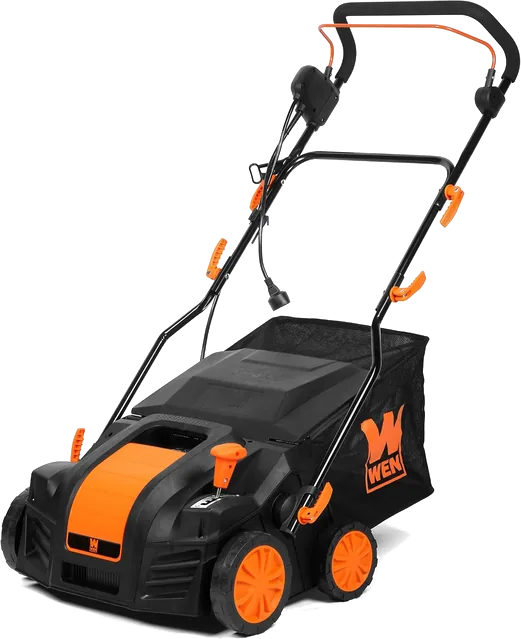
1. WEN DT1516 16-Inch Corded Dethatcher and Scarifier Best Overall
For a house lawn with an outlet in reach, both reels in one box and a clear depth chart.

2. Sun Joe 24V-X2-DTS15 Cordless Dethatcher and Scarifier Best Premium
For a lawn where a cord gets in the way and you accept the price, the weight and an unpublished run time.

3. Sun Joe AJ798E Corded Dethatcher and Scarifier Best Value
For a small flat lawn on a tight budget where light weight matters more than reach.
Match the machine to your outlet, your lawn and your thatch, and work only on dry ground. For most homeowners, the WEN DT1516 is the best lawn dethatcher on this page, and my WEN DT1516 review gives the full verdict.
Why WEN DT1516 16-Inch Corded Dethatcher and Scarifier Might Be the Best Choice
The WEN DT1516 comes first because one box covers the light pass and the hard one. On the house lawn I start on the -1/8 in. step and keep the blade steps for a thick mat, and the depth chart tells me which step belongs to which job.
The trade-off is the cord. WEN supplies none, and a 15 amp motor needs 14 gauge up to 25 ft or 12 gauge up to 50 ft. I compare two corded dethatcher and scarifier models in my WEN DT1516 against Greenworks DHA103 comparison.
Here is what the DT1516 gives you:
✓ A 24-tine dethatching reel and a 20-blade scarifier reel in the box.
✓ Five depth steps with a chart that names each job.
✓ A 16 in. working path and a 15 amp motor with overload protection.
✓ A detachable bag on a rack, which WEN tells you to empty often.
✓ A warranty of 2 years or 500 hours for personal use.
Frequently Asked Questions
What is the best lawn dethatcher?
The best lawn dethatcher for most homeowners is the WEN DT1516, a corded 2-in-1 with a 24-tine dethatching reel, a 20-blade scarifier reel and five charted depth steps in one box. Choose it when an outlet sits within a good extension cord’s reach, and pick another type when it does not.
Are Agri Fab dethatchers worth buying?
Agri-Fab dethatchers are worth buying for a rider-mower owner who wants a low-cost way to comb a large lawn, and the 45-0294 on this page is the model I pick. They are light combs with no depth control and no scarifier reel, so a thick mat needs a powered machine.
Is dethatching worth it?
Dethatching is worth it when a plug cut from your lawn shows a thatch layer thicker than about half an inch, because a thick layer holds back water and gives pests and disease a home. A thin layer is helpful, and mechanical dethatching is hard on the lawn, so leave a firm lawn alone.
What is the best dethatcher in 2026?
The best dethatcher in 2026 is the WEN DT1516 for most lawns with an outlet in reach, the Sun Joe 24V-X2-DTS15 for a lawn without one and the Agri-Fab 45-0294 behind a riding mower. Each of them has a limit, such as the cord, the weight or the lack of a depth control, so read its review before you buy.
What is the best electric lawn dethatcher?
The best electric lawn dethatcher is the WEN DT1516 when you can run an extension cord from an outlet, and the Sun Joe 24V-X2-DTS15 when you want a battery kit with two packs and no cord. Both carry a tine reel and a blade reel, so the choice comes down to the cord and the price.
References
- Dunn JH, Sheffer KM, Halisky PM. Thatch and Quality of Meyer Zoysia in Relation to Management. Agronomy Journal. 1981;73(6):949-952.
- Carrow RN, Johnson BJ, Burns RE. Thatch and Quality of Tifway Bermudagrass Turf in Relation to Fertility and Cultivation. Agronomy Journal. 1987;79(3):524-530.
- Ojeokun O, Fry J, Todd T, Martin C, Chandra A, Xiang M, et al. Thatch Accumulation in Zoysiagrass Genotypes across the US Transition Zone and Southern Regions. HortTechnology. 2025;35(4):502-512.
- Stange NR, Jennissen CA. Lawnmower-Related Eye Injuries in the U.S., 2004 to 2023. Am J Ophthalmol. 2025;277:7-16.
- Balanay JAG, Kearney GD, Mannarino AJ. Assessment of Occupational Noise Exposure among Groundskeepers in North Carolina Public Universities. Environ Health Insights. 2016;10:83-92.
- National Institute for Occupational Safety and Health. Noise-Induced Hearing Loss. Noise and Hearing Loss. Centers for Disease Control and Prevention; 2024.
Safety Note: Read your manual first. A dethatcher or scarifier throws stones, sticks and other debris with force, so walk the lawn first and remove stones, sticks, toys, wire, hoses and pet waste. Mark sprinkler heads, irrigation and drip lines, low-voltage lighting wire and buried pet fence wire, keep the drum clear of them, and follow your manual’s limits near underground cables and pipes. Wear impact-rated eye protection with side coverage that meets ANSI Z87.1, hearing protection, gloves, long pants and sturdy non-slip closed shoes, plus a dust mask when the work raises dust. Keep people and pets as far away as your manual says, and stop at once if anyone comes closer. Never use a powered dethatcher on wet grass or in rain. The machine can jump up or forward when the tines hit hard or frozen ground, roots, stumps or buried rocks, so avoid those spots and hold the handle with both hands. Never lift or tilt the machine or reach under it while the drum turns. Before you clear a jam, empty or fit the collection bag, change the depth, clean, inspect or adjust the machine, turn it over, leave it, or touch the tines or blades, switch it off, wait for the drum to stop completely, then unplug the cord or remove every battery pack, and remove the safety key if it has one. Let hot tines cool before you handle them. If the machine starts to vibrate hard, switch it off, wait for the drum to stop completely, then unplug the cord or remove every battery pack and any safety key before you check it for damage. For a corded model, use an undamaged outdoor extension cord of the gauge and length your manual gives, plugged into a GFCI outlet, keep the cord behind you and clear of the drum, and never handle the plug with wet hands. For a battery model, use only the battery and charger approved for your tool, charge and store them within the temperature range in your manual, and never use a damaged or swollen pack. Stay off steep and wet slopes and work slopes only in the direction your manual gives. For a tow-behind dethatcher, follow both your tractor’s and your dethatcher’s manuals: tow it only behind a lawn tractor or riding mower that meets the maker’s requirements, never on public roads or behind a car or truck, keep a slow, steady speed, avoid sudden turns and stops, carry less weight on slopes and never more than the manual allows, never carry riders, and fit any tine safety wires the manual requires. Before you adjust or clear it, stop the tractor, set the parking brake, remove the key and disconnect the dethatcher as its manual describes. Dethatching at the wrong time of year, too deep or on stressed turf can badly damage a lawn, so match the timing and depth to your grass type.