
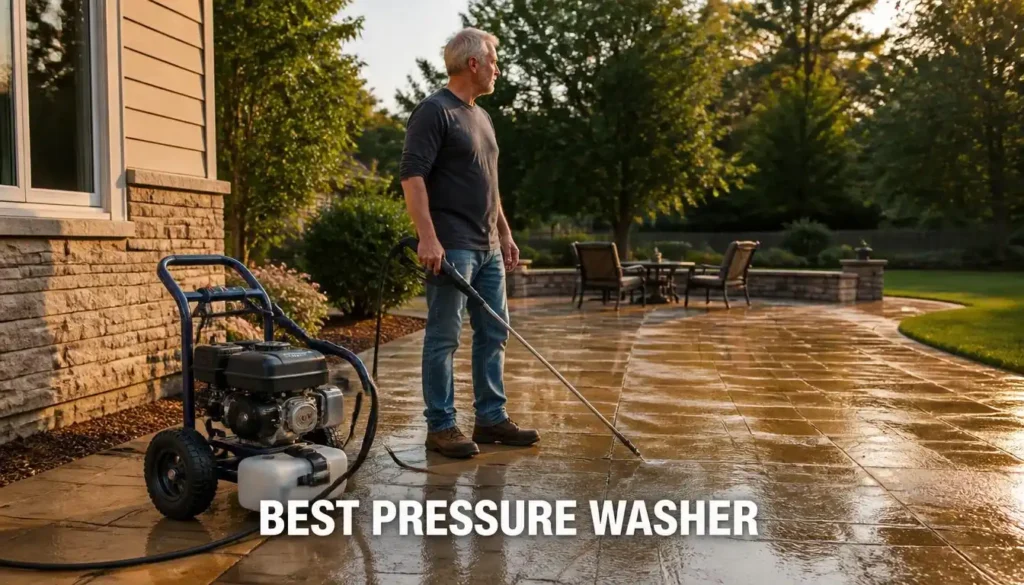
The best pressure washer is the one whose power source, hose, nozzles and manual suit the work you give it. In large-scale production, I checked sprayer nozzle output with calibration cylinders, so I read a washer’s printed figures the same way, and I handled each of these nine on my own ground.
Affiliate Disclosure: Garden Power Scout is a proud participant in the Amazon Services LLC Associates Program. As an Amazon Associate, we earn from qualifying purchases, at no extra cost to you.
My top pick, Westinghouse WPX3400 3400 PSI Gas Pressure Washer, is a gas washer with its own soap tank. Below are eight more across gas, corded and battery power, then how to choose and the safety steps to know before the first start.
Best Pressure Washer 2026: 9 Gas, Corded and Battery Models I Put to Work
Two of these nine run on gasoline, six plug into a grounded outlet and one runs on batteries. Each entry gives the ratings with the maker’s own basis words, the hose, the nozzles, the detergent system and the warranty. Those ratings are the makers’ figures under their own stated conditions.
1. Westinghouse WPX3400 3400 PSI Gas Pressure Washer Best Overall
The Westinghouse WPX3400 is the gas washer I recommend to most homeowners who want one machine for the yard, the drive and the gear that gets muddy. It is rated at 3400 PSI and 2.6 GPM, according to Westinghouse, and it carries its own 0.42 gallon soap tank, so a detergent job needs no separate bucket. The price of that convenience is weight and an engine to look after, which suits a buyer who accepts both.

WHY I CHOSE THIS ✓
I put the WPX3400 first because it asks the fewest extra purchases of a gas buyer. The soap tank is built in, the nozzle table is in the manual, and the stop order is printed step by step, so you can read what the maker expects before you buy. That is why I call it the best pressure washer for a household that wants one machine across the property. The trade-off is plain: it is a heavy machine with an engine to look after.
Westinghouse WPX3400 3400 PSI Gas Pressure Washer Specs
Key Features:
- Onboard soap tank: a 0.42 gallon tank siphons detergent into the low-pressure stream, and only when the black soap nozzle is on the lance, so the choice to use detergent stays with you.
- Five quick-connect nozzles: red, yellow, green and white tips at 0, 15, 25 and 40 degrees plus the black soap nozzle, all listed by color in the manual’s own nozzle table.
- Printed nozzle table: the manual names a nozzle for each kind of job, so you read your settings from Westinghouse’s page and your detergent label.
- 15 second pressure release: the manual prints one step order for relieving trapped pressure, ending with the trigger lock released and the trigger held for 15 seconds.
- Thermal relief valve: if the pump runs more than a minute without spraying, the valve opens and discharges hot water onto the ground to cool the pump.
- Recoil start with choke: the 212 cc engine starts on a pull cord, with a choke for a cold engine and a short warm-up before you spray.
- Cleaning tool in the carton: a nozzle cleaning tool ships with the washer, for use after the stop steps if a nozzle blocks.
Westinghouse puts five quick-connect nozzles in the carton and says to use only the nozzles supplied with the washer. Before you change one, complete the stop and make-safe steps in the safe-state box in the safety section below. The collar pulls back, the tip seats, and the manual says to pull on the nozzle to confirm it is secured, a habit I picked up within minutes. I fit the black soap nozzle only when I mean to use detergent, since Westinghouse says it is what draws the soap.
Westinghouse names the fuel: the engine takes 87 to 93 octane unleaded gasoline with no more than 10 percent ethanol, and it says no E15, no E85 and no gas and oil mix. The crankcase takes SAE 10W-30 and needs oil before the first start. Fuel left in the tank for more than 30 days can deteriorate, per the manual. Before you refuel, complete the stop and make-safe steps in the safe-state box in the safety section below. Westinghouse then asks for refuelling outdoors, at least two minutes of cooling and no overfilling.
Winter asks the most of this class of washer. The manual says not to let water in the pump freeze, and its winter notice calls for RV non-toxic antifreeze or a pump protection product made for pressure washers. After the safe-state steps, the manual’s order drains the hoses, gun and lance, then has you pull the recoil handle five or six times with the engine off to push liquid out of the pump. I treat that notice as a real chore, and Westinghouse wants 30 minutes of cooling before storage.

Before you touch a hose, complete the stop and make-safe steps in the safe-state box in the safety section below, then run the garden hose clear for 30 seconds and check the pump inlet screen, as the manual says.
Westinghouse requires safety goggles, which cover the sides, top and bottom of the eyes, and says not to mistake safety glasses for goggles. Put them on with full ear protection before the start. Westinghouse’s start order comes first: hoses connected and water on, air purged until a steady stream flows, engine switch and fuel valve on, and the choke set for a cold engine. Then I pull slowly until I feel resistance and rapidly after that, as the manual says.
Routine care follows a schedule. The manual lists the air filter every 50 hours or six months, the spark plug cleaned at 100 hours or six months and replaced at 300 hours or every year, and valve clearance by a dealer. Complete the safe-state steps first, and add what Westinghouse adds: disconnect the spark plug boot before maintenance. The manual asks for a second person when lifting the unit.
Buy it if you want one gas washer for the property and accept fuel, oil, a pull-cord start and winter storage as chores. Skip it if you have no outdoor spot at least 20 feet from windows, doors and vents, as CDC says, or if nobody can help you lift a 63 pound frame.
FINAL VERDICT
Westinghouse puts the tank, the nozzles and a printed stop order in one carton, and that is why the WPX3400 leads. Plan for an outdoor spot 20 feet from windows, doors and vents, and for a second pair of hands at lift time.
It is the gas washer I recommend to most homeowners.
2. EGO Power+ HPW3204-2 3200 PSI Cordless Pressure Washer Kit Best Premium
The EGO Power+ HPW3204-2 is the washer I pick for a buyer who wants no fuel, no engine and no power cord on the job. The kit ships with two 6.0 Ah ARC Lithium batteries and a charger, so the box holds everything except a water supply. EGO prints a maximum rated 3200 PSI and, depending on the gun set-up, 1.2 or 2.0 GPM. EGO’s manual for this kit is its HPW3200 manual, and the kit sits in the premium tier on this list.

WHY I CHOSE THIS ✓
I rank the HPW3204-2 second because it removes three chores at once: fuel, a pull cord and a power cord. Two batteries, a charger, a foam cannon and a full nozzle set are in the kit, and the speed button sits on the gun. It earns the premium place for a buyer who weighs those chores heavily. The batteries are the part I look after most.
EGO Power+ HPW3204-2 3200 PSI Cordless Pressure Washer Kit Specs
Key Features:
- Two-battery design: the compartment takes two 56V packs, and EGO prints that a single pack gives no TURBO speed.
- Remote-control gun: the short gun carries a speed button and a five-LED fuel gauge, and it runs on a CR2032 coin cell.
- Three speed levels: low, high and TURBO are set from the gun, so you adjust output without walking back to the machine.
- Foam cannon in the box: it snaps onto the gun and takes detergent through a knob that sets the amount.
- Quick-connect lance and stainless wand: the wand locks into the gun’s quick coupler, and a knob on the lance tightens it.
- Siphon hose and filter: water can come from a garden hose or, through the siphon hose, from a bucket with the filter fully immersed.
- Telescopic handle with wheels: the handle locks in three positions, and the hose stores behind it on a strap.
The nozzle system differs from a gas washer’s. The 15, 25 and 40 degree and Turbo nozzles fit the quick-connect end of the wand, while the rinse nozzle and the foam cannon snap onto the gun, and EGO says to tug on any nozzle to confirm it is attached. Before you change a nozzle or the foam cannon, complete the stop and make-safe steps, including the battery steps, in the safe-state box in the safety section below. EGO also says to hold the gun with one hand and the nozzle with the other when you disconnect it, because a nozzle can jump out.
EGO ties its two flow figures to the gun set-up: a maximum rated 1.2 GPM with the quick-connect lance and stainless wand, and 2.0 GPM with only the short pressure gun. I read that as two tools in one kit, a wand for reach and a short gun for close work, and I keep the two figures apart. The speed button on the gun was the first control I reached for. One pack gives no TURBO speed, and EGO says TURBO use may shorten runtime per charge.
EGO names a garden hose or a bucket with the siphon hose as supplies, never hot water, never water from pools or lakes, and never a hose coupling with Aquastop or a backflow preventer. It also says the product is not intended for connection to the potable water mains, so read its water-supply page before the first start. The manual also says not to use the washer with hard water, and it asks for a flush of at least 120 seconds before storage and periodic descaling. At the pump head of my drip system a 150-mesh disc filter catches what the water carries, so I read a hard-water warning as a real instruction. Before you flush, drain or store the washer, complete the safe-state steps.

Before you fit or change a battery, complete the stop and make-safe steps, including the emergency exception, in the safe-state box in the safety section below. Then listen for the click, since EGO says the latch must snap into place and the packs must be secured before you start.
Use only the batteries and the charger EGO specifies for this washer. EGO prints 41 to 104 degrees F as the washer’s recommended operating temperature and IPX5 protection only with the battery compartment closed.
Ownership means a battery platform. EGO says to recharge only with the specified charger and to avoid a damaged or modified pack, and the coin cell in the remote gun carries its own ingestion warning. Before you store the washer, complete the stop and make-safe steps, including removing the battery packs. EGO says to store it dry, locked up or up high, out of the reach of children and away from fertilizers, gasoline and other chemicals. The unit weighs 36.2 pounds without the packs, so add the packs when you plan a lift, and I fold the hose behind the handle on its strap before I roll it.
This kit suits a buyer who wants to wash without fuel or an outlet within reach, and your water supply meets the rules on EGO’s water-supply page. Skip it if your water is hard, since EGO says not to use the washer with hard water, or if you prefer a machine with no batteries to charge and store.
FINAL VERDICT
No other entry removes fuel, engine and cord together. EGO’s water rules, hard water excluded, are the check to make before buying.
It is the cordless washer I recommend at the premium tier.
3. Westinghouse ePX3100 2300 PSI Electric Pressure Washer Best Value
The Westinghouse ePX3100 is the corded washer I pick for a first machine and light household work. It plugs into a standard grounded outlet, carries a GFCI in the plug, and brings an onboard soap tank, a five-nozzle set and a manual with its own step order. Westinghouse prints a maximum of 2300 PSI and a rated 1900 PSI, and the washer sits in the budget tier on this list.

WHY I CHOSE THIS ✓
I rank the ePX3100 third as the best value for a first corded machine, because it carries a GFCI plug, a soap tank and a five-nozzle set in the budget tier. The plug-in start is the point: no fuel, no oil and no pull cord. Its weakest spot on this page is reach, since the cord is the limit and Westinghouse does not recommend an extension cord. That limit decides who I recommend it to.
Westinghouse ePX3100 2300 PSI Electric Pressure Washer Specs
Key Features:
- GFCI in the plug: Westinghouse names a Class A GFCI built into the plug, with TEST and RESET buttons on it.
- Auto-start pump: the motor runs for a few seconds, then waits until the trigger is squeezed.
- Onboard soap tank: a tank on the machine feeds the soap nozzle at low pressure, and only that nozzle.
- Five nozzles: 0, 15 and 25 degree nozzles, a soap nozzle and a turbo nozzle, all quick-connect.
- Printed nozzle table: page 14 of the manual names the nozzle for each job, so you read settings from Westinghouse’s page.
- Retainers and holsters: the body carries a hose retainer, a cord retainer and holsters for the gun and lance.
- Casters in the carton: the casters push into slots in the base until they snap, and the manual covers assembly step by step, down to the warning not to overtighten the lance.
The pump starts in a way that surprised me. The manual says the unit will run for several seconds and shut off, and that it could be pressurized even if the motor and pump cannot be heard. I treat silence as a live machine, and I learned to squeeze the trigger in slow, deliberate pulls, because Westinghouse says rapid pulls can make the unit miss an on and off cycle.
The GFCI is the part to test. Westinghouse’s manual describes a TEST and RESET routine for the plug’s GFCI and calls for a monthly test, while CDC advises testing the GFCI first and having an electrician check a unit that trips a breaker. Westinghouse also says to use only identical replacement parts if the plug or cord ever needs replacing, so the GFCI stays in the circuit, and to examine the high-pressure hose regularly and replace it if it is damaged.
Westinghouse says the washer is not recommended for use with an extension cord. If one must be used, the manual says it must be in good working condition, with a wire gauge of at least 16 AWG for 50 feet or less and the next heavier gauge when in doubt. For winter, complete the safe-state steps first. The manual then asks for indoor storage in a heated place, because water that freezes in the pump will crack it, and it adds that a pump saver is not included.

Before you change a nozzle, complete the stop and make-safe steps in the safe-state box in the safety section below. Then push the nozzle in until it clicks, as page 14 describes.
Wear eye protection and, per Westinghouse’s symbol table, ear protection whenever the washer runs, and never operate it in bare feet, sandals or open-toed shoes, as the manual says. Westinghouse also says never to let a child use the washer. The casters pushed into the base slots until they snapped, and the cord retainer holds the wrapped cord against the body, two details I noticed at assembly and storage.
Care is short. Complete the safe-state steps first, then wipe the exterior with a soft brush and a damp cloth, since the manual says never to clean the washer with a garden hose. It also says to clean the hose O-rings regularly and lubricate them with non-water-soluble grease such as petroleum jelly, and to turn the washer off after five minutes of inactivity. Detergent is the other limit: Westinghouse says to use only detergent formulated for pressure washers, and that dish and laundry soap is too thick and will clog the nozzle of the detergent bottle.
This is the washer for a first electric machine on a small property, with a grounded outlet within the cord’s reach. Skip it if the work sits beyond that reach, since Westinghouse does not recommend an extension cord.
FINAL VERDICT
Outlet distance settles this one. Westinghouse does not recommend an extension cord, so measure that distance before you order.
It is the corded washer I recommend for a first machine.
4. Simpson PowerShot PS61002 3500 PSI Honda GX200 Gas Pressure Washer Best Honda Engine
The Simpson PowerShot PS61002 is the gas washer on this list built around a Honda engine. Simpson names a Honda GX200 on its product page and rates the machine at 3500 PSI and 2.5 GPM. It sits in the premium tier, and it suits a buyer who wants that engine more than a soap tank on board.

WHY I CHOSE THIS ✓
The Best Honda Engine label goes to the PS61002 because Simpson names a Honda GX200 on its product page and no other gas washer on this page does. The engine is the reason to pick it, and the maintenance-free pump is the second. I count the missing soap tank against it for a first-time buyer.
Simpson PowerShot PS61002 3500 PSI Honda GX200 Gas Pressure Washer Specs
Key Features:
- Honda GX200 engine: Simpson’s product page names it, and the manual starts it with a recoil pull.
- Maintenance-free pump: according to Simpson’s manual, the pump was filled with oil at the factory and has no oil drain or fill plugs.
- MorFlex hose: 25 feet of 5/16 inch hose with a polyurethane outer jacket.
- Siphon soap hose: a filtered end in a container draws detergent once the black soap nozzle is fitted.
- Rear-load gun and 16 inch lance: the manual says not to over-tighten the lance coupler.
Simpson’s manual lists the protective equipment first: ear plugs or muffs, ANSI Z87.1 safety glasses or goggles, long pants, a long-sleeved shirt and rubber-soled shoes that fully cover your feet. It adds that you must not use the washer while standing on a ladder. I put all of it on before I touched the recoil handle, and I return the starter grip gently by hand, as the manual says. The manual’s engine warning says why: rapid retraction of the starter cord can pull your hand and arm toward the engine faster than you can let go.
The pump limit is the figure to remember. Simpson says more than two minutes without pulling the trigger overheats the pump and opens the thermal relief valve. If you will not spray for longer than that, complete the stop and make-safe steps in the safe-state box in the safety section below. Before you refuel, do the same; Simpson then requires refuelling outdoors with the engine stopped and cool, a fire extinguisher handy and flammable materials at least five feet away.
Before you add detergent, complete the safe-state steps. I then drop the filtered end of the siphon hose into the container and fit the black soap nozzle, and the manual has you rinse the system with clean water afterward.
Before air filter work, complete the stop and make-safe steps in the safe-state box in the safety section below, then wear gloves: the REV E manual warns that the filter element and air box may contain polycyclic aromatic hydrocarbons.
Freezing damage is not covered by the warranty, and the winter steps call for a pump antifreeze. Complete the safe-state steps before you move or store it. At 74 pounds, the machine is too heavy for one person to lift.
Choose it for a gas washer with a named Honda engine, when you are content to carry soap in a container. Skip it if you want a built-in tank, a lighter machine or a household warranty term.
FINAL VERDICT
A Honda GX200 and a pump with no oil service: that is the PS61002. Budget a soap container, because there is no tank on board.
It is the gas washer I recommend for the Honda engine.
5. Greenworks 3000 PSI Brushless Electric Pressure Washer GPW3002A Brushless Motor
The Greenworks GPW3002A is the corded washer on this page whose listing describes a brushless motor. The manual adds a built-in detergent tank and a thermal relief valve, and prints a maximum of 3000 PSI. It sits in the mid-range tier.

WHY I CHOSE THIS ✓
The GPW3002A carries the Brushless Motor label because Greenworks’s listing describes the motor as brushless, which no other washer here does. The thermal relief valve and the detergent tank in the manual are the features I rely on.
Greenworks 3000 PSI Brushless Electric Pressure Washer GPW3002A Specs
Key Features:
- Thermal relief valve: the manual describes a thermal protector that releases a small amount of water at 140 degrees F to cool the pump.
- Built-in detergent tank: detergent goes through the soap tip only, and only at low pressure.
- Turbo nozzle: the manual says it rotates in a zero-to-15-degree spray pattern.
- Quick-connect collar: pull the collar back, insert the tip, release, and pull on the tip to confirm it is installed.
- Pump protector line: the manual recommends a pump protector solution, sold separately, after every use and before long-term storage.
Assembly is the first job: the wheels go on the axle with a cotter pin, the upper handle unfolds and bolts in place, and the gun holder and cord arms need a Phillips screwdriver that the box does not include. Greenworks says not to power the washer on before assembly is complete. I counted the screwdriver as part of the purchase, and the upper handle unfolded and bolted on without trouble.
Hose connection comes after the stop and make-safe steps in the safe-state box in the safety section below. Greenworks then has you let water flow through the garden hose for 30 seconds, keep at least 10 feet of free hose between the inlet and the supply, and inspect the inlet filter. If the filter is damaged, do not use the machine until it is replaced.

Before you change a nozzle, complete the safe-state steps. Then pull on the tip once it clicks, as the manual says, and read Greenworks’s own pressure release line in section 4.3.
Put on the safety goggles or glasses with side shields that the manual names, plus a full-face shield as necessary, before the washer starts.
Before you fill the tank, complete the safe-state steps: the built-in tank pours cleanly, and detergent flows only through the soap tip. Greenworks says to store the washer in a dry, isolated and frost-free area, out of the reach of children, and the cord arms and hose hook let me park it upright. Complete the safe-state steps first. The water supply must come from the water main, never hot water and never water from ponds or lakes, according to the manual.
Pick it for a high printed pressure rating in a plug-in washer, provided an outlet sits within reach of its cord. Skip it if you want a washer that arrives assembled. I go through the GPW3002A in full in my greenworks 3000 psi pressure washer review.
FINAL VERDICT
A listing that promises a brushless motor and a manual that adds a thermal relief valve make the GPW3002A a plug-in washer worth the assembly, though you supply the screwdriver.
It is the corded washer I pick for the brushless motor.
6. Sun Joe SPX3000 Corded Electric Pressure Washer Two Detergent Tanks
The Sun Joe SPX3000 is the corded washer on this page with two detergent tanks, set up with a dial so that two solutions can stay loaded. Sun Joe prints a 14.5 amp motor, a 35 foot GFCI power cord and a 20 foot hose, and its manual gives up to 2030 PSI at initial discharge by CSA internal testing. It sits in the mid-range tier.

WHY I CHOSE THIS ✓
The SPX3000 earns the Two Detergent Tanks label because it is the only washer on this page whose manual prints two removable tanks with a selection dial. I accept the flush step as the price of that convenience.
Sun Joe SPX3000 Corded Electric Pressure Washer Specs
Key Features:
- Two detergent tanks: two removable tanks sit behind a selection dial, and the center position is off.
- Total Stop System: Sun Joe says water stops flowing when the trigger is released, and the system then turns the motor off.
- Thermal sensor and unloader valve: the manual prints both as safety devices.
- Onboard nozzle storage: the nozzles park on the machine, with a needle tool in the carton.
- Hose and cord holders: the body carries a hose holder and a cord holder.
The dial is the feature that sets this washer apart. Sun Joe says to use the detergent dial to select which of the two tanks the unit draws from. Before you fill a tank or fit the soap nozzle, complete the stop and make-safe steps in the safe-state box in the safety section below. I turn the dial to the center position, which Sun Joe prints as off, before I fit the soap nozzle. Afterward the manual has you siphon fresh water at low pressure for one minute to flush the system.
The Total Stop System changed how the machine felt in my hands, because the motor stops when I release the trigger. The thermal sensor can also stop the machine, and Sun Joe says it restarts after a few minutes once it cools.

Complete the safe-state steps before the hose goes on. Sun Joe then asks for a reinforced garden hose of at least 1/2 inch internal diameter and intake water no warmer than 104 degrees F.
Sun Joe’s manual lists safety glasses and, in the same line, safety footwear, snug-fitting clothing, protective gloves, hearing protection and head protection. It prints a sound power level of 96 dB(A), and I read that hearing line before I pick up the gun.
Sun Joe says an extension cord is not recommended; if you use one, it must be 14 gauge or heavier with a watertight plug and socket, no longer than 25 feet, with 60 feet combined with the supplied cord. The manual says freeze damage is not covered by the warranty, and it says never to store the washer outdoors. Before you store it, complete the safe-state steps. Before you move it, complete the safe-state steps; at 27.6 pounds net on two wheels it then moves without help.
This washer fits a buyer who wants two detergent solutions loaded at once and an outlet close to the work. Skip it if your only water connection is a potable mains line, since Sun Joe says the washer is not suitable for connection to the potable water mains. I discuss this two-tank corded washer in my sun joe spx3000 review.
FINAL VERDICT
Two detergent solutions, one dial: that is the SPX3000, and the flush after each use is the cost Sun Joe attaches to it.
It is the corded washer I pick for the two-tank dial.
7. Greenworks 2000 PSI GPW2003 Corded Electric Pressure Washer Auto On/Off Switch
The Greenworks GPW2003 is the corded washer on this page whose manual names an Auto On/Off switch: set the power switch on, the pump pressurizes and shuts down, and the unit runs again when the trigger is squeezed. Greenworks prints a maximum of 2000 PSI, a rated 1.2 GPM and a net weight of 27.73 pounds. It sits in the mid-range tier.

WHY I CHOSE THIS ✓
The GPW2003 carries the Auto On/Off Switch label because Greenworks names that switch and walks through it step by step: power switch on, the pump pressurizes and stops, and squeezing the trigger starts the motor. A printed net weight of 27.73 pounds also lets you size the lift before the box arrives. I keep both in mind when I pick it.
Greenworks 2000 PSI GPW2003 Corded Electric Pressure Washer Specs
Key Features:
- Auto On/Off switch: once the power switch is on, the pump pressurizes, shuts down and restarts when the trigger is squeezed.
- Detergent tank at the base: the black soap tip draws from it automatically, and only at low pressure.
- GFCI plug: the manual says the power cord is equipped with a GFCI plug.
- Turbo nozzle: the manual describes a zero-to-15-degree circular pattern.
- Hose hook and cord retainer: both are in the packing list.
Greenworks’s manual says the washer may be on and the system pressurized even when the pump and motor cannot be heard running. That is the Auto On/Off switch at work, and it surprised me the first time the pump went quiet with the switch on. I treat a silent machine as live, and I keep both hands on the trigger handle, since Greenworks says to expect the handle to move when the trigger is pulled.
Assembly is required and needs a Phillips screwdriver that the box does not include, and Greenworks says not to connect power before it is finished. The handle goes up by pushing and holding a button until the lock button snaps through its slot, a detail I liked. The manual also says to check the bolts and nuts on the shell for looseness before each use, and I do.

Before you change a spray tip, complete the stop and make-safe steps in the safe-state box in the safety section below. Greenworks then says never to change tips without engaging the lock-out.
Greenworks requires eye protection with side shields marked ANSI Z87.1 and protective footwear, and it asks for a minimum clearance of 3 feet from combustible materials.
Before you fill the tank or store the washer, complete the safe-state steps. Greenworks allows only detergents designed for pressure washers, forbids acids, alkalines, solvents, flammable material and bleaches, and has you siphon clean water through the tank at low pressure for one minute after use. It says to store the washer in a dry, covered, frost-free area, after emptying the hoses, the pump and the detergent container.
This washer suits a buyer who wants a named auto on and off switch, a printed net weight and a tank at the base. Skip it if you dislike assembly, since you build it with a screwdriver you supply.
FINAL VERDICT
The Greenworks GPW2003 starts on a named Auto On/Off switch, and its weight is printed before the box arrives. Treat the silent pump as live every time.
It is the corded washer I pick for the auto on and off switch.
8. CRAFTSMAN CMEPW2100 2100 PSI Corded Electric Pressure Washer 90-Day Money-Back Guarantee
The CRAFTSMAN CMEPW2100 is the corded washer on this page whose manual prints a 90 day money-back guarantee beside a three-year limited warranty. Craftsman rates it at a maximum 2,100 PSI on the CETA CPC-100 basis and a rated 1.2 GPM, and the spec table prints a 25 foot hose and a 35 foot cord. It sits in the mid-range tier.

WHY I CHOSE THIS ✓
The CMEPW2100 gets the 90-Day Money-Back Guarantee label because the manual prints that guarantee beside its three-year limited warranty, and no other manual on this page prints one. A guarantee depends on the seller, so check the seller’s terms on the listing before you buy. The two-handle wand and the removable tank are the parts I liked handling.
CRAFTSMAN CMEPW2100 2100 PSI Corded Electric Pressure Washer Specs
Key Features:
- Removable soap tank: the tank lifts out of the machine for cleaning, and a soap nozzle draws from it.
- Two-handle wand: a spray handle and a grip let one hand work the trigger while the other steadies the wand.
- GFCI test routine: the manual prints a test before each use: indicator green, press TEST, indicator off, press RESET.
- Onboard storage: hooks for the hose and the spray handle and a place for the power cord.
- Printed lengths: the manual’s spec table gives the hose and cord lengths.
I run the GFCI test the way the manual lays it out: plug into a working grounded outlet, watch the indicator turn green, press TEST, watch it disappear, then press RESET. Craftsman says not to use the washer if that test fails. It is a short routine, and it is printed in the manual, which I cannot say of every washer.
The wand has two handles, and the manual says to keep one hand on the spray handle grip and the other on the spray handle, and to hold securely in anticipation of a sudden reaction. Craftsman also says not to change nozzles while the washer runs. Before you change a nozzle, complete the stop and make-safe steps in the safe-state box in the safety section below. When the box arrives, count your tips against the manual’s table.

Hose first: complete the safe-state steps, and Craftsman then has you hold the trigger for 30 seconds to purge the system of air.
Craftsman’s manual prints certified eye, hearing and respiratory protection, names ANSI Z87.1 for the eyes, and says everyday eyeglasses are not safety glasses.
Before vent cleaning or storage, complete the stop and make-safe steps in the safe-state box in the safety section below. Craftsman then says to blow dirt and dust out of the air vents with clean, dry air at least once a week, never to use solvents or harsh chemicals on the washer, and to store it indoors, dry and covered, where the temperature will not fall below 4 degrees C. Its safety rules say not to use an extension cord, so plug it straight into the outlet, and I lift the soap tank out to rinse it.
It suits a plug-in buyer who values a printed GFCI test and a guarantee period, with an outlet within 35 feet of the work. Skip it if you need to reach beyond the cord, since the manual rules out an extension cord. I review this washer on its own in my craftsman cmepw2100 review.
FINAL VERDICT
A GFCI test and a 90 day guarantee sit in one manual. Read the return terms on the seller’s listing before ordering.
It is the corded washer I pick for the printed guarantee.
9. Karcher K1800PS 1800 PSI Corded Electric Pressure Washer Foot-Pedal Switch
The Karcher K1800PS is the corded washer on this page with a foot-pedal switch. The pedal arms the machine, and the motor then runs only while the trigger is pulled. Karcher’s manual prints 1800 PSI as operating pressure and 1.2 GPM as maximum water volume, and the washer sits in the mid-range tier.

WHY I CHOSE THIS ✓
I give the K1800PS the Foot-Pedal Switch label because its manual prints a pedal switch that no other washer on this page has. The pedal is the control I notice every time I start it. It earns the place for a buyer who likes a clear on and off.
Karcher K1800PS 1800 PSI Corded Electric Pressure Washer Specs
Key Features:
- Foot-pedal switch: you step down on the pedal to turn the machine on, and the motor starts when the trigger is pulled and stops when it is released.
- Removable detergent tank: detergent is applied through the soap nozzle, and only at low pressure.
- GFCI test line: Karcher recommends testing the GFCI at each start-up: press TEST, then RESET.
- Hose and gun bin: a bin on the cart.
- Component rating line: the manual says not to run the pump with parts rated below 1800 psi working pressure, guns, hose and connections included.
The pedal changes the routine. Karcher says to switch the machine on by stepping down on it, and then to pull the trigger to start the motor. The manual also says high pressure remains in the device after the trigger is released. For a break of five minutes or more, the manual has its own steps, and the stop and make-safe steps in the safe-state box in the safety section below come first. I found the pedal a natural place for my foot when the gun is in my hands.
Karcher’s safety lock must be engaged when you replace a nozzle or leave the gun, and the manual says it does not lock the spray in the ON position. The gun kicks back, so hold it with both hands. Before you replace a nozzle, complete the stop and make-safe steps in the safe-state box.

Complete the safe-state steps before the garden hose goes on. Karcher then asks for a hose of at least 5/8 inch, a supply of at least 2 GPM and water no warmer than 104 degrees F.
Karcher says to wear safety goggles and ear protection, and that safety glasses do not give full protection from splash-back. Before you lift or move it, complete the safe-state steps. At 20.7 pounds without accessories, as Karcher’s page prints it, I lift it by the handle, and the cart’s bin takes the hose and gun, which I found tidier than coiling both on the ground.
Karcher says not to use an extension cord, and to connect the washer to an individual branch circuit only. It says to use the detergents it recommends, because other detergents may affect operation and void the warranty. The manual calls the unit maintenance free apart from the water inlet filter, and freezing during storage voids the warranty. Before you store it, complete the safe-state steps.
The K1800PS fits a buyer who wants a plug-in washer with a pedal switch and an outlet close to the work. Skip it if your garden hose supply cannot meet the 2 GPM Karcher sets.
FINAL VERDICT
The pedal decides it: a foot switch plus a motor that follows the trigger. Check first that your hose supply reaches the 2 GPM Karcher sets, through a 5/8 inch hose.
It is the corded washer I pick for the foot pedal.
How to Choose the Best Pressure Washer
Six factors decide whether a pressure washer suits your property: the power source, the printed ratings, the hose and cord, the nozzles and detergent system, the weight and winter storage, and the warranty. Each factor below says what to read, what the figure means and the mistake to avoid.
Gas, Corded or Battery Power
Pick the power source first, because it decides where the washer can run. A gas washer carries an engine and runs outdoors, a corded washer needs a grounded outlet with a GFCI, and a battery washer needs charged packs. For a buyer who wants the best cordless pressure washer, the question is how many packs the machine takes and what the maker says about the water you feed it. If you already know you want a plug-in machine, my best electric pressure washer roundup compares nine models by their printed specs.
| Type | What it needs | Where it fits |
|---|---|---|
| Gas | Fuel, oil, a pull-cord start and outdoor space away from windows, doors and vents | A property with room to run an engine and a shed to store it |
| Corded electric | A grounded outlet with a GFCI and a cord that reaches the work | Work close to an outlet |
| Battery | Charged packs and the maker’s water rules | Work with no fuel and no outlet nearby |
Gas washers exhaust carbon monoxide, and CDC says never to use a gasoline washer in an enclosed space or less than 20 feet from any window, door or vent (1). A medical examiner’s review of fatal carbon monoxide cases tied to small engines included a pressure washer, so the exhaust is a real hazard (2). Corded washers put mains electricity beside water, and CDC says to test the GFCI first and have an electrician check a unit that trips a breaker (1).
I check where I can place an engine 20 feet from the house before I look at anything else on a gas washer. The mistake to avoid is choosing a corded washer on its plug-in convenience and then finding the outlet far from the work. My best gas pressure washer roundup compares five models by their engines.
PSI and GPM as Printed
PSI is the pressure and GPM is the water flow, and every maker prints them on its own basis. Read the basis word before the number, because a maximum, a rated figure and an operating figure are different statements.
| Printed word | What it tells you |
|---|---|
| Maximum | The ceiling the maker prints for the machine |
| Rated | A figure the maker prints beside the maximum, on the maker’s own stated conditions |
| Operating | The pressure the maker lists for running the machine |
| Peak or at initial discharge | The maker’s test condition for the highest figure |
- Read the basis word first: the same number means different things under different words.
- Keep the two ratings apart: never multiply PSI by GPM, and never set one maker’s figure against another’s.
- Treat both as the maker’s ratings: they describe the machine on a test, and your manual and your detergent label set the work.
In large-scale production, I checked sprayer nozzle output with calibration cylinders, and a rating on a box is the same kind of claim: a maker’s figure taken under the maker’s conditions. The mistake to avoid is buying the biggest number and then ignoring the manual’s own limits for the machine.
Key Takeaway
A printed rating is the maker’s figure on the maker’s basis. Read the word beside the number, and take your settings from the manual and the detergent label.
Hose, Cord and Reach
Reach is the length of the high-pressure hose plus the garden hose behind it, and on a corded washer the power cord too. Makers print the hose and cord lengths, and several manuals add their own rules about extension cords. The best budget pressure washer for a small property is usually a corded one beside an outlet, and its limit is the cord.
- High-pressure hose length: the distance from the machine to the gun, as the maker prints it.
- Power cord length: the reach of a corded washer, with an extension cord used only as the manual permits.
- Garden hose and water supply: the manual’s hose diameter, supply flow and water temperature limits.
- Hose condition: Westinghouse and Simpson say never to repair a high-pressure hose, so a damaged one is replaced.
I coil the hose loosely on a hook after a job and look along its length before the next one. The mistake to avoid is an undersized garden hose, since several manuals set a minimum diameter and a minimum supply.
Nozzles and Detergent System
Manuals name their nozzles by degree and color and print a table that says which nozzle suits which job, so the table in your manual decides the nozzle. Use only the nozzles and accessories the manual permits. Detergent reaches the stream three ways: an onboard tank, a siphon hose or a foam cannon, and each manual lists the detergents it allows.
- Onboard tank: a tank on the machine feeds detergent through the soap nozzle.
- Siphon hose: a hose with a filtered end draws detergent from a container you supply.
- Foam cannon: an accessory that snaps onto the gun and takes detergent through a knob. If car washing is your main job, my roundup of the best pressure washer for cars picks nine models for it.
Westinghouse, Greenworks, Sun Joe and Karcher each tie detergent to a soap nozzle and low pressure, and Westinghouse adds that thick detergents such as dish soap clog the injection system. My plant protection training taught me to read a label before I open a container, and a detergent label gets the same treatment.
Pro Tip
Read the detergent line of the manual before you buy a detergent. A tank is no use if the manual rules out your product.
Weight, Storage and Winter
Weight is printed on different bases: dry, without the battery, net or as shipped. Compare a weight only with a weight on the same basis. Westinghouse asks for a helper when lifting its gas washer and Simpson calls its washer too heavy for one person, so a heavy frame needs two people on the day it arrives. My roundup of portable pressure washers compares nine cordless and corded models that are easier to move.
Winter storage is part of the purchase. Westinghouse says not to let water in the pump freeze, the Westinghouse electric manual says a frozen pump will crack, and Sun Joe says freeze damage is not covered by its warranty. I read the winter lines of a manual before I read its feature list, because a cracked pump ends the season.
- Weight basis: dry, net, without battery or as listed by the maker.
- Where it lives in winter: a heated, dry place where the manual says to store it.
- Pump protection: the antifreeze or pump protector the manual names, which is often a separate purchase.
Warranty and the Manual
Warranties differ by part and by use. Westinghouse prints one year for repair expense, two for replacement parts and three for limited parts under consumer use, Simpson prints a commercial limited warranty for some models, and Greenworks asks for registration. Read the exclusions first, because commercial use, freeze damage and purchases from unauthorized sellers appear in several of them.
I read the manual for the exact model before I read anything else about a washer, since its warnings and its steps come before every claim on a listing. The mistake to avoid is treating a three-year headline as three years on the whole machine.
Pressure Washer Safety Before the First Start
A pressure washer is a pump that turns a garden hose into a narrow, high-pressure stream, and it adds an engine, mains electricity or a lithium-ion battery to the job. This section gives the steps I follow before any hands-on work, and every product block above points back to the box below.
Safe-State Box
Emergency first, for a washer with a battery: if you notice an unusual odor, a change in color, too much heat, a change in shape, leaking or odd noises from a lithium-ion battery, stop using the washer and follow your battery manual’s emergency instructions. Stop and make safe before you connect or disconnect a hose, change a nozzle, wand or accessory, clear a clogged nozzle, clean a filter, add detergent, refuel, check the oil, charge or change a battery, drain the washer, move it, store it or leave it. Release the trigger and engage the trigger lock on the spray gun. Gas washer: turn the engine off with its switch as the manual says and wait until all moving parts have stopped. Let the engine and the muffler cool for the time your manual gives before you refuel, store the washer or touch hot parts, and disconnect the spark plug wire before maintenance where your manual directs it. Corded electric washer: turn the washer off with its power switch and wait until all moving parts have stopped. Battery washer: turn the washer off and wait until all moving parts have stopped. Every washer, after the steps above for your type: follow your manual’s water-supply shutdown and pressure-relief procedure. Point the gun away from people, pets and electrical equipment at a discharge location your manual and the detergent label permit. Disengage the trigger lock, squeeze the trigger to relieve the trapped pressure as the manual directs, then engage the lock again. Then unplug a corded washer by the plug, not by the cord, with dry hands, or remove the battery from a battery washer as your manual directs and keep it away from the washer while you work. Do not disconnect hoses or change nozzles before the pressure is relieved. If the manual’s procedure does not release the pressure, stop and get service; do not loosen a fitting to release it. Only then disconnect hoses or change nozzles. Where your manual gives a different order for these steps, follow your manual’s order. Follow every applicable step in your manual, in the order it specifies, and check that every hose, fitting and nozzle is attached and undamaged before water or power goes back on.
Where a Manual Gives Its Own Stop Order
Several manuals print a stop order of their own, and where yours differs from the box above, yours wins. These are the orders the opened manuals print, so read yours before the first start.
- Sun Joe, Craftsman and Karcher: switch the washer off and unplug it first, then shut off the water and squeeze the trigger to release the pressure.
- Westinghouse electric and Greenworks: the Westinghouse ePX3100 manual releases the pressure before unplugging, and Greenworks prints the pressure release before the cord comes out, with isolation first for maintenance.
- EGO: release the trigger and lock it, switch off, close the water, squeeze the trigger to empty the hoses, disconnect, run the pump briefly to drain it, switch off and remove the battery; EGO separately requires the battery out before servicing, cleaning or changing attachments.
- Westinghouse and Simpson gas: lock the trigger, switch the engine off, close the fuel valve where fitted, shut off the water, then release the pressure, and disconnect the spark plug wire before maintenance.
The Manual and Protective Equipment
Read the pressure washer’s manual before you connect water or power, and follow it. Its warnings, its operator rules and its steps for your exact model come before anything in this article.
Wear safety glasses or goggles and closed footwear when you operate the washer, and put them on before you start; where your manual requires goggles, side shields or a face shield, that requirement replaces the minimum here. Follow the manual’s additional protective-equipment requirements, including hearing protection where the manual requires it, and the detergent label’s requirements when you handle detergent.
Keep your hands and feet away from the spray. Protective equipment does not make contact with the stream safe.
The Spray, the Trigger Lock and Footing
Never point the spray at yourself, another person, a pet or any part of the body. Keep your hands and feet away from the nozzle and the stream. CDC says the strong spray can cause serious wounds that might first appear minor (1).
Get medical care without delay for a spray wound, even if it looks minor at first. Tell the clinician that a pressure washer caused the injury.
Pressure washers are the most common source of hand injection injuries in US emergency department data (3), reviews of such injuries describe infection and, in some cases, amputation (4), and a case series of pressure washer eye injuries ended in poor visual outcomes (5).
Engage the trigger lock on the spray gun whenever you stop spraying, even for a moment, before you set the gun down, and before you walk away or change position. Disengage the lock only for controlled spraying or for the manual’s pressure-relief procedure, with the gun pointed in a safe direction.
Hold and brace the spray gun as your manual instructs, keep firm footing on a surface that is not slippery, and follow your manual’s warning about the push of the gun when you squeeze the trigger. Start the stream away from your feet and from anyone else, and never swing the gun toward people or pets as you turn.
Do not use a pressure washer for a task at height, such as from a ladder, unless your manual expressly permits the equipment and the method.
Gas Exhaust and Refuelling
Operate a gas pressure washer outdoors, never inside a building or a partly enclosed space. CDC says to keep it at least 20 feet from any window, door or vent, and your manual may set a stricter placement, which you follow.
Engine exhaust contains carbon monoxide, which you cannot see or smell and which can kill. Opening a door or a window does not make it safe to run an engine inside. If anyone develops symptoms such as headache, dizziness, weakness, nausea or confusion, move to fresh air and get emergency medical care.
Before you refuel, complete the applicable stop and make-safe steps in the safe-state box, including letting the engine cool as the manual directs. Add only the fuel and oil the manual names, keep fuel away from flame and sparks, and wipe up spilled fuel before you start the engine.
The engine and the muffler stay hot after the engine stops, so keep your hands, skin and clothing away from them.
Westinghouse asks for at least two minutes of cooling before you refuel and forbids overfilling the tank, and Simpson requires refuelling outdoors with the engine stopped and cool and says to let spilled gasoline dry before you start. Fire clearances are model-specific too: Simpson’s PowerShot manual keeps all flammable materials at least five feet away on all sides, and Westinghouse sets its own clearances around the washer. Simpson’s manual also asks for a fire extinguisher handy while you refuel. Follow your manual’s distances alongside CDC’s 20 feet from windows, doors and vents.
Corded Electricity
Use the electrical supply and the GFCI protection your manual specifies, and test the GFCI before use according to its instructions. If the washer trips a GFCI or a circuit breaker while you use it, stop using it and have a qualified repair person examine it before you use it again; do not keep resetting it and carry on.
Where the washer has a grounding prong, connect it to a properly grounded receptacle and never remove the prong. Never cut or splice a power cord or an extension cord. Wear closed, rubber-soled footwear that gives some electrical insulation, plus any additional footwear the manual requires; footwear does not replace GFCI protection or the other electrical precautions.
Use an extension cord only if your manual permits it, and then only the type and length it names. Keep every plug and cord connection dry, out of standing water and away from runoff and the area you are washing, and keep the spray away from outlets, wiring and electrical equipment. Do not use a damaged cord or plug.
Battery Washers
Use only the battery and the charger the maker specifies for your exact pressure washer, and charge, store and handle them only as your manual describes. Before you change or charge the battery, follow the emergency exception and the applicable stop and make-safe steps in the safe-state box.
Lithium-ion batteries can overheat and catch fire (thermal runaway), so do not use a damaged battery or charger. If you notice an unusual odor, a change in color, too much heat, a change in shape, leaking or odd noises from a battery, stop using it and follow your battery manual’s emergency instructions.
Water Supply, Start-Up and Nozzles
Before you inspect parts or connect hoses, complete the applicable stop and make-safe steps in the safe-state box. Inspect the high-pressure hose, the spray gun and every fitting before each use, as your manual describes, and do not use a damaged part.
Replace a damaged high-pressure hose; never repair or patch it. Connect the hoses and turn on the water before you start the machine, and purge and start it in the order your manual specifies.
Use only the nozzles and accessories your manual permits, following its instructions for the job. Never direct any nozzle at skin, people or animals. Before you change a nozzle, complete the stop and make-safe steps in the safe-state box.
A nozzle that gives a weak, uneven or pulsing stream may be blocked. Complete the stop and make-safe steps in the safe-state box, then clear the nozzle only with the tool and the method your manual describes. Never look into the nozzle or point it at anyone to check it.
Detergent and Runoff
Before you add detergent or connect or adjust a detergent accessory, complete the applicable stop and make-safe steps in the safe-state box. Use only the detergents your manual allows, through the detergent system the manual describes, and read the detergent label before you open it.
Wear the protective equipment the detergent label requires, and avoid contact of detergent with your eyes and skin. Do not run a detergent that your manual does not name through the pump.
Before you wash, plan how to keep wash water, detergent and debris out of streets, storm drains, ditches and streams, because a storm drain carries what enters it to local waters without treatment. Check with your city or county stormwater office about collecting and disposing of the wash water for the job.
Send wash water to landscaping only where local rules and the detergent label permit it and the soil can absorb it without runoff or contamination. Otherwise contain and collect it for an approved disposal route. Do not assume that water carrying oil, paint debris, pesticide residue or material from an old treated deck is suitable for a lawn.
Children, Maintenance, Storage and Emergencies
Keep children, pets and other people away from the work area while the machine runs, and never let a child use the machine. Store the washer and its battery or fuel where children cannot reach them.
Before you clean the machine, check or clean the inlet filter, or do any other maintenance, complete the stop and make-safe steps in the safe-state box. Do the maintenance your manual describes, in the order it describes it, and do not use a part or an accessory the maker does not name.
Before you store the pressure washer, complete the stop and make-safe steps in the safe-state box. Drain and store it as your manual directs, in a place the manual allows and away from children. Store a battery as the battery manual describes, and fuel as the manual and the fuel container’s label describe.
If someone is hit by the stream, get medical care without delay, even if the wound looks small. If someone swallows a cleaning product or gets it in the eyes, follow the label’s first-aid section and call Poison Control at 1-800-222-1222. Call 911 for a fire or immediate danger.
Key Takeaway
Complete the safe-state steps before every hands-on job. A hose, a nozzle, a filter, a fuel cap or a battery is never touched until the box above has been done in your manual’s order.
My Overall Verdict
Nine washers across three power sources come down to a few decisions: where the work sits, what powers the machine and what the manual asks of you. The right washer follows your outlet or your fuel shed and the manual’s rules. My roundup of pressure washers for home use lists nine corded and battery models for a house and yard.

1. Westinghouse WPX3400 3400 PSI Gas Pressure Washer Best Overall
For one gas washer with a built-in soap tank and a printed stop order.
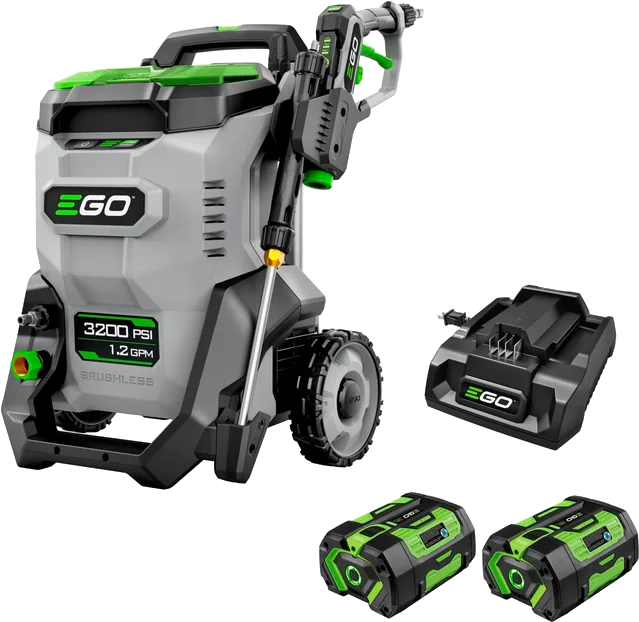
2. EGO Power+ HPW3204-2 3200 PSI Cordless Pressure Washer Kit Best Premium
For a premium cordless kit with no fuel, no engine and no cord.
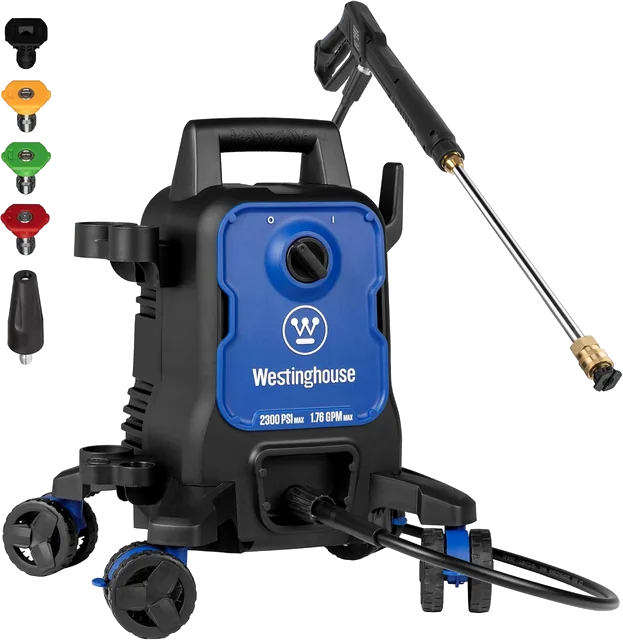
3. Westinghouse ePX3100 2300 PSI Electric Pressure Washer Best Value
For a first corded washer on a small property near an outlet.
Pick the power source first, read the manual before the first start and complete the safe-state steps every time. For most households, the Westinghouse WPX3400 is the best pressure washer I can recommend, and the EGO and the ePX3100 cover the buyers who do not want an engine.
Why Westinghouse WPX3400 3400 PSI Gas Pressure Washer Might Be the Best Choice
I put the WPX3400 first because it asks the fewest extra purchases of a gas buyer. Westinghouse builds in a 0.42 gallon soap tank, packs five nozzles in the carton and prints its stop order step by step.
The trade-off is plain: it is a 63 pound machine with an engine, fuel and a pull cord, and winter storage takes real work.
Here is why it earns the top place:
✓ Soap tank on board: a 0.42 gallon tank that draws through the black soap nozzle.
✓ Five nozzles in the carton: red, yellow, green and white tips plus the soap nozzle.
✓ Printed stop order: the manual lists the steps after each use.
✓ 15 second pressure release: one step order for trapped pressure.
✓ Written warranty tiers: up to three years on limited parts for consumer use.
Frequently Asked Questions
What pressure washer is best?
The best pressure washer for most households is a gas model with a built-in soap tank, and my pick is the Westinghouse WPX3400. A corded washer suits a small property near a grounded outlet, and a battery kit suits a buyer who wants no fuel, no engine and no cord.
What is a good brand of pressure washer?
A good brand of pressure washer is one whose manual names your exact model, prints its ratings with their basis and lists its warranty terms in writing. On this page that means Westinghouse, Simpson, EGO, Greenworks, Sun Joe, Craftsman and Karcher, each with a manual for the exact model you buy.
Is it better to get an electric or gas pressure washer?
It is better to get a gas pressure washer if you have an outdoor spot 20 feet from windows, doors and vents and will keep fuel fresh, and an electric washer if an outlet sits within the cord’s reach. Westinghouse and Sun Joe do not recommend extension cords and Karcher rules them out, so measure that distance first.
Is there a good cordless pressure washer?
A good cordless pressure washer on this page is the EGO Power+ HPW3204-2, a premium kit with two 56V batteries, a charger and a foam cannon in the carton. EGO says one battery pack gives no TURBO speed, and its manual rules out hard water, hot water and pool water.
Do pressure washers come with a foam cannon?
Some pressure washers come with a foam cannon, and on this page the EGO kit is the one that lists a foam cannon in its carton. The other eight take detergent through a soap nozzle fed by an onboard tank or by a siphon hose that draws from a container of detergent.
References
- Centers for Disease Control and Prevention. Pressure washer safety. Natural Disasters. Published May 15, 2024. Reviewed August 26, 2026. Accessed October 31, 2026.
- Hyson BE, Friedman BM, Spear B, Bishop-Freeman SC. Lethal carbon monoxide generated from small internal combustion engines. J Anal Toxicol. 2024;48(8):625-629.
- Johnson C, Newton W, LaRochelle L, Allen J, Daly C. High-pressure injection injuries of the hand in community and industrial settings: incidence and trends. Hand (N Y). 2025;20(6):917-922. doi:10.1177/15589447231218404
- Hogan CJ, Ruland RT. High-pressure injection injuries to the upper extremity: a review of the literature. J Orthop Trauma. 2006;20(7):503-511. doi:10.1097/00005131-200608000-00010
- Placide J, Yang MY, Gross AW, Crowell EL. Case series: traumatic ocular lacerations secondary to pressure washers. Am J Ophthalmol Case Rep. 2022;27:101612. doi:10.1016/j.ajoc.2022.101612
Safety Note: Read your pressure washer’s manual before you connect water or power, and follow it. Never point the spray at yourself, another person, a pet or any part of the body. Keep hands and feet away from the nozzle and stream. Get medical care without delay for a spray wound, even if it looks minor at first. Tell the clinician that a pressure washer caused the injury. Wear safety glasses or goggles and closed footwear before operating the washer, plus any additional protection required by the manual and the detergent label. Follow the manual’s instructions for the trigger lock, grip, footing and recoil, and engage the trigger lock whenever you stop spraying. Use only the nozzles, accessories and detergents the manual permits, and never point any nozzle at skin, people or animals. Do not perform a task at height without instructions expressly permitting the equipment and method in the exact manual. Gas models: operate outdoors, never inside a building or a partly enclosed space. Keep the engine at least 20 feet from any window, door or vent, following CDC’s pressure washer guidance and any stricter manual requirement. Exhaust contains carbon monoxide, which cannot be seen or smelled and can kill. Opening doors or windows does not make indoor operation safe. Refuel only with the engine off and cool, following the manual. Corded models: use the manual’s specified electrical supply and GFCI protection, and test the GFCI before use according to its instructions. After an operating GFCI or breaker trip, do not reuse the washer until a qualified repair person has examined it. Where the washer has a grounding prong, connect it to a properly grounded receptacle and never remove the prong. Wear closed, rubber-soled footwear that provides some electrical insulation, plus any additional footwear required by the manual; footwear does not replace GFCI protection or the other electrical precautions. Never cut or splice cords. Use an extension cord only as the manual permits. Keep connections dry and away from runoff, standing water and the washing area, and keep spray away from electrical equipment. Battery models: use only the battery and charger the maker specifies for your exact model. Emergency first: if you notice an unusual odor, a change in color, too much heat, a change in shape, leaking or odd noises from a lithium-ion battery, stop using the washer and follow your battery manual’s emergency instructions. Otherwise, complete the applicable stop and make-safe procedure before hose, nozzle, wand or accessory work, clearing a blockage, cleaning, maintenance, refueling, checking oil, adding detergent, battery changes or charging, draining, moving, transporting, storing or leaving the washer. Follow your exact manual’s procedure and order. Release the trigger and engage its lock. Gas: switch the engine off and wait for it to stop; disconnect the spark plug wire before service as the manual directs, and let hot parts cool before refueling, storage or contact. Corded: switch off and unplug by the plug with dry hands. Battery: switch off, remove a removable battery as the manual directs and keep it away while working; for a built-in battery, follow the manual’s isolation procedure and do not open the battery compartment. Complete the manual’s water-supply shutdown and pressure-relief steps: point the gun in a safe direction at a permitted discharge location, disengage the trigger lock, squeeze the trigger as directed to relieve pressure, then reengage the lock. Do not disconnect hoses or change nozzles until pressure is relieved. If pressure cannot be relieved by the prescribed procedure, obtain service without loosening fittings. Refit and inspect parts before restoring water or power. Replace a damaged high-pressure hose; never repair or patch it. Before you wash, plan how to keep wash water, detergent and debris out of streets, storm drains, ditches and streams, and check with your city or county stormwater office about collection and disposal. Send wash water to landscaping only where local rules and the detergent label permit it and the soil can absorb it without runoff or contamination. Keep children and pets away, and never let a child use the machine. Drain and store the washer as its manual directs. For exposure to a cleaning product, follow the label’s first-aid instructions and call Poison Control at 1-800-222-1222. Call 911 for a fire or immediate danger.