
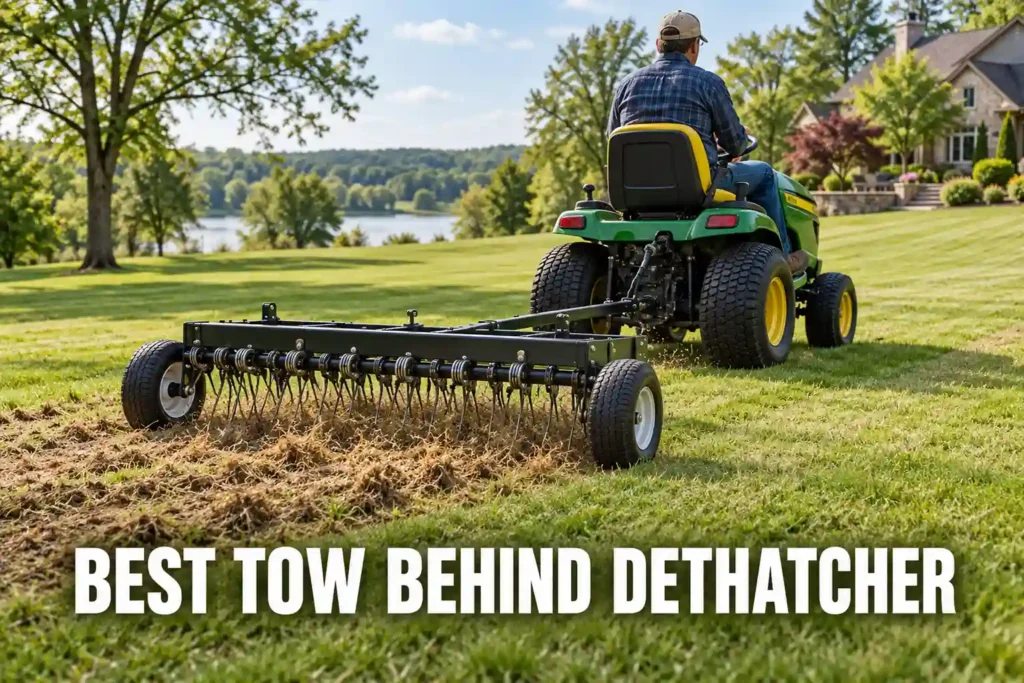
The best tow-behind dethatcher is the one that matches the mower you already own, because the hitch, the tray weight and the tine height decide the result more than the badge. I cut a plug of turf with a spade before I buy any tool for a lawn, and I laid these five out on my concrete work pad by the machinery shed.
These are the five I rank, with the Agri-Fab 45-0294 40-Inch Tow-Behind Dethatcher on top. After the reviews I cover how to choose, what a spring-tine tray can and cannot do, and the towing rules in each manual.
Best Tow-Behind Dethatcher Reviews 2026 With 5 Models Ranked by Width, Warranty and Hitch
These are the five tow-behind dethatchers I rank, from a 40 in tray with a lift handle to a 48 in tool with one fixed tine height. Each review gives the width, the tine setup, the tray weight and who should skip it.
1. Agri-Fab 45-0294 40-Inch Tow-Behind Dethatcher Best Overall
The Agri-Fab 45-0294 is the tow-behind dethatcher with the fewest parts to go wrong: a 40 in tray of spring tines, a lift handle and two wheels, with no engine, no cord and no depth knob. It is the best tow behind dethatcher for a riding mower owner who wants a plain tool, and its owner’s manual dates back to a 2001 revision. Agri-Fab also builds this same design for a second brand.

WHY I CHOSE THIS ✓
I rank it first because it is a budget to mid-range way into dethatching for anyone with a hitch, and nothing on it needs power. The design is one Agri-Fab has built for years. I recommend it to a riding mower owner with a lawn of a quarter acre or more and a moderate mat.
Agri-Fab 45-0294 40-Inch Tow-Behind Dethatcher Specs
Key Features:
- 40 in tine tray: each pass covers 40 in, so a quarter acre of open lawn is a short list of passes.
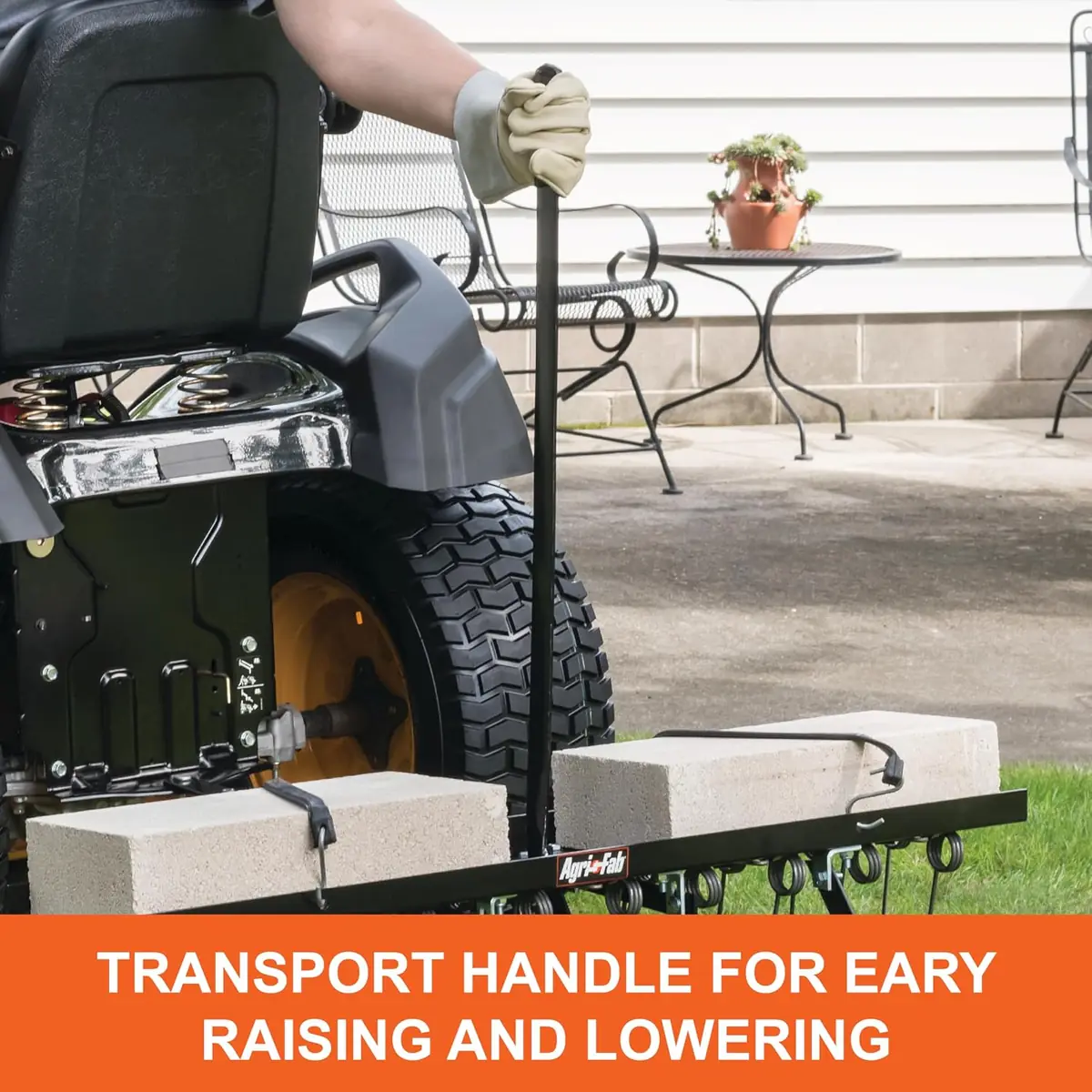
- Lift handle: it raises the tines for transport and lowers them to work, and the manual says it locks up with side tension.
- Levelled tine shield: two nuts at the rear hitch mount arms let you level the shield until the front and rear tines both touch the ground.
- Weight tray: the shield doubles as a tray, and Agri-Fab’s page says it holds up to 70 lb of patio blocks for more soil contact.
- Pin hitch: a 3/8 in hitch pin with a 1/8 in hair cotter pin runs through two hitch brackets to the vehicle.
- Replaceable tines: a bent tine comes out alone, as Agri-Fab part 43783, so one strike on a stone does not retire the tool.
- Plain upkeep: check the nuts and bolts before each use, lubricate the wheels and store the tool dry with a light coat of oil.
Dethatching here is a rake pulled at walking pace. Agri-Fab’s manual says to start in first gear at low engine speed, to vary the speed until the action is best and to use a crisscross pattern on a grass that tolerates it. Spring tines lift thatch and cut no soil, so I treat this as a light comb for a moderate mat. A thick mat or a seedbed that needs opening is a job for a different machine.
There is no depth setting, so weight and speed decide how hard the tines bite. Agri-Fab says that if the tool jumps, extra weight goes on the tine shield, and that in most conditions extra weight will be needed. Concrete patio blocks tied through the holes in the shield flange are the maker’s suggestion, and the page figure for the tray is 70 lb.
I set the tool up on the concrete work pad before it touched grass. Leveling the tine shield is the step that matters: park, set the brake and take the key out, then loosen the two nuts at the rear hitch mount arms, lower the handle and adjust until the front and rear tines touch together. It took two wrenches, and Agri-Fab’s tool list for the whole assembly runs to two 1/2 in wrenches, a 9/16 in wrench, an adjustable wrench and pliers. The limit is reach: the tray lifts thatch and leaves it on the surface, so I rake or sweep the lawn afterwards.
Before the first pass, walk the lawn and pick up sticks, stones, toys and dog waste, and mark sprinkler heads and drip lines, because the tines have no depth stop.
Follow the manual’s safety list: no towing on a highway, no riders on the frame or the vehicle, no steep slopes, and passes up and down a slope, never across its face. The tine points are sharp, so wear sturdy footwear and eye protection, and keep children and pets out of the area.
Upkeep is a rag and a can of oil: lubricate the wheels, sand and repaint any rust, and store the tool dry with a light coat of oil on bare metal. Assembly runs to about 24 steps, so I check every nut again before each use, as the manual asks. Agri-Fab’s manual states a 1-year warranty, so confirm the current term on the listing. This Agri-Fab tow behind dethatcher has no bag, so it leaves the lifted thatch for you to collect. The newer 2018 manual form swaps in nylock nuts and has the tines bend into tabs with a screwdriver or a round punch.
Buy it if you mow with a riding mower or tractor that has a rear hitch, your lawn is a quarter acre or more and the thatch is a moderate mat. Skip it if you push your mower, your lawn slopes steeply or you want to open soil for seed with a set depth.
FINAL VERDICT
The 45-0294 does one job with no motor and few parts to service. Choose it when a riding mower already stands in your shed and the lawn needs a light comb.
It is the plain tow rake I put first for riding mower owners.
2. Brinly DT-402BH-A 40-Inch Tow-Behind Dethatcher Best Premium
The Brinly DT-402BH-A is built around a Transport position: one Lift Lock handle lifts the tines clear for a drive, drops them to dethatch, or drags them to scarify a seed bed. It takes Best Premium for that handling and for a 2-year warranty on the steel frame. I pick it for a lawn you reach across concrete or asphalt.

WHY I CHOSE THIS ✓
I put it second because one Lift Lock handle sets Transport, Dethatch and Scarify, which no plain tray offers. Brinly backs the steel frame for 2 years. I recommend it to anyone with concrete or asphalt between the shed and the turf.
Brinly DT-402BH-A 40-Inch Tow-Behind Dethatcher Specs
Key Features:
- Lift Lock positions: Transport raises the tines, Dethatch sets them for the lawn and Scarify drags them along the ground.
- Transport setting: Brinly’s manual says to use it when towing across concrete or asphalt driveways and walkways.
- Shim setup: the tines are set level on a 1/2 in shim in Dethatch, and fine adjustments are no more than 1/4 in at a time.
- 70 lb tray: the tray takes added weight to a 70 lb maximum, and the maximum towed weight is 105 lb.
- Clevis hitch: it works with hitch heights from 7 to 14 in and locks with a 1/2 x 2-1/2 in pin and a hairpin cotter.
- Safety wires: two wires run through the tine loops, and the manual says never to run the tool without them.
- Towing speed: Brinly says best results come at 3 mph or less, and never above 5 mph.
The Lift Lock is what I noticed first. In Position 2 the tines work the lawn, and in Position 1 they ride clear of the ground, so the tool crosses a drive or a walkway without its points dragging on concrete. Brinly’s manual says damage can occur if you tow across hard surfaces without the Transport setting. Lifting the tines for transport is not unique to this tool, but one handle that also sets Dethatch and Scarify is.
Setup takes longer than on a plain tray. On a flat surface, rest both rows of tines on a 1/2 in shim with the handle in Position 2, slide the Lift Lock until the wheels sit firmly, tighten and pull the shim. Brinly says the grass should be under 3 in, and the tines should deflect back and flip the thatch forward. If they drag without flipping, raise the tray, and if they stay free, lower it.
Position 3 is the second job. Brinly says the tines drag along the ground to scarify a seed bed, and that is tine drag and not a blade drum, so it scratches the surface for seed and does not slice the soil. The manual gives no inch range for Positions 1 and 3, so I set the shim on the work pad with a folded piece of packaging cardboard, two layers to about 1/2 in, and keep the grass short. The Lift Lock has a handle, a spring and a control rod that can pinch, so I hold the handle firmly against the lock when I move the tool by hand.

Brinly says added weight should not normally be needed. If the tool jumps or walks, check the handle setting and the tine height first, then add weight, only while the tool is hitched and the weight is secured, and recheck the tine height.
Mind the weights: Brinly says the vehicle and operator together must outweigh the tool’s maximum towed weight of 105 lb with the tray loaded, and the load must stay within the vehicle’s towing capacity and drawbar pull rating. Tow only in the vehicle’s tow mode or under 5 mph, turn wide, stay off steep slopes and wear safety glasses, and unload the tray before you unhook the tool.
Tines, tires and wheels carry 90 days, and Brinly’s cover is for residential use and the original owner. Oil the tines after use, clear debris from between them, check the fasteners after the first 30 minutes and store the tool low with the tine points toward the wall or ground. The drawbar sticks out in the shed like a ski pole and is a trip hazard. Read the 40 in figures in Brinly’s manual before you buy this Brinly tow-behind dethatcher.
Pick it if you cross a drive or a path to reach the lawn, tow behind a lawn tractor or riding mower with a rear hitch and want a handle-set tine height. Skip it for a steep lawn, for commercial or multi-property use, where Brinly’s cover drops to 90 days on all parts, or for a mower with no rear hitch.
FINAL VERDICT
The DT-402BH-A pays its premium in handling: a transport position, a scarify drag and a 2-year frame warranty. Pick it when the route to your lawn crosses hard ground.
It is the Lift Lock tow dethatcher for lawns behind a paved drive.
3. CRAFTSMAN CMXGZBF7124315 40-Inch Tow-Behind Dethatcher Best Value
The CRAFTSMAN CMXGZBF7124315 is the Agri-Fab design in a red finish with a 3-year limited warranty, and that term is why it takes Best Value. This is a warranty-value call, not a price call: a 40 in tray of spring tines, a transport handle and flat-free wheels for a buyer who wants the longer cover behind a simple tool. Craftsman’s manual says Agri-Fab makes it.

WHY I CHOSE THIS ✓
I chose it third because a 3-year term is a lot of cover for a tool with no motor, and that term is what the value rests on. Craftsman’s manual states it plainly and asks you to register. I recommend it to a buyer who reads warranty terms first and wants the plain design behind them.
CRAFTSMAN CMXGZBF7124315 40-Inch Tow-Behind Dethatcher Specs
Key Features:
- 3-year limited warranty: it covers defects in materials and workmanship from the date of purchase, and it excludes normal wear, abuse, accessories and repairs by others.
- Online registration: the manual asks you to register the tool, and the 3 years run from the date of purchase.
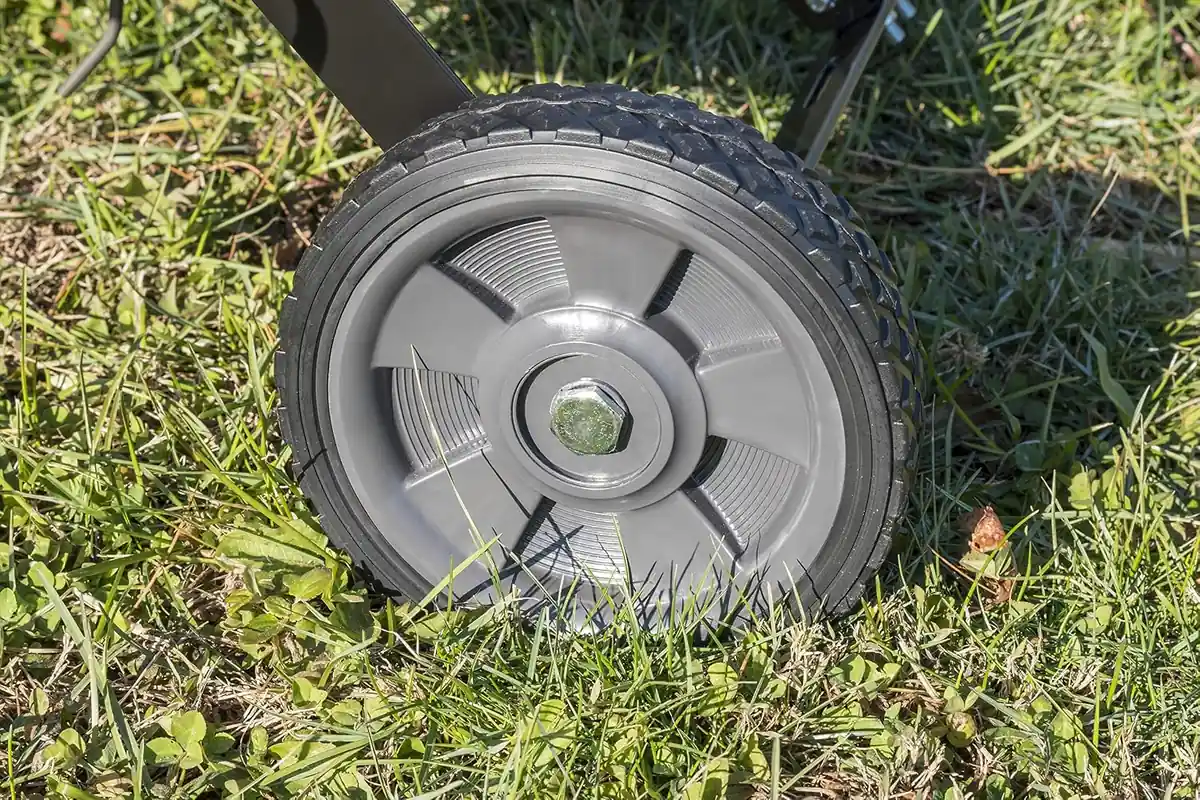
- Flat-free wheels: Craftsman’s page lists two 7 in flat-free wheels, so there is no tire to fill or to find flat on a mowing day.
- Transport handle: the page describes a cantilever handle that raises and lowers the tines.
- 70 lb tray: the page gives 70 lb as the tray limit, and the manual says to add weight if the tool jumps and to tie it through the shield flange with straps or wire.
- Universal rear hitch: a 3/8 in hitch pin and a 1/8 in hair cotter pin are included, for mowers with a rear hitch pin.
- Replaceable tines: a screwdriver or punch pries up the locking tab, the tine comes out and the tab bends back down.
This is the Agri-Fab design, so it works the same way: spring tines on a tray, pulled at an even speed. The manual says to vary the vehicle’s speed until the dethatching action is best and to use a crisscross pattern on a grass that tolerates it. It lifts thatch and cuts no soil, so it is a light comb and not a seedbed tool. Craftsman’s page calls the raking action automatic.
There is no depth setting. If the tool jumps, Craftsman’s manual says to add weight to the tine shield and that extra weight will be needed in most conditions. Concrete patio blocks tied through the holes in the shield flange are the maker’s suggestion, and the page gives 70 lb as the tray limit.
Setup decides the result. With the tool parked, the engine off and the key out, loosen the two nylock nuts and carriage bolts at the rear hitch mount arms, adjust until the front and rear tines both touch the ground, then tighten. This is the tool’s weakest side on this page: the maker publishes no weight and no tray maximum in the manual. The warranty is the part I can check on paper, because a weight to check against my hand carry to the tool shed is something Craftsman does not give. The wheels are the detail I notice: two 7 in flat-free wheels mean no tire pressure to check before a pass.
Register the tool online the week you buy it and keep the receipt with the manual, because the 3 years run from the date of purchase. Keep the manual with it, since the safety list is short and plain.
Craftsman’s manual opens with a warning to read every safety instruction and never to modify the tool, and its list is the usual one: no towing on a highway, no riders on the frame or the vehicle, first gear at low engine speed, no steep slopes and passes up and down a slope. Children and pets stay out of the area, and the tine points are sharp.
Upkeep matches the design: lubricate the wheels at least once a year, check the nuts and bolts before each use, sand and paint any rust and store the tool dry with a light coat of oil on bare metal. The flat-free wheels roll over my crushed stone yard without a tire to check. The manual says the tool is made in the USA, and the tool has no bag, so you rake or sweep the lifted thatch afterwards.
Choose it when you mow with a riding mower or zero-turn with a rear hitch pin and want the longer warranty behind a plain tow rake. It is the best tow behind lawn dethatcher for a rider who puts warranty terms first. Skip it if you push your mower, need a published weight or want to scarify, since spring tines open no soil.
FINAL VERDICT
The CRAFTSMAN rests its value on one thing, a 3-year warranty on a proven design. It fits the buyer who reads the terms first and wants a plain tool for a lawn of a quarter acre or more.
It is the warranty pick for a plain tow rake.
4. Brinly 48-Inch Tow-Behind Dethatcher (DT-480BH-A2) Best 48 Inch
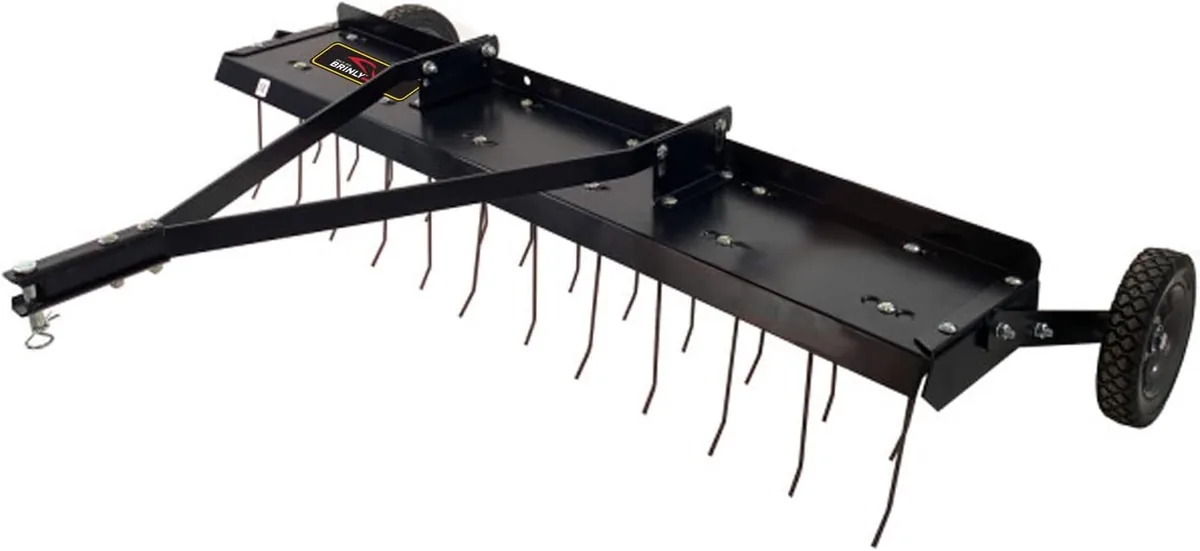
Brinly’s 48 in tow-behind dethatcher, which Brinly sells as the DT-480BH, is the widest tool on this page: 48 in of spring tines in two rows on a 14 gauge steel frame, according to Brinly. It takes Best 48 Inch because no other tool here covers that width, and it is the 48 inch tow behind dethatcher I pick for an open lawn.
WHY I CHOSE THIS ✓
I chose it for width and a single fixed setting, which suit an open lawn with nothing to adjust once the shim step is done. I recommend it where the lawn is long and the turns are few.
Brinly 48-Inch Tow-Behind Dethatcher (DT-480BH-A2) Specs
Key Features:
- 48 in swath: each pass is 48 in wide, so a long open lawn takes fewer turns.
- Fixed tine height: it is set once at assembly on a 1/2 in shim, then trimmed by no more than 1/4 in at a time.
- Triple-coil tines: Brinly lists 24 spring steel tines of 3/16 in in two rows.
- 8 in wheels: Brinly’s page lists semi-pneumatic wheels with a diamond tread.
- Adjustable drawbar: Brinly’s page says it adapts to tractor hitch heights, for a rear hitch plate.
Brinly says the grass should be under 3 in, and the tines should deflect back and flip the thatch forward. With the vehicle stopped and shut off, raise the tray if the tines drag without flipping and lower it if they stay free, by no more than 1/4 in each time. Dethatching takes several passes, and alternating the direction by 90 degrees helps on a grass that tolerates it.
This tool has one mode and one height, with no Lift Lock, no transport position and no weight tray, so you tow it to the lawn with the tines down. Brinly’s manual prints a maximum towed weight of 37 lb, the same as the empty weight, and gives no ballast instruction, so I tow it empty. The vehicle and operator together must outweigh that figure and the load must stay within the vehicle’s towing capacity and drawbar pull rating, with a best speed of 3 mph or less and a limit of 5 mph.

The tines lift thatch to the surface and nothing collects it, so rake or sweep it up. Flag raised sprinkler heads and drip lines with stakes before the first pass, as Brinly says they must be avoided.
Walk the lawn and remove stones first, because striking objects can break a tine and the tines carry 90 days. Install the two safety wires, since a tine can disengage without them.
Assembly bolts 12 coil parts to the tray with 28 carriage bolts, which is a long job on a bench. On the work pad the 48 in tray fits the 30 ft side of my slab seven and a half times, and the 8 in wheels rolled it over the crushed stone yard without a fuss. Check the fasteners after the first 30 minutes.
Choose it when your lawn is open and long, your mower has a rear hitch plate and you want the widest pass. Skip it for a lawn crossed by hard surfaces, for a push mower or for thick thatch, since the tines lift thatch to the surface and need several passes. My full Brinly DT-480BH review goes through the 48 inch tool in detail.
FINAL VERDICT
Brinly’s 48 in tool trades adjustability for reach. Pick it when width matters more to you than a handle-set height.
It is the widest tow dethatcher for an open lawn.
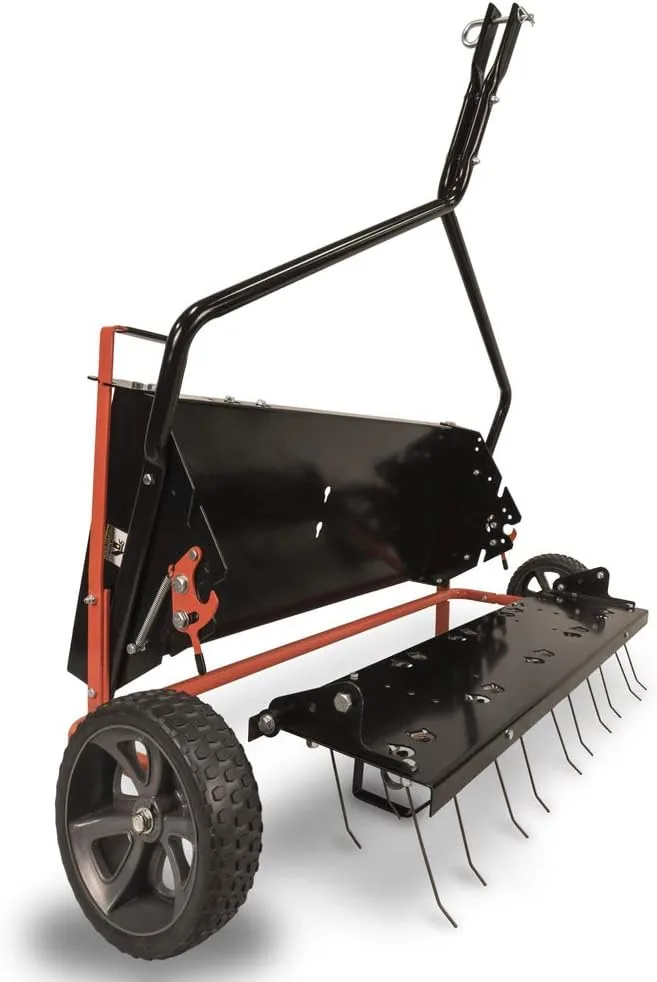
5. Agri-Fab 45-0457 SmartLINK Dethatcher Attachment Best SmartLINK Add-On
The Agri-Fab 45-0457 SmartLINK is a 19 lb dethatcher attachment, and it needs the SmartLINK Master Platform, model 45-0473, which is sold separately and is not in the box. The platform costs more than the attachment, so the complete setup costs more than a stand-alone tow-behind tray. It takes Best SmartLINK Add-On for the owner who wants one frame for several lawn tools.

WHY I CHOSE THIS ✓
I chose it fifth for the shared frame: an owner who wants aeration and rolling with the same hitch can add tools to one platform. The attachment weighs 19 lb, so it is easy to lift by hand. I recommend it to an owner who already has or plans the platform.
Agri-Fab 45-0457 SmartLINK Dethatcher Attachment Specs
Key Features:
- Tool-free fit: Agri-Fab says the attachment goes on without tools, locked with clevis and cotter pins.
- Platform lift handle: it lowers the tines onto the ground and raises them for transport, and a catch holds the transport position.
- Brace on top: the platform manual puts the center brace on top of the frame when the dethatcher or roller is fitted.
- Tray weight: the platform manual allows up to 140 lb of sand bags or blocks, tied down front and rear.
- One frame, several tools: the platform manual lists a plug aerator, a spike aerator, a roller and the dethatcher.
The platform manual gives the order of work. Mow first and remove loose clippings, start the tractor in neutral at a slow engine speed, engage the lowest forward gear and lower the dethatcher until the spring tines touch the ground. Raise the speed until the action is best, and raise the tool before you cross a walk or a drive. Use a crisscross pattern only on a grass that tolerates it.
There is no depth setting. The manual says that if the dethatcher appears to jump, extra weight should go on the tray, and that in most conditions it will be needed. The load decides how hard the tines work, up to the manual’s 140 lb, so I flag my drip lines before the first pass, and a lawn with sprinkler heads needs them marked too.
Buy the platform with the attachment: a tow behind dethatcher and aerator system means a second and third purchase.
Follow the platform manual: stay off steep slopes, work up and down a slope, slow down near creeks and ditches, and let nobody ride the frame or the vehicle. Never leave a sharp-pointed tool lying around, and keep children and pets clear.
The shoulder bolts dropped into the retainer slots by hand, and clevis and cotter pins locked the attachment, so the fit needed no tools. I fitted it to the platform on the work pad before I touched grass, and I stand the platform upright against the shed wall afterwards, the way Agri-Fab says to store it. The safety text sits in the platform’s manual, and the maker publishes no warranty term for the attachment.
Choose it when you own the platform or want one frame for aerating, rolling and dethatching behind a lawn tractor. Skip it if you only want to dethatch, since the platform is a second purchase, or if you push your mower.
FINAL VERDICT
The SmartLINK attachment is light on its own, and the complete setup costs more than a stand-alone tray. Pick it for the shared frame and not as a stand-alone dethatcher.
It is the add-on I pick for the shared SmartLINK frame.
How to Choose the Best Tow-Behind Dethatcher
A tow behind lawn dethatcher is a tray of spring tines on a hitch, so the mower, the hitch and the lawn come first. I check six things in this order, and each rests on a figure a maker prints.
Your Mower, Your Hitch and Your Slope
A tow-behind tool needs a tow vehicle, so start with the rear hitch on your mower or tractor. The makers here name lawn tractors, garden tractors, zero-turn mowers and riding mowers with a rear hitch plate or pin. Brinly’s manual gives hitch heights of 7 to 14 in for its 40 in tool and the other makers publish no range. I read the hitch height first, because a hitch outside the range is a problem no setting fixes. My Brinly DT-402BH-A vs DT-480BH-A comparison shows how the 40 inch and 48 inch tools differ.
- Hitch: a rear hitch plate or pin is the connection every tool here uses.
- Weight rule: Brinly says the vehicle and the operator together must outweigh the tool’s maximum towed weight, and the load, ballast included, must stay within the vehicle’s towing capacity and drawbar pull rating.
- Speed: Brinly says to tow only in the vehicle’s tow mode or under 5 mph.
- Slopes: every manual says to stay off steep slopes, and Agri-Fab says to work up and down a slope, never across it.
Working Width and the Number of Passes
Width sets the number of passes, and the tools here run from 40 in to 48 in. A 48 in tray covers a lawn in fewer rows than a 40 in tray, and a wider tool needs more room to turn at each end. I lay the width against the lawn on paper before I choose, because the sum is quick and the turns cost the time. My best dethatcher for large lawn roundup covers seven picks that clear more ground per pass.
| Tool width | What it suits | Watch for |
|---|---|---|
| 40 in | A lawn of a quarter acre or more with a few obstacles | More rows than a wider tray |
| 42 in tool length, SmartLINK attachment | A shared platform, with no swath figure published | The platform’s own width |
| 48 in | A long, open lawn with few turns | A wider turn at each row end |
How the Tine Height Is Set
Depth is the setting that matters, and a tow-behind tool has no depth dial. Each maker sets the tine height in its own way, so read how the one you buy does it. According to Penn State Extension, removing more thatch than you want can severely thin a lawn, so I start with the lightest bite the tool allows and move one step at a time.
| Maker and tool | How the tine height is set |
|---|---|
| Agri-Fab, 40 in | Level the tine shield at the rear hitch arms; the lift handle raises or lowers the tool |
| Brinly, 40 in | Three Lift Lock positions, Transport, Dethatch and Scarify; tines on a 1/2 in shim in Dethatch |
| Brinly, 48 in | One fixed height set at assembly on a 1/2 in shim, trimmed by no more than 1/4 in |
| Craftsman, 40 in | Level the tine shield at the rear hitch arms; the handle raises or lowers the tool |
| Agri-Fab, SmartLINK attachment | No setting; the platform’s lift handle raises or lowers it, and tray weight decides the bite |
Tray Weight and Towed Weight
The makers differ on ballast, so read yours. Agri-Fab, Craftsman and the SmartLINK platform manual say to add weight if the tool jumps, and the platform manual allows up to 140 lb. Brinly’s 40 in manual says weight should not normally be needed, gives 70 lb for the tray and 105 lb for the towed total, and puts the handle setting and tine height first. Brinly’s 48 in tool has no tray. I treat the maker’s tray figure as a ceiling and not as a target. My Brinly DT-480BH-A vs Agri-Fab 45-0294 comparison sets the two tow-behinds side by side.
- Add weight in steps, where the manual allows it: patio blocks tied through the tray holes with straps or wire are the maker’s suggestion.
- Never unhook a loaded tray: Brinly says to unload the tray before you disconnect the tool.
- Check the tow vehicle: the vehicle and the operator must outweigh the loaded tool.
Pro Tip
Tie every block down. Agri-Fab and Craftsman say to secure the weight with straps or wire, and the SmartLINK manual says the ties must not tangle in any rotating part.
Transport, Storage and Tine Care
A tool that sits low behind a mower is awkward to move, so look for a transport setting or a lift handle. Brinly’s 40 in tool has a Transport position for hard surfaces, the Agri-Fab and Craftsman handles raise and lower the tines, and Brinly’s 48 in tool has no transport mode at all. I store a tool like this with the tine points toward the wall, since Brinly calls the drawbar a trip hazard. My comparison of the Brinly DT-402BH-A and Agri-Fab 45-0294 sets the two 40 inch tools side by side.
- Oil and rust: Agri-Fab and Brinly say to sand rust, repaint it and store the tool dry with a light coat of oil.
- Fasteners: Agri-Fab says to check the nuts and bolts before each use, and Brinly says to check them after the first 30 minutes.
- Safety wires: Brinly says never to run its tool without the safety wires fitted.
Warranty and What It Covers
Read the warranty as a list of parts, because the steel frame and the tines carry different terms. Brinly gives 2 years on the steel frame and steel parts and 90 days on tines, tires and wheels, for residential use only. Craftsman gives 3 years limited from the date of purchase. Agri-Fab’s owner’s manual states 1 year, and the maker publishes no term for the SmartLINK attachment.
Key Takeaway
Tines strike stones, and Brinly says striking objects can cause tine breakage, so a 90 day tine term matters more than a long frame term.
Tow-Behind or Walk-Behind for Your Lawn
A tow-behind tool needs a riding mower or a tractor, so a push mower owner is looking at the wrong group. A walk-behind electric or battery dethatcher has a motor, a depth setting and a collection bag, and a spring-tine tray has none of them. Without a suitable tow vehicle, a walk-behind machine is the right group, and I rank corded and cordless electric dethatchers in a separate roundup.
What a Tow-Behind Dethatcher Can and Cannot Do
A towed spring-tine tray is a light comb, and it lifts thatch to the surface without slicing the soil. That suits a moderate mat on a lawn you can rake or sweep afterwards, and it sets the limit on what to expect from a thick one. For a thick mat, my roundup of dethatchers for thick thatch covers machines built for matted turf.
How much thatch builds up depends on the grass. Tall fescue cultivars differed in thatching tendency three years after planting (1), and raising the mowing height of Kentucky bluegrass from 2.5 to 5.0 cm increased thatch (2). Thatch is also not useless: in packed soil columns it delayed the start of water infiltration, longer for the thicker red fescue thatch (3).
The removal studies used vertical mowing, which cuts into the thatch where a towed tray only combs it, so their results do not measure what a tray achieves. Annual vertical slicing cut thatch depth in Meyer zoysia by 12 to 18 percent a year (4), and vertical mowing twice a year cut thatch in Tifway bermudagrass by 8 percent while it hurt shoot density (5).
Key Takeaway
Measure the thatch before you hitch anything: cut a wedge and check the brown layer between the green blades and the soil. Extension services start to treat thatch as a problem at about half an inch, and some warm-season guidance waits until about an inch.
The right season depends on the grass. According to Penn State Extension and the University of Illinois Extension, cool-season grasses are dethatched in late summer to early fall, and according to Clemson and Mississippi State extension, bermudagrass and zoysiagrass are worked in late spring to midsummer while they grow actively. The University of Florida extension says not to use power rakes on St. Augustinegrass or centipedegrass, which carry only above-ground stems, and to make passes in one direction only, so the crisscross pattern some manuals suggest is not for every lawn. My roundup of dethatchers for Bermuda grass matches machines to dense warm-season lawns.
Towing, Weight and Slope Rules From the Manuals
Every manual here makes the same safety points, and the tow vehicle matters as much as the tool. Follow the manual of the tool and the manual of the mower or tractor, and where they differ, follow the stricter one.
- Roads: do not tow on a highway or public road, and never behind a car or truck.
- Riders: nobody rides the frame of the tool or the tow vehicle.
- Slopes: stay off steep slopes, and Agri-Fab says to work up and down a slope, never across its face.
- Speed and turns: start in low gear, keep to the maker’s speed limit and turn wide.
- Tines: the points are sharp, so wear sturdy footwear and gloves when you handle them.
The tool is silent and the vehicle is not. Riding mower use was associated with high noise exposure in a study of groundskeepers (6), and NIOSH recommends an exposure limit of 85 dBA over an eight-hour day, with the time halved for every 3 dBA more (7). I wear hearing protection around any engine that runs for a whole pass.
Safety First
Wear eye protection with side coverage, hearing protection, sturdy footwear and gloves for the tines. Before you leave the seat, touch a tine or change a setting, stop on level ground, disengage the drives, set the parking brake, shut off the engine, wait for everything to stop and take the key out. Unload a loaded tray before you unhook the tool.
My Overall Verdict
I ranked these five on the hitch they need, the width, how the tine height is set and the warranty behind them. The top three suit different lawns, and the first is the simplest tool for a riding mower owner. My roundup of the top lawn dethatchers ranks nine machines by yard size and budget.
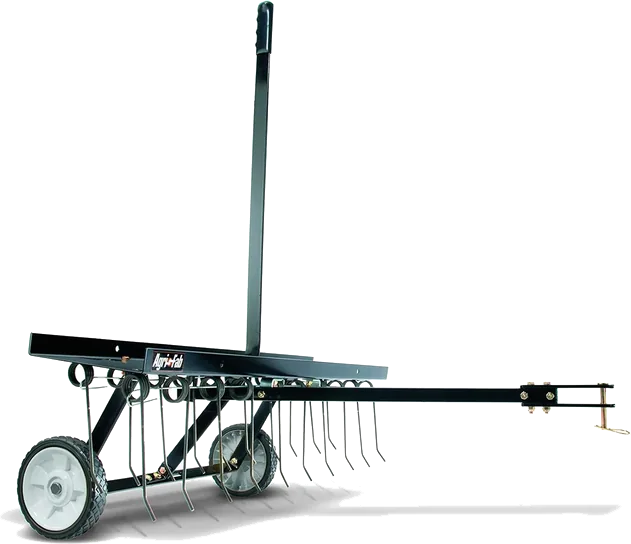
1. Agri-Fab 45-0294 40-Inch Tow-Behind Dethatcher Best Overall
For a riding mower or tractor owner with a quarter acre or more and a moderate mat, who wants a 40 in tray with no engine.
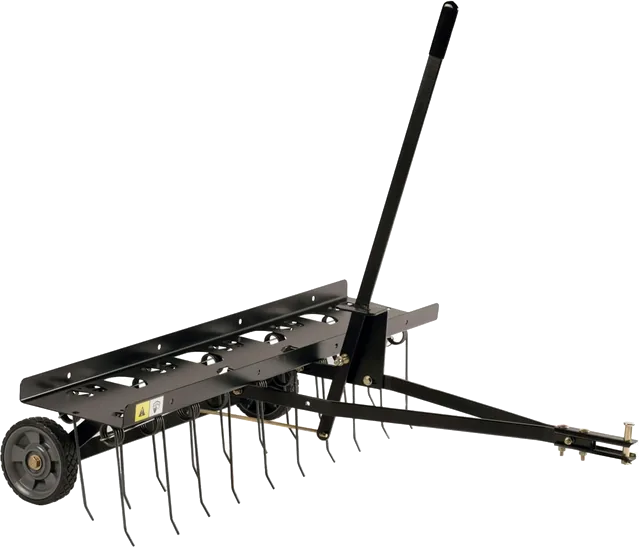
2. Brinly DT-402BH-A 40-Inch Tow-Behind Dethatcher Best Premium
For a lawn you reach across concrete or asphalt, where the Transport position keeps the tine points off the ground.
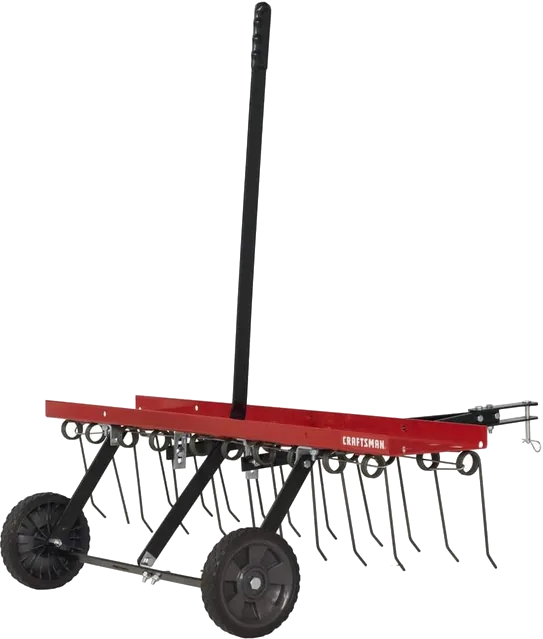
3. CRAFTSMAN CMXGZBF7124315 40-Inch Tow-Behind Dethatcher Best Value
For the buyer who reads the warranty first and wants a Craftsman tow behind dethatcher with 3 years of cover on a proven design.
Match the tool to your hitch, your lawn and your slope, and buy the warranty term you can live with. For most riders with a rear hitch and a moderate mat, the Agri-Fab 45-0294 40-Inch Tow-Behind Dethatcher is my pick as the best tow-behind dethatcher. My Agri-Fab dethatcher review covers the 45-0294 in detail.
Why Agri-Fab 45-0294 40-Inch Tow-Behind Dethatcher Might Be the Best Choice
I put the Agri-Fab 45-0294 40-Inch Tow-Behind Dethatcher first because it is the plainest way to dethatch behind a mower: a 40 in tray of spring tines, a lift handle and nothing to power. Its owner’s manual dates back to a 2001 revision.
The trade is control. It has no depth setting, so tray weight and speed decide the bite, and a thick mat or a seedbed needs another machine.
What puts it first:
✓ Width: a 40 in tray covers an open lawn in a short list of passes.
✓ Handle: a lift handle raises the tines for transport.
✓ Tray: it takes patio blocks when the tool jumps.
✓ Tines: a bent tine is replaced on its own.
✓ Upkeep: oil, rust paint and a nut check are the whole routine.
Frequently Asked Questions
Are tow-behind dethatchers any good?
Tow-behind dethatchers are good for lifting a light to moderate mat of thatch on a lawn you already mow with a riding mower, but they are light spring-tine rakes and not power rakes. They often need weight on the tray and several passes, and they cannot open soil the way a scarifier blade does.
What’s the best dethatcher to buy?
The best dethatcher to buy depends on what moves it, and for a lawn you mow with a riding mower this page picks the Agri-Fab 45-0294. A small lawn with no tractor suits a walk-behind electric or battery dethatcher instead, because a tow-behind tray needs a rear hitch to work.
Do pull behind dethatcher attachments work?
Pull behind dethatcher attachments work as spring-tine rakes that lift dead grass to the surface, and Agri-Fab, Craftsman and SmartLINK say to add weight when the tray jumps. Brinly says to check the handle setting and tine height first and keep the grass under 3 in, so measure the thatch before you buy.
What is the best dethatcher and aerator combo?
The best dethatcher and aerator combo on this page is the Agri-Fab SmartLINK system, because its platform manual lists a plug aerator, a spike aerator, a roller and the dethatcher as attachments. The platform is sold separately, so a buyer who only wants to dethatch is better served by a stand-alone tow-behind tray.
Is there a heavy duty tow behind dethatcher?
Brinly lists a 14 gauge steel frame for its 48 in tow-behind dethatcher, with 2 years on steel parts. Its tines carry only 90 days, and its warranty covers residential use only, so treat every tool on this page as a home lawn machine and not as a commercial one.
References
- Shearman RC, Anderson BE, Kopec DM, Riordan TP. Thatch Accumulation in Tall Fescue Turfs. HortScience. 1986;21(5):1164.
- Shearman RC, Kinbacher EJ, Riordan TP, Steinegger DH. Thatch Accumulation in Kentucky Bluegrass as Influenced by Cultivar, Mowing, and Nitrogen. HortScience. 1980;15(3):312-313.
- Liang X, Su D, Wang Z, Qiao X. Effects of Turfgrass Thatch on Water Infiltration, Surface Runoff, and Evaporation. Journal of Water Resource and Protection. 2017;9(7):799-810.
- Dunn JH, Sheffer KM, Halisky PM. Thatch and Quality of Meyer Zoysia in Relation to Management. Agronomy Journal. 1981;73(6):949-952.
- Carrow RN, Johnson BJ, Burns RE. Thatch and Quality of Tifway Bermudagrass Turf in Relation to Fertility and Cultivation. Agronomy Journal. 1987;79(3):524-530.
- Balanay JAG, Kearney GD, Mannarino AJ. Assessment of Occupational Noise Exposure among Groundskeepers in North Carolina Public Universities. Environ Health Insights. 2016;10:83-92.
- National Institute for Occupational Safety and Health. Noise-Induced Hearing Loss. Noise and Hearing Loss. Centers for Disease Control and Prevention; 2024.
Safety Note: Read your manual first. A dethatcher or scarifier throws stones, sticks and other debris with force, so walk the lawn first and remove stones, sticks, toys, wire, hoses and pet waste. Mark sprinkler heads, irrigation and drip lines, low-voltage lighting wire and buried pet fence wire, keep the drum clear of them, and follow your manual’s limits near underground cables and pipes. Wear impact-rated eye protection with side coverage that meets ANSI Z87.1, hearing protection, gloves, long pants and sturdy non-slip closed shoes, plus a dust mask when the work raises dust. Keep people and pets as far away as your manual says, and stop at once if anyone comes closer. Never use a powered dethatcher on wet grass or in rain. The machine can jump up or forward when the tines hit hard or frozen ground, roots, stumps or buried rocks, so avoid those spots and hold the handle with both hands. Never lift or tilt the machine or reach under it while the drum turns. Before you clear a jam, empty or fit the collection bag, change the depth, clean, inspect or adjust the machine, turn it over, leave it, or touch the tines or blades, switch it off, wait for the drum to stop completely, then unplug the cord or remove every battery pack, and remove the safety key if it has one. Let hot tines cool before you handle them. If the machine starts to vibrate hard, switch it off, wait for the drum to stop completely, then unplug the cord or remove every battery pack and any safety key before you check it for damage. For a corded model, use an undamaged outdoor extension cord of the gauge and length your manual gives, plugged into a GFCI outlet, keep the cord behind you and clear of the drum, and never handle the plug with wet hands. For a battery model, use only the battery and charger approved for your tool, charge and store them within the temperature range in your manual, and never use a damaged or swollen pack. Stay off steep and wet slopes and work slopes only in the direction your manual gives. For a tow-behind dethatcher, follow both your tractor’s and your dethatcher’s manuals: tow it only behind a lawn tractor or riding mower that meets the maker’s requirements, never on public roads or behind a car or truck, keep a slow, steady speed, avoid sudden turns and stops, carry less weight on slopes and never more than the manual allows, never carry riders, and fit any tine safety wires the manual requires. Before you adjust or clear it, stop the tractor, set the parking brake, remove the key and disconnect the dethatcher as its manual describes. Dethatching at the wrong time of year, too deep or on stressed turf can badly damage a lawn, so match the timing and depth to your grass type.