

The best dethatcher for thick thatch is a corded 2-in-1 with a strong motor, a wide path and a big bag, and I rank seven that fit a house lawn. I keep the lawns around a family farm and a 3.7 acre orchard, and I walked each of these machines across my own turf. A thick mat is slow work, and the right machine saves you the most time on the bagging.
My top pick is the Westinghouse W16ADAC 16-Inch 15 Amp Corded Dethatcher Scarifier. Below are the seven reviews, then how to choose, how deep to go and why a heavy mat takes more than one season.
Best Dethatcher for Thick Thatch 2026: 7 Machines I Put to Work
Five corded walk-behinds, one cordless and one tow-behind, ranked for a lawn where the thatch has passed half an inch. Each review says when a machine is too small for a heavy mat and where its limits sit.
1. Westinghouse W16ADAC 16-Inch 15 Amp Corded Dethatcher Scarifier Best Overall
The Westinghouse W16ADAC has the widest path of the walk-behind machines on this page: a 16 in path, a 15 amp motor and a 14.5 gal bag, the largest published bag here. I rank it first because a thick mat is mostly a bagging and pacing job, and this machine makes both of them easier. It suits a flat house lawn within reach of an outlet where the thatch is well past half an inch and you want it out in as few trips as possible.

WHY I CHOSE THIS ✓
I put it first because it carries more thatch per trip than anything else on this page. A 16 in path, 15 amps and a 14.5 gal bag take the walking out of a heavy lawn. Its limits are the cord and the manual’s once-per-season rule.
Westinghouse W16ADAC 16-Inch 15 Amp Corded Dethatcher Scarifier Specs
Key Features:
- 16 in working width: A wider path means fewer rows across the lawn.
- 15 amp motor: Westinghouse rates it at 15 A, and thermal protection shuts it down on overload. The manual says to wait 15 minutes after a trip.
- Five depth steps: They run from +0.24 in above the soil to -0.47 in into it. The manual says the right depth depends on the lawn and the grass height.
- Both blades in the box: The rake blade lifts thatch and the scarifier blade slices into the soil. You swap them by hand with the Allen wrench, wearing gloves.
- 14.5 gal rear bag: According to Westinghouse it is the biggest on this page, so you walk to the compost pile less often.
- Three handle heights: The upper handle sets at 37, 40.5 or 42.5 in, which matters over a long lawn.
- 100 ft keep-away distance: The manual states it for bystanders, children and pets, so you do not have to guess how far is far enough.
The manual gives no chart that pairs a depth step with a job. It says only that the right depth depends on the lawn and the grass height, and that a depth that is too shallow gives poor performance and abnormal noise, so you should work slower and deeper. On a thick mat I take that as a pacing rule: walk slowly and keep the rows straight. Westinghouse also asks for slightly moist soil and grass 2 to 3 in high, so I mow first.
Thick thatch is hard on the turf beneath it. University of Illinois Extension calls mechanical dethatching very destructive when the roots live in the thatch, and Penn State advises a trial patch with the blades set high before you commit. I try a corner away from the house first, then go one step lower only if the mat is still there. The manual says not to use it more than once per season, so I plan the one session around a trial corner.
The cord is the real boundary of this machine. The manual calls for an outdoor extension cord of 14 AWG up to 25 ft and 12 AWG up to 50 ft in the 12.1 to 16 A class. A thin or long cord trips the thermal protection, and then you stand and wait. A cord holder on the unit keeps the plug joined, and the cord stays behind you and clear of the tines.
Pick up stones, sticks and wire before the first row, because the manual warns that the tines throw them in any direction. Mark any irrigation fittings first.
Switch off, wait for the tines to stop, unplug the cord and only then touch the blades, the bag or the depth lever, and wear gloves. The tines turn for a few seconds after you release the lever, and the manual says to keep bystanders, children and pets at least 100 ft away.
After each use I brush the underside of the tine guard and the motor housing, as the manual says, and never hose it down. I dry the tines and shaft and wipe on a light coat of oil, then park it in the machinery shed unplugged, away from fertilizer and rock salt. At 29.5 lb it is heavy for a push unit, and I feel that at the end of a long row. The listing does not print the model number, so check that it reads W16ADAC before you order.
Buy it if you have a flat house lawn within cord reach, and a thatch layer thicker than half an inch. Skip it if the lawn is wet most mornings, if you expect to run it more than once in a season or if you want cordless freedom. A lawn far from an outlet needs a long cord that this motor does not like.
FINAL VERDICT
Pick the W16ADAC when the job is a heavy mat on a flat lawn and the bag is what slows you down. It gives the widest walk-behind path and the biggest published bag on this page, and it asks for a proper extension cord and no more than one use per season.
It is the corded machine to buy for a heavy mat within cord reach.
2. Sun Joe AJ808E 15-Inch 15 Amp Corded Dethatcher Scarifier Best Premium
The Sun Joe AJ808E is the premium pick for a flat lawn and a strong circuit. Its scarifier drum goes down to -12 mm (0.47 in), which is the maximum the machine offers and not a depth to start at. It pairs the strongest motor in Sun Joe’s corded line, 15 amps and 1,800 W rated input, with a 13.2 gal bag. It sits at the upper end of the mid-range tier and suits a small to mid-sized lawn.

WHY I CHOSE THIS ✓
It takes second place as the match for a flat lawn and a strong circuit. The 15 amp motor and the scarifier range to -12 mm are the reasons to spend the extra. It is not the lightest machine here, and it asks more of your circuit.
Sun Joe AJ808E 15-Inch 15 Amp Corded Dethatcher Scarifier Specs
Key Features:
- 15 amp motor: It is the highest amp rating in the Sun Joe corded line, and its 3,600 RPM no-load speed is higher than the 12 to 13 amp models.
- Scarifying range to -12 mm: The deepest of the five steps sits 0.47 in below the soil line. It is the maximum, and the shallow steps come first.
- Both drums included: A drum of 24 spring steel tines lifts thatch, and a drum of 16 slicing blades cuts grooves. You fit one at a time.
- 13.2 gal rear bag: It is a large bag for a 15 in machine, and Sun Joe says to empty it when it is half full.
- Raking steps to +5 mm: The tine drum works from 0 to +5 mm, which suits a first pass on a lawn that is not yet matted.
- Wheel sizes: The front wheels are 8 in and the rear wheels 5.5 in, per Sun Joe, which rolls the 27 lb machine over the lawn.
- Overload protection: If material builds up around the drum or the resistance gets too high, the motor stops.
The key point on a thick mat is which drum does the work. The tine drum raking steps stop at 0 to +5 mm, and the three deep steps, -3, -6 and -12 mm, are for scarifying and are marked not recommended for raking. So on a deep mat the blade drum is the one that bites, and that is also the drum that tears up live turf. Penn State says removing more thatch than you meant to can severely thin the stand, so I start with a light step on a trial patch and go deeper one notch at a time.
Sun Joe’s own advice is a slow push in overlapping straight rows, with the lawn mown first and fertilized afterwards. It also says not to dethatch too deep at too fast a rate, because the machine can overload. I take that to mean a thick mat needs a slow walk. Sun Joe’s manual says never to work wet grass, since the clippings stick to the underbody and block the discharge.
The cord and the circuit come first with a 15 amp machine. The manual asks for a GFCI-protected circuit and an outdoor-rated extension cord in good condition, and it does not carry the gauge chart that the smaller Sun Joe manuals have, so I follow the cord-gauge rule of a 15 amp tool and keep the run short. On a hard patch the tines can catch and propel the machine forward, and the manual says to let go of the handlebars and the lever if that happens. Gravel is another warning in the manual: it asks for extreme caution on drives and walks and for the tines to be stopped when you cross them.

Fit the bag before you start, as the manual insists, because without it the machine throws debris backwards.
The tines turn for a moment after you let go of the lever. Switch off, wait for the drum to stop and unplug the cord before you touch the bag, the drum or the depth lever, and wear gloves.
Changing drums is a bench job: bag off, machine on its side, two bolts and the hex key, and the bearing seat goes back semi-circle down. Clippings stick to the drum in heavy use and cause overheating, so Sun Joe asks you to clean it after every use with a brush, never with water or solvents. At 27 lb it is the heaviest corded Sun Joe in this set. The tines are wearing parts and the 2-year household warranty does not cover them.
This one suits a homeowner with a small to mid-sized flat lawn, a mat that calls for a scarifier and a circuit that carries 15 amps. Skip it if you want the lightest machine, if the cord run is long on a weak circuit or if the ground is wet or steep. Set the depth by the manual, the grass and a shallow trial patch, and leave the deep steps for opening soil.
FINAL VERDICT
Choose the AJ808E when the lawn is flat and you want a 15 amp motor with a scarifier that has range to spare. It asks for a good circuit, a slow walk and a shallow trial patch first.
It is the 15 amp corded machine for a flat lawn and a strong circuit.
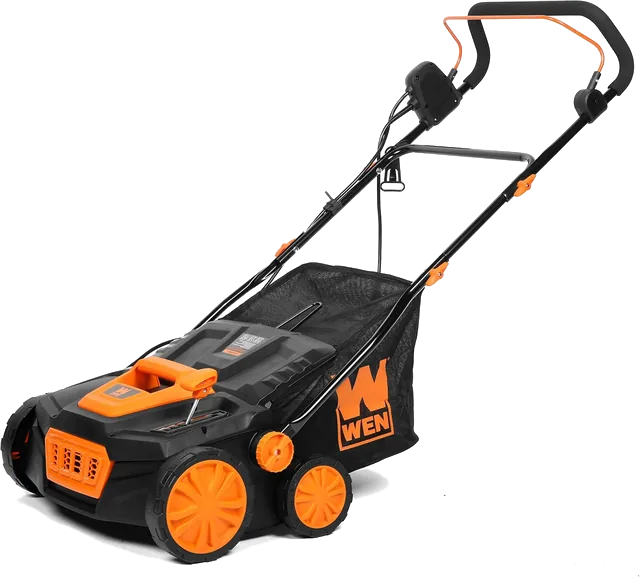
3. WEN DT1315 15-Inch 13 Amp Corded Dethatcher Scarifier Best Value
The WEN DT1315 is the best value on this page for a small to mid-sized flat lawn within cord reach: a 15 in path, both drums in the box and a five-step depth chart that says which steps are for which job. It sits in the budget to mid-range tier and runs on 13 amps. On a very thick mat it carries the lowest amp rating of my top three.

WHY I CHOSE THIS ✓
It sits third because it gives the most machine for the money. Both heads and a depth chart that tells you the job for each step are what you pay for. On a very thick mat or a long lawn it has the smaller rating.
WEN DT1315 15-Inch 13 Amp Corded Dethatcher Scarifier Specs
Key Features:
- Both heads in the box: A 24-tine steel dethatching head and a 16-blade scarifying head ship together, so you can lift thatch first and cut later.
- Depth chart with jobs: Steps 1 and 2 are for dethatching only. Step 3, at -1/4 in, covers dethatching and scarifying. Steps 4 and 5, at -3/8 and -1/2 in, are for scarifying.
- 15 in working width: It is wide enough to keep the row count down on a flat house lawn.
- 13 amp motor: WEN rates it at 13 A and 3,300 RPM no-load, and the overload protection stops the motor when material builds up.
- Cord table in the manual: For 13 A it gives 14 gauge to 25 ft and 12 gauge to 50 ft, and calls 100 ft and 150 ft cords not recommended.
- Rear bag on a rack: The bag rides on a rack behind the deck. The listing gives 12 gal, though WEN does not publish a size.
- Two-year warranty with an hours cap: WEN covers personal use for 2 years or 500 hours, and cuts that to 90 days for professional or commercial use.
The depth chart is the reason I like this one for a thick mat. WEN’s chart marks steps 1 and 2 as dethatching only, step 3 as the shared step and steps 4 and 5 as scarifying steps where dethatching is not recommended. So the tine head stays at steps 1 to 3, and the thatch below that is the blade head’s job. I run the tine head first, look at what is left, and only then decide whether the blade head belongs on the lawn at all.
WEN’s own words are that scarifying carries some risk of pulling up grass roots, and extension agrees. University of Illinois Extension calls mechanical dethatching very destructive when roots live in the thatch, and Penn State says thin turf after a heavy removal needs reseeding. So I treat the blade steps as a tool for opening soil before seed, not as the first move on a thick mat. WEN asks for actively growing grass and soil with some moisture, and the manual says not to work a wet lawn.
The short cord is the first thing to sort out. The factory cord is 16 AWG and 0.35 m, so WEN requires an extension cord and the manual’s table sets the gauge by length. I read that table before the first row and pick the cord from the shed shelf to match. I keep one extension cord coiled with the machine, because the factory cord is only 0.35 m long. On hard packed or frozen soil and on stones or roots the machine can bounce or jump forward, so walk the lawn first, take hoses off it and mark sprinkler heads and lights.

Empty the bag before it is full, as WEN asks, because a packed bag cuts the performance and overloads the motor.
Switch off, wait for the tines to stop and then disconnect the cord before you touch the head, the bag or the depth lever. The tines and blades are sharp and get hot, and WEN asks for gloves.
Clean it after each use, brushing the underside of the tine guard and the motor housing, and never use a hose. WEN asks you to lubricate the tines or blades and the shaft once per season, and the bag figure of 12 gal comes from the Amazon title, not from WEN.
Choose it for a small to mid-sized flat lawn near an outlet, where the mat is moderate and you want both drums at a sensible price. Skip it if the lawn is large, the soil is hard and stony, the cord run is long or you need a published bag size or noise figure. A very thick mat wants a bigger motor and a bigger bag than this machine carries.
FINAL VERDICT
The DT1315 is the value pick for a small to mid-sized lawn near an outlet. It gives both heads and a clear depth chart for a lower tier, and its 13 amp rating is lower than the 15 amp ratings above it. Choose it for a moderate mat on a short cord run.
It is the corded value pick for a short cord run and a moderate mat.
4. WEN 20716 20V Max 15-Inch Cordless Dethatcher Scarifier Kit Best Cordless
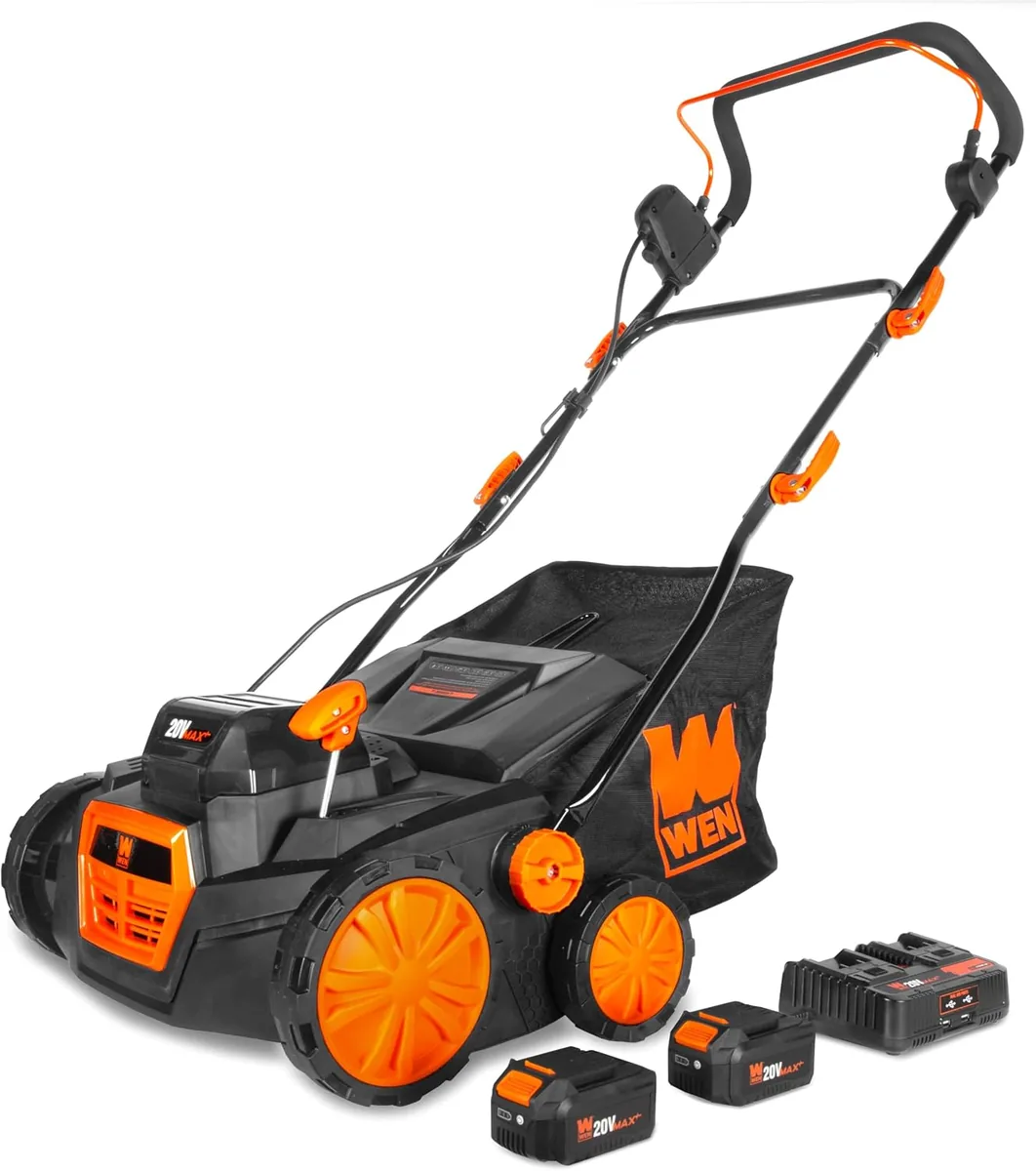
The WEN 20716 is the best cordless dethatcher on this page, and the only cordless walk-behind here, with no cord to drag across the lawn. The box holds the machine, both drums, two 4.0 Ah batteries and a dual-port charger, so nothing else is needed to start. It suits a flat lawn with no outlet nearby, and the buyer pays a premium-tier price for that freedom.
WHY I CHOSE THIS ✓
As the cordless pick it ranks fourth, because it is the only cordless walk-behind here, so it works away from an outlet. If your lawn sits far from the shed, this is the one to look at. The price is a run time WEN does not state.
WEN 20716 20V Max 15-Inch Cordless Dethatcher Scarifier Kit Specs
Key Features:
- Cordless, brushless: No extension cord to snag and no outlet limit. WEN gives up to 3,000 RPM no-load.
- Two batteries required: It will not run on one pack, and the smaller pack sets the run time.
- Safety key: The machine will not start without it, and it comes out whenever you park it.
- Kit in one box: Both heads ship with two 4.0 Ah batteries and a dual-port charger.
- Depth chart by job: Steps 1 to 3 dethatch, and steps 3 to 5 scarify.
With a cord out of the picture, the question on a thick mat becomes how long the packs last, and WEN publishes no run time. A heavy mat loads the motor harder than a light one, so I plan the job in pack swaps, not in one go. What surprised me first was the second pack: with one battery in, nothing starts. WEN says to push slowly, because pushing too hard overloads the motor or blocks the discharge.
Charging is the other unknown, because WEN publishes no charge time. The batteries ship at a low charge and need a full charge before first use. Charge within 41 to 104 F, and let a hot pack cool before it goes on the charger.
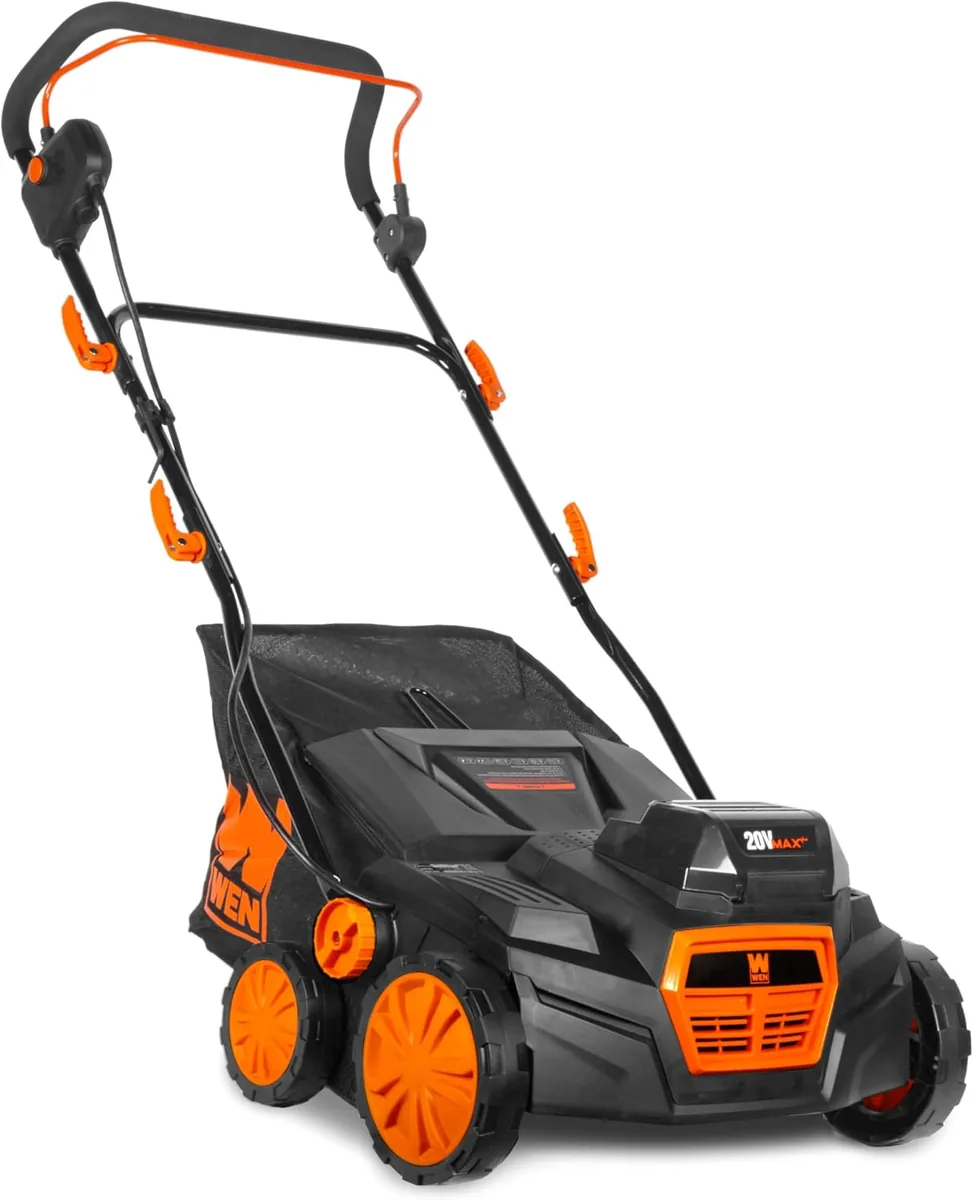
The 23.4 lb figure leaves out the batteries and charger, and the weight with both packs fitted is not published.
Switch off, wait for the tines to stop, then take out the safety key and both batteries before you touch the head, the bag or the depth lever. Wear gloves.
I take both packs out after each use and leave the safety key off the machine. I store the packs charged in a cool, dry shed, as the manual asks. The packs are WEN 20V Max, and one fits another tool only if the maker’s list for that battery says so.
The 20716 is for a flat lawn far from an outlet, with a mat that is moderate, and a buyer who accepts planning the job around pack swaps. Skip it if you need a published run time, if the mat is very thick or the lawn is large. A buyer who already owns WEN 20V Max packs should check the tool-only version first.
FINAL VERDICT
The WEN 20716 is the cordless choice on this page. It frees you from the cord, and it asks you to plan the job around two 4.0 Ah packs with no published run time. A flat lawn with no nearby outlet is its home ground.
It is the cordless walk-behind for a flat lawn far from an outlet.
5. Brinly DT-402BH-A 40-Inch Tow-Behind Dethatcher Best Tow Behind
The Brinly DT-402BH-A is the best tow behind dethatcher on this page, and the only one that needs no motor, no cord and no battery. It is a 40 in tray of spring tines that a riding mower or tractor with a rear hitch plate pulls across the lawn. The wrong first tool for a thick, dense mat.

WHY I CHOSE THIS ✓
Fifth place goes to the only towed option, which handles upkeep on a large lawn. It does not fix a thick mat. If a mower with a hitch plate already sits in your shed, it keeps a cleaned lawn clean.
Brinly DT-402BH-A 40-Inch Tow-Behind Dethatcher Specs
Key Features:
- Three Lift Lock positions: Transport lifts the tines clear for driveways and walkways, Dethatch is the working height, and Scarify drags the tines along the ground to rough up a seed bed.
- 40 in working width: A mower or tractor covers a wide strip in one pass, with no cord to manage.
- Weight tray: It takes up to 70 lb, which Brinly asks you to add only if the unit jumps or walks.
- Hitch heights from 7 to 14 in: The tow bars slide on the tray to fit the hitch.
- No bag: The tines lift thatch to the surface and you rake or sweep it up afterward.
A thick mat is where this machine runs out of ability. Extension services name powered machines for heavy thatch: vertical mowers, whose rotating blades slice into it, and power rakes, with vertically rotating tines. A towed tray has neither a motor nor blades, and Brinly describes its tines as gently combing away dead grass, roots and debris. On a dense mat, start with a powered machine, a walk-behind with a blade drum or a rented power rake, then keep the tray for upkeep.
The manual says the work can take several passes, always in the same direction to protect the roots, with grass under 3 in and a moderate to dry lawn. Best speed is 3 mph or less, and the maximum is 5 mph.

Park, set the brake, shift to neutral and disengage the blade before you change the tray height, then move it no more than 1/4 in at a time: up if the tines drag without flipping thatch forward, down if they stay in the free position.
Tow it below 5 mph, never on steep slopes and never with a rider, and use Transport on concrete or asphalt. Unload any tray weight before you disconnect it, and wear safety glasses around the sharp tine tips.
I set the tines on the concrete pad with two layers of packaging cardboard, which the manual says equals about 1/2 in, and the tines barely touched the ground. At 35 lb empty it moves by hand, and I park it low with the tine points toward the wall. I leave the tray empty until the unit jumps.
The Brinly suits an owner with a riding mower or tractor, a large lawn and thatch that is light to moderate. Skip it if you have a thick mat, a push mower only or steep ground, because the manual rules out steep slopes and passengers.
FINAL VERDICT
The DT-402BH-A is the upkeep tool for a large lawn behind a mower you already own. It cannot replace a powered dethatcher on a thick mat. Pick it for width and low effort, and bring in a powered machine first when the layer is past half an inch.
It is the towed upkeep tool for a large lawn that is already clean.
6. Greenworks DHA103 14-Inch 13 Amp Corded Dethatcher Scarifier Longest Warranty
The Greenworks DHA103 carries the longest warranty on this page, three years against defects, and that makes it the best dethatcher for home use if cover matters more to you than width. The manual leads with its 20-blade drum, built to rip moss, weeds and roots out of the soil, and treats the spring tine drum as the dethatching conversion. Both drums are in the box.

WHY I CHOSE THIS ✓
It ranks sixth because it carries the longest warranty on this page, and a manual that is blunt about the hazard. A three-year term and a blade-first design suit the buyer who wants cover and a deep step.
Greenworks DHA103 14-Inch 13 Amp Corded Dethatcher Scarifier Specs
Key Features:
- Three years of cover: Greenworks covers materials, parts and workmanship for 3 years for the original purchaser, for personal use only.
- Blade drum first: The manual says the 20-blade drum rips out moss, weeds and their roots. The tine drum converts it to a dethatcher.
- Five steps down to -7/16 in: One lever sets the depth, forward for deeper, and the same steps serve both drums.
- Three handle heights: The handle sets to suit the person pushing.
- Cord retainer on the handle: It holds the extension cord in place mid-row.
The odd thing about this machine is the order of its drums. Greenworks designs it as a scarifier first, so the blade drum is the default and the tine drum is the change. On a thick mat that means the first pass can bite harder than you want. I mow first, because the troubleshooting table lists too-tall grass as a cause of hard pushing, and I start at the shallowest step. My Greenworks DHA103 review goes through the two drums in more detail.
The start sequence takes a pass to learn: connect the outdoor cord, push and hold the start button, pull the bail switch to the handle and let the button go. Releasing the bail stops it, and the cylinder must stop fully before a restart. Do not flick it off and on. The cord has to be 14 gauge to 25 ft or 12 gauge to 50 ft, and the outlet needs GFCI protection.

I walk the lawn and clear stones and sticks first, because the machine throws objects and the manual’s DANGER box mentions amputation.
Greenworks keeps bystanders, helpers and pets at least 100 ft away, a long zone for a small yard. Switch off, wait for the cylinder to stop and unplug the cord before you touch the drum or the grass catcher, and wear heavy gloves.
The deepest step reaches 7/16 in below the ground line, and my drip lines lie on the soil near the tree strips, so I lift or mark them before a pass and never go that deep next to a row. It weighs 28.2 lb with no battery to add. Store it dry and clean between 32 and 113 F.
Pick it for a small to medium flat lawn within a short cord run where you want both drums and the longest cover here. Walk away if you need a wide path, a published bag size or cordless freedom, or if the lawn is wet most mornings, because the manual rules out wet or damp areas.
FINAL VERDICT
The DHA103 gives the longest warranty on this page and a blade drum at its core. It asks for a good cord, a flat dry lawn and care with its deep steps, so choose it when a three-year term decides the purchase.
It is the home-use machine to buy when three years of cover decides.
7. Sun Joe AJ798E 12.6-Inch 12 Amp Corded Dethatcher Scarifier Best Budget
The Sun Joe AJ798E is the best budget dethatcher on this page, and the lightest corded machine here at 21 lb. It still ships with both drums, 21 spring tines and 22 slicing blades, so a small lawn gets the full 2-in-1 for the lowest price tier. On a thick mat it has the smallest motor and the narrowest path on the page, and I rank it last for that reason.

WHY I CHOSE THIS ✓
Last place goes to the budget pick, because it costs the least and weighs the least. It gets a small lawn both drums for the lowest tier. It is not the machine for a mat past an inch or a large lawn.
Sun Joe AJ798E 12.6-Inch 12 Amp Corded Dethatcher Scarifier Specs
Key Features:
- 21 lb net weight: It is the lightest corded machine on this page.
- Both drums in the box: 21 spring tines lift thatch and 22 slicing blades cut grooves.
- Four depth stages: +5 mm rakes a healthy lawn, 0 mm is for transport and storage, and -5 and -10 mm are for scarifying.
- 8 gal bag: Sun Joe says to empty it when it is half full, because a full bag cuts performance.
- Cord chart in the manual: 14 AWG up to 50 ft, 12 AWG to 100 ft, and no cord over 100 ft.
A 12 amp motor and a 12.6 in path set the pace on a thick mat. The manual warns against dethatching too deep at too fast a rate, so you walk slowly and take more rows. The raking stages only reach 0 to +5 mm, so on a deep mat the tine drum works the top of the thatch and the blade stages do the cutting. I use the light stage on a test patch first.
The 8 gal bag is the smallest here, and Sun Joe’s advice to empty it at half full means many trips to the compost pile. Plan the work around the bag. Mow first and fertilize afterward, as the manual says, and never work wet grass, because it sticks to the underbody and blocks the discharge.

I tie the plug connection in a knot as the manual shows, so the cord cannot pull out mid-row.
Before you clear the bag, the tines or the blades, switch off, wait for the drum to stop and unplug the cord. The manual asks for glasses with side shields, ear defenders and a mask in dusty conditions.
At 21 lb I lift it onto the tool shed shelf by myself, with the drum stopped and the plug out. Clippings stuck to the drum cause overheating, so clean it after every use. The tines and blades are wearing parts the warranty does not cover, and it skips products bought from unauthorized sellers.
It suits a first-time buyer with a small flat lawn, a light to moderate mat and a short cord run. Skip it for a mid-sized or large lawn, for a mat past an inch, for wet or steep ground or if you want a big bag. On a thick mat it means more rows and more bag stops.
FINAL VERDICT
The AJ798E is the low-tier way into a 2-in-1 for a small lawn with a light mat. It asks for patience and frequent bag stops. Decide on the size of the lawn: small and easy suits it, and thick and large does not.
It is the light corded starter for a small lawn with a light mat.
How to Choose the Best Dethatcher
Eight checks sort a dethatcher for a heavy mat, and the first is the thatch itself, because the layer you have decides whether you need a machine at all. I run them in this order before I spend anything.
Measure the Thatch Before You Buy
Measure the layer first. Thatch is a layer of living and dead stems and roots between the green leaves and the soil. A thin layer insulates the turf, and most extension services start to treat it as a problem past about half an inch. Some warm-season guidance waits until about an inch, so the grass sets the line.
| Depth | What extension services say |
|---|---|
| Up to 1/2 in | A thin layer insulates the turf and is left alone |
| Past 1/2 in | Most services treat it as a problem and remove it |
| 1 in or more | Preventive practices no longer control it, and warm-season guidance removes it at this depth |
Thickness matters because thatch holds water away from the soil. In a two-year golf green trial, a mat thicker than 1.3 cm, about half an inch, was called undesirable because it reduces water infiltration and raises dry spots and pest problems (1). A column study with bluegrass and red fescue thatch found that thatch delays the start of infiltration, and thicker thatch delays it longer (2).
I cut a wedge from a corner of the lawn and measure the brown, spongy layer before I buy anything.
Pro Tip
Cut a wedge or plug in two or three spots and measure the brown layer between the green leaves and the soil. The layer is rarely even across a lawn.
Match the Motor and Cord to the Mat
Corded walk-behinds on this page run 12 to 15 amps. A thick mat loads the motor more than a light one, and every corded manual here has overload protection that stops the motor when material builds up. The best corded dethatcher for a heavy mat also needs a cord that can carry the load. I compare corded and cordless machines in my best electric dethatcher roundup.
- Cord gauge: Maker tables for these tools call for 14 AWG up to 25 or 50 ft and 12 AWG beyond that, and a cord that is too thin or too long costs power.
- GFCI: Most corded manuals here ask for a ground-fault circuit interrupter outlet or circuit.
- Overload stops: When material builds up around the drum, the motor stops. Switch off, wait for the drum to stop and unplug the cord, then let the motor cool and clear the cause. One maker says to wait 15 minutes.
- Cordless: The best battery powered dethatcher on this page needs two batteries, and the maker publishes no run time, so a heavy mat is a job for pack swaps. For lawns without an outlet nearby, my cordless dethatcher roundup ranks the battery machines against each other.
I check the cord and the circuit in the machinery shed before I look at the machine.
Choose Tines, Blades or Both Drums
A tine drum lifts thatch, and a blade drum slices into the soil. Makers call the blade drum a scarifier, and WEN says scarifying is more intense than dethatching and carries some risk of pulling up grass roots. Extension pages use other words: vertical mowers with rotating blades and power rakes with rotating tines. The best dethatcher and scarifier for a heavy mat is a 2-in-1 that puts both drums in the box. I compare more machines supplied with both drums in my best dethatcher and scarifier roundup.
| Drum | What it does | What to watch |
|---|---|---|
| Spring tines | Pull thatch to the surface for the bag | The raking steps on many models stop at or just above the soil line |
| Slicing blades | Cut grooves into the soil and the mat | They can pull up live roots, and the deep steps are for scarifying only |
| Towed tines | Comb dead grass with no motor | Light work only, with no blades and no bag |
Heavy thatch is slow to clear on any machine. Vertical mowing twice a year cut thatch by only 8 percent in a four-year bermudagrass study, and it reduced shoot density (3). In a five-year zoysia study, annual vertical slicing took 12 to 18 percent off the thatch depth each year (4). Plan a thick mat across seasons, and seed the thin spots. For Bermuda lawns, I compare suitable machines in my best dethatcher for Bermuda grass roundup.
I keep the spare drum in a labeled box on the tool shed shelf so a sharp one never sits loose.
Lawn Health
Dethatching or scarifying at the wrong time, too deep or on stressed grass can badly damage a lawn. Mechanical dethatching is hard on turf whose roots sit in the thatch, so test a corner first.
Read Depth Steps as Maximums
Depth steps are maximums for that machine, not a target. The scale is signed: a plus number sits above the soil and a minus number cuts below it. On this page the steps run from +0.24 in to -1/2 in, and some makers mark which steps are for dethatching and which are for scarifying only. I compare corded and cordless machines for moss and matted turf in my best lawn scarifier roundup.
- Start light: Set the shallowest working step on a trial patch and make a second pass if the mat is still there. Penn State calls that the safer approach.
- Go one step at a time: One maker says the right depth depends on the lawn and the grass height, and that a setting that is too shallow gives poor performance and noise.
- Respect the deep steps: They are for scarifying, and a drip line or a shallow root near the surface can be caught there.
- Set it with the machine off: Switch off, wait for the drum to stop and unplug the cord or remove the batteries before you move the lever.
I trust the lever more than my wrist, because the same step on every row leaves an even lawn.
Size the Bag and the Path to the Mat
A thick mat fills a bag fast, so bag size sets how often you stop. Bags on the walk-behinds here run from 8 gal to 14.5 gal, and some makers print no size at all. One maker says to empty the bag when it is half full, because a full bag lowers performance. Walk-behind paths run from 12.6 to 16 in, and a wider path means fewer rows. If a wide path matters most, my roundup of dethatchers for a large lawn lists picks that cover more ground.
- Unstated sizes: Some makers print no bag size, so compare only the sizes that are printed.
- Half-full rule: Plan your trips to the compost pile around half a bag, not a full one.
- Path width: A 16 in path covers a flat lawn in fewer rows than a 12.6 in path.
The compost pile is a walk from the house lawn, so I count bag stops before I count rows.
Know When a Tow-Behind or a Rental Fits
A tow-behind dethatcher is a motorless tray of spring tines pulled by a riding mower or tractor, and it combs, it does not cut. The best tow behind dethatcher keeps a large lawn clean once the mat is under control. For a thick mat, powered machines come first, because extension services name vertical mowers and power rakes for heavy thatch, and a rented one covers a job you do once. Once a tray suits the job, I compare five options in my best tow-behind dethatcher roundup.
Key Takeaway
Powered first, towed after. Use a walk-behind or a rented power rake on the heavy mat, then keep the lawn clean with towed tines.
Time the Job and Plan the Recovery
Dethatch while the grass grows hard, never in heat, drought or on wet soil. For cool-season grasses that means late summer to early fall, and for warm-season grasses it means late spring through early summer after green-up. St. Augustinegrass and centipedegrass need extra care, because Florida extension warns against power rakes on them.
- Mow first: One maker asks for grass 2 to 3 in high and slightly moist soil.
- Water and feed after: Rake up the debris and water so exposed roots do not dry out. Sun Joe and WEN say to fertilize after the pass, and extension services for specific grasses set the fertilizer about a week later, at a rate that depends on the grass.
- Seed thin spots: Penn State says heavy thatch removal needs provisions to seed the thinned turf.
In a first-year putting green trial, two passes with a vertical mower prepared a better seedbed than tine cultivation when seeding into dead turf, and the difference was gone by year two (5). Thatch also returns unless the cause is fixed, and Illinois names excess nitrogen and overwatering. I put the seed down the same day while the soil is open.
Read the Safety Rules Before the First Row
A dethatcher throws stones, and its drum keeps turning after you release the lever. I follow the full order every time: switch off, wait for the drum to stop, unplug the cord or remove the battery, and only then touch the tines, blades or bag.
- Eyes and ears: Wear glasses with side shields marked ANSI Z87.1 and hearing protection, with long pants, closed boots and gloves.
- Bystanders: Two manuals here give 100 ft for people and pets, and the others say a safe distance.
- The lawn: Remove stones, sticks, toys and wire, and mark sprinkler heads, drip lines and any buried cable.
- Wet grass and slopes: Never work wet grass, and work across a slope only where the manual allows.
I walk the lawn first and pick up every stone and stick, and I mark the drip lines near the tree strips.
Before You Start
Check the manual of the machine you buy. Distances, depth steps and cord rules differ by model.
My Overall Verdict
A thick mat rewards a strong motor, a wide path and a big bag, and the top three spend your money on those three things in different ways.

1. Westinghouse W16ADAC 16-Inch 15 Amp Corded Dethatcher Scarifier Best Overall
For a flat house lawn within cord reach, where the thatch is past half an inch and the bag is what slows you down.

2. Sun Joe AJ808E 15-Inch 15 Amp Corded Dethatcher Scarifier Best Premium
For a small to mid-sized lawn where you want a 15 amp motor and a scarifier with range to spare, on a strong circuit.
3. WEN DT1315 15-Inch 13 Amp Corded Dethatcher Scarifier Best Value
For a small flat lawn near an outlet with a moderate to thick mat and a tighter budget.
Whatever you buy, wear eye and ear protection and mark the irrigation lines before the first row.
Measure the thatch, check the cord, start light and plan a heavy mat across seasons. For most flat house lawns the Westinghouse W16ADAC is the best dethatcher for thick thatch. For other lawns, my ranking of lawn dethatchers sorts machines by yard size and budget.
Why Westinghouse W16ADAC 16-Inch 15 Amp Corded Dethatcher Scarifier Might Be the Best Choice
I put the Westinghouse W16ADAC 16-Inch 15 Amp Corded Dethatcher Scarifier first because it carries the most thatch per trip. A 16 in path and a 14.5 gal bag mean fewer rows and fewer walks to the compost pile.
The trade is the cord and the season. The manual asks for a proper extension cord and says not to use the machine more than once per season.
What puts it first:
✓ Width: a 16 in path.
✓ Motor: 15 amps.
✓ Bag: 14.5 gal, per Westinghouse.
✓ Depth: five steps from +0.24 to -0.47 in.
✓ Both blades: rake and scarifier in the box.
Frequently Asked Questions
Which is better, Power Rake or dethatcher?
A power rake is better for a very thick mat, and a dethatcher is better for a lighter layer on a small to mid-sized lawn. Extension services name power rakes and vertical mowers for heavy thatch, while a corded 2-in-1 with a 12 to 15 amp motor suits a lawn you can reach with a cord.
Is it really necessary to dethatch your lawn?
Dethatching is needed when measured thatch passes the depth extension services set for your grass, about half an inch for most lawns and about an inch for St. Augustinegrass and some warm-season lawns. Cut a wedge to measure it, since many lawns never need the work and a thin layer helps the turf.
What does it mean to dethatch a lawn?
To dethatch a lawn means to pull out the layer of dead and living stems and roots that builds between the green grass and the soil. On a thick mat a machine lifts that layer to the surface so you can bag it, and the thinned turf then needs seed.
What is the best dethatcher on the market?
The best dethatcher on the market for a thick mat is the Westinghouse W16ADAC, a corded 2-in-1 with a 16 in path, a 15 amp motor and a 14.5 gal bag. The Sun Joe AJ808E suits a deep scarifying cut, and the WEN DT1315 suits a small flat lawn on a tighter budget.
What is the best battery-powered lawn dethatcher?
The best battery-powered lawn dethatcher on this page is the WEN 20716, a 20V Max kit with two 4.0 Ah batteries, both drums and a 15 in path. WEN publishes no run time, so a thick mat is a job for pack swaps, and a corded machine suits a heavy mat better.
References
- McCarty LB, Gregg MF, Toler JE, Camberato JJ, Hill HS. Minimizing Thatch and Mat Development in a Newly Seeded Creeping Bentgrass Golf Green. Crop Science. 2005;45(4):1529-1535.
- Liang X, Su D, Wang Z, Qiao X. Effects of Turfgrass Thatch on Water Infiltration, Surface Runoff, and Evaporation. Journal of Water Resource and Protection. 2017;9(7):799-810.
- Carrow RN, Johnson BJ, Burns RE. Thatch and Quality of Tifway Bermudagrass Turf in Relation to Fertility and Cultivation. Agronomy Journal. 1987;79(3):524-530.
- Dunn JH, Sheffer KM, Halisky PM. Thatch and Quality of Meyer Zoysia in Relation to Management. Agronomy Journal. 1981;73(6):949-952.
- Miltner ED, Stahnke GK, Rinehart GJ, Backman PA. Seeding of Creeping Bluegrass into Existing Golf Course Putting Greens. HortScience. 2005;40(2):457-459.
Safety Note: Read your manual first. A dethatcher or scarifier throws stones, sticks and other debris with force, so walk the lawn first and remove stones, sticks, toys, wire, hoses and pet waste. Mark sprinkler heads, irrigation and drip lines, low-voltage lighting wire and buried pet fence wire, keep the drum clear of them, and follow your manual’s limits near underground cables and pipes. Wear impact-rated eye protection with side coverage that meets ANSI Z87.1, hearing protection, gloves, long pants and sturdy non-slip closed shoes, plus a dust mask when the work raises dust. Keep people and pets as far away as your manual says, and stop at once if anyone comes closer. Never use a powered dethatcher on wet grass or in rain. The machine can jump up or forward when the tines hit hard or frozen ground, roots, stumps or buried rocks, so avoid those spots and hold the handle with both hands. Never lift or tilt the machine or reach under it while the drum turns. Before you clear a jam, empty or fit the collection bag, change the depth, clean, inspect or adjust the machine, turn it over, leave it, or touch the tines or blades, switch it off, wait for the drum to stop completely, then unplug the cord or remove every battery pack, and remove the safety key if it has one. Let hot tines cool before you handle them. If the machine starts to vibrate hard, switch it off, wait for the drum to stop completely, then unplug the cord or remove every battery pack and any safety key before you check it for damage. For a corded model, use an undamaged outdoor extension cord of the gauge and length your manual gives, plugged into a GFCI outlet, keep the cord behind you and clear of the drum, and never handle the plug with wet hands. For a battery model, use only the battery and charger approved for your tool, charge and store them within the temperature range in your manual, and never use a damaged or swollen pack. Stay off steep and wet slopes and work slopes only in the direction your manual gives. For a tow-behind dethatcher, follow both your tractor’s and your dethatcher’s manuals: tow it only behind a lawn tractor or riding mower that meets the maker’s requirements, never on public roads or behind a car or truck, keep a slow, steady speed, avoid sudden turns and stops, carry less weight on slopes and never more than the manual allows, never carry riders, and fit any tine safety wires the manual requires. Before you adjust or clear it, stop the tractor, set the parking brake, remove the key and disconnect the dethatcher as its manual describes. Dethatching at the wrong time of year, too deep or on stressed turf can badly damage a lawn, so match the timing and depth to your grass type.