
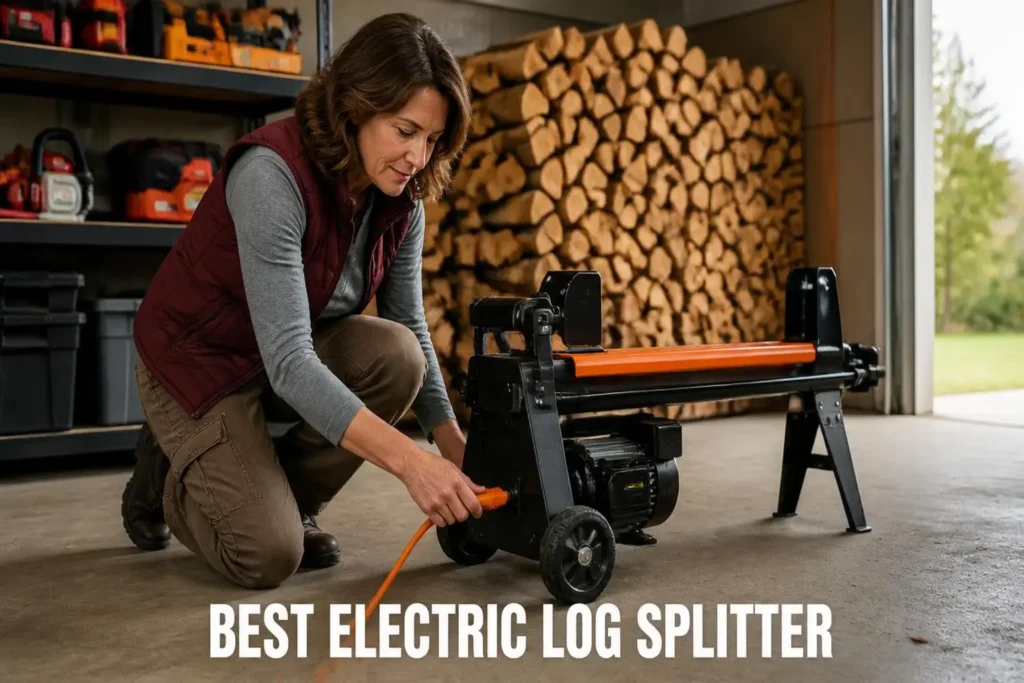
The best electric log splitter for a home woodpile is the one whose log limits, cord rules and warranty fit your pile, and none of the five below needs more than a standard outlet. I run a 3.7-acre apricot and plum orchard, and I put each of these machines to work on apricot and plum wood from that orchard.
Below are five plug-in hydraulic splitters, led by my pick, the YARDMAX YS0650 6.5 Ton Electric Log Splitter. Each review gives the printed log size, the rules its manual sets and who should skip the machine.
Best Electric Log Splitter 2026: 5 Plug-In Models I Put to Work
These five electric log splitters run from a standard 15 amp outlet, from a 5 ton machine for a small pile to a 14 ton machine for wide rounds. I ranked them by how well each fits a homeowner’s firewood and by what its own manual says it will not do.
1. YARDMAX YS0650 6.5 Ton Electric Log Splitter Best Overall
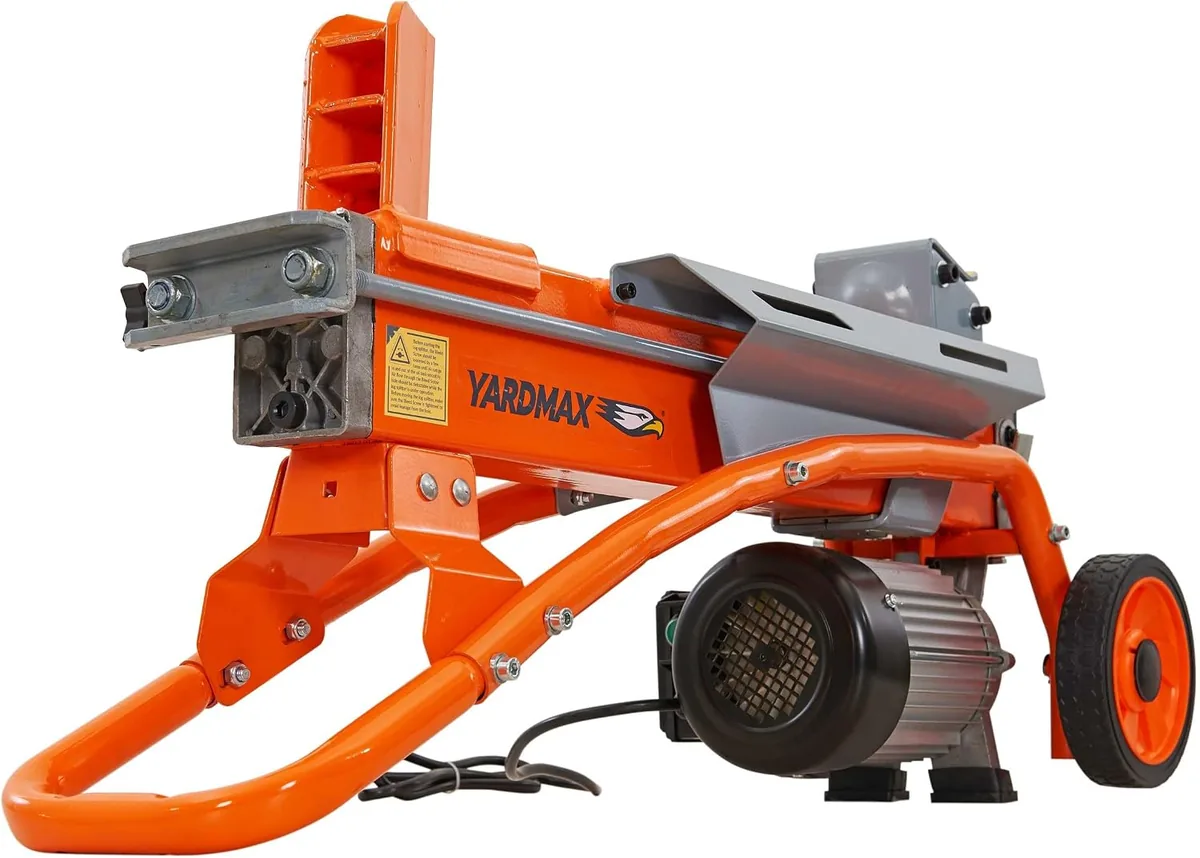
Both of my hands stay on the controls for the whole splitting stroke of the YARDMAX YS0650, and that is why it leads this page. The manual calls the control a ZHB system: the left hand holds the hydraulic lever, the right hand holds the push button, and the ram stops if either is released. The ram returns only after both are released, and hands stay clear through the return. It is rated for 6.5 ton, takes logs up to 20.5 in long and 10 in across, and suits a homeowner who splits a few loads of firewood at a time.
WHY I CHOSE THIS ✓
I ranked it first because the control asks for both hands on the lever and the button, and releasing either one stops the ram. The ZHB control holds both hands on the lever and the button through the splitting stroke, the 20.5 in by 10 in limit fits rounds from fruit-tree wood, and the manual prints clear steps for the return stop, the bleed screw and the oil. For a homeowner with a shed outlet and a pile of small rounds, it is the first splitter I recommend.
YARDMAX YS0650 6.5 Ton Electric Log Splitter Specs
Key Features:
- ZHB two-hand control: the ram stops when you release either the lever or the push button, and it returns to its start only after both are released, according to the manual.
- Return stop and stroke limiter: sliding the stop toward the splitter shortens the stroke for a short round, as the manual’s steps describe, with your hands clear of the ram.
- 20.5 in by 10 in log limit: these are ceilings, and the manual asks for square-cut ends and branches cut off flush with the trunk.
- Bleed screw: you loosen it before use so air moves in and out of the oil tank, and tighten it before you move the machine.
- Frame and wheels: a tubular frame doubles as the handle and the front legs, and a pair of 7 in wheels lets you roll it by hand to the work spot.
- Dipstick with two grooves: the oil level sits between them, and the manual calls for 10W AW32, ASLE H-150 or ISO 32 oil in a 0.93 gal tank.
- Printed cord rule: an extension cord may be no longer than 30 ft, with a minimum of 12 gauge and a grounded three-prong plug.
On a stack of straight apricot rounds the out-and-back of the ram felt steady, and I used each pause to choose the next round, because the manual says not to load a log until the ram has stopped. The 19 seconds is the maker’s printed cylinder cycle time, and its basis is not stated. The rating carries a printed tolerance of plus or minus 10 percent, so read 6.5 ton as the maker’s rating and plan your rounds around the log limits.
The manual asks you to secure the splitter on level ground with two bolts or stakes, and the box holds neither, so buy them before the first split. On the level pad in front of my machinery shed I set the two stakes first, and the low frame stayed where I put it. The manual asks for safety glasses, with Z87 rated glasses recommended, protective nonconductive gloves and nonskid footwear, and its symbols add hearing protection. The beam sits low and no stand comes with it.
A forked plum round showed me the 5 second rule at work. The manual says to release both controls if a log has not begun to split after 5 seconds, because the motor or the hydraulic fluid may overheat, and to turn an extremely hard log by 90 degrees to see whether it splits another way. I turned the fork once, it still held, and I set it aside for a bigger machine, which is what the manual says about a log whose hardness exceeds the splitter’s capacity. The manual also says a knot can turn a log into a projectile, so I stood behind the splitter, as it asks.

Slide the return stop in for a short round before the first stroke, so the ram stops where the round ends. Before you adjust the stop or anything else on the machine, complete the full shutdown in the safety section below.
Loosen the bleed screw before every use and tighten it before you move the machine, and complete the full shutdown in the safety section below first. The manual says that skipping the loosening will blow out the seals of the hydraulic system and cause permanent damage, so I treat it as part of starting the machine, like checking the dipstick.
The manual does not say whether the oil ships in the machine, so check the dipstick before the first use, then change the oil after every 150 hours of use. Keep any extension cord within the manual’s 30 ft and 12 gauge rule. The manual prints no warranty. The price tier is mid-range.
Buy it if you split small to mid-size rounds up to 10 in across, work near a shed outlet and want both hands on the controls through each stroke. Skip it if your rounds run past 10 in, if you need a stand at working height, or if you want a warranty printed in the manual.
FINAL VERDICT
The YARDMAX is the electric splitter I hand to a neighbor with a woodpile and a shed outlet. Choose it for short rounds on a level pad and keep rounds above 10 in for a bigger machine.
It is the electric splitter I recommend to most homeowners.
2. SuperHandy 14 Ton Electric Log Splitter Best Premium
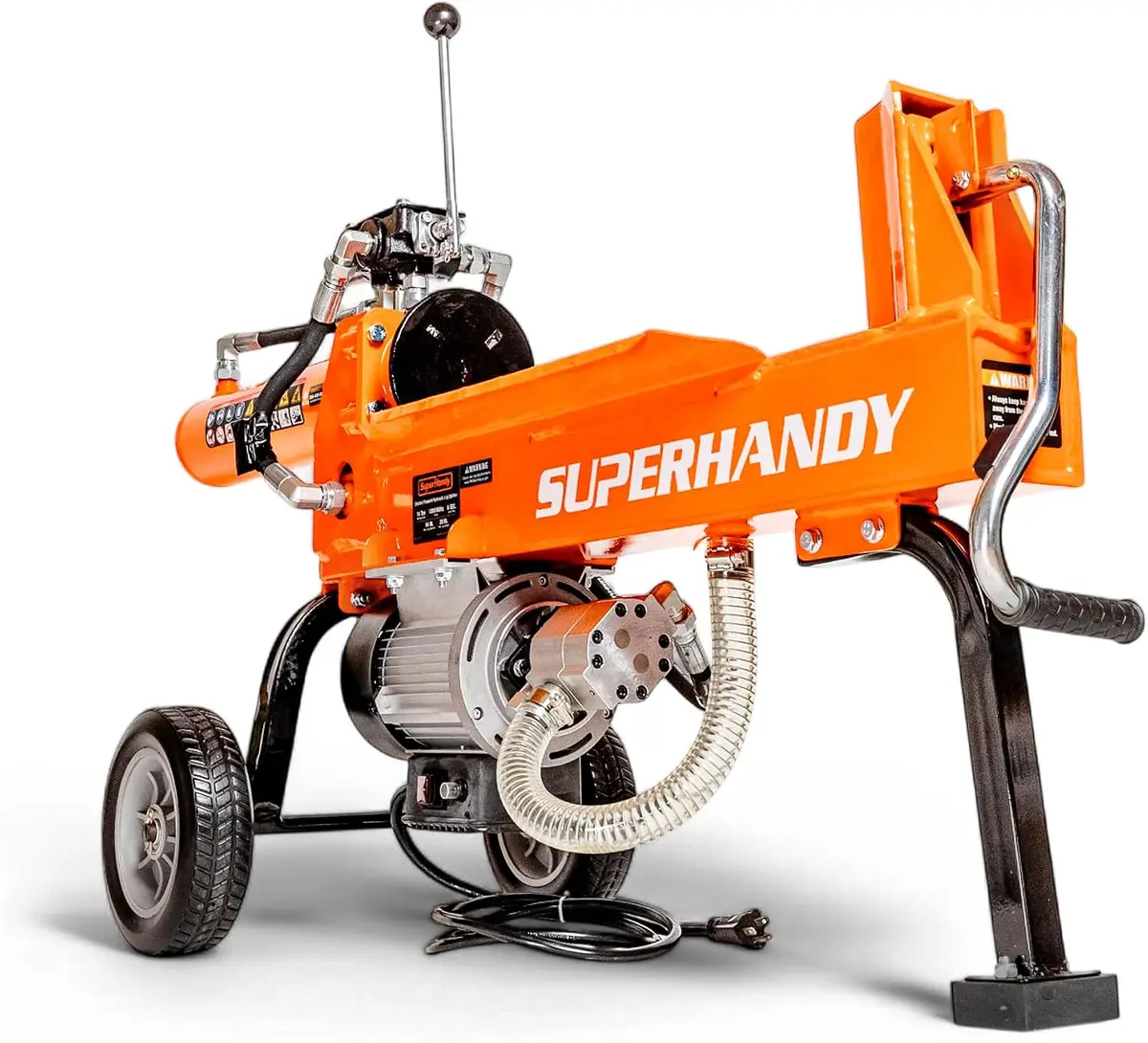
The first job with the SuperHandy GUO084 is to fill it with oil, because the box holds none. The manual calls for 1.6 gal of AW32 or AW46 hydraulic oil in a 2.1 gal tank before the first start, and that one task tells you what you are buying: a 14 ton electric log splitter on 8 in wheels, and the higher-priced pick on this page. It is for the owner whose rounds run wider than the 10 in class.
WHY I CHOSE THIS ✓
I ranked it second because it answers a question the 6.5 ton class cannot. The manual’s 16 in diameter and 14 ton rating let it take rounds that stop the smaller machines, and the 8 in wheels and the support leg make it manageable on a yard. For a heavy pile of wide rounds, it is the splitter I recommend before any other on this page.
SuperHandy 14 Ton Electric Log Splitter Specs
Key Features:
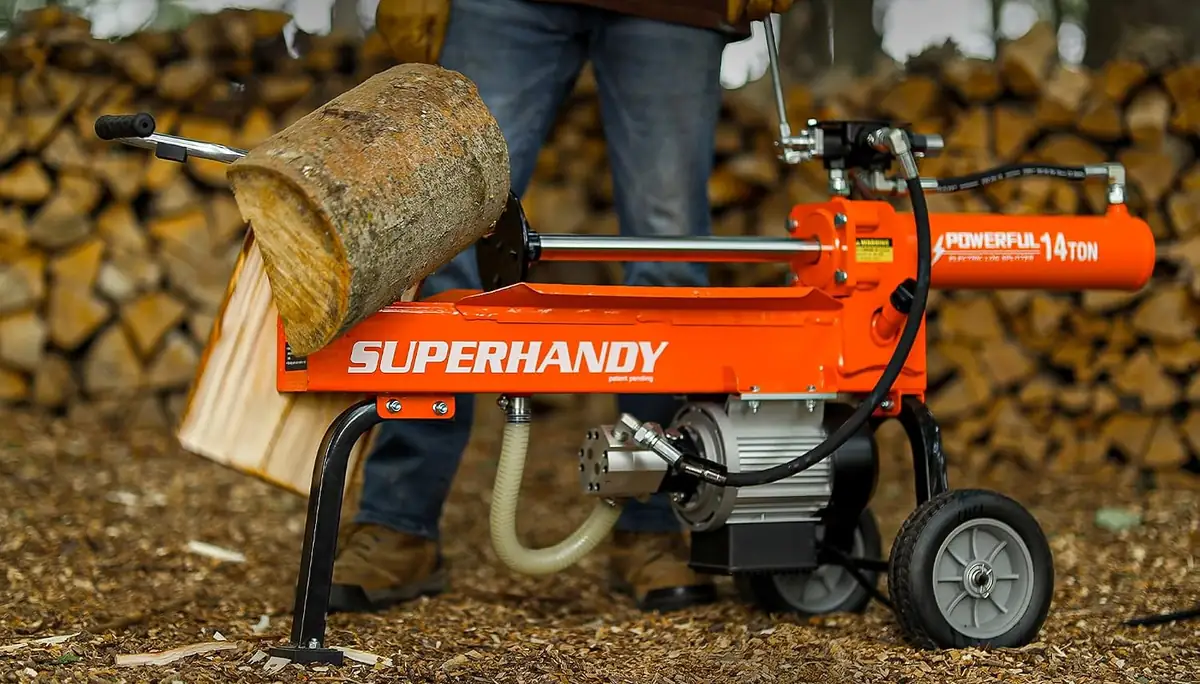
- Rated 14 ton: the manual prints a maximum exerted splitting force of 14 US tons, the highest rated tonnage on this page.
- 16 in log diameter, per the manual: the listing says 14 in, so measure your rounds against the manual’s figure and keep them under it, with a length of 20.5 in at most.
- Detent control valve: the manual lists a control valve detent for auto-return, so the ram comes back on its own after the stroke.
- Separate oil tank: the 2.1 gal tank sits inside the beam, and the first fill takes 1.6 gal.
- 8 in wheels and a support leg: the wheels and handle are for moving it by hand only, the manual says it is not meant to be towed, and the leg steadies it when you set it down.
- Read-only dipstick: you insert it until it stops and read the level, and the manual says never to thread it into the fill neck.
- Cold-weather note: below 32 F outdoor temperature the manual says Dexron III transmission fluid can be used.
A rating of 14 tons is the maker’s figure, so I use the 20.5 in length and 16 in diameter limits to decide what goes on the beam. A long round cut from an old orchard trunk fits only when it is within that length, and a round past it waits for a larger machine. The manual’s 16.5 second cycle has no stated basis. The 16 in limit is wide enough that none of my orchard rounds came near it.
The manual prints 126 lb net, and the 143.7 lb on the listing is a different figure, so plan for the net number plus the oil you add. Rolling it across the gravel yard on the 8 in wheels, I set the support leg down before the first round, and the machine stood steadier for it. The manual says the handle and wheels are only for moving it by hand, and a machine this heavy is not one to lift up steps alone. Before you move it, the full shutdown steps are in the safety section below.
A cold morning taught me the oil lesson. The first strokes came slowly, so I ran the cylinder out and back with no log on it until the motion smoothed, the same purge the manual describes for air in the system. I left the oil grade alone and followed the manual, which allows Dexron III below 32 F and says never to adjust the pump or valve pressure. The manual lists its own stop signs: if the motor sparks or smokes, vibrates excessively or leaks fluid, stop using the machine, and the full shutdown steps come first.
Before every use, check that all nuts and bolts are tight, because motor vibration can loosen them, as the manual says. Before you put a wrench on anything, complete the full shutdown in the safety section below.
Hydraulic parts can become very hot, so complete the full shutdown in the safety section below, and never remove the oil fill cap while the motor runs or the unit is hot. The manual asks for goggles or safety glasses with side shields, a face shield, ear protection when needed, safety shoes or work boots and non-slip heavy-duty gloves.
Living with it starts with the oil and the build. The manual lists ten assembly steps with wrench sizes from 10 to 27 mm and a slotted screwdriver, so have those tools ready. Keep the cooling vents clear and cover the machine or put it in a shed when it is idle. Retailer pages mention a one-year warranty that the manual does not print.
Choose it when your rounds are wider than 10 in and you accept a heavy machine with a first fill of oil. Skip it if you carry your splitter up steps by yourself, want a stand, or want a time limit, a stuck-log method or a warranty printed in the manual.
FINAL VERDICT
The SuperHandy is the heavy-duty electric splitter for the owner with wide rounds and a solid outlet. Pay the higher price for the 16 in diameter and the 14 ton rating, and plan the oil and the build before you start.
It is the heavy-duty electric splitter for wide rounds.
3. BILT HARD 6.5 Ton Electric Log Splitter Best Value
The BILT HARD WS6T is my pick for value on small rounds, provided you already have a bench and a protected outlet. It is a 15 amp electric hydraulic splitter rated for 6.5 ton, with a 20.47 in by 9.84 in log limit, and the manual says it is a home use model. It sits on a bench, not a stand, so the buyer builds the work spot, and I rank it third for that and for its short warranty.

WHY I CHOSE THIS ✓
I rank it third because the printed facts add up to a fair price for what you get. The 6.5 ton rating, the 20.47 in length and the two-hand control match what other 6.5 ton machines print, and the manual is complete on the bleed screw, the dipstick and the 150 hour oil change. For small rounds on a bench near an outlet, it is the best value here, and that scope is all I claim for it.
BILT HARD 6.5 Ton Electric Log Splitter Specs
Key Features:
- ZHB two-hand control: you hold the push button to start the motor, then press the lever to engage the pusher, and the pusher freezes if either hand lets go.
- Diameter marked as indicative: the manual says a small knotty log can resist at 9.84 in, while a straight log over the figure may split, and it still says never to split logs larger than the table.
- Bench set-up: the manual places the machine on a stable, level bench 60 to 75 cm high and says to bolt it down if it slips, walks or slides.
- Lift handles at both ends: you lift it by the handles at both ends, and the wheels are marked for minor moving only.
- Dipstick with two grooves: the oil level sits between them, and the manual names ISO 22 oils such as Shell Tellus 22 and Mobil DTE 11 in a 0.9 gal tank.
- Bleed screw: you loosen it a few turns before operating and tighten it before moving the machine, or oil can leak from that point.
- Sharpenable wedge: the single fixed wedge can be sharpened with a fine-toothed file, and the manual asks you to smooth any burrs on the cutting edge.
The start order is the part I had to learn: hold the push button to start the motor, then press the lever, which sounds simple until a round is already on the beam. The manual prints no cycle time. A branch collar from an apricot limb stalled it, and the manual’s rule applies: never force the machine for more than 5 seconds, then turn the log 90 degrees, and discard it if it will not split, because the oil under pressure overheats.
I put the machine on a bench at the manual’s 60 to 75 cm height, because a splitter at that height saves lifting a round off the ground. I lifted it by the handles at both ends, with a second pair of hands, since the manual prints 44.5 kg with no stated basis. The wheels are for minor moving only, so this is a machine you place once and use where it stands. Before any move, complete the full shutdown in the safety section below.
Power is the part to check before the first plug-in. The manual asks for a 120 V supply with protection devices and a residual current device rated at 0.03 A, a ground connection, and an extension cord no longer than 10 m with a section of at least 2.5 mm2. It prints those cord figures in metric only, so I read the cord rule off the manual and bought a cord to match its numbers, and I did not convert them into a gauge. The bleed screw needs loosening before each use and tightening before you move the machine, or the seals can blow out, so complete the full shutdown in the safety section below first.

Smooth any burrs on the wedge’s cutting edge with a fine-toothed file when the manual says it is due, and only after you have completed the full shutdown in the safety section below.
Keep your hands off the log while the pusher moves, never let another person help free a jammed log, and after the full shutdown in the safety section below follow the manual’s own stuck-log steps. The manual asks for safety goggles, since everyday eyeglasses are not safety glasses, and recommends protective non-conductive gloves, non-skid footwear and a cover for long hair.
Plan for a bench, a bolt kit and a grounded supply with an RCD. The manual prints a 90 day limited warranty, with repairs by certified and licensed technicians, which is the shortest term on this page. The oil is not listed as included, so check the dipstick before the first use and change the oil after every 150 hours. The price tier is mid-range.
This is the splitter for a homeowner who has a bench, a protected outlet and rounds under 9.84 in across. Anyone who wants a stand in the box, a long warranty or a cycle time printed in the manual should look elsewhere.
FINAL VERDICT
The BILT HARD WS6T earns its place as a value pick for small rounds on a bench. Choose it for the price and the two-hand control, and plan the bench and the cord before it arrives.
It is the bench-top splitter I pick for small rounds on a budget.
4. VEVOR ELS106S 6.5 Ton Electric Log Splitter Thermal Overload Protector
The VEVOR ELS106S is the only splitter on this page whose manual prints a thermal protector on the motor. If the motor is overloaded for a long time, the protector cuts the power, and the manual asks for a 30 minute cool-down before a restart. The splitter is rated for 6.5 ton and takes logs up to 20 in long and 10 in across. I cover the ELS106S in full in my VEVOR log splitter review.

WHY I CHOSE THIS ✓
I rank it fourth because it is a sound machine with one clear edge. It prints its pressure, its oil list and a one year warranty, but my label rests on one fact: the thermal protector on the motor, which cuts the power on a long overload. For an owner who wants that backstop, it is a rule worth having.
VEVOR ELS106S 6.5 Ton Electric Log Splitter Specs
Key Features:
- Two controls at once: you hold the lever and the push button together, and the machine stops if either is released.
- Thermal protector: after a long overload the power cuts, and the manual asks for 30 minutes of cooling before a restart.
- Printed pressure and oil list: 3200 PSI and ISO 22 class oils such as Shell Tellus 22.
- Bleed screw: open it one or two turns before use and close it before moving the machine.
- Oiled wedge and beam: the manual asks you to oil the wedge and the top of the beam for smoother operation.
Before the first round the manual asks you to run the unit without a load, so I did that, completed the full shutdown in the safety section below, and only then oiled the wedge and the beam. Two gloved hands on two controls took a few rounds to get used to, and then the routine was easy to repeat. The 22 second cycle carries an asterisk that says tonnage and cycle times may vary, and its basis is not stated.
The manual asks for goggles or safety glasses, steel toed shoes, tight fitting gloves and a protective hearing device, every time. At 99.4 lb net, I placed it with the lift handles and blocked the 6 in wheels at the work spot, as the manual asks.
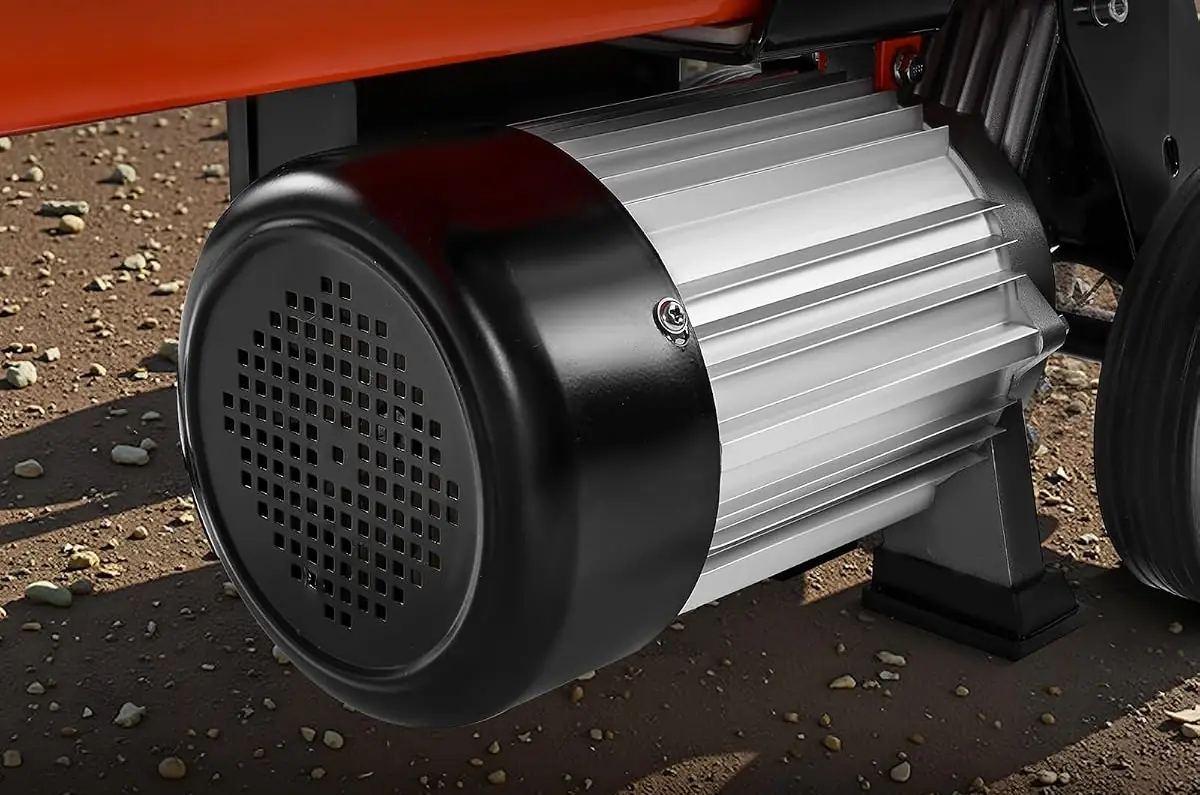
If the ram moves slowly or jerks, the manual points to air in the system or too little oil. Before you check the oil or touch the bleed screw, complete the full shutdown in the safety section below.
The manual caps an extension cord at 25 ft with a minimum gauge of 16. I checked the walk from the shed outlet before I chose where to set it up, because the distance decides where this machine can work.
Wipe the machine with an oiled rag after use, once you have completed the full shutdown in the safety section below, and let it cool for 5 minutes before you store it dry. The price tier is mid-range.
Pick it for work near an outlet, rounds of 10 in or less and 20 in long, and a manual that spells out its rules. Skip it if your work spot is far from a socket, your wood is wide and knotty, or you want a stand.
FINAL VERDICT
Choose the VEVOR when you want a thermal protector on the motor and a manual that prints its limits. Leave it for a yard where the outlet sits close to the pile.
It is the splitter with a thermal protector on its motor.
5. Sun Joe LJ602E 5 Ton Electric Log Splitter Longest Printed Warranty
The Sun Joe LJ602E is honest about what it is: the manual calls it a splitter for occasional use and prints a duty rating of 5 minutes on and 10 minutes off. Rated for 5 ton, it takes logs up to 20.5 in long and 10 in across, and it carries the longest warranty printed on this page, 2 years for household use. It suits a homeowner with a small pile and no hurry.

WHY I CHOSE THIS ✓
I rank it fifth because it is the most limited machine here, and it says so. The 5 ton rating is the lowest on this page and the duty rating is short, but the 2 year household warranty is the longest printed on this page. That is the electric log splitter warranty a cautious buyer wants to see.
Sun Joe LJ602E 5 Ton Electric Log Splitter Specs
Key Features:
- Duty rating printed: at a 15 amp load, run no more than 5 minutes, then let the motor cool for at least 10.
- Two hands, two controls: one hand presses the hydraulic lever, the other holds the on/off switch.
- Five-second limit: the manual says not to split wood that takes more than 5 seconds.
- Cord table: 14 AWG up to 25 ft, 12 AWG from 25 to 50 ft, GFCI-protected circuit, no cord over 50 ft.
- Supporting leg and lifting handle: both come in the box with the bolts.
The 5 minutes on and 10 minutes off rating shaped how I worked. I split a few rounds, stacked while the motor rested, and came back to the beam, which suited a small pile. The manual prints no cycle time. Logs with knots or harder wood, the manual adds, may be harder to split.
The manual sets the machine on a surface 23.6 to 29.5 in high and prints 92.6 lb net, so I lifted it by the handle and set it on the bench with the supporting leg bolted on. Before you lift or move it, complete the full shutdown in the safety section below. Bystanders, children and pets stay at least 16.5 ft away, and the manual says to stop the splitter if people or pets enter the discharge area.
I knotted the machine’s cord to the extension cord before the first plug-in, as the manual says, so a tug could not pull them apart. Before you handle either plug, complete the full shutdown in the safety section below.
The manual asks for eye protection, ear protection above 85 dB and sturdy footwear, and it recommends gloves outdoors. If a log is jammed, do not call a second person, and use only the manual’s method after the full shutdown in the safety section below.
Oil is the routine. The manual names Shell Tellus 22 and Mobil DTE 11 oils, a 1.1 gal capacity and a change after every 150 hours. The price tier is mid-range.
Choose it for a small pile, a GFCI outlet and a buyer who wants a warranty in the manual. Skip it if you split wood all day, want a cycle time on paper, or have rounds that need more than 5 ton.
FINAL VERDICT
The Sun Joe LJ602E is the occasional-use splitter with the longest printed warranty here. Buy it for a modest woodpile and treat its duty rating as part of the plan.
It is the occasional-use splitter with the longest warranty on this page.
How to Choose the Best Electric Log Splitter
Choosing an electric log splitter comes down to the log size you split, the cord and outlet you have, the duty limits the manual prints and the warranty behind it. I read the manual’s numbers first and the product page second, because the manual is the document the maker stands behind.
Rated Tons and the 6.5 Ton Electric Log Splitter Class
Tonnage is the maker’s rating of force, and it does not tell you which wood will split. An electric hydraulic log splitter uses a motor to drive a pump, which pushes oil into a cylinder and moves a ram against a fixed wedge. The five machines here are rated from 5 ton to 14 ton, and four of them sit between 5 and 6.5 ton. My best hydraulic log splitter ranking covers gas and manual machines too.
| Rated class | Log limit as printed | Suits |
|---|---|---|
| 5 to 6.5 ton | About 20 in long and up to 10 in across | Small and mid-size rounds of fruit-tree and yard wood |
| 14 ton | 20.5 in long and 16 in across, as one manual prints it | Wider rounds that stop the smaller class |
- Rating, not result: a maker’s tonnage is a rated force, and several manuals add that force and cycle time can vary.
- Time limit: you stop at the limit the manual prints, because the machine does not stop itself, and a bigger rating does not remove it.
- Plug limit: every machine here draws from a 15 amp outlet, so the motor, not the tonnage, sets the pace.
On my work pad by the machinery shed I judge a splitter by what it does to a forked limb, and a forked limb is where the rating stops mattering and the 5 second rule starts.
Log Length, Diameter and the Wood You Split
The printed log length and diameter are the limits that decide what goes on the beam. A small electric log splitter in this class takes logs about 20 in long and 10 in across, and the manuals ask for square-cut ends and branches cut off flush. Treat each figure as a ceiling, and leave a round that is longer or wider for a larger machine. I compare five options for firewood, branches and kindling in my best log splitter for small logs roundup.
Wood changes the answer more than a rating does. The US Forest Products Laboratory describes interlocked-grain wood as exceedingly difficult to split radially (1). A University of Tennessee extension publication puts green wood normally above 60 percent moisture and properly seasoned firewood below 20 percent (2). A manual’s log limit does not say which of those you are splitting.
- Size ceilings: the printed length and diameter, which no round should pass.
- Forks, knots and branch collars: one manual warns a knot can turn a log into a projectile.
- Green wood: above 60 percent moisture by one extension’s definition, so check what your manual says about the wood it is rated for.
I cut my apricot and plum rounds square before they reach the beam, because a slanted end rocks under the wedge.
Power, Cord and Outlet
All five machines are 120 V, 15 amp units, and every manual sets its own cord rule. One caps an extension cord at 25 ft and 16 gauge, one allows 30 ft at 12 gauge, one prints 14 AWG up to 25 ft and 12 AWG to 50 ft, and one prints metric figures only. Use the length and gauge in the manual of the machine you buy, never a rule from another maker.
| Question | Where to find the answer |
|---|---|
| How long may the cord be? | The cord section of your manual |
| Which gauge? | The same section, in its own units |
| Is a GFCI or RCD required? | The electrical lines of your manual |
| Is a grounded plug required? | Yes, on every machine here |
Electric Cord
Use the grounded supply your manual requires and GFCI protection. If the manual permits an extension cord, use a grounded three-wire cord rated for outdoor use, with the manual’s specified gauge and length. Keep connections away from water and the cord away from moving parts and your feet. Never handle the plug with wet hands or unplug by pulling the cord.
I look at the walk from the shed outlet to the work pad before I pick a machine, because the cord rule decides where it can stand.
Cycle Time, Duty Limits and the 5-Second Rule
A cycle time means nothing until you know what it counts. The figures printed here are 16.5, 19 and 22 seconds, none of the three says whether the return is included, and two manuals print no cycle time at all. Compare a duty rule instead: one manual prints 5 minutes on and 10 minutes off at a 15 amp load, and another prints a 30 minute cool-down after its thermal protector trips.
- Five seconds: the YARDMAX and BILT HARD manuals say to release the controls when a log has not begun to split in 5 seconds, and the Sun Joe manual says not to split wood that takes more than 5 seconds.
- After the first try: the VEVOR manual says not to insist when a log does not split on the first attempt, because the oil can overheat.
- Turn the log 90 degrees once: the YARDMAX, BILT HARD and Sun Joe manuals allow it for a very hard log, and a log that still will not split is beyond the machine.
Pro Tip
Plan a pile in short rounds. Split a few, stack the pieces and let the motor rest while you do, because the manuals that print a time limit give overheating as the reason.
I judge a ram by whether I am left waiting for it, and on every machine here I could stack between strokes.
Weight, Wheels and Moving the Machine
A weight figure is only useful with its basis. Makers print net weight, product weight, a weight with no basis, or a listing weight that can include packaging, and numbers on different bases cannot be set against each other. A portable electric log splitter in this class is portable by hand only: the wheels and handles are for rolling it to the pile, and none of the manuals describes towing. My best portable log splitter roundup compares five picks for easier movement.
| Basis printed | What it means for you |
|---|---|
| Net weight | The weight of the machine itself, as the maker states it |
| Product weight | The maker’s figure for the machine; the basis stays unstated |
| No basis | A figure to treat with care |
| Listing weight | Can differ from the manual and may include packaging |
Bench height matters too. One manual sets the machine on a bench 60 to 75 cm high and another on a surface 23.6 to 29.5 in high, so check where you will set it before you buy.
I decide where a machine will stand before I buy it, because the wheels are only meant for short moves by hand.
Controls, Oil and Warranty
A two-hand control keeps both hands on the controls during the splitting stroke. Four of the five manuals here describe a lever held with one hand and a push button held with the other, the ram stops when either is released, and it returns only after both are released. Your hands stay clear through the return. Every manual also names the oil, with grades such as AW32, AW46 and ISO 22, so buy the grade your manual lists.
- Bleed screw: several manuals ask you to loosen it before use and tighten it before moving the machine.
- Oil change: where a manual prints an interval it is every 150 hours.
- Warranty: printed terms run from 90 days to 2 years for household use, and one manual prints none.
Key Takeaway
Read the cord rule, the log limit and the warranty line in the manual before you buy. These three lines tell you more about a splitter than its tonnage.
Every electric log splitter review here ends with who should skip the machine, because a warranty of 90 days and a warranty of 2 years change what a mistake costs.
Safety Rules and the Full Shutdown Steps
A log splitter pushes a ram with tons of force. A hand, finger or foot between the log and the wedge, the ram, the beam or the end plate is crushed or cut off. A Vermont case series reviewed disabling hand injuries from powered log splitters (3), and a Swedish study linked wedge-splitter injuries to unsafe machines and to patterns of use such as two people at the machine (4).
Shutdown Before You Touch the Machine
Shutdown before you free a stuck log, check or add fluid or oil, touch a hose, fitting or the wedge, clean, sharpen, adjust, move, store or leave the splitter. Never use your hands to free a stuck log, and never check a hydraulic leak with your hand. Electric splitter: release the controls, switch the motor off, wait until every moving part has stopped completely, including the ram and any flywheel, then unplug it from the outlet by the plug. On a hydraulic splitter, relieve the hydraulic pressure as your manual describes before servicing it or touching any hose, fitting, cap or the wedge area. Never remove the hydraulic oil cap or vent plug while the machine is running or hot. Use only the stuck-log procedure your manual gives, including its instructions for any powered clearing step, and refit every guard before restarting.
Hands and Controls
Never put your hands or feet between the log and the wedge, the ram or any part of the splitter while it moves, and keep your fingers out of cracks that open in the log: they can close suddenly. Load the log by holding its sides, never its ends, and run the control only with your hand. Never tie down, block or bypass a two-hand control. Keep your hands clear during both the splitting stroke and the return stroke. Follow your manual’s unloading sequence. Never straddle or step over an operating splitter or reach or bend over it to retrieve a log.
One Operator
One person operates the control. That person also loads the log unless the exact manual explicitly permits a loading helper. Never let anyone hold the log while you operate the splitter. If a loading helper is permitted, wait until the helper has left the operating area and reached the clearance required by the manual before moving the control.
Protective Gear
Wear the eye protection your manual specifies, and a face shield where your manual asks for one; hearing protection wherever your manual asks; sturdy boots, steel-toed where your manual asks; gloves exactly as your manual directs; and no loose clothing, jewelry, drawstrings or untied long hair.
Bystanders
Keep children, pets and other people out of the work area, at least the distance your manual prints, and stop the splitter if anyone comes closer. No distance makes a work area safe on its own: keep watching it. Sun Joe prints 16.5 ft for the LJ602E, VEVOR and SuperHandy print 10 ft for their machines, and the YARDMAX and BILT HARD manuals print no number.
Site and Weather
Set the splitter on firm, level, dry ground outdoors, never on a slope, ice, mud or slippery ground. Secure it against movement as the manual directs. Work in daylight or good artificial light as the manual permits, and keep split pieces cleared away from your feet. Never run an electric splitter in rain or damp conditions, and observe every additional weather restriction in your manual.
What to Split
Split one log at a time, with the grain and square-cut ends, within every size and weight limit your manual gives. Check for nails, wire and other foreign objects. Do not use knotted, curved or uneven logs where your manual forbids them. Stop at the manual’s splitting time limit and follow its procedure for repositioning or rejecting the log; never force it.
Pressurised hydraulic fluid escaping from a pin hole can be almost invisible and can inject under the skin. A literature review of high-pressure injection injuries to the upper extremity found that the injured site and the injected material affected the need for amputation (5).
Hydraulic Fluid
Pressurised hydraulic fluid can inject through your skin from a hole too small to see. Never check for a leak with your hand: pass a piece of cardboard or wood over the spot and look for discolouration. If fluid hits your skin, see a doctor at once, even if the wound looks small. Before touching any hose, fitting or cap, complete the full shutdown for your splitter in the shutdown box, including hydraulic pressure relief exactly as your manual describes. Never open the hydraulic oil cap or vent plug while the machine is running or hot.
Stuck Log
Never free a stuck log with your hands. Before intervening, complete the full shutdown in the shutdown box. Follow only your exact manual’s stuck-log procedure, including any instructions for a powered clearing step. Complete the full shutdown again before any further hands-on intervention.
Before Each Use
Before every start, check that the wedge, ram, beam, hoses and fittings are undamaged and tight, the fluid is at the level your manual gives, and every guard is in place. If the splitter leaks, groans, vibrates or moves the ram on its own, stop, complete the full shutdown and have it fixed before you use it again.
Loading rounds is heavy, repetitive work. Follow your manual’s lifting and handling instructions and every printed log-weight limit. Take breaks and stop when you are tired or your attention slips.
On the farm I set the glasses, the gloves and the boots by the machine before the plug goes into the outlet, and I never touch the wedge area without the full shutdown first.
Electric vs Gas for Home Firewood
Choosing between an electric and a gas log splitter depends on where you work. An electric machine needs an outlet or a heavy cord within the manual’s limit, makes no exhaust and sits in the 5 to 14 ton range on this page. A gas splitter carries an engine that makes carbon monoxide and works outdoors only, so it suits a woodlot far from a socket rather than a shed yard like mine. For a broader comparison, my ranked log splitter picks cover home firewood jobs from kindling to rounds.
My Overall Verdict
Five electric splitters made this page, and the YARDMAX YS0650 leads it because its two-hand control, its 20.5 in by 10 in log limit and its clear manual suit a homeowner with a shed outlet. The SuperHandy takes the higher-priced place with a 14 ton rating and a 16 in diameter, and the BILT HARD earns the value place on a bench. My SuperHandy log splitter review covers its 14 ton rating in more detail.

1. YARDMAX YS0650 6.5 Ton Electric Log Splitter Best Overall
For a homeowner who splits small and mid-size rounds near a shed outlet and wants both hands on the controls.

2. SuperHandy 14 Ton Electric Log Splitter Best Premium
For an owner with wide rounds who accepts a 126 lb net machine and a first fill of oil.

3. BILT HARD 6.5 Ton Electric Log Splitter Best Value
For a buyer with a bench and a protected outlet who splits rounds under 9.84 in across.
Match the log limit to your widest round, the cord rule to your walk from the outlet and the warranty line to how much risk you accept, then buy the YARDMAX if none of those pulls you elsewhere. Used within its limits, it is the best electric log splitter for most home woodpiles. My ranking of log splitters for home use compares five options for household firewood work.
Why YARDMAX YS0650 6.5 Ton Electric Log Splitter Might Be the Best Choice
I rank the YARDMAX first because it holds both of my hands on the controls through each stroke and asks little of the buyer. Its manual prints the log limit, the cord rule, the oil grade and the steps for the return stop and the bleed screw.
The trade is the warranty: the manual prints none, and rounds above 10 in belong to a bigger machine.
Here is what the YARDMAX gives you:
✓ Two-hand control: the ram stops when either hand lets go.
✓ Log limit: 20.5 in long and 10 in across.
✓ Return stop: a shorter stroke for short rounds.
✓ Cord rule: 30 ft at 12 gauge, grounded.
✓ Rated tonnage: 6.5 ton on a 15 amp outlet.
Frequently Asked Questions
Do electric log splitters work well?
Electric log splitters work well for a homeowner’s firewood when the log fits the maker’s length and diameter limit and the wood is not too hard. They run from a standard outlet and you stop at the time limit the manual prints, so a knotty round goes to a bigger machine.
How do electric log splitters work?
An electric log splitter works by running a motor that drives a pump, which pushes oil into a cylinder and moves a ram against a fixed wedge. On four of the five machines here you hold a lever and a push button together, and the ram returns after you release them.
What is an electric hydraulic log splitter?
An electric hydraulic log splitter is a machine that uses a plug-in motor to power a hydraulic pump, cylinder and ram that push a log onto a wedge. The five here run on a standard 15 amp outlet, and their makers rate them from 5 ton up to 14 ton.
What is a small electric log splitter?
A small electric log splitter is a 15 amp, 120 volt machine rated near 5 to 6.5 ton, with a log limit of about 20 in long and 10 in across and small wheels. The makers print weights from about 90 to 105 lb, so it moves by hand only.
What is an electric log splitter with a stand?
An electric log splitter with a stand is a hydraulic splitter sold with a frame that holds the beam at working height, so you load rounds without lifting them to a bench. None of the five here ships with a separate stand, so check the working height your manual prints.
References
- Ross RJ, ed. Wood Handbook: Wood as an Engineering Material. General Technical Report FPL-GTR-282. USDA Forest Service, Forest Products Laboratory; 2021.
- Taylor A. Moisture Content of “Seasoned” Firewood. W179. University of Tennessee Institute of Agriculture; 2014.
- Kristiansen TK, Seligson D. Log splitter injuries to the hand. J Occup Med. 1981;23(6):400-402.
- Lindqvist A, Nilsson O. Hand injury from powered wood splitters: machine safety, patterns of use and injury events. Int J Occup Saf Ergon. 2011;17(2):175-186.
- Hogan CJ, Ruland RT. High-pressure injection injuries to the upper extremity: a review of the literature. J Orthop Trauma. 2006;20(7):503-511.
Safety Note: Only an adult who has read the manual and understands the controls should use a log splitter, never a child or anyone tired or impaired. The ram and wedge push with tons of force and can crush or cut off fingers, hands and feet: never put your hands or feet between the log and the wedge, the ram or any part of the splitter while it moves, keep your fingers out of cracks that open in the log, load each log by holding its sides, never its ends, and run the control only with your hand, never tying down, blocking or bypassing a two-hand control. Keep your hands clear during both the splitting stroke and the return stroke. Follow the manual’s unloading sequence; WEN 56207 requires the entire cycle to finish and the ram to retract fully before removing split wood. Never straddle or step over an operating splitter or reach or bend over it to retrieve a log. One person operates the control and also loads the log unless the exact manual explicitly permits a loading helper. Never let anyone hold the log while you operate the splitter. If a loading helper is permitted, wait until that helper has left the operating area and reached the manual’s required clearance before moving the control. Keep children, pets and other people out of the work area, at least the distance your manual prints for that exact model, and stop if anyone comes closer. No single distance is safe for every splitter. Set the splitter on firm, level, dry ground outdoors, never on a slope, ice, mud or slippery ground. Secure it against movement as the manual directs; Yardmax requires blocking the front and back of both wheels. Work in daylight or good artificial light as the manual permits, and keep split pieces cleared away from your feet. Never run an electric splitter in rain or damp conditions. Split one log at a time, with the grain and square-cut ends, within every size and weight limit your manual gives, including any minimum length. Check for nails, wire and other foreign objects. Reject knotted, curved or uneven logs where the manual forbids them; Boss ES7T20 forbids uneven logs, including knotted or curved logs. Stop at the manual’s splitting time limit and follow its procedure rather than forcing the log. Wear the eye protection your manual specifies: Champion calls for ANSI-approved safety glasses, and Boss calls for safety goggles or safety glasses with side shields. Also use a face shield where your manual asks for one, hearing protection with a gas engine or wherever your manual asks, sturdy boots (steel-toed where your manual asks), gloves exactly as your manual directs, and no loose clothing, jewelry, drawstrings or untied long hair. Pressurised hydraulic fluid can inject through your skin from a hole too small to see: never check for a leak with your hand, pass cardboard or wood over the spot instead, and see a doctor at once if fluid hits your skin, even if the wound looks small. Before freeing a stuck log, checking or adding fluid or oil, servicing, cleaning, sharpening, adjusting, moving, towing, storing or leaving the splitter, complete the shutdown for its power type. Electric: release the controls, switch the motor off, wait until every moving part has stopped completely, including the ram and any flywheel, then unplug it from the outlet by the plug. Gas: release the controls or return the hydraulic control lever to neutral as your manual directs, turn the engine off, wait until every moving part has stopped completely, including any flywheel, let the engine and muffler cool, then disconnect the spark plug wire and secure it away from the plug. Manual hydraulic: stop pumping and release the pressure exactly as your manual directs. On every hydraulic splitter, relieve hydraulic pressure as the manual describes before servicing or touching a hose, fitting, cap or the wedge area. Never remove the hydraulic oil cap or vent plug while the machine is running or hot, and never adjust pump or valve pressure settings. Before moving, towing or storing a gas splitter, close its fuel valve where fitted as the manual directs. Free a stuck log only by the manual’s procedure, including its instructions for any powered clearing step, never with your hands. Refit every guard before restarting. Use the grounded supply your manual requires and GFCI protection. If an extension cord is permitted, use a grounded three-wire outdoor-rated cord of the manual’s specified gauge and length. Keep connections away from water, keep the cord clear of moving parts and your feet, and never handle the plug with wet hands or disconnect it by pulling the cord. Refuel a gas splitter outdoors in a well-ventilated area with the engine off and cooled for several minutes, following any longer cooling period in its manual. Keep smoking, flames and sparks away, never overfill the tank, and wipe up spills before starting. Keep the manual’s clearances from surrounding objects and combustible materials. Never run it indoors or in a garage or shed, even with the doors open, because the exhaust contains carbon monoxide. Tow a towable splitter only as its manual describes, with towing chains attached exactly as the manual specifies, and never faster than the speed it prints. Store it dry and out of children’s reach, following the manual’s fuel-storage restrictions; Champion 100236 prohibits storing the unit indoors with fuel in its tank. Follow your manual’s lifting and handling instructions and every printed log-weight limit. Take breaks and stop when you are tired.