

The best gas lawn edger is the one that fits your edge, and on my farm that means long runs of lawn beside a concrete pad and a path, plus the tilled strip under the plum rows. I used each of the five machines below along those edges, and I tell you where each one falls short.
My top pick is the ECHO PE-225 Curved-Shaft Gas Stick Edger. After the reviews I explain how to choose, with the safety steps I follow every time.
Best Gas Lawn Edger Reviews 2026: 5 Models I Put to Work
These five are the best gas edger models I used, in two formats: stick edgers you carry along the edge and walk-behind machines that roll on four wheels. I ranked them on weight, engine, depth control and what each one asks of you. Every review says who should skip the machine.
1. ECHO PE-225 Curved-Shaft Gas Stick Edger Best Overall
The ECHO PE-225 is the gas stick edger I recommend to anyone with a long lawn edge and a gas can already on the shelf. It cuts with a 7.75 in blade driven by a 21.2 cc two-stroke engine, and ECHO backs it with a 5-year consumer warranty. It does one job, edging, with a single guide wheel and a molded debris shield, and that keeps the machine simple to learn.

WHY I CHOSE THIS ✓
I put the PE-225 first because it is a dedicated gas stick edger with a 5-year consumer warranty and nothing extra to maintain. It is the best gas lawn edger here for a long edge that you cut often. If your edges are wide and overgrown, read the limits below before you buy.
ECHO PE-225 Curved-Shaft Gas Stick Edger Specs
Key Features:
- 21.2 cc two-stroke engine: air cooled, with a centrifugal clutch, so the blade stays still at idle while the engine warms up.
- Curved shaft, 67.9 in long: the blade sits at the end of the shaft, so you walk upright and the engine rides near your hip.
- Adjustable guide wheel: with the engine stopped, the blade still and the spark plug wire off, loosen one knob and slide the wheel up to cut deeper or down to cut shallower.
- Molded nylon debris shield: it sits over the blade and sends the thrown soil down and away, according to ECHO.
- i-30 starter: ECHO says it reduces starting effort by 30 percent, which matters on a recoil start.
- Replaceable 7.75 in blade: the manual says to change it when it is bent, damaged or worn shorter than 6 in, with a new split pin each time.
- 5-year consumer warranty: commercial use is covered for 2 years, so check which one describes your use.
I set the guide wheel until about half an inch of blade went into the ground, the depth the manual calls optimal, and I watered the strip first because the manual says that softens the soil. Along the concrete work pad I ran the engine at full throttle, lowered the blade gently and let it set the pace. The manual says never to force the blade, and edging often keeps each visit to a single pass. I walk on the hard surface with the unit on my right side, the way the manual teaches.
The engine is the part that asks something back. The mix is 50:1 with fresh 89 octane gasoline and a two-stroke oil that meets ECHO’s standard, which comes to 2.6 fl oz of oil per US gallon, and ECHO says to mix no more than you will use in 30 days, or 90 days with a stabilizer. I already mix two-stroke fuel for other tools, so the routine cost me nothing, but a buyer with no gas tools should count it as a chore. Lay the unit flat with the blade clear before the first pull, because on a cold start the blade turns the moment the engine fires if the trigger is held.
The weight is easy to forget at first. ECHO lists 13.1 lb dry, and fuel adds to it, so after the whole border around the house lawn my forearms told me what the number meant. Before I cut the strip border under the plum rows I mark the drip lines, because the blade cuts soil and ECHO publishes no maximum depth for this edger. I keep to the manual’s half inch and I call 811 before any cutting into soil.
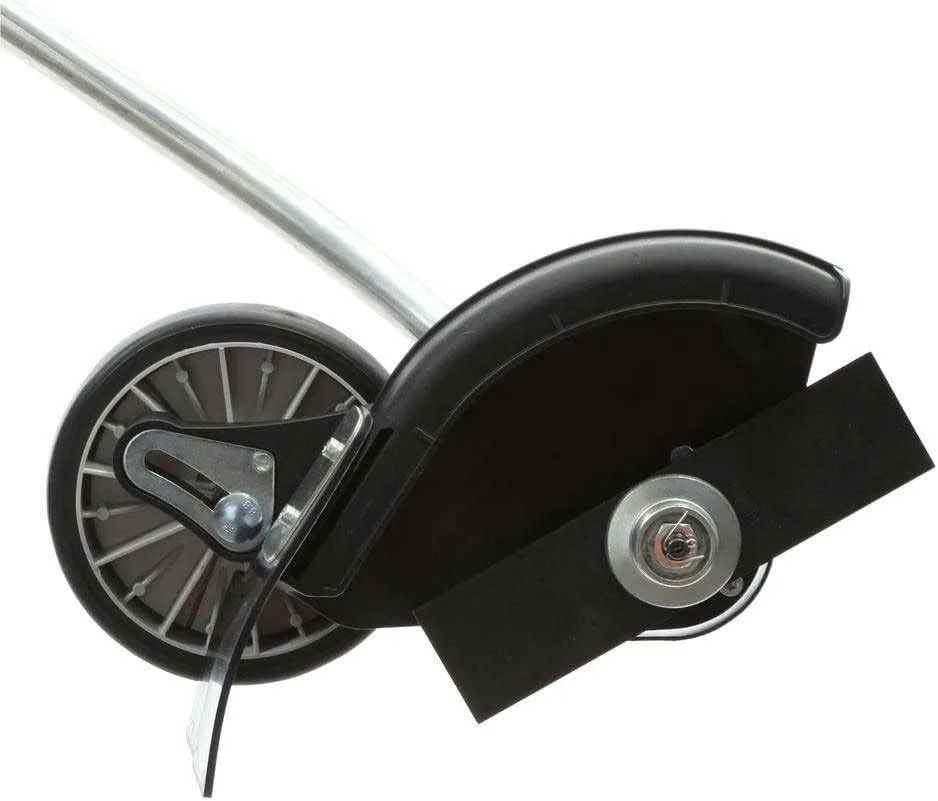
Plan the route so the unit stays on your right side and you walk on the hard surface, as the manual says. Blade height may need a small change where the paving sits higher than the turf, and you make it only with the engine stopped, the blade still and the spark plug wire off.
The muffler and the drive shaft get very hot, ECHO warns, and the blade can strike sparks off a stone or a piece of metal. I wear eye protection that meets ANSI Z87.1, ear protection, long pants, close-fitting sleeves, boots and gloves every time, and people and pets stay at least 50 ft back, and I stop the engine if anyone comes closer.
A label on the unit says no use in gravel, so I keep it to turf and soil and never run it along the gravel yard edge. Before I touch the blade or clear it, I switch off, wait until the blade has stopped, disconnect the spark plug wire and let the engine cool. For storage over 30 days ECHO says to drain the tank, run the engine until it stops and put 7 cc of fresh two-stroke oil in the cylinder. ECHO publishes no noise, vibration or run time per tank for this model, so I plan breaks and wear ear protection throughout.
Buy it if you have long lawn edges, want one dedicated gas tool and already handle two-stroke fuel. Skip it if you want a tilting blade, a curb wheel, a quiet tool or a battery tool, or if your edge runs along gravel.
FINAL VERDICT
The PE-225 is the gas stick edger to buy for long edges that you cut often with one dedicated tool. You give up a tilting head and a curb guide, and you get a 5-year consumer warranty and a manual that covers every step.
It is the gas stick edger I recommend to most lawn owners.
2. McLane 101-5.50GT-7 Gas Walk-Behind Edger Best Premium
The McLane 101-5.50GT-7 is the premium pick because it is a four-wheel gas walk behind edger with a built-in curb riding position and a head that tilts for a 20 degree bed cut. The listing says it is made in the USA, and it sits in the premium price tier. It carries a 9 in spring steel blade and a 3.5 hp Briggs & Stratton engine, and the manual calls it an edger-trimmer because the head also turns horizontal.

WHY I CHOSE THIS ✓
I ranked it second because it puts a wheeled frame, a curb riding position and a tilting head on one machine, and the listing says it is built in the USA. It is the premium choice for long edges along a pad, a path or a bed.
McLane 101-5.50GT-7 Gas Walk-Behind Edger Specs
Key Features:
- Curb riding position: remove the spacer between the front wheels, slide the right wheel next to the left and put the spacer on the frame side, and the pair rides the hard edge for vertical cuts.
- Tilting cutterhead: one lever sets the blade horizontal for trimming or at several vertical positions for edging, and the manual suggests 20 degrees around flowers.
- Clutch and depth lever: one lever engages the drive belt and sets the depth in notches, and you start the engine with it in the rear, disengaged position.
- 9 in spring steel blade: it is 2 in wide, and McLane sells the replacement blade in a 3-pack.
- Blade guard, belt guards and debris guard: the manual says never to run the machine without all three in place.
- Walking-pace design: the manual says to push at a moderate walking speed and states that the machine is designed to cut more than 100 ft per minute.
- Optional curb wheel attachment: part 2101 adds a height-adjustable wheel that rides on the road surface, and it is sold separately.
Along the concrete work pad I moved the spacer to the curb riding position, and the front wheels rode the slab edge while the blade stayed vertical. Next to a stick edger, where I steer the blade with my wrists, the wheeled frame held the line by itself and I only had to push. The manual says to keep a moderate walking speed. Let the blade work at its own pace and stop it before you cross gravel, a walk or a road.
Beside the vegetable plot I tilted the head to 20 degrees, the angle the manual suggests for flowers, to cut a sloped edge toward the packed path. What surprised me was how much the wheel position mattered: to turn around a bed curve, the manual has you slide the front wheels together and lift the rear wheels slightly. Before any wheel change, stop the engine, wait for the blade to stop and pull the spark plug wire, and follow the manual’s steps.
With the head turned horizontal and the wheels moved to the right, the machine trims along the strip where grass creeps toward the tilled soil. It works, but every change from edging to trimming is a manual swap of the spacer and the wheels, and the manual says never to do it with the engine running, so the full stop comes first. McLane publishes no weight, so I check where I will store it before I buy a machine of this size. Set the depth for 1/2 to 1 in: the manual warns that too deep stresses the engine and wears the blade, and too shallow lets the roots regrow.

Start the engine with the lever in the rear position, and check at assembly that the blade does not turn with the lever in the top notch. Re-adjust the depth as the blade wears at the tips.
Never run it in a closed shed or garage, even with the door open, because the exhaust carries carbon monoxide, and fill the tank outdoors with the engine off and cool. McLane gives no bystander distance, so I keep people and pets well clear, never aim the discharge toward anyone, and wear eye protection, ear protection, long pants, boots and gloves.
The oil goes in the crankcase and never in the gasoline, and McLane says to check the oil level every time you use the machine. For fuel grade and oil grade the manual sends you to the Briggs & Stratton engine manual, so read that before the first start. Storage means draining the tank, running the engine until it stops, refilling the crankcase with fresh oil and putting an ounce of oil in the cylinder. This McLane gas edger has no spark arrestor muffler, which matters on California brush or grass land, and the warranty is one year, with 60 days for commercial use.
Choose it if you edge long, straight runs along a pad, a path or a bed and want wheels to hold the line. Skip it if you have a small yard, tight bed outlines or a need for a light tool, and skip it if you want a battery or a quiet machine.
FINAL VERDICT
The McLane is the premium choice when the edge is long and straight and you want wheels, a curb position and a tilting head on one frame. It asks for storage space, a wheel swap when the job changes and a read of the engine manual, and in return it handles the long runs without steering.
It is the walk-behind I pick for long, straight edges.
3. Earthquake 41273 79cc 4-Cycle Walk-Behind Edger Best Value
The Earthquake 41273 is my value pick among the gas walk-behinds, because a 79 cc four-cycle engine, a tilting head and a 5-year product and engine warranty come at a mid-range price. Earthquake says the engine needs no mixing of gas and oil. It is built for long, straight edges along flower beds, terraces, sidewalks and curbs, and at 57 lb net it weighs far more than a stick edger.

WHY I CHOSE THIS ✓
I rank it third as the value pick because the price buys a large engine, a tilting head and a long warranty, and nothing on the machine asks for fuel mixing. For long, straight edges it is my best gas lawn edger for the money, and a small yard does not need this much machine.
Earthquake 41273 79cc 4-Cycle Walk-Behind Edger Specs
Key Features:
- 79 cc Viper four-cycle engine: it has a recoil start and 3.3 ft-lb of maximum torque, according to the manual, and oil goes in the crankcase.
- No fuel mixing: you fill the tank with fuel and check the oil before starting, so there is no ratio to measure.
- Tilting cutting head: a handle adjusts the blade 20 and 10 degrees either side of vertical, which gives five positions for a beveled cut at a bed.
- Blade depth control lever: it sits on the left of the upper handle, and the further forward you push it the deeper the blade cuts, with 10 positions per the maker.
- Throttle and centrifugal clutch: the throttle on the right handle starts the blade, and the blade stops turning when you release it and the engine drops to idle.
- Debris guard: the maker lists a guard with chains, and the manual says never to run the machine without its guards.
- 5-year warranty: it covers the product and the engine, provided the registration reaches Earthquake within 30 days of purchase.
Along the concrete work pad the sod was thick, so I took the manual’s advice for a new edge: several passes, each one a notch deeper, with the left rear wheel on the hard surface and the blade close to the edge but not touching it. Let the blade reach full speed before you lower it, and never lower it over concrete, asphalt or rocks, because it can strike the surface and hurt you. Two things kept the cut clean: a slow forward and backward pace, and dry grass, since the manual says never to operate in wet grass.
The engine is the easy part of ownership. There is no mix to measure, only fuel and a crankcase to keep topped up, and the maker lists 10W-30 oil with a capacity of 11.83 fl oz. I check the oil before every start, as the manual stresses, and I stand the machine on level ground, since the manual limits it to slopes under 15 degrees. Earthquake says the four-wheel design tracks straight.
The weight decides how you live with it. At 57 lb net, with fuel and oil adding more, that is more than four times what the stick edgers here list before fuel, so plan how you will lift and move it, because the manual says to move the packaged machine with a partner. Before I cut the strip border I lift or mark the drip lines, because the machine cuts soil and the manual says never to edge above underground utilities such as water lines, gas lines or cables. I call 811 before any cutting into soil, and I keep the engine at least 3 ft from buildings while it runs.
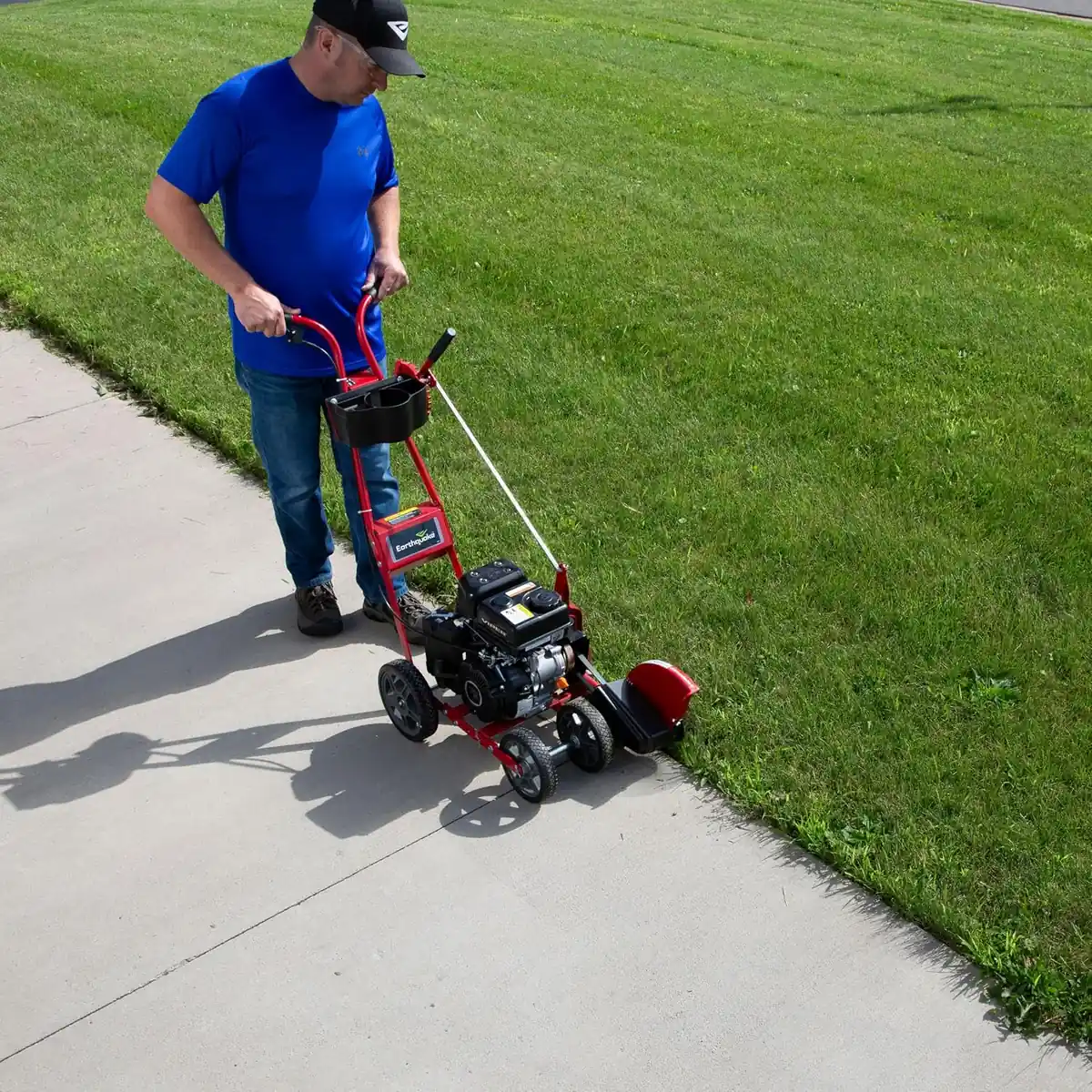
Raise the depth lever to the top position when you travel between edging areas, and keep the blade off hard surfaces on the way.
The muffler area can exceed 150 degrees F (65 degrees C), so keep dry grass and other material away from the muffler guard and never remove the guard. Wear goggles or glasses with side shields, ear protection, work gloves, long trousers and safety shoes, keep the area clear of people, never run the engine in an enclosed or partly enclosed space, and fill the tank outdoors with the engine off and cool.
For storage of 30 days or more, add fuel stabilizer, run the engine 10 to 15 minutes, then drain the rest of the fuel into an approved container. Oil changes, the spark plug and the air filter follow the engine’s own manual, and you register the warranty within 30 days or only the emissions items stay covered. Before any blade work or head adjustment, stop the engine, wait for the blade to stop, pull the spark plug wire and let the engine cool. The maker’s figures disagree in places: the manual prints a depth of 3.5 in and the page says 2.5 in, so I plan for the shallower number.
Pick it if you have long, straight edges along a walk or a bed, want a tilting head and prefer to skip the fuel mix. Skip it if your yard is small, your edges curve tightly, you need a machine you can carry, or the ground slopes more than 15 degrees.
FINAL VERDICT
The Earthquake 41273 gives the most engine, a tilting head and a 5-year warranty for a mid-range price. You pay in weight and storage space, so buy it for long straight edges and leave it if your edges are short.
It is the walk-behind I recommend when a long edge is the whole job.
4. ECHO PAS-225VP Gas Trimmer and Edger Kit Best 2-in-1 Trimmer and Edger
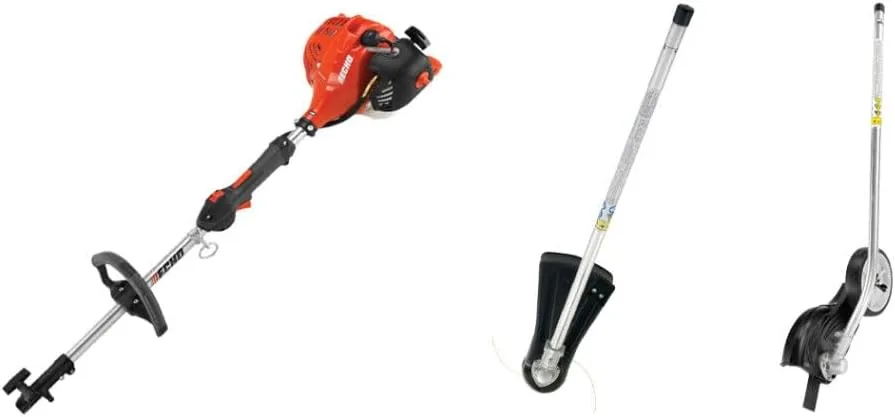
The ECHO PAS-225VP is the gas trimmer edger kit for an owner who wants one 21.2 cc power head that runs both a string trimmer and a curved-shaft edger. The box holds the power head, a Speed-Feed 400 trimmer attachment and the edger attachment, and ECHO gives the kit a 5-year consumer warranty. It sits in the premium price tier.
WHY I CHOSE THIS ✓
I rank it fourth for the owner who wants one engine for the edging and the trimming, a gas powered trimmer edger that swaps heads at the lawn edge. The saving is the second engine you do not buy.
ECHO PAS-225VP Gas Trimmer and Edger Kit Specs
Key Features:
- Two attachments in one box: the Speed-Feed 400 trimmer head and the curved-shaft edger share one power head and one fuel.
- Tool-less coupler: a quarter-turn pin and a clamping knob hold each attachment.
- Twelve compatible attachments: ECHO says the power head pairs with up to 12 PAS attachments.
- Open, anti-clog shield: the edger’s plastic shield is open-faced.
- 5-year consumer warranty: commercial use is covered for 2 years.
At the edge of the work pad I changed from the trimmer to the edger with the quarter-turn pin and the clamping knob, and the swap took less effort than I expected. The edger works like ECHO’s stand-alone model: set the guide wheel for about half an inch of blade, walk on the hard surface and lower the blade gently at full throttle. Stop the engine, wait for every part to stop, pull the spark plug wire and let it cool before each swap.
With the edger on, the parts add up to about 14.5 lb, the 9.3 lb power head plus the 5.17 lb edger attachment, and the weight hangs at the end of a long shaft. After a whole lawn border I noticed it in my shoulders more than in my hands. ECHO publishes no noise or vibration figure for the edger, so I plan breaks and wear ear protection.
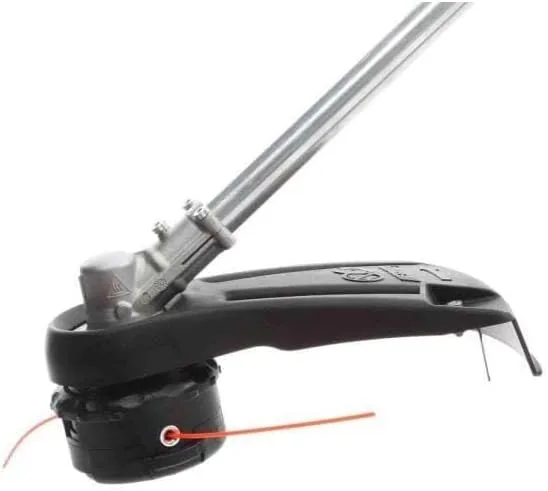
Only ECHO attachments approved for the PAS power head fit, so check the fit list before you buy an extra one. If you are weighing this gas kit against a battery one, my comparison of EGO MHC1603 versus ECHO PAS-225VP lays out the difference.
The blade turns the moment a cold engine fires with the trigger held, so I lay the unit flat with the blade clear before the first pull. The muffler and gear case get very hot, so I wear gloves, eye and ear protection and keep people and pets at least 50 ft away.
The mix is 50:1 with fresh 89 octane gasoline and an approved two-stroke oil, used within 30 days, or 90 with a stabilizer. Fill outdoors and move at least 10 ft from the fuelling spot before you start. Before I touch the blade I switch off, wait until it has stopped, pull the spark plug wire and let the engine cool.
It fits an owner who wants one gas power head for trimming and edging. Skip it if you only want an edger, a tilting head or a curb wheel.
FINAL VERDICT
The PAS-225VP is the kit to buy when you want a gas trimmer and an edger from one engine. You carry 14.5 lb of edger on a long shaft, so choose it for the two jobs and not for a very long edge.
It is the one-engine kit for a trimmer and an edger.
5. Husqvarna 525ECS Professional Gas Stick Edger Best Professional
The Husqvarna 525ECS is the pick for an owner who wants a single-purpose gas stick edger with a professional-grade design. Husqvarna’s page says it is designed for professional use, and the manual says the machine is only designed for edging lawns. It has a 25.4 cc X-Torq engine, a curved shaft and a stand-alone starter.

WHY I CHOSE THIS ✓
I rank it fifth as the professional pick because Husqvarna designs it for professional use and lists a 300 hour emissions durability period. The manual sets out no professional duty cycle, so treat the label as the maker’s positioning.
Husqvarna 525ECS Professional Gas Stick Edger Specs
Key Features:
- X-Torq 25.4 cc engine: the manual lists about 1.0 kW at 8,500 rpm.
- Curved shaft and loop handle: you hold the machine with both hands on the right side of your body.
- Auto-return stop switch: it returns to the start position by itself.
- Blade guard: it is meant to stop loose objects flying toward you.
- Vibration damping system: the manual lists 9.1 m/s2 at the rear handle and 4.2 m/s2 at the front at maximum speed.
I noticed that the blade keeps turning after the engine stops, as the manual warns. Husqvarna says to stop the blade by letting it touch the ground, so I made that part of my routine along the lawn edge. At 94 dB(A) at the operator’s ear, per Husqvarna, it is also a loud tool, and I wear ear protection from the first pull.
The blade starts to turn at once if the engine starts with the choke in the choke or start position, so clear it before every pull. At the edge, work at full throttle with the blade close to the ground, and return to idle between jobs, because long periods at full throttle without load can damage the engine.
Along the vegetable plot edge I watched where the soil went and left the guard alone, because it stops thrown objects. After a long border my hands felt the vibration, which Husqvarna lists at 9.1 m/s2 at the rear handle at maximum speed, and I hold the machine with both hands on the right side of my body.
The catalytic muffler stays very hot, also at idle, so keep it away from dry grass. People and animals stay at least 50 ft away, I stop the machine at once if someone comes closer, and eye protection to ANSI Z87.1, ear protection, gloves, heavy long pants and steel-toe, non-slip boots go on every time.
The mix is 50:1 with Husqvarna two-stroke oil and gasoline of at least 87 octane, E10 at most, and no more than a month’s fuel at a time. Before I clean, inspect or change the blade, I switch off, wait for the blade to stop and pull the spark plug cap. The manual gives no standard warranty period, so check it before you buy.
It suits an owner who wants a dedicated gas stick edger from a maker with a professional line and accepts the mix and the noise. Skip it if you want a published cutting depth, a guide wheel, a light or quiet tool or a tool that also trims. A side-by-side with ECHO’s gas stick edger is in my comparison of ECHO PE-225 versus Husqvarna 525ECS.
FINAL VERDICT
The 525ECS suits an owner who wants a dedicated professional-grade gas edger and is happy to set the depth by eye. Check the warranty terms before you order.
It is the professional-grade gas stick edger for one job.
How to Choose the Best Gas Lawn Edger
Six checks sort a good gas powered lawn edger from a poor fit. Start with the format, because it decides weight, storage and how tight a curve you can cut. Then check the engine and its fuel, the blade and depth, the noise and the safety steps in the manual of your machine.
Stick Edger or Walk-Behind Edger
A gas powered stick edger is a long shaft with the engine at the top and the blade at the bottom, and you carry it along the edge. A walk-behind rolls on four wheels and you push it. A stick edger goes wherever you can walk, and a walk-behind holds a straight line on a long run. A kit sits between them, with one power head and an edger attachment. I put two gas walk-behinds head to head in my comparison of McLane vs Earthquake 41273.
| Format | Listed weight | How you use it |
|---|---|---|
| Stick edger | 13.1 to 13.9 lb before fuel | Carry it along the edge |
| Kit with the edger on | About 14.5 lb before fuel, from a 9.3 lb power head and a 5.17 lb attachment | Carry it and swap heads |
| Walk-behind | 57 lb net on the one that lists a weight | Push it on four wheels |
Check whether the maker counts fuel, the blade or the attachment in a weight, because the bases differ, and one walk-behind lists no weight at all. I carry a stick edger along the house lawn border without trouble for a while, and then the weight starts to tell. A gas walk behind edger spares my arms and costs me storage space, and it needs room to turn on a tight curve.
I check the weight before I check the engine, because a machine I cannot lift is a machine I will not use. The best gas edger for lawn borders is one you can lift, start and store. My comparison of ECHO PE-225 vs Earthquake 41273 shows how far weight changes the choice between a stick edger and a walk-behind.
Engine Type and Fuel Mix
Most gas stick edgers run a two-stroke engine on mixed fuel. According to ECHO, the mix is 50:1, which is 2.6 fl oz of two-stroke oil per US gallon of gasoline, and Husqvarna’s table gives 2 1/2 fl oz per gallon. A 4-cycle gas edger keeps its oil in the crankcase and runs on plain fuel, and Earthquake says its engine needs no mixing of gas and oil. My Earthquake edger review covers that 4-cycle engine in more detail.
| Engine | What goes in the tank | Oil |
|---|---|---|
| Two-stroke, per ECHO | 89 octane gasoline mixed 50:1 with approved two-stroke oil, used within 30 days | Mixed into the fuel |
| Two-stroke, per Husqvarna | Gasoline of at least 87 octane, E10 at most, mixed 50:1, one month’s supply | Mixed into the fuel |
| Four-cycle, per Earthquake | Fuel with no mixing | In the crankcase, checked before every start |
Follow the mix and the oil in the manual of your machine, because the ratio, the oil standard and the fuel limits differ by maker, and the wrong oil can void a two-stroke warranty. I measure the mix the way I do for my other two-stroke tools and write the date on the can.
Pro Tip
ECHO’s manual says to mix no more fuel than you will use in 30 days, or 90 days with a stabilizer, and to shake the can before every fill.
Blade, Depth and Guide Wheel
The blade is a flat steel disc or bar that stands on edge, and the depth you set decides how much soil it cuts. Manuals list 7.75 in blades on the stick edgers and 9 in blades on the walk-behinds, and one maker names its blade by a code instead of an inch size.
- Depth: ECHO’s manual calls about 0.5 in of blade in the ground optimal, and McLane’s manual says 1/2 to 1 in gives the best results.
- Passes: for a new edge, Earthquake’s manual says to lower the depth in steps and make several passes.
- Wheels: a guide wheel sets the depth on a stick edger, and a walk-behind rolls on four wheels, with a curb riding position on one of them.
- Tilt: two walk-behinds tilt the head for a beveled cut at a bed, one to 20 degrees and one 20 and 10 degrees either side of vertical.
On a gas sidewalk edger the wheel rides the hard surface and the blade stays close to the edge without touching it. Maximum depths are not comparable between makers, so read each figure as that maker’s own for that machine. I start shallow on the pad edge and go deeper only on the strip border. For concrete edges, I compare seven options in my roundup of lawn edgers for sidewalk edges.
Key Takeaway
Set the shallowest depth that does the job. McLane’s manual says too deep strains the engine and wears the blade, and too shallow lets the roots regrow.
Kit or Single-Purpose Edger
A gas powered trimmer edger kit gives you one engine and two attachments, while a single-purpose edger gives you a simpler tool for one job. Only attachments approved for that power head fit. A string trimmer turned on its side can edge, and it makes a different cut from a blade edger.
- Kit: one fuel can, one engine to service and a head swap at the edge.
- Single-purpose: a shaft and shield built for edging only.
- Fit: the maker of the kit says to use only its own approved attachments.
I like one engine on my land, because every extra engine is another machine to fuel and service. A gas edger and trimmer from one power head also leaves one fewer machine to store.
Noise, Vibration and Hearing Protection
A gas edger is loud and it vibrates. Only one maker here publishes a noise figure, 94 dB(A) at the operator’s ear, and the same maker lists vibration of 9.1 m/s2 at the rear handle and 4.2 m/s2 at the front at maximum speed. The others publish neither, so plan for protection anyway. If you are considering switching from gas, my roundup of cordless battery powered lawn edgers compares seven options.
In NIOSH personal sampling of 80 landscaping workers, noise and carbon monoxide exposure were significantly higher with fuel-powered blowers, string trimmers and chainsaws than with battery versions (1). NIOSH recommends a limit of 85 dBA over an eight-hour day and halving the exposure time for each 3 dBA increase (2).
In a study of 17 groundskeepers, lifetime hand-arm vibration dose was 33 times that of office workers for the right hand (3). I wear ear protection from the first pull, take breaks along a long border and keep both hands on the handles as the manual shows.
- Hearing: plugs and earmuffs together give the most protection, and the manuals ask for hearing protection on every use.
- Hands: gloves, breaks and the grip your manual shows matter more than any single vibration figure.
- Figures: check the standard and where a number was taken before you compare two of them.
Safety Steps Before Every Cut
An edger throws soil and stones and cuts into the ground, so the safety steps matter more than any spec. In a review of US emergency department data on lawn trimmer injuries from 2000 to 2009, the eye accounted for 42.5 percent of injuries and most came from foreign objects (4). An edger throws soil and stone as well, so eye protection with side coverage that meets ANSI Z87.1 goes on first.
In the EPA’s study of operators of lawn and garden equipment, ten-second carbon monoxide exposures exceeded 120 ppm for some engine applications (5). That is why a gas edger never runs in a shed or a garage, even with the door open.
- Switch off the engine.
- Wait until the blade has stopped.
- Pull the spark plug wire.
- Let the engine cool.
- Wear gloves, then touch the blade.
Keep bystanders and pets at the distance your manual gives. ECHO and Husqvarna say 50 ft, and McLane and Earthquake give no figure, so I keep people well clear and stop the machine when anyone comes close. One maker warns that its blade keeps turning after the engine stops, and a blade that turns at idle means you do not use the machine. My review of the McLane edger shows how that gas walk-behind works in use.
Call 811 before you edge or trench into soil, and follow the locating process it starts. It covers public utilities, so I mark my own drip, sprinkler and lighting lines before I edge.
Never Indoors
Never start or run a gas edger in a shed, a garage or any closed space, even with the door open. Fuel it outdoors with the engine off and cool, and move away from the fuel spot by the distance your manual gives before you start. ECHO says 10 ft, and its label says no use in gravel.
My Overall Verdict
The best gas powered edger depends on weight, engine, depth control and what each machine asks of you, and I ranked these five on those four. The top three suit three different edges. If gas is not a firm requirement, my ranking of lawn edgers of every type covers corded and battery models too.

1. ECHO PE-225 Curved-Shaft Gas Stick Edger Best Overall
For long lawn edges that one person cuts often and who already mixes two-stroke fuel.

2. McLane 101-5.50GT-7 Gas Walk-Behind Edger Best Premium
For long, straight edges along a pad, a path or a bed, where wheels and a curb riding position hold the line.

3. Earthquake 41273 79cc 4-Cycle Walk-Behind Edger Best Value
For a long edge when you want a large four-cycle engine, a tilting head and a long warranty at a mid-range price.
Pick the format first, then check the fuel and the weight against how you work. Stick edgers carry, walk-behinds roll, and every one runs outdoors only, with the safety steps in its manual. For most lawn borders, the PE-225 is the best gas lawn edger on this page.
Why ECHO PE-225 Curved-Shaft Gas Stick Edger Might Be the Best Choice
I put the ECHO PE-225 gas edger first because it is a dedicated gas stick edger with a 5-year consumer warranty, and it does the one job I buy an edger for. On a long lawn edge it earned first place, and the manual explains every step.
The trade-off is the fuel and the single depth control. It needs a 50:1 mix, the guide wheel is its only depth setting and ECHO publishes no maximum depth, so it suits regular edging better than a first cut through an overgrown edge.
Here is what the PE-225 gives you:
✓ A 7.75 in blade on a 21.2 cc two-stroke engine.
✓ A guide wheel that sets the depth with one knob.
✓ A molded nylon debris shield over the blade.
✓ A 5-year consumer warranty, and 2 years for commercial use.
✓ A manual with the mix table and the storage steps.
Frequently Asked Questions
What is the best gas lawn edger to buy?
The best gas lawn edger to buy for most lawn borders is the ECHO PE-225, a dedicated stick edger with a 7.75 in blade and a 5-year consumer warranty. Choose a walk-behind if your edges are long and straight and you can store a heavy machine, and choose a kit if you also need a trimmer.
How much does a gas edger cost?
A gas edger costs from the mid-range tier for a dedicated stick edger or a 79 cc walk-behind to the premium tier for a trimmer kit or the largest walk-behind. Add the cost of two-stroke oil or engine oil and a fuel can, and compare the current prices on the listings before you order.
What engine size do I need in a gas edger?
The engine size you need in a gas edger follows the format: the stick edgers here run 21.2 cc and 25.4 cc two-stroke engines, and the walk-behinds run a 3.5 hp engine and a 79 cc four-cycle engine. Match the format to your edge first, then read the maker’s cc or horsepower and its fuel rules.
Does a gas edger need mixed fuel?
A gas edger needs mixed fuel when it has a two-stroke engine, and ECHO and Husqvarna both call for a 50:1 mix of gasoline and two-stroke oil. A four-cycle engine keeps its oil in the crankcase, so Earthquake says its walk-behind needs no mixing, and your manual names the fuel and oil to use.
How heavy is a gas edger?
A gas edger weighs about 13 lb for a stick edger before fuel and 57 lb net for the one walk-behind that lists a weight. A kit with its edger on adds up to about 14.5 lb, so choose a stick edger if you carry it along the edge and a walk-behind if wheels will carry it.
References
- Alexander BM, Graydon PS, Pena M, Feng HA, Beamer BR. Hazardous exposures and engineering controls in the landscaping services industry. Journal of Occupational and Environmental Hygiene. 2025;22(3):189-202.
- National Institute for Occupational Safety and Health. Noise-Induced Hearing Loss. Noise and Hearing Loss. Centers for Disease Control and Prevention; 2024.
- Chen N, Yang S, Oh J. Evaluation of hand-arm vibration (HAV) exposure among groundskeepers in the southeastern United States. Annals of Work Exposures and Health. 2025;69(1):81-95.
- Leinert J, Griffin R, Blackburn J, McGwin G. The epidemiology of lawn trimmer injuries in the United States: 2000-2009. J Safety Res. 2012;43(2):137-139. doi:10.1016/j.jsr.2012.03.001
- Baldauf R, Fortune C, Weinstein J, Wheeler M, Blanchard F. Air contaminant exposures during the operation of lawn and garden equipment. J Expo Sci Environ Epidemiol. 2006;16(4):362-370. doi:10.1038/sj.jes.7500471
Safety Note: Read your manual first. An edger can throw stones, soil and other debris with force, so remove loose stones, glass, wire and other objects before you start, keep the blade guard in place, and never edge in or near gravel or let the blade strike pavement or rocks on purpose. Wear impact-rated eye protection with side coverage that meets ANSI Z87.1, hearing protection, gloves, long pants, close-fitting long sleeves and sturdy slip-resistant boots. Keep people and pets at least as far away as your manual says (50 feet in some manuals, 100 feet in others), and stop if anyone comes closer. Use only the blade your manual lists for your exact edger or attachment, and fit an attachment only to a power head its maker approves, with the coupling fully locked. Before each use, with the tool switched off, all movement stopped and the battery removed, the cord unplugged or the spark plug wire disconnected (a gas engine cooled), check the blade, its bolts and the guard, and replace a cracked, bent or badly worn blade as your manual says; never sharpen a blade unless that manual allows it. Start the tool in the position your manual shows, with the blade clear of the ground, and let it reach full speed before you ease it into the cut. The blade can push the tool sideways when it hits concrete, a stone or a root, so hold both handles, keep firm footing and never force the cut. After the blade strikes something or the tool starts to vibrate, switch it off, wait for all movement to stop, disconnect the power the same way and inspect it before you go on. Before you clear a jam, change depth, clean the tool, fit or remove an attachment, or inspect or replace the blade, stop the motor or shut off the engine, wait for all movement to stop, then remove the battery, unplug the cord or disconnect the spark plug wire. On a gas edger, releasing the blade control can leave the engine running, and a blade that turns at idle means the edger must not be used until it is repaired. An edger cuts into the soil: in the US, contact 811 before you edge or trench into soil, and mark sprinkler lines, drip lines, landscape lighting wire and other private lines, which 811 may not locate. Refuel a gas model outdoors with the engine off and cool, away from flames or sparks, and move as far from the fueling spot as your manual says before starting; start and run it outdoors only, never in a garage, shed or other closed space, even with the door open. For a battery model, use only the battery and charger approved for your tool, charge and store them within the temperature range in your manual, and never use a damaged or swollen pack. For a corded model, use an undamaged outdoor extension cord of the gauge and length your manual gives, plugged into a GFCI outlet, keep the cord clear of the blade, the wheels and your feet, and avoid wet conditions.