
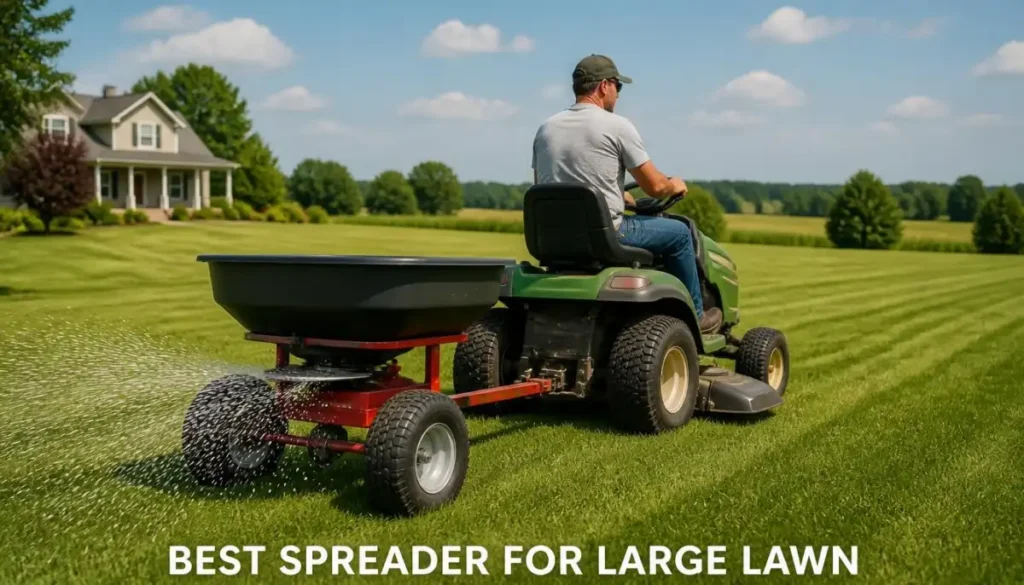
The best spreader for large lawn work carries a big hopper, rolls on pneumatic tires and shuts its gate on command, and its maker’s manual tells you how to run it. I am an agricultural engineer trained in plant protection, and I keep a 3.7-acre orchard and the lawns around the family house.
Affiliate Disclosure: Garden Power Scout is a proud participant in the Amazon Services LLC Associates Program. As an Amazon Associate, we earn from qualifying purchases, at no extra cost to you.
I put seven big-hopper spreaders through the checks that matter on a big lawn: hopper, wheels, gate and care. My top pick, Agri-Fab 45-0463 130 lb Tow-Behind Broadcast Spreader, is a tow-behind with a 130 lb hopper, and six push models follow it.
Best Spreader for Large Lawn 2026: 7 Models I Put to Work
These seven cover one tow-behind and six push spreaders, from a 40 lb hopper to a 130 lb hopper. Each review gives the hopper, the gate, the wheels and the care as the maker prints them, and says who should skip it.
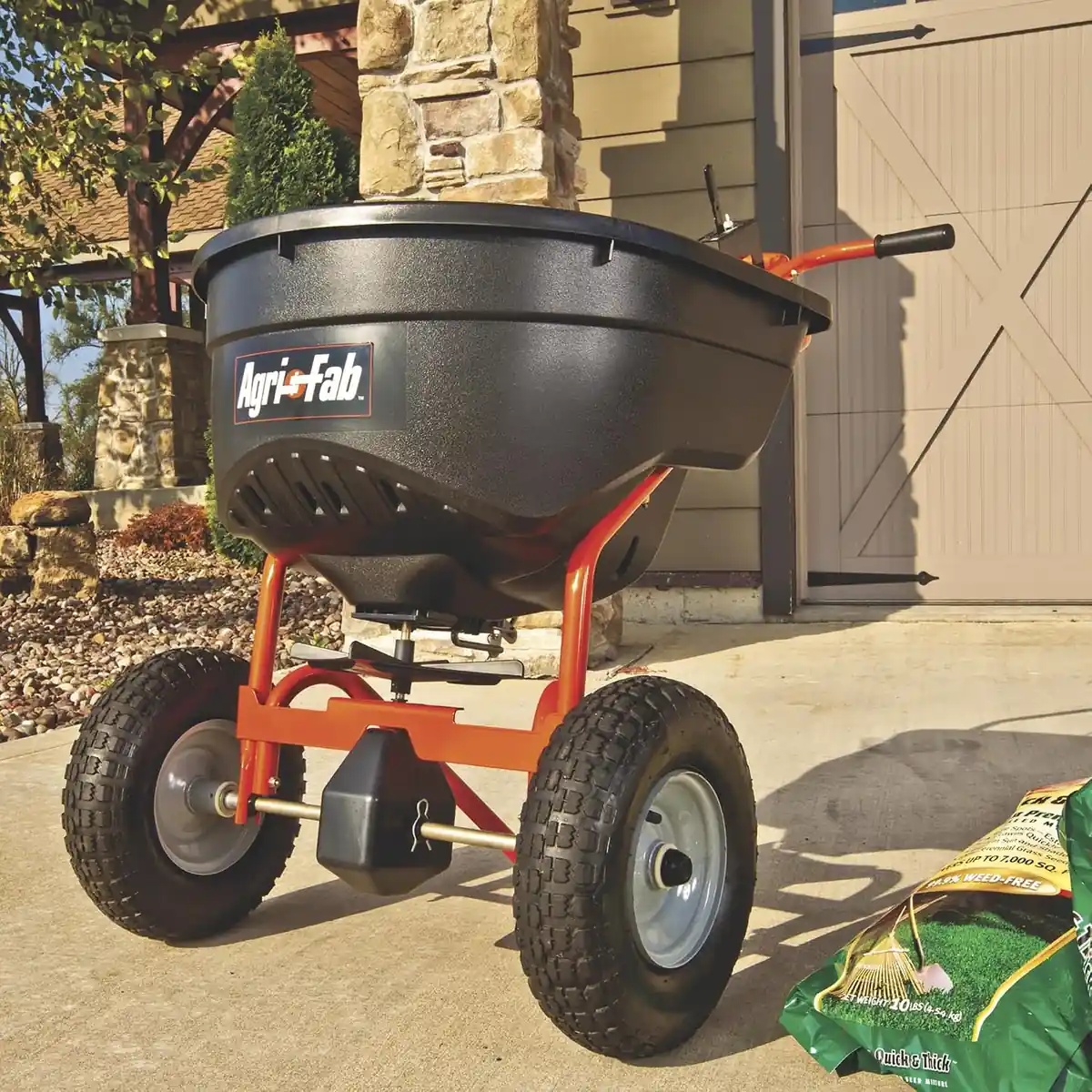
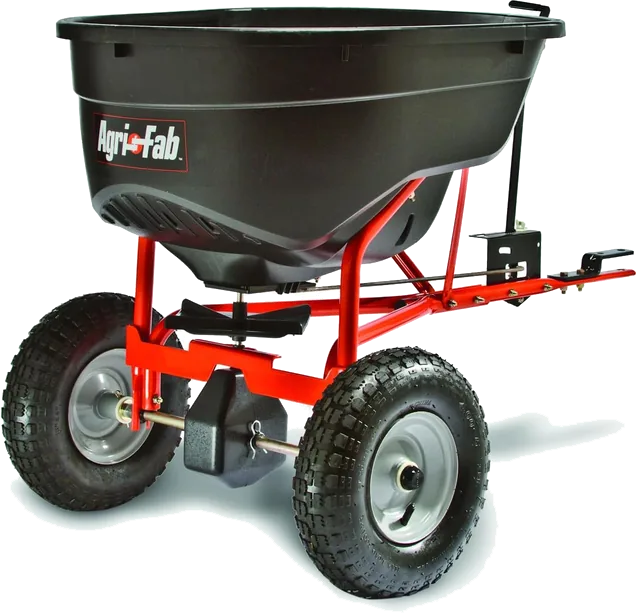
1. Agri-Fab 45-0463 130 lb Tow-Behind Broadcast Spreader Best Overall
The Agri-Fab 45-0463 takes the walking out of a big job. It is a tow-behind broadcast spreader with a 130 lb hopper, a universal hitch and a steel rod that works the gate from the seat of the towing vehicle. Its manual prints a towing speed limit, which no other manual on this page does, and I put it first for a lawn where a push spreader means constant refills.

WHY I CHOSE THIS ✓
The 45-0463 sits first because it is the only tow-behind on this page, and its manual states its own limits instead of leaving them to a sales page. A 130 lb hopper behind a vehicle is the plain answer to a lawn that wears out a push handle. The trade-off is the documentation: the manual has no stop-and-make-safe order and no clearing method, so I follow the safe-state box in the safety section below before every hands-on step.
Agri-Fab 45-0463 130 lb Tow-Behind Broadcast Spreader Specs
Key Features:
- 130 lb hopper: the maker prints it on the manual cover, and a bigger load per fill means fewer stops at the bag. The manual prints no fill level, so I treat 130 lb as a ceiling.
- Steel flow control rod: a rod and control arm reach from the flow plate to the vehicle seat, so you open and close the gate without climbing down.
- Locking notch: the manual says to push the arm over into the notch for the off position, which keeps the gate shut while you turn.
- Adjustable stop on a wing nut: it limits how far the plate opens. The manual’s chart and the product label give the starting point, never a promise.
- Universal hitch: a hitch tube, bracket and pin secured with a hairpin cotter. Your vehicle’s manual says what it may tow.
- Pneumatic tires: the listing gives 13 in x 4 in, and the manual asks you to check inflation before each use.
- Three-year household term: the original purchaser is covered at home for three years, with wheels, bearings and plastic gearboxes excluded after year one.
A ground-driven spreader turns its plate only while the wheels turn, so the gate opens after the vehicle is moving and closes before it slows. Agri-Fab’s manual for this model says the same in two lines: start the tractor in motion before opening the flow plate, and close the flow plate before turning or stopping. It begins in first gear at low engine speed and caps towing speed at 6 mph, with a warning that more speed may wear the spreader gears.
The manual prints no hitch rating, no tongue weight and no slope angle. It tells you to read the towing vehicle’s owner’s manual and to know how to operate the tractor before you use the spreader, and I treat that manual as the real limit. It also warns that braking and stability can change with an attachment, to stay off steep slopes and to keep away from a creek or ditch edge, where holes can cost you control.
What surprised me was how much of the build is alignment. The manual runs 17 steps with a hammer, pliers and four wrenches, and most early bolts stay loose until the hitch tubes, hopper supports and cross brace sit square. The last steps set the control bracket so the flow plate opens about half way at the stop and closes completely, and I run that open-and-close check every time. The manual prints no weight, so I cannot tell you how heavy the frame is to lift into a shed.

Check the tire valve and the inflation line before the first fill of the season. The manual asks for it before each use and says never to go past the maximum pressure printed on the tire.
Agri-Fab’s manual asks for eye and hand protection when you handle and apply lawn or garden chemicals, and for substantial footwear when you operate the tractor and spreader. It prints no shutdown order, so before you reach into the hopper, touch the impeller or open the gearbox, complete the tow-behind steps in the safe-state box in the safety section below.
Before you rinse, grease or open anything, complete the tow-behind steps in the safe-state box. The manual’s care is short: rinse the inside of the hopper and the outside of the spreader only as the product label and the manual both permit, let it dry and store it in a clean, dry area, and keep wash water out of drains. The gear lubrication step opens the gearbox by three clips and greases the gears lightly, and the manual says to mark every part’s position. The hopper cover is an optional part, not in the box, and the manual does not recommend powdered lawn chemicals.
Pick the 45-0463 for a lawn where a push spreader means too many refills and where your vehicle’s manual allows a towed spreader of this size. Skip it for small lawns, tight beds and ground that the vehicle’s manual rules out, and skip it if you want a weight figure before you buy, because the maker prints none.
FINAL VERDICT
The Agri-Fab 45-0463 is the tow-behind I recommend for a large lawn: a printed 130 lb hopper, a rod gate and a manual that states its own towing speed limit. Read the vehicle’s manual and the safety section on this page before the first fill. Buy it when the lawn is big and the vehicle’s manual allows the load.
It is the tow-behind spreader I put first for a big lawn.
2. Chapin 8400C 100 lb Professional SureSpread Push Spreader Best Premium
The Chapin 8400C rolls on the largest wheels on this page: 14-inch pneumatic tires, as the listing prints them. It is a 100 lb push broadcast spreader with a stainless steel frame and linkage, and a hopper grate and rain cover are in the kit. I recommend it for a large lawn where a tall wheel and a covered hopper matter to you.

WHY I CHOSE THIS ✓
The 8400C earns second place because the tall wheels, the grate and the rain cover arrive together, and it sits in the premium tier on this page. A grate and a cover are the parts I miss on a hopper this size. The manual asks only for the label, eyewear and gloves, and no children at the controls.
Chapin 8400C 100 lb Professional SureSpread Push Spreader Specs
Key Features:
- 14-inch tires: the listing prints the size in its title and callout. The manual’s parts list shows 14 in and 12 in wheel kits, so the listing’s figure is the one I use.
- Hopper grate: the manual’s parts list names it, and the listing says it is included.
- Rain cover: the parts list names it too, and the listing says the cover is in the kit.
- Stainless frame and linkage: the listing title says so.
- Left and right gates: step 12 of the manual shows full, left, right and narrow centered patterns.
- Flat or spiked auger: the manual picks the flat one for general turf products and the spiked one for dense or damp material.
- Enclosed gearbox with a grease fitting: the manual asks for general purpose grease at least monthly where a fitting is fitted.
Before you adjust the gate, complete the stop and make-safe steps in the safe-state box in the safety section below. The gate is a rotary design, and Chapin’s step 11 has you turn it clockwise until it is completely closed, set the gate control forward and tighten the nuts with both closed. The manual calls its application settings only a guideline, and the label and the maker’s chart decide what you set.
The pattern control is the feature a big lawn rewards. Closing the left gate, the right gate or both gives the full, left, right and narrow centered patterns of step 12, and a sample page marks where to shut off and restart at the end of a pass. The manual prints no swath, so it gives you patterns to choose from and no width to plan around. The gate linkage is steel and held by an R-pin, which makes the gate easy to inspect once the stop and make-safe steps are done.
Assembly is 12 steps with two wrench sizes, and the hopper has to be maneuvered until the slide gate sits under the hopper frame. If the drive shaft moves from side to side, the manual supplies extra washers, and I added them where the shaft showed play. Hardware stays loose on purpose until step 11, which says to go back and tighten everything left loose. From the handle end, the 14-inch tires are the first thing I notice, and the parts list shows the grate and the rain cover as separate pieces in the box.
Cleaning comes after the stop and make-safe steps in the safe-state box in the safety section below. Then hose it down only as the product label and the manual both permit, keep the spray off the gearbox, and skip the power washer, as Chapin advises.
Chapin’s manual asks for protective eyewear and gloves when you handle and apply lawn and garden chemicals, and it says not to let children operate the spreader. It has no clog method and no moving-part warning, so before you fill, clear, clean or grease anything, complete the stop and make-safe steps in the safe-state box in the safety section below.
Chapin’s manual does not recommend this spreader for rock salt, and the listing’s text is longer: salt products, sand, pelletized lime, lime and lime powders. I read both lists before I pick a product, and the stricter one wins. Handle leftover product and wash water as the product label directs, and keep both out of drains. The parts list names the gearbox, drive shaft, gate control, impeller, wheels, grips, auger and baffle as replaceable parts, so a worn piece is a part-number order.
Choose the 8400C if a covered hopper and a tall wheel matter on a long lawn. Skip it if you want a stated swath, a printed weight, or a spreader for salt, sand or lime, which its documents rule out. The manual also points to a website for the warranty, so check that term before you buy.
FINAL VERDICT
The Chapin 8400C is the push spreader I recommend when you want tall wheels, a grate and a rain cover in one kit. Its manual and listing set material limits that you follow along with the label. Choose it for a covered hopper and a big wheel.
It is the tall-wheel push spreader with a rain cover in the kit.
3. EarthWay 2600A-Plus 40 lb Push Broadcast Spreader Best Value
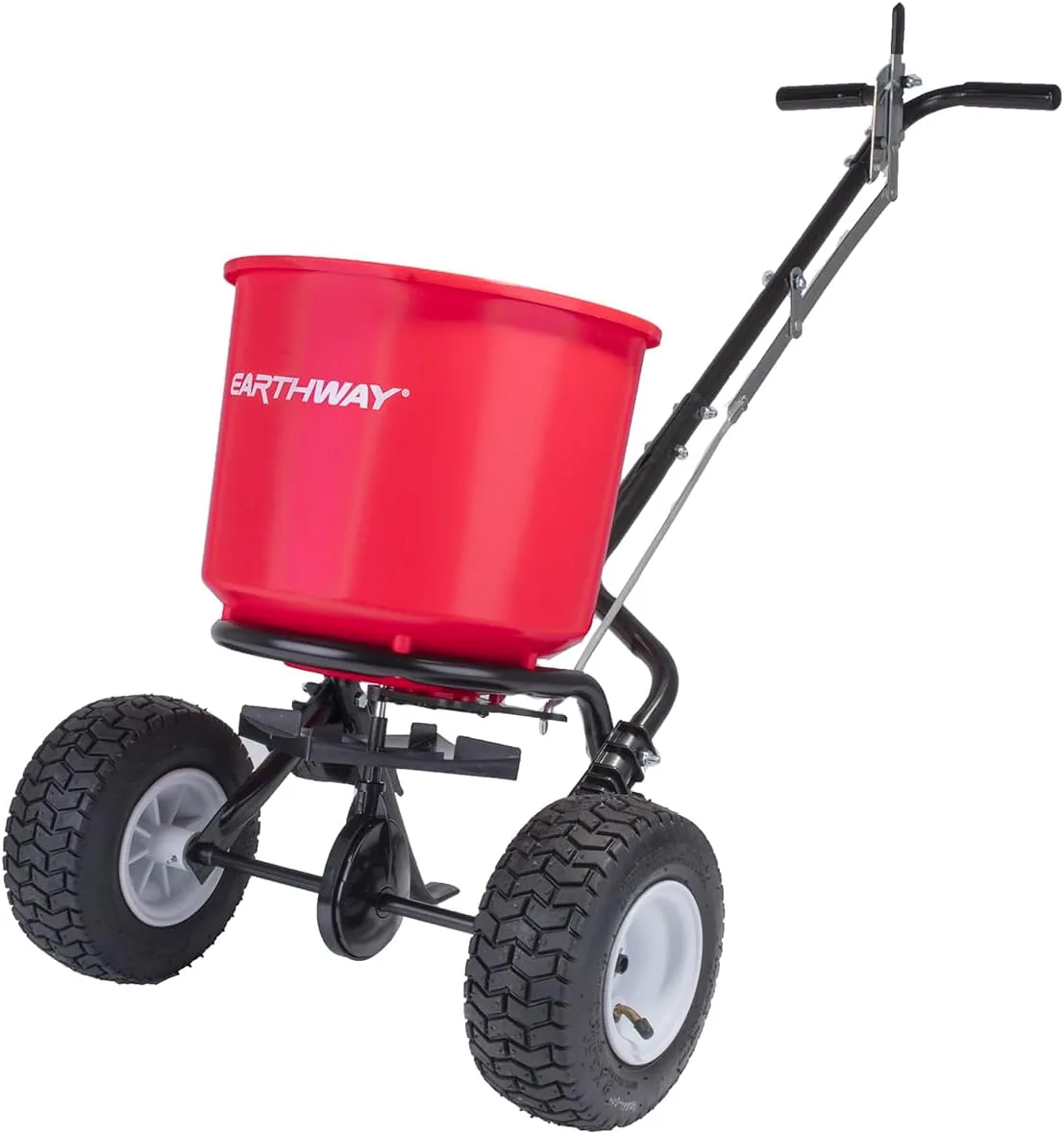
The EarthWay 2600A-Plus is the value pick for a large lawn, with one condition: its hopper holds 40 lb, the smallest on this page, so you refill more often. For the lowest price on the page you get a side control for the left edge, an agitator, 9-inch pneumatic wheels and a lever on a numbered gauge. I recommend it when the budget matters more than the length of a refill stop.
WHY I CHOSE THIS ✓
Third place goes to the 2600A-Plus because it is the lowest-priced spreader on this page and still carries a side control. It is the value pick for a large lawn only if you accept a 40 lb hopper. The hopper and the wheels are the smallest here, and the manual has no safety section, so the safe-state box in the safety section below does that work.
EarthWay 2600A-Plus 40 lb Push Broadcast Spreader Specs
Key Features:
- 40 lb hopper: the maker’s figure on its sell sheet and product page. The manual prints no capacity or fill level, so I treat 40 lb as a ceiling.
- Side Spread Control: a lever under the right side of the hopper that EarthWay says shuts off left-side spreading.
- 3-hole shut-off: EarthWay’s name for the opening pattern under the hopper. It is the maker’s own term, and I read it as a description of the openings.
- Gauge with a stop bolt: the lever pulls back to the stop bolt for the setting. The label and the maker’s setting guide decide the setting.
- Agitator on a pin: the parts list names an agitator pin in the hopper.
- 9 inch pneumatic wheels: the parts list names them. They are the smallest wheels on this page, a printed size and nothing more.
- Cable-free linkage: the sell sheet and the parts list show solid rods, so there is no cable to kink.
You set the stop bolt, push forward, pull the lever back to the stop bolt, and push it forward to close the flow holes before you stop moving. The agitator and the 3-hole shut-off do the metering, and the manual says wet fertilizer changes the pattern and the flow rate.
The side control is a lever under the right side of the hopper. Slide it from the front to the back, set the left wheel the distance the manual gives from the sidewalk, bed or driveway, and spread as normal. Close the main flow lever at the end of that pass, then slide the side control forward again for the full 180 degree pattern. The manual says nothing about wind or about where granules land.
The value label needs a scope: the 40 lb hopper is the smallest on this page and the 9-inch wheels are the smallest too, so a long lawn means more stops at the bag. Assembly is 16 steps, and the wheel pins are bent over with pliers so they cannot fall out. A tip printed in the assembly figures says the control rod must sit above the lower handles, and I check that before I tighten anything. The T-handle carries a numbered gauge and a stop bolt, and I look at where the stop bolt sits before every fill, because the label and the maker’s setting guide decide that position and nobody else.
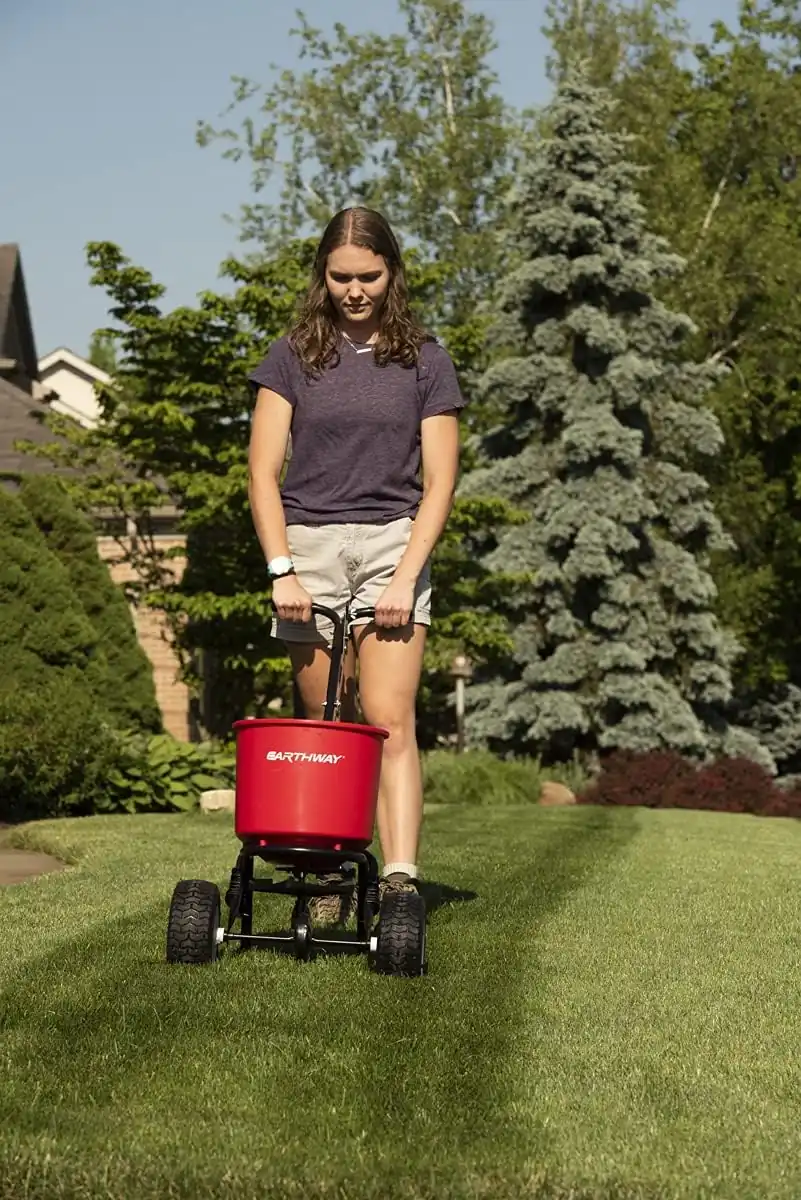
The gearbox direction is the one step to get right: the word FRONT points to the front and the impeller turns clockwise as you push. Check it before the first fill.
The manual prints no operator, protective equipment, clog or moving-part line, so before you fill, clean, oil or clear anything, complete the stop and make-safe steps in the safe-state box in the safety section below. Never open the gearbox, because the manual says dirt may enter.
Before you empty, rinse or oil anything, complete the stop and make-safe steps in the safe-state box. EarthWay’s current manual then has you empty the hopper, rinse the spreader as the product label and the manual permit, and coat the metal parts with light oil, since the gears are permanently lubricated at the factory. The manual says not to use powdered materials, because they can damage the gearbox. The warranty runs one year in the February 2025 edition, and the rain cover is a separate accessory that is not in the box.
Buy the 2600A-Plus if you need a lower price, mind your edges and can live with more refills. Skip it for the longest lawns and for powdered products, which the manual rules out. It also lacks a printed swath and a printed weight.
FINAL VERDICT
The EarthWay 2600A-Plus is the value spreader on this page for a large lawn, as long as you accept its 40 lb hopper and small wheels. Its Side Spread Control and agitator come at the lowest price here. Pick it when budget decides and refills do not.
It is the lowest-priced push spreader for a large lawn.
4. Brinly P20-500BHDF-A 50 lb Push Spreader With Deflector Side Deflector Included
A flip-up shield on the left side of the hopper is what sets the Brinly P20-500BHDF-A apart. It is a 50 lb push broadcast spreader and the only spreader on this page with a side deflector kit included. I recommend it for a lawn with a border on its left side.

WHY I CHOSE THIS ✓
The P20 takes fourth place because a deflector is in the box instead of sold as an extra. The 50 lb hopper is a size fact and nothing more. The manual names no gloves and gives no clearing method, so I add the label’s equipment and the safe-state box.
Brinly P20-500BHDF-A 50 lb Push Spreader With Deflector Specs
Key Features:
- Side deflector kit: a left-side shield that the manual says will keep material from moving toward that side. A knob flips it up or down.
- Hopper screen: used when you fill, to break up clumps.
- Rotary agitator: removable, to be used only if needed.
- Rod linkage on the gate: a lever works the shut-off plate through rods. The label and the manual’s chart decide the setting.
- Lower handle position: upper bolt holes lower the handle.
The manual asks you to learn the spreader before any material goes in the hopper. Walk it, open the rate gate and close it at the right moments, and only then fill, on a flat, level surface. It also says to open the gate once the spreader is moving, because opening it while stopped only drops product on the ground.
Fitting the deflector is the odd part. You tip the spreader onto its right side, take two screws out of the left side of the frame, then fix the plate and the shield. The numbered plate uses the wingnut edge as its marker, and I move the lever up and down to see the shut-off plate open and close before any product goes in. My Brinly P20 spreader review covers the 50 lb model with its side deflector.
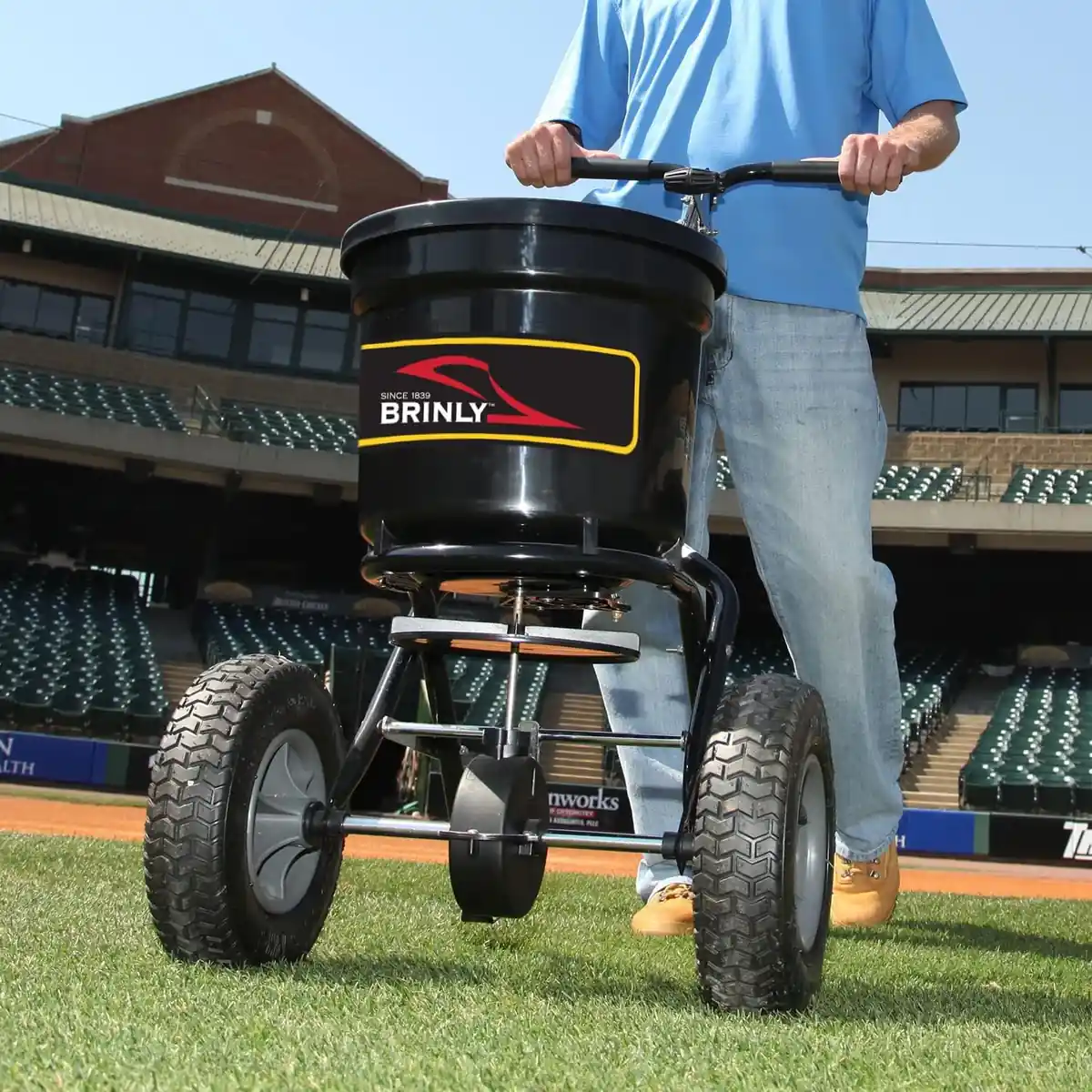
Walk it empty first. I practice the start, stop and turn with the gate on an empty hopper, as the manual asks, before the first fill of the season.
Brinly’s manual calls for eye protection, substantial footwear and long trousers, never barefoot or in open sandals, bars smoking, drinking and eating around chemicals, and asks for hand washing after fertilizers and pesticides. Before you fill, clear or clean, complete the stop and make-safe steps in the safe-state box in the safety section below.
Before you clean or oil anything, complete the stop and make-safe steps in the safe-state box. Never leave product in the hopper, says the manual, because it can draw moisture, clump and rust the controls. If the lever is hard to move, check for buildup between the bottom of the hopper and the shut-off plate. Do not use it on windy days, says the manual.
Buy the P20 if one side of your lawn runs along a border and you want the shield included. Skip it if your borders are on the right, or if you spread on a commercial or rental basis, which its warranty excludes. I put the P20 beside the EarthWay 2600A-Plus in my Brinly and EarthWay spreaders comparison.
FINAL VERDICT
The Brinly P20-500BHDF-A is the push spreader I recommend for a lawn with a border on the left, because the deflector, the screen and the practice-run advice arrive in one box. Choose it for a left-hand border.
It is the left-border push spreader with the deflector in the box.
5. Chapin TurfPro 89400C 100 lb Stainless Steel Push Spreader Stainless Steel Axle and Gate
The Chapin TurfPro 89400C puts stainless steel where the metal meets the product. Chapin’s product page lists a stainless axle, slide gate and hardware on a 100 lb poly hopper, with a stainless frame and handle. I recommend it for a large lawn where you want a big hopper and a gate you can set once and lock.
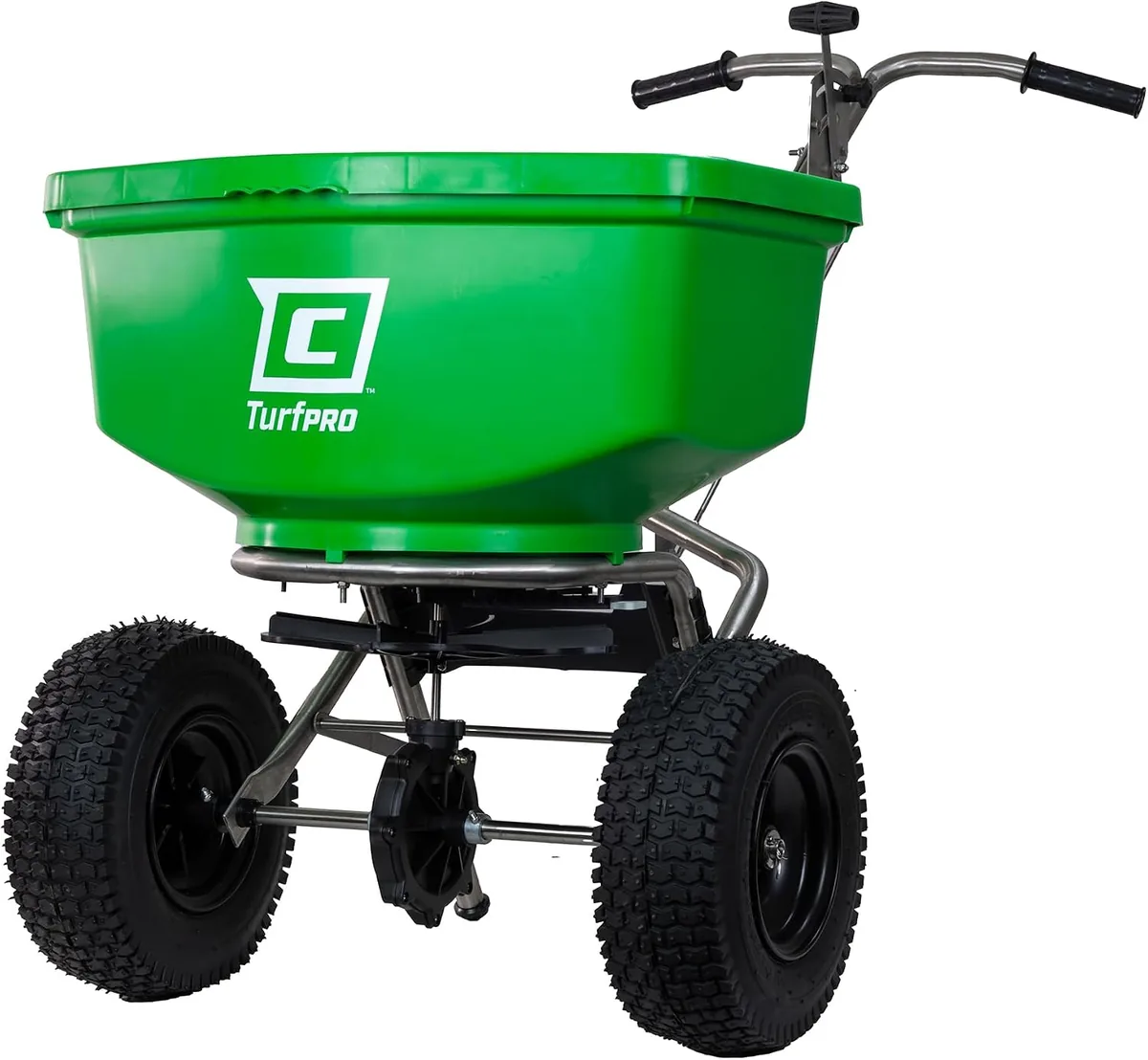
WHY I CHOSE THIS ✓
Fifth place goes to the 89400C because its gate lever locks on a numbered plate, and Chapin names a stainless frame, handle, axle, slide gate and hardware. The 100 lb hopper is the size on the manual cover. The trade-off is the missing swath, hopper grate and rain cover.
Chapin TurfPro 89400C 100 lb Stainless Steel Push Spreader Specs
Key Features:
- Stainless parts: Chapin names the frame, handle, axle, slide gate and hardware.
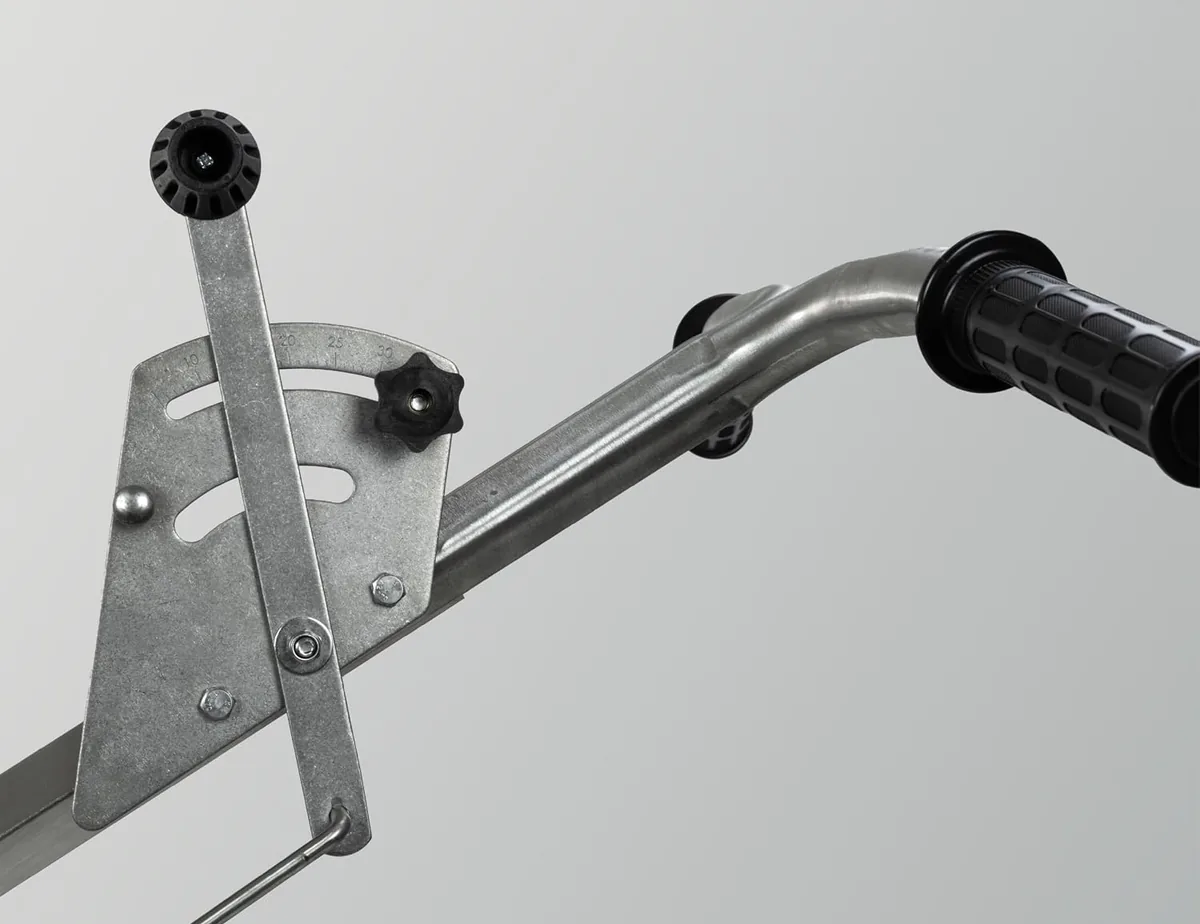
- Locking gate lever: the lever sits on a numbered plate with a locking knob, and the listing says to adjust the gate opening once and lock it in.
- Left and right gates: step 12 shows four patterns.
- Flat or spiked auger: chosen by material, as step 8 lists.
- 100 lb hopper: the figure on the manual cover, in a one-piece poly bin.
The pattern control is the part I read twice. The manual closes the left gate, the right gate or both, and shows full, left, right and narrow patterns. The lever sits on a numbered plate with a locking knob, and I turn the knob through its lock before the first fill. It prints no swath for this model, so I give you the patterns and no width. I cover the 100 lb push broadcast model and its stainless frame in my Chapin 8400C review.
Assembly is 12 steps. The hopper will not drop straight onto the frame, and the manual says to maneuver it until the slide gate sits under the hopper frame. The cotter pin attaches on the outside of the wheel and the bolts go on the inside, and bolts stay loose on purpose until step 11.
Finish the stop and make-safe steps in the safe-state box in the safety section below, and only then clean the spreader. Wash it with a garden hose only as the product label and the manual permit, keep the spray off the gearbox, and skip the power washer.
Chapin’s manual asks for protective eyewear and gloves when you handle and apply lawn and garden chemicals, and it has no clog method. Before you fill, clear, clean or grease anything, complete the stop and make-safe steps in the safe-state box in the safety section below.
The manual says this spreader is not recommended for rock salt, and the maker’s page adds sand, lime, lime mixes and pelletized lime. Where a grease fitting is fitted, it asks for general purpose grease monthly. Hose it down after every use only as the label and manual permit, then dry it.
Choose it if you want a big hopper, stainless parts and a locked gate setting. Skip it if you need a hopper screen, a rain cover in the box or a printed swath. My Agri-Fab vs Chapin spreader comparison puts it next to the 45-0462.
FINAL VERDICT
The Chapin TurfPro 89400C is the push spreader I recommend for a large lawn when stainless parts and a lockable gate matter most. Read the manual’s material cautions before you fill it. Pick it for a big lawn and a gate you set once.
It is the stainless push spreader with the locking gate.
6. EarthWay 2150 Commercial 50 lb Push Broadcast Spreader Tall-Operator Handle Setup
The EarthWay 2150 is the push spreader with a handle for every height. The manual prints two upper handle positions and a tall-operator setup with a different bolt hole, on a 50 lb poly hopper and 13 inch pneumatic wheels. I recommend it for a long property with a tall operator and edges to respect.

WHY I CHOSE THIS ✓
The 2150 takes sixth place because its handle adjusts for the person pushing it, and it carries a left-edge lever under the hopper. The manual has no safety section, so I add the label and the safe-state box.
EarthWay 2150 Commercial 50 lb Push Broadcast Spreader Specs
Key Features:
- Handle positions: two upper positions and a tall-operator setup with a different bolt hole.
- Side Spread Control: a lever under the hopper closes the left side of the throw.
- Hopper grate: a round screen that the listing says slides in and out.
- Gauge and stop bolt: the stop bolt holds the main lever at your chosen setting.
- Sealed gearbox: the manual says not to open it, or dirt may enter.
The main flow lever sits on the T-handle, and the edge lever sits under the hopper, so the two are separate jobs. You set the stop bolt, push forward and pull the main lever back to the stop bolt, and you push it forward to close the flow holes before you stop moving. Wet fertilizer changes the pattern and the flow rate, says the manual.
For an edge pass, slide the side control lever from the front to the back and set the left wheel the distance the manual gives from the sidewalk, bed or driveway. At the end of that pass, close the main flow lever and slide the side control forward again for the full 180 degree pattern. I use it to place the wheel, because the manual gives no promise about where granules land. I walk through the whole push spreader in my EarthWay 2150 spreader review.

On assembly the word FRONT on the gearbox must point to the front, so the impeller turns clockwise as you push, and a reversed gearbox turns it the other way. The axle bearings are a tight fit by design.
The manual has no operator line, no protective equipment line and no clog or moving-part warning. Before you fill, clean, oil or clear anything, complete the stop and make-safe steps in the safe-state box in the safety section below.
The current manual says rock salt and powdered materials should not be used in this spreader, because they can damage the gearbox, and its warranty text excludes corrosion damage and improper storage. EarthWay says to wash between the shut-off plate and the hopper bottom and oil the metal parts afterwards, so wash only as the label and the manual allow, dry fully, then oil. The warranty runs one year.
Choose the 2150 if the person pushing it is tall and the lawn runs beside paths and beds. Skip it for rock salt, powdered products or a printed swath. I set the 2150 against the smaller 2600A in my EarthWay 2600A against 2150 comparison.
FINAL VERDICT
The EarthWay 2150 is the push spreader I recommend for a tall operator with edges to respect, because the handle adjusts and the edge lever sits under the hopper. It takes granular products only, under the label’s rules and its own. Choose it for a tall operator on a long property.
It is the push spreader with a handle for tall operators.
7. Agri-Fab 45-0462 130 lb Push Broadcast Spreader Largest Push Hopper
A push spreader with a 130 lb hopper is the Agri-Fab 45-0462, the largest push hopper on this page as the listing prints it. The lever, a numbered gauge and an adjustable stop all sit under the grips, so the gate is within reach of your hand as you walk. I recommend it for a large lawn walked on foot.

WHY I CHOSE THIS ✓
I put the 45-0462 seventh because it carries the largest hopper of the push models here, with the lever, gauge and stop at the handle. It is the pick for a long lawn on foot. The manual prints no capacity or weight.
Agri-Fab 45-0462 130 lb Push Broadcast Spreader Specs
Key Features:
- 130 lb hopper: the listing prints it, and the manual prints no capacity, so treat 130 lb as a ceiling.
- Lever, gauge and stop: the manual has you pull the lever forward against the adjustable stop for on. The chart and the package decide the setting.
- 13 in x 4 in pneumatic tires: the listing prints the size.
- Serviceable gear case: housings open by three clips.
- Three-year household term: wheels and bearings are excluded in years two and three.
The manual keeps the routine short. Start the spreader in motion and then pull the control lever forward against the adjustable stop, and always move the lever to OFF before turning or stopping. The label and the chart decide the setting. I give my verdict on the 130 lb push broadcast model in my Agri-Fab 45-0462 spreader review.
The build is 16 steps with a hammer, pliers and two 7/16 inch wrenches. The hub caps are tapped on with a hammer, and the early steps say do not tighten completely. The last steps align the control bracket so the shut-off plate closes completely with the lever at OFF, and I check that plate before I add product.
Check the tire inflation before each use. The manual asks for it and sets the limit at the maximum pressure printed on the tire.
Agri-Fab’s manual asks you to wear eye and hand protection when you handle and apply lawn or garden chemicals, and it says not to use powdered lawn chemicals. It has no moving-part line and no clog method, so before you fill, clear, clean or open the gearbox, complete the stop and make-safe steps in the safe-state box in the safety section below.
Before you empty or rinse anything, complete the stop and make-safe steps in the safe-state box. The manual then says to empty the spreader after each use, keep leftover product in its original bag, rinse the hopper and the outside, dry it and store it in a clean, dry area; and follow the product label for leftovers and rinse water. For weed control products, the manual says the pattern must not reach evergreen trees, flowers or shrubs.
Choose the 45-0462 if you walk a large lawn and want the biggest push hopper on this page. The listing says the model 45-0614 has replaced it. Skip it if you want a deflector or a printed weight. My Agri-Fab tow behind spreader comparison sets the 45-0463 against this push model.
FINAL VERDICT
The Agri-Fab 45-0462 is the push spreader I recommend for a long lawn walked on foot, because its 130 lb hopper and its handle controls come together. Follow the label and the manual’s material rule. Choose it when you want to stay on foot with a large hopper.
It is the biggest-hopper push spreader for a long lawn on foot.
How to Choose the Best Spreader for Large Lawn Work
A large lawn asks four things of a spreader: a hopper that cuts your stops at the bag, a gate you can shut at once, a frame and handle you can live with, and a care routine you will follow. The factors below run in that order. A bigger machine never replaces the product label.
Hopper Size and What the Maker Prints
Hopper capacity is the first figure I read on a large lawn, because it sets how often you stop to refill. Makers print it in pounds, and some manuals print no capacity at all and leave it to the sales page. Treat the figure as a ceiling for the hopper and let your manual and the product label set the fill level. A full hopper also weighs more to push or tow, and a maker’s weight is only useful when it names its basis, empty or boxed.
| Figure | What it tells you | Mistake to avoid |
|---|---|---|
| Hopper capacity in pounds | How much one fill holds | Reading the ceiling as a target |
| Printed swath | The maker’s own upper figure | Reading it as the width you will get |
| Weight and its basis | What you lift or pull | Comparing an empty weight with a boxed one |
| Wheel size as printed | What the maker fits | Treating a size as a ranking |
| Warranty term and its use | Who and what the term covers | Assuming a household term covers commercial use |
I read the capacity, then I look for a fill level in the manual, and a missing fill level is my reason to fill lighter than the ceiling.
Push Spreader or Tow-Behind Spreader
A broadcast spreader throws a fan of granules while you walk behind it. The University of Kentucky says rotary spreaders spread a wider swath and suit large areas, though they are less precise than drop spreaders (1), and NC State Extension adds that they cover more area faster and need less effort to push (2). When walking the lawn and refilling the hopper become the hard part, the next step is a tow-behind unit. My best broadcast spreader roundup compares push, tow-behind and handheld models.
- Stay with a push spreader if you want to walk the edges, store it in a small space or have no vehicle whose owner’s manual allows towing a spreader. I compare walk-behind models by frame and wheels in my best push spreader roundup.
- Move to a tow-behind unit if the lawn is large, you want a spreader for lawn tractor towing and the vehicle’s manual allows a loaded hopper.
- Read both manuals first: the vehicle’s owner’s manual sets hitching, turning, slope and load limits, and the spreader’s manual sets the rest.
The best pull behind spreader is the one your vehicle’s manual allows it to tow, because a loaded hopper adds a hitch and slopes to the job, and the full tow-behind rules sit in the safety section below. Read the vehicle’s manual before the spreader’s.
Wheels, Frame and Handle
A large lawn means a long walk behind the hopper, so the frame and handle matter as much as the gate. Keep the tires inflated as your manual says. Some manuals ask for a check before each use and warn against inflating past the maximum printed on the tire. NC State Extension also says to hold the handle at the same height you used when you set up the spreader, and to push it instead of pulling it (2). I compare nine push and handheld models by hopper and gate in my best lawn spreader roundup.
- Wheel size and type as the maker prints them, with no ranking.
- Handle positions: some makers print a lower or taller setting.
- Frame and hopper material as printed, and folding only where the maker says so.
- Assembly: step counts and tools differ, and several early bolts stay loose on purpose.
I set the handle where my wrists sit level before the first fill, because a full hopper tires the arms first.
Gate, Rate Lever and Edge Control
The gate is the part you touch most, so it should open and close without a fight. NC State Extension says to reach your steady pace before you open the lever and to close it before slowing, turning or stopping, because one wheel usually drives the impeller and spreading through a turn changes how it spins (2). A laboratory test of one rotary turf spreader found that the application rate changed with small changes in speed, and its author cautions that only one material and one spreader were tested (3).
Settings Come From the Label
The product label gives the application directions, so read it before you set the gate. A setting listed for your exact spreader and product is a starting point, not proof of the amount delivered: follow the spreader’s manual and calibrate for the product, the spreader and the person using it before you apply. Never exceed the label’s application rate.
Some makers print a side deflector, a side control or left and right gates. Each manual describes what its feature is for. UC IPM says to use drop spreaders instead of rotary spreaders to avoid off-target application (4), so a rotary spreader asks more care near beds, paths and water. A rotary spreader throws a wide fan, and that width is the reason it needs more control at the edges.
| Feature | What the maker describes | What I check |
|---|---|---|
| Gate lever and linkage | A lever that opens and shuts a plate under the hopper | That it moves freely and shuts completely |
| Rate gauge and stop | A numbered scale and a stop that holds the lever | That the label and the maker’s chart set the number |
| Side deflector or side control | A shield or lever that closes one side of the throw | Which side it covers and how it is set |
| Left and right gates | Gates that close one side or both | Which patterns the manual shows |
I shut the gate before every stop or turn, and a stiff lever is my cue to stop and make safe, never to push harder.
What the Manual Lets You Put in the Hopper
Manuals differ on materials. Some forbid powdered products, some list materials the hopper must not hold, and some say nothing at all.
The best fertilizer spreader for large lawn work is the one whose manual accepts your product. The product label decides what the product may do, and the manual decides what the machine may take. If both cannot be followed, the spreader is the wrong tool for that product, and a bigger spreader is never the answer to a label limit. My ranking of the best fertilizer spreader picks sorts push models by edge control and kit.
Read the Material List First
Before you buy, find the manual’s list of materials the hopper may hold or must not hold. A long list of forbidden products tells you the maker has thought about its gears.
Care, Cleaning and Storage After Each Job
NC State Extension says to wash a spreader after each day’s use, dry it completely to prevent rust, lubricate it as the owner’s manual specifies and keep product dry (2). A laboratory study found that fertilizer with insoluble parts builds up on the impeller and gradually shifts a rotary pattern (5). Gearboxes differ: some manuals give a grease routine, and one seals the gearbox and says not to open it, so follow the manual of the machine you own.
- Close the gate and complete the stop and make-safe steps in the safe-state box in the safety section below.
- Empty the hopper and handle leftover product as the label directs.
- Rinse only where the label and the manual permit it, and keep wash water out of drains.
- Dry the spreader completely, and lubricate only as the manual directs.
- Store it empty, clean and dry, with the gate closed.
Hosing a spreader down is quick, and drying it completely comes before it goes back in the shed.
Safety With Spreaders and Lawn Products
A spreader is a hopper with a gate over a spinning plate, and the product in the hopper can be a pesticide that harms people, pets, bees and water. Only what your exact manual and your product’s label say applies to you, and you follow both. A manual never authorizes a use that the product label prohibits.
Safe-State Box
Stop and make safe before you fill or unload the hopper, reach into the hopper, clear a clog, clean or rinse the spreader, lubricate it, adjust the gate or the pattern, change a part, hitch or unhitch it, move it, store it or leave it. Keep your hands, feet, hair and loose clothing away from the impeller, the plate, the agitator, the gears and the wheels while anything can turn. During normal spreading, walk or drive only as your manual and the product label permit; walking behind a push spreader, or pulling a tow-behind unit at the speed its manual describes, is operation, not transport.
- Walk-behind spreader: close the gate, then stop walking, and wait until the impeller, plate, agitator and wheels have stopped turning.
- Tow-behind spreader: close the gate, stop the vehicle, set the parking brake, switch the engine off and remove the key as the vehicle’s manual says, and wait until the wheels, impeller and agitator have stopped turning, before you reach into the hopper or touch the impeller.
Then Finish Only as Your Manual Says
Keep the gate closed while you fill. Wear all the protective equipment the product label and your manual require while you fill, clean or clear a jam. Clear a clog only with the method in your exact manual. Follow every applicable safety step in your manual, in the order it specifies. Refit every guard and cover, and check that the gate opens and closes before product goes back in.
Label, Protective Equipment and Filling
Read the product label before you open the bag. Follow its directions for the permitted use, the application amount, protective equipment, weather, watering in, access by people and pets, storage and disposal.
Using a registered pesticide in a way its label does not allow is against federal law. Follow the spreader’s manual too. If the product’s instructions and the spreader’s instructions cannot both be followed, do not use that combination; ask the manufacturers for guidance.
Wear all the protective equipment the product label and your spreader’s manual require, and put it on before you open the bag. Wear it every time you fill the hopper, clean the spreader or clear a clog. Protective equipment lowers your exposure; it does not make handling a lawn product safe.
Before you fill or unload the hopper, complete the stop and make-safe steps for your spreader in the safe-state box, and keep the gate closed. For fertilizer, fill on a hard surface where spilled granules can be swept up, away from drains and water (4). Follow the product label’s handling and ventilation directions, and wear all the protective equipment the label and your manual require.
Fill only to the level your manual allows, and secure the hopper cover or lid if your spreader has one. Keep children and pets away, and never leave a filled spreader where they can reach it.
Wash your hands before eating, drinking, smoking or using the restroom when you work with pesticides. Change your clothes and wash your hands immediately after you apply a product that contains a pesticide, and follow the label’s additional washing and clothing instructions.
Spills, Runoff and Hard Surfaces
Keep people and pets away from a spill. Follow the product label and its safety data sheet for collecting, reusing and disposing of spilled product, and wear the protective equipment they require.
Never hose or wash granules into a street, a gutter, a drain, a ditch or water, and do not pile spilled product onto the lawn or return contaminated material to the bag. If you cannot manage the spill safely, stay away and call the emergency number on the label. Call Poison Control at 1-800-222-1222 if anyone is exposed, and call 911 for a fire or immediate danger.
Keep fertilizer off pavement and out of drains and surface water. If scattered plain fertilizer lands on a sidewalk, a driveway or a patio, sweep it back onto the lawn before you water, without going over the label rate; collect a concentrated spill instead.
Purdue Extension says the same about granules on hard surfaces, and advises against fertilizing drought-stressed, dormant or frozen turf (6). For pesticide granules, follow the label’s cleanup instructions.
Follow any buffer requirement that applies and keep fertilizer out of those areas. EPA advises against fertilizing before windy or rainy days. Follow the product’s weather and watering directions too.
Gate, Clogs, Children and Pets
Close the gate before you stop, before you slow down to turn, and whenever you pause, and open it again only after you are walking or driving at the steady pace your manual describes. Do not spread while you turn.
Never push, kick or dig product out of the gate or off the plate while anything can turn. If product clumps or bridges in the hopper or the gate clogs, stop and complete the stop and make-safe steps in the safe-state box first, then clear it only with the method in your manual.
Keep children, pets and other people away from the area while you fill and spread, and keep them off the treated area for as long as the label says. Store the bag and the filled spreader where they cannot reach them.
Tow-Behind Units
Follow your towing vehicle’s owner’s manual and the spreader’s own manual for hitching, turning, slopes, speed and load limits, and stay within the tow capacity in the vehicle’s owner’s manual. Never ride on a spreader or carry a passenger on it. Turn only as the two manuals direct, and keep children and pets well clear of the vehicle and the spreader while you load, hitch and spread. Before you fill, hitch, unhitch, reach into the hopper or touch the impeller, complete the tow-behind steps in the safe-state box.
Rock Salt and Ice Melt
Use ice melt or salt only when both the product’s directions and your spreader’s manual permit it. Salt-based deicers can damage metal, so follow your model’s cleaning instructions after use. Before you clean the spreader, complete the stop and make-safe steps in the safe-state box. Rinse only if the manual permits it, and dry the spreader as the manual directs.
Do not use lawn fertilizer to melt ice. Keep deicing products away from children and pets.
Cleaning, Storage and Exposure
Before you clean the spreader, complete the stop and make-safe steps in the safe-state box, and wear the protective equipment the product label and your manual require. Handle leftover product, cleaning water and residues as the product label directs.
Clean the spreader only by a method both the label and the manual permit, and rinse it only where they permit it, keeping product and contaminated wash water out of drains and water supplies. Dry the spreader completely, and lubricate it as its manual directs. If you change products, follow both products’ cleaning requirements: a rinse alone does not show that all residue is gone.
Before you store the spreader, complete the stop and make-safe steps in the safe-state box. Store it empty, clean and dry, as your manual describes, with the gate closed. Keep products in their original labeled containers, securely closed, under the storage conditions their labels give, and away from children and pets. Lock pesticides away, apart from fertilizer, food and animal feed, and never put any product into a food or drink container.
If someone swallows or is exposed to a lawn product, follow the first-aid section of the product label and call Poison Control at 1-800-222-1222, and keep the product label with you. Call 911 in an emergency.
My Overall Verdict
Each spreader here earned its place on its printed hopper, its gate, its wheels and what its maker says about care and materials. The top three give you a tow-behind with a 130 lb hopper, a push spreader on 14-inch tires with a grate and a rain cover, and a push spreader at the lowest price here.
1. Agri-Fab 45-0463 130 lb Tow-Behind Broadcast Spreader Best Overall
For a lawn too large to push, the tow-behind with a 130 lb hopper and a rod gate.

2. Chapin 8400C 100 lb Professional SureSpread Push Spreader Best Premium
For a premium push spreader, the 100 lb model on 14-inch tires with a grate and a rain cover.

3. EarthWay 2600A-Plus 40 lb Push Broadcast Spreader Best Value
For a lower budget, the 40 lb push spreader with a left-edge control and a sealed gearbox.
Match the machine to your vehicle’s manual, the product label and the manual of the spreader, then fill only to the level the manual allows. For the best spreader for large lawn work, I start with the Agri-Fab 45-0463. If your lawn is small, my roundup of spreaders for a small lawn mixes hand, battery and push models.
Why Agri-Fab 45-0463 130 lb Tow-Behind Broadcast Spreader Might Be the Best Choice
I put the 45-0463 first because it takes the walking out of the biggest job and its manual states its own limits. A 130 lb hopper behind a vehicle means fewer stops at the bag.
The trade-off is plain: the manual prints no weight and no shutdown order, so I follow the safe-state box on this page before every hands-on step.
Here is why it earns the top place:
✓ Hopper: a printed 130 lb capacity on a tow-behind frame.
✓ Gate: a steel rod and control arm that work the flow plate from the seat.
✓ Limit: a towing speed limit printed in the manual for this model.
✓ Hitch: a universal hitch with a hitch pin and a hairpin cotter.
✓ Warranty: three years at home on the maker’s own sheet.
Frequently Asked Questions
What is the best pull behind lawn spreader?
The best pull behind lawn spreader on this page is the Agri-Fab 45-0463, a tow-behind broadcast model with a 130 lb hopper and a steel rod that works the gate from the seat. Its manual prints a towing speed limit, and your vehicle’s owner’s manual decides what it may tow.
What type of fertilizer spreader is best?
The best type of fertilizer spreader for a large lawn is a broadcast spreader, because Kentucky and NC State Extension both say it covers wide areas faster than a drop spreader. A drop spreader places product more precisely, so it suits small contained areas, and your product label decides what either one may hold.
What should you look for in a spreader for a large lawn?
A spreader for a large lawn should have a big printed hopper, a gate you can shut at once, tires you can keep inflated and a manual that names what the hopper may hold. Read each figure as the maker prints it, and let the product label and the manual decide the rest.
Is a bigger hopper better for a large lawn?
A bigger hopper is better for a large lawn when you want fewer stops at the bag, because the capacity the maker prints sets how much you load per fill. It also weighs more when full, so fill only to the level your manual allows and treat the printed figure as a ceiling.
Is a tow behind spreader worth it for a large lawn?
A tow behind spreader is worth it for a large lawn when walking and refilling a push model becomes the hard part and your vehicle’s manual allows the load. It adds a hitch, a loaded hopper and slopes to the job, so follow the vehicle’s manual, the spreader’s manual and the product label.
References
- Munshaw G. Calibrating Fertilizer Spreaders for the Home Lawn. AGR-211. University of Kentucky Cooperative Extension Service; 2014.
- Miller G, Kerns JP, Billeisen T. Organic Lawn Care: Composting and Spreaders. AG-562. NC State Extension; 2026.
- Parish RL. The effect of speed on performance of a rotary spreader for turf. Appl Eng Agric. 1987;3(1):17-19.
- UC Statewide Integrated Pest Management Program. How to apply fertilizer. In: UC Guide to Healthy Lawns. University of California Agriculture and Natural Resources; 2017.
- Parish RL. The effect of relative humidity on rotary turf spreader patterns. Appl Eng Agric. 1991;7(5):541-544.
- Bigelow CA, Tudor WT, Nemitz JR. Facts About Phosphorus and Lawns. AY-334. Purdue University Extension.
Safety Note: Read the product label and your spreader’s manual before handling product. Follow both; if their instructions cannot both be met, do not use that combination. Registered pesticide use must comply with its labeling. A listed spreader setting is a starting point; calibrate as the manual directs and never exceed the label rate. Wear all protective equipment required by the label and manual before opening the container and during filling, cleanup and jam clearing. Wash your hands before eating, drinking, smoking or using the restroom when working with pesticides. After application, change your clothes and wash your hands immediately, and follow the label’s additional washing and clothing instructions. Keep children, pets and other people away during handling and application and off treated areas for as long as the label requires. Emergency first: if a battery becomes unusually hot, swells, hisses, smells unusual or smokes, stop using the spreader without handling or removing the battery. Keep people away and follow the battery manual’s emergency instructions. If it smokes, burns or presents immediate danger, move away and call 911 or the fire department. Otherwise, complete the applicable stop and make-safe sequence before filling, unloading, reaching into the hopper, clearing a jam, cleaning, lubricating, adjusting, changing parts or batteries, hitching, unhitching, transporting, storing or leaving the spreader. Walk-behind or hand-crank: close the gate, stop walking or cranking, and wait for all moving parts to stop. Tow-behind: close the gate, stop the vehicle, set the parking brake, switch off the engine and remove the key as the vehicle manual directs, and wait for the wheels, impeller and agitator to stop before reaching into the hopper or touching the impeller. Battery spreader: release the trigger or close the gate, switch off, wait for moving parts to stop, then remove the battery as the manual directs and keep it away while working. Follow any additional isolation steps in the exact manual. Keep hands, feet, hair and loose clothing away from moving parts. Clear jams only by the manual’s method. Refit guards and covers and check the gate before refilling. With the spreader made safe and the gate closed, fill fertilizer on a hard surface where spills can be collected, away from drains and water. Follow the label’s handling and ventilation directions and the manual’s fill limit. Keep people and pets away from spills. Follow the label and safety data sheet for collection, reuse and disposal; do not spread concentrated spills onto the lawn or return contaminated product to its bag. Sweep scattered plain fertilizer from pavement onto the intended lawn before watering only without exceeding the label rate. Follow the label’s cleanup instructions for pesticide granules. Never wash product into streets, gutters, drains, ditches or water. Observe applicable buffers. EPA advises against fertilizing before windy or rainy days; Purdue advises against fertilizing drought-stressed, dormant or frozen turf. Close the gate before stopping or turning, as the manual directs. Follow both towing manuals for hitching, turning, slopes, speed and load limits; never ride on the spreader or carry passengers on it. Use only batteries specified for the model. Recharge rechargeable batteries only with a charger approved for them, as the manual directs; never recharge disposable cells. After completing the applicable shutdown, handle leftover product, cleaning water and residues according to the product label. Clean only by methods permitted by both label and manual, keeping contaminated water out of drains and water supplies. Rinse only if permitted, then dry and lubricate as directed. A rinse does not establish that all pesticide residue is gone. Use salt or ice melt only when the product directions and spreader manual permit it. Salt-based deicers can damage metal; follow the model’s cleaning instructions. Do not use lawn fertilizer to melt ice. Store the spreader empty, clean and dry as its manual directs. Keep products securely closed in their original labeled containers under their labels’ storage conditions, away from children and pets. Lock pesticides away, separate from fertilizer, food and feed; never use food or drink containers. For human exposure, follow the label’s first-aid instructions, call Poison Control at 1-800-222-1222 and keep the label available. Call 911 for immediate danger.