

The best lawn mower for small yard work is the one you can start, finish and store without a fight, and I rank nine across battery, gas, corded and reel. I keep the lawns around a family farm and a 3.7 acre orchard, and I have run these mowers on my own grass.
My top pick is the EGO Power+ LM2112 21-Inch Cordless Push Mower Kit. The reviews come first, then how to choose and what each type asks of you.
Best Lawn Mower for Small Yard Reviews 2026: 9 Picks Across Four Power Types
Five battery, two gas, one corded and one reel mower, ranked for a flat house lawn and the strips around it. Each review gives the weight with its basis, the run time with its pack and who should skip the mower.
1. EGO Power+ LM2112 21-Inch Cordless Push Mower Kit Best Overall
On my house lawn the EGO LM2112 is the mower I pull out first, because it carries a full 21 inch deck at 45.2 pounds without its battery and folds away flat for the shed. It is a 56V brushless push mower with mulch, bag and side discharge, and EGO rates its 4.0 Ah battery at up to 35 minutes of mowing. I recommend it to anyone with a small, level yard who wants battery power with no fuel and no drive to push around.

WHY I CHOSE THIS ✓
I put it first because it fits a small yard from the deck to the storage space. A full 21 inch cut, 45.2 lb without the battery and a handle that folds flat make it the easiest mower here to live with. It is the wrong mower for a yard that needs more than one charge.
EGO Power+ LM2112 21-Inch Cordless Push Mower Kit Specs
Key Features:
- Brushless 56V motor: There is no pull cord, no fuel and no oil, and EGO says the pack fits its other 56V tools.
- Seven heights on one lever: One hand sets the deck anywhere from 1-1/4 to 4 in, so a tall first cut and a low last cut need no tools.
- Three grass modes: The mulch insert, the 2.0 bushel bag and the side chute all come in the box, and the insert must come out for the bag or the chute.
- Folding handle: The mower stands upright or lies flat, and the manual prefers flat because an upright mower can tip.
- Electric brake: Let go of the bail and the blade stops within 3 seconds, so you can step back at the end of a lane.
- Status light: Solid green means working with at least 15 percent charge, and flashing red warns that the pack is low.
- LED headlights: They light the grass ahead of the deck when you mow at dawn or dusk.
The start takes three moves: press the safety button, pull the bail up to the handle, then let the button go. I mow in straight lanes and take no more than 1-1/2 inches of grass in one pass, as the manual advises, because a light cut keeps a small pack going longer. Run time is the number to plan around. EGO gives up to 35 minutes with this pack and names no grass height or mode.
I read 35 minutes as a best case. The manual’s own table for a larger 6.0 Ah pack runs from 55 minutes at light load down to 30 at heavy load, so thick grass cuts into any pack. The 4.0 Ah battery, the charger and the mower are all in the box, and the manual lists larger EGO packs among the approved batteries if one pack proves too short.
The height lever earns its place on uneven ground. Along the gravel edge of the yard the grass line wanders over small bumps, so I set the deck high for the first pass, as the manual advises for uneven ground, and lower it once the line is clear. The deck scalped a bump on my first lane at the low end of the range, which is why I start high now. In a hot, dry spell I leave the lever at a high notch for the whole week, because extension advice is to cut higher in heat, and the limit I found is the 2.0 bushel bag, which fills before the lane ends on tall grass.

Walk the yard first and pick up sticks, fallen fruit and stones, because the manual keeps children, bystanders and pets at least 100 feet away while the blade turns.
Wet grass and rain are off limits, because the manual forbids both and wet clippings stick under the deck. To clear a jam, release the bail, wait for the blade to stop, take out the battery and then reach in with heavy gloves.
Next to my old gas push mower there is no cord to pull and no fuel can to carry, though the minutes on the pack are fixed. After each mow I clean the underside of the deck, because the manual says clippings promote rust, and I keep the battery indoors at room temperature. EGO does not publish the charge time for this pack, so I charge it before I need it. The manual asks for the blade to be sharpened about twice a season, more often in sandy soil.
Buy it if your yard is flat and small and you want no fuel, and it is my pick as the best lawn mower for a small yard. It suits a lawn you can finish inside one charge. Skip it if you want self-propel, if your grass stays wet most mornings or if a slope runs steeper than the 15 degrees the manual allows.
FINAL VERDICT
The LM2112 gives a small yard a full-width deck, three grass modes and a shed-friendly fold, all on one pack. It asks you to push every pound and to finish inside EGO’s 35 minutes. Pick it when your longest mow fits that charge.
It is the small-yard mower I pull out first.
2. Honda HRN-BV 21-Inch Self-Propelled Battery Mower Best Premium
The Honda HRN-BV is the one mower here that drives its own rear wheels and still runs on a battery, so a small yard gets all the cutting and none of the pushing. Honda backs the mower with dealer service, 36 months of residential cover and a 21 inch steel deck that cuts as low as 1 inch. I rate it my premium pick for a small, flat yard where the drive and the build matter more than the minutes on one pack.
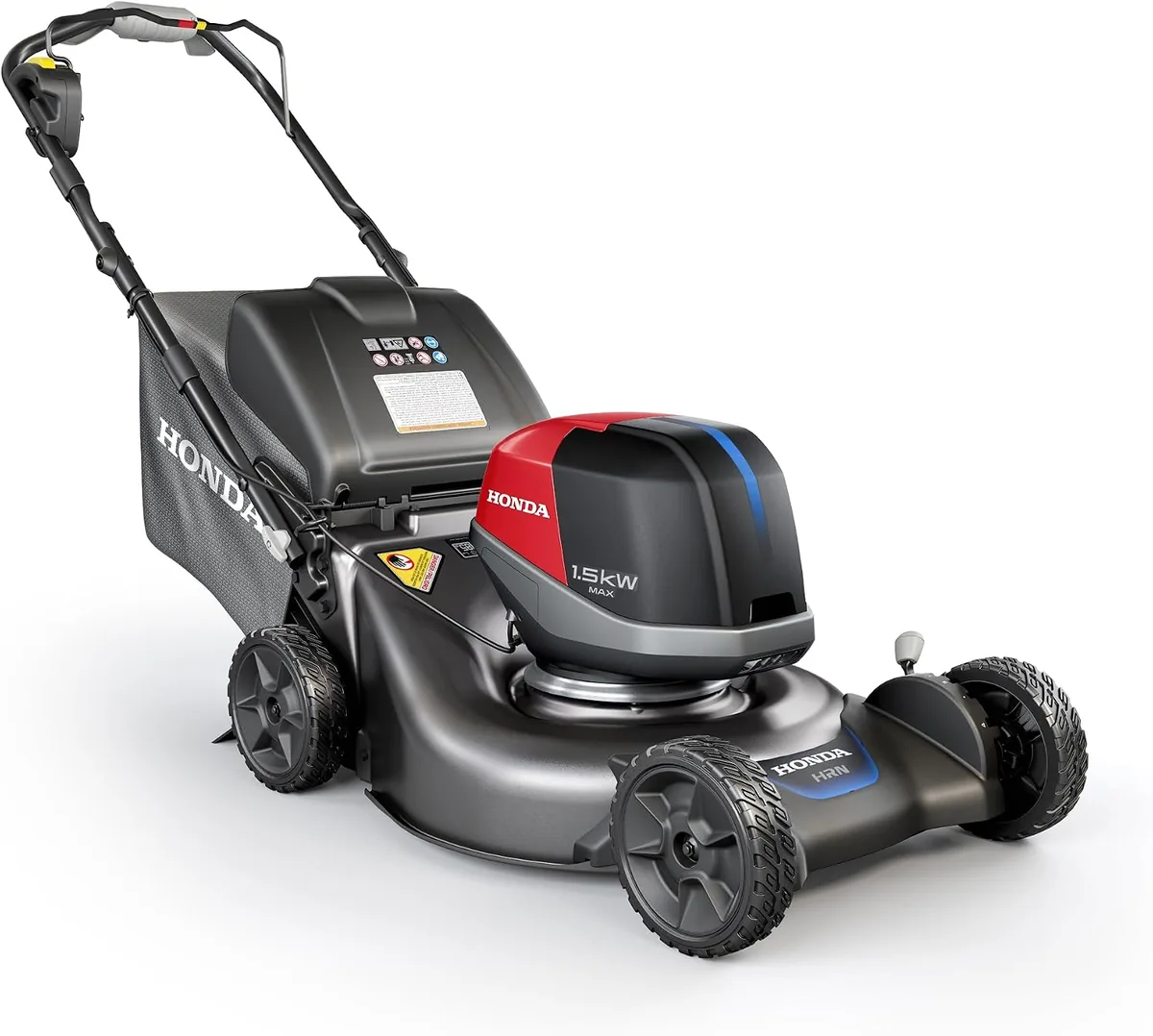
WHY I CHOSE THIS ✓
I rank it second because the drive and the build are the strongest here. A variable-speed drive, a steel deck with a 1 inch lowest cut and Honda dealer service behind 36 months of residential cover justify the premium. It is not the mower for a yard that needs long runs between charges.
Honda HRN-BV 21-Inch Self-Propelled Battery Mower Specs
Key Features:
- Smart Drive paddle: Light pressure on the paddle moves the mower slowly and more pressure speeds it up to 3.80 mph, and letting go stops the rear wheels.
- Five handle positions: The paddle sits in five positions, so the grip suits different hand heights.
- Twin MicroCut blades: An upper and a lower blade work as a set, and the deck cuts from 1 in up to 4 in.
- Two-lever height setting: You set the rear lever first and match the front, with the battery out.
- Clip Director: One deck handles mulching, bagging and rear discharge.
- Folding handlebar: The knobs turn 90 degrees and the bar folds forward for transport and storage.
- Headlight: It stays on for 3 minutes after you release the controls, which helps at dusk.
The drive is the reason to buy this mower. The paddle is pressure-sensitive, so I ease off to a crawl at the shade trees and press harder along the straight edge of the lawn. Releasing it disengages the drive and leaves the mower free to push by hand around an obstacle. On the level lawn I set a slow, steady pace and let the drive hold it, which leaves both hands free to steer at the corners.
Run time is where Honda asks for patience. The maker says up to 30 minutes on the 8 Ah pack and gives no grass or speed, and the optional 12 Ah pack stretches that to up to 45 minutes. The manual’s own fixes for a short run are a narrower swath, a slower pace, a higher cut and mowing before the grass gets long.
Weight is the thing the drive hides until you lift the mower. The manual gives 82.3 lb with the bag and the battery, so the paddle does the pushing on the lawn but the step into the shed is mine to carry. After a wet week I found the deck clogging on the shaded side of the lawn, and I stopped the mower, waited for the blade to stop, took out the battery and cleared the deck with a stick, as Honda says to. The standard 2 A charger needs about 4.5 hours, and Honda sells a quick charger that takes about 1 hour, which matters when a yard needs a second go.
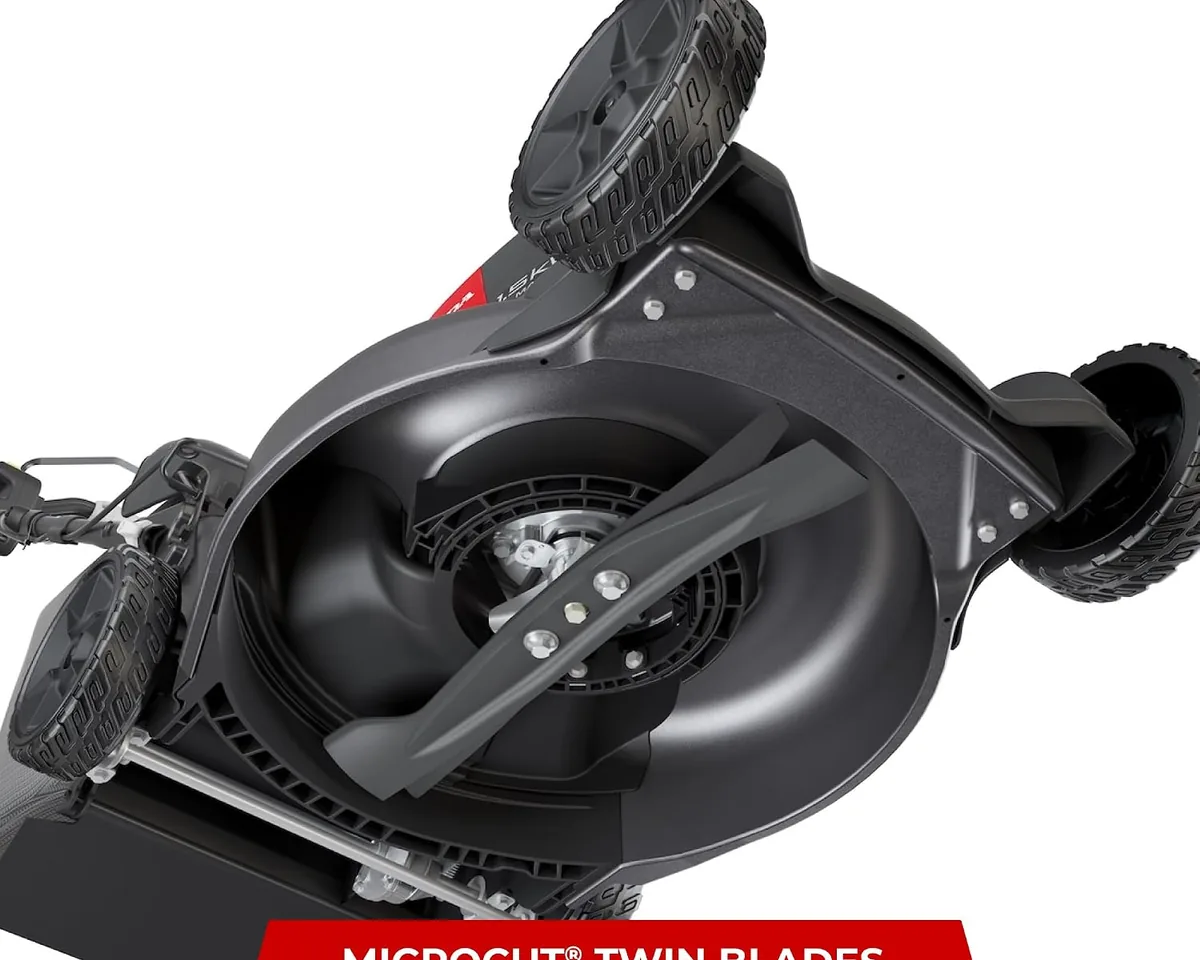
Hold the blade control button for 2 seconds, pull the lever back and release the button to start, and never run the blades over gravel, because the manual says a struck object can damage the power unit and that damage is not covered.
Wet grass and wet hands are out, because the manual bans mowing in the one and handling the pack with the other. Stay off slopes steeper than 15 degrees, and cross a slope, never up and down.
The weight and the standard charger bother me most, and the rear wheels run on sintered bushings, not ball bearings, a detail I notice at this level of build. The bag is fabric with no frame and hooks on behind the discharge guard. Store the mower with the battery out, clean and dry, under a breathable cover and not under a solid plastic sheet that traps moisture. Use only Honda’s charger and packs, and read the separate battery manual for the charging range before the first charge.
A small, flat yard, a dislike of pushing and a wish for a premium warranty all point to this mower, and so does a Honda dealer nearby. Skip it if you lift the mower in and out of a car often, if your grass is wet most mornings or if you need a mower that finishes a lawn on one standard pack.
FINAL VERDICT
Choose the HRN-BV when a small yard calls for a drive, a low cut and a warranty from a dealer-backed maker. It costs you weight and charging hours. If you can live with 30 minutes between charges, nothing else here pushes for you.
It is the mower that does the pushing for me.
3. American Lawn Mower 1204-14 14-Inch Push Reel Mower Best Value
The American Lawn Mower 1204-14 is the one machine on this page with no motor, no battery, no cord and no fuel: the wheels turn the reel, and the reel scissors the grass against a fixed blade. It weighs 19 pounds according to the maker and costs the least of the nine. I rate it the best value for a small, flat lawn of cool-season grass that you mow often and keep short.

WHY I CHOSE THIS ✓
I put it third because nothing else here costs so little to own. There is no fuel, charger, cord or pack to buy, and the 19 lb frame is easy to carry and store. It is the weakest mower here on tall, thick or wet grass and on cutting height, because it stops at 1-3/4 inches.
American Lawn Mower 1204-14 14-Inch Push Reel Mower Specs
Key Features:
- Scissor cut: The reel turns against a fixed bottom blade, and the maker calls the result a clean, precise cut.
- No power source: The wheels spin the reel as you walk, so there is nothing to charge, fuel or plug in.
- Four-blade reel: The maker says four blades suit lighter, regularly mown lawns and may struggle on very thick ones.
- Height by roller bolts: You move the bolts between the hole positions on both sides to set 1/2 to 1-3/4 in, and both sides must match.
- 8-1/2 inch wheels: The maker lists polymer wheels with molded tread.
- Steel reel and blade: The maker lists a tempered alloy steel reel and bed knife.
- 19 pound frame: The maker’s figure for the assembled mower, with no battery or fuel to count.
The reel cuts only while the wheels turn, so your walking pace is the engine. I push at an easy walk, because the manual says to walk slowly and keep sure footing. The cut is a scissor cut and leaves clean grass tips when the reel and the bottom blade are set right. What I did not expect was the sound: with no engine, all I hear on the house lawn is the click of the reel.
The limits are the grass and the height. The mower cuts from 1/2 to 1-3/4 inches, and the maker says it suits cool-season grasses such as bluegrass, fescue and rye. Reels struggle in wet or drooping grass, so the maker’s rule is to mow again once the lawn grows more than an inch above the last cut. I wait for a dry afternoon, because the manual says never to mow when the grass is wet enough to be slippery.
A reel tells you at once when it is out of adjustment. The manual names the symptoms as a rough, uneven cut or a hard-pushing mower, and its fix is the paper test: turn the mower over, slide a sheet of paper between the reel and the bottom blade and turn the reel by hand until every blade slices the paper cleanly. On my first pass of the season the cut came out ragged, so I ran the paper test before I touched anything else, and I turned each screw very little, because the manual calls 1/16 of a turn a major adjustment. For a tall patch the maker says to take half the reel width at a time, make the shortest cut you can or raise the height.

Assemble the handle by the manual and keep it off the rear roller bolts, which it marks as the wrong place.
Keep hands, fingers and feet out of the reel. The manual warns that the reel cuts whenever the wheels turn, even without a motor, so I pick up stones, sticks and fruit before the first pass, most of all along the gravel edge of the yard where a stone would dent the blade.
Care is light: a light oil on the cutting surfaces, the axle and the wheels, and the maker says sharpening should not be needed for several years if the mower is lubricated and adjusted. Sharpening is a lapping job with compound, and the manual suggests a professional if you would rather not do it. The warranty is short and covers home push use only, so read the current terms before you buy. A reel gives no bag and no mulch mode, so clippings stay where they fall.
The job is a cool-season lawn that stays short and flat, and it is the pick if you want the best inexpensive lawn mower for a small yard, with nothing to charge or fuel. Skip it if you want a bag or mulching, if your grass is tall or wet when you mow, if the lawn needs to be cut above 1-3/4 inches or if you hate pushing the whole way.
FINAL VERDICT
For a small lawn that you keep short, the 1204-14 gives the cleanest, quietest and cheapest year of mowing on this page. It leaves the power, the bag and the tall-grass work to other mowers. Pick it only if your lawn and your habits already suit a reel.
It is the quiet reel I keep for the short lawn.
4. PowerSmart B8721C 21-Inch Briggs & Stratton Gas Push Mower Best Gas
The PowerSmart B8721C is the 21 inch gas push mower here, and PowerSmart names its engine as a 125 cc Briggs & Stratton 300E. You press a primer bulb, pull the cord and mow in two modes, mulch or side discharge, with no bag in the box. It suits a small, flat yard where you want a plain engine and a 2-year home warranty.

WHY I CHOSE THIS ✓
it is the gas mower with the larger 21 inch deck, a 125 cc Briggs & Stratton engine at a modest price with a 2-year home warranty. It has no bag and no drive, so I recommend it for a small flat lawn only.
PowerSmart B8721C 21-Inch Briggs & Stratton Gas Push Mower Specs
Key Features:
- Named engine: PowerSmart lists a Briggs & Stratton 300E, a 125 cc four-stroke overhead valve design.
- Primer bulb start: Press the bulb one to three times when cold, hold the control and pull the cord.
- Six heights on one lever: The range runs from 1.5 to 3.9 in, and the manual says to cut no more than 2 in. in one pass.
- Mulch or side discharge: The chute ships in the box, and no bag comes with the mower.
- Stop control: Releasing it stops the engine.
The engine ships without oil or fuel, so the first job is a fill: the manual calls the oil check before each use critical for starting. I check the oil before every mow, because it is a 15.8 fl oz fill and takes a minute. Cold, I press the primer one to three times, hold the stop control against the handle and pull slowly until I feel resistance, then fast.
Use fresh, lead-free gasoline of 87 octane or higher, never mixed with oil, and refuel outdoors with the engine off and cool, waiting at least 2 minutes before you open the cap. Wear eye and hearing protection from the first pull.

Start on a higher height setting, as the manual advises, so the engine does not labor and the deck does not scalp.
The manual says the machine can amputate hands and feet, so keep both away from the deck and the discharge. Never run the engine in a garage, a shed or any partly enclosed space, because carbon monoxide can kill in minutes.
The first start after winter was the hard one: old fuel in the tank is the manual’s own warning, so for 30 days or more of storage I run the tank dry. Before any work under the deck I stop the engine, wait for the blade to stop, let the engine cool, pull the spark plug wire and put on heavy gloves. Blade sharpening goes to an authorized service center, a running cost on a low-price mower.
A small, flat lawn of about a quarter acre is the job, as the maker’s own listing says, and it is my pick for the best gas lawn mower for a small yard when you prefer an engine to a charger. Skip it if you want a bag, self-propel or quiet running. The manual gives no slope limit, so keep it to level ground.
FINAL VERDICT
For a small flat yard, the B8721C gives you a named engine and a plain gas routine. It leaves out the bag and the drive. Buy it if you like a pull cord more than a charger.
It is the plain gas push mower for a flat lawn.
5. Craftsman CMEMW213 20-Inch Corded Electric Mower Best Corded
The Craftsman CMEMW213 is the only corded mower on this page, so it never runs out of charge and never needs fuel: you plug it in and mow as far as the cord reaches. It has a 20 inch deck, a 13 amp motor and three modes, mulch, bag and side discharge, according to Craftsman. It suits a small yard with an outdoor outlet close by.

WHY I CHOSE THIS ✓
it is the only corded mower here, and the three modes and the 3-year warranty come at a low price. The cord makes it the weakest here for a yard far from an outlet or full of beds and trees.
Craftsman CMEMW213 20-Inch Corded Electric Mower Specs
Key Features:
- 13 amp motor: There is no battery to buy, charge or replace, and the mower runs as long as it is plugged in.
- Three modes: Mulch, bag and side discharge come in one kit with the chute in the box.
- Six height notches: One lever locks the deck from 1-1/2 to 4 in.
- Automatic brake: The blade stops in three seconds or less after you release the bail.
- Folding handles: The handles fold forward for storage, and a carry handle sits on the deck.
The cord is the whole handling job, and the manual builds its mowing pattern around it. Lay the bulk of the cable on the lawn near the outlet and mow so the cord falls on grass you have already cut, step over it at each turn and never work toward the cable.
Craftsman claims the mower cuts up to a quarter acre, and the cord decides how much of that you reach. The manual’s cord chart for a 13 amp motor allows 14 AWG up to 25 feet and 12 AWG up to 50 feet, and it does not recommend longer runs. The cable on the mower itself has no published length, so the extension cord is the part you buy and manage.

Use an outdoor-rated three-wire extension cord and a ground fault protected outlet, as the manual requires.
Release the bail, wait for the blade to stop, then unplug the mower before you clear the bag, tip the deck or touch the blade, because the blade needs up to three seconds to stop. Never mow damp or wet grass with a corded tool.
I release the bail before I cross the gravel edge of the yard and keep the cord out of the stones. I run the cord from the outlet on the workshop wall and lay it on cut grass, stepping over it at every turn. When the bag clogs in fast-growing grass I release the bail, wait for the blade to stop, unplug, shake the grass down and clear the opening with a gloved hand. The manual asks for the air vents to be blown clear of dust weekly.
Choose it when you have a flat yard and an outdoor outlet near the lawn, and you want the best corded lawn mower for a small yard, with a bag. Skip it if the lawn is far from an outlet, if you mow around many trees or beds, or if your grass is wet at mowing time.
FINAL VERDICT
The CMEMW213 is a corded 20 inch mower with a bag, mulch and side discharge, and no run-time clock. It ties you to an outlet and a cord you must keep clear of the deck. Pick it if your outlet reaches the whole lawn.
It is the corded mower for a lawn near an outlet.
6. WORX WG733.1 20V 14-Inch Cordless Push Mower Best Lightweight Cordless
The WORX WG733.1 is the lightest battery mower with a published weight at 22.35 pounds without its battery, and its 14 inch deck threads between beds and fence lines. It is a 20V PowerShare push mower that mulches or bags, and WORX rates it for yards up to 3,200 square feet on one charge. It suits a very small lawn where lifting and storing matter more than width.
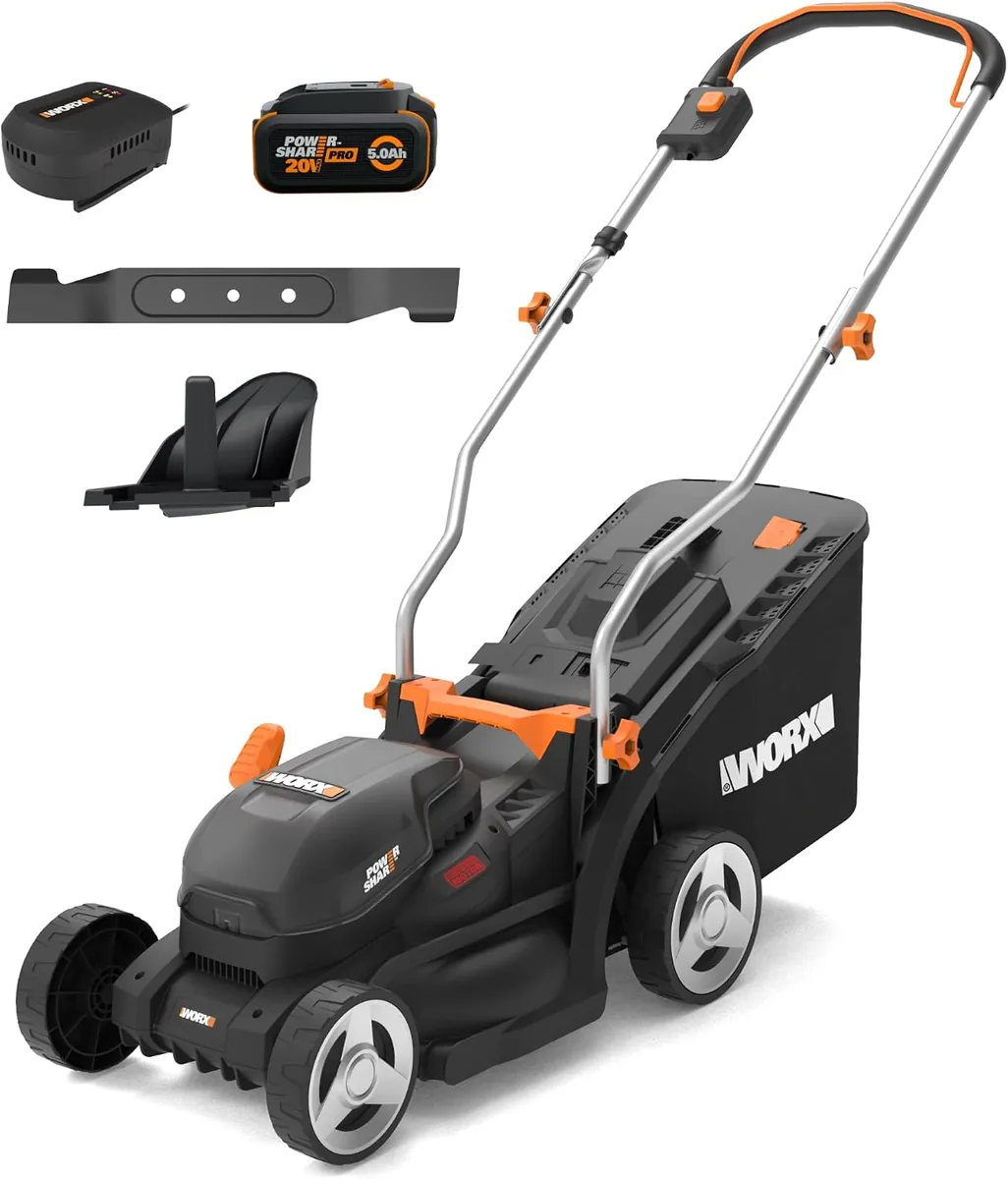
WHY I CHOSE THIS ✓
it has the lowest published battery-mower weight, 22.35 lb without the pack, with a 14 inch deck that goes where a wide mower cannot. The wrong lawn for it is one near a quarter acre.
WORX WG733.1 20V 14-Inch Cordless Push Mower Specs
Key Features:
- Brushless motor: It spins at 3,800 RPM with no load and needs no fuel or cord.
- PowerShare battery: WORX says the same 20V pack fits its other PowerShare tools.
- Six heights on one lever: The range runs from 1 to 3 in, and a higher height stretches the battery, per the manual.
- Bag fill flap: The flap floats when the bag is empty and drops when it is full.
- Folding handle: The upper handle folds so the mower stores in a small space.
A 13 inch cut means more passes than a wide deck, but it also means the mower turns where a wide one cannot. I run it along the tree-row strips, parallel to the drip lines rather than across them, so the deck never rides over a line. Start with the lock-off button held in, then pull the bail, and let go of the bail to stop.
WORX gives 3,200 square feet per charge, with no minutes and no conditions, and that is about 0.07 acre. A quarter acre is 10,890 square feet, more than three times that area, so a lawn of that size needs several charges or packs, depending on conditions. The manual says a higher cut, one third or less of the grass height at a time and fewer stops all stretch the pack.

When I switch from mulching to bagging along the strip edges, I take the mulch plug out first, as the manual says, and put it back in afterwards.
Leave wet grass alone, because it sticks under the deck and the clippings do not collect properly. Before you clear the bag or touch the blade, switch off, wait for the blade to stop and take out the battery.
After each mow I clean the deck with a soft brush and cloth with the battery out, because the manual says not to use water or solvents. The kit is the 5.0 Ah PowerShare pack with a 2.0 A charger. The manual says to replace the blade after 50 hours of mowing or 2 years of use, whichever comes first.
It fits a tiny lawn, an owner of WORX 20V tools and anyone who wants a small lightweight mower for tight corners. Skip it if your lawn is a quarter acre, if you want side discharge or a drive, or if your grass is often tall.
FINAL VERDICT
The WG733.1 is the mower to lift with one hand and store anywhere. It gives up width, bag size and run time to get there. Pick it only if your lawn is closer to 3,200 square feet than to a quarter acre.
It is the light mower for tight corners.
7. SKIL PM4910-15 PWR CORE 40 20-Inch Cordless Push Mower Kit Best Run Time
The SKIL PM4910-15 gives the longest run time any maker states for the nine mowers on this page: SKIL says up to 60 minutes on its 6.0 Ah battery, a best case with no conditions given. It is a 40V brushless push mower with a 20 inch deck and a 1.7 bushel bag, and it folds to stand upright. It suits a small yard whose mowing takes longer than a short pack allows.

WHY I CHOSE THIS ✓
I chose it for the longest stated run time on this page, a 6.0 Ah pack with a 60 minute claim and a 5-year registered tool warranty. It has no published weight and no drive, so the claim has to prove itself on your lawn.
SKIL PM4910-15 PWR CORE 40 20-Inch Cordless Push Mower Kit Specs
Key Features:
- 60 minute claim: SKIL’s best-case figure with the 6.0 Ah pack, which the manual says grass and cutting height change greatly.
- Seven heights on one lever: One hand sets the deck from 1.5 to 4 in, and the lowest cut is 1.5 in.
- 3-in-1 grass handling: Bag, mulch insert and rear discharge, with the insert out for the bag.
- Folding handle: The mower stands upright or lies flat, and the manual prefers flat because an upright mower can tip.
- Electric brake: The blade stops within 3 seconds of releasing the bail.
The start takes two hands: press the safety button, pull the bail to the handle and release the button. The motor will not run unless the side rails are fully out, both clamps are closed and the handle sits in an operating position. I plan my mowing in real minutes, not in the 60 on the box, because the manual says grass and height greatly affect run time. I compare these two battery push mowers in WORX WG752 versus SKIL PM4910-15.
The kit holds one battery and one charger, and the manual lists wet grass as a no. SKIL publishes no weight, charge time or deck material. The registered 5-year tool warranty ties with EGO’s 5 years for the longest tool term stated here, but it needs registration within 30 days and covers the battery and charger for only 2 years.

Register the mower within 30 days, because without it the tool warranty drops from 5 years to 3.
Never mow wet grass or on a slope steeper than 15 degrees, and mow across the face of a slope. Turn the motor off, wait for the blade to stop and take out the battery before you clear a jam.
In late October I fit the mulching insert and run over the first apricot and plum leaves instead of raking, which only works in dry material. I sharpen the blade about twice a season, as the manual says. The lowest cut is 1.5 inches, so a close-cut lawn is out of reach. My roundup of mulching mowers for fine clippings covers nine battery and gas picks.
Reach for it if you want the best cordless lawn mower for a small yard and your mowing takes longer than a short pack allows. Skip it if you need a lawn cut below 1.5 inches, if you want self-propel or if the grass is wet most mornings.
FINAL VERDICT
Pick the PM4910-15 when run time is your worry and you will register the warranty. It gives you one pack, one charger and a push. Plan your mow in the minutes the lawn really takes, since the 60 minutes is SKIL’s own best case.
It is the mower with the longest run-time claim here.
8. Greenworks 24V x 2 MO48L4210 20-Inch Cordless Push Mower Best Turbo Mode
The Greenworks MO48L4210 is the only mower of the nine with a Turbo button: press it and the blade speed rises from 2,850 to 3,250 RPM for a thick patch. It is a 48V brushless push mower with a 20 inch deck, two 4.0 Ah batteries and a bag, mulch and side discharge. It suits a small, flat yard where thick spots are the problem.

WHY I CHOSE THIS ✓
I picked it for the Turbo button that no other mower here has, a 20 inch deck and two packs in one box for a mid-range price. It is a push mower of 54.5 lb without the batteries, so every pound is yours to move.
Greenworks 24V x 2 MO48L4210 20-Inch Cordless Push Mower Specs
Key Features:
- Turbo button: It lifts the blade from 2,850 to 3,250 RPM for thick patches, and holding it drains the packs faster.
- Two 24V batteries: Together they make 48V, and the mower will not start on one pack.
- One-lever height: A single lever sets all four wheel heights at once from 1-3/8 to 4 in.
- Four grass modes: Mulch, rear bag, side discharge and Turbo come with the plug, bag and chute in the kit.
- Folding handles: The mower stores upright with the handles folded, bag off, and battery and key out.
The start is a button press and then the handle: put the safety key in, hold the start button and grab the start handle. After a wet week the strip beside the garden stood taller than the lawn, and I held Turbo for that strip only, because holding it drains the batteries. Let go of the handle and the blade stops within three seconds.
Greenworks Canada gives up to 50 minutes on the two packs and states no grass or mode, so I read it as a best case. Both packs must be in, and if their charge or amp-hours differ the mower runs to the weaker one. The manual says to raise the blade for new or thick grass, and the mower stops if the blade is set too low.

Charge both packs together in the workshop, so they run down evenly.
Wait for dry grass, because the manual says to wait until it dries and wet clippings stick to the deck and the blade. Keep slopes under 15 degrees and cross them, never up and down.
I bring the packs in from the cold shed before winter and keep them dry, within the temperature range the manual gives. I clean the deck with a dry cloth and no hose. Greenworks sells other 24V tools that share the packs, which is a platform you buy into once. The mower is for personal use only, because the warranty excludes hired or commercial mowing.
Thick patches on a flat small yard are its job, and it suits anyone who wants a mower that boosts through them. Skip it if you want self-propel, if one pack must do the job or if your grass is wet most mornings. For lawns that are thick everywhere, my roundup of lawn mowers for thick grass goes further.
FINAL VERDICT
The MO48L4210 earns its place with a Turbo button and a two-pack kit on a push mower. It asks you to push 54.5 lb and keep both packs charged together. Choose it for a small yard with thick spots.
It is the push mower with a boost for thick patches.
9. PowerSmart DB8618C 18-Inch Gas Push Mower Best Small Gas
The PowerSmart DB8618C is the smallest gas mower on this page: an 18 inch deck, 51 pounds by the manual and a handle that folds for the shed. It runs a 144 cc four-stroke engine, mulches or throws clippings to the side and has no bag. It suits a small, flat yard, which the maker puts at about a quarter acre.
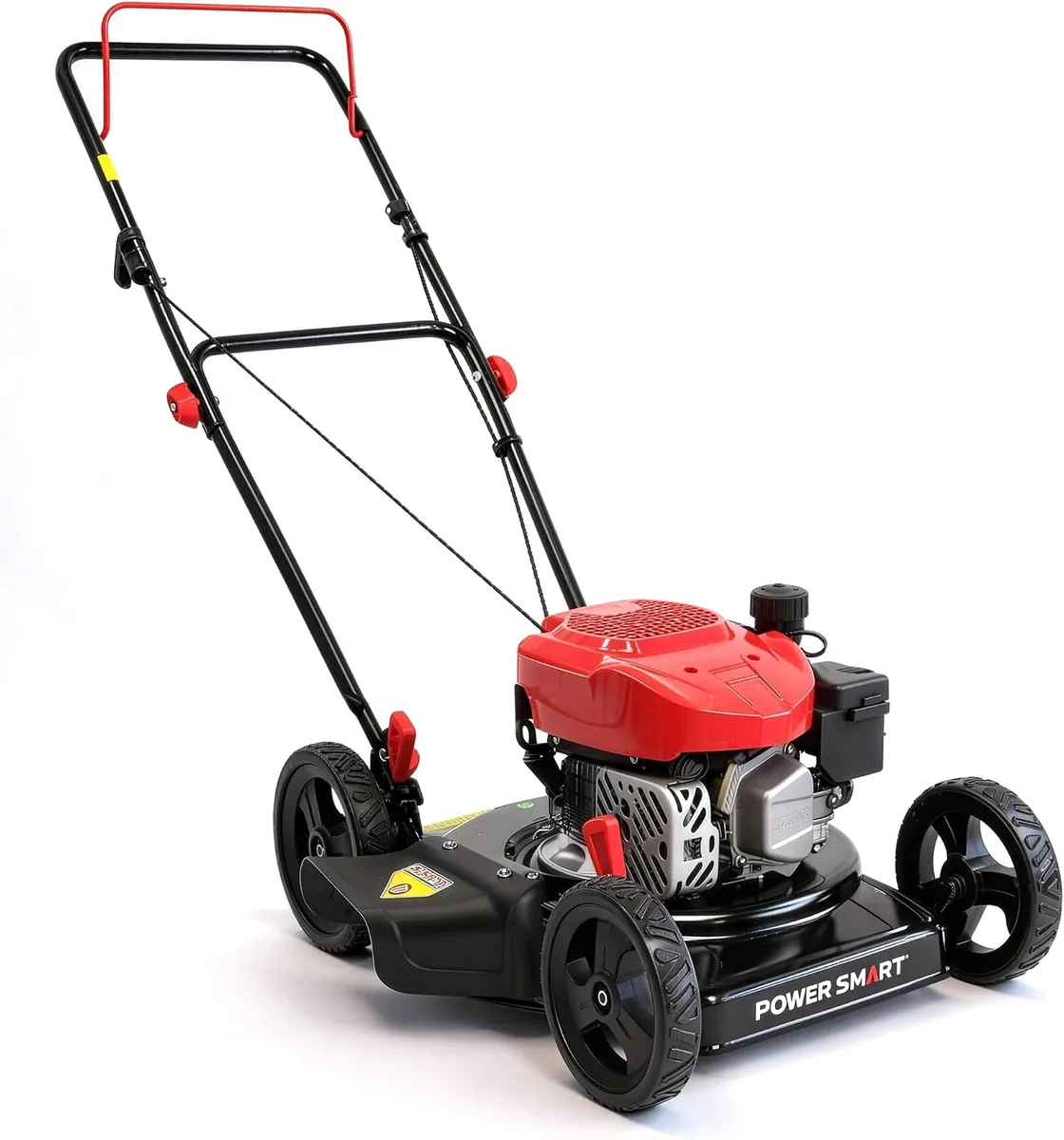
WHY I CHOSE THIS ✓
I rank it ninth for its small size, an 18 inch deck at 51 lb with a 2-year home warranty. It is narrower and has fewer heights than a 21 inch gas mower, and it has no bag.
PowerSmart DB8618C 18-Inch Gas Push Mower Specs
Key Features:
- 18 inch deck: The narrow cut turns tight around beds and trees and stores small.
- 144 cc engine: A four-stroke overhead valve design with a primer bulb and a recoil pull.
- Five heights on two levers: The range is 1.5 to 3.9 in, and the manual says to start high to avoid scalping.
- Side discharge and mulching: The chute comes in the box, and no bag is sold.
- Folding handle: The mower stores in a small space.
Start cold with one to three presses of the primer bulb, hold the stop control against the handle and pull the cord slowly until you feel resistance, then quickly. At 51 pounds it goes over a curb and into the shed without a fight, though the small 7 inch front wheels sink on soft or rutted ground. The 18 inch cut takes more passes than a 21 inch deck on the same lawn.
Use fresh, lead-free gasoline of 87 octane or higher, never mixed with oil, and refuel outdoors with the engine off and cool, waiting at least 2 minutes before you open the cap. The manual says to check the oil before each use and to cut no more than 2 inches of grass in one pass. PowerSmart publishes no run time per tank and no noise figure.

Before you tip it, stop the engine, wait for the blade to stop, let the engine cool and pull the spark plug wire, and never tip it more than 90 degrees, because oil can run into the upper engine.
The manual says the machine can amputate hands and feet and throw objects, so keep both away from the deck and the discharge. Never run the engine in a garage or shed, because carbon monoxide can kill in minutes.
Before winter I run the tank dry for storage of 30 days or more, because stale fuel is the manual’s own warning, and I change the oil after the season. Ragged, brown grass tips tell me the blade is dull, and the manual sends sharpening to an authorized service center with a yearly check. Wear eye and hearing protection from the first pull. Before you touch the blade, stop the engine, wait for the blade to stop, let the engine cool, pull the spark plug wire and put on heavy gloves.
Pick it if your yard is small and flat and you want a small gas mower for tight spaces and easy storage. Skip it if you want a bag, self-propel or quiet running, or if your lawn is bigger than the maker’s quarter acre. The manual gives no slope limit, so stay on level ground.
FINAL VERDICT
The DB8618C is the smallest gas mower here and the easiest to store. It gives up the bag and the drive. Choose it when a small flat yard and a fuel routine suit you.
It is the compact gas mower for a flat yard.
How to Choose the Best Lawn Mower for a Small Yard
A small yard changes the order of the questions: storage and run time come before power. Seven checks sort the mowers on this page, and I run them in this order on my own lawns.
Match the Deck Width to the Yard
Decks here run from 14 to 21 inches. A narrow deck turns around beds and trees and fits a small shed, and a wide deck needs fewer passes, though on a small yard the extra passes cost less than the extra storage space. For lawns of half an acre or more, my roundup of mowers for a large yard covers five picks.
| Deck | Suits | Trade-off |
|---|---|---|
| 14 inches | A very small lawn, edges and tight corners | Most passes, small bag |
| 18 to 20 inches | A small lawn with a few beds | A middle ground in passes and storage |
| 21 inches | A small to mid-size level lawn | Largest to store, fewest passes |
One maker rates its 14 inch mower for up to 3,200 square feet on a charge, a little under a tenth of an acre, while both gas models are put at about a quarter acre. I read a maker’s area claim against my own lawn before I read anything else, and the best lawn mower for a very small yard is the narrowest deck that still finishes the job.
Pick the Power Source You Can Live With
Each power source asks something of you every season. Battery and corded models count as electric, so the right choice depends on whether you can reach an outlet or must carry a pack. My roundup of push mowers by power source covers battery, gas, corded and reel models.
| Power source | What you supply | What it limits |
|---|---|---|
| Battery | Charging, and a second pack for long jobs | Minutes on one pack |
| Gas | Fuel, oil and a pull cord | Noise, exhaust and no running indoors |
| Corded | An outlet and an outdoor-rated extension cord | Reach, and a cord the blade can cut |
| Reel | Your own push | Tall, wet or thick grass |
Noise belongs in that choice. A study that measured more than 600 mowers at 25 feet and at the operator’s ear found that electric mowers are significantly quieter than gas mowers (1). A life cycle study of 12 gasoline mowers, one battery mower and one corded mower found that the gasoline mowers emitted the most of every contaminant except lead, up to 1,500 times more carbon monoxide, and that the corded model was the most benign (2). It covered one battery model from 2004, so I read it as a direction, not a rate.
Read Run Time Against Your Real Mowing Time
A run time on a box is a best case. The battery mowers here state between 30 and 60 minutes on their kit pack and none states the grass or the mode, and one maker’s own table drops from 55 minutes at light load to 30 at heavy load on a single pack. Plan the mow in the minutes your lawn really takes, and the best battery mower for a small yard is the one whose pack outlasts your longest mow. My roundup of cordless battery lawn mowers covers nine picks for small and large lawns.
- Light load: short, dry grass cut at a high setting gets the most from a pack.
- Heavy load: tall, thick or wet grass cuts the run time, and every manual here warns against wet grass.
- A second pack: a lawn that needs it should push you toward a platform with larger packs or a corded mower.
Pro Tip
Ask which grass height and mode a run time was given for. A figure with no conditions is a best case.
Decide Between Push and Self-Propelled
On a small, flat yard a push mower does the job and saves the weight and the cost of a drive. A drive earns its place when the mower is heavy or when you push for a long time. Releasing a drive control stops the drive, and it does not brake the wheels, so steer with both hands near trees. A self-propelled mower is worth buying only if you can still lift it, because a drive adds weight. My roundup of the best self-propelled lawn mower covers that choice in more detail.
Check the Weight and the Storage Space
Makers weigh a mower with the battery out, with the bag and battery in, or with no basis stated. Compare only figures with the same basis, and think about the shed step and the car boot before the deck width. I read the weight first and its basis second.
| Type | Weight | What the figure includes |
|---|---|---|
| Reel | 19 lb | Maker figure for the assembled mower |
| Battery push | 22.35 to 54.5 lb | Manual figures with the battery out |
| Self-propelled battery | 82.3 lb | Manual figure with the bag and battery |
| Gas and corded | 51 to 62 lb and about 46 lb | Manual or maker figures, basis not stated |
Set the Cutting Height by the One-Third Rule
Heights here run from 1/2 inch on the reel to 4 inches on four battery models. The one-third rule says to cut no more than a third of the leaf height at a time, and a field study found it cut the mowing events required by 31 percent, about 8 a year, compared with mowing weekly (3). A dull blade works against you: in a Nebraska experiment on Kentucky bluegrass it lowered turf quality and raised gasoline use by 22 percent (4). I check the blade by the cut before I check it by the clock.
Read the Safety Rules Before the First Mow
Mowers hurt people. A US emergency department analysis estimated 934,394 lawn mower injuries from 2005 to 2015, and the hand and finger were the most injured part (5). Another study of eye injuries found that 77 percent came from projectiles, mostly grass, dirt and rocks, and that only 2 percent of those cases documented eye protection (6).
- Blade: it keeps turning for a few seconds after the control is released, so stop the motor or engine, wait for the blade to stop, then take out the battery, unplug the cord or pull the spark plug wire before any work under the deck.
- Thrown objects: walk the lawn first and pick up stones, sticks and toys, wear eye protection and stop the blade on gravel.
- Children and pets: keep them out of the yard while you mow, at the distance the manual gives where it gives one.
- Fuel: refuel outdoors with the engine off and cool, and never run a gas engine in a garage or shed, even with the door open.
- Slopes: mow across a slope, never up and down, and keep to the maker’s limit, which is 15 degrees where a manual states one. My roundup of the best lawn mower for hills ranks models by drive and slope limits.
- Batteries and cords: use the maker’s charger only, charge and store packs within the temperature range in the manual, never use a damaged or swollen pack, and use an outdoor-rated cord on a corded mower.
Blade Safety
Wear closed shoes and heavy gloves for any blade work, and look behind before and while you back up.
My Overall Verdict
Storage, run time and what a mower asks of you decided my ranking more than any single spec, and the top three suit three different small yards. For bigger lawns I rank more machines in my lawn mower picks by size.

1. EGO Power+ LM2112 21-Inch Cordless Push Mower Kit Best Overall
For a small, level yard that one charge can finish, when you want a full deck that folds flat.

2. Honda HRN-BV 21-Inch Self-Propelled Battery Mower Best Premium
For a small flat yard where you dislike pushing and want Honda’s cover and a low cut.

3. American Lawn Mower 1204-14 14-Inch Push Reel Mower Best Value
For a small lawn you keep short, when you want the quietest and cheapest year of mowing.
Start with the power source, check the run time against your longest mow and read the weight with its basis. For most small, level yards, my best lawn mower for small yard work on this page is the EGO LM2112, which I cover in my review of the EGO LM2112.
Why EGO Power+ LM2112 21-Inch Cordless Push Mower Kit Might Be the Best Choice
I put it first because it gives a small yard a full 21 inch deck at 45.2 pounds without the battery, and it folds flat. On my house lawn I watch the status light stay green as the lanes pile up.
The trade is the pack. EGO gives up to 35 minutes on the 4.0 Ah battery and the mower is a push model, so a yard that takes longer needs a second charge.
What puts it first:
✓ Deck: a full 21 inches that cuts in few passes.
✓ Weight: 45.2 lb without the battery, per the manual.
✓ Modes: mulch, bag and side discharge in the box.
✓ Storage: the handle folds and the mower lies flat.
✓ Brake: the blade stops within 3 seconds of releasing the bail.
Frequently Asked Questions
What to use to mow a small yard?
A small yard is best mowed with a push mower sized to the lawn, either a battery, corded or reel model. On this page I use the EGO LM2112 for a small, level lawn that one charge can finish, and a reel mower for a tiny lawn you keep short.
Which is the smallest lawn mower?
The smallest powered lawn mower on this page is the WORX WG733.1, with a 14 inch deck and 22.35 pounds without the battery. The American Lawn Mower 1204-14 reel mower is also 14 inches wide and weighs 19 pounds, but it has no motor and cuts only up to 1-3/4 inches.
What are the best brands of lawn mowers?
The best brands of lawn mowers on this page are EGO for a full-size battery mower, Honda for dealer service behind a premium model and Craftsman for a corded one. SKIL and Greenworks add battery push mowers with a long run-time claim and a Turbo button, and every brand here publishes a manual.
What is the life expectancy of a lawn mower?
The life expectancy of a lawn mower is not stated in years by any maker on this page, so I cannot give a figure. A sharp blade, a clean deck, dry storage and, on a gas mower, fresh fuel and scheduled oil changes decide how long a mower keeps working.
What is the best lawn mower for a small yard?
The best lawn mower for a small yard on this page is the EGO LM2112, a 21 inch battery push mower that folds flat. A buyer who dislikes pushing should look at the Honda HRN-BV, and one who wants no battery or fuel should look at the American Lawn Mower reel.
References
- Blomberg L, Trezza D. The evolution of quiet lawn mowers and their impact on community noise and hearing conservation. INTER-NOISE and NOISE-CON Congress and Conference Proceedings. 2021;263(2):4896-4902. doi:10.3397/in-2021-2877
- Sivaraman D, Lindner AS. A Comparative Life Cycle Analysis of Gasoline-, Battery-, and Electricity-Powered Lawn Mowers. Environmental Engineering Science. 2004;21(6):768-785. doi:10.1089/ees.2004.21.768
- Law QD, Bigelow CA, Patton AJ. Selecting Turfgrasses and Mowing Practices that Reduce Mowing Requirements. Crop Science. 2016;56(6):3318-3327. doi:10.2135/cropsci2015.09.0595
- Steinegger DH, Shearman RC, Riordan TP, Kinbacher EJ. Mower Blade Sharpness Effects on Turf1. Agronomy Journal. 1983;75(3):479-480. doi:10.2134/agronj1983.00021962007500030015x
- Harris C, Madonick J, Hartka TR. Lawn mower injuries presenting to the emergency department: 2005 to 2015. The American Journal of Emergency Medicine. 2018;36(9):1565-1569. doi:10.1016/j.ajem.2018.01.031
- Stange NR, Jennissen CA. Lawnmower-Related Eye Injuries in the U.S., 2004 to 2023. Am J Ophthalmol. 2025;277:7-16.
Safety Note: A mower blade can cut through a hand or foot and throw stones and sticks with force. Pick up debris before you mow, keep the discharge guard, bag or mulch plug in place, never point the discharge at people, windows or cars, and keep children and pets indoors while the mower runs; never let a child ride on a riding mower. Never disable the operator-presence control. Before you clear a clog, tip the mower or touch the blade, stop the engine or motor, wait until the blade has stopped, then remove the safety key or battery, or disconnect the spark plug wire on a gas model. Mow across slopes with a walk-behind mower and up and down with a riding mower, within the slope limit in your manual, and stay off wet slopes, drop-offs and ditch edges; on a rider with a rollover protection bar, keep it up and wear the seat belt as the manual says. Refuel only outdoors with the engine off and cool, wear closed shoes and eye and hearing protection, and read the manufacturer’s manual.