

The best pole saw reaches your limbs from the ground and fits the power you will keep up, and that is a different saw for an orchard than for a hedge line. I run 3.7 acres of apricots and plums, so high limbs and dead wood come to me every year, and I put these nine saws to work on them.
Below are nine battery, corded and gas pole saws, ranked by what each manual says about bar, shaft, oiling and warranty, and by how they cut. My top pick, the EGO Power+ PS1001 10 in Telescoping Battery Pole Saw Kit, is the saw I recommend first to anyone with limbs under 8 in.
Best Pole Saw Reviews 2026 With 9 Models I Put to Work
These nine saws cover the three power types a buyer chooses between: battery, corded and gas. I rank them on what each manual says about the bar, the shaft, oiling and the warranty, and on how they cut. Every one is a tool for cutting branches from the ground, never for felling a tree or working from a ladder.
1. EGO Power+ PS1001 10 in Telescoping Battery Pole Saw Kit Best Overall
The EGO Power+ PS1001 is the best pole saw I can recommend first to anyone who prunes from the ground, because the box holds nearly everything the job needs: a 10 in bar on a telescoping carbon fiber pole, a 56V 2.5Ah battery, a charger, a shoulder strap and a chain sheath. According to EGO, an LED at the head lights the cut line, which helps under a dark canopy. Buy a bottle of bar and chain oil with it, because the oil tank ships empty.

WHY I CHOSE THIS ✓
I rank the PS1001 first because a new buyer can open the box and cut with the fewest extra purchases: battery, charger, strap, sheath and a tool-free knob are already there, and the LED solves a problem I meet in shade. I accept the weight at full reach and the small oil tank. It is the saw I reach for first on the upper limbs of the plum rows.
EGO Power+ PS1001 10 in Telescoping Battery Pole Saw Kit Specs
Key Features:
- Telescoping carbon fiber pole: a quick-release lever locks the length you set, from 7.64 to 9.58 ft without an extension pole.
- LED cut-line light: the lamp comes on when you squeeze the trigger and stays on for about 10 seconds after release, so the chain stays visible in shade.
- Tool-free tension knob: one knob sets chain tension, and an eccentric gear in the side cover is designed to stop you over-tightening it.
- Automatic oiler: a semi-transparent 2.7 oz tank feeds the chain while you cut and shows the level at a glance.
- Bucking spikes: metal spikes at the head bite into the limb and hold the saw in place while the chain starts to cut, as the manual shows.
- Shoulder strap with a quick-release loop: it takes weight off your arms and lets you shed the saw fast in an emergency.
- Extension pole option: EGO sells a 3.28 ft extension pole separately, and the manual allows up to two, which lengthens the machine to 12.86 ft with one.
The LED earned its place on the shaded side of a canopy. With the trigger squeezed, the light fell along the chain line, and I could see where the bar sat on the limb before I committed to the cut. The manual’s ceiling is a limb up to 8 in thick, and I keep well inside it. I follow the cutting sequence in Pole Saw Safety Before You Buy below, so every limb gets its relief cut, its top cut and a final cut outside the branch collar.
After about ten minutes at full length the pole felt much heavier than it did at the first cut. The 9.37 lb that EGO lists is the saw without the battery and chain sheath, and the pull on your wrists grows with every foot of pole, so the number on the box understates what you carry. I put the strap on before the first cut now, and I rest the pole on the ground between limbs.
Two small things showed up in the first sessions. The chain slackened after the first few cuts, which is normal for a new chain: EGO says to turn the knob counterclockwise at least one turn and then tighten it fully. And after the saw lay on its side in the tool shed overnight, it left a dark patch of oil on the floor. EGO calls seepage normal and says to empty the tank after each use and run the saw for one minute, so that is now my last step of the day.

Plan with the tool length and not the reach claim: the manual gives 9.58 ft at full extension, and the 13 ft in the listing depends on a user height that EGO does not publish.
EGO adds a rule that belongs to this saw: never remove the battery pack at a high location, so lower the pole to the ground and follow the shutdown orders in Pole Saw Safety Before You Buy below before you swap packs. The manual describes no chain brake.
Upkeep is short. Fill the tank before the first use, grease the bar-tip sprocket weekly with a syringe, and keep the saw indoors and dry with the sheath fitted. The motor will not run when the battery or the head is too hot, and EGO gives an operating range of 5 to 104 F, so I keep the pack indoors on frost mornings until the cut starts.
Buy the PS1001 if you prune limbs under 8 in from the ground and want the battery side handled in one box. It suits an orchard owner or a homeowner with tall shade trees and a dry shed. Skip it if your limbs are thicker than the manual allows, if the work sits near wires or in rain, or if you need a stated run time in minutes: EGO gives only up to 100 cuts on the 2.5Ah battery, with no cut size.
FINAL VERDICT
The PS1001 is the pole saw I recommend to most homeowners with tall limbs and a dry place to store it. Ground pruning of limbs under 8 in is the job it was made for.
It is the battery pole saw I recommend to most homeowners.
2. ECHO PPT-2620 12 in Telescoping Gas Pole Saw Best Premium
The ECHO PPT-2620 is the pole saw I pick when reach matters more than carrying batteries: a 25.4 cc two-stroke engine on a telescoping shaft that runs 106 to 145 in, with a 12 in bar. It is the best gas pole saw on this page because it is the only gas model here, and it is premium in price and in intent. Fuel mix and bar oil are not in the box, and you carry 17.4 lb dry.

WHY I CHOSE THIS ✓
The PPT-2620 takes second place because it is the premium option for tall limbs without a battery, with a five-year consumer warranty. I pay for that with weight, fuel mixing and a recoil start. I use it when the job is high and long, and the pack would give out first.
ECHO PPT-2620 12 in Telescoping Gas Pole Saw Specs
Key Features:
- Telescoping shaft with a clamp knob: an upper tube slides inside a fiberglass lower tube and locks when you turn the knob clockwise.
- 12 in bar: the manual rates the saw for light to medium trimming of limbs and branches up to 8 in in diameter.
- Adjustable automatic oiler: a screw on the bottom of the gear case sets the oil flow, and the 0.2 L tank is refilled with each tank of fuel.
- Side-access tensioner: a screw on the side moves chain tension without taking the cover off, after the bar nuts are loosened to finger tight.
- Shoulder harness in the box: the manual tells you to check that it is adjusted before you cut.
- Choke and purge bulb start: the manual’s cold start uses the choke, four to five presses of the bulb after fuel shows in the return line, and rapid pulls on the recoil handle.
- Optional 4 ft extension: ECHO sells one, the manual allows only one on the pruner, and ECHO’s page puts the reach claim with it at 20 ft.
The shaft is the reason to own this saw. At full length the head sat well above the point where my loppers stop, and the 12 in bar spanned the limbs I cut. I stood to the side of each limb and not under it, and I watched it come down: ECHO warns that cut branches bounce when they strike the ground, and its manual says to hold the cutting shoe against the branch so the limb does not whip, with no back-and-forth sawing.
Dry weight is 17.4 lb, and ECHO’s brochure says that is without the bar and chain, so the saw in your hands weighs more once you add fuel and oil. ECHO publishes no weight with fuel, no balance figure and no run time per tank. I clip the harness on before the first cut. Mix fuel at 50:1 with fresh 89 octane gasoline from the pump, because ECHO does not approve E15 or E85 and wants fuel bought within the last 30 days.
Stone-fruit wood showed me the upkeep side. After a morning in the plum rows, gum and fine dust had packed the guide bar and sprocket area. ECHO says some sap and resin is corrosive, so wash that area after each use and coat the metal parts with light oil. I also turned the oiler screw down once, because ECHO says very little visible oil on the chain is enough and tells you to reduce the oil discharge if oil leaks from the bar cover, which keeps bar oil off the soil under the trees.
Start it on the ground with the head clear of everything and at least 10 feet from the spot where you fuelled it. The manual says the attachment must not move at idle, and if it does, the saw goes to a dealer.
Gas adds one caution to Pole Saw Safety Before You Buy below: the exhaust is hot and contains carbon monoxide, so the saw never runs indoors, and ECHO asks for head protection with a full face shield, eye protection that meets ANSI Z87.1 and hearing protection from the first pull.
Living with it means fuel discipline. Mix no more than 30 days of fuel, or 90 days with stabilizer, and for storage over 30 days drain the fuel, run the engine dry and put 7 cc of two-stroke oil in the cylinder, as the manual says. Grease the flexible drive shaft every 25 hours of use and keep the air filter and cooling fins clean, because clogged fins lead to overheating and seizure.
Buy the PPT-2620 if you want gas power on a telescoping shaft that runs to 145 in, you already mix two-stroke fuel for other tools and your limbs stay under 8 in. Skip it if you want a battery tool, a light pole or a stated noise figure, or if you prune limbs near a roof or a wire.
FINAL VERDICT
The PPT-2620 is the premium gas option on this page, with a telescoping shaft that runs to 145 in. It rewards a buyer who already mixes two-stroke fuel and will carry the weight.
It is the gas pole saw I keep for the high limbs.
3. Greenworks 40V 8 in Pole Saw Kit PS40B210 Best Value
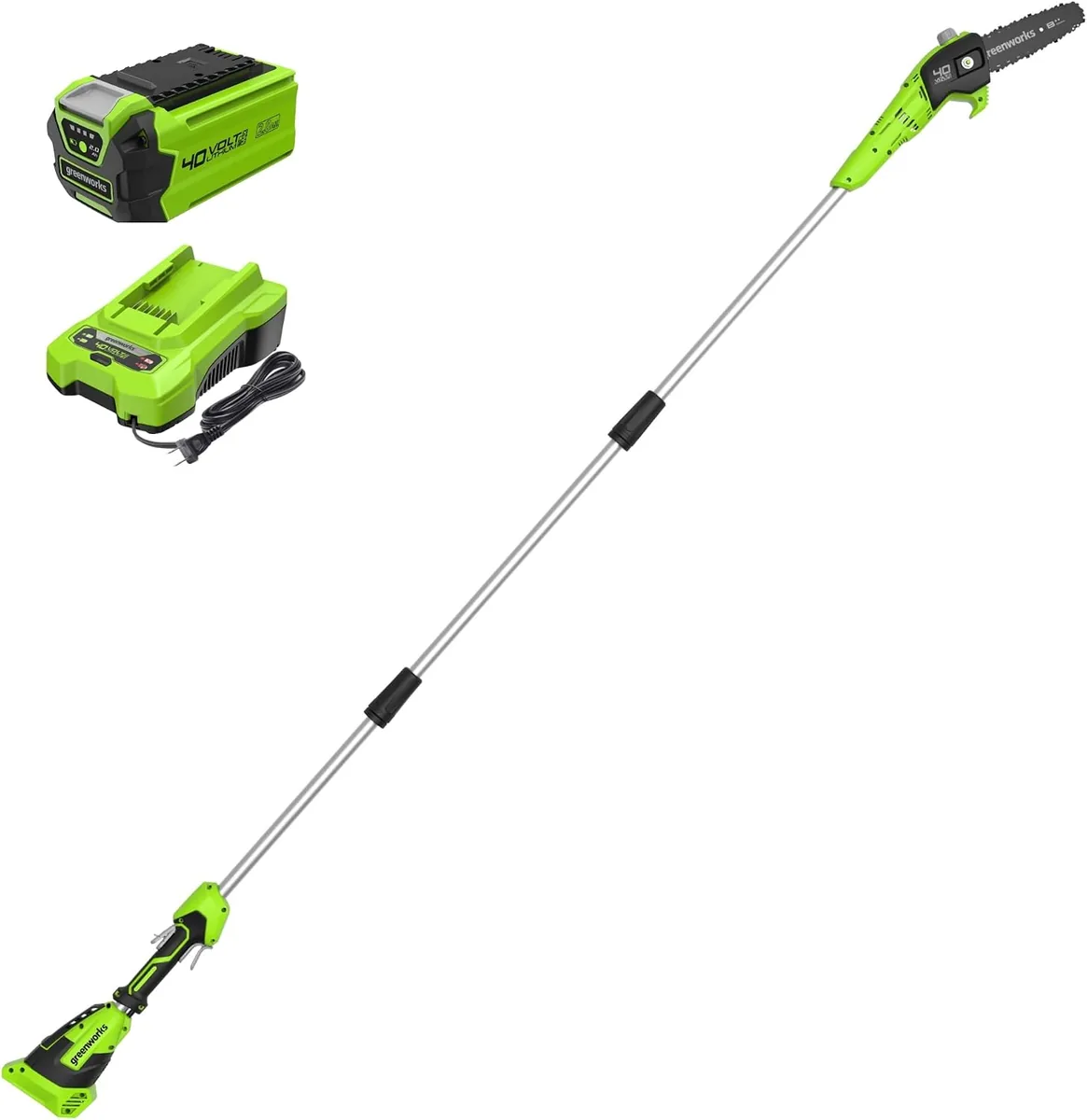
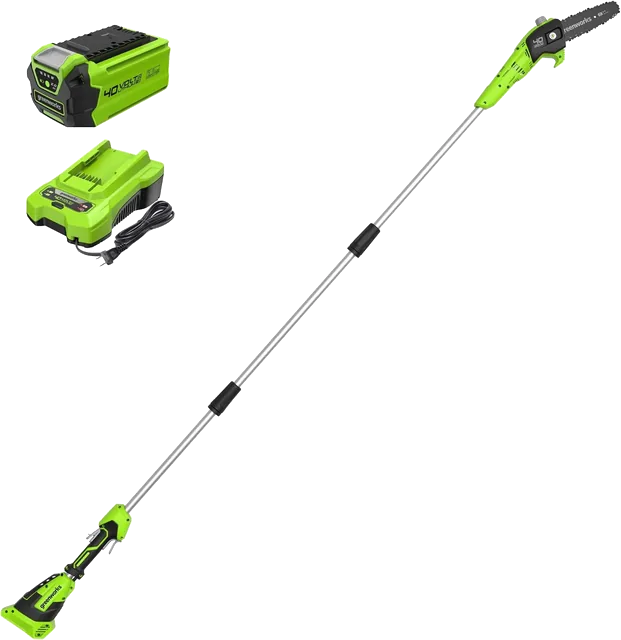
The Greenworks 40V PS40B210 is the best pole saw for the money if your limbs are small and your garden already runs on 40V tools. For a budget-tier price you get an 8 in saw, a 3-piece shaft that reaches 9 ft with the extension pole fitted, a 2.0Ah battery, a 2 A charger and a wrench. Oil is not in the box, and the maker caps the job at limbs up to 6 in thick.
WHY I CHOSE THIS ✓
This is my value pick for a specific buyer: small limbs, a 40V battery system and a limited budget. The kit is complete except for oil, and the manual states the 60 degree angle and the no-ladder rule in words. I do not ask it for more than light pruning from the ground.
Greenworks 40V 8 in Pole Saw Kit PS40B210 Specs
Key Features:
- 3-piece shaft with collars: the head, the handle and an extension pole join with collars, and the manual says to tighten each one completely.
- 6 in limb size: Greenworks designs the saw for limbing and pruning small branches up to 6 in in diameter.
- Automatic oiler: an 80 ml translucent tank feeds the chain while you cut, and the manual asks you to check it every 30 minutes.
- 40V battery platform: the 2.0Ah pack and charger also fit Greenworks’ other 40V tools, so a second pack for a long job is a battery you may already own.
- Wrench and scabbard in the kit: the wrench sets the chain tension, and the scabbard covers the bar between jobs.
- Internal circuit breaker in the battery: on overload you release the switch and restart, and the manual says to let the pack cool for about a minute.
- Short charge: Greenworks’ page gives 60 minutes on the 2 A charger.
Small limbs are where this saw belongs. Before a summer cut on the apricot and plum tops, I stepped back until I could see the limb, every wire and my footing clearly, and where leaf cover hid the cut point I did not cut. I follow the cutting sequence in Pole Saw Safety Before You Buy below and hold the front cutting guide against the limb with light pressure. Past the 6 in rating, this is the wrong saw for the limb, so I leave thicker wood to a bigger tool.
The weight is 8.2 lb without the battery, and Greenworks gives no figure with the battery on. A saw head and a pack at the end of a 9 ft pole is the heaviest at full reach, so I work in short bursts. Greenworks lists only a cuts figure on a 4×4, up to 45 on the 2.0Ah battery, and no minutes, so I plan one pack for a few limbs and a second charged pack for anything longer. The first pack takes about an hour to recharge, according to Greenworks.
One morning I found a collar not fully tightened when I checked before lifting the pole. The manual names this hazard and says to be certain the collars are fully tightened and to check them periodically during use, so I now check them every time I set the saw down. The other thing I noticed was the oil. The tank ships empty, and the manual says oil may seep in storage, so empty it after use and run the saw for a minute.

A new chain stretches. The manual says to check the tension frequently and to run a new chain in for 2 to 3 minutes, so retighten before you judge how it cuts.
The weak spots are plain: a brushed motor, a 6 in limb rating and no strap in the box, so a long session at full reach tires the arms sooner. The full shutdown steps are in Pole Saw Safety Before You Buy below.
Upkeep is a wrench, a bottle of bar and chain oil and a file for the chain. Greenworks says to empty the oil tank after each use if you want to avoid seepage and to lightly lubricate the chain for storage of three months or more. The battery and the saw have an operating range of -4 to 104 F.
Buy the PS40B210 if your limbs stay under 6 in, you want a complete kit at a modest price and a 40V battery fits your tools. Its limits are a 6 in branch capacity, a sectional shaft, a brushed motor and no strap in the box. Skip it if you prune limbs thicker than 6 in or want any of those fixed.
FINAL VERDICT
The PS40B210 is the value pick for small limbs on a 40V battery system. A tight budget and light pruning from the ground are what it suits.
It is the budget pole saw I recommend for small limbs.
4. Sun Joe SWJ803E 10 in Corded Telescoping Pole Saw Best Corded Electric Pole Saw
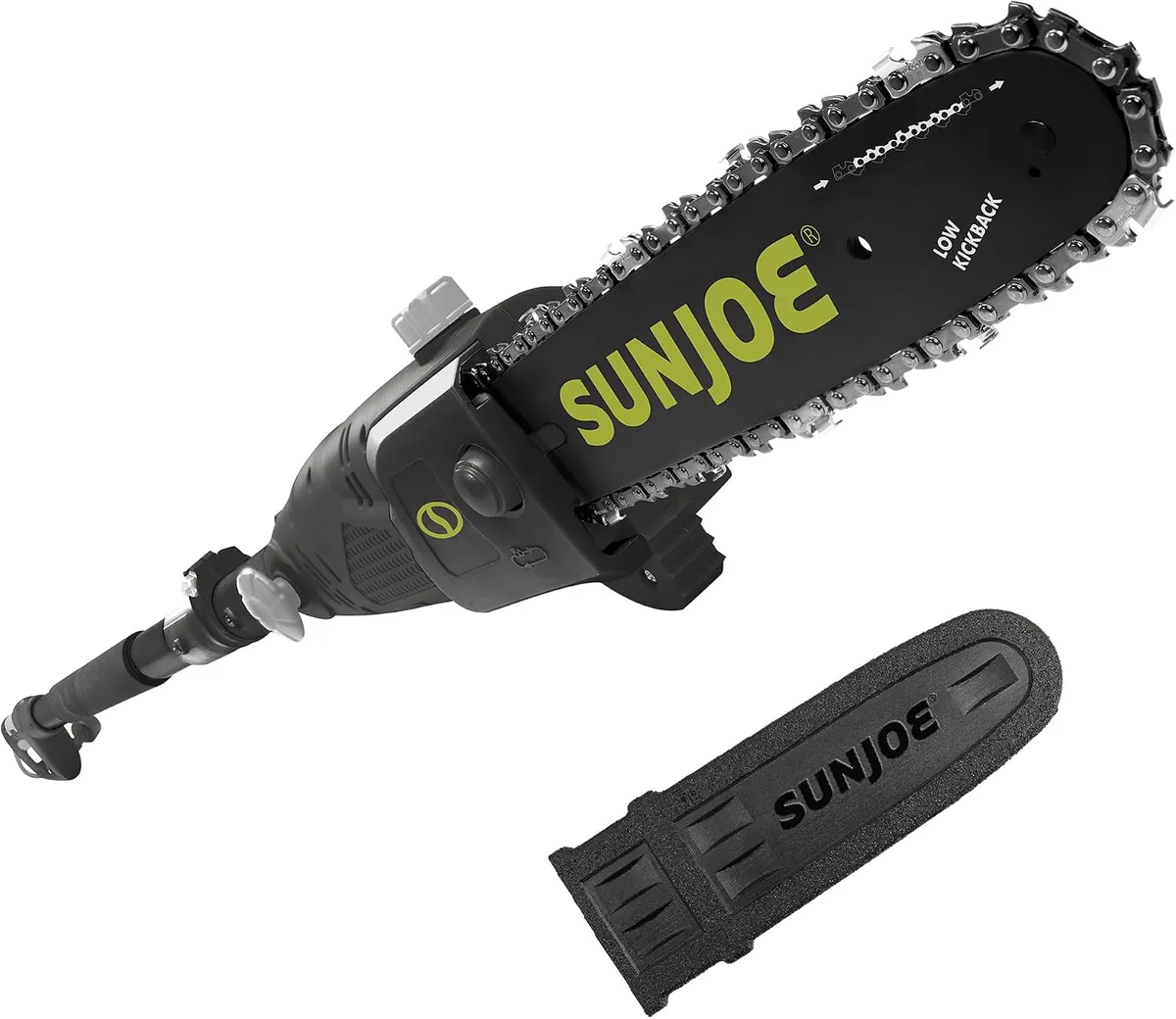
The Sun Joe SWJ803E is the best corded pole saw on this page because it never asks you to charge anything. An 8 A motor turns a 10 in bar on a telescoping pole, the head tilts from 0 to 30 degrees, and your work ends where your extension cord does. Bar and chain oil and the cord are not in the box.
WHY I CHOSE THIS ✓
The SWJ803E earns fourth place as the one saw here that runs for as long as you have power and a cord. The tilting head, the 10 in bar and a telescoping pole make it a capable tool for limbs near an outlet. I keep it for the trees beside the house, where the cord reaches.
Sun Joe SWJ803E 10 in Corded Telescoping Pole Saw Specs
Key Features:
- Head that tilts 0 to 30 degrees: a dial locks the head at the angle you set.
- 10 in bar: Sun Joe gives 9.5 in as the maximum cutting thickness and 8.5 in as the recommended one.
- Telescoping pole: the shaft runs 5.8 to 8.8 ft on a cam-lock.
- Automatic oil pump: a window with a minimum mark shows the 2 fl oz tank.
- Cord hook and handle loop: the extension cord loops through the handle and around the hook, away from the chain.
On a limb that leaned away from the trunk, I turned the dial, locked the head and met the limb square-on instead of pushing the pole past the 60 degree limit the manual sets. Next to a hand pruning saw on a pole, the power saw was far faster on a thick limb, and far heavier.
The 7.9 lb net weight sits at the far end of a pole that reaches 8.8 ft, and the manual says not to overreach. The cord is the other chore: it lay on the same ground as my drip lines, so I kept it behind me and outside the drop zone. My Sun Joe pole saw review goes through the SWJ803E’s reach, weight and cord in more detail.
Check the cam-lock before you lift the pole. If the shaft slides with the lock closed, tighten the nut with the hex key.
Use an outdoor-rated extension cord of the gauge Sun Joe gives: 16 AWG up to 50 ft and 14 AWG from 50 to 100 ft, with no cord longer than 100 ft. Plug into GFCI-protected power, and never use the saw in rain.
Tension takes a screwdriver and a hex key, a new chain stretches, and oil seeps in storage unless you empty the tank after use. Follow the shutdown orders in Pole Saw Safety Before You Buy below before any chain work, carrying or storage.
Buy the SWJ803E if the trees stand within a cord’s reach of an outlet and you want a 10 in bar without a battery. It suits yard trees and orchard rows near a building. Skip it if the limbs are far from power, if you need a tool-free tension knob, or if you work near wires: the cord is the saw’s limit, and it is also a hazard.
FINAL VERDICT
The SWJ803E is a corded saw with a 10 in bar and a tilting head, and it belongs where an outlet is close. A plug beats a charger for yard trees beside the house.
It is the corded pole saw I use beside the house.
5. Makita XAU02ZB 36V (18V x2) 10 in Telescoping Pole Saw, Tool Only Best Long Pole Saw
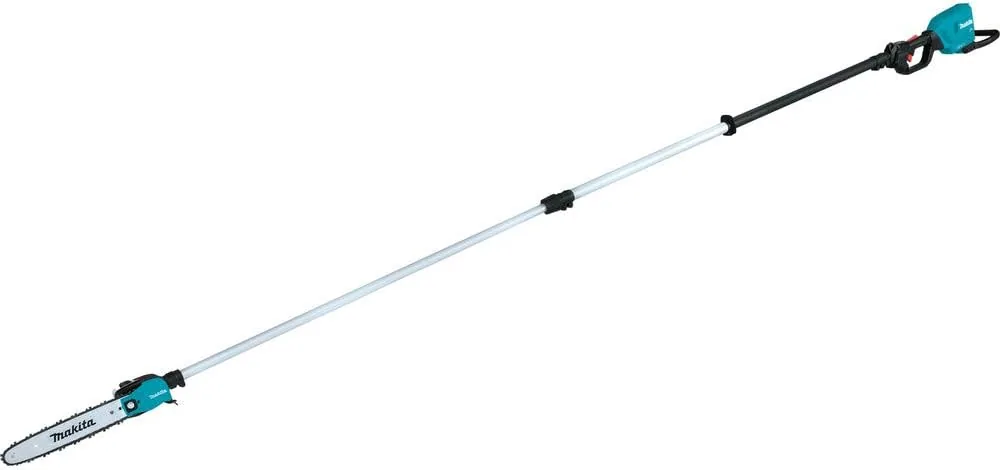
The Makita XAU02ZB is the best long pole saw among the battery models on this page: its telescoping shaft runs from 99.5 to 148 in without the guide bar, the longest tool length of the battery saws here. The box holds the saw, a harness and a chain cover, and no batteries and no charger. You need two 18V LXT batteries and a charger, and the pair makes a 36V saw.
WHY I CHOSE THIS ✓
I rank it fifth because length is the one thing it does better than any other battery saw here, and I trade for it with weight and a tool-only price. If you already own 18V LXT batteries, it makes sense. It is quieter than a gas saw, but I still wear ear and eye protection.
Makita XAU02ZB 36V (18V x2) 10 in Telescoping Pole Saw, Tool Only Specs
Key Features:
- Telescoping lock ring: you loosen the ring, slide the pipe and lock it again.
- Torque Boost mode: for thick or hard wood, it works for up to 60 seconds before it shifts back.
- Constant speed and electric brake: the tool stops by itself on overload, overheating or over-discharge, and a lamp shows which.
- Shoulder harness in the box: the manual says to use it every time you cut.
- Adjustable oiler: a screw sets the oil flow, and the translucent tank shows the level.
The extra length changed which limbs I could take from the ground. At full extension the head reached well above my loppers’ range, and the pole is the point of this saw. Makita publishes no limb size, and the bar’s cutting length of 9-1/2 in is not a limb limit, so I cut small limbs and take long branches in sections from the tip, as the manual says, so the drop stays under control. My Makita pole saw review covers the XAU02ZB as a tool-only purchase.
Makita’s page gives 18.1 lb with batteries, and the manual warns you to watch your balance because of the weight of the tool head. The manual says to wear the harness every time you cut, and I check the lock ring before every lift, because a pole is only as stiff as its weakest joint. Makita claims up to 140 cuts in 4×4 cedar on two 5.0Ah batteries, with no minutes figure, so I charge a second pair for a long day.
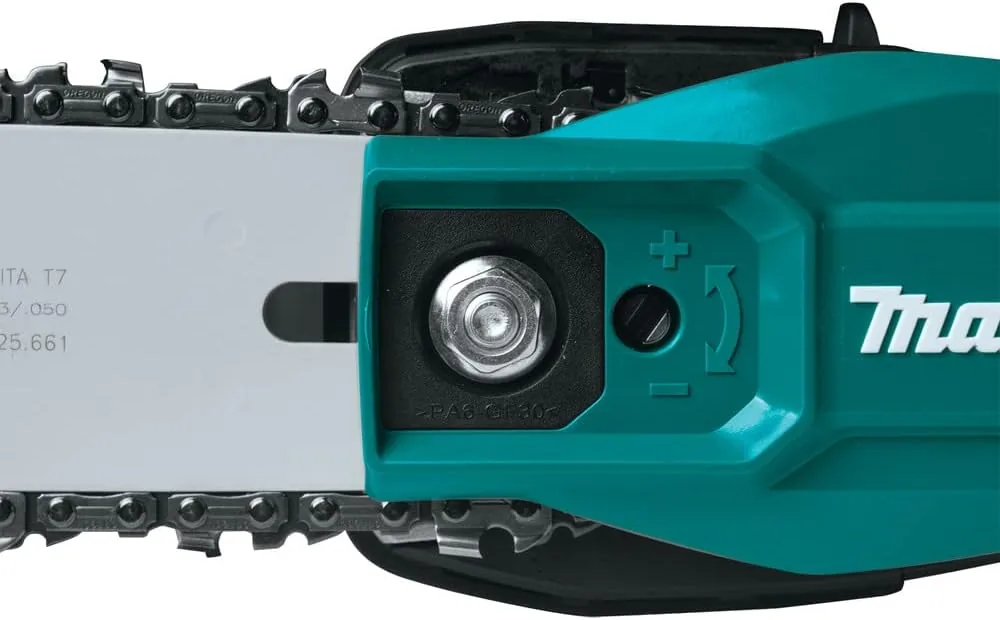
On a cold morning the pack cut out early. Makita’s protection stops the tool on overload, overheating or over-discharge, and the charging range is 10 to 40 C, so I start with batteries that spent the night indoors.
Makita adds that the tool head gets hot during operation, and the full shutdown steps are in Pole Saw Safety Before You Buy below.
Charge before the pack is fully discharged, and rest 10 to 20 minutes every hour, as Makita advises. Use botanical oil when pruning trees.
Buy the XAU02ZB if you already own 18V LXT batteries and the limbs are high. It is a premium tool once you add two batteries and a charger. Skip it if you have no 18V batteries, need a stated limb limit or a light pole, or work near wires. I set the XAU02ZB tool only against the PS1001 kit in EGO against Makita pole saws.
FINAL VERDICT
The XAU02ZB gives battery owners a long pole without a fuel can. It makes sense for anyone with 18V batteries on the shelf and limbs that sit high.
It is the long-reach battery pole saw for the high limbs.
6. WORX WG323 20V 10 in 2-in-1 Pole Saw and Chain Saw Best 2-in-1 Pole Saw
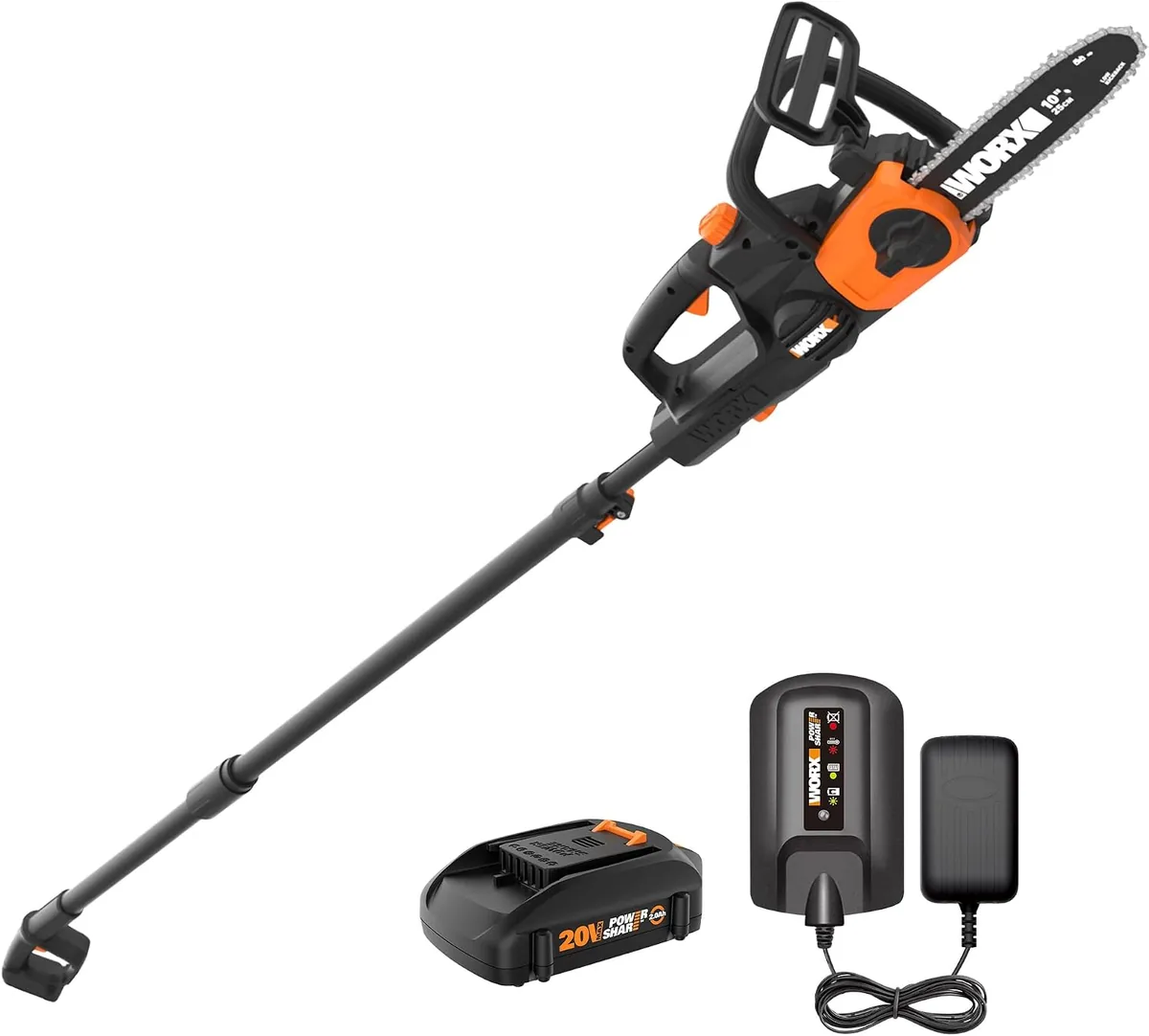
The WORX WG323 is a 2 in 1 pole saw: a compact 10 in chain saw that clips onto a telescoping pole for high limbs and comes off for wood on the ground. One 20V PowerShare battery, a charger and the pole are in the box. Bar and chain oil is not, and the saw ships with an empty tank.
WHY I CHOSE THIS ✓
I put the WG323 sixth because it is the only saw on this list that is also a handheld chain saw, and one battery covers both jobs. I accept the short oil run and the long charge. Before I moved a limb, I moved the drip line under it.
WORX WG323 20V 10 in 2-in-1 Pole Saw and Chain Saw Specs
Key Features:
- Saw head that comes off the pole: the same 10 in saw runs on the pole or off it.
- Telescoping pole: a clamping lever sets any length from 77 to 105 in.
- Tool-free auto-tension knob: a ratchet in the knob sets the chain, and the same knob tightens the chain cover.
- Automatic oiler with a window: the 4.5 oz tank lasts about 12 minutes of cutting, according to the manual.
- PowerShare battery: the 20V pack also fits other WORX PowerShare tools.
The pole mode is where it works for high limbs. With the head locked on the pole I cut upper branches from the ground, and the second job is off the pole: I took the saw off for a dead plum limb that was already on the ground. That handheld mode has its own rules in the WORX manual, and I read them before the first cut in either mode. My WORX WG323 pole saw review looks at both the pole and chain saw modes.
WORX lists 10.0 lb with chain and bar, and the head is a full chain saw with its battery, so the pole is top-heavy at 105 in. The tank needs refilling about every 12 minutes of cutting, and the charge takes 5 hours, according to the manual and WORX’s page. The manual gives no limb size or maximum angle, so I keep to small limbs and a low angle.

Store the saw horizontal with the oil cap uppermost: the manual says the vent channels let oil seep otherwise. After a new chain goes on, check the tension about every 10 minutes, and if the chain loosens, back the knob off about three turns and reset it, always after the shutdown orders below.
The WG323 manual prints a power line distance far shorter than the 50 feet other makers give, and Pole Saw Safety Before You Buy below is the rule to follow. The manual says the saw is not designed to protect you from shock, and the full shutdown steps are in that section.
Living with it is routine care. Use standard bar and chain oil, ISO VG32. Follow the carrying and storage order in Pole Saw Safety Before You Buy below.
Buy the WG323 if you want one saw for high limbs and for wood on the ground, and you already use 20V WORX batteries. Skip it if you prune tall trees most days, want an angled head or need a stated limb limit: the head is fixed in line with the pole, and WORX publishes no branch size. I compare the WG323 with the 8 in telescoping model in WORX WG349 vs WG323.
FINAL VERDICT
The WG323 is a pole saw that doubles as a chain saw. One battery covers the high limbs and the ground wood.
It is the pole saw I keep when one tool has to do two jobs.
7. Greenworks 24V Brushless 10 in Pole Saw and Pole Hedge Trimmer Combo Best Pole Saw and Hedge Trimmer Combo
The Greenworks 24V brushless combo is the best cordless pole saw and hedge trimmer combo on this page, because one pole, one 4.0Ah battery and one charger run two tools: a 10 in pole saw head and a 20 in pole hedge trimmer head. The second tool is a hedge trimmer, and its blade does not cut limbs. Bar and chain oil is not in the box.

WHY I CHOSE THIS ✓
I put the combo seventh because it does two jobs on one battery, and no other saw on the page trims a hedge. It is a good pick for a small property with limbs and hedges, and a poor pick for heavy pruning. I choose it when the hedge and the branch are on the same job.
Greenworks 24V Brushless 10 in Pole Saw and Pole Hedge Trimmer Combo Specs
Key Features:
- Two heads, one pole: the 10 in saw head and the 20 in hedge trimmer head fit the same pole, battery and charger.
- Brushless motor: the manual lists a brushless motor on the saw.
- Collars for the extension pole: two collars join the handle and the extension pole.
- Automatic oiler: an 80 ml tank with an oil window.
- Shoulder strap and scabbard: Greenworks lists both in the kit.
A tall hedge stem at the property line and a few water sprouts high in the plum crowns are both jobs where I otherwise need two tools, and one battery covers both heads. Before I swap heads I follow the shutdown orders in Pole Saw Safety Before You Buy below, and I check the fit before I power up. Cuttings from the hedgerow stem fell toward the flowering strip, so I raked them clear and now cut so they land on the track. Keep the saw head for branches and the hedge head for hedges: a hedge trimmer blade does not cut limbs.
The saw weighs 8.2 lb without the battery, and Greenworks gives no weight with the 4.0Ah pack or for the hedge head. The strap Greenworks lists in the kit is there to take some of that load.

The 24V manual gives no limb size or angle, so I keep to small limbs and hold the pole at 60 degrees or less to the ground, the limit several makers set. Examine the collars during the job and not only at the start.
Tension needs the wrench and a loosened bar nut. The full shutdown steps are in Pole Saw Safety Before You Buy below.
After the saw head the pole carried a film of bar oil, so I wipe it before I fit the hedge head. The manual says to remove all residual oil before storage and to keep the machine away from garden chemicals and de-icing salts.
Buy the combo if you have branches and hedges to trim from the ground and want one battery for both. Skip it if you prune thick limbs, need a telescoping pole or want a stated reach, a weight with the battery or a limb limit.
FINAL VERDICT
The combo suits a mixed property of small limbs and hedges. One battery and one pole do both jobs.
It is the combo I keep for the hedge line and the high sprouts.
8. WORX WG349 20V 8 in Telescoping Pole Saw with Adjustable Head Best Battery Pole Saw With Adjustable Head
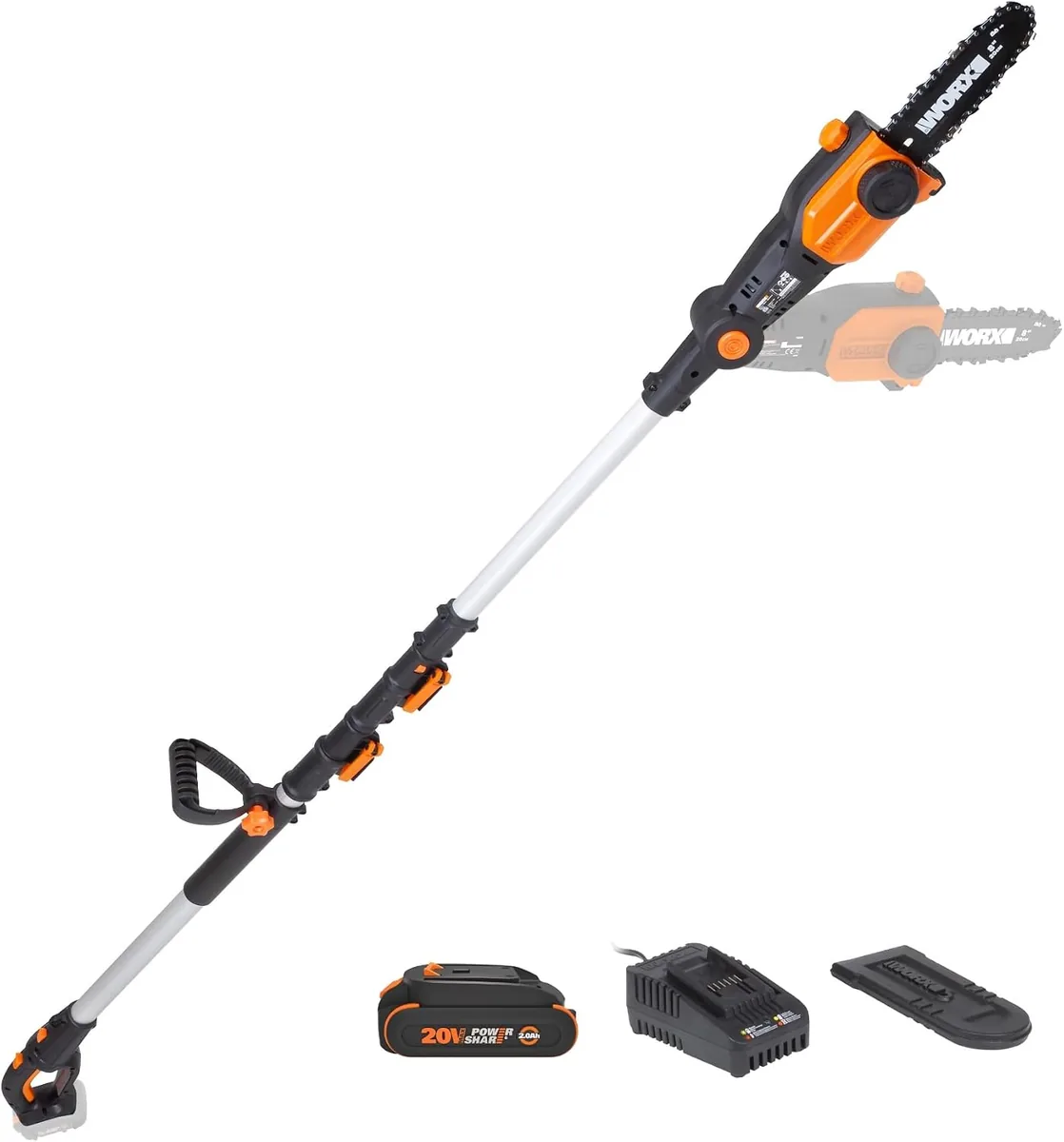
The WORX WG349 is the one battery saw on this page whose head tilts: three positions, 0, 15 and 30 degrees, on an 8 in saw with a telescoping pole and a handle that rotates. A limb that grows sideways meets the bar at the right angle without you bending the pole. The kit holds a battery, a fast charger, an auxiliary handle and a chain sheath, and bar oil is not included.
WHY I CHOSE THIS ✓
I rank the WG349 eighth because no other battery saw here lets you change the head angle. It is a good fit for awkward limbs and a poor one for long sessions. I use the tilt when the limb will not come to the bar.
WORX WG349 20V 8 in Telescoping Pole Saw with Adjustable Head Specs
Key Features:
- Head set at 0, 15 or 30 degrees: you press two knobs on the sides of the head, set the angle and lock it, and the manual says the head must be securely locked before you cut.
- Rotating rear handle: it turns 180 degrees in total, for vertical or horizontal cuts.
- Telescoping pole: a clamping lever locks it from 83 to 110 in.
- Tool-free tensioning: an auto-tension knob with a ratchet sets the chain, and the same knob tightens the chain cover.
- One-hour charger: the manual gives 1 hour on the WA3881 fast charger in the kit.
The head earned its keep on a limb that grew out sideways from the trunk. I set the head to 30 degrees, heard it lock and kept the pole lower than a fixed head allows. At full length the pole flexed and the cut wandered, so I shortened it by a section and moved closer. My WORX pole saw review covers the WG349 telescoping 20V saw in full.
WORX lists 8.8 lb with chain and bar, and the weight sits at the top of a pole that reaches 110 in. The oil tank holds 2.8 oz, and the manual says a full tank lasts about 12 minutes of cutting, so I refill it often and read the window before each limb. The manual gives no limb size and no maximum angle, so I keep to small limbs.

A new chain stretches. WORX says to check the tension about every 10 minutes after a chain change, and if the chain loosens, to back the knob off three turns and reset it.
Its manual prints a power line distance far shorter than the 50 feet other makers give, so follow the 50 feet in Pole Saw Safety Before You Buy below. WORX also says not to extend your arms above your shoulders.
Store it horizontal with the oil cap uppermost, because the vent channels can let oil seep. The manual calls for standard bar and chain oil, ISO VG32, and says an empty tank wrecks the saw, so keep a bottle with the charger.
Buy the WG349 if your limbs lean, you want a battery saw and you can live with an 8 in bar. Skip it if you need a stated limb limit or a long run between oil fills. I weigh the WG349 against the LPP120 in WORX against BLACK+DECKER pole saws.
FINAL VERDICT
The WG349 is the battery saw with a tilting head and a one-hour charge. Leaning limbs are where it earns its place.
It is the battery pole saw I pick for the leaning limbs.
9. BLACK+DECKER LPP120 20V MAX 8 in Pole Saw Kit Best Budget Pole Saw
The BLACK+DECKER LPP120 is the best budget pole saw on this page, and the price buys you a complete battery kit: a 20V MAX battery, a charger, an oil bottle, a wrench and a blade guard come in the box. You oil the chain by hand and tension it with a wrench, and the 8 in bar fits small limbs.

WHY I CHOSE THIS ✓
I rank the LPP120 last because it is the cheapest complete battery kit here, and I keep it for the days when the job is a handful of small limbs. It does the job when the limbs are small and the budget is smaller.
BLACK+DECKER LPP120 20V MAX 8 in Pole Saw Kit Specs
Key Features:
- Complete kit: the battery, charger, oil bottle, wrench and blade guard are all in the box.
- Three-module pole: the handle, the center extension and the saw head join by sleeves, for about 6 ft or about 9 ft.
- Fiberglass pole: the maker’s photo caption calls it lightweight.
- Hand oiling: you lubricate the whole chain before each use, and the manual says to check tension and lubricate every 10 minutes.
- Auto-stop system, as the manual words it: it says the chain stops when you release the trigger, and to test that before every use.
This is a saw for a few small limbs. I thread the sleeves on until no orange thread shows, which is the manual’s own check, then oil the whole chain and start. I follow the cutting sequence in Pole Saw Safety Before You Buy below, with the manual’s first cut 6 in from the trunk on the underside.
A new chain slackens early, and the manual says to retighten it frequently during the first two hours. Over-tightening lowers the cuts you get per charge and wears the bar, and the chain contracts as it cools, so the manual says to ease the tension after the job.
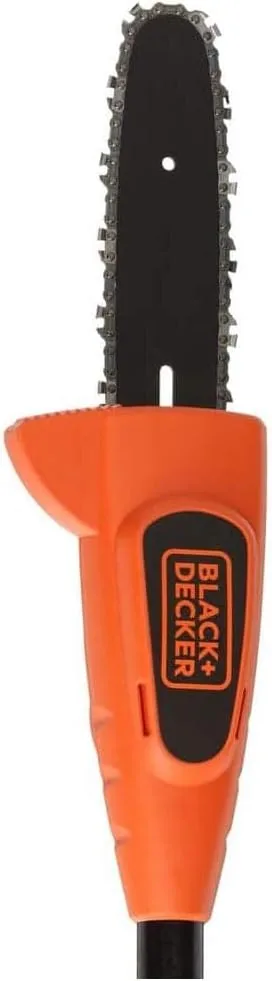
Oil by hand every time you put a charged battery on, because the manual asks for it, and use vegetable-based oil for pruning: BLACK+DECKER says mineral oil may harm trees.
The manual sets 60 degrees as the maximum angle from ground level and says the cutters dull at once if they touch the ground, stones or a nail. The full shutdown steps are in Pole Saw Safety Before You Buy below.
Living with it means two chores every session: oil by hand and check the tension. I oil at the start and again at every battery swap, as the manual asks, and I work with someone within earshot, outside the 50 ft bystander distance. The small battery means I do not plan a long day on one pack.
Buy the LPP120 if you have a few limbs under 6 in, want a battery pole saw in one box and do not mind oiling by hand. Skip it if you want an automatic oiler, tool-free tension, an angled head or a telescoping pole, or if you cut many limbs per session.
FINAL VERDICT
The LPP120 is the cheapest way into a battery pole saw on this page. A few small limbs and some hand oiling are the price of entry.
It is the budget pole saw I keep for a few small limbs.
How to Choose the Best Pole Saw
A pole saw buyer decides on six things: power type, bar length, tool length, weight, upkeep and what the kit includes. I work through them in that order, because the branch decides the first two and the manual decides the rest.
Choose the Power Type for Your Branches
Battery, corded and gas saws suit different work, and the section after this one sets them side by side. Start with the total minutes of cutting you do in a session and not one limb: a few cuts suit a battery, and a long afternoon near an outlet suits a cord. In NIOSH sampling of landscaping workers, noise and carbon monoxide exposure were significantly higher with fuel-powered leaf blowers, string trimmers and chainsaws than with battery versions (1). That is a reason to take a battery seriously, and it is not a measurement of any pole saw. My best corded electric pole saw roundup compares five plug-in models.
- Battery: no cord and no fuel mix, and you follow the shutdown orders below before any chain work.
- Corded: the best corded electric pole saw needs no charging, but it needs an outlet within cord reach and the cord of the gauge your manual gives.
- Gas: a fuel mix, a recoil start and exhaust, in return for a shaft that can run long.
I count minutes this way for every battery tool in the orchard, and I plan a pole saw day around the pack and not the limb. Judge the best battery pole saw by its pack, charger and strap in the box and not by volts alone.
Match the Bar to the Limb
The bar is the called length, and the manual gives the limb the saw may cut. Makers print different limits, and the manual’s number is the one that counts: one prints 6 in, two print 8 in, one prints 9.5 in with 8.5 in recommended, and several print no limit at all. A buyer shopping for the best pole saw for home use should pick the bar by the largest limb they cut from the ground, then stay well inside the manual’s number. My roundup of the best pole saw for thick branches lists the stated branch limit of each pick.
| Printed limit | What it means for you |
|---|---|
| 6 in | Light pruning only; a thicker limb needs a bigger saw or a professional |
| 8 in | Typical household limbs; the manual still says cut in sections and stand clear |
| 9.5 in, 8.5 in recommended | The largest printed limit here; plan by the recommended number |
| No limit printed | Bar length is not an approved limb size; follow the intended-use wording in your manual |
Pro Tip
A bar rating is a limit for the saw. A pole saw is for cutting branches from the ground, never for felling a tree.
Read Tool Length and Reach Claims Separately
Tool length is a measurement of the pole. A reach figure adds the user, and the maker’s assumed height is rarely printed. Compare tool length with tool length, and treat a reach claim as the maker’s number. On a telescoping pole, check the lock by hand before every lift, because a pole is only as stiff as its weakest joint, and I check mine each time. For long reach, my roundup of pole saws for tall trees names five long-shaft saws.
| Figure | What it measures |
|---|---|
| Tool length | The pole with the head, as the manual prints it, collapsed and extended |
| Reach claim | A maker’s claim that adds the user’s height and arm; the assumed height is often not printed |
| Guide bar length | The called bar size; the wood cut in one pass is a little shorter |
- Check whether the figure includes the guide bar.
- Check whether the pole is telescoping, sectional or in modules.
- Never raise the handle above your shoulders to chase a higher branch.
Read Weight With Its Basis
Weights on spec sheets describe different things: a saw without its battery, a saw with bar and chain, a dry engine without bar and chain, or a net weight with no basis stated. Compare only figures with the same basis, and ask what a number leaves out. Overhead work loads the neck and shoulders: in a lab study of 18 young men, neck and shoulder muscle activity was significantly higher when the task sat 20 cm above head height than when it sat 10 cm above (2). After about ten minutes at full reach I feel the pole in my wrists, so I plan rests. My best lightweight pole saw ranking compares saws by weight.
- Without battery: add the pack to get the weight in your hands.
- Dry weight: add fuel, oil, bar and chain.
- Net weight: ask what the figure includes before you trust it.
Look at Oiling and Chain Tension
Every powered pole saw needs bar and chain oil, and most boxes do not hold any. Automatic oilers feed the chain while you cut, and a level window shows when the tank is low. One kit on this page asks you to oil the chain by hand before each use. A new chain stretches, so check its tension often at first.
- Tool-free knob: sets tension by hand, after the shutdown orders below.
- Screw and wrench: needs the tool in the kit, and the same shutdown orders.
- Oil seepage: most manuals call it normal, and some say to empty the tank after use.
Pro Tip
Check the oil level window before each limb. A saw run dry smokes the bar and wears the chain fast.
Check the Kit and the Warranty
The best pole saw for tree trimming arrives ready to cut: a kit that holds the battery, the charger and a strap saves a second shopping trip, and a tool-only saw adds the cost of the batteries. Warranties differ in the small print: five years on the tool for household use on one saw, two years on another, and household use only is the common limit. I read the warranty page and the whole manual before the first start. My roundup of the best pole saw for homeowners picks nine saws for safe, easy yard pruning.
- Battery and charger in the box, or tool only.
- Strap or harness included.
- Bar and chain oil: almost never included.
Key Takeaway
Pick the bar length by the limbs you cut, the power type by the minutes you work, and judge every saw by what its manual says about oiling, tension and the warranty.
Battery, Corded or Gas Pole Saws and the Yard Each One Fits
Each power type earns a place on this list, and each costs you something. The table sets them side by side, and the sentences after it give the short version of the choice. Two sibling guides go deeper on battery against gas and on corded against battery.
| Power type | What you handle | What the manuals add |
|---|---|---|
| Battery | Battery, charger, bar oil | Follow the shutdown orders below before any chain work; charge and store in the manual’s temperature range |
| Corded | Outlet, outdoor extension cord, bar oil | Cord of the manual’s gauge, GFCI power, no rain |
| Gas | Fuel mix, recoil start, bar oil | 50:1 mix in the ECHO manual, 10 feet from the fuelling spot before starting, never indoors |
The best electric pole saw for you is a battery saw if you move around the property, and a corded saw if the work stays beside an outlet. A battery lets you roam, and the cord sets the edge of the job.
A battery saw suits a long session only if a second pack waits on the charger, and that matters more than any single volt figure when you look for the best battery powered pole saw. I keep a spare warm indoors on frost mornings, because cold costs runtime. My roundup of battery pole saw picks lists nine cordless saws for pruning high branches.
A gas saw asks for fresh mix: ECHO wants fuel bought within the last 30 days, and the best gas powered pole saw is the one you will feed that way. Gas gives you a long shaft and no battery, and it adds weight, exhaust and a fuel can.
Pole Saw Safety Before You Buy
A pole saw puts a powered chain on a long pole. It shares the chain hazards of a chainsaw, and it adds three of its own: the cut is overhead, the cut branch falls toward you, and the pole, the saw and the branch can carry electricity from a line. It is a tool for cutting branches from the ground, for an adult who has read the manual, understands the controls and is not tired or impaired by alcohol, drugs or medication.
Power Lines and Falling Branches
Before you start, look for every overhead wire, including wires hidden in leaves. Keep yourself, the saw, the pole and any branch you cut or that could fall or swing at least 50 feet (15 m) from every overhead line, the distance the EGO, Ryobi, DeWalt, Greenworks, Milwaukee, Remington and Echo manuals give, or farther if your own manual asks for more.
Power Lines
The saw is not insulated, and electricity can jump through the air and travel through branches, especially wet ones. Treat every wire, including service drops and communication lines, and anything touching one, as live. If you cannot keep that distance the whole time, stop: a branch near or touching a line is a job for the utility and its qualified line-clearance crews, not for you and not for a general arborist.
In Massachusetts, a landscaper on a raised work platform was electrocuted when the top section of his pole saw touched overhead power lines (3). In New Jersey, a tree-care worker on an aluminum extension ladder about 30 feet up a tree was electrocuted when his extendable pole saw touched a 7,200-volt line (4).
If the saw, the pole or a branch touches a wire, the saw, the branch, the wire and the ground around them can become live. Do not go to the saw or pick it up, touch nothing that is in contact with the line, keep everyone away, and call the utility at once, and 911 if anyone is hurt, a fire starts or a line comes down. Only the utility frees the saw.
Falling Branches
Never stand under the branch you are cutting. Before you cut, look for loose, dead or hung branches above you and clear trip hazards from the ground; stand to the side, out of the branch’s path, plan where it will fall and keep a clear way back, and remember that a cut branch can bounce toward you when it lands. Cut long branches in sections, lower branches first. If a branch falls or swings unexpectedly, get clear at once.
Loose, dead or hung branches above you, or above your way back, are a job for a professional: have them dealt with before you start. Anything near a power line goes to the utility, as above.
In another New Jersey case, a ground crewman was killed by a 38-pound branch dropped from about 60 feet up an 80-foot ash tree; investigators pointed to a drop zone that was not marked off (5). I stand to the side of the limb, watch it come down and keep my way back clear.
Gear, Grip and Footing
Hold the saw with both hands, keep the pole at 60 degrees or less to the ground (the limit in the EGO, Ryobi, DeWalt, Greenworks and Milwaukee manuals; follow your own manual if it is stricter), keep your hands below shoulder height, and never overreach.
Ladders
Never use a pole saw from a ladder, a roof, a tree or any unstable support; work from the ground on firm, level footing. A branch you cannot reach from the ground is a job for a certified arborist (or the utility, if it is near a line).
About 97 percent of the ladder injuries in a 1990 to 2005 US emergency department study that had a recorded location happened outside work, in places such as homes and farms (6).
If the tip of the bar touches a branch, a wire or anything else, the bar can be thrown up and back toward you (kickback). Wood pinching the chain on the top of the bar pushes the saw back toward you, and wood binding the chain on the bottom pulls it forward and away; any of these can make you lose control or balance. Keep both hands on the saw and firm footing, keep the tip clear, watch for branches behind the one you cut and for wood closing on the bar, and use only the reduced-kickback chain and bar your manual approves; no part of the saw removes this risk.
Wear safety glasses with side shields marked Z87.1, and a face shield over them where your manual asks for one; a hard hat or safety helmet rated for falling objects (DeWalt names ANSI Z89.1); hearing protection; work gloves; close-fitting long pants and long sleeves with no loose clothing or jewelry; non-slip boots; a dust mask when the work is dusty; and tie long hair up above shoulder level.
Keep people and pets, helpers included, at least 50 feet (15 m) away, or farther if your manual asks for more, and out of the whole area where the branch can fall and bounce. If anyone comes closer, stop cutting until they are clear, and look behind you before you swing the pole.
Never cut in rain, high wind, a storm or when lightning is possible, and cut only when the light lets you see the branch, every wire and your footing clearly.
Cutting Controls and the Three-Cut Method
Start every cut with the chain clear of everything and let it reach full speed before it touches wood. Cut one branch at a time, rest the cutting shoe, hook or bucking spikes against the branch as your exact manual shows, and use light, steady pressure and let the chain cut. Never start a cut with the tip of the bar and never make a plunge or bore cut. Keep control of the head as the branch separates so it does not drop, and release the trigger as soon as the cut is done.
For a limb within your saw’s limit that you can drop safely, use three cuts:
- The first cut goes on the underside, out from the trunk, about a quarter of the way through in the EGO and Greenworks manuals and no more than a third in the Husqvarna manual.
- The second cut comes from the top, a little farther out, so the limb falls; take long limbs in sections, lower ones first.
- The third cut goes just outside the branch collar, the swollen ring at the base of the limb, and never flush with the trunk.
In a test on pin oak, sycamore and Norway maple branches, cuts made outside the collar left wounds only 4 to 6 percent wider than the branch, against 32 to 51 percent for cuts through the collar (7).
Battery, Cord and Fuel
Use only the maker’s battery and charger for your saw, charge and store them within the temperatures your manual gives and never in rain or wet places, never use or charge a damaged, swollen or leaking pack, and keep loose batteries away from metal objects that could short the terminals.
Use an outdoor-rated extension cord of the gauge your manual gives for its length, plug into GFCI-protected power, never use the saw in rain or wet conditions (GFCI protection does not make that safe), keep the cord away from the cut and your feet, and unplug it before any work on the chain.
Start a gas pole saw as its manual shows, on the ground with the chain clear of everything, at least 10 feet (3 m) from where you fuelled it, and never run it indoors or in a garage or shed: the exhaust contains carbon monoxide.
Before each use, check the saw as your manual describes: a sharp, undamaged chain at the right tension, chain oil in the tank, telescoping locks, couplings and the head tight, the trigger lock-off and switch working, and the battery, cord or fuel system undamaged; on a gas saw the chain must not move at idle. If anything fails, do not use the saw until it is fixed.
Shutdown Orders
Two exceptions come first. If the saw, the pole or a branch touches a wire, follow the line contact steps above and never go back to the saw to switch it off, remove its battery or unplug it. If a branch falls, swings or shifts unexpectedly, get clear at once and never delay for the trigger, battery, cooling, collapsing the pole or the chain cover. For normal work, use the order that fits the task:
- Stopping, every saw, the first step of everything below: release the trigger, switch the engine or motor off and wait until the chain has stopped completely (the chain keeps moving for a moment after the switch is off).
- Maintenance and adjustment (touching the chain, clearing a jam, adjusting tension, filling oil, sharpening, changing the bar or chain, cleaning, changing the pole length or head angle, joining or separating pole sections, fitting or removing an attachment): stop as above, then on a battery saw take the battery out; on a corded saw pull the plug from the outlet by the plug, not the cord; on a gas saw let the engine and muffler cool and pull the spark plug cap off. Lay the saw on a flat surface and put on gloves before touching the chain. Check every lock and coupling before power goes back on.
- Refuelling a gas saw: stop as above, let the engine cool, refuel outdoors with no smoking, flames or sparks nearby, wipe spills, and move at least 10 feet (3 m) away before starting.
- Carrying, transport and storage: stop as above, battery out or unplugged, pole collapsed where it telescopes, chain cover (scabbard) fitted, carried by the handle or at the balance point with the bar pointing behind you, stored indoors and dry out of children’s reach.
- Pinched bar: follow your own manual. The EGO manual says to stop the motor and remove the battery, lift the limb while holding the saw if it can be reached from the ground, and call a professional if the saw is still trapped. Use that only for a small limb you can reach easily from the ground without standing in its fall path, that is not under tension, hung up or storm-loaded; otherwise keep people clear and call a professional. Never yank the pole, never climb to free it, and never use this for a saw touching a wire.
When to Call a Professional
Hand these jobs to a certified arborist: a branch thicker than your manual allows, a limb under tension or hung up after a storm, a large limb over a house, car, fence or road, and any job that needs a ladder, climbing or a lift. Anything near a power line goes to the utility and its qualified line-clearance crews, as above. I keep my own pole saw work to limbs I can reach from the ground, and I leave the rest to a professional crew.
My Overall Verdict
Three saws stand out, and the order depends on how you want to power the work. Pick the power type first: battery for most yards, gas for a long telescoping shaft, and a cord when an outlet sits near the trees. My roundup of telescoping pole saw picks lists seven adjustable-length saws.

1. EGO Power+ PS1001 10 in Telescoping Battery Pole Saw Kit Best Overall
The best all-round pick for limbs under 8 in, with the battery, charger and strap in the box.

2. ECHO PPT-2620 12 in Telescoping Gas Pole Saw Best Premium
The premium gas saw for tall limbs when you would rather mix fuel than carry packs.
3. Greenworks 40V 8 in Pole Saw Kit PS40B210 Best Value
The value pick for small limbs on a 40V battery system.
The question I put to every saw was how little it asks of you before the first cut, and how clearly its manual says what to check. The EGO Power+ PS1001 10 in Telescoping Battery Pole Saw Kit asks the least, and it is the best pole saw I can recommend to a homeowner who prunes from the ground.
Why EGO Power+ PS1001 10 in Telescoping Battery Pole Saw Kit Might Be the Best Choice
The EGO Power+ PS1001 10 in Telescoping Battery Pole Saw Kit is my top pick because it asks the least of a buyer before the first cut. A tool-free knob, an automatic oiler and a battery, charger and strap in the box keep setup short.
The trade-off is weight at full reach: the 9.37 lb EGO lists is without the battery, so I wear the strap and rest the pole between limbs. My PS1001 pole saw review covers the EGO kit in more detail.
Here is what puts it at the top:
✓ Pole: telescoping carbon fiber with a quick-release lever.
✓ Light: an LED shows the cut line in shade.
✓ Tension: a tool-free knob, no wrench.
✓ Kit: battery, charger and strap included.
✓ Warranty: five years on the tool for household use.
Frequently Asked Questions
What is the best pole saw?
The best pole saw for most homeowners is the EGO Power+ PS1001, a 56V battery saw with a 10 in bar, a telescoping pole and the battery, charger and strap in the box. For gas power on a longer shaft I pick the ECHO PPT-2620, and for small limbs on a tight budget the Greenworks 40V PS40B210.
Who makes the best pole saw?
EGO, ECHO and Greenworks make the three pole saws I rank first, and each backs its saw with a manual and a warranty you can read before you buy. Makita, WORX, Sun Joe and BLACK+DECKER make the rest of my list, so read the manual of the exact model before you choose.
What is the best pole saw for the money?
The best pole saw for the money is the Greenworks 40V PS40B210 if your limbs stay under 6 in, because the kit holds a 2.0Ah battery, a charger and a wrench at a budget-tier price. Buyers with thicker limbs should look at a saw whose manual allows 8 in, such as the EGO PS1001.
Can I use a pole saw to trim hedges?
A pole saw cuts branches and not hedges: the Sun Joe and BLACK+DECKER manuals both say not to cut small brush and saplings with the saw, and a hedge is mostly that. A pole hedge trimmer head, as in the Greenworks 24V combo, is the tool built for hedges, and it has its own manual rules.
What saws do arborists use?
Arborists use professional tree-care equipment, including climbing gear and aerial lifts, for work a homeowner pole saw excludes. According to UF/IFAS, a certified arborist handles limbs that need climbing or a lift, and the pole saws on this page are ground tools whose manuals rule out ladders, trees and felling.
References
- Alexander BM, Graydon PS, Pena M, Feng HA, Beamer BR. Hazardous exposures and engineering controls in the landscaping services industry. Journal of Occupational and Environmental Hygiene. 2025;22(3):189-202.
- Shin SJ, Yoo WG. Effects of overhead work involving different heights and distances on neck and shoulder muscle activity. Work. 2015;51(2):321-326.
- Massachusetts Fatality Assessment and Control Evaluation (FACE) Program. Landscaper working from a raised portable work platform was electrocuted when a pole saw contacts overhead power line – Massachusetts. NIOSH FACE report 13MA019. National Institute for Occupational Safety and Health, Centers for Disease Control and Prevention; 2015.
- New Jersey Fatality Assessment and Control Evaluation (FACE) Program. Tree-care worker electrocuted while trimming branch near power line. NIOSH FACE report 13NJ074. National Institute for Occupational Safety and Health, Centers for Disease Control and Prevention; 2016.
- New Jersey Fatality Assessment and Control Evaluation (FACE) Program. Twenty-seven-year-old tree-care worker killed by falling branch. NIOSH FACE report 12NJ019. National Institute for Occupational Safety and Health, Centers for Disease Control and Prevention; 2013.
- D’Souza AL, Smith GA, Trifiletti LB. Ladder-Related Injuries Treated in Emergency Departments in the United States, 1990-2005. American Journal of Preventive Medicine. 2007;32(5):413-418.
- Neely D. Closure of Branch Pruning Wounds with Conventional and ‘Shigo’ Cuts. Arboric Urban For. 1988;14(11):261-264.
Safety Note: Only an adult who has read the manual and understands the controls should use a pole saw, never a child or anyone tired or impaired; practise first on small, low branches you can reach easily from the ground. A pole saw is made for cutting branches from the ground, never for felling trees, and never from a ladder, a roof, a tree or any unstable support. Power lines can kill. Before you start, look for every overhead wire, including wires hidden in leaves, and keep yourself, the saw, the pole and any branch you cut or that could fall or swing at least 50 feet (15 m) from every line, the distance many pole saw manuals give, or farther if your manual asks for more. The saw is not insulated, and electricity can jump through the air and travel through branches, especially wet ones. Treat every wire, and anything touching one, as live. A branch near or touching a line is a job for the utility and its qualified line-clearance crews, not for you and not for a general arborist. If the saw or a branch touches a wire, do not go to the saw or touch the saw, the branch or the wire, keep everyone away and call the utility, and 911 if anyone is hurt. Before you cut, look for loose, dead or hung branches above you and clear trip hazards from the ground. Never stand under the branch you are cutting: stand to the side, out of its path, plan where it will fall and keep a clear way back, because a cut branch can bounce toward you when it lands. Cut long branches in sections, and if a branch falls or swings unexpectedly, get clear at once. Hold the saw with both hands, keep the pole at 60 degrees or less to the ground, the limit several makers set, keep your hands below shoulder height, and never overreach. Let the chain reach full speed before it touches wood, and never start a cut with the tip of the bar. If the bar tip touches anything, the saw can kick up and back toward you, and wood pinching or binding the chain can push it back or pull it forward: keep the tip clear and use only the reduced-kickback chain and bar your manual approves. Wear safety glasses with side shields marked Z87.1 (and a face shield over them where your manual asks for one), a hard hat or safety helmet rated for falling objects, hearing protection, work gloves, close-fitting long pants and long sleeves with no loose clothing or jewelry, and non-slip boots, and tie long hair up. Keep people and pets, helpers included, at least 50 feet (15 m) away, or farther if your manual asks, and out of the whole area where the branch can fall and bounce; stop cutting if anyone comes closer. Never cut in rain, high wind, a storm or when lightning is possible, or in light too poor to see the branch, the wires and your footing. Before each use, check the chain, its tension and the oil, the telescoping locks and the switch as your manual describes, and do not use a saw that fails a check. Before you touch the chain, clear a jam, adjust the tension, fill the oil or change the pole length or head angle: release the trigger, switch the saw off and wait until the chain has stopped, then take the battery out, unplug a corded saw by the plug, or on a gas saw let the engine cool and pull the spark plug cap off; wear gloves. To carry or store the saw, release the trigger, switch it off and wait until the chain has stopped, then take out the battery or unplug it, collapse the pole and fit the chain cover. Use only the maker’s battery and charger, charge and store them within the temperatures your manual gives and never in the wet, never use or charge a damaged, swollen or leaking pack, and keep loose batteries away from metal objects that could short the terminals. Use a corded saw only with an outdoor-rated extension cord of the gauge your manual gives, plugged into GFCI-protected power, and never in rain or wet conditions: GFCI protection does not make that safe. Start a gas pole saw on the ground with the chain clear of everything, at least 10 feet from where you fuelled it; refuel outdoors with the engine off and cool, with no smoking, flames or sparks nearby, and never run it indoors or in a garage or shed, because the exhaust contains carbon monoxide. A branch thicker than your manual allows, a limb under tension or hung up after a storm, a large limb over a house, car or road, or anything you cannot reach from the ground is a job for a certified arborist. Stop when you are tired.