

Finding the best portable generator starts with weight: one unit on this list weighs 39 lb by WEN’s figure and another weighs more than 200 lb, and both are sold as portable. I have set up gasoline and propane units on the gravel pad behind my machinery shed, and I judge each one by whether I can move it, start it and run it far from the house.
I rank nine, from a light inverter to a tri-fuel giant, led by the Westinghouse WGen5300DFcv 5,300-Watt Dual Fuel Generator. After the reviews I explain sizing, placement and what to leave to an electrician.
Best Portable Generator Reviews 2026 With 9 Top Models for Home, Camp and RV
These nine cover the jobs a household hands to a portable generator: outage backup for a freezer and a pump, a camper cord, a campsite and a workshop. Each review says who should skip the machine, so the best portable generator for home backup is easy to tell from the one for a tailgate.
1. Westinghouse WGen5300DFcv 5,300-Watt Dual Fuel Generator Best Overall
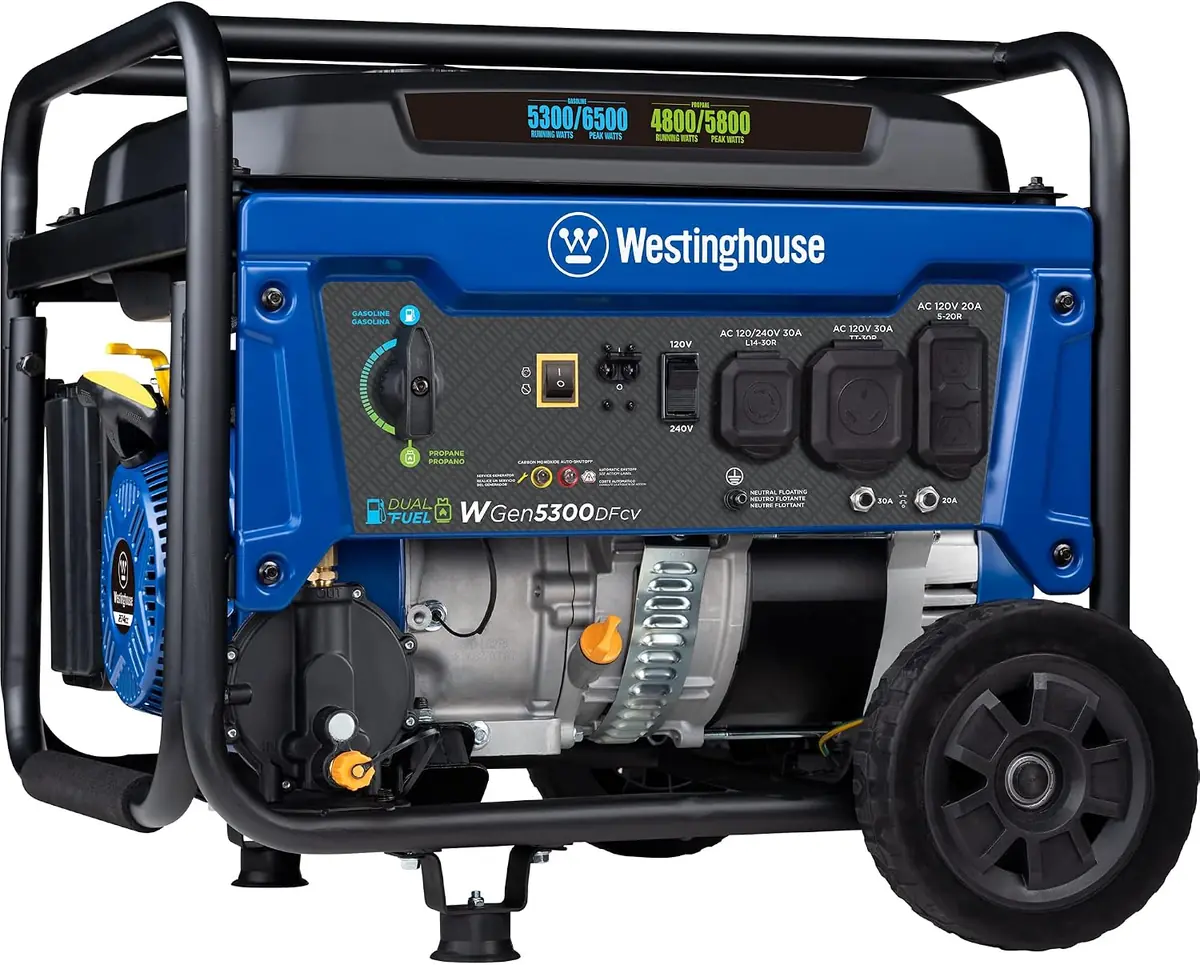
The WGen5300DFcv is the best portable generator on this page for a household that wants one machine for the freezer, the workshop and a camper cord. It gives 5,300 running watts on gasoline, a built-in carbon monoxide sensor and a wheel kit at about 136 lb. The 6,500 in the listing title is the peak figure, so size your loads against 5,300. It suits a buyer who can roll a machine onto level ground and wants gasoline or propane in the same frame.
WHY I CHOSE THIS ✓
I put it first because it carries a carbon monoxide sensor, two fuels and three outlet families at a weight I can roll over the yard. Nothing on the panel needs an adapter for the loads a household reaches for in an outage. I do not pick it for quiet or for push-button starting, and I say so up front.
Westinghouse WGen5300DFcv 5,300-Watt Dual Fuel Generator Specs
Key Features:
- CO sensor: According to the manual, it shuts the engine down when carbon monoxide builds near the unit, and a flashing red light marks the shutoff.
- 120/240 V selector: One switch sets the household outlets to 120 V or the twist-lock outlet to 240 V, and you move it with the engine off.
- TT-30R outlet: A 30 A camper cord plugs in directly, with no adapter to size.
- L14-30R outlet: This is the 30 A outlet a transfer switch uses, and a licensed electrician makes that connection.
- Fuel selector: Gasoline and propane switch over while the engine runs, once the propane tank is connected before starting.
- Low-oil shutoff: The engine stops when oil runs low, which matters on a unit that ships with an empty sump.
- Wheel kit: Two wheels and two mounting feet ship in the box, and the manual says the wheels are for moving it by hand and never for towing.
The manual’s sample chart lists a refrigerator or freezer at about 700 running watts and 2,200 starting watts, a sump pump at 800 and 1,300, and a furnace at 800 and 2,350. By those approximate figures 5,300 running watts holds a fridge, a freezer, a sump pump and the shed lights together, with the start-up surge of one motor on top. I plug the freezer in first and add the rest one at a time. It will not start a large central air conditioner or a big 240 V well pump with margin, so read those nameplates first.
The engine starts on a pull cord with a choke lever and has no electric or remote start: choke on for a cold start, pull slowly to resistance, then pull fast, and move the choke off after several seconds. Westinghouse gives up to 14.5 hours at 25% load on the 4.7 gal tank and 11 hours at 50% load. On propane the manual rates 4,800 running watts, about 9 percent below gasoline, and Westinghouse lists 9 hours at 50% load. Connect the propane tank before you start the engine, then turn the selector.
The voltage selector caught me on the first 240 V job: in the 240 V position the 120 V household outlets go dead and only the twist-lock works, exactly as the manual says. The other two outlets cover the other two jobs, a camper cord on the TT-30R and a transfer switch on the L14-30R, and both are 30 A circuits. That caps the unit well below a whole house. The sensor can also trip on another engine’s exhaust pointed at it, which the manual calls normal, so two engines never face each other on my pad.

The sump ships empty, so I pour the supplied 10W-30 in small steps and check the dipstick before the first pull. The manual says cranking it dry wrecks the engine, and it asks for the first five hours at or below half of rated running watts.
Set it outdoors on level ground at least 20 feet from the house, with the exhaust pointed away from doors, windows and vents, as the CPSC says. The manual states that the sensor does not replace a battery carbon monoxide alarm in the house.
Oil is the main chore, with a check before every start, a change after the first 25 hours or the first month, then every 50 hours or 6 months. Gasoline can deteriorate in 30 days, so for a 2 to 6 month rest I follow the manual with fresh fuel, stabilizer and a drained carburetor bowl. At 68 dBA with no distance given, I wear ear protection beside it. The panel has no GFCI outlets, so a GFCI cord is an extra layer on any damp-risk load, and the manual still forbids wet use.
The WGen5300DFcv suits a household with a fridge, a freezer, a sump pump and workshop lights, a camper owner who needs a 30 A outlet, and a buyer who wants propane in storage. Skip it if you want a quiet engine, if you cannot lift about 136 lb into a truck, or if you need push-button start, a 50 A outlet or clean power for sensitive electronics. Total harmonic distortion runs up to 23 percent.
FINAL VERDICT
The WGen5300DFcv takes first place by putting a carbon monoxide sensor, two fuels and the three outlets most households need into one wheeled frame. Its limits are the pull cord and the 68 dBA figure. Pick it when you want one dependable machine for outage essentials and can start it by hand.
It is the wheeled dual fuel generator I recommend first.
2. Westinghouse WGen9500DF 9,500-Watt Dual Fuel Generator Best Premium
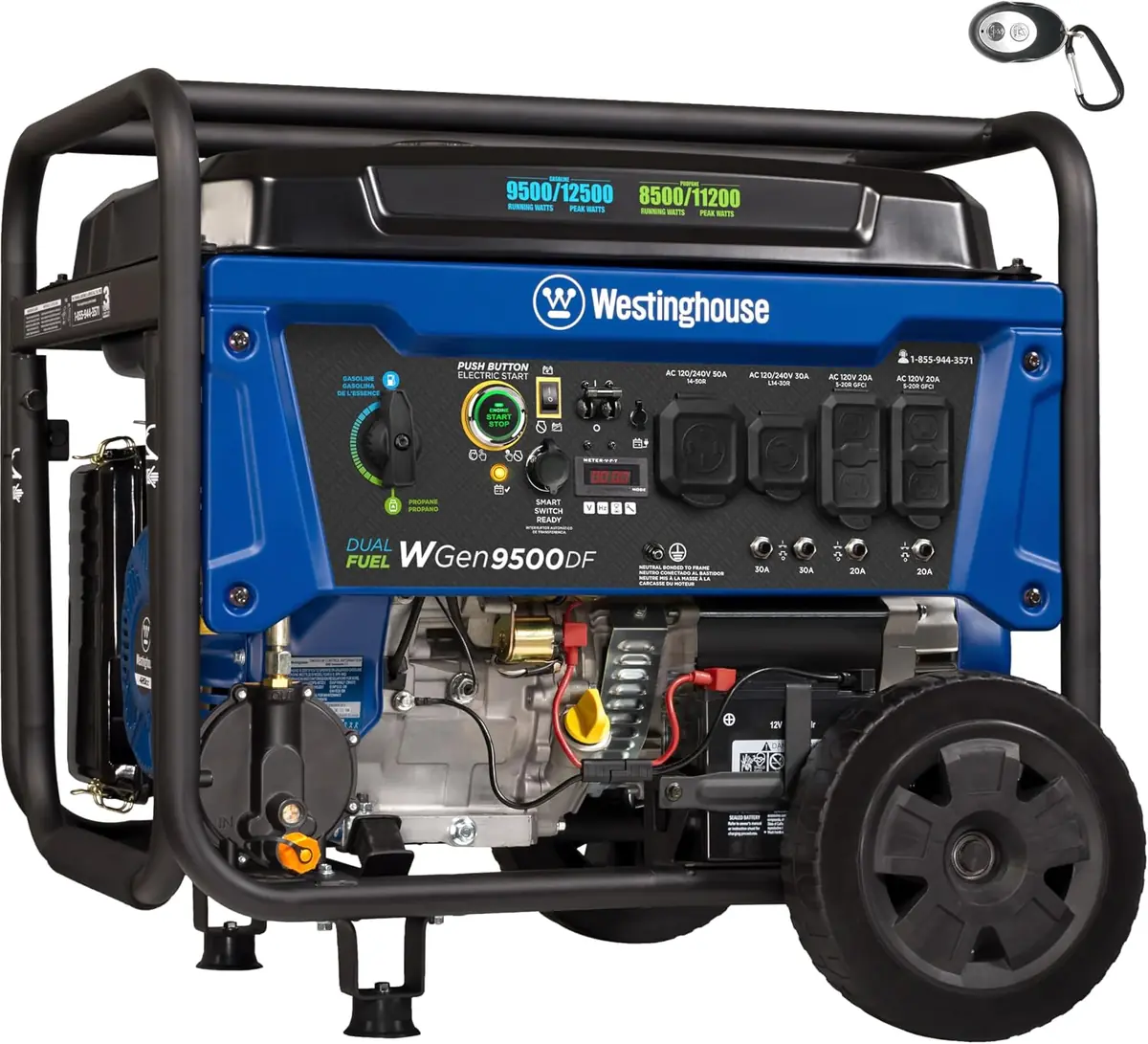
The WGen9500DF is the best premium generator on this page for a farm or workshop that must run a 240 V pump and a freezer at the same time. It gives 9,500 running watts on gasoline, a 50 A outlet and a key fob that starts the engine from up to 99 feet. Premium here means price tier and output, and the cost is 211 lb dry according to Westinghouse.
WHY I CHOSE THIS ✓
I made it the premium pick because the extra money buys output you can use on a farm: a 50 A socket, a 30 A twist-lock and enough watts to start a pump once its nameplate is checked. Premium, here, is the top of the Westinghouse range on this page. I do not claim quiet, light or a built-in carbon monoxide sensor.
Westinghouse WGen9500DF 9,500-Watt Dual Fuel Generator Specs
Key Features:
- 9,500 running watts: That is the gasoline figure. Propane gives 8,500, so size the job for the lower number when propane is the plan.
- 50 A outlet: A 14-50R at 120/240 V feeds a large 240 V load or a heavy cord to the workshop.
- 30 A twist-lock: A 120/240 V outlet suits a transfer switch or interlock that a licensed electrician installs.
- Two GFCI outlets: 20 A household duplex sockets run ordinary plugs, with ground fault protection built in.
- Key fob start: Push the button from up to 99 feet, with push-button and pull-cord starting as backups.
- Data center: The panel shows voltage, frequency, hours run and a maintenance timer.
- Low-oil shutdown: The engine stops on low oil, and an indicator tells you why.
The 240 V pump decides this purchase, and the 12,500 W peak printed on the box says nothing about my pump, so I read the pump’s nameplate for volts, running watts and starting watts before I count on any number. The manual’s sequence is to start the largest load first, then add the next largest one at a time, and to list every device’s starting watts. At 9,500 running watts a pump, a freezer and the workshop lights sit comfortably under the line, and the 50 A outlet carries both 120 V and 240 V loads to a heavy cord at the workshop. A cord that is too long or too thin wastes power as heat.
Westinghouse lists 12 hours at 25% load and 8 hours at 50% load on gasoline from the 6.6 gal tank. Propane runs 7 hours at 50% load on a 20 lb cylinder, and it costs 1,000 running watts against gasoline. Break the engine in with the supplied oil for five hours at or below half of rated running watts, and keep the first load light.
At 211 lb dry the wheel kit moves it on hard ground, and the manual says the wheels are for hand transport only. The manual wants 5 feet of cooling and fire clearance on every side and overhead, and children, bystanders and pets at least 10 feet away. On a frost morning the fob saved me the walk across the yard, though the unit must already stand outdoors with fuel in it and the switches set. The fob battery drains, range drops with it, and the fob can be re-paired.

The sump holds 1.16 qt of 10W-30, and the manual asks for a check before each use or every 8 hours of running. The first service comes at 25 hours, and the panel’s maintenance timer keeps the count.
Westinghouse lists no CO sensor, so the only alarms are the battery carbon monoxide alarms inside the house. I park it on the gravel pad nearest the pump house, at least 20 feet from the house per the CPSC, with the exhaust pointed away from doors, windows and vents.
Westinghouse lists 74 dBA with no distance, so it is loud under any load. The tank holds 6.6 gal, so a long outage means refueling, and every refill happens outdoors with the engine off and cool, from approved containers. Keep the unit out of rain, snow and spray, on a dry spot that is covered but never enclosed. The panel’s hour meter and maintenance timer make the service schedule easy to follow, and the first service falls at 25 hours.
The WGen9500DF suits a farm or workshop with a transfer switch or interlock, a 240 V well or irrigation pump, and a household that stores gasoline or propane. It is the wrong machine for camping, a small lot, a quiet street or anyone who cannot get 211 lb into a truck with a ramp. A buyer who needs a built-in carbon monoxide sensor should look elsewhere, and a buyer who wants the machine to stay light for one-person moves should too. Propane users plan on the 8,500 W figure.
FINAL VERDICT
A 240 V pump and a freezer in the same outage are what this machine is built for, and the cost is weight and noise. A property with room to run it far from the house is where it earns its place.
It is the big Westinghouse I keep for the pump and the freezer.
3. A-iPower GXS5000 5,000-Watt Generator Best Value
The GXS5000 is the best portable generator for the money among gasoline units that bring a built-in carbon monoxide shutoff, 4,000 running watts and two 30 A outlets. It burns gasoline only and gives 120 V only. It suits a buyer who plugs tools, a freezer and lights into a transfer switch or a cord and does not need propane, 240 V or electric start.

WHY I CHOSE THIS ✓
The value label rests on one fact: a carbon monoxide shutoff and 4,000 running watts at a budget tier are rare together. The label is scoped to gasoline units with 120 V outlets. On this page it is the weakest choice for anyone who needs propane, 240 V, electric start or a quiet engine.
A-iPower GXS5000 5,000-Watt Generator Specs
Key Features:
- CO WATCH-GUARD: The engine shuts off on rising carbon monoxide, a red light shows the shutoff, and a yellow light means a sensor fault that needs service.
- 30 A twist-lock: An L5-30R outlet at 120 V takes a heavy cord or a transfer switch inlet that an electrician installs.
- 30 A RV outlet: A TT-30R takes a camper cord directly.
- Two 20 A outlets: Household duplex sockets run tools, lights and chargers.
- Low-oil shutdown: The engine stops on low oil, and the same switch can trip when the unit stands tilted.
- Data center: The panel reads volts, hertz and hours run.
- Wheels and support legs: The kit ships in the box with vibration mounts, and the manual says lifting needs a helper.
The 5,000 starting watts on the box are a peak, so size by the 4,000 running watts and add the start-up surge of a freezer or pump motor on top. That covers a freezer, the shed lights, a charger bench and a table saw if I start the saw first. The manual says total draw across all outlets must never exceed the nameplate watts, and the data center on the panel shows hours run, so I know when the next oil check is due. A freezer’s compressor cycles on and off, so its average draw sits well below its running figure, though each restart pulls a surge again.
A-iPower gives up to 20 hours at 25% load on the 6.3 gal tank, with no figure at higher loads, so plan on far less at full load. Recoil start is the only start, and a 223cc engine pulls harder on a cold morning than a small inverter does. The manual asks for the first five hours at or below half of running watts, which is 2,000 W, and I vary the load during break-in as it says. Empty the fuel system before any storage over 30 days, because gasoline left in the tank goes stale.
My first mistake was a low-oil shutdown: the unit stopped on the gravel pad because it stood tilted on the crown, and a level spot fixed it, as the manual says it will. The output is not clean power, with total harmonic distortion under 23 percent, so a laptop or a router needs the device maker’s power requirements checked first. A-iPower’s manual says to call the company before returning the unit to a store, and warranty claims need proof of purchase, ideally with registration within 10 days. The carbon monoxide shutoff also reacts to exhaust from another engine nearby, which the manual says is not a fault.

The oil gets a check every 8 hours of use. Change it at 25 hours or the first month, then every 100 hours or 6 months, and keep the oil bottle from the box with the machine.
The shutoff only works while the engine runs, and it does not replace a battery carbon monoxide alarm in the house. Do not tamper with the module, because removing it prevents starting and voids the warranty, and refuel outdoors with the engine off and cool.
At 111.6 lb on a wheel kit it rolls over flat ground, and it is a heavy machine to carry out of the shed. The 68 dB figure carries no distance. I check my irrigation pump’s nameplate for volts before I count this unit in, since it cannot run a 240 V pump. Fuel goes in outdoors with the engine off and cool.
The GXS5000 suits a workshop, a job site, a camper with a 30 A cord and a household that needs the basics through a transfer switch. Skip it for a 240 V well or irrigation pump, for a quiet campsite and for anyone who wants push-button starting. The warranty covers parts only in years 2 and 3, and the manual separates residential from commercial terms, so read them on the listing before you buy. Keep the receipt with the manual from the first day, and keep the oil bottle and the spark plug wrench from the box beside the machine.
FINAL VERDICT
For 120 V loads and a carbon monoxide shutoff at a budget tier, the GXS5000 is the practical buy. Add up your running watts first, because anything above 4,000 rules it out.
It is the budget gasoline generator with a CO shutoff.
4. Honda EU2200i 2,200-Watt Inverter Generator Best Inverter
The EU2200i is the best portable inverter generator on this page for one person who needs a fridge, lights and a router kept alive. It weighs 47.4 lb dry, carries a built-in carbon monoxide shutoff and drops its engine speed at light load, with Honda listing 48 dB(A) at a quarter load against 57 dB(A) at rated load and no distance for either. The price tier buys safety and handling, and little output.

WHY I CHOSE THIS ✓
I ranked it fourth and gave it the inverter label because the sensor and the 47.4 lb frame are worth paying for when the load list is short. It is a machine I can carry out of the machinery shed alone and set on the pad in one trip. I do not buy it for a pump.
Honda EU2200i 2,200-Watt Inverter Generator Specs
Key Features:
- CO-MINDER: A sensor stops the engine before surrounding carbon monoxide climbs too far, and a flashing light says the sensor is wearing out.
- Eco-Throttle: Engine speed follows the load for less fuel and less noise, and the manual says to switch it off when large loads start together.
- Oil Alert: The engine stops on low oil, with 14 oz of 10W-30 in the sump.
- Parallel option: Honda’s own cable links it to a second compatible Honda for more output.
- Two 20 A outlets: Duplex sockets at 125 V run a fridge, a freezer, lights and chargers, with no 30 A socket on this variant.
The 1,800 rated watts are a small number and I keep them in view. A fridge, a chest freezer, the shed lights and a router can fit inside it when their running and starting figures add up under the limit, and a cycling compressor pulls its surge again, so I leave headroom, but a pump motor can trip the Overload alarm, so I start the biggest load first and add the small ones after it.
The 0.95 gal tank sets the rhythm of the day. Honda gives 3.2 hours at rated load and 8.1 hours at a quarter load, so the box figure is the light-load one. That works out to a refill roughly every three hours at full load. I refill with the engine stopped and cool, and I carry the machine at least 10 feet from the fuelling spot before I start it, as the manual says.

Check the oil on level ground before every run, because Oil Alert blocks starting when the level is low.
Stand it outdoors, at least 20 feet from the house per the CPSC and CDC, with the exhaust pointed away from doors, windows and vents. The sensor is a second line of defense, and a battery carbon monoxide alarm belongs in the house.
Before the season ends I put stabilizer in the tank and follow the manual’s storage section, which covers draining the carburetor. The first oil change comes at 20 hours. The engine is quiet at light load and loud at full load, so I run it as far from the house as the cord allows.
The EU2200i fits outages that ask for a fridge, a freezer, lights and a router, and a buyer who values a sensor and a light frame over output. Skip it for a well pump, a 240 V load or central air.
FINAL VERDICT
Small loads, a one-person carry and a built-in shutoff are what the EU2200i offers. If everything on your list fits under 1,800 rated watts, it is the inverter to own.
It is the small Honda I keep for light loads.
5. Champion 201050 4,000-Watt Dual Fuel RV Ready Inverter Generator Best RV Ready
The Champion 201050 is the best portable generator for RV trips on this page if your camper needs a 30 A cord and you want propane in the same engine. It has a TT-30R outlet, an LPG hose in the box and a carbon monoxide shutoff at 51.8 lb dry. Gasoline gives 3,000 running watts and propane 2,700, and the engine starts by pull cord only.

WHY I CHOSE THIS ✓
The RV label rests on one fact: it pairs a camper outlet, a carbon monoxide shutoff and a hose for propane in one frame. It is a camping engine that a person can lift. I do not choose it for emergency backup.
Champion 201050 4,000-Watt Dual Fuel RV Ready Inverter Generator Specs
Key Features:
- TT-30R outlet: A 25 A, 120 V RV outlet takes a camper cord directly.
- CO Shield: The engine shuts off when it detects unsafe carbon monoxide, and a red light blinks for at least 5 minutes.
- LPG hose in the box: A propane cylinder connects with the supplied hose, and the manual calls for a soap-and-water leak check.
- Parallel ready: Two parallel outlets accept the maker’s kit, which is sold separately.
- 12 V DC outlet: An automotive-style 8 A socket sits beside the 20 A household duplex.
The 3,000 running watts are an RV-sized figure, and the outlet limits the circuit to 25 A. Check the nameplate of whatever you plan to run on the camper cord against 3,000 W before you leave the yard, and add motor start-up surge for anything with a compressor. Propane trims the running figure to 2,700 W, so size for that when the cylinder is the fuel.
Champion lists up to 10 hours at 25% load on the 1.54 gal gasoline tank and up to 25 hours at 25% load on a 20 lb propane cylinder. The noise figure is 64 dB(A) at 23 ft, per Champion. Cold weakens propane flow, and the manual says to swap the cylinder or warm it when ice forms on the valve, hose or regulator.
Start with nothing plugged in, let the engine warm for a few minutes, and then add the largest load first. Break-in is the first five hours at or below half of running watts.
Keep the exhaust pointed away from windows, doors and vents, outdoors only, never in a camper compartment or under an awning with the sides closed. The manual forbids use in rain or snow and allows only a fire-retardant canopy with the exhaust area open.
On a frost morning the pull cord needs the choke, and I give the engine a minute before I add a load. I fill the tank outdoors on a cool engine and check the propane hose for leaks at each use. The panel has no GFCI outlets, so any damp-risk load needs a GFCI cord, though the manual still rules out wet use.
The 201050 suits a camper owner with a 30 A cord, a tailgate setup, and a few essential appliances on cords at home. It is the wrong pick for a 240 V load, for a well pump or for a buyer who wants push-button starting. Whole-house backup is outside its range. I cover this dual fuel inverter in more detail in my Champion 201050 review.
FINAL VERDICT
Pack the 201050 when a camper cord, propane and a 51.8 lb frame matter more than 240 V or push-button starting.
It is the camper-ready propane inverter I take on the road.
6. WEN 56235i 2,350-Watt Inverter Generator Best for Camping
The WEN 56235i is the best portable generator for camping on this page if a carry matters more to you than output. It weighs 39 lb according to WEN, runs an inverter engine at 1,900 running watts and adds USB and 12 V DC sockets for phones and lights. WEN lists 51 dB at a quarter load without a distance, and the engine has no carbon monoxide sensor, so every outdoor rule applies in full.

WHY I CHOSE THIS ✓
Weight earns the camping label, because a 39 lb unit goes from a truck bed to a campsite in one lift. Phones, lights and a fridge fit inside its 1,900 running watts. I do not claim it is the quietest, and I do not treat it as a backup for a house.
WEN 56235i 2,350-Watt Inverter Generator Specs
Key Features:
- Eco mode: Engine speed follows the load, and the manual says to keep it on below 1,000 W and off above.
- Two 20 A outlets: One household duplex runs lights, a fridge or a camp kitchen at 120 V.
- USB and 12 V DC: Two USB ports and an 8.3 A cigarette-style socket charge phones and small gear.
- Parallel port: WEN’s own kit links two WEN units, sold separately.
- Fuel-off position: The switch has a fuel shutoff, and the manual asks you to drain the carburetor after each use.
At 1,900 running watts, with the manual advising 1,710 W as the 90 percent line, the 56235i runs a camp lighting set, a small fridge and a phone charger together. The manual’s chart puts a refrigerator at 800 running watts and 1,200 starting, and a window air conditioner at 1,200 and 1,800. Add only the loads you will actually run together.
Half load on the 1.06 gal tank lasts 5.7 hours, which is a camp evening with one refuel after it. The unit ships with no oil, so I pour it in before the first start, and the manual asks for a check before every start. Start it with nothing plugged in and let it run for several minutes before you connect a load.

I set it on a level spot outdoors, at least 20 feet from the house and from any door, window or vent, with the exhaust pointed away. The manual’s 2 ft on all sides and 5 ft from buildings are cooling and fire clearances, and the surface near the exhaust can exceed 150 F.
Outdoors is the only place for it, never in a tent, a camper or a partly enclosed space, even with a fan or an open window, and keep the CPSC distance of 20 feet from the house. This model has no carbon monoxide sensor, so a battery CO alarm indoors is not optional.
Before the season ends I drain the carburetor, as the manual asks after each use and before storage, and it says never to leave fuel in the tank for more than two months. A 20 to 30 minute run every month is required.
The 56235i suits tailgating, camping, a fridge and lights during a short outage, and a buyer who moves it often. Skip it for a well pump, central air, a 30 A RV outlet or a built-in shutoff, since it is 120 V only with 20 A sockets. I take a closer look at this 39 lb inverter for camping and outages in my review of the WEN 56235i.
FINAL VERDICT
The 56235i belongs in the truck bed of someone who carries a generator more often than they run it. With no sensor on board, the outdoor distance rules apply in full.
It is the light inverter I load into the truck bed.
7. DuroStar DS13000MXT 13,000-Watt Tri-Fuel Generator Best Tri-Fuel
The DS13000MXT is the best tri fuel portable generator on this page because one engine runs on gasoline, propane or a natural gas line, with 10,500 running watts on gasoline, 10,000 on propane and 9,000 on natural gas. A long outage that outlasts the gasoline can go on propane or the house gas supply. It suits a property with room and a buyer who can handle 211 lb.

WHY I CHOSE THIS ✓
Fuel choice earns the tri-fuel label, because no other unit on this page can take a gas line. Weight and noise are the price of that choice. It is a heavy unit that stays where I put it.
DuroStar DS13000MXT 13,000-Watt Tri-Fuel Generator Specs
Key Features:
- Three fuels: A selector switch moves between gasoline, propane and natural gas, and the natural gas hose and quick connect ship in the box.
- CO ALERT: A red light and an engine shutdown mark rising carbon monoxide, and the engine will not restart for 5 minutes.
- Remote fob and push button: Electric start works from the panel or the fob, with a pull cord as backup.
- 30 A and 50 A outlets: A 30 A and a 50 A socket at 120/240 V suit a transfer switch, a subpanel or an RV hookup.
- Battery tender: A tender ships in the box to keep the start battery charged between runs.
Natural gas gives 9,000 running watts, which is 1,500 fewer than gasoline, and the propane figure is 10,000. Size the load for the lowest fuel you plan to burn. The gas line is a job for a licensed plumber: the manual calls for at least a 3/4 in. quick connect and 6.0 to 9.0 in. of water column at the inlet at every load, and I leave that work to a professional.
The manual lists 8.5 hours at 50% load on gasoline from the 8.3 gal tank and 6.5 hours on a 40 lb propane cylinder. A natural gas run time is not published. Break in the engine for 6 to 8 hours on conventional oil at under 50% load, then change the oil.
The sump takes 40.5 fl oz of 10W-30, so check it on level ground before each run. Drain the gasoline tank before storage.
Set it on the gravel pad at least 20 feet from the house, with the exhaust pointed away, as the CPSC says. CO ALERT is a backup, and a battery carbon monoxide alarm still belongs in the house.
At 211 lb, I treat it as a fixed install on a hard, level spot, and I run a heavy grounded outdoor cord to the workshop, sized from the manual’s chart: 10 gauge for 30 A at 50 ft. The exhaust area can exceed 150 F.
Buy it for a home backup with a transfer switch and a gas line, a farm or workshop with big loads, or a 50 A RV hookup. Skip it for camping, for quiet use and for small loads, since a smaller machine fits those jobs. The warranty covers parts only.
FINAL VERDICT
Plan the gas line and the transfer switch first, and the DS13000MXT then carries any of three fuels through a long outage. A property with neither is better served by a lighter machine.
It is the tri-fuel unit I keep for the long outage.
8. WEN DF475T 4,750-Watt Dual Fuel Generator Best Budget Dual Fuel
The DF475T is the best dual fuel portable generator for a buyer on a tight budget who wants 240 V and a key start. It delivers 3,800 running watts on gasoline and 3,500 on propane, and it carries the outlet a transfer switch uses. The price is a lead-acid battery to keep charged and an unpublished noise figure.

WHY I CHOSE THIS ✓
I put it in the dual fuel slot because it is the lowest-cost route on this page to propane, 240 V and electric start. The saving comes with a battery to keep alive and a loud engine. I check the battery before every season.
WEN DF475T 4,750-Watt Dual Fuel Generator Specs
Key Features:
- Key start and recoil: Electric start runs from a 12 V 7 Ah battery that you connect at setup, and the pull cord still works on propane when the battery is dead.
- Fuel selector: A dial switches between gasoline and propane, and you change fuels with the unit off or under half load.
- 120/240 V selector: An L14-30R twist-lock outlet gives 120 V or 240 V, and the two 20 A household outlets go dead in the 240 V position.
- Wheel kit: Two wheels and a handle come in the box, and the buyer assembles them.
- GFCI sockets: Two 20 A duplex outlets and a 12 V DC socket cover plugs and a battery charger.
The manual says to run the engine for a few minutes, then plug in the largest load first and the others one at a time. Never start or stop the engine with devices plugged in. At 3,800 running watts it holds a freezer, lights and a workshop charger bench, but it will not start a central air conditioner or a big 240 V pump with margin.
WEN lists up to 11 hours at half load on the 4 gal gasoline tank and about 7 hours on propane from a 20 lb cylinder. Propane loses about 8 percent of the running watts. Keep the cylinder upright with the valve shut when idle, and leak-check the connections with soapy water once the valve is open.

Connect the battery before the first start, and run the engine 20 to 30 minutes every month, which also charges the battery. Pull the battery for cold storage and use a trickle charger.
Run it outdoors at least 20 feet from the house, never in a garage, shed or crawl space, and keep it away from doors, windows and vents. The manual’s 5 ft is a clearance minimum, and the CPSC and CDC distance applies to the exhaust.
At 105.8 lb the wheels help on hard ground and struggle on gravel. I roll it out in the morning, and each season I connect the propane hose with the cylinder valve closed, then open the valve and brush on soapy water to look for bubbles before I start the engine. Drain the carburetor after each use and before storage, and never store it with fuel in the tank for more than two months. Above 2,000 ft the manual requires a high-altitude kit.
The DF475T fits a home backup with a transfer switch, a farm yard and a buyer who wants propane in storage. Skip it if you want a quiet or light machine, because WEN publishes no noise figure and the frame weighs 105.8 lb.
FINAL VERDICT
At a budget tier the DF475T gives propane, 240 V and a key start together. Keep the battery charged and put the monthly run on the calendar.
It is the budget dual fuel generator for the farm yard.
9. DuroMax XP13000EH 13,000-Watt Dual Fuel Generator Best High Output Dual Fuel
The XP13000EH is the pick for a buyer who wants the most running watts from a dual fuel engine, 10,500 on gasoline and 9,975 on propane. The propane figure drops only 525 W from gasoline, which makes the second fuel useful at full size. It also has a 50 A outlet and a 30 A twist-lock, and it weighs 234 lb dry according to DuroMax.

WHY I CHOSE THIS ✓
Output earns this label, because no other dual fuel unit on this page gives more running watts on either fuel. It is for a property that runs a pump, a freezer and a workshop in one outage. I do not choose it for a lot where a machine must be moved often.
DuroMax XP13000EH 13,000-Watt Dual Fuel Generator Specs
Key Features:
- 10,500 running watts: The gasoline figure sits above the other dual fuel units on this page, with 9,975 W on propane.
- Three high-amp outlets: A 14-50R, an L14-30R and an L5-30R give 120/240 V and 120 V circuits for a home hookup or an RV.
- Two GFCI outlets: 20 A household duplex sockets run ordinary plugs.
- Digital panel: A multimeter shows voltage, frequency, hours run and hours to the next maintenance, and lights report low oil and charging.
- Wheel kit: A fold-down handle and wheels ship in the box and need assembly.
A 10,500-watt machine can take a 240 V well pump, a freezer and the workshop together, but the box number does not size the job. I read my well pump’s nameplate for volts, running watts and starting watts. The manual warns that long or thin cords lose power, so a longer run needs a heavier cord.
DuroMax gives up to 17 hours at 25% load on the 8.3 gal gasoline tank, which is a best-case figure at light load. Set the idle control switch off before starting, per the quick start, and turn the battery switch on. On propane a 40 lb cylinder is the suggested size.
I remove the shipping braces under and beside the engine before the first start, and add the 10W-30 oil at the cap on the lower block. Oil is not in the box.
It makes carbon monoxide like any engine, and the manual says to use it outdoors in a non-confined area. Keep it at least 20 feet from the house per the CPSC, with a battery carbon monoxide alarm indoors.
At 234 lb, even a wheel kit needs a ramp or two people on gravel and steps. DuroMax gives 74 dB with no distance. I pour fuel from approved containers outdoors with the engine off and cool.
The XP13000EH suits a property with a transfer switch and a large list of loads, a 240 V pump and an RV hookup on the 50 A outlet. Skip it for camping, tight lots and anyone who moves the machine often, since it is loud and heavy. A buyer who wants a quiet or light engine will find it in the smaller units. I take a closer look at this dual fuel backup generator in my DuroMax XP13000EH review.
FINAL VERDICT
When output decides the purchase, the XP13000EH gives the most running watts on either fuel of any dual fuel unit here. Bring a ramp or a second person.
It is the high-output dual fuel generator for the heavy loads.
How to Choose the Best Portable Generator
Seven checks sort a portable generator for your needs, and the first is how far you must move it. I run them in this order, because a wrong answer to the first makes the others pointless.
Weight, Wheels and the Spot You Can Reach
Portable covers a wide range. On the makers’ figures the inverter generators I rank weigh 39 to 51.8 lb, and the open-frame units weigh 105.8 to 234 lb. The best small portable generator is the one you can lift without help, and the heavy ones need a ramp, a second person or both. For trips where every pound counts, my roundup of the best generator for camping ranks light, quiet units for tents and trailers.
| Class | Weight range | How it moves |
|---|---|---|
| Inverter generator | 39 to 51.8 lb | One person carries it |
| Small open-frame | 105.8 to 111.6 lb | Wheel kit on hard ground, two people to lift |
| Mid-size open-frame | 135.6 lb | Wheel kit on level ground, a ramp for a truck |
| Large open-frame | 211 to 234 lb | Wheel kit, a ramp or two people for gravel and steps |
The manuals I read say the wheels are for moving the machine by hand. I move a generator with my own back, so I check the weight before I check the watts, and I walk the route from the shed to the gravel pad before I buy.
Pro Tip
Measure the door, the step and the truck bed before you order, because a 200 lb machine that cannot leave the shed is a shed ornament.
Running Watts and Starting Watts
Running watts are what a unit holds for hours, and starting watts are a peak that lasts a few seconds. Compare the running figure, because the large number on the box is the start-up peak. A motor, such as a freezer compressor or a pump, pulls several times its running current for a moment.
| Load | Chart A | Chart B |
|---|---|---|
| Refrigerator or freezer | 700 / 2,200 | 800 / 1,200 |
| Sump pump | 800 / 1,300 | 800 / 1,200 |
| Small well pump | 1,000 / 2,000 | 1,000 / 1,000 |
| Furnace | 800 / 2,350 | Not listed |
| Window air conditioner | Not listed | 1,200 / 1,800 |
The charts disagree, which is the point: they are approximate, and the nameplate on your own appliance is the only number to trust. On chart A a freezer and a sump pump run on 1,500 watts together, and the biggest start-up adds 1,500 more, so the unit must hold about 3,000 watts for a moment. I read the nameplate on my pump and my freezer before I trust any table.
- Add the running watts of everything that must run at the same time.
- Add the extra start-up watts of the single largest motor, which is its starting figure minus its running figure.
- Check that the unit’s starting rating covers the running total plus that extra, and that each outlet and circuit can carry its load.
- Leave headroom, because OSHA warns that overloading a generator can overheat it and create a fire hazard.
Key Takeaway
Start the largest motor first and add the small loads one at a time, the order several manuals give.
Open-Frame or Inverter
The two engines trade weight and noise against output. An inverter makes cleaner power and slows its engine at light load, and an open-frame unit gives the most watts for the money. I keep both kinds in mind, because the right one depends on the loads I must keep alive. My roundup of the best inverter generator covers the clean-power side of this choice.
| Type | What you get | What it costs you |
|---|---|---|
| Open-frame | The most watts, 240 V and 30 A or 50 A outlets | Heavy, loud, and power that sensitive electronics may not like |
| Inverter | A lighter frame and lower engine speed at light load | Lower top output, 120 V only on the units I rank |
Total harmonic distortion runs up to 23 percent in two of the open-frame manuals I read, which is why a laptop or a router needs the device maker’s power requirements checked, or an inverter circuit. In my yard I plug the freezer and the pump into the open-frame unit and keep the electronics for a small inverter.
Gasoline, Propane or Natural Gas as Fuel
Gasoline can deteriorate in as little as 30 days, according to one manual, and propane does not gum a carburetor. For a long rest between outages the best portable propane generator is a dual fuel unit, provided you size the job for the propane figure. My roundup of the best dual fuel generator compares gasoline and propane output for each pick.
| Unit class | Gasoline | Propane | Natural gas |
|---|---|---|---|
| Dual fuel inverter | 3,000 | 2,700 | Not offered |
| Dual fuel open-frame, mid-size | 3,800 and 5,300 | 3,500 and 4,800 | Not offered |
| Dual fuel open-frame, large | 9,500 and 10,500 | 8,500 and 9,975 | Not offered |
| Tri-fuel open-frame | 10,500 | 10,000 | 9,000 |
Propane gives about 89 to 95 percent of the gasoline watts in these rows, and natural gas gives less again. I size the job for the lower number. Natural gas needs a licensed gas plumber and the pressure the manual gives, so I leave that work to the plumber. The manuals I read allow ethanol up to 10 percent and rule out E15 and E85. My roundup of the best tri-fuel generator covers the natural gas option in more depth.
Reading Noise Figures With Their Distance
A decibel figure means little without its distance and load. Makers quote 64 dB(A) at 23 ft, 57 dB(A) at rated load with no distance, 68 dBA with no distance and 74 dBA with no distance, and those numbers cannot be compared. The best quiet portable generator for a small load is an inverter running below its rated load.
- Inverters slow their engine at light load, so one maker’s 48 dB(A) at a quarter load against 57 dB(A) at rated load shows the gap. My roundup of the best quiet generator ranks units by noise rating and distance.
- Open-frame engines usually hold one speed, so expect the same note from a light job and a heavy one.
- Every unit deserves hearing protection beside it, and OSHA lists noise as a generator hazard.
In a pilot study of one university building, noise from portable generators averaged 60.26 dB indoors and 58.15 dB outdoors, above WHO guideline limits, and occupants reported ear pain, headache and tiredness (1). It is a small study with self-reported symptoms, and I read it as a reminder that a generator is a daily annoyance as well as a hazard. On my land the nearest house is far enough that noise is a family matter, but I still put the unit as far from the house as the cord allows.
Outlets, Voltage and the House Connection
Read the plug on your appliance before you read the generator. A 120 V unit cannot run a 240 V pump, and the best portable home generator still needs a transfer switch or interlock fitted by a licensed electrician for a house connection. My roundup of the best generator for home backup focuses on units sized to keep a house running.
- 20 A duplex sockets run ordinary household plugs, tools and chargers.
- A 30 A RV socket takes a camper cord, and it sits on units from small inverters to mid-size open-frame machines. My roundup of the best generator for RV matches each pick to the outlet your camper needs.
- A 30 A twist-lock and a 50 A socket carry 120/240 V on the larger units, for a transfer switch, a subpanel or a 240 V pump.
OSHA says never to attach a generator to a building’s wiring without a transfer switch, because power fed back through the panel can energize lines and kill utility workers. I run a grounded, outdoor-rated cord from the generator to each appliance and lay it where nobody trips on it. The cord’s gauge comes from the manual’s chart, because a longer run needs thicker wire.
Carbon Monoxide, Placement and Fuel Handling
Carbon monoxide is the hazard that kills, and it is colorless and odorless. The CPSC says to run a portable generator outside only, at least 20 feet from the house, with the exhaust pointed away, and the CDC says to keep it 20 feet from doors, windows and vents.
Portable generators were behind 264 of 1,604 US patients treated with hyperbaric oxygen for acute carbon monoxide poisoning in a three-year report, and the authors estimate about 4,000 people a year are poisoned by them (2). After a major Maine ice storm, locating a generator in a basement or an attached structure such as a garage was the strongest risk factor for poisoning (3). A garage with the door open is still indoors, and a porch is no safer.
Alarms matter as much as distance. After a 2002 ice storm in North Carolina, 96.2 percent of the severe poisonings occurred in homes with no reported working carbon monoxide alarm (4). NIST garage tests recorded peak house CO from under 10 ppm to over 10,000 ppm across seven door and ventilation setups, the highest with a stock generator, the garage door closed and the house door open 5 cm (5).
In Kentucky in 2009, ten deaths were attributed to carbon monoxide poisoning after an ice storm, and eight of them were related to inappropriate generator location (6). I keep battery CO alarms on every floor of the house and test them when I check the generator.
- Five of the nine units I rank list a built-in shutoff, and it is a backup that never justifies a closer spot.
- Refuel with the engine stopped and cool, outdoors, and keep fuel in approved containers away from the unit and out of the house.
- Keep it dry, and never touch it with wet hands or while standing in water.
Never Indoors
Never run a fuel generator in a garage, basement, shed, carport or on a porch, even with the doors and windows open.
Best Portable Generator Brands and the Warranty Behind Each
A brand is a promise of manuals, a phone line and a warranty, and the warranty shows how the maker expects the machine to be used. I read it before I read the watts. The terms below are the residential ones the makers state. My head-to-head of Champion and Westinghouse generators shows how two brands handle the same job.
| Brand | Residential warranty | Detail |
|---|---|---|
| Westinghouse | 3 years limited | 1 year limited for commercial use |
| Honda | 3 years | Residential use |
| Champion | 3 years limited | Free lifetime technical support |
| DuroMax | 3 years limited | Maker’s limited terms |
| DuroStar | 3 years, parts | 1 year for heavy or commercial use |
| A-iPower | 3 years | Parts only in years 2 and 3 |
| WEN | 2 years limited | Home use only |
Two lines in these terms decide more than the number of years. A warranty for home use only ends the moment a generator goes onto a job site, and a parts-only warranty leaves the labor to you. I keep the receipt with the manual from the first day.
How I Set Up a Portable Generator Outdoors
The manuals I read agree on the order, and my routine follows it. I do it the same way every time, because a skipped step is how a unit gets damaged.
- Roll or carry the machine to a level, dry spot on open ground, at least 20 feet from the house, with the exhaust pointed away from every door, window and vent.
- Check the oil on level ground, then check the fuel with the engine off.
- Start the engine with nothing plugged in and let it run for a few minutes.
- Plug in the largest load first, then add the others one at a time.
- Refuel only after the engine is stopped and cool, and keep the fuel can away from the unit.
I lay the cord so nobody trips on it, and I never run it through a window that stays open. A cord through an opening gives exhaust a path indoors.
My Overall Verdict
I ranked these nine on running watts, fuel, weight and the manual’s safety rules. The top three suit three different households. My roundup of the best generator widens the field to home backup, camping and job site power.

1. Westinghouse WGen5300DFcv 5,300-Watt Dual Fuel Generator Best Overall
For a household that wants a carbon monoxide sensor, two fuels and 30 A outlets in one wheeled frame.

2. Westinghouse WGen9500DF 9,500-Watt Dual Fuel Generator Best Premium
For a farm or workshop that must start a 240 V pump and keep a freezer running.

3. A-iPower GXS5000 5,000-Watt Generator Best Value
For a buyer whose loads are all 120 V and who wants a carbon monoxide shutoff at a budget tier.
Add up the running watts of what must run together, then add the extra start-up watts of your biggest motor. Buy a unit whose running rating covers the first number and whose starting rating covers the second, check the outlet limits, run it outdoors and leave the house wiring to an electrician. For most households with a freezer and a sump pump, the WGen5300DFcv is the best portable generator on this page.
Why Westinghouse WGen5300DFcv 5,300-Watt Dual Fuel Generator Might Be the Best Choice
I put the Westinghouse WGen5300DFcv 5,300-Watt Dual Fuel Generator first because it brings a carbon monoxide sensor, two fuels and three outlet families into one frame that rolls. At 5,300 running watts on gasoline it covers a freezer, a sump pump and the shed lights together.
The trade is the pull cord and the noise. Westinghouse lists 68 dBA with no distance, so I place it far from the house and wear ear protection beside it. I cover this dual fuel backup model in my review of the Westinghouse WGen5300DFcv.
What puts it first:
✓ Output: 5,300 running watts on gasoline and 4,800 on propane.
✓ Safety: a carbon monoxide sensor that shuts the engine down.
✓ Outlets: a 20 A household duplex, a 30 A RV socket and a 30 A twist-lock.
✓ Hookup: a transfer-switch-ready outlet for an electrician’s install.
✓ Support: a 3-year warranty for residential use.
Frequently Asked Questions
What are the different types of generators?
The different types of generators are open-frame portables, inverter generators, dual-fuel and tri-fuel units, and permanently installed standby units that a licensed electrician sets up. A portable power station is a different product, a battery with an inverter that burns no fuel and makes no exhaust, and it follows its own manual for indoor use.
Can I run my whole house on a 12000 watt generator?
A 12000 watt generator can run much of a house, but the answer depends on the running watts of everything you switch on together plus the start-up surge of your biggest motor. Add up the nameplates of your central air conditioner, well pump and water heater first, and have an electrician size and install the transfer switch.
What is the most reliable home generator brand?
Warranty length alone cannot name the most reliable home generator brand, because it says nothing about how often a machine fails. A practical test is service access, meaning a published manual, a support line and a warranty that covers your use, and on this page Westinghouse, Honda, Champion and DuroMax give 3 years residential while WEN gives 2.
What is the best portable generator for home use?
The best portable generator for home use is the WGen5300DFcv on this page for most households, because it covers a fridge, a freezer and a sump pump on 5,300 running watts with a carbon monoxide sensor. A home with a 240 V pump and larger loads moves up to the WGen9500DF through a transfer switch.
Can I run a generator without a transfer switch?
You can run a generator without a transfer switch by plugging each appliance into it with a grounded, outdoor-rated extension cord sized to the load. Never plug it into a wall outlet, because power fed back into the house wiring can electrocute utility workers, and any house connection needs a transfer switch or interlock fitted by a licensed electrician.
References
- Olamijulo JO. Noise from portable electric power generators in an institutional setting: a neglected risk factor. Int J Environ Monit Anal. 2016;4(4):115. doi:10.11648/j.ijema.20160404.11
- Hampson NB, Dunn SL. Carbon Monoxide Poisoning from Portable Electrical Generators. J Emerg Med. 2015;49(2):125-129.
- Daley WR, Smith A, Paz-Argandona E, Malilay J, McGeehin M. An outbreak of carbon monoxide poisoning after a major ice storm in Maine. J Emerg Med. 2000;18(1):87-93. doi:10.1016/S0736-4679(99)00184-5
- Centers for Disease Control and Prevention. Use of carbon monoxide alarms to prevent poisonings during a power outage – North Carolina, December 2002. JAMA. 2004;291(14):1691. doi:10.1001/jama.291.14.1691
- Emmerich SJ, Persily AK, Wang L. Modeling and Measuring the Effects of Portable Gasoline Powered Generator Exhaust on Indoor Carbon Monoxide Level. NIST Technical Note 1781. National Institute of Standards and Technology; 2013. doi:10.6028/NIST.TN.1781
- Lutterloh EC, Iqbal S, Clower JH, et al. Carbon monoxide poisoning after an ice storm in Kentucky, 2009. Public Health Rep. 2011;126(Suppl 1):108-115. doi:10.1177/00333549111260S114
Safety Note: Generator exhaust contains carbon monoxide, which can kill in minutes. Run a fuel generator outdoors only, never in a home, garage, basement, shed or other enclosed or partly enclosed space, even with doors or windows open. The CPSC says to place it at least 20 feet from your home and other buildings, with the exhaust pointed away from doors, windows and vents. Install battery-operated or battery-backup carbon monoxide alarms on every level of the home and outside sleeping areas. Never plug a generator into a wall outlet: connect it to a house only through a transfer switch or interlock installed by a licensed electrician. Refuel only with the engine off and cool, and read the manufacturer’s manual, including for a portable power station.