


My Dreame A3 AWD Pro review starts with the verdict: buy the 3500 if you have an open to medium lawn of up to 0.87 acre and want no wire and no RTK base station, and skip it if your lawn has steep banks. It finds its way with LiDAR and cameras, drives all four wheels through hub motors and crosses objects up to 5.5 cm high, according to the manual. I used it on the quarter-acre house lawn and the grass edges around my orchard, and the notes below come from that work.
Dreame A3 AWD Pro Review: My Quick Verdict on the 3500
I recommend the Dreame A3 AWD Pro 3500 to anyone whose lawn is open to medium in layout, up to the maker’s rating of 0.87 acre, and who does not want to bury a wire or place an RTK base station. It maps with LiDAR and two cameras, cuts a 40 cm swath with two discs and lets the app set the height from 3 to 10 cm. The price of that simplicity is weight, 24.3 kg with the battery, and a maker that publishes no run time per charge. In my best robot lawn mower for large yard roundup, I compare five wire-free picks by acreage.
- Who it is for: an open to medium lawn up to 0.87 acre, with moderate slopes and no wish for a wire or an RTK base station.
- What it does best: hub-motor all-wheel drive that crosses objects up to 5.5 cm high, with a motorized cut from 3 to 10 cm.
- Main trade-off: 24.3 kg to lift, no published minutes per charge and a maker advice to keep work areas below 36 percent slope.
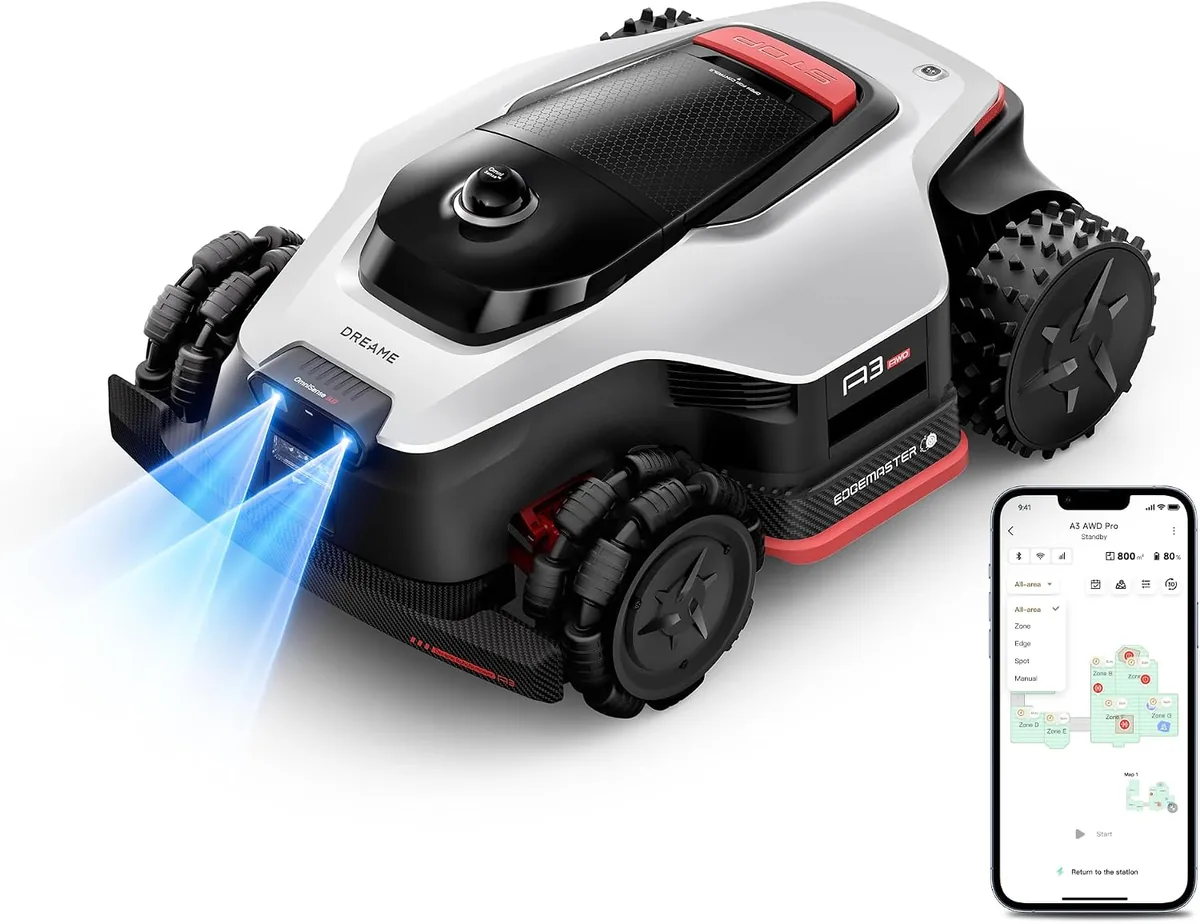
Dreame A3 AWD Pro Robot Lawn Mower Specs That Matter
Two rows decide most buys: the rated area of 3,500 m2 and the slope advice of 36 percent against the 80 percent the robot can navigate. If your lawn is closer to half an acre, my ranking of mowers for half an acre shows which wire-free models have room to spare.
| Spec | Value |
|---|---|
| Navigation | 360 degree LiDAR plus two cameras; no wire, no RTK station |
| Rated area | 3,500 m2 (0.87 acre), recommended working capacity |
| Slope | 80% (38 degrees) navigable; below 36% (20 degrees) advised |
| Cutting width | 40 cm (15.75 in), two discs |
| Cutting heights | 3 to 10 cm (1.2 to 3.9 in), set in the app |
| Drive | All-wheel drive with hub motors; crosses objects up to 5.5 cm |
| Charge time | 85 minutes; run time not published by the maker |
| Noise | 65 dB(A) sound power; 54 dB(A) at the operator |
| Weight | 24.3 kg (53.6 lb) with the battery |
| Warranty | 3 years, per the Amazon listing |
Performance in Real Work
The mower is a LiDAR and camera machine first, so I start with how it learns the lawn and then follow it onto bumps, edges and slopes. My roundup of LiDAR robot mowers compares seven wire-free picks by lawn and slope.
Setup and Mapping
The app does the mapping. I removed the LiDAR cover, checked that the battery was above 50 percent and walked within 5 m behind the robot as the manual asks. Do not move the robot by hand until mapping ends, and it needs at least 80 cm to pass any gap. I measured the gap between the shed and the hedge against that 80 cm minimum before mapping it. After the first map the app builds two weekly schedules and offers a Do Not Disturb time.
Starting a run takes a PIN. I pressed Stop, lifted the top cover and entered the PIN on the panel, and the app could not start the mower afterwards until I did. A mower stopped by hand stays stopped.
LiDAR and Cameras Instead of RTK
The mower’s LiDAR system has a 360 by 59 degree field of view, and two HDR cameras add vision. According to Dreame, the position comes from LiDAR and cameras and not from satellites, so there is no RTK base station and no sky-view rule. That matters under trees, since canopy cover cut the satellites an RTK receiver could use in a field study (1). A line of branches over the grass is where canopy can weaken satellite positioning, so this design matters most there. The manual lists “LiDAR is blocked” and “dirty” as faults, and a lint-free cloth is the fix. After a dusty run along the machinery shed I wiped the dome and the front camera. For more options without a buried wire, I rank nine models in my roundup of robot mowers without perimeter wire.
All-Wheel Drive and Obstacles
An all-wheel drive robot lawn mower drives every wheel, and here hub motors sit in the drive wheels with omni wheels at the front. The manual says the robot cannot cross objects higher than 5.5 cm (2.2 in).
A height limit is not a promise that every lower object passes. The “Robot trapped” fault names holes in the ground, grass taller than 10 cm and obstacles, and some sites in a seven-greenspace study needed manual help because mowers got stuck on shallow tree roots (2). Before the first run I filled two dips near the drip lines and cut the grass to about 10 cm with a push mower. Bumps, roots and ruts are the reason I wrote my list of robot mowers for uneven terrain.
Edges and Cutting Height
Two discs cut a 40 cm swath, and the deck moves from 3 to 10 cm in 5 mm steps through the app. At the edge, Dreame says EdgeMaster 2.0 keeps the disc-to-edge distance under 3 cm (1.2 in). If the lawn edge stands more than 5.5 cm above the ground beside it, keep the robot at least 10 cm away. Along the gravel yard edge I left the edge mode on, and a thin strip stayed along the stones that I trimmed by hand. Manual finishing along curbs and walls was needed in all seven greenspaces of that study (2), and a tall fescue trial found higher turf density with an autonomous mower than with a gasoline mulching mower (3).
Slopes and the 36 Percent Advice
The robot can navigate slopes up to 80 percent (38 degrees), and in the same sentence Dreame recommends keeping work areas below 36 percent (20 degrees). The figure is for the mowing area, not the edge, and the manual gives no wet-slope figure. I read the 80 percent figure as the limit of what it can climb and plan my lawn around the lower advice. I sort the climbers by their slope figures in my robot mowers for steep slopes ranking.
Living With the Dreame A3 AWD Pro
Daily life with the 3500 is charging, a little cleaning and a few safety habits, and the manual is strict about each.
Charging, Run Time and Noise
Charging takes 85 minutes, according to Dreame, when the robot returns to the station at low battery, and Dreame publishes no minutes of run time per charge. Standard mode lists 2,500 m2 per 24 hours and Rush 5,000 m2. On the quarter-acre house lawn the mower left for the station by itself at low battery and went back to work after the charge. Charge only with the included charging station and its power supply, within the temperature range in your manual, and never charge a damaged or swollen battery. The manual gives 65 dB(A) as sound power and 54 dB(A) at the operator, two measures that never compare. From the kitchen door the mower was a low hum on the grass, and I heard it clearly only when it turned at the gravel edge.
Weight, Blades and Cleaning
The robot weighs 24.3 kg (53.6 lb) with the battery, and the manual says to carry it by the rear handle with the blade disc away from the body. Blades should change every 6 to 8 weeks, and 18 spares come in the box. Before you lift, clean or touch the blades, stop the mower, switch it off, wait until the blade disc has stopped and put protective gloves on. Fit the LiDAR cover before you turn the robot over, rinse it with a hose and never use a pressure washer or detergent.
Security, 4G and Wildlife
The security set includes a lift alarm that locks the robot until the PIN is entered, an off-map alarm, real-time location, live video from the front camera, a PIN and a child lock. The 4G link service has a free period that depends on the configuration, so check the remaining time in the app. I turned on the PIN and the lift alarm on the first day and left the child lock on, because a family lawn has children on it. Keep children and pets off the lawn while it runs, as the manual says.
The manual says to keep children and animals out of the work area and to stop the robot if one is in its path. In collision tests of 18 robotic mower models with hedgehog cadavers, none detected dependent juvenile hedgehogs under 200 g, and every model had to touch a hedgehog to detect it (4). A German survey recorded 370 hedgehogs with cut injuries from garden equipment, and at least 47 percent did not survive (5). I schedule runs for daylight and keep night mowing off.
Rain protection must be switched on, and the manual warns that mowing wet grass can damage your lawn and bars operation with standing water in the work area. Frost protection pauses mowing below 6 C (42.8 F). For winter, charge fully, clean, fit the LiDAR cover, store indoors above 0 C and recharge every 6 months.
Who Should Buy It and Who Should Skip It
- Buy it if your lawn is open to medium in layout and up to 0.87 acre.
- Buy it if you want no wire and no RTK base station.
- Buy it if your slopes stay moderate, below the 36 percent the maker advises.
- Buy it if location tracking, a PIN and an alarm matter on your property.
- Skip it if your banks sit near the 80 percent figure.
- Skip it if you want the edge cut to zero, since EdgeMaster stops within 3 cm of an edge, not at it.
- Skip it if you cannot lift 24.3 kg.
- Skip it if you want a published run time per charge.
Drawbacks to Weigh Before You Buy
The slope advice is the first drawback, since steep banks need a different mower. Weight is the second, and run time per charge is not published, so your first full mow is the test. Walls and beds need a trimmer, because EdgeMaster stops within 3 cm of an edge. Steep banks are the reason I ranked AWD and tracked models in my list of robot mowers for hills.
Lastly, the 4G free period is not stated in numbers, so check it in the app. I read the warranty line on the listing before I order.
How It Compares With Other Robot Mowers
Two other mowers answer the same question differently, and the table keeps each maker’s figure on its own basis. My Dreame versus LUBA 3000 comparison puts the Dreame next to the newer Mammotion AWD model.
Mammotion LUBA 2 AWD 3000HX
The Mammotion LUBA 2 AWD 3000HX Wire-Free Robot Mower is the pick for rough ground. Its manual rates it to pass objects up to 80 mm (3.2 in), against 5.5 cm for the Dreame, and it adds spring suspension on four driven wheels. It needs an RTK station with open sky, and it also states 80 percent with no edge figure. I cover that mower on its own in my Mammotion LUBA 2 AWD 3000HX review.

Segway Navimow i210 AWD
The Segway Navimow i210 AWD Wire-Free Robot Mower is the pick for a small lawn. It is rated for about 0.25 acre, holds 45 percent at the lawn and at the boundary and weighs 27.12 lb with the battery. It uses Network RTK where coverage exists, or the included local RTK antenna with open sky where it does not, and a lawn above a quarter acre is too much for it. I set this Navimow beside a Sunseeker rival in my comparison of X5 AWD against i210 AWD.

| Spec | Dreame A3 AWD Pro 3500 | LUBA 2 AWD 3000HX | Navimow i210 AWD |
|---|---|---|---|
| Navigation | LiDAR and cameras, no RTK station | RTK station plus vision backup | Network RTK plus camera |
| Rated area | 0.87 acre | 0.75 acre recommended | About 0.25 acre |
| Slope | 80% navigable, 36% advised | 80%, edge not stated | 45% at lawn and boundary |
| Obstacle | 5.5 cm | 80 mm | Not published |
| Warranty | 3 years per listing | 3 years | 3 years; battery 2 years |
Choose the LUBA 2 AWD 3000HX if your ground is rough and you can site an RTK station. The Navimow i210 AWD suits a lawn of a quarter acre or less. Stay with the Dreame if you want no RTK station and a lawn of up to 0.87 acre.
Common Problems and How to Prevent Them
- Robot trapped: holes, grass taller than 10 cm and obstacles cause it. Fill holes, mow first or draw a no-go zone.
- Robot lifted: an object higher than 5.5 cm stops it. Remove it or exclude it from the map.
- LiDAR blocked or dirty: wipe the sensor with a lint-free cloth and keep it dry.
- Mapping fails: moving the robot by hand or docking it remotely during mapping can make mapping fail. Let mapping finish.
Never disable the lift alarm, the PIN or the child lock to work around any of these. If the robot stops at a stone near a drip line, press STOP, hold the power button for 2 seconds to switch it off, wait until the blade disc has stopped and put protective gloves on before you clear it, then draw a no-go shape around the line.
My Final Verdict on the Dreame A3 AWD Pro
Walk your lawn first: fill the holes, measure your worst edge against 5.5 cm and check the slope against the 36 percent advice. If the lawn passes, order the 3500 and map it with the app; if a bank fails, choose another mower. That is where my Dreame A3 AWD Pro review lands: a clear yes for the open lawn and a clear no for the bank. My best robot lawn mower roundup compares nine picks for small lawns, big yards and steep hills.
Frequently Asked Questions
Is LiDAR necessary for a robot mower?
LiDAR is not necessary for a robot mower, because other models find their position with an RTK base station, a boundary wire or a camera. The Dreame A3 AWD Pro 3500 uses LiDAR and two cameras, which is why, according to Dreame, it needs no RTK base station and follows no sky-view rule.
Do robotic lawn mowers have trackers?
Many robotic lawn mowers have trackers, and the Dreame A3 AWD Pro 3500 shows its real-time location in Google Maps through its built-in 4G link service. It also sounds a lift alarm and an off-map alarm and locks until you enter the PIN, so check the free period of the service in the app.
Does a robot lawn mower do edges?
A robot lawn mower mows up to its edge but usually leaves a thin strip that you trim by hand. The Dreame A3 AWD Pro 3500 extends its discs at the edge with EdgeMaster 2.0 to within about 3 cm (1.2 in), so keep a trimmer ready for walls and beds.
Can you leave a robot lawn mower outside?
A robot lawn mower can stay outside in season when its manual allows it, and the Dreame A3 AWD Pro 3500 is rated IPX6 and pauses for rain and frost when protection is on. For winter the manual asks you to charge it, clean it and store it indoors and dry above 0 C.
Can robot lawn mowers go uphill?
A robot lawn mower can go uphill up to the slope its maker states for that exact model, and the figure differs by model. The Dreame A3 AWD Pro 3500 can navigate 80 percent (38 degrees), but Dreame advises keeping work areas below 36 percent (20 degrees), and the manual gives no wet-slope figure.
References
- Lopatin E, Väätäinen K, Kukko A, et al. Unlocking Digitalization in Forest Operations with Viewshed Analysis to Improve GNSS Positioning Accuracy. Forests. 2023;14(4):689. doi:10.3390/f14040689
- Sportelli M, Martelloni L, Orlandi A, et al. Autonomous Mower Management Systems Efficiency Improvement: Analysis of Greenspace Features and Planning Suggestions. Agriculture. 2019;9(6):115. doi:10.3390/agriculture9060115
- Grossi N, Fontanelli M, Garramone E, et al. Autonomous Mower Saves Energy and Improves Quality of Tall Fescue Lawn. HortTechnology. 2016;26(6):825-830. doi:10.21273/horttech03483-16
- Rasmussen SL, Schrøder A, Mathiesen R, Nielsen JL, Pertoldi C, Macdonald DW. Wildlife Conservation at a Garden Level: The Effect of Robotic Lawn Mowers on European Hedgehogs (Erinaceus europaeus). Animals. 2021;11(5):1191. doi:10.3390/ani11051191
- Berger A. Occurrence and Characteristics of Cut Injuries in Hedgehogs in Germany: A Collection of Individual Cases. Animals. 2023;14(1):57. doi:10.3390/ani14010057
Safety Note: A robot mower has sharp blades. Keep hands and feet away from them. Do not run it with children, other people or animals on the lawn; stop it and park it or switch it off if they come onto the lawn. Never ride on it or let children play with it. Clear toys, hoses, sticks, stones and fallen fruit before a run, and do not mow while sprinklers run. Never lift or tip it while it runs or while it sits in its charging station. Before you lift it, clean it or touch the blades, press STOP, switch it off exactly as your manual says, wait until every blade has stopped, and wear protective gloves. Daytime schedules reduce encounters with animals that come out at night, though animals can be on the lawn by day too. Plug the power supply into a covered outdoor GFCI outlet, keep its cable out of the mowing area, and follow your manual for installation, slopes, charging and storage.