
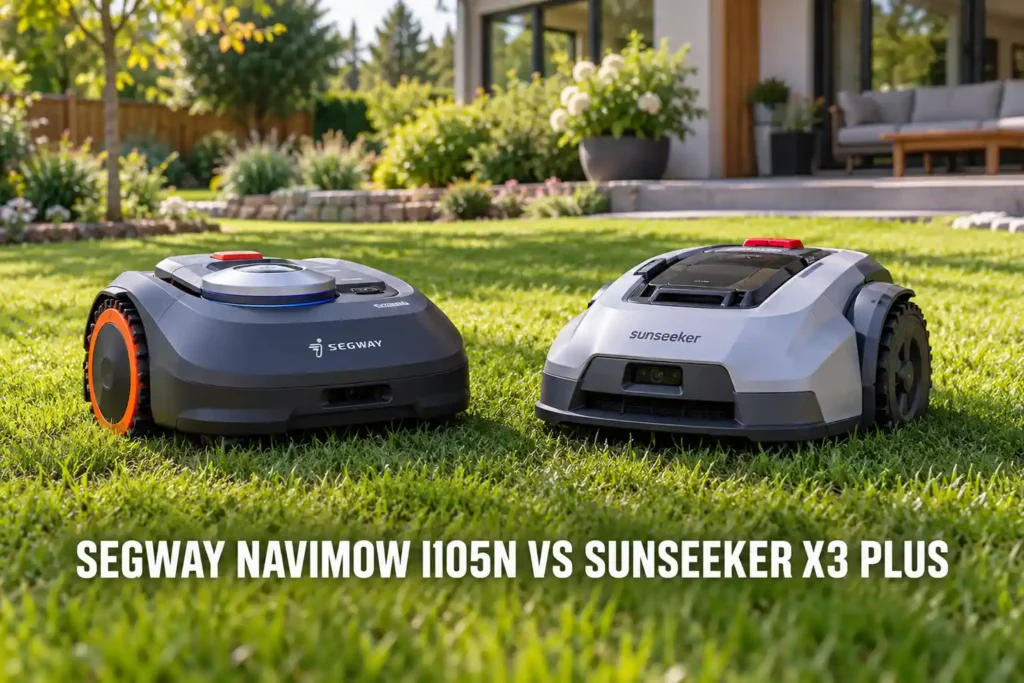

In the Segway Navimow i105N vs Sunseeker X3 Plus match-up, the Sunseeker X3 Plus is the better buy for most yards, because it is rated for 0.3 acre against the Navimow’s 1/8 acre. The Navimow i105N wins on a lawn of 1/8 acre or less, where lower declared sound figures and a 3-year warranty count. I read a robot mower’s spec sheet the way I read a seed drill setting: the rated figure first, the conditions behind it second. Below I set area, slope, set-up, run time and safety side by side.
Segway Navimow i105N vs Sunseeker X3 Plus at a Glance
Both mowers are wire-free. Each uses a local satellite antenna on your lawn plus a camera, and each is mapped from an app. The big gaps are lawn size and slope reporting, and the table shows them like for like, with the kit and the basis of every figure. Beyond this pair, my Sunseeker X5 AWD review covers the half-acre AWD model in the same line.
| Row | Segway Navimow i105N | Sunseeker X3 Plus |
|---|---|---|
| Rated area, maker’s figure | About 1/8 acre (up to 0.15 acre depending on layout) | Up to 0.3 acre |
| Slope, in percent with its basis | 30% (17 degrees) inside the work area, 10% at the boundary | 30% (17 degrees), inside or edge not stated |
| Navigation | Local GNSS antenna on the station plus camera | Local RTK antenna plus camera |
| Cutting width | 7.1 in (18 cm) | 8 in |
| Cutting height | 2 to 3.6 in, set by a knob on the mower | 1.6 to 3.2 in |
| Run time per charge, maker’s figure | About 60 minutes typical, fresh-cut lawn at 25 degrees C | Up to 2 hours |
| Charge time, maker’s figure | About 90 minutes | About 90 minutes |
| Sound power / sound pressure, dB(A) | 58 / 50 | 60 / 52 |
| Weight | 24 lb (10.9 kg) with battery | About 20 lb (9 kg), the manual’s figure |
| Antenna spacing | More than 2 m (6.6 ft) from houses, trees and walls | At least 1.5 m (about 5 ft) from walls and trees, open sky angle of 100 degrees or more |
| Mowing hours | Day or night; the night switch reduces speed | Daylight only |
| Warranty | 3 years; battery pack 2 years | 2 years |
Two rows decide it for most buyers: the rated area and the slope basis.
What Is Actually Different
The two kits look alike on paper, and the difference is in how each is sited. The i105N kit holds the mower, the charging station, a separate GNSS antenna with a 10 m (32.8 ft) extension cable, a 10 m power extension and 12 spare blades. The X3 Plus kit holds the mower, the charging station, an RTK antenna with its own power supply, a 49 ft RTK power cord, a 26 ft station cord and 6 spare blades.
Neither kit has a 4G module. Navimow sells its Access+ 4G module separately for anti-theft, and the Sunseeker offers a GPS and 4G module as an option.
Lawn Size and Rated Area
An eighth of an acre is about 5,445 square feet, and 0.3 acre is about 13,068. Set against a quarter-acre house lawn of 10,890 square feet, the i105N covers about half of it. The X3 Plus covers that lawn with roughly a fifth to spare, and the orchard alleys are a different job for either. My list of robot mowers for 1/4 acre shows which wire-free models cover that area without crowding the rated size.
Run time points the same way. Sunseeker gives about 0.06 acre per hour and up to 2 hours per charge, which works out to about 0.12 acre per charge at best. Navimow gives 60 to 100 square meters per hour, so a full eighth acre of about 506 square meters takes about five to eight hours of mowing across several charges. Those are two makers’ figures on different bases, so I take them as a rough sense of scale, not a race.
On the rated area, I would not buy the i105N for any lawn above 0.15 acre, the top of its range.
Winner: Sunseeker X3 Plus, because it is rated for more than twice the area.
Slope and Edges
The i105N allows only 10 percent at the boundary, and both mowers leave a strip to finish by hand at walls and beds. My comparison of the Navimow i210 and i215 looks at the other Segway models and their slope limits.
Slope Rating
Both makers print 30 percent, which is 17 degrees.
Navimow adds the basis: 30 percent inside the work area and only 10 percent at the boundary, about 5.7 degrees, and its manual says not to mow steeper. Sunseeker does not say whether its 30 percent is inside or at the edge.
Sunseeker calls the X3 Plus a poor fit for deep ruts and uneven ground. An abrupt drop at the lawn border rules out both mowers. A continuous border slope is allowed on the i105N up to 10 percent, so measure the border before you buy. Neither mower is all-wheel drive.
The ratings do not make either mower the slope winner. Neither suits a hillside, and the i105N is the one that states its boundary limit.
Edge Cutting and the Gravel Side
A robot cuts inside its mapped line, so a strip stays at walls and beds. In a study of seven greenspaces from 200 to 9,000 square meters, all seven needed manual finishing along curbs and walls, and some mowers got stuck on shallow tree roots (1). Sunseeker says its Ride-on-Edge offset blade reaches over borders to cut closer to fences and beds. The Navimow Ride-on Boundary straddles the edge only when the gap between grass and non-grass is under 1 cm (0.4 in). Neither maker publishes an uncut strip width, so plan to finish walls and beds by hand. My list of robot mowers for uneven terrain ranks models by the roots and ruts they handle.
At the soft edge of my gravel yard, crushed stone is not a gap under 1 cm, so I plan a trimmer pass there whichever mower I choose.
No winner here: both makers describe an edge feature, and I plan manual finishing at walls and beds with either.
Set-Up, Antenna Siting and Mapping
Both mowers need two sited parts: the charging station and an antenna. Get the antenna wrong and the map is weak. The siting rules are the hardest part of the decision.
The Antenna Spot
The Navimow manual puts the antenna more than 2 m (6.6 ft) from houses, trees and walls, with open sky above and not on a slope. The Sunseeker manual asks for at least 1.5 m from walls and trees, an upright antenna on flat ground, an open sky angle of at least 100 degrees, home Wi-Fi coverage and a power outlet nearby. The machinery shed beside my yard is the first spot I cross off for either mower. If shade rules out an antenna spot, my ranking of the best LiDAR robot mowers covers models that skip it.
Canopy is the known problem for satellite positioning. In a study of an RTK receiver on a moving forest harvester under mature spruce, canopy cover cut the available satellites and gave more inaccurate positions (2). In static tests a smartphone showed around 1.5 m of error under canopy, while a u-blox ZED-F9P receiver gave median errors under a decimeter after post-processing (3). Those were static readings, not a mower on the move, so I treat them as a warning about shade and not as a mower test.
Mapping Walk
On the i105N, the Satellite Signal Analyzer in the app checks the antenna spot before mapping and wants at least 5 satellites visible to both the mower and the antenna. I cut the lawn to 6 cm (2.4 in) or lower before the first map, as the manual says, and then walk the edge with the mower by remote control. Assist Mapping follows clear lawn edges with the camera. My picks among robot mowers without perimeter wire list the other models that map the lawn from an app.
On the X3 Plus, the app moves the mower 1.5 m ahead of the station, and I drive it to the border and walk the edge with the remote. The manual asks for the lawn at 8 cm or lower, at least 5 cm kept from fences and walls, and passages wider than 80 cm. Moving the antenna after the map is saved can make the mower lose its position (error E1), and moving the station means mapping again.
The i105N asks for the same discipline: if the station or the antenna moves after the map is saved, the mower needs a new map, and in spring the antenna and station must come back within 5 cm of the old spot.
Winner: Segway Navimow i105N, because its app checks the satellites before you map.
Run Time, Noise and Charging
The i105N runs about 60 minutes typical per charge in the maker’s test on a fresh-cut lawn at 25 degrees C, and it resumes mowing at 95 percent charge after a full recharge of about 90 minutes. Sunseeker states up to 2 hours per charge and about 90 minutes to charge. A bigger lawn needs several cycles with either one.
Sound is close. Navimow declares 58 dB(A) sound power and 50 dB(A) sound pressure, and Sunseeker declares 60 and 52 in its manual, each with an uncertainty of 3 dB. Compare sound power with sound power and sound pressure with sound pressure, never across the two measures. Charge each pack inside its manual’s range: 0 to 40 degrees C for the i105N and 5 to 40 degrees C for the X3 Plus.
Winner: Sunseeker X3 Plus for the longer advertised run time, Navimow i105N for the lower declared sound figures, a 2 dB(A) gap inside the 3 dB uncertainty of both.
Safety and Care
The rules are the same for both, and the order matters. Stop the mower, switch it off the maker’s way, wait for the blades to stop, then put on protective gloves. On the i105N, hold OK for 3 seconds to power it off, because it will not switch off in the station, and lock it with the PIN lock (MOW and HOME held for 3 seconds) before lifting. For the X3 Plus, set the device lock (LOCK) before you check, clean or work on the mower, set it to OFF for maintenance, and wear protective gloves and eye goggles.
- Weather: the i105N manual says not to mow in heavy rain, a thunderstorm or snow, because wet grass sticks to the mower and it can slip, so mow in dry weather. The X3 Plus manual bars operation where standing water has formed after heavy rain.
- People and pets: keep children, pets and bystanders off the lawn while the mower runs. Never let a child ride or play with it, and never lift it while it runs.
- Clear the lawn: toys, hoses, drip lines, sticks, stones, fallen fruit and dog waste, before every run.
- Charging: the maker’s station and supply only, within the manual’s temperature range, never a damaged or swollen pack.
- Sprinklers: keep the mower off the lawn while a pop-up sprinkler runs.
Night mowing is a known risk to hedgehogs and other small animals. In collision tests of 18 robot mower models with hedgehog cadavers, none detected juvenile hedgehogs under 200 g, and every model had to touch the animal to detect it (4). The X3 Plus mows in daylight only because its camera needs light. The i105N has a night switch, and I keep that switch off.
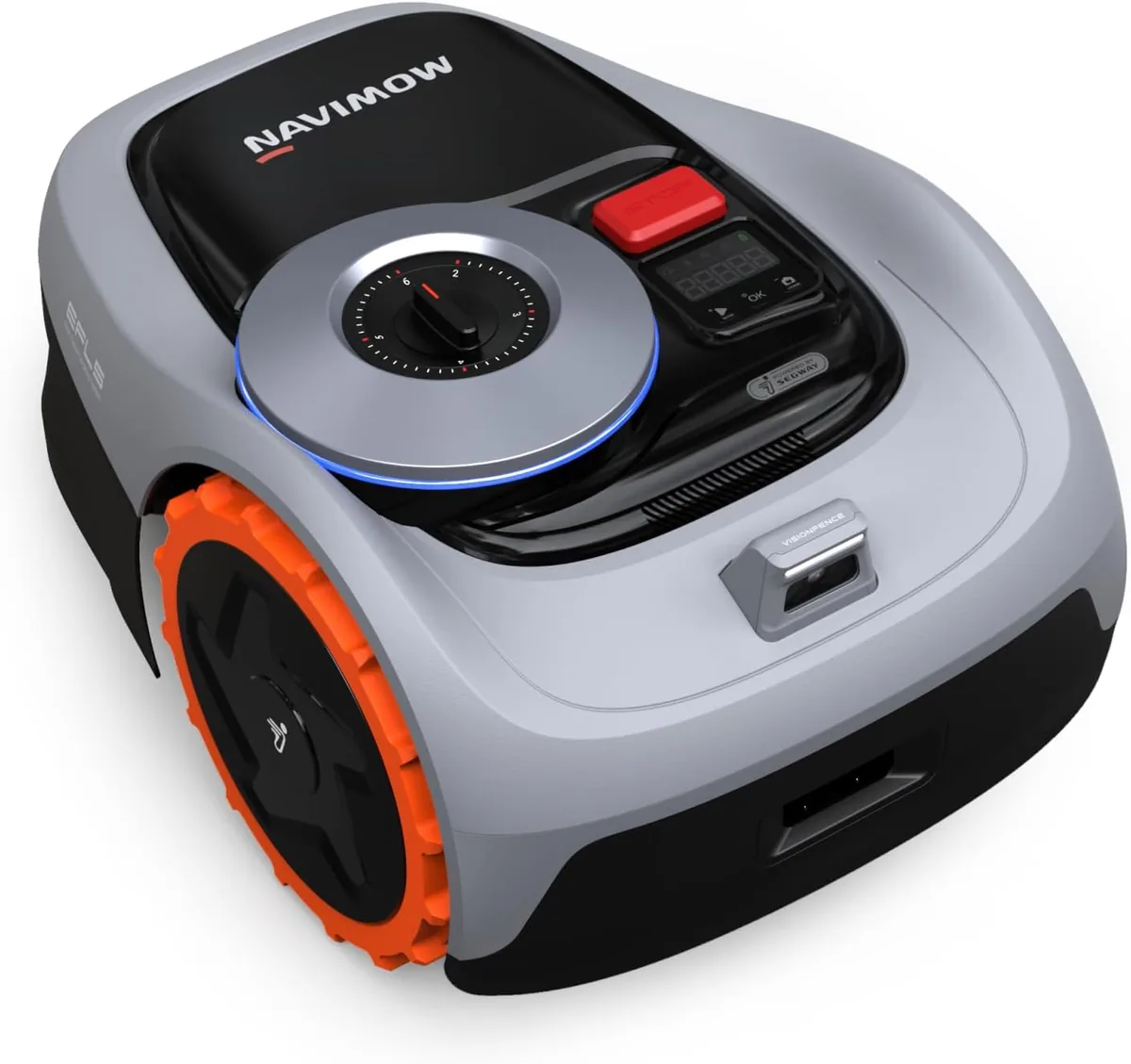
Choose the Segway Navimow i105N If
- Your lawn is 1/8 acre or less, open to the sky and level at the border.
- You want a 3-year warranty and the lower noise figure.
- You like an app step that checks the satellites before you map.
When I placed the i105N antenna, a yellow ambient light on the mower meant a poor satellite signal, and that was my cue to move the antenna before mapping. The 12 spare blades in the box are the other detail I notice, because the manual asks for a swap every 1 to 2 months with regular use. I cover the LiDAR sibling in the same Segway series in my Navimow i215 LiDAR mower review.
Choose the Sunseeker X3 Plus If
- Your lawn runs up to 0.3 acre and you can place an antenna in open sky with a Wi-Fi point nearby.
- You want the longer run time and wider 8 in cut that Sunseeker states.
- You mow in daylight and plan a trimmer pass along walls.
Before each mapping walk with the X3 Plus I wipe the front camera, because the manual lists a blocked camera as an error cause, and I leave a corridor between zones so the mower can find its way back to the station. The 49 ft RTK power cord is the part that settles where the antenna goes, because it must reach an outlet from open ground.

How I Settle the Choice
Lawn size decides first. Under an eighth of an acre, pick the i105N for its warranty, its boundary slope figure and its lower noise.
From there up to 0.3 acre, pick the X3 Plus, and site its antenna in open sky before you buy. Skip both on a lawn above 0.3 acre, on ruts or steep ground, or where no open-sky antenna spot exists. The Segway Navimow i105N vs Sunseeker X3 Plus choice comes down to those two numbers, and for most yards the larger Sunseeker wins it. My guide to robot mowers for any lawn ranks nine models across every lawn size.
Frequently Asked Questions
Is Navimow a good brand?
Navimow is a sound brand for a small wire-free lawn when the model matches the yard, and the i105N is rated for 1/8 acre with a 3-year warranty. Its manual limits slopes to 30 percent inside the work area and 10 percent at the boundary, so check the border first.
Are Sunseeker robotic mowers any good?
Sunseeker robotic mowers are a fair fit when the model matches the lawn, and the X3 Plus is rated for 0.3 acre with a 2-year warranty from the maker’s US store. It mows in daylight only because the camera needs light, so plan the schedule around daylight and keep the antenna in open sky.
Is navimow better than mammotion?
Navimow is better than Mammotion for a small, flat lawn near 1/8 acre, where the i105N and its 3-year warranty fit, while Mammotion suits a larger or steeper lawn. For its LUBA mini 2 AWD 1500H, Mammotion lists 1,500 square meters (0.37 acre) and 80 percent slope inside the task area.
How are robotic mowers programmed?
Robotic mowers are programmed in an app, where you walk the lawn edge with the mower by remote control and then set a schedule in the same app. Before mapping the lawn must be cut short, to 6 cm or lower for the i105N and 8 cm or lower for the X3 Plus.
How long do robotic mowers last?
How long a robotic mower lasts depends on how much it mows and how well it is kept, and a warranty covers defects, not expected life. For these two, Navimow gives the i105N 3 years, with 2 on the battery pack, Sunseeker gives the X3 Plus 2 years, and both ask for new blades every 1 to 2 months.
References
- Sportelli M, Martelloni L, Orlandi A, et al. Autonomous Mower Management Systems Efficiency Improvement: Analysis of Greenspace Features and Planning Suggestions. Agriculture. 2019;9(6):115. doi:10.3390/agriculture9060115
- Lopatin E, Väätäinen K, Kukko A, et al. Unlocking Digitalization in Forest Operations with Viewshed Analysis to Improve GNSS Positioning Accuracy. Forests. 2023;14(4):689. doi:10.3390/f14040689
- Tomaštík J, Everett T. Static Positioning under Tree Canopy Using Low-Cost GNSS Receivers and Adapted RTKLIB Software. Sensors. 2023;23(6):3136. doi:10.3390/s23063136
- Rasmussen SL, Schrøder AE, Mathiesen R, Nielsen JL, Pertoldi C, Macdonald DW. Wildlife Conservation at a Garden Level: The Effect of Robotic Lawn Mowers on European Hedgehogs (Erinaceus europaeus). Animals. 2021;11(5):1191. doi:10.3390/ani11051191
Safety Note: A robot mower has sharp blades. Keep hands and feet away from them. Do not run it with children, other people or animals on the lawn; stop it and park it or switch it off if they come onto the lawn. Never ride on it or let children play with it. Clear toys, hoses, sticks, stones and fallen fruit before a run, and do not mow while sprinklers run. Never lift or tip it while it runs or while it sits in its charging station. Before you lift it, clean it or touch the blades, press STOP, switch it off exactly as your manual says, wait until every blade has stopped, and wear protective gloves. Daytime schedules reduce encounters with animals that come out at night, though animals can be on the lawn by day too. Plug the power supply into a covered outdoor GFCI outlet, keep its cable out of the mowing area, and follow your manual for installation, slopes, charging and storage.