


My Makita pole hedge trimmer review ends on a clear recommendation: buy the XNU01Z if you already own 18V LXT batteries and want to shape the top of a tall hedge from the ground, and skip it if you cut stems thicker than 10 mm (3/8 in) or want a kit with a battery in the box. I used it on the hedgerow at the edge of my orchard, and I read Makita’s limits before the first cut, the way I read a spray label. Below are the head, the weight, the safety rules and the drawbacks.
Makita Pole Hedge Trimmer Review: My Verdict on the XNU01Z
The XNU01Z is Makita’s 18V LXT pole hedge trimmer with a 20 in blade on an articulating head that folds and locks in six steps over 115 degrees, so one tool trims the top of a tall hedge and the side of a low one from the ground. Makita’s manual limits it to branches up to 10 mm (3/8 in) in diameter, and the box holds the trimmer and a blade cover only, with no battery or charger. I recommend it for soft, leafy growth and for owners who have 18V LXT packs already. For more options that reach tall hedges from the ground, I compare nine models in my pole hedge trimmer picks.
- Who it is for: owners of 18V LXT batteries who trim leafy hedges that are taller than they can reach with a handheld trimmer.
- What it does best: it angles the head 45 degrees up or 70 degrees down in locked steps, with three speeds and a reverse button for tangles.
- Main trade-off: a 10 mm (3/8 in) branch limit, and a weight of up to 9.3 lb with a battery held at the end of an 83-1/4 in tool.
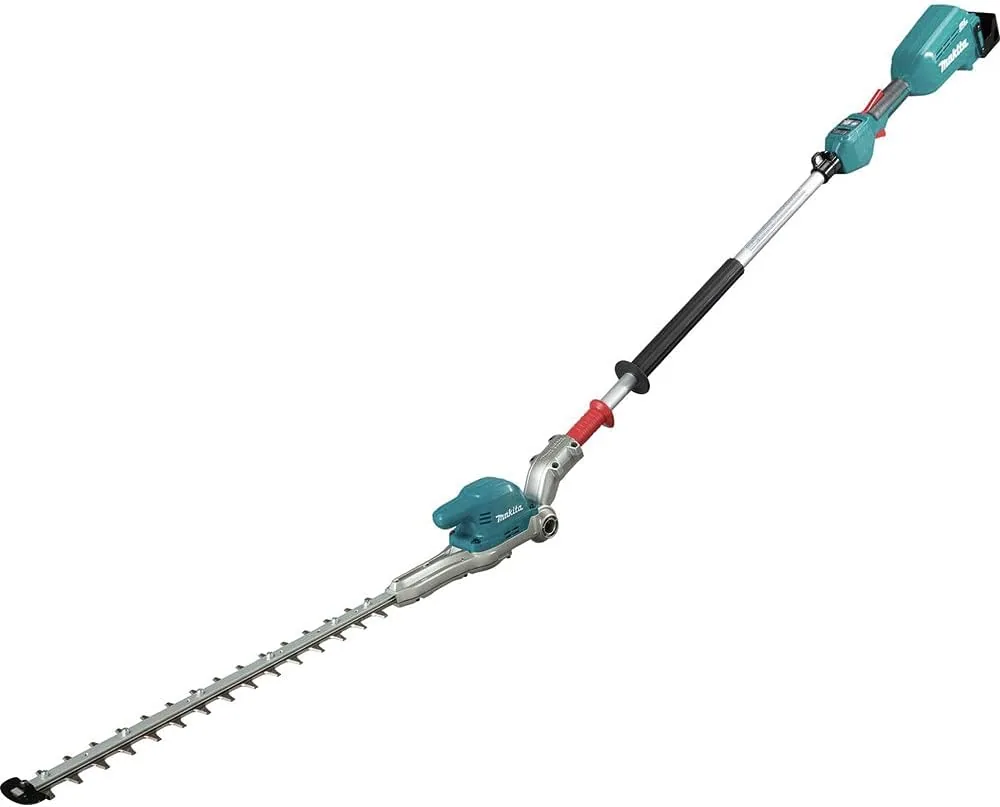
XNU01Z Specs and What Comes in the Box
Two rows decide most buying choices: the 10 mm (3/8 in) branch limit and the weight, which Makita states as a range with a battery fitted.
| Spec | Makita XNU01Z |
|---|---|
| Trimmer type | Pole hedge trimmer, battery, articulating head |
| Power source | 18V LXT, tool only (no battery or charger in the box) |
| Blade length, as Makita calls it | 20 in (the manual’s XNU01 column prints 500 mm, 19-3/4 in) |
| Cutting capacity, manual | Branches up to 10 mm (3/8 in) in diameter |
| Head angle, manual | 115 degrees (45 up, 70 down) in 6 locked steps |
| Overall tool length, manual | 2,115 mm (83-1/4 in); Makita prints no reach figure |
| Weight with a battery fitted, manual | 8.6 to 9.3 lb (3.9 to 4.2 kg), lightest to heaviest battery combination |
| Blade stop, manual | Electric brake; stop time not published by the maker |
| Warranty, Makita’s page | 3-year limited warranty |
According to Makita’s page, the box holds the trimmer with its 20 in blade assembly and a blade cover, and battery and charger are sold separately. The Makita 18V pole hedge trimmer takes the packs the manual lists: BL1815N, BL1820B, BL1830, BL1830B, BL1840B, BL1850B and BL1860B. Makita’s page also gives 7.8 lb without a battery, a different basis from the manual’s range, so I never subtract one from the other. For other cordless options, I compare nine models in my battery hedge trimmer picks.
As a battery pole hedge trimmer in the premium tier before you add a pack, it suits someone who owns the batteries already, because the pack and charger are the biggest extra purchase.
How the Articulating Head and Three Speeds Work in Use
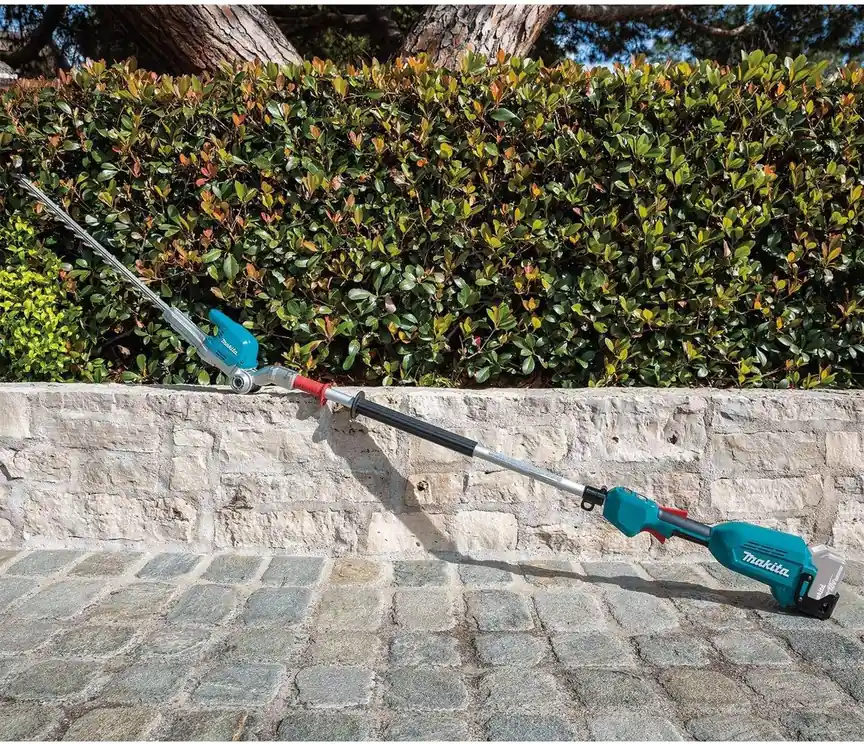
The head is the reason to pick this tool. A slide sleeve lets it fold, and it has to lock with a click in one of six steps, up 45 degrees or down 70, before the blade runs. Makita says to fit the blade cover before folding and to keep fingers out of the gap between the head and the slide sleeve.
On the hedgerow along my orchard edge I set the head angle first and pulled on it before I pressed the power button. A head that has not clicked into its lock does not get a running blade from me. Changing the angle is an adjustment, so I release the switch, switch the motor off and wait until the blade has stopped completely, then take the battery pack out, put on gloves before I touch the blade and check every lock and coupling before the battery goes back in.
Each press of the main power button steps the strokes per minute through High at 4,400, Medium at 3,600 and Low at 2,000. To start, press the main power button, then pull the trigger while you press the lever, and release the trigger to stop. The lever is an unintended-start lock, and Makita says never to tape it down.
Makita’s pace is 3 to 4 seconds per meter, with the blades tilted toward the trimming direction and the sides cut from the bottom to the top. I kept to that pace and to the bottom-to-top order on the side of the row, and I picked the speed before the first cut rather than in the middle of one.

Cutting Capacity, Overload Lamps and the Reverse Button
Makita’s manual says not to attempt to cut branches thicker than 10 mm (3/8 in) in diameter. That is a branch diameter, a different kind of number from the stem limits printed for other pole trimmers, so I do not rank them against each other. Makita also asks you to cut branches 10 cm (4 in) below the final cutting height with branch cutters first, and not to trim grass or weeds, which tangle in the blades.
I cut the thick stems on the orchard hedgerow with loppers first and left the trimmer for the leafy growth above them.
When branches tangle, speed lamps 2 and 3 blink and the tool stops, and some overloads stop it with no indication at all. The first time a stem tangled the blades, the lamps blinked and the tool stopped, as the manual describes, and I followed the jam steps below before I touched anything.
Clearing a Jam on the XNU01Z
Before you cut, look through the hedge for fence wire, cable and cords. If the blade jams on a wire or a cord, do not touch the blade, the wire or the cord and do not try to free the trimmer: stopping the blade does not remove the electrical danger, so the electrical supply to the damaged line or cord must be disconnected first. Treat anything touching a wire as live, and if it is a utility line, never go back to the trimmer to switch it off or unplug it: follow the line contact steps in the safety section below.
For a jam of cut growth, Makita’s reverse button is meant for tangled branches, and your body parts stay clear of the blade while you press it. When the reverse does not free the blades, release the switch, switch the motor off and wait until the blade has stopped completely, then take the battery pack out. Put on gloves before you touch the blade and use pliers, because Makita warns that clearing the material by hand can injure you when the blades move in reaction. Check every lock and coupling before power goes back on.
Weight, Balance and the Optional Shoulder Harness
Makita’s manual prints 8.6 to 9.3 lb with a battery fitted, and the tool is 83-1/4 in long overall. That weight sits at the far end of your arms, because a pole trimmer is held out in front of you while you cut. Whichever Makita pole hedge trimmer battery you fit, Makita calls a shoulder harness an optional accessory and builds a hanger for it into the tool. At 83-1/4 in, it is one of the models in my long reach hedge trimmer picks.
By the end of the row the pole felt heavier in my arms than at the first cut, and with the head tilted up the tool felt least steady at the far end. I took breaks before my grip weakened.
Weight at arm’s length builds up over a long hedge: take breaks and stop when you are tired or your grip weakens. Numb fingers or a weakening grip mean stop, not a change of grip. A study of 120 garden workers in China found that pruning high hedges put the arms above shoulder height and loaded the shoulder and arm muscles, and its authors linked awkward positions to fatigue (1). In a test of 20 young agricultural operators using a brushcutter, an electric saw and a hedge trimmer, the authors found asymmetric posture and called for prevention of musculoskeletal disorders (2).
Blade Lubrication, Battery Care and Storage
Makita says to apply low-viscosity oil (machine oil or a spray lubricating oil) to the shear blades before the operation and once per hour during it. After use, clean both sides of the blades with a wire brush, wipe them and oil them again, and never wash the blades in water. The gear needs grease every 25 operating hours, by the steps in the manual.
I oil the blade before the first cut and again at the hour mark, and I wipe the sap off before the tool goes back on its hook.
To clear a jam, remove cut material, clean, lubricate or touch the blade, release the switch, switch the motor off and wait until the blade has stopped completely. Then take the battery pack out, put on gloves before you touch the blade, and check every lock and coupling before power goes back on.
Use only the maker’s battery and charger for your trimmer, charge and store them within the temperatures your manual gives and never in rain or wet places, never use or charge a damaged, swollen or leaking pack, and keep loose batteries away from metal objects such as keys, coins and nails that could short the terminals. Makita gives 10 to 40 degrees C (50 to 104 F) for charging.
To carry or store the trimmer, release the switch, switch the motor off and wait until the blade has stopped completely. Then take the battery pack out, fit the blade cover, carry the trimmer by the handle with the blade pointing behind you, and store it indoors in a dry place out of children’s reach. Makita says never to carry the tool with the blades running.
Safety on a Pole Trimmer: Overhead Work and Power Lines
A pole trimmer adds the overhead cut and the power line hazard to the blade hazard.
Wear safety glasses with side shields marked ANSI Z87.1, and a face shield over them where your manual asks for one; hearing protection; stout leather work gloves (Makita warns against cloth work gloves that can tangle); long pants and long sleeves with no loose clothing or jewelry; and closed, non-slip shoes or boots. Wear head protection when you operate a pole or long-reach trimmer overhead.
Makita prints no sound figure, and a field comparison of hedge-trimming crews found lower noise exposure for a battery crew than a gas crew (3), so I wear hearing protection all the same.
Before you start, look for every overhead wire, including wires hidden in leaves. Keep yourself, the trimmer, the pole and any branch you cut or that could fall or swing at least 50 feet (15 m) from every overhead line, the distance Ryobi and Echo print in their pole hedge trimmer manuals, or farther if your own manual asks for more. A pole hedge trimmer is not insulated, and electricity can jump through the air and travel through branches, especially wet ones. Treat every wire, including service drops and communication lines, and anything touching one, as live. If you cannot keep that distance the whole time, stop, and leave a hedge that has grown into or near a wire to the utility and its qualified line-clearance crews.
Makita’s manual says never to use the tool near any electrical power lines and prints no distance, so I follow the 50 feet above. A survey of US tree care companies found that contact with an electrical conductor was the most common fatal accident, ahead of being struck by a falling limb (4); it covers professional tree care, but it supports the same hazard.
If the trimmer, the pole or a branch touches a wire, the trimmer, the branch, the wire and the ground around them can become live. Do not go to the trimmer or pick it up, touch nothing that is in contact with the line, keep everyone away, and call the utility at once, and 911 if anyone is hurt, a fire starts or a line comes down. Only the utility frees the trimmer.
Do not use a hedge trimmer on a ladder, a roof, a tree or any unstable support; the manuals of EGO, Ryobi, Milwaukee and Echo ban it, and Husqvarna bans work from any raised position that is not fully secured. For a tall hedge, stay on the ground and use a pole or long-reach hedge trimmer, or hire a professional. Makita calls overreaching, particularly from a ladder, extremely dangerous, and it asks for bystanders at least 15 m (50 ft) from the tool.
Before I cut I look through the hedge for wire, posts and nests, and I never reach through to the far side. I rake the clippings off the drip lines when the row ends.
Who Should Buy the XNU01Z and Who Should Skip It
- Buy it if you own 18V LXT packs and want a Makita cordless pole hedge trimmer that folds its head for a tall top and a low side.
- Buy it if your hedge is leafy growth within the branch limit and you work from firm ground.
- Skip it if you have no Makita batteries and want a kit with a battery and charger in the box.
- Skip it if your hedge has stems thicker than 10 mm (3/8 in), or has grown into a wire.
Drawbacks of the XNU01Z
- Small capacity: 10 mm (3/8 in) branches, so thicker stems go to loppers or a pruning saw.
- No battery or charger: the real cost and weight depend on the pack you add.
- Missing figures: no sound, vibration or run time in the manual, and no reach from Makita.
- Blade routine: oil once per hour of work, plus grease every 25 operating hours.
How the XNU01Z Compares With Other Pole Hedge Trimmers
Two pole models from the same Garden Power Scout list sit closest. The capacity kinds differ (a branch for Makita, a stem for the other two), so I do not rank them by that row. I run the two closest pole models head to head in my Makita against CRAFTSMAN pole trimmer comparison.
| Spec | Makita XNU01Z | CRAFTSMAN CMCPHT818D1 | Sun Joe SJH902E |
|---|---|---|---|
| Power source | 18V LXT, tool only | V20 battery, 2.0Ah pack and charger in the kit | Corded, 4 A |
| Blade length | 20 in as Makita calls it | 18 in | 21 in |
| Cutting capacity, manual | Branches up to 10 mm (3/8 in) | Stems up to 3/4 in | Stems up to 0.7 in (18 mm) |
| Weight, manual | 8.6 to 9.3 lb with a battery | Not published by the maker | 8.8 lb net weight |
| Head positions | 6 locked steps over 115 degrees | 5 positions | 6 angles from -90 to 60 degrees |
Pick the CRAFTSMAN V20 18-Inch Pole Hedge Trimmer Kit if you want a battery and charger in the box and your stems stay within its stem limit. Choose the Sun Joe SJH902E 21-Inch Corded Telescoping Pole Hedge Trimmer if an outlet sits near the hedge and you want no battery to charge. The XNU01Z is for owners of 18V LXT packs.
If you choose the corded Sun Joe, use an outdoor-rated extension cord of the gauge your manual gives for its length, plug into GFCI-protected power, keep the cord behind you and over your shoulder, away from the blade and your feet, and never use the trimmer in rain, in wet or damp conditions or with wet hands (GFCI protection does not make wet use safe).
If the cord is cut or damaged, disconnect it at once: pull the plug from the outlet by the plug before you touch the cord or the blade. Before you clear a jam or touch the blade, release the switch, switch the motor off, wait until the blade has stopped completely, then pull the plug from the outlet by the plug, not the cord, and put on gloves.
Common Problems and How to Avoid Them
Makita’s manual names the fix for the problems that come up most.
- Blade strikes a fence or a hard object: release the switch, switch the motor off, wait until the blade has stopped completely and take the battery pack out, then put on gloves and check the cutter for damage.
- Blade touches the ground: the tool may recoil, so keep the blade clear of soil and stones.
- Tool stops by itself: it stops on overload, overheat or low battery, and the speed lamps show the reason, though some overloads give no indication. To change the pack, release the switch, switch the motor off, wait until the blade has stopped completely, then take the battery pack out, and let a hot pack cool first.
My Final Verdict on the Makita XNU01Z
Buy the XNU01Z if you own 18V LXT batteries, trim soft leafy growth within 10 mm (3/8 in) branches and want the head angle to reach a tall top from firm ground. Skip it if you need a kit with a battery in the box, thicker stems or any work near a wire. That is where my Makita pole hedge trimmer review lands: a clear yes for the owner of 18V LXT packs, and a clear no for everyone who needs more cutting capacity. I compare seven pole models that reach from the ground in my roundup of hedge trimmers for tall hedges.
Frequently Asked Questions
Is a Makita hedge trimmer good?
A Makita hedge trimmer is good when the model fits the job, and for the XNU01Z pole model that job is leafy growth within Makita’s 10 mm (3/8 in) branch limit. It gives you a head that locks in six angles and three speeds, but you add the 18V LXT battery and charger yourself.
Is Makita better quality than DeWalt?
Makita is not shown to be better quality than DeWalt by a single pole trimmer, because quality is a brand-wide question that one tool cannot settle. Compare each maker’s cutting capacity wording, weight with its basis and what comes in the box, then choose the model that fits your hedge and your batteries.
Which battery does the Makita pole hedge trimmer use?
The XNU01Z takes 18V LXT batteries, and its manual lists the BL1815N, BL1820B, BL1830, BL1830B, BL1840B, BL1850B and BL1860B. Use only the battery and charger that Makita names for the tool, charge them between 10 and 40 degrees C (50 to 104 F) as the manual says, and never charge a damaged pack.
Does the Makita pole hedge trimmer come with a battery?
The XNU01Z comes without a battery or a charger, because it is the tool-only version. According to Makita’s page, the box holds the trimmer with its 20 in blade assembly and a blade cover, so you buy a compatible 18V LXT battery and a charger separately before you can make a single cut.
Which Makita pole hedge trimmer is the best?
The best Makita pole hedge trimmer for an owner of 18V LXT batteries who trims leafy growth is the XNU01Z reviewed here, within its 10 mm (3/8 in) branch limit. I make no brand-wide ranking, so check the capacity wording of any other Makita pole model against your hedge before you buy it.
References
- Yang W, Li S, Li B, Liu W, Ning F, Gao S. Analysis of the effects of working position on muscle fatigue during hedge pruning: a cross-sectional study based on Chinese garden workers. J Mech Med Biol. 2023;23(2):2350027.
- Roggio F, Vitale E, Filetti V, Rapisarda V, Musumeci G, Romano E. Ergonomic evaluation of young agricultural operators using handle equipment through electromyography and vibrations analysis between the fingers. Saf Health Work. 2022;13(4):440-447. doi:10.1016/j.shaw.2022.07.003
- Beamer B, DiFrancesco J. Field Comparison of Gas-Powered vs. Battery-Powered Equipment for Grounds Maintenance – Hedge Trimming Operations. Inter-Noise 2019, 48th International Congress and Exposition on Noise Control Engineering (Madrid); Spanish Acoustical Society. 2019.
- Ball J, Vosberg S. A survey of United States tree care companies: part I – safety training and fatal accidents. Arboric Urban For. 2010;36(5):224-229.
Safety Note: Only an adult who has read the manual and understands the controls should use a hedge trimmer, never a child or anyone tired or impaired. The blades are sharp, a hand that touches them is cut in a fraction of a second, and they keep moving for a moment after you release the switch. Hold the trimmer with both hands on the handles, by the insulated gripping surfaces only because the blades can contact hidden wiring (the grips do not make the trimmer insulated or wire contact safe), whenever the blades move; on a trimmer with two switches, both hands must be on the switches to start. Never hold a branch or reach toward the blades, through the hedge or into any opening while they move, and never reach into any opening of a gas trimmer while the engine is running, because a blade that stops in a jam does not stop the engine. Never overreach, and trim only what you can see. Before you start, look through the hedge for wire, fence wire, cords, posts, stakes, irrigation lines, nests, people and pets, and keep the cord or hose out of the blade’s path. If a blade jams on a wire or a cord, do not touch the blade, the wire or the cord: stopping the blade does not remove the electrical danger, so the electrical supply to the damaged line or cord must be disconnected first. Cut only stems up to the capacity your manual states, in the maker’s own wording, and leave thicker wood to loppers or a saw. Do not use a hedge trimmer from a ladder, a roof, a tree or any unstable support, so for a tall hedge stay on the ground and use a pole or long-reach hedge trimmer, or hire a professional. Power lines can kill. With a pole or long-reach hedge trimmer, look for every overhead wire, including wires hidden in leaves, and keep yourself, the trimmer, the pole and any branch that could fall or swing at least 50 feet (15 m) from every line, the distance Ryobi and Echo print in their pole hedge trimmer manuals, or farther if your manual asks for more. A pole hedge trimmer is not insulated, and electricity can jump through the air and travel through branches, especially wet ones. Treat every wire as live, and leave a hedge that has grown into or near a wire to the utility and its qualified line-clearance crews. If the trimmer, the pole or a branch touches a wire, treat the trimmer, the branch, the wire and anything touching them as live: do not go back to the trimmer to switch it off or unplug it, do not touch anything in contact with the line, keep everyone away and call the utility, which alone frees the trimmer, and 911 if anyone is hurt, a fire starts or a line comes down. Wear safety glasses with side shields marked Z87.1, a face shield over the glasses where your manual asks for one, hearing protection, sturdy gloves, long pants, long sleeves with no loose clothing or jewelry, and closed, non-slip shoes. Wear head protection when you work a pole or long-reach model overhead, as the Ryobi, Husqvarna and Echo pole manuals require, and a respirator when dust is present, as the DeWalt manual states; where a manual forbids cutting overhead, do not. Keep people and pets away at the distance your manual gives, and stop trimming if anyone comes closer. Never trim in rain, fog, strong wind, a storm or when lightning is possible, trim only in good light, and let the hedge dry first. Before each use, remove the blade cover (it is for carrying and storage only), and check the blades, the operating guards, the switches and every handle and pole coupling as your manual describes, and do not use a trimmer that fails a check. Before you clear a jam, remove cut material, clean, lubricate or touch the blades: release the switch, switch the motor or engine off and wait until the blades have stopped completely, then take the battery pack out, unplug a corded trimmer from the outlet by the plug, or on a gas trimmer let the engine and muffler cool and pull the spark plug wire off; put on gloves and check every lock and coupling before power goes back on. To carry or store the trimmer, release the switch, switch the motor or engine off and wait until the blades have stopped completely, then take the battery out, unplug a corded trimmer by the plug, or on a gas trimmer let the engine and muffler cool and pull the spark plug wire off; fit the blade cover, carry the trimmer by the handle with the blades pointing behind you, and keep it indoors, dry and out of children’s reach. Use only the maker’s battery and charger, charge and store them within the temperatures your manual gives and never in the wet, never use or charge a damaged, swollen or leaking pack, and keep loose batteries away from metal objects that could short the terminals. Use a corded trimmer only with an outdoor-rated extension cord of the gauge your manual gives, plugged into GFCI-protected power, with the cord behind you and away from the blades, and never in rain or wet conditions: GFCI protection does not make that safe; if the cord is cut or damaged, disconnect it at once by pulling the plug from the outlet by the plug, before you touch the cord or the blades. Refuel a gas trimmer outdoors with the engine off and cool, with no smoking, flames or sparks nearby, wipe up spills, move at least 10 feet from where you fuelled before you start it, wear hearing protection, and never run it indoors or in a garage or shed, because the exhaust contains carbon monoxide. Look for nests before you cut and leave a hedge where birds are nesting. Take breaks and stop when you are tired.