


The Sun Joe CJ603E vs SDJ616 choice is easy once you see that these two machines do different jobs. Buy the CJ603E if you have pruned wood up to its 1.73 inch cutting diameter as well as leaves, and pick the SDJ616 only if your pile is leaves, grass clippings and pine needles, because its maker says it cannot shred branches, sticks or brush. I run an apricot and plum orchard with a lawn beside the house, so my year has both piles: winter prunings and October leaves. Below I compare capacity, leaf work, the bag, weight, safety and care, then say which one fits which yard.
Sun Joe CJ603E vs SDJ616: Which One Fits Your Yard Waste?
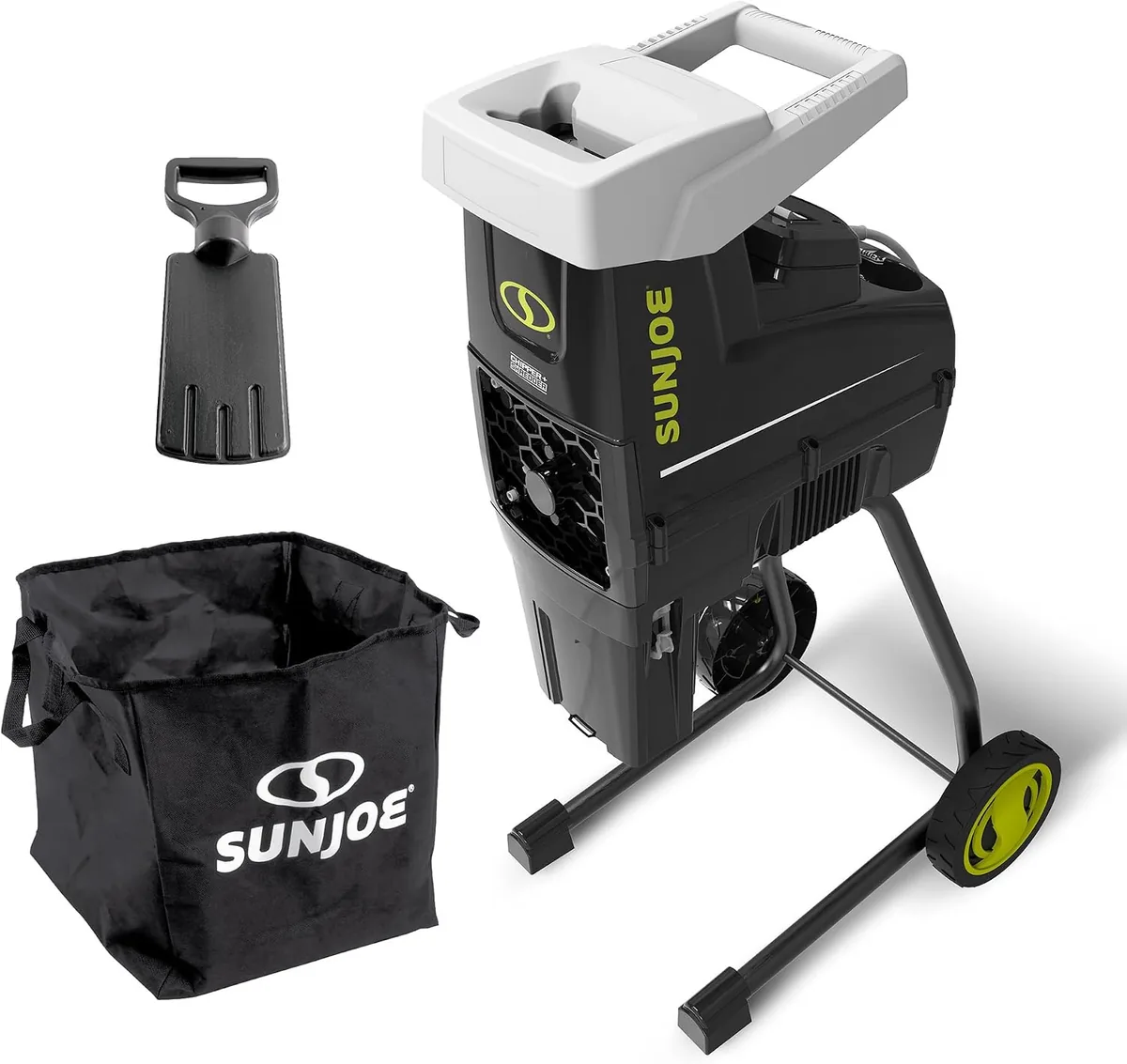
The Sun Joe CJ603E Electric Chipper Shredder is a chipper shredder: one top funnel and hopper, blades that work against an adjustable counterplate, and a fabric bag and push paddle in the box. The Sun Joe SDJ616 Electric Leaf Mulcher is a leaf mulcher: a wide funnel over a spinning head of plastic cutting line, with no branch inlet at all. They do different jobs, so the table sets them side by side without ranking one class against the other.
| Row | Sun Joe CJ603E | Sun Joe SDJ616 |
|---|---|---|
| Machine type | Electric chipper shredder, one top funnel and hopper | Bladeless electric leaf mulcher and shredder, one funnel |
| Power | 120 V, 15 A, corded | 120 V, 13 A, corded |
| Cutting system, maker’s words | Blades with an adjustable counterplate | Spinning head with two plastic cutting lines, 0.1 in by 12.6 in |
| Capacity, maker’s words | Cutting diameter 1.73 in, into the one hopper | Leaves, thatch, grass clippings and pine needles; “It cannot be used to shred branches, sticks, or brush” |
| Reduction ratio, as printed in the manual | 21:1 | 16:1 (up to 16:1 at the FINE setting) |
| Mulch rate, maker’s figure | None printed | 55 gal/min |
| Collection | Fabric bag on two hooks, in the box | No bag in the box; you supply a plastic, paper or cloth bag, or use a bag-lined trash container |
| Net weight, as the manual prints it | 38.6 lb (bag not stated) | 14.5 lb in the 2022 manual, 13.2 lb in the 2015 manual |
| Moving it | Two 7 in wheels the manual lists, plus a leg stand | No wheels; three telescoping legs, carried |
| Bystander distance, manual | A safe distance, no figure printed | A safe distance, no figure printed |
| In the box, manual | Body, paddle, two legs, axle, two wheels, bag, tools | Funnel, motor bracket, three legs, 20 extra cutting lines; no bag, no cord |
| Warranty, manual | Two years, household use | Two years, household use (2022 manual) |
| Noise, manual | Rated 94 dB, no distance printed | Not printed |
Two rows decide it: capacity and the bag. If your pile has any wood in it, only the CJ603E can take it. If it is all leaves and you want a light machine that you carry to the pile, the SDJ616 is the smaller, simpler tool. Both carry the Sun Joe name, so read the model number on the box before you order. My wood chippers for branches ranking sorts nine machines by branch capacity.
Safety and the Full Shutdown for Both Machines
Both machines are electric, so one plug-and-wait order covers them, and both manuals tell you to unplug before you reach into the funnel or hopper. The box below is the one shutdown I use for every task in this article: clearing, cleaning, emptying the bag, moving, storing or leaving either machine.
Full Shutdown for Both Machines
Shutdown before you clear a clog, open a hopper, chute or panel, touch knives, hammers or the cutting line, empty a bag or bin, move, tilt, store or leave the machine. Never use your hand, foot or any body part to unclog it, even after shutdown, and clear a blockage only with the method and tool your manual names. Electric chipper with a hopper (Sun Joe CJ603E): switch it off, unplug it from the outlet by the plug, and wait until the blades have stopped completely. Electric leaf mulcher (Sun Joe SDJ616): switch it off, wait until all motion has stopped, then unplug it by the plug. Never open any electric machine before it is unplugged and still. Never open a hood or access panel before every moving part has stopped. Refit every guard, flap, hopper, discharge chute and any collection bag your manual requires before you restart.
Hands, Feeding and Operators
Never put your hands, feet or any part of your body into the hopper, the chute or the discharge while the machine is running or the rotor is still turning, and never reach past the rubber flap or the mouth of the chute. Push short pieces in only with the paddle or push tool your manual supplies, or with the next branch or a small stick as your manual describes, never with your hand or foot. CDC describes operators of wood chippers being pulled into the rotating knives through the feed chute (1), and a plastic surgery report describes severe hand injuries to the operators of yard shredder and chipper machines (2).
The CJ603E takes branches, so stand to the side of the hopper, never directly in front of it, and feed branches butt end first. Hold the branch near its outer end with an open hand, never wrap your fingers tightly around it, and let it go as soon as the machine draws it in; never follow a branch into the chute. Feed only the material and the branch size your manual allows, into the opening it names. The SDJ616 takes handfuls of leaves, so that branch-feeding position does not apply to it, but the hands-out rule above does.
Protective Gear and Noise
Wear safety glasses or goggles with side shields marked ANSI Z87.1, and a full face shield where your manual asks for one; hearing protection; gloves, snug ones without loose cuffs or drawstrings; long pants and sturdy non-slip boots; and a dust mask. Both Sun Joe manuals call for protective gloves, a dust mask and head protection during use. Never wear loose clothing, scarves, jewelry or dangling drawstrings, and tie up long hair: anything that catches on a branch can be pulled toward the inlet.
Hearing protection is not optional. The CJ603E manual rates the machine at 94 dB with no distance printed, and NIOSH recommends limiting noise to 85 dBA averaged over an eight-hour workday (3). The noise at the hopper was louder than I expected, even with ear protection on.
A Cochrane review reports that poor earplug fit may limit protection for about 40% of users (4), so seat the plugs properly or wear muffs. The SDJ616 manual prints no noise figure, and I treat it the same way.
Bystanders, Site and Cord
The machine can throw chips, stones and metal out of the hopper and the discharge. One adult who has read the manual feeds the machine and runs the controls; a helper never touches the controls and stays outside the work area. Keep children, pets and other people well clear of the work area, as your manual describes, and stop the machine at once if anyone comes closer. No distance makes a work area safe on its own: keep watching it.
Never point the discharge at people, animals, windows, cars or buildings, and never look into the hopper or chute while the machine runs.
Set the machine on firm, level earth or grass, never on a slope, on pavement, concrete or gravel, or close to a wall or building, where chips and stones ricochet. Clear the area of stones, wire, rope and other loose objects first, and work in daylight. Never work on wet or slippery footing, where you could slip toward the inlet, never run an electric chipper in rain or in damp or wet conditions, and stop any chipper and seek shelter if you hear thunder or see lightning.
Use an outdoor-rated extension cord of the gauge your manual gives for its length, plug into GFCI-protected power, keep the cord away from the hopper, the discharge and your feet, and never touch the machine or the plug with wet hands or while standing in water. Never carry the chipper by its cord or yank the cord to unplug it. Both Sun Joe manuals print the same chart, 14 AWG to 50 feet and 12 AWG from 50 to 100 feet, and allow no cord over 100 feet. My first setup near the shed left the cord lying under the feed path, so I moved the machine and ran the cord to the side.
What to Feed, Kickback and Clogs
Feed only clean wood and plant material that your manual allows, into the opening it names and within that opening’s limit; the SDJ616 takes no branches, sticks or brush. Never put in stones, soil, metal, nails, wire, glass, plastic, cans or bottles, and remove soil and stones from roots first. Leave out pressure-treated wood, painted wood and lumber unless your manual allows them.
If a branch will not feed, kicks back or cannot be controlled, stop feeding and let go: never chase it into the chute or try to hold it back. Keep the discharge area clear: chips that build up there can make new material kick back toward you.
Never use your hand, foot or any body part to unclog the machine, even after it is shut down. On an electric hopper chipper, switch it off, unplug it from the outlet by the plug, and wait until the blades have stopped completely; on a leaf mulcher such as the SDJ616, switch it off, wait until all motion has stopped and unplug it by the plug; never open or clear any electric machine until it is unplugged and all motion has stopped. Then follow your manual’s own clearing steps: open only the hopper or panel it names, remove the material only with the tool it names, and refit every guard and any required bag before you restart.
Pre-Start Check and Dust
Before every start, check that the guards, flaps, hoppers, discharge chute and any collection bag your manual requires are fitted and secured, and that knives, fasteners and the cord are undamaged. If the machine starts to vibrate abnormally, stop it at once, complete the full shutdown in the box above and have the cause fixed before you restart. Feeding is heavy, repetitive work: take breaks, and stop when you are tired or your attention slips.
Chips are dusty to empty. A small volunteer study found flu-like symptoms and signs of lung inflammation in some participants after brief exposure to wood chip mulch dust (5). I wear a dust mask when I empty the CJ603E bag, and the SDJ616 manual asks for a dust mask and says not to stand in front of the motor ventilation slots.
Branches and Capacity
The CJ603E manual gives a cutting diameter of 1.73 inches for its one hopper and says not to force anything larger in. The SDJ616 has no branch capacity at all. Wood thicker than 1.73 inches is no job for the CJ603E either: it goes to a tree professional. My Sun Joe CJ603E chipper review goes through the funnel, the paddle and the cord limit on its own.
Feeding the CJ603E with prunings from the plum rows, the pile from one row ended up as a much smaller heap in the bag, which fits a printed ratio of 21:1.
A forked twig is the shape that hangs at the mouth of the hopper, so I now cut the fork short with shears first and feed the straight part butt end first. Once a branch at the thick end of what the hopper accepts made the motor labor and the overload protection cut the power. I went through the full shutdown in the box above and waited at least the minute the manual asks for. Then I pressed the reset button, set the switch to its reverse end and pressed ON so the machine pushed the jammed branch back out of the funnel, and only then restarted forward with thinner wood.

Winner: the CJ603E, because it is the only one of the two with a branch capacity.
Leaves, Grass and Wet Material
The SDJ616 is built for this job. Its manual says to feed double handfuls of dry leaves or single handfuls of wet leaves with the unit running, and to let the head regain speed before the next handful. A control dial sets coarse, medium or fine: coarse runs faster with a larger particle, fine is slower and smallest. The maker prints 16:1 and 55 gal/min as its figures. My SDJ616 leaf mulcher review covers its funnel, line and leaf loads on its own.
Wet plum leaves from the tree-row strip packed the funnel until the motor stopped. I went through the full shutdown in the box above, cleared the funnel only as the manual describes, waited at least one minute after the cutout, pressed the reset button and then the green ON button, and went back to single handfuls. Dry leaves in double handfuls, with a pause for the head to regain speed, went through steadily, and the shredded layer stayed light where whole leaves had matted.

The CJ603E takes leaves too, with a rule. Its manual says to alternate wilted, damp garden waste with dry branches, to keep a few dry branches for the end, and never to feed soft, damp material such as kitchen waste. Chopped material must fall freely from the ejection slot, because a build-up in the discharge zone can kick material back through the hopper.
For a pile of mostly leaves, that adds steps a mulcher does not need. Feeding dry leaves with a handful of twigs kept the CJ603E moving. For a leaf-heavy fall, my wood chippers for leaves ranking lists seven machines for cleanup.
Winner: the SDJ616 for a leaf-only yard, because its manual is written around leaves, grass clippings and pine needles and gives a dial for particle size.
Bag, Weight and Moving It
The CJ603E ships with a fabric bag on two hooks, so the chips land in the bag. The SDJ616 ships without one. Its manual says to supply a plastic, paper or cloth bag held on with an elastic strap, or to take the legs off and fit the motor bracket on a trash container lined with a leaf bag.
Plan that extra step before you order. Before you empty or remove either bag, complete the full shutdown for your machine in the shutdown box above.
Weight follows each manual’s net figure: 38.6 pounds for the CJ603E and 14.5 pounds for the SDJ616 in the 2022 manual, 13.2 pounds in the 2015 one. Neither manual says whether a bag is counted, so I compare them as printed.
The CJ603E rolls on two 7 inch wheels the manual lists, tipped back, and the manual says never to tilt it while it runs. The SDJ616 has no wheels; the legs come off and the parts stack in the box for storage. Before you tip, carry, move or store either one, complete the full shutdown for your machine in the shutdown box above.
At 38.6 pounds the CJ603E is a two-handed lift for the step into the machinery shed. I carry the SDJ616 to the edge of the leaf pile with one hand. If carrying weight matters most, my small wood chipper picks rank light electric and gas models for small yards.
Winner: the SDJ616 for weight and carrying, and the CJ603E for the bag that comes in the box.
Care, Blades and Cutting Line
The CJ603E has a counterplate that the manual says to adjust as the blade wears, and it lists a counterplate and blade replacement. Follow those steps exactly as printed, and do any blade or counterplate work only after the full shutdown in the box above, with gloves on, as the manual says. Troubleshooting for blades that cut poorly is to adjust or replace the counterplate.
The SDJ616 wear part is its cutting line. The manual says to replace the line when shredding efficiency drops noticeably, names the SDJ616L line as the replacement, and allows a substitute only temporarily, up to 0.1 inch thick and 12.6 inches long, which it says is not recommended. The funnel comes off on two clamps to clean the head, and that is also a job for the shutdown box above first. Clean both machines with a warm damp cloth and a soft brush, never with a spray of water or solvents.
Winner: the SDJ616, because its wear part is a line, and 20 extra lines come in its box, while the CJ603E asks for counterplate adjustment and blade work.
Choose the Sun Joe CJ603E If
The CJ603E is the machine for a property with wood in the pile. I keep it near the shed outlet and bring the prunings to it. If you are weighing the CJ603E against another plug-in chipper, my CJ603E versus WEN 41130 comparison sets it beside the WEN 41130.
- Your pile has branches: twigs and small branches up to the manual’s 1.73 inch cutting diameter.
- Your pile mixes wood and leaves: one machine, as long as you alternate damp waste with dry branches. For a pile that mixes wood and leaves, my roundup of wood chipper shredder picks covers nine models for branches and leaves.
- You want the bag and paddle in the box: both come with it.
- You have an outlet in reach: the manual wants an outdoor-rated 14 AWG cord through 50 feet, 12 AWG over 50 through 100 feet, and no cord longer than 100 feet.
- Skip it if you need a light machine or your pile is only leaves.
Choose the Sun Joe SDJ616 If
The SDJ616 is the machine for a leaf pile. Taking the legs off and setting it on a bag-lined trash container is how I catch the output at the edge of the pile. I also compare it with the Yard Force YF8000 in my SDJ616 versus YF8000 leaf mulcher guide.
- Your pile is soft: leaves, thatch, grass clippings and pine needles only.
- You want to carry it: 13.2 to 14.5 pounds by the manuals, with legs that come off.
- You have a bag or a trash container: none comes in the box.
- You want a particle size dial: coarse, medium and fine.
- Skip it if any branch, stick or brush is in the pile.

Matching the Machine to Your Pile
Look at the pile before you look at the brand. If it holds pruned wood up to 1.73 inches, the CJ603E is the one that takes it, and it handles dry leaves under the manual’s alternation rule. If it holds leaves, grass clippings and pine needles, the SDJ616 is lighter and simpler once you add your own bag. On my land the winter prunings and the October leaves are two different piles. My wood chippers for home use roundup ranks nine machines for branches and leaves around the house.
Both manuals tie the two-year warranty to household use and to an authorized seller, so keep the receipt. For permitted pruning wood and mixed waste, the Sun Joe CJ603E vs SDJ616 choice lands on the CJ603E; for leaves and other soft material, it lands on the SDJ616.
Frequently Asked Questions
What is the difference between the Sun Joe CJ603E and the Sun Joe SDJ616?
The difference between the Sun Joe CJ603E and the Sun Joe SDJ616 is the job each does. The CJ603E is an electric chipper shredder with a 1.73 inch cutting diameter, and the SDJ616 is a leaf mulcher that cannot shred branches, sticks or brush, so pick by what is in your pile.
Which is lighter, the Sun Joe CJ603E or the Sun Joe SDJ616?
The Sun Joe SDJ616 is lighter, at 14.5 pounds in its 2022 manual against 38.6 pounds for the Sun Joe CJ603E. The CJ603E rolls on two wheels while you carry the SDJ616, so the lighter machine suits a pile you must reach by hand, and neither manual says whether the bag is counted in its weight.
Does the Sun Joe CJ603E or the Sun Joe SDJ616 come with a collection bag?
The Sun Joe CJ603E comes with a fabric collection bag on two hooks, and the Sun Joe SDJ616 comes without one. For the SDJ616 the manual says to supply a plastic, paper or cloth bag, or to fit the motor bracket on a trash container lined with a leaf bag.
Can the Sun Joe CJ603E or the Sun Joe SDJ616 shred branches?
The Sun Joe CJ603E can shred branches up to its manual’s cutting diameter of 1.73 inches, and the Sun Joe SDJ616 cannot shred branches at all. Its manual says it is for leaves, thatch, grass clippings and pine needles, so thicker limbs go to a tree professional, never into the hopper.
Which is better for leaves, the Sun Joe CJ603E or the Sun Joe SDJ616?
The Sun Joe SDJ616 is better for a pile of only leaves, because its manual is written around leaves, grass clippings and pine needles and it has a dial for particle size. The CJ603E also takes leaves, but its manual asks you to alternate wilted, damp waste with dry branches.
References
- Centers for Disease Control and Prevention. Fatal and nonfatal occupational injuries involving wood chippers–United States, 1992-2002. MMWR Morb Mortal Wkly Rep. 2004;53(48):1130-1131.
- Hallock GG. Mutilating shredder/chipper hand injuries. Ann Plast Surg. 1994;33(1):6-8.
- National Institute for Occupational Safety and Health. Noise-Induced Hearing Loss. Noise and Hearing Loss. Centers for Disease Control and Prevention; 2024.
- Morata TC, Gong W, Tikka C, Samelli AG, Verbeek JH. Hearing protection field attenuation estimation systems and associated training for reducing workers’ exposure to noise. Cochrane Database of Systematic Reviews. 2024;5(5):CD015066.
- Wintermeyer SF, Kuschner WG, Wong H, D’Alessandro A, Blanc PD. Pulmonary Responses After Wood Chip Mulch Exposure. J Occup Environ Med. 1997;39(4):308-314.
Safety Note: Only an adult who has read the manual and understands the controls should use a wood chipper or shredder, never a child or anyone tired or impaired. The rotor, knives, hammers or cutting line behind the inlet can draw in a hand, a sleeve or a glove faster than you can let go, and they keep turning after you switch the machine off. Never put your hands, feet or any part of your body into the hopper, the chute or the discharge while the machine runs or the rotor still turns, never reach past the rubber flap or the mouth of the chute, and push short pieces in only with the paddle or push tool your manual supplies, or with the next branch or a small stick as your manual describes. Stand to the side of the hopper, never in front of it, feed branches butt end first with an open hand near the outer end, and let go as soon as the machine draws the branch in; if a branch kicks back or will not feed, stop feeding and let go, never chase it into the chute. Feed only the clean material your manual allows, into the opening it names and within that opening’s limit (a chipper chute and a shredder hopper have different limits, and a leaf mulcher takes no branches, sticks or brush), and never stones, soil, metal, nails, wire, glass or plastic. The machine can throw chips, stones and metal: keep children, pets and other people out of the work area, at least the distance your manual prints (the Champion, MTD and Yardmax manuals ask for 75 feet), stop at once if anyone comes closer, and never point the discharge at people, animals, windows, cars or buildings. Set the machine on firm, level earth or grass, never on a slope, on pavement, concrete or gravel, or close to a wall, work in daylight, never work on wet or slippery footing where you could slip toward the inlet, never run an electric chipper in rain or in damp or wet conditions, and stop and seek shelter for thunder or lightning. Wear safety glasses or goggles with side shields marked ANSI Z87.1, a face shield where your manual asks for one, hearing protection, gloves only as your manual directs (snug ones without loose cuffs or drawstrings where it asks for them), long pants and sturdy non-slip boots, and respiratory protection as your manual requires (WEN asks for NIOSH-approved dust masks or other respiratory protection during operation and cleaning); never wear loose clothing, scarves, jewelry or dangling drawstrings, and tie up long hair. Before every start, check that the guards, flaps, hoppers, discharge chute and any collection bag your manual requires are fitted and secured, and stop at once if the machine starts to vibrate abnormally, complete the full shutdown below and have the cause fixed before you restart. Never use your hand, foot or any body part to unclog the machine, even after it is shut down. Before you clear a clog, open the hopper or a panel, touch the knives, empty the bag, move or tilt the machine or leave it: on an electric hopper chipper, switch it off, unplug it from the outlet by the plug and wait until the blades have stopped completely, and on a leaf mulcher switch it off, wait until all motion has stopped and unplug it by the plug, never opening any electric machine before it is unplugged and still; on a gas chipper, follow your manual’s own shutdown sequence and every wait it prints: the engine off, the rotor and every moving part stopped completely, the engine and muffler cooled, the key removed where fitted, and every spark plug wire pulled off and secured away from its plug or grounded where your manual says so; on a PTO chipper, throttle to idle, disengage the PTO, turn the tractor off, remove the key, set the parking brake, wait until all motion has stopped and disconnect the PTO shaft before any service. Complete every model-specific step and minimum wait in the order your manual prescribes before any access, clear the blockage only with the method and tool it names, and refit every guard and any required bag before you restart. Use an electric chipper only with an outdoor-rated extension cord of the gauge and length your manual gives, plugged into GFCI-protected power, and never touch it or the plug with wet hands. Refuel a gas chipper outdoors with the engine off and cooled for at least the time your manual gives (Champion and MTD: two minutes), open the cap slowly, keep smoking, flames and sparks away, wipe up spills and never start it where fuel spilled; clear chips and leaves from the engine and muffler only after the full shutdown, spark plug wire off included, keep every cooling and combustible-material clearance your manual gives (Champion: 3 feet around the machine for cooling, 5 feet from combustible materials and dry vegetation), and never run it indoors or in a garage or shed, even with the doors open, because the exhaust contains carbon monoxide. Take breaks and stop when you are tired.