


EFCUT C30 LITE vs R30 is a choice between two 7 HP gas chippers that share an engine and a 3 inch limit and differ in the cutter, the weight figure and the blade job. I pick the C30 LITE for most buyers, and I keep the R30 for the owner who wants a cutting roller and will set a blade gap. I prune the orchard every winter, so I judge a chipper by the chore it adds later, and the blade job is that chore. I used both on open, level ground at the end of the orchard rows, well away from the sheds.
EFCUT C30 LITE vs R30: My Short Answer
Buy the EFCUT C30 LITE 7 HP Gas Wood Chipper if you want the shorter blade job. EFCUT’s guide for it runs six steps with a 13 mm socket spanner and an Allen key, and its manual prints an assembled size of 34 by 27 by 41 inches. Buy the EFCUT R30 7 HP Gas Wood Chipper if you want a cutting roller with two-edge blades and accept an eight-step guide that ends with a 1.0 to 1.5 mm gap set with a thickness gauge.
Power and capacity do not separate them. Both have a 7 HP, 212 cc four-stroke engine, both take solid wood up to 3 inch (76 mm), both feed by gravity, and both throw chips out of a chute with no bag. The table puts the rows side by side, and the weight row carries two different bases, so I do not subtract one figure from the other.
| Spec | EFCUT C30 LITE | EFCUT R30 |
|---|---|---|
| Machine type | Gas wood chipper, one feed hopper, adjustable discharge chute | Gas wood chipper, one feeding chute, adjustable discharge chute |
| Engine, maker’s figure | 7 HP maximum, 212 cc, 4-stroke OHV, air cooled, recoil start | 7 HP maximum, 212 cc, 4-stroke OHV, air cooled, recoil start |
| Cutting system, maker’s words | “2 cutting knives” on a flywheel assembly | A cutting roller with two L120 two-edge blades and one 116 fixed blade |
| Capacity, maker’s words | Solid wood up to 3 inch (76 mm) in diameter, through the feed hopper | Solid wood up to 3 inch (76 mm) in diameter, through the feeding chute |
| Reduction ratio | 15:1 according to EFCUT’s product listing; the manual prints none | 15:1 according to EFCUT’s product listing; the manual prints none |
| Feed, maker’s words | “Type of feed: Gravity” | “Type of feed: Gravity” |
| Collection | Discharge chute, no bag | Discharge chute, no bag |
| Weight as printed | 84 lb (38 kg), printed as “Net weight” | 103.62 lb (47 kg), printed as “Overall weight” |
| Assembled size | L34 x W27 x H41 in | Not published by the maker |
| Wheels | Two wheels, handle and support frame | Two wheels, handle and support base |
| Bystander distance, as printed | At least 10 metres (about 33 ft) for the general public | At least 10 metres (about 33 ft) for the general public |
| Packing list | Body, bracket, two tyres, supports, discharge chute, bottom and upper feed hopper, handle; no oil, no bag, no push tool | Housing, engine base, bracket, supports, support base, feeding chute, discharge and adjustable chute, handle, two tyres, fasteners; no oil, no bag, no push tool |
| Blade guide | Six steps, 13 mm socket spanner and Allen key, 28 to 32 N.m, a new locknut every time | Eight steps, 16 mm and 13 mm spanners, thickness gauge, 1.0 to 1.5 mm gap |
| Warranty, as printed | One year against machine construction, blades and other consumables excluded | One year against machine construction, blades and other consumables excluded |
Two rows decide it: the blade guide, where the C30 LITE is shorter, and the cutting system, where the R30 offers a roller.
What Both Machines Share
Most of a chipper’s working day sits in the parts these two have in common, so I start there with the engine and the capacity. Both are EFCUT wood chipper models built around the same engine size, and EFCUT prints one sentence of intended use for each: it is designed to chip solid wood up to 3 inch (76 mm) in diameter. I also compare the S1 with the R30 in my GARDENBEAUT and EFCUT chippers comparison.
That figure is a ceiling. It names clean brushwood, and EFCUT bans muddy or dirty wood, roots, potted plants, bricks, stones and metal. At the pruning pile I sort first: what fits the limit goes to the chipper, and the thick limbs stay out of the machine for a tree professional. A limb thicker than 3 inch never goes into the machine: it is a job for a tree professional. My ranking of the best wood chippers for branches sorts machines by how much wood they take.
Fuel and oil match too, apart from one small figure. Each tank holds 2.8 litres of 87+ unleaded gasoline with at most 10 percent ethanol. The C30 LITE takes 0.5 litre of SAE 15W-40 oil and the R30 takes 0.55 litre, and neither packing list holds any oil, so buy it before the first start.
Flywheel Knives or Cutting Roller, and the Feed Opening
The EFCUT C30 LITE wood chipper cuts with a flywheel assembly that carries two knives. The R30 cuts with a cutting roller that carries two L120 blades, each with two cutting edges, against a fixed 116 blade.
Full Shutdown Box
Shutdown before you clear a clog, open a hopper, chute or panel, touch knives, hammers or the cutting line, empty a bag or bin, move, tilt, store or leave the machine. Never use your hand, foot or any body part to unclog it, even after shutdown, and clear a blockage only with the method and tool your manual names. Gas chipper: turn the engine off, wait until the rotor and every moving part have stopped completely, let the engine and muffler cool, remove the key where fitted, and pull every spark plug wire off and secure it away from its plug. Then add your manual’s own steps in their order: Champion closes the fuel valve and runs the engine until fuel starvation stops it before a clog is cleared, and cools the unit and drains the fuel before the access panel is opened for a serious clog; MTD grounds the disconnected plug wire against the engine; Toro, Yardmax, Boss and SuperHandy GUO148 wait five minutes for the flywheel and every part to stop and cool. EFCUT’s manual adds one line of its own: stop the engine and wait for moving parts to stop before removing material. Never open a hood or access panel before every moving part has stopped. Refit every guard, flap, hopper, discharge chute and any collection bag your manual requires before you restart.
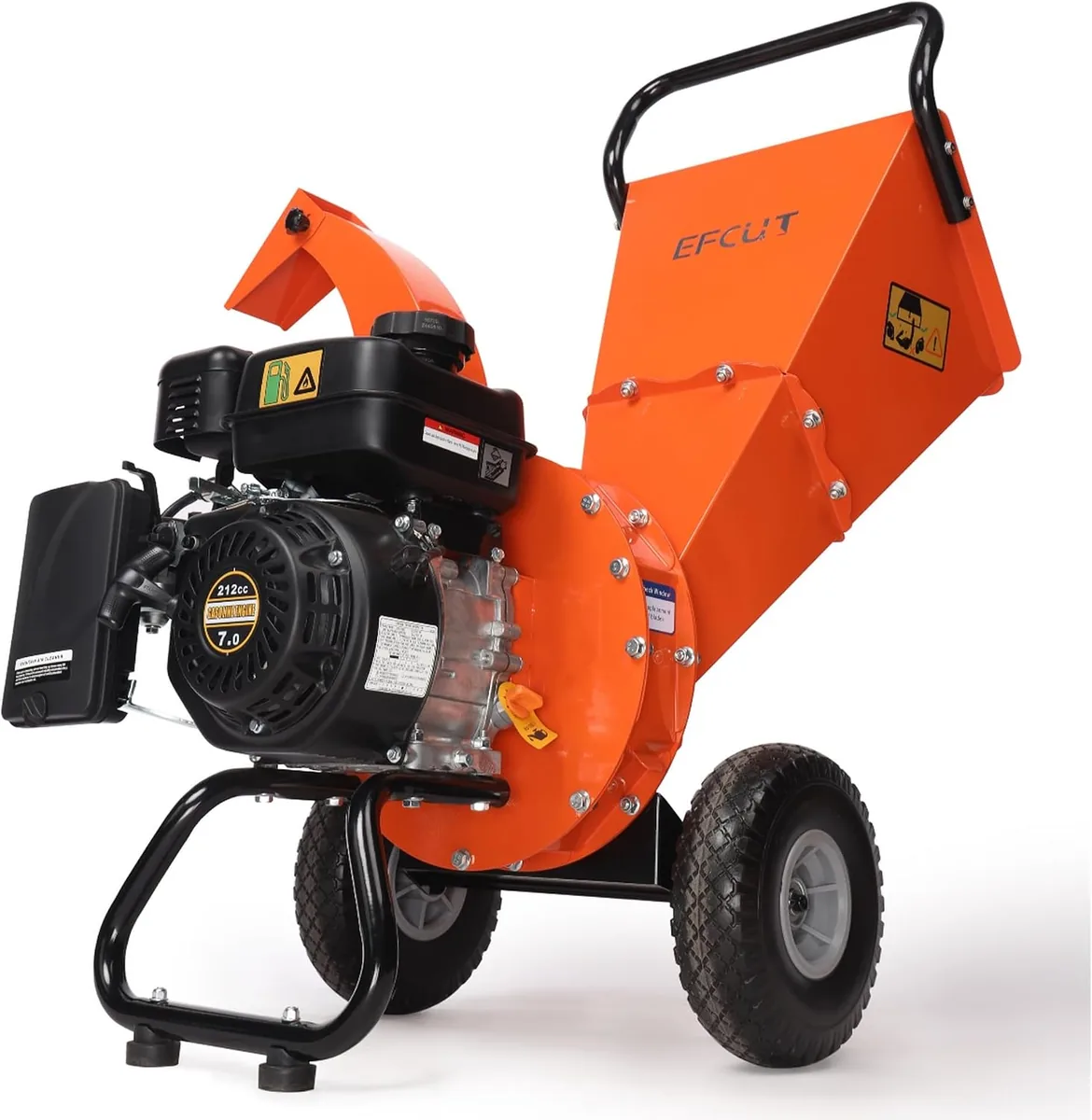
The openings look different. The C30 LITE has a funnel-shaped feed hopper with a bottom and an upper section and a handle.
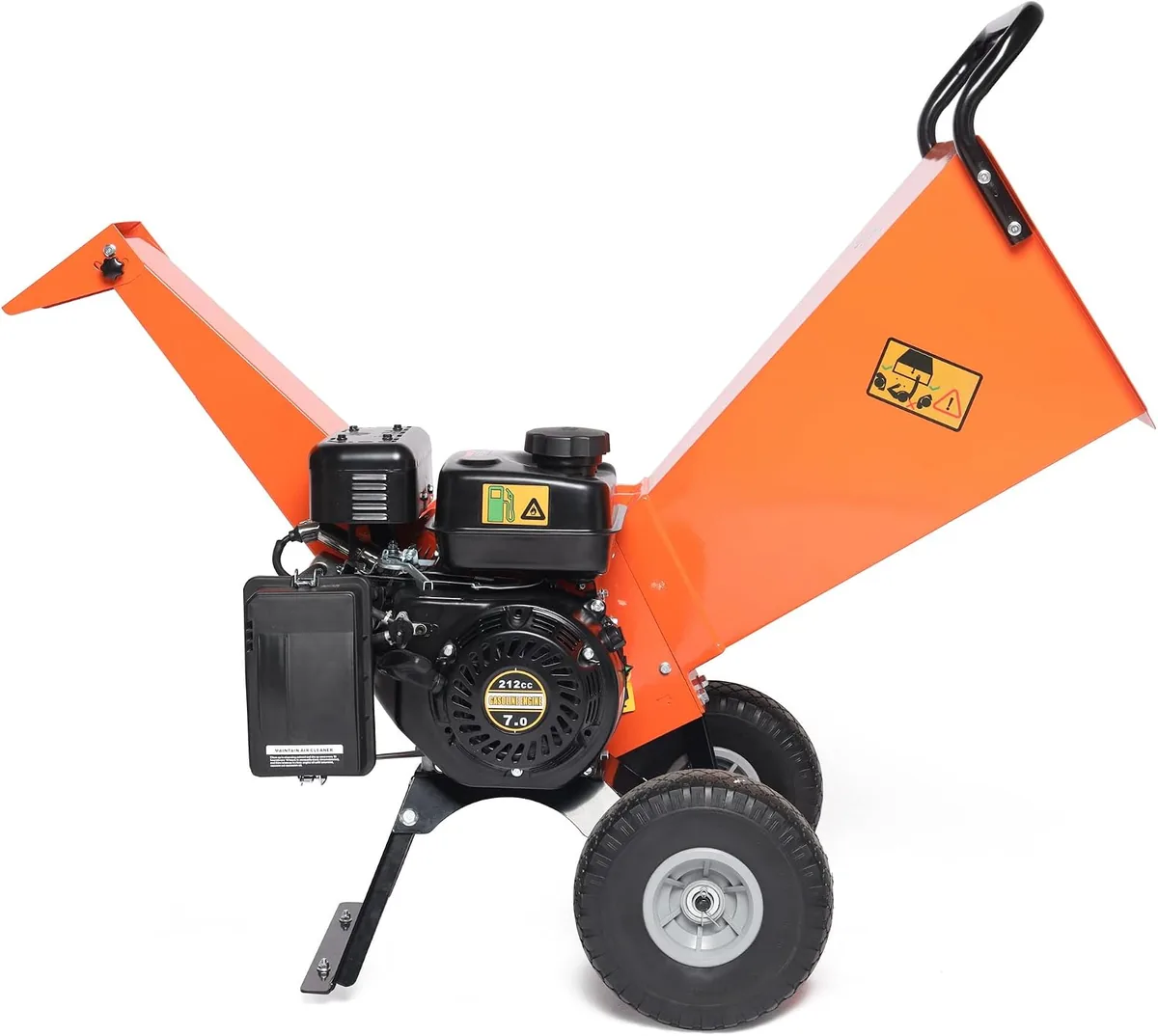
The R30 has a long, angled feeding chute with a pull handle. EFCUT says of both machines that the wood will be drawn into the cutting blade quite quickly.
On the C30 LITE, a forked twig once hung up at the hopper mouth, so I stopped, completed the full shutdown in the shutdown box above, and only then trimmed it before it went back in. That is the manual’s advice for badly twisted brash, which can move from side to side in the hopper with great force. On the R30, the long chute kept me a step back from the opening, and the draw-in was quick enough that I let go of each prunings piece early. I stand to the side of either opening.
Watch the discharge the whole time. EFCUT’s manual says what goes into the chipper must come out, and that if chips stop leaving the discharge tube while the machine keeps taking wood, you stop immediately. Continuing to feed a blocked machine packs chips into the rotor housing and makes the clog slow to clear. Stop the feed at once, then complete the full shutdown in the shutdown box above.
Winner: a draw on capacity, because both stop at 3 inch.
Weight, Wheels and Moving Them
The manuals print two weights, and they do not share a basis. EFCUT gives the C30 LITE as 84 lb (38 kg) “Net weight” and the R30 as 103.62 lb (47 kg) “Overall weight”, without saying what the overall figure includes. A gap between the two printed numbers is therefore not a measured gap, and I do not name a lighter machine. I compare the C30 LITE with the CSV-3090H in my EFCUT and Patriot chippers comparison.
Both machines stand on two wheels with a handle. The C30 LITE has a support frame and the R30 a support base, and the R30 photo shows a rear support leg. Before I moved either one across the yard, I completed the full shutdown in the shutdown box above, with the engine and muffler cooled and the spark plug wire off. On level ground the wheels did the work, and the step to the shed took two of us, as the manuals’ weight deserves. The R30’s rear support leg held it steady while I fed, and I still checked that the ground was level first.
EFCUT’s transport page asks you to strap the chipper down firmly, to keep the engine upright with the fuel valve turned off, and to leave the feed hopper handles out of the strapping. Never move, tilt or carry a running machine, and never carry a unit by its fuel tank.
Winner: none, because 84 lb net and 103.62 lb overall are different bases and the manuals give no way to line them up.
Blade Care for the Knife Swap and the Roller Gap
Both manuals give one sharpening rule: re-sharpen after about 3 hours of chipping fresh wood, or 1 hour for dry wood because it is harder, and sooner when the feed slows. Both ask for riggers gloves during the blade job and for replacement when the cutting edge cracks or chips, or after it has worn 2 mm through many re-sharpenings. Before either job, complete the full shutdown in the shutdown box above.
The C30 LITE job is six steps. You remove the blade cover plate, take off the lower two bolts of the housing’s turnover plate, loosen the upper two nuts and tip the plate up. Then you hold the blade bolt with an Allen key and turn the opposite nut with a 13 mm socket spanner, and you tighten it back to 28 to 32 N.m. Every locknut you remove is replaced with a new one, so keep a bag of them.
The R30 job is eight steps, and I follow EFCUT’s guide in full rather than from memory. It starts at the feeding chute and a safety screw that stops the roller from turning, turns the two-edge blade over, and ends with the fixed blade set to a 1.0 to 1.5 mm gap, checked with a thickness gauge at every cutting edge before the chute and guards go back on. EFCUT ends the guide with the line THIS IS IMPORTANT FOR SAFETY.
Before the first season I laid out the 13 mm socket and the Allen key for the C30 LITE and the 16 mm spanner and a thickness gauge for the R30, and the R30 pile of tools was the longer one. I pencilled the 3 hour and 1 hour rule on a tag by the shed door, where I see it before each pruning day.
Winner: the C30 LITE, because its guide is six steps against eight and needs no gauge, though its locknuts are single use.
Clogs, Discharge and Safety With Either Machine
The two manuals share their safety text word for word, so everything below applies to both machines. Where a rule comes from EFCUT’s own pages, I say so.
Feeding Position and Hands
Never put your hands, feet or any part of your body into the hopper, the chute or the discharge while the machine is running or the rotor is still turning, and never reach past the rubber flap or the mouth of the chute. Push short pieces in only with the paddle or push tool your manual supplies, or with the next branch or a small stick as your manual describes, never with your hand or foot. Neither EFCUT packing list holds a push tool, and neither manual describes one.
One person feeds the machine and runs the controls; a helper never touches the controls and stays outside the work area. Stand to the side of the hopper or chute, never directly in front of it, and feed branches butt end first. Hold the branch near its outer end with an open hand, never wrap your fingers tightly around it, and let it go as soon as the machine draws it in; never follow a branch into the chute. Feed only the material and the branch size your manual allows, into the opening it names. EFCUT’s own line is to release the material before it engages the rotor.
CDC reports that chipper operators have been caught in the feed mechanism and pulled into the rotating knives (1). A plastic surgery report describes severe hand injuries to the operators of yard shredder and chipper machines, most often in fall and spring (2). Those are workplace and clinical findings, and I read them as one lesson: the hopper is never a place for a hand.
If a branch will not feed, kicks back or cannot be controlled, stop feeding and let go: never chase it into the chute or try to hold it back.
EFCUT’s manual also says a piece that is too tough or too large will slow the engine down. When the engine note drops, I stop feeding, let go and complete the full shutdown in the shutdown box above before I touch the piece. Remove trapped material only after that shutdown, with every extra step your manual adds. Keep the discharge area clear, because chips that build up there can make new material kick back toward you.
Clogs and Jams
Never use your hand, foot or any body part to unclog the machine, even after it is shut down. On a gas chipper, follow your manual’s own shutdown sequence and every wait it prints: the engine off, the rotor and every moving part stopped completely, the engine and muffler cooled, the key removed where fitted, and every spark plug wire pulled off and secured away from its plug. Refit every guard before you restart.
EFCUT’s clog page reaches a gloved hand into the rotor housing, and the warning box beside it says not to reach into the rotor housing with unprotected hands, because the blades are sharp and a small movement of the rotor can cause serious injury. I do not follow that step. When the clog is still there after the full shutdown, the machine goes to a repair shop, which is also where EFCUT sends broken rotor paddles.
Discharge, Site and Bystanders
The machine can throw chips, stones and metal out of the hopper and the discharge. Keep children, pets and other people out of the work area, at least the distance your manual prints (the Champion, MTD and Yardmax manuals ask for 75 feet), and stop the machine at once if anyone comes closer. No distance makes a work area safe on its own: keep watching it. Never point the discharge at people, animals, windows, cars or buildings, and never look into the hopper or chute while the machine runs.
EFCUT prints a minimum exclusion zone of 10 metres, about 33 feet, for the general public, and I treat that as a floor. I keep everyone beyond the larger distance, the 75 feet that the Champion, MTD and Yardmax manuals print, and I recommend you do the same. I mark the area with tape as EFCUT suggests.
Set the machine on firm, level earth or grass, never on a slope, on pavement, concrete or gravel, or close to a wall or building, where chips and stones ricochet. Clear the area of stones, wire, rope and other loose objects first, and work in daylight. Never work on wet or slippery footing, where you could slip toward the inlet, and stop any chipper and seek shelter if you hear thunder or see lightning. EFCUT adds that the chipper never runs inside buildings and needs good ventilation, because the exhaust is dangerous.
In my yard the chips pile up where the chute throws them, and the pile climbs toward the discharge if I leave it. I rake it back only after the full shutdown in the shutdown box above, because a built-up pile can make new material kick back, and EFCUT says to keep the area clear of debris build-up.
Noise, Dust and Protection
Wear safety glasses or goggles with side shields marked ANSI Z87.1, and a full face shield where your manual asks for one; hearing protection; gloves only as your manual directs, and where it asks for gloves, snug ones without loose cuffs or drawstrings; long pants and sturdy non-slip boots; and respiratory protection as your manual requires. EFCUT’s own list names a safety helmet with a mesh visor and ear defenders, work gloves with an elasticated wrist, steel toe cap boots, close fitting heavy-duty clothing and a face mask if appropriate. Never wear loose clothing, scarves, jewelry or dangling drawstrings, and tie up long hair: anything that catches on a branch can be pulled toward the inlet.
EFCUT prints no sound figure for either machine, so I go by the protection its manual lists. NIOSH recommends limiting noise to 85 dBA averaged over an eight-hour day and halving the exposure time for every 3 dBA increase (3). A Cochrane review notes that poor earplug fit may limit protection for about 40 percent of users, so I seat my plugs properly and wear ear defenders over them (4). At the hopper the noise is louder than I expected, even with that protection on, which fits the maker’s decal about noise, dust and ejected particles at the hopper front.
Dust varies with the wood. In one survey of chipper operators, those working in the open were exposed to about three times the wood dust of operators in an enclosed cab (5). That was forestry work, not a backyard, but it is why I wear a dust mask on dry prunings.
Fuel, Starting and Storage
Refuel a gas chipper outdoors with the engine off and cooled for at least two minutes, as the Champion and MTD manuals say, with no smoking, flames or sparks nearby; open the cap slowly, wipe spills and never start the engine where fuel spilled. Never run a gas chipper indoors or in a garage or shed, even with the doors open: the exhaust contains carbon monoxide, which you cannot see or smell.
EFCUT’s decal asks for a cool-down of at least a minute, and its manual says to refuel at least 10 metres away from the operating location, to stop filling at the maximum fill indicator and to have a fire extinguisher on site.
Before you start, with the engine off and cool, clear chips and dry leaves from the engine and muffler; if debris builds up during work, complete the full shutdown in the shutdown box above, spark plug wire off included, before you clean it away.
Pull the starter cord slowly until you feel resistance, then pull rapidly, and never start the engine with material in the hopper or chute. EFCUT says to run at maximum engine speed when chipping. After storage, EFCUT asks you to drain the carburetor completely, replace old fluids, and then run the machine for 15 minutes at half throttle before any cutting, then 5 more minutes at full throttle. Draining and replacing fluids is maintenance: complete the full shutdown in the shutdown box above first, and keep the engine off until that work is finished. Only the run-in that follows is done with the engine on, outdoors.
Before storing the machine, complete the full shutdown in the shutdown box above. Store it dry, out of children’s reach, and never with fuel in a building near a furnace, water heater, dryer or other flame or spark source.
Feeding branches is heavy, repetitive work: take breaks, and stop when you are tired or your attention slips. Before every start, check that the guards, flaps, hoppers and discharge chute are fitted and secured, that knives and fasteners are undamaged, and look over the engine and fuel system for fluid leaks: EFCUT says to resolve any leak before operating the chipper. If the machine starts to vibrate abnormally, stop it at once, complete the full shutdown in the shutdown box above and have the cause fixed before you restart.
Choose the C30 LITE If
The C30 LITE suits the owner who wants the plainest blade job and the one printed size. I pick it for those two things and no others. My EFCUT C30 chipper review looks at the C30 LITE 7 HP gas model for 3-inch branches.
- You do your own blade work: six steps, two tools and a torque figure, with a new locknut each time.
- You want a printed footprint: the manual gives an assembled size of 34 by 27 by 41 inches, so you can plan the shed space.
- Your wood is clean brushwood up to 3 inch: the machine takes it through one funnel-shaped feed hopper.
Skip it if you want a bag, a second shredder opening or a stated reduction ratio in the manual, because it has none of them.

Choose the R30 If
The EFCUT R30 wood chipper suits the owner who wants a cutting roller and will do the gap job properly. Its blades have two edges, and EFCUT’s guide turns the blade over to bring the second edge into use. I give my verdict on this 3-inch gas model for branch piles in my EFCUT R30 chipper review.
- You want the long angled chute: it keeps the opening a step away from you, as the photo shows.
- You are happy with a gauge: the 1.0 to 1.5 mm gap is part of every blade change.
- You accept the gap job as the trade: two L120 two-edge blades work against a fixed blade, and every blade change ends with the 1.0 to 1.5 mm gauge check.
Skip it if you want the shortest blade job or a printed assembled size, because the manual gives neither.

My Pick Between the Two
I pick the C30 LITE. Its blade guide is six steps against eight, it needs no thickness gauge, and its manual prints the machine’s size. The R30 earns its place for the owner who wants a roller cutter and the gap job that comes with it. Both sit in my ranking of the best 3 inch wood chippers, next to seven other gas machines.
Both machines stop at 3 inch, both put chips on the ground, and both ask for the same full shutdown, the same distance from bystanders and the same protection. Neither is a machine for a thick limb or a leaf pile. In the EFCUT C30 LITE vs R30 choice, I pick the C30 LITE for the shorter blade job and keep the R30 for the owner who wants its roller. For more gas options, see my best gas wood chippers roundup.
Frequently Asked Questions
What is the difference between the EFCUT C30 LITE and the EFCUT R30?
The difference between the EFCUT C30 LITE and the EFCUT R30 is the cutter, the printed weight basis and the blade job. The C30 LITE cuts with a flywheel and two knives, while the R30 uses a roller with two-edge blades and a fixed blade set to a 1.0 to 1.5 mm gap.
Which is better, the EFCUT C30 LITE or the EFCUT R30?
The EFCUT C30 LITE is the better pick for most buyers, because its blade guide takes six steps against eight and needs no thickness gauge. The R30 is better only for an owner who wants a roller cutter with two-edge blades and accepts the gap setting that comes with it.
Does the EFCUT C30 LITE or the EFCUT R30 come with a bag?
Neither the EFCUT C30 LITE nor the EFCUT R30 comes with a bag. Both manuals and packing lists show a discharge chute only, with no bag, no shredder hopper and no push tool, so the chips land on the ground where the chute points and you keep that side of the machine clear of people.
Which takes thicker branches, the EFCUT C30 LITE or the EFCUT R30?
Neither the EFCUT C30 LITE nor the EFCUT R30 takes thicker branches than the other: EFCUT gives both as solid wood up to 3 inch (76 mm) in diameter through one opening. Treat 3 inch as a hard ceiling, and leave thicker limbs to a tree professional, who has the equipment for them.
How often do the EFCUT C30 LITE and the EFCUT R30 need their blades sharpened?
The EFCUT C30 LITE and the EFCUT R30 share one rule: EFCUT recommends re-sharpening after about 3 hours of chipping fresh wood or 1 hour of dry wood. Sharpen sooner if the feed slows, and before either blade job complete the full shutdown for your machine in the shutdown box above.
References
- Centers for Disease Control and Prevention. Fatal and nonfatal occupational injuries involving wood chippers–United States, 1992-2002. MMWR Morb Mortal Wkly Rep. 2004;53(48):1130-1131.
- Hallock GG. Mutilating shredder/chipper hand injuries. Ann Plast Surg. 1994;33(1):6-8.
- National Institute for Occupational Safety and Health. Noise-Induced Hearing Loss. Noise and Hearing Loss. Centers for Disease Control and Prevention; 2024.
- Morata TC, Gong W, Tikka C, Samelli AG, Verbeek JH. Hearing protection field attenuation estimation systems and associated training for reducing workers’ exposure to noise. Cochrane Database of Systematic Reviews. 2024;5(5):CD015066.
- Magagnotti N, Nannicini C, Sciarra G, Spinelli R, Volpi D. Determining the Exposure of Chipper Operators to Inhalable Wood Dust. Ann Occup Hyg. 2013;57(6):784-792.
Safety Note: Only an adult who has read the manual and understands the controls should use a wood chipper or shredder, never a child or anyone tired or impaired. The rotor, knives, hammers or cutting line behind the inlet can draw in a hand, a sleeve or a glove faster than you can let go, and they keep turning after you switch the machine off. Never put your hands, feet or any part of your body into the hopper, the chute or the discharge while the machine runs or the rotor still turns, never reach past the rubber flap or the mouth of the chute, and push short pieces in only with the paddle or push tool your manual supplies, or with the next branch or a small stick as your manual describes. Stand to the side of the hopper, never in front of it, feed branches butt end first with an open hand near the outer end, and let go as soon as the machine draws the branch in; if a branch kicks back or will not feed, stop feeding and let go, never chase it into the chute. Feed only the clean material your manual allows, into the opening it names and within that opening’s limit (a chipper chute and a shredder hopper have different limits, and a leaf mulcher takes no branches, sticks or brush), and never stones, soil, metal, nails, wire, glass or plastic. The machine can throw chips, stones and metal: keep children, pets and other people out of the work area, at least the distance your manual prints (the Champion, MTD and Yardmax manuals ask for 75 feet), stop at once if anyone comes closer, and never point the discharge at people, animals, windows, cars or buildings. Set the machine on firm, level earth or grass, never on a slope, on pavement, concrete or gravel, or close to a wall, work in daylight, never work on wet or slippery footing where you could slip toward the inlet, never run an electric chipper in rain or in damp or wet conditions, and stop and seek shelter for thunder or lightning. Wear safety glasses or goggles with side shields marked ANSI Z87.1, a face shield where your manual asks for one, hearing protection, gloves only as your manual directs (snug ones without loose cuffs or drawstrings where it asks for them), long pants and sturdy non-slip boots, and respiratory protection as your manual requires (WEN asks for NIOSH-approved dust masks or other respiratory protection during operation and cleaning); never wear loose clothing, scarves, jewelry or dangling drawstrings, and tie up long hair. Before every start, check that the guards, flaps, hoppers, discharge chute and any collection bag your manual requires are fitted and secured, and stop at once if the machine starts to vibrate abnormally, complete the full shutdown below and have the cause fixed before you restart. Never use your hand, foot or any body part to unclog the machine, even after it is shut down. Before you clear a clog, open the hopper or a panel, touch the knives, empty the bag, move or tilt the machine or leave it: on an electric hopper chipper, switch it off, unplug it from the outlet by the plug and wait until the blades have stopped completely, and on a leaf mulcher switch it off, wait until all motion has stopped and unplug it by the plug, never opening any electric machine before it is unplugged and still; on a gas chipper, follow your manual’s own shutdown sequence and every wait it prints: the engine off, the rotor and every moving part stopped completely, the engine and muffler cooled, the key removed where fitted, and every spark plug wire pulled off and secured away from its plug or grounded where your manual says so; on a PTO chipper, throttle to idle, disengage the PTO, turn the tractor off, remove the key, set the parking brake, wait until all motion has stopped and disconnect the PTO shaft before any service. Complete every model-specific step and minimum wait in the order your manual prescribes before any access, clear the blockage only with the method and tool it names, and refit every guard and any required bag before you restart. Use an electric chipper only with an outdoor-rated extension cord of the gauge and length your manual gives, plugged into GFCI-protected power, and never touch it or the plug with wet hands. Refuel a gas chipper outdoors with the engine off and cooled for at least the time your manual gives (Champion and MTD: two minutes), open the cap slowly, keep smoking, flames and sparks away, wipe up spills and never start it where fuel spilled; clear chips and leaves from the engine and muffler only after the full shutdown, spark plug wire off included, keep every cooling and combustible-material clearance your manual gives (Champion: 3 feet around the machine for cooling, 5 feet from combustible materials and dry vegetation), and never run it indoors or in a garage or shed, even with the doors open, because the exhaust contains carbon monoxide. Take breaks and stop when you are tired.