
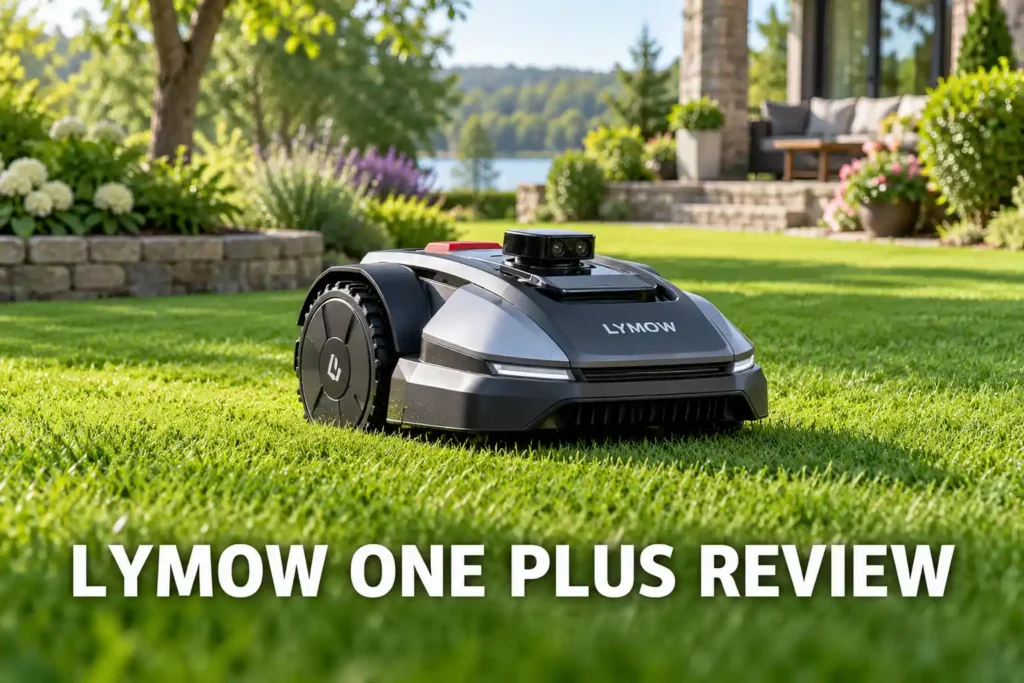

In my Lymow One Plus review the verdict is short: buy this tracked robot mower for banks and rough ground, and skip it for a small tidy lawn. I tested it on the house lawn and the gravel yard edge of a family farm, and I weighed it for the orchard alleys.
Lymow One Plus Review: My Verdict on the Tracked Robot Mower
The Lymow One Plus is a tracked, wire-free robot mower with a 16 in dual-blade mulching cut, a motorized deck and a slope rating of up to 45 degrees, which is 100 percent. It earns my recommendation when the ground has banks, you have open sky for its reference station and you have room to store 77.6 lb. It loses that recommendation on a small lawn under tree cover. Three points sum it up:
- Who it is for: owners of rough or sloping ground who can give the RTK reference station a clear view of the sky.
- What it does best: tracks that carry a maker rating of up to 45 degrees, with a deck that lifts from 1.2 to 4 in. My list of robot mowers for hills shows where tracked models sit among the AWD picks.
- The main trade-off: 77.6 lb of machine, a map you draw by driving it and a warranty that leaves out the tracks and blades.

Lymow One Plus Specs That Matter on a Slope
Two rows decide this purchase: the slope rating and the navigation row, because the reference station needs open sky. Lymow marks its area numbers as laboratory values.
| Spec | Lymow One Plus |
|---|---|
| Navigation | RTK plus vision (VSLAM), reference station in the box |
| Slope rating | Up to 45 degrees (100 percent); no working-slope figure published |
| Drive | Rubber tracks; 2 in obstacle climbing |
| Cutting width and height | 16 in, 1.2 to 4.0 in, motorized deck |
| Rated area, laboratory value | Up to 0.57 acre per charge |
| Run time and charging | Up to 3 hours; 90 minutes for 10 to 90 percent on the 10 A charger |
| Weight | 77.6 lb |
| Warranty, manual | 2 years; tracks and blades excluded |
How the Lymow One Plus Performs on Real Ground
Four jobs decide it: climbing, mapping, cutting and docking.
The Tracks and the 45 Degree Rating
Rubber tracks put a long contact patch on the ground, and Lymow states that the machine handles up to 45 degrees, or 100 percent. That is rise equal to run. The manual gives no working slope, no wet-grass figure and no separate edge figure, so I treat 45 degrees as the ceiling and not as a mowing instruction. Many people cannot judge a slope by eye, and a commonly recommended maximum for ride-on mowers is 15 degrees (1). My roundup of robot mowers for steep slopes lines up the climbing ratings side by side.
During mapping I kept the machine at least 10 cm (4 in) from the fence and from the ditch, as the manual asks. The 2 in obstacle climbing height is the tracks’ limit on a step, so I filled the low spot at the gravel edge before I mapped it. My roundup of mowers for uneven terrain shows which models cope with roots, bumps and ruts.
Setting Up the RTK Station and Mapping the Lawn
The reference station decides whether this mower works on your property. The manual wants flat open ground or an unobstructed wall or roof, no eaves, trees or metal roofs nearby, at least 2 m (7 ft) from walls and not under a tree. Its compliance note says the station needs professional installation and a significant level of technical expertise. Canopy cover reduces the number of satellites an RTK receiver can use (2). That study used a survey receiver on a forest harvester, so I read it as a warning about trees and not as a mower figure.
I put the station where the house lawn had a clear view and left the orchard alleys out, because under the fruit trees in leaf I found no clear site. Before mapping I waited for the accuracy readout to come within 0.05 m, as the manual requires, and the first fix can take up to 3 minutes.
Mapping is manual. You drive the mower with the app joystick, keeping the phone 6 to 8 m from it and never beyond 20 m. I drove the lawn edge to close the zone, then drew a channel to the dock. I would add a no-go zone around the drip line. A missing channel shows as a Zone not reachable or Charging station not reachable fault, and I saw that fault until the channel was in place. Move the station later and you redraw the map. My roundup of mowers with no perimeter wire compares how each wire-free model is mapped.
Cutting, Mulching and the Edge
Two blades cut a 16 in path and mulch the clippings. The deck lifts from 1.2 to 4.0 in by 5 mm per press in the app, so a thick patch and a finished lawn get different heights. Lymow advises at least 40 mm (1.6 in) when the grass is over 60 mm (2.4 in), and no more than a third of the grass height per cut.
The mowing settings let you add one to three perimeter laps and a safe-margin mode with an offset or a precise edge. On the gravel yard edge I set the offset edge and still had a strip to finish with a trimmer. A study of seven areas managed by robot mowers found manual finishing along curbs and walls in all seven (3). Plan that trimmer pass from day one.
Docking, Charging and Noise at the House
The charging station needs flat, dry ground, preferably shaded, with 1.5 m by 3 m (5 ft by 10 ft) clear in front, 200 mm clear on both sides and 60 cm (24 in) from flammable material, outside any mapped zone. Charge only with the supplied charger. Lymow gives 90 minutes for 10 to 90 percent on the 10 A charger and 150 minutes on the 5 A charger, and it does not say which charger sits in the box. I placed the station on flat ground near the shed outlet and checked the charging time on the app screen.
Lymow publishes no noise figure. With 6,000 rpm blades and 1,785 W of peak power, I do not call this mower quiet, and at the house wall I could tell when it was running.
Living With the Lymow One Plus
The mower weighs 35.2 kg (77.6 lb) and the package 47 kg, which means a two-person lift or a ramp.
Weight, Cleaning and Storage
The body is rated IPX6, but the manual forbids submerging it and requires a full cleaning after wet work. I brushed the underside of the deck and the fender brush after a wet mow and checked the tracks for packed clippings. For storage the manual wants the battery at 60 to 70 percent, the mower off and indoors, and the battery out if the mower sits unused for 15 days or more. Below 5 F (-15 C) bring the mower and charging station indoors and take down the RTK unit.
Battery, Connectivity and Anti-Theft
The 15 Ah LiFePO4 battery charges best between 5 and 35 C (41 and 95 F). It connects by Bluetooth, 2.4 GHz Wi-Fi and 4G; the manual does not say whether a data plan is included. Anti-theft covers a 4-digit PIN with a default of 0000 that I changed first, a geo-fence that locks the mower and sounds a warning and a Find My Robot location tool.
Safety Around the Blades and the Wildlife
Before I lift, tip or clean the mower, I press stop, switch it off, disconnect the battery and wait for the blades to stop completely, then wear protective gloves. Keep children and pets off the lawn while it runs, and never lift it while it operates. A test of 18 robot mower models on dead hedgehogs found that none detected dependent juvenile hedgehogs under 200 g, and its authors said day-only mowing might largely avoid the problem (4). I schedule daytime runs and check the lawn for small animals first, as the manual asks.
Mowers also injure people: a US analysis estimated 934,394 lawn mower injuries from 2005 to 2015, with the hand and finger the most injured part (5). The figure covers every mower type, so I use it as a reason to keep my hands away from the blades.
Who the Lymow One Plus Suits and Who Should Skip It
The right buyer has rough ground and open sky above the lawn.
- Buy it for: a large open lawn, or rough, steep or rolling ground, where you can site the reference station in the open. My list of robot mowers for large yards sorts the models by the acreage each one handles.
- Buy it for: an owner who accepts mapping by joystick and a heavy machine in exchange for a high slope rating.
- Buy it for: a property with open sheds or yards, where the PIN and geo-fence lock matter.
- Skip it if: trees or tall walls cover the lawn and the station has no clear site.
- Skip it if: you cannot lift or ramp 77.6 lb, or you want a published noise figure.
- Skip it if: you count on warranty cover for the tracks and blades.
Lymow One Plus Drawbacks
Lymow One Plus problems are real, and most have a workaround.
Weight and Setup
The weight of 77.6 lb is the first drawback. A ramp at the shed door or a second pair of hands solves the lift. Mapping by joystick is the second, since you drive each zone and channel with your phone within 20 m.
Sky, Noise and Warranty
A shaded yard may rule this mower out, since the station needs open sky. Lymow publishes no noise figure. The manual gives a 2-year warranty and excludes the tracks and blades, the parts that wear on rough ground, so check the warranty term on the listing you buy from before you rely on it. The manual also says to avoid operating in rain or standing water.
How the Lymow One Plus Compares
Three other machines from my robot mower picks cover the same ground: another tracked one, a large wheeled one and a small wheeled one. The table sets each maker’s own figures side by side. I compare the two tracked models in my One Plus and Yarbo Y40 guide.
| Model | Drive | Slope, as the maker states it | Area, as the maker states it | Weight |
|---|---|---|---|---|
| Lymow One Plus | Tracks | Up to 45 degrees (100 percent) | Up to 0.57 acre per charge, laboratory | 77.6 lb |
| Yarbo Y40 | Tracks | 35 degrees (70 percent), one figure | Up to 6 acres, twice a week | About 210 lb whole unit |
| Dreame A3 AWD Pro 3500 | All-wheel drive | 80 percent navigable, below 36 percent advised | 0.87 acre recommended | 53.6 lb |
| LUBA mini 2 AWD 1500H | All-wheel drive | 80 percent inside, 40 percent at the edge | 0.37 acre recommended | About 39 lb |
Yarbo Y40
The Yarbo Y40 is the larger tracked alternative: a 20 in cut and up to 6 acres on a twice-a-week schedule, with a 35 degree rating.

Pick the Yarbo if your property runs to several acres and you accept about 210 lb of machine and a grease routine for the tracks.
Dreame A3 AWD Pro 3500
The Dreame A3 AWD Pro 3500 is the wheeled alternative for a larger lawn, with no RTK station. Dreame navigates up to 80 percent but advises work areas below 36 percent. My Dreame A3 Pro review covers its LiDAR navigation and rough-lawn behavior in full.
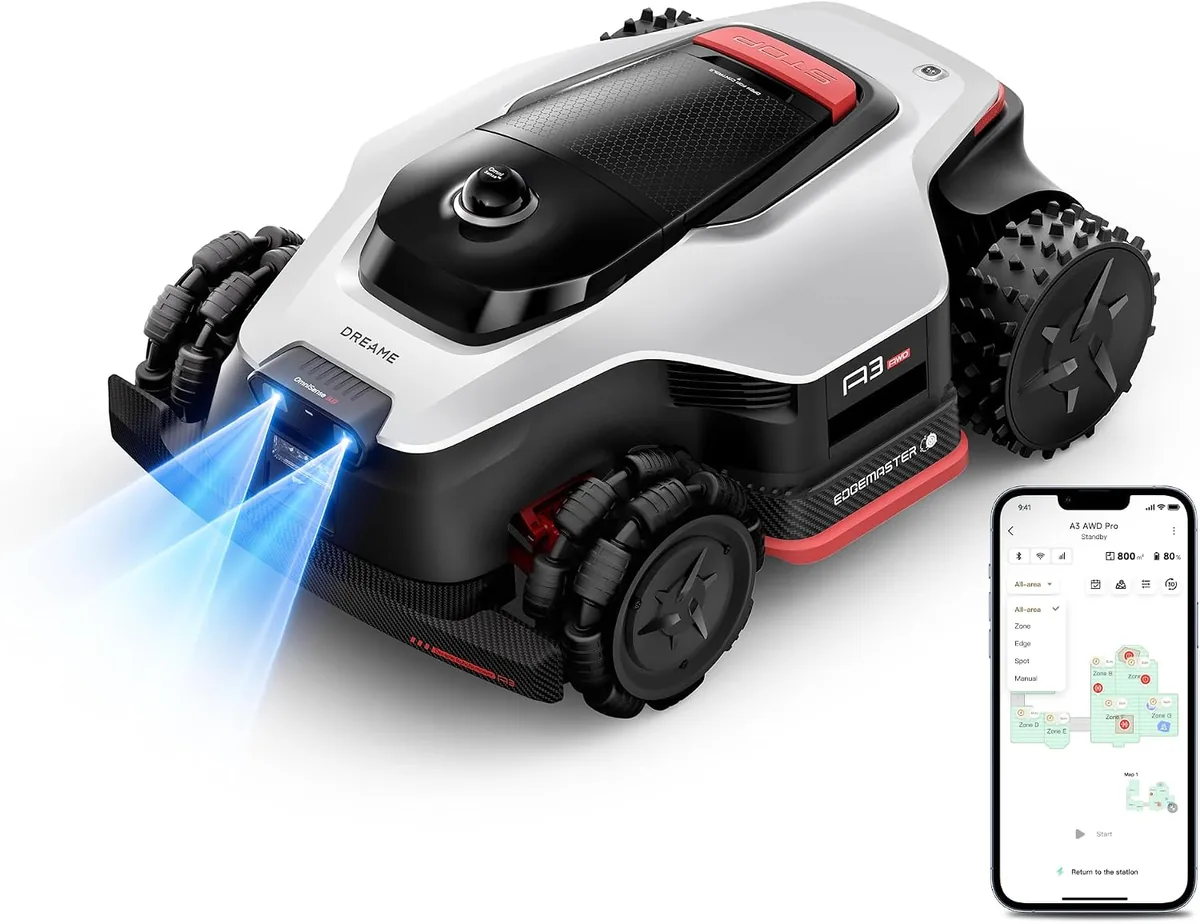
Pick the Dreame if the lawn is large with moderate slopes and you want no base station, and you can lift 53.6 lb.
Mammotion LUBA mini 2 AWD 1500H
The LUBA mini 2 AWD 1500H is the light option for a small sloped lawn. Mammotion states 80 percent inside the area and 40 percent at the edge. My LUBA mini 2 review goes through its slope figures and setup in full.

Pick the Mammotion if the lawn stays under 0.37 acre and you want a machine you can carry.
Common Problems and How to Prevent Them
The app lists the faults, and the manual gives the fix for each. Most trace back to the sky, the grass on the tracks or the map.
- Weak RTK signal: move the mower to an open area and restart, or reposition the station with a clear view of the sky.
- Slipping detected or Mower stuck: stop the mower, switch it off, disconnect the battery and wait for the blades to stop, then put on gloves to inspect the tracks and clean off packed clippings, and avoid wet slopes.
- Zone not reachable or Charging station not reachable: add the missing channel on the map.
- Excessive tilt or Unsafe drop detected: keep the machine away from drop-offs and ditch edges.
- Blade jammed: stop it, switch it off, disconnect the battery and wait for the blades to stop before you clear it, wearing gloves.
- Vision faults: clean the camera and light lenses.
My Final Verdict on the Lymow One Plus
The One Plus carries the highest stated slope rating among the robot mowers I looked at, on tracks. It asks for open sky, a heavy lift and a hand-drawn map, and its warranty leaves out the parts that wear. I recommend it for banks and rough ground that can pay those costs, and a small or shaded lawn is better served by a lighter wheeled mower. That is where my Lymow One Plus review lands: buy it if the ground has banks, the sky is open and you can lift 77.6 lb. My picks of the top robot lawn mowers put this model in context with the rest of the field.
Frequently Asked Questions
What are the common issues and problems with the Lymow One Plus?
The issues and problems the Lymow One Plus manual covers are a weak RTK signal, slipping or a stuck machine, and missing channels that cause Zone not reachable faults. The manual also requires a full cleaning after wet work, and the tracks and blades carry no warranty under the manual’s terms.
Can robot lawn mowers go uphill?
Robot lawn mowers can go uphill up to the slope each maker states for that exact model, which is the most the machine handles. The Lymow One Plus states up to 45 degrees (100 percent) with no working slope or wet figure, so keep every mower off wet slopes and drop-offs.
Do robot lawn mowers do a good job?
Robot lawn mowers do a good job on a lawn they are sized for, cutting a little each day and mulching fine clippings back into the turf. The result depends on the mapped area, sharp blades and ground cleared of toys, hoses and stones, so match the rated area to your lawn.
Does a robot lawn mower do edges?
A robot lawn mower trims most of the edge but leaves a strip along walls, beds and gravel that you finish with a trimmer. The Lymow One Plus lets you set one to three perimeter laps and a safe margin in its mowing settings, so keep a trimmer ready for the strip.
Can you leave a robot lawn mower outside?
You can leave a robot lawn mower outside only as its maker allows, and the Lymow One Plus manual advises against operating in rain or standing water. Below 5 F (-15 C) it wants the mower and charging station indoors, so store it dry and frost-free through the winter with the battery at 60 to 70 percent.
References
- Karnes EW, Leonard SD, Lenorovitz DR. Ride-on lawnmowers warnings: Slope measurements and safety-by-separation. WORK: A Journal of Prevention, Assessment & Rehabilitation. 2012;41(S1):3629-3632. doi:10.3233/wor-2012-0116-3629
- Lopatin E, Väätäinen K, Kukko A, et al. Unlocking Digitalization in Forest Operations with Viewshed Analysis to Improve GNSS Positioning Accuracy. Forests. 2023;14(4):689. doi:10.3390/f14040689
- Sportelli M, Martelloni L, Orlandi A, et al. Autonomous Mower Management Systems Efficiency Improvement: Analysis of Greenspace Features and Planning Suggestions. Agriculture. 2019;9(6):115. doi:10.3390/agriculture9060115
- Rasmussen SL, Schrøder A, Mathiesen R, Nielsen JL, Pertoldi C, Macdonald DW. Wildlife Conservation at a Garden Level: The Effect of Robotic Lawn Mowers on European Hedgehogs (Erinaceus europaeus). Animals. 2021;11(5):1191. doi:10.3390/ani11051191
- Harris C, Madonick J, Hartka TR. Lawn mower injuries presenting to the emergency department: 2005 to 2015. The American Journal of Emergency Medicine. 2018;36(9):1565-1569. doi:10.1016/j.ajem.2018.01.031
Safety Note: A robot mower has sharp blades. Keep hands and feet away from them. Do not run it with children, other people or animals on the lawn; stop it and park it or switch it off if they come onto the lawn. Never ride on it or let children play with it. Clear toys, hoses, sticks, stones and fallen fruit before a run, and do not mow while sprinklers run. Never lift or tip it while it runs or while it sits in its charging station. Before you lift it, clean it or touch the blades, press STOP, switch it off exactly as your manual says, disconnect the battery as the Lymow manual instructs, wait until every blade has stopped, and wear protective gloves. Daytime schedules reduce encounters with animals that come out at night, though animals can be on the lawn by day too. Plug the power supply into a covered outdoor GFCI outlet, keep its cable out of the mowing area, and follow your manual for installation, slopes, charging and storage.