


In my Mammotion LUBA 2 AWD 5000HX review, the verdict comes first: buy it for an open lawn of about an acre, up to its 1.25 acre rating, with a clear sky over the station, and skip it where trees shade most of the grass. Mammotion rates the robot for 1.25 acres recommended and 1.5 acres maximum, with an 80% (38.6 degree) climbing figure and a 3-year warranty. I set it up on the lawn and orchard alleys of my family farm.
Mammotion LUBA 2 AWD 5000HX Review: The Quick Verdict
The Mammotion LUBA 2 AWD 5000HX Wire-Free Robot Mower is a wire-free, wheeled robot mower for big, open lawns, and it is the one I recommend when your open turf is about an acre, within Mammotion’s 1.25 acre rating. RTK satellite positioning and a camera backup do the navigating, four driven wheels climb to 80% by Mammotion’s figure, and a 190 minute battery sets the pace. It sits in the premium price tier, and the station needs open sky. For more wire-free options, I compare nine picks in my best robot lawn mower without perimeter wire roundup.
- Who it is for: an owner with an open lawn of about an acre who wants no boundary wire.
- What it does best: it keeps navigating on a camera for up to 300 m when trees or eaves block the satellites.
- Main trade-off: Mammotion publishes 190 minutes per charge and no area per charge, so you plan the schedule around recharging.

Mammotion LUBA 2 AWD 5000HX Specs
Two rows matter most here: the rated area and the mowing time per charge, because together they set how the schedule works on a large lawn.
| Spec | Value |
|---|---|
| Navigation | RTK-GNSS with a reference station, plus AI vision as backup; no boundary wire |
| Rated Area | 1.25 acres recommended, 1.5 acres maximum, per Mammotion |
| Slope Rating | 80% (38.6 degrees), climbing ability; no inside or edge split published |
| Cutting Width | 15.7 in (400 mm), two discs |
| Cutting Heights | 2.2 to 4 in, set in the app (H version) |
| Drive | All-wheel drive with spring suspension; 3.2 in obstacle passing |
| Run Time and Charge Time | 190 minutes mowing per charge, 120 minutes to charge, per Mammotion |
| Noise | Sound power 66 dB(A); sound pressure 58 dB(A) |
| Connectivity | Bluetooth, Wi-Fi and built-in 4G; 1 year of free 4G data per Mammotion’s US terms, optional |
| Warranty | 3 years on the robot, battery, charging station and RTK reference station |
How the 5000HX Performs in Real Work
I judged it on the jobs a big lawn sets: mapping the edge, holding a position, covering the area, climbing and finishing the borders.
Setup and Mapping Without a Wire
Setup is a two-box job. The charging station goes on flat ground with a 1 x 1 m (3 x 3 ft) clear area and a slope under 5 degrees, the RTK reference station goes in open sky, and you fit the vision module on the robot yourself. Because the mower maps its work area instead of following a buried loop, it works as a wire free robot lawn mower and no wire can be cut by a spade.
Mapping runs through the app. I walk the robot around the edge with the joystick, staying within 1.5 m (4.9 ft) for the Bluetooth link and at least 15 cm (6 in) from walls, fences and ditches. Beside the shed wall the app dropped below Good, and I moved the RTK station to open ground, since Mammotion’s fault guide asks for no obstructions within at least 5 m (16 ft) of it. A channel wider than 1 m (3.3 ft) has to link every zone to the charging station, or the robot cannot dock by itself.
Pick the open-sky spot for the stations before you map anything, because moving the RTK station afterwards makes the map diverge and you delete it and map again.
RTK and the Vision Backup
A gps robot lawn mower reads satellites, and RTK adds a reference station that corrects the fix. Mammotion states about 5 cm (2 in) for RTK, and it calls the position Good below 10 cm, down to 2 cm in a good open-sky area. Only the Good status enables automatic mowing, and I wait for it before the first run. When eaves or trees block the sky, the robot switches to vision positioning, which lasts for 300 m (984 ft) before it must return to RTK coverage or stop.
Trees do cut the fix. In a study of RTK positioning on a moving forest harvester under mature spruce, canopy cover reduced the number of available satellites and gave more inaccurate positions (1). A test of low-cost receivers under canopy reported median horizontal errors under 0.1 m for one receiver, though it used static, post-processed readings of 20 minutes that a moving mower does not get (2). On my farm the machinery shed wall and the plum rows both fail Mammotion’s rule of 3 m (10 ft) from any wall or tree, so the station goes on the open side of the yard.
Obstacle avoidance uses the camera, an ultrasonic radar and a bumper. I keep the app on Standard, because Mammotion says Sensitive can leave dried-out patches unmowed and Off makes the robot bump into things.
Area and Battery on a Big Lawn
Mammotion rates the 5000HX at 5,000 m2, which is 1.25 acres, with a maximum of 6,000 m2 (1.5 acres). That makes it a robot lawn mower for large lawns; I compare five wire-free options by acreage in my list of robot mowers for large yards. Against my quarter-acre house lawn, 1.25 acres is five times the area, with the orchard alleys on top.
The manual gives no area per charge and lists no larger pack for this size, so I treat the rating as a ceiling and build the schedule around recharging. On my first full day it returned to the dock through the channel I had drawn when the battery fell under 15%. Mammotion says to mow once a day at most and to avoid wet grass.
Slopes and Rough Ground
Mammotion gives 80% (38.6 degrees) as the climbing ability, and the manual does not say whether that holds inside the lawn or at the edge. I keep the mapped line well back from the ditch along my orchard border. All four wheels are driven, springs follow the ground, and the H version passes obstacles up to 3.2 in (80 mm). For other hill climbers, my picks of robot mowers for hills include AWD and tracked machines.
A study of seven greenspaces managed by autonomous mowers found that some needed help after sticking on shallow tree roots, and that manual finishing was needed along curbs and walls in all seven (3). For that reason I walk the lawn for roots, holes and stones before the first run, and I clear toys, hoses and branches before every run. If your ground is rougher than a clean lawn, my picks of robot mowers for uneven terrain cover bumpy ground.
Cutting Height, Edges and Wildlife
The H version cuts at 2.2 to 4 in, set in the app, with two discs over a 15.7 in width. Mammotion states no edge-trim claim and no uncut-strip width, and after a first cut at 4 in the strip along the shed wall stood uncut, so I trimmed it by hand.
An Italian trial on tall fescue found denser turf under an autonomous mower than under a gasoline mulching mower (4), one site and one grass. Wildlife Safe Mode holds night speed below 0.3 m/s or cancels night tasks, and tests with 18 robotic mower models found that none detected dependent juvenile hedgehogs under 200 g, tested as cadavers in Europe (5). I keep my runs in daylight.
Living With the 5000HX
Living with it is mostly routine: dock, app, blades and winter.
- Noise: Mammotion lists 66 dB(A) sound power and 58 dB(A) sound pressure for the H version.
- 4G and the app: Built-in 4G comes with 1 year of free data per Mammotion’s US terms and is not mandatory, since Wi-Fi and the radio link also work. The terms page does not publish the price after year one.
- Upkeep: Blades come off every 3 months or after 150 hours, all blades and screws together, after you press stop, long-press the power button, remove the security key and wait until the cutting disc has completely stopped, with gloves on and never an electric screwdriver. Wipe the front vision lens, or the vision module suffers.
- Weight and storage: The robot weighs about 42 lb. Below -20 C (-4 F) the robot and both stations come indoors. Store the robot clean, dry and fully charged with the security key removed, and charge it fully every 90 days.
I wipe the lens on the same weekly check as the blades, and I keep the dock where the 120 minute charge does not need me. Mammotion forbids a pressure washer.
Blades and Children
Before you lift or tip the robot, clean it, clear a blockage or touch the blades, press stop, long-press the power button, remove the security key and wait until the cutting disc has completely stopped. Wear protective gloves, never lift the robot while it is on, and keep children and pets off the lawn while it runs.
Who the 5000HX Suits and Who Should Skip It
Among Mammotion robot lawn mower options, the 5000HX is the middle size of the LUBA 2 AWD family, and the H version cuts taller, from 2.2 to 4 in. My LUBA 2 AWD 3000HX review covers the 3000HX from the same family.
- Choose it for: an open lawn of up to about 1.25 acres, where the station can see the sky.
- Choose it for: grass you keep tall, at 2.2 to 4 in.
- Skip it if: trees or walls shade most of the lawn, since RTK needs open sky.
- Skip it if: you want a mower that needs no trimmer pass along walls and beds.
- Skip it if: you cannot lift 42 lb.
Drawbacks
The limits below are the ones to check before you order.
- No area per charge. The manual states 190 minutes of mowing and 120 minutes of charging, so test the schedule on your own lawn.
- No edge figure. Plan a trimmer pass along walls and beds.
- 4G cost after year one is not published. The service is optional.
- The battery is not a user swap. Service goes through Mammotion.
How the 5000HX Compares
Three other robot mowers differ on acreage, edge slope and whether they need an RTK station. The table gives each figure with its basis.
| Figure | LUBA 2 AWD 5000HX | Yarbo Y40 | LUBA 3 AWD 3000 | Dreame A3 AWD Pro 3500 |
|---|---|---|---|---|
| Navigation | RTK and vision backup | RTK, vision, radar | LiDAR, vision, RTK | LiDAR and cameras, no RTK |
| Rated area | 1.25 acres recommended | Up to 6 acres, mowing twice a week | 0.75 acre mowing area | 0.87 acre recommended |
| Slope figure | 80%, no inside or edge split | 70% (35 degrees), one figure | 80% inside, 40% at the edge | 80% navigable; below 36% advised |
| Drive | Wheeled, all-wheel | Tracked | Wheeled, all-wheel | Wheeled, all-wheel |
| Mowing time per charge | 190 minutes | Not published | 150 minutes | Not published |
| Warranty | 3 years | 2 years | 3 years | 3 years per the listing |
Versus the Yarbo Y40
The YARBO Y40 Core Tracked Robot Mower Pro is tracked, rated up to 6 acres on a twice-a-week schedule and much heavier. Pick it if you mow several acres or rough, wet ground. Pick the 5000HX if your lawn is about an acre and a wheeled robot is enough. I put the two head to head in my comparison of the 5000HX and Yarbo Y40.

Versus the Mammotion LUBA 3 AWD 3000
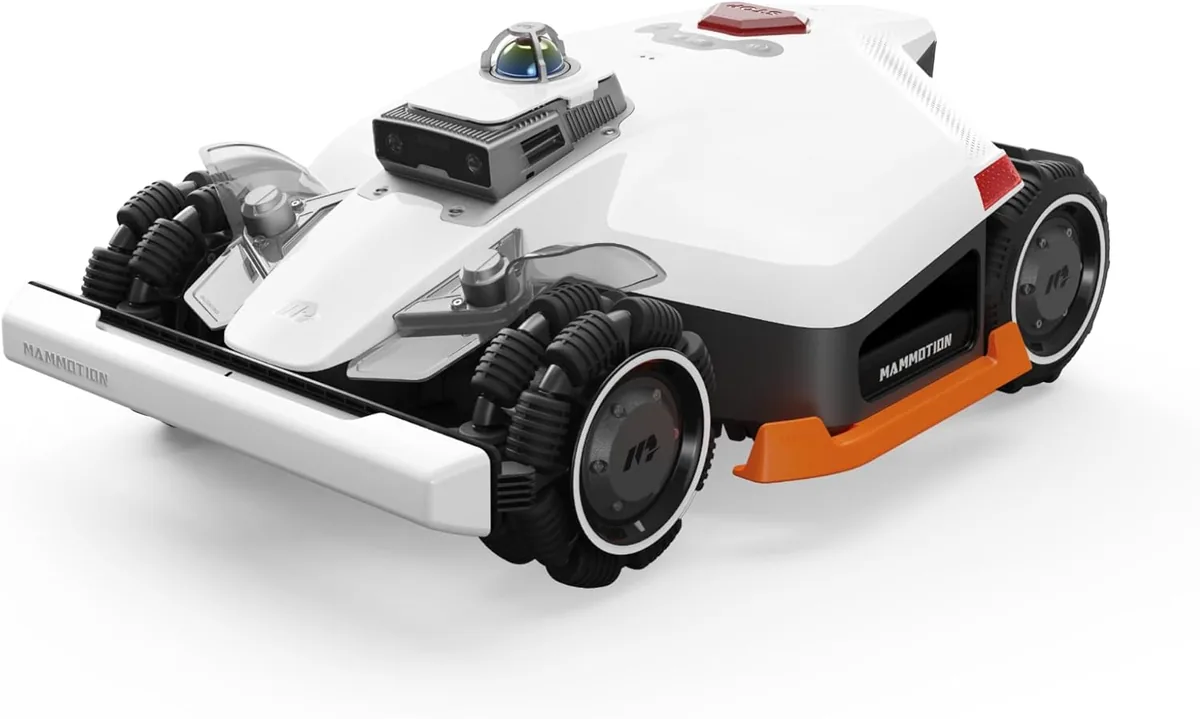
The Mammotion LUBA 3 AWD 3000 LiDAR and RTK Robot Mower adds LiDAR to RTK and vision and gives a 40% edge slope figure beside its 80% inside figure, but it is rated for 0.75 acre. Pick it for a smaller lawn with a sloping border. Pick the 5000HX when the area is the problem. My LUBA 3 AWD 3000 review looks at that model on slopes and under open sky.
Versus the Dreame A3 AWD Pro 3500
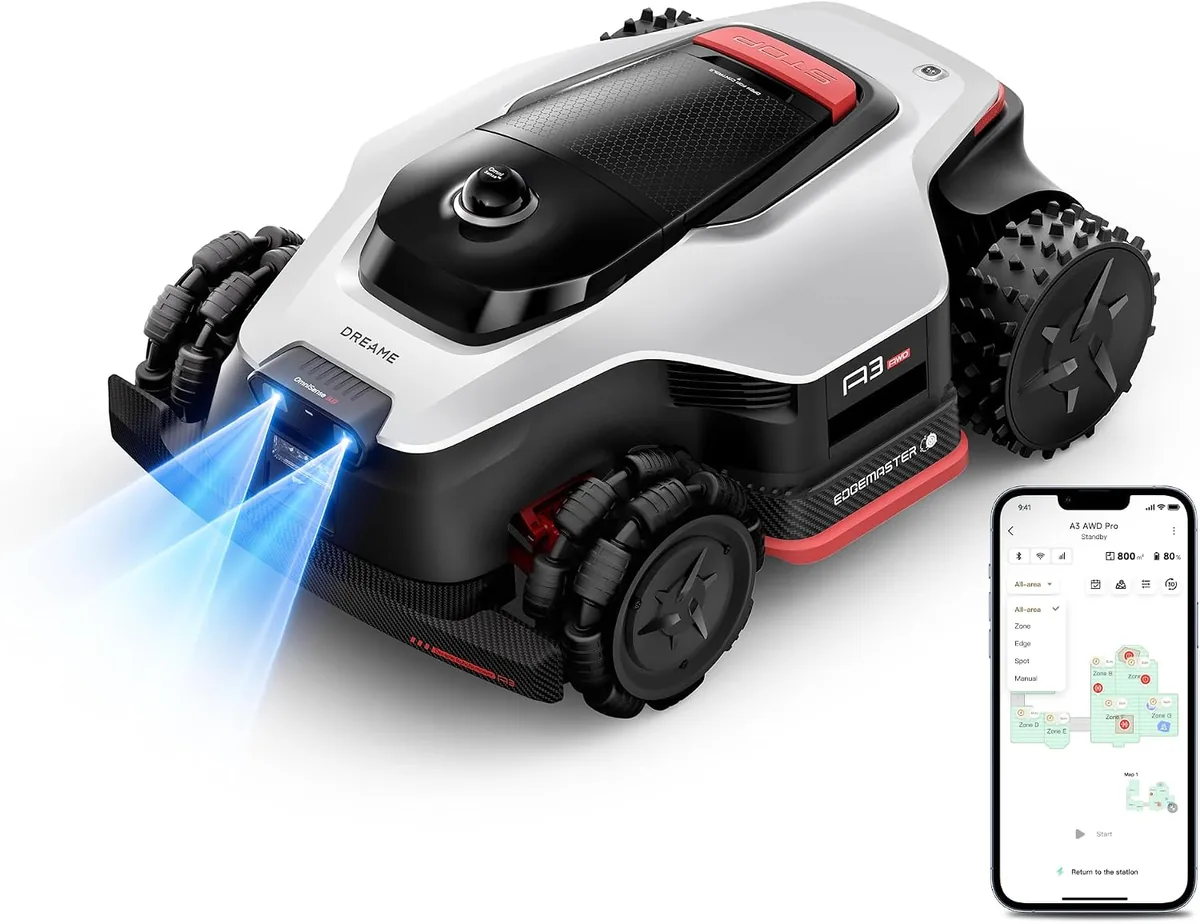
The Dreame A3 AWD Pro 3500 LiDAR Robot Mower navigates with LiDAR and cameras and needs no RTK station, and Dreame rates it at 0.87 acre. Pick it where no spot has a clear sky. Pick the 5000HX where you can place a station in the open and need the extra area. My Dreame A3 Pro review follows it across rough lawns.
Common Problems and How to Prevent Them
The problems below come from the manual’s own fault guide for the LUBA 2 AWD robot lawn mower series.
- Position not Good: trees, walls or fences weaken the signal. Move the RTK station to open ground, with nothing within 5 m (16 ft).
- Map diverges: the RTK station was moved after mapping. Delete the map and map again, and mount the station where it stays.
- Robot will not dock: there is no channel to the charging station. Draw a channel wider than 1 m (3.3 ft).
- Dried-out patches: obstacle sensitivity is on Sensitive. Set it to Standard.
- Grass sticks and the robot slips: the lawn is wet. Wait for dry grass, and use the rain setting that stops mowing when rain is detected.
My Final Verdict on the 5000HX
The 5000HX earns its place on an open lawn of about an acre, within its 1.25 acre rating. Before you order, check the sky over the spot for the reference station and the width of the beds you will trim. My Mammotion LUBA 2 AWD 5000HX review ends with a clear yes for an open, mostly sunny lawn within its 1.25 acre rating, and a no for shaded ground. For the wider field, I rank nine of the top robot lawn mowers in one place.
Frequently Asked Questions
Is Mammotion Luba 2 good?
The Mammotion LUBA 2 AWD 5000HX is good for open lawns of about an acre, where Mammotion rates it at 1.25 acres recommended with an 80% climbing figure. It is a poor fit under heavy tree cover, because RTK needs open sky and the vision backup lasts only 300 m.
Are Mammotion robot mowers any good?
Mammotion robot mowers are well specified, and the 5000HX carries a 3-year warranty with RTK and vision navigation. Check the exact model’s rated area and slope basis before you buy, because they differ across the line, and treat every maker figure as a ceiling on your own lawn each season.
How well do robot lawn mowers work?
Robot lawn mowers work well on mapped, open lawns when you clear stones and toys before each run, keep the schedule to daylight and plan a trimmer pass along walls and beds yourself. Wet grass, trees overhead and steep banks can slow or stop a run, so check them first.
Is a robot lawn mower worth it?
A robot lawn mower is worth it on a large, open lawn that you map once, since it replaces the weekly mow with short daily cuts and needs little from you between runs. It pays back less under heavy tree cover, where the edges need constant trimming or where nobody clears the lawn before each run.
How do robot lawn mowers work?
A robot lawn mower cuts with a small blade disc and returns to its charging station when the battery runs low. Wire-free models like the 5000HX learn the boundary from one walk around the edge in the app and then follow a map, using RTK satellites, LiDAR, cameras or a mix.
References
- Lopatin E, Väätäinen K, Kukko A, et al. Unlocking Digitalization in Forest Operations with Viewshed Analysis to Improve GNSS Positioning Accuracy. Forests. 2023;14(4):689. doi:10.3390/f14040689
- Tomaštík J, Everett T. Static Positioning under Tree Canopy Using Low-Cost GNSS Receivers and Adapted RTKLIB Software. Sensors. 2023;23(6):3136. doi:10.3390/s23063136
- Sportelli M, Martelloni L, Orlandi A, et al. Autonomous Mower Management Systems Efficiency Improvement: Analysis of Greenspace Features and Planning Suggestions. Agriculture. 2019;9(6):115. doi:10.3390/agriculture9060115
- Grossi N, Fontanelli M, Garramone E, et al. Autonomous Mower Saves Energy and Improves Quality of Tall Fescue Lawn. HortTechnology. 2016;26(6):825-830. doi:10.21273/horttech03483-16
- Rasmussen SL, Schrøder A, Mathiesen R, Nielsen JL, Pertoldi C, Macdonald DW. Wildlife Conservation at a Garden Level: The Effect of Robotic Lawn Mowers on European Hedgehogs (Erinaceus europaeus). Animals. 2021;11(5):1191. doi:10.3390/ani11051191
Safety Note: A robot mower has sharp blades. Keep hands and feet away from them. Do not run it with children, other people or animals on the lawn; stop it and park it or switch it off if they come onto the lawn. Never ride on it or let children play with it. Clear toys, hoses, sticks, stones and fallen fruit before a run, and do not mow while sprinklers run. Never lift or tip it while it runs or while it sits in its charging station. Before you lift it, clean it or touch the blades, press STOP, switch it off exactly as your manual says, wait until every blade has stopped, and wear protective gloves. Daytime schedules reduce encounters with animals that come out at night, though animals can be on the lawn by day too. Plug the power supply into a covered outdoor GFCI outlet, keep its cable out of the mowing area, and follow your manual for installation, slopes, charging and storage.