
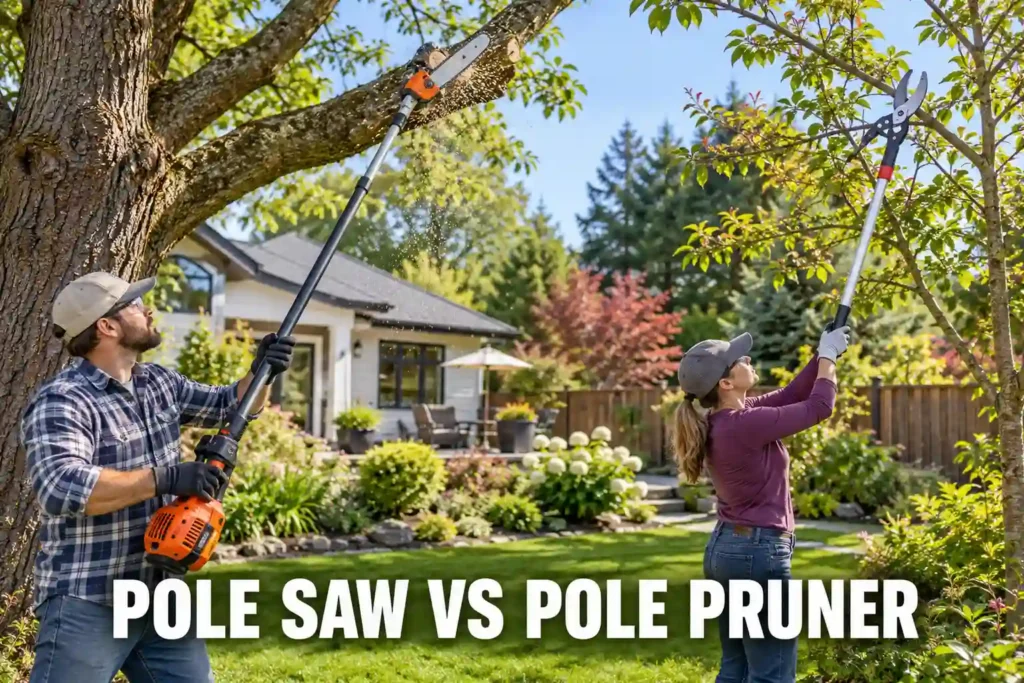
Pole saw vs pole pruner is mostly a question of names: in several maker manuals both words describe the same tool, a small chain saw on a long pole, and the real split runs between that powered chain head and a motorless blade head. I prune a 3.7-acre apricot and plum orchard every winter, so I judge a tool by what it cuts and from where, not by its label. Below I sort out the names, the branch sizes, the weight and the safety rules, and I say which tool fits which job.
Pole Saw vs Pole Pruner: The Short Answer
A pole saw and a pole pruner are the same tool whenever the head holds a motor-driven chain and a bar. Echo calls that tool a Power Pruner in its PPF-2620 and PPT-2620 manuals, the EGO, Ryobi, DeWalt, Husqvarna and Remington manuals write “pole pruner” in their safety text, and Greenworks sells its version as a polesaw. In my guide to “what is a pole saw”, I explain the tool’s parts and what it can cut from the ground.
The name pole pruner also belongs to a second tool with no motor. A manual pole pruner carries a hand-operated blade head, and some sets add a swap-in pruning saw. The UC Master Gardener program of Napa County rates pole pruners for branches up to 2 inches, while the powered saws in the EGO, Ryobi, DeWalt and Echo manuals are rated for 8 inches.
Read the Head
A bar, a chain and a motor or engine make it a pole saw, whatever the label says. A hand-operated blade head with no motor makes it a manual pole pruner.
In my orchard the choice splits by wood size. The upper scaffold limbs of the apricot and plum trees have grown past what my loppers reach, and the thin water sprouts above them call for a different tool than a thick limb does. My guide answers “how much reach do I need from a pole saw” by starting from your branch height.
Why the Two Names Cause So Much Confusion
Makers do not agree on one word, and stores add their own, so one shelf can hold a motorized saw and a hand tool under similar names. Three questions settle it every time: is there a motor, what does the head cut with, and what cutting limit does the maker print.
Echo uses Power Pruner for its gas models with a 25.4 cc two-stroke engine. Stihl, a brand sold mostly through dealers, calls its chain-driven models pole pruners, in petrol and battery versions. Greenworks writes polesaw as one word. The tool underneath is the same in all three cases: a short bar and chain driven from the end of a pole. In my guide to the cc a gas saw needs, I explain how engine size, weight and branch limits affect the choice.
The UC Master Gardener guide for Napa County calls the hand version a pole pruner and also describes pole and rope saws that cut limbs up to 2 or 3 inches. Stores then add their own wording. A pole tree pruner can be either a motorless hand tool or a powered saw, so the label alone settles nothing.
How a Pole Saw Head Cuts
A pole saw works like a chain saw moved to the end of a pole. A motor or engine drives a chain around a bar, and an oiler feeds bar oil to the chain. The Echo PPT-2620H, for example, keeps its 25.4 cc engine at the grip end and sends power to the head through the shaft. I follow the parts from trigger to chain in my answer to “how does a pole saw work”.
What the Makers Rate It to Cut
Several manuals print a maximum branch size, and your own manual’s figure is the one that counts. The EGO manual for the PS1000, the saw sold in the PS1001 kit, says limbs up to 8 in (200 mm). The Echo PPT-2620H manual says “light to medium trimming of limbs and branches up to 203 mm (8 in.) diameter.” The Greenworks 1400702CT manual says 6 inches, and the Milwaukee 3013-20 manual lists 9.75 inches in its specifications but warns against branches over 9 inches, so 9 inches is the limit for that saw.
Treat the figure in your own manual as a ceiling for a limb you can reach comfortably from the ground. An electric pole pruner, meaning a battery or corded saw, has no exhaust and no fuel to mix. A gas saw runs on a 50:1 two-stroke mix in the Echo and Husqvarna manuals and gives off carbon monoxide. Which power source to buy is a separate decision, and my battery vs gas pole saw comparison covers it.
Planning a Cut Within the Rating
The three-cut method applies to a branch inside the saw’s rating, never to a large limb. Iowa State University Extension advises it for branches thicker than 1 1/2 inches, and it keeps the bark from tearing as the branch falls. The sources differ on the distances, so keep to the order of the cuts and follow your manual.
Start the saw with the chain clear of the branch and every other object, and let the chain reach full speed before it touches the wood. Cut one branch at a time, rest the cutting shoe or hook against the branch as your manual shows, use light, steady pressure and let the chain cut, never start a cut with the tip of the bar, and never make a plunge cut. Keep control of the head as the branch separates so it does not drop, and release the trigger as soon as the cut is done.
- Underside cut: from below, about one third of the way through the branch, 6 to 12 inches from the trunk according to Iowa State; the EGO manual says about 1/4 of the limb diameter.
- Top cut: from above and farther out, 1 to 2 inches beyond the first cut according to Iowa State (Clemson says 3 to 6 inches), so the branch drops without tearing.
- Final cut: just outside the branch collar, the slightly swollen ring at the base of the branch, never flush with the trunk.
Pro Tip
Mark the underside cut and the top cut before you start, so the final cut lands just outside the branch collar and the branch drops clear of you.
Cutting outside the collar matters for the tree. In a four-year study of pin oak, sycamore and Norway maple, cuts made away from the collar left wounds only 4 to 6% wider than the branch, against 32 to 51% wider for cuts through the collar (1).
On my own trees I make the underside relief cut first and stand clear of the drop zone, because the weight of a thick limb arrives faster than you expect.
Chain oil and chain tension need attention. The EGO manual says to check the oil level after every 20 minutes of use, and Echo says to refill the oil reservoir with each tank of fuel. Echo also warns that tree sap and resin are corrosive, so wash the guide bar and sprocket areas after each use. Gum and fine dust from apricot and plum wood pack the bar cover quickly, so I clean it every time I pick the saw up. My guide explains how the automatic oiler on pole saws keeps the chain wet.
Any work on the chain follows one fixed order: touching the chain, clearing a jam, adjusting tension, filling oil, sharpening, changing the bar or chain, cleaning, changing the pole length or head angle, joining or separating pole sections, and fitting or removing an attachment.
- Release the trigger, switch the engine or motor off and wait until the chain has stopped completely (the chain keeps moving for a moment after the switch is off).
- On a battery saw take the battery out; on a corded saw pull the plug from the outlet by the plug, not the cord; on a gas saw let the engine and muffler cool and pull the spark plug cap off.
- Lay the saw on a flat surface and put on gloves before touching the chain.
- Check every lock and coupling before power goes back on.
How a Manual Pole Pruner Cuts
A manual pole pruner has no motor, no chain and no oil. You work a blade head at the end of the pole by hand from the ground, so your arms and the blade set the limit. For the cleanest, healthy cuts, the UC Master Gardener guide advises a bypass-style pruner, and for larger branches it advises a pole saw pruner with interchangeable heads, one bypass pruner and one pruning saw.
The tool earns its place on small wood. There is nothing to fuel, charge or oil, and the UC guide says to hone the cutting edges of pole pruners with a sharpening stone or device. For water sprouts and thin suckers high in the crown I reach for the hand tool first, because a motor adds weight and noise to a cut that takes a moment. I compare a manual and powered pole saw on your trees and your back in a separate guide.
The same guide is blunt about the downsides. It calls these tools “difficult and time consuming” and lists balancing the pole, getting to the correct limb, staying out of the way of falling branches and the reaction of your shoulders. In one laboratory study of 18 workers, neck and shoulder muscle activity was significantly higher when an overhead task sat 20 cm above head height than 10 cm above (2).
The task was simulated and used no pole tool, but it fits what I notice with a pole at full length. The weight at my hands grows with every foot of pole, so I stop and rest well before my arms ask me to.
Branch Size, Reach and Weight Side by Side
The table sets two powered saws, used here only as examples, beside a manual pole pruner. Each row says what it measures, because a tool length and a reach claim are different numbers. My guide answers “how is pole saw reach measured” and shows why reach claims differ from pole length.
| Row | EGO PS1001 (battery) | Echo PPT-2620H (gas) | Manual pole pruner |
|---|---|---|---|
| Cutting head | Chain on a 10 in bar | Chain on a 12 in bar | Hand-operated blade head, some with a swap-in pruning saw |
| Branch size, maker’s rating | Up to 8 in (EGO manual) | Up to 8 in (Echo manual) | About 2 in with the pruner head, 2 to 3 in with a swap-in saw head (UC Master Gardener, Napa) |
| Power | 56V battery | 25.4 cc two-stroke, 50:1 mix | Your arms |
| Tool length, no user height | 7.64 ft to 9.58 ft (EGO manual) | 106 in to 145 in (Echo manual) | Varies by model |
| Weight | 9.37 lb without battery and chain sheath | 17 lb dry, before fuel and oil; Echo says the figure also leaves out the bar and chain | Varies by model |
Pole Saw vs Pole Pruner on Branch Size
The UC guide lists hand pruners at 3/4 inch, loppers at 2 inches, pruning saws at 3 inches and pole pruners at 2 inches. The pruner head of a manual pole pruner stops at about 2 inches, and a swap-in manual saw head reaches the 2 to 3 inches the guide lists for pole and rope saws. Above that, a powered saw within its own rating takes over, and a certified arborist takes over beyond the rating. My guide on pole saw vs pruning saw sorts branches and reach between the two.
A telescoping pole pruner and a telescoping power saw both lengthen by sliding and locking the pole. A loose lock is a hazard: the Greenworks, Milwaukee and Remington manuals say so for their saws. Before you change the pole length or tighten a collar on a powered saw, follow the maintenance steps in the pole saw section above, then check each collar again during use. A maker’s reach number adds the user. DeWalt’s footnote bases a 15 ft reach on a 6.0 ft person holding the pole at shoulder level, 60 degrees from the ground, while its manual describes a pole of about 10 ft with the center extension.
Which Job Suits Which Tool
The deciding fact is the thickness of the wood against the limit in your manual. Sort the high work into small stems, limbs inside the saw’s rating and everything else before you pick up a tool. If a chainsaw is also on your list, I compare a chainsaw and a pole saw for yard and tree work.
Choose a Pole Saw If
- The limb is thicker than a manual head handles: past about 2 to 3 inches and inside the limit in your manual, such as 8 in for the EGO and Echo examples above. My picks of pole saws for thick branches list each saw’s stated branch limit.
- You have many cuts to make: the motor does the cutting, so your arms only place the saw.
- You can reach the limb from firm, level ground with the pole at 60 degrees or less to the ground.
- You accept the weight at full extension: the Echo PPT-2620H weighs 17 lb dry, before fuel and oil, and Echo says that figure leaves out the bar and chain. For the question “how heavy is a pole saw”, I list the weights by power type in a separate guide.
Choose a Manual Pole Pruner If
- The work is small stems and water sprouts, up to about 2 inches.
- You want no fuel, charger or oil to store and manage.
- You make a few cuts a season, so the extra effort per cut costs little. I weigh costs and alternatives in my guide to deciding if a pole saw is worth buying.
Call a Professional If
The branch is thicker than the manual’s stated capacity, hung up or under tension after a storm, a large limb over a house, car, fence or road, or anything that needs a ladder, climbing or a lift. Those jobs go to a certified arborist. Anything near a power line goes to the utility.
I leave storm-broken limbs hanging in a tree alone, because wood under tension is the most dangerous cut there is. Limbs over the roof edge or a neighbor’s fence get the same answer.
Safety Rules That Apply to Both Tools
Both tools cut overhead, so the branch comes down toward you unless you stand to the side, out of its fall and bounce path. The powered saw adds a moving chain, so its rules are stricter, but the overhead hazards are shared.
Power Lines
Before you start, look for every overhead wire, including wires hidden in leaves. Keep yourself, the saw, the pole and any branch you cut or that could fall or swing at least 50 feet (15 m) from every overhead line, the distance the EGO, Ryobi, DeWalt, Greenworks, Milwaukee, Remington and Echo manuals give, or farther if your own manual asks for more. The saw is not insulated, and electricity can jump through the air and travel through branches, especially wet ones. Treat every wire, including service drops and communication lines, and anything touching one, as live.
If you cannot keep that distance the whole time, stop: a branch near or touching a line is a job for the utility and its qualified line-clearance crews, not for you and not for a general arborist.
Apply the same distance to a manual pole pruner, because a pole that reaches a wire reaches it whether or not it has a motor. Electrocution from power lines was the most common fatal incident, 18.3%, in 93 FACE reports on landscaping and tree care workers (3). In one Massachusetts case a landscaper was electrocuted when the top section of his pole saw touched an overhead line (4). In a New Jersey case a worker on an aluminum ladder was electrocuted when his extendable power pole saw touched a 7,200-volt line (5).
If the saw, the pole or a branch touches a wire, the saw, the branch, the wire and the ground around them can become live. Do not go to the saw or pick it up, touch nothing that is in contact with the line, keep everyone away, and call the utility at once, and 911 if anyone is hurt, a fire starts or a line comes down. Only the utility frees the saw. Report any line contact to 911 as well.
Key Rule
Keep yourself, the saw, the pole and every branch at least 50 feet (15 m) from every overhead line.
Falling Branches, Footing and Protection
Never stand under the branch you are cutting. Before you cut, look for loose, dead or hung branches above you and clear trip hazards from the ground; stand to the side, out of the branch’s path, plan where it will fall and keep a clear way back, and remember that a cut branch can bounce toward you when it lands. Cut long branches in sections, lower branches first. If a branch falls or swings unexpectedly, get clear at once.
Hold the saw with both hands, keep the pole at 60 degrees or less to the ground (the limit in the EGO, Ryobi, DeWalt, Greenworks and Milwaukee manuals; follow your own manual if it is stricter), keep your hands below shoulder height, and never overreach. Never use a pole saw from a ladder, a roof, a tree or any unstable support; work from the ground on firm, level footing. A branch you cannot reach from the ground is a job for a certified arborist (or the utility, if it is near a line). In the United States there were 113 work-related ladder fall deaths in 2011 (6).
Keep people and pets, helpers included, at least 50 feet (15 m) away, or farther if your manual asks for more, and out of the whole area where the branch can fall and bounce. If anyone comes closer, stop cutting until they are clear, and look behind you before you swing the pole. Wear safety glasses with side shields marked Z87.1, and a face shield over them where your manual asks for one; a hard hat or safety helmet rated for falling objects (DeWalt names ANSI Z89.1); hearing protection; work gloves; close-fitting long pants and long sleeves with no loose clothing or jewelry; non-slip boots; a dust mask when the work is dusty; and tie long hair up above shoulder level.
Never cut in rain, high wind, a storm or when lightning is possible, and cut only when the light lets you see the branch, every wire and your footing clearly.
If the bar tip touches a branch, a wire or anything else, the bar can be thrown up and back toward you (kickback). Wood pinching the chain on the top of the bar pushes the saw back toward you, and wood binding the chain on the bottom pulls it forward and away; any of these can make you lose control or balance. Keep both hands on the saw and firm footing, keep the tip clear, watch for branches behind the one you cut and for wood closing on the bar, and use only the reduced-kickback chain and bar your manual approves; no part of the saw removes this risk.
Never From a Ladder
A pole saw is for cutting from the ground. A branch you cannot reach from the ground goes to a certified arborist.
Power Source and Pre-Use Checks
Before each use, check the saw as your manual describes: a sharp, undamaged chain at the right tension, chain oil in the tank, telescoping locks, couplings and the head tight, the trigger lock-off and switch working, and the battery, cord or fuel system undamaged; on a gas saw the chain must not move at idle. If anything fails, do not use the saw until it is fixed.
- Battery: Use only the maker’s battery and charger for your saw, charge and store them within the temperatures your manual gives and never in rain or wet places, never use or charge a damaged, swollen or leaking pack, and keep loose batteries away from metal objects that could short the terminals.
- Corded: Use an outdoor-rated extension cord of the gauge your manual gives for its length, plug into GFCI-protected power, never use the saw in rain or wet conditions (GFCI protection does not make that safe), keep the cord away from the cut and your feet, and unplug it before any work on the chain.
- Gas: Start a gas pole saw as its manual shows, on the ground with the chain clear of everything, at least 10 feet (3 m) from where you fuelled it, and never run it indoors or in a garage or shed: the exhaust contains carbon monoxide.
Shoulder fatigue is a safety issue too. Weight at full extension tires the arms and neck fast, so take breaks and stop when you are tired.
Common Mistakes When Choosing
Most wrong buys come from trusting the name instead of the head and the rating. These are the mistakes I see most often.
- Buying a powered saw for twigs. A hand tool finishes small stems in a moment, and the saw adds weight, noise and upkeep.
- Using the pruner head on a 3 inch limb. The lopper-style head is rated for about 2 inches, so a 3 inch limb needs the swap-in saw head or a powered saw.
- Treating the manual’s limit as a target. The 8 in figure is a ceiling for an easy limb, not a challenge for the thickest one you can find.
- Reading a reach claim as pole length. A claim that adds the user’s height is not the length of the tool.
- Reaching for a ladder. A limb you cannot reach from the ground is a job for a certified arborist.
I check the cutting limit in the manual before I think about price or brand, because that single number decides what the tool is for. The same limit sits behind my guide to the pole saw size you need, which ties bar length, branch size and weight together.
My Pick for Most Orchard and Yard Work
Read the head, not the label: a bar and chain makes a pole saw, and a hand-operated blade makes a pole pruner. Match the tool to the wood: about 2 inches for the manual pruner head, 2 to 3 inches with a saw head, the manual’s stated limit for the saw, and a certified arborist for anything beyond it.
One habit from my dormant pruning days is to sort the high work into small stems and thick limbs before I pick up anything. That sort decides the tool, and the 50 feet (15 m) from every overhead line stays the same for both. Before you buy, read the cutting limit in the manual of the model you are considering, since that number settles the pole saw vs pole pruner choice for your trees. My ranking of the best pole saw picks covers battery, corded and gas models.
Frequently Asked Questions
What is the difference between a pole saw and a pole pruner?
The difference between a pole saw and a pole pruner is often only the name, because makers such as Echo call a chain saw on a pole a power pruner. A manual pole pruner is a separate tool, a hand-operated blade head with no motor that the UC Master Gardener program of Napa County rates for branches up to 2 inches. Check the head before you buy, since a bar and chain means a pole saw whatever the label says.
What size branch can a pole saw cut?
A pole saw cuts branches up to the limit in its own manual: 8 inches in the EGO, Ryobi, DeWalt and Echo manuals, 6 inches in the Greenworks 1400702CT manual, and 9 inches for the Milwaukee 3013-20, whose specifications list 9.75 inches but whose manual warns against branches over 9 inches. Treat that figure as a ceiling for a limb you can reach comfortably from the ground. A thicker branch, or any limb that is hung up or under tension, goes to a certified arborist.
Can a pruning chainsaw cut trees?
A pruning chainsaw on a pole is a pole saw, and it is made for branches, not trunks: the Ryobi, DeWalt and Remington manuals say never to use one to fell a tree or cut logs. Tree removal belongs to a certified arborist. Anything near a power line belongs to the utility.
How do I sharpen a pole saw blade?
Sharpen a pole saw chain with the round file size and angles your own manual gives; the EGO PS1000 manual, for example, calls for a 5/32 in (4.0 mm) round file, a 30 degree top plate angle, a 65 degree side plate angle and a depth gauge setting of 0.020 in (0.52 mm), and other chains differ. Before you touch the chain, follow the maintenance steps in the pole saw section above, in full and in order. The EGO manual warns that an improper filing angle or a low depth gauge raises the risk of severe kickback.
How to use a pole chain saw?
A pole chain saw is used from the ground by an adult who has read the manual, on branches within the maker’s stated size, and never to fell a tree or cut logs. Hold the saw with both hands, keep the pole at 60 degrees or less to the ground (the limit in the EGO, Ryobi, DeWalt, Greenworks and Milwaukee manuals; follow your own manual if it is stricter), keep your hands below shoulder height, and never overreach. The safety section above gives the rest: power lines, falling branches, kickback and protective gear.
References
- Neely D. Closure of Branch Pruning Wounds with Conventional and ‘Shigo’ Cuts. Arboric Urban For. 1988;14(11):261-264.
- Shin SJ, Yoo WG. Effects of overhead work involving different heights and distances on neck and shoulder muscle activity. Work. 2015;51(2):321-326.
- Kearney GD, Romano N, Doub A. Fatal injuries among landscaping and tree care workers: Insights from NIOSH and state-based FACE reports. Journal of Safety Research. 2024;91:393-400.
- Massachusetts Fatality Assessment and Control Evaluation (FACE) Program. Landscaper working from a raised portable work platform was electrocuted when a pole saw contacts overhead power line – Massachusetts. NIOSH FACE report 13MA019. National Institute for Occupational Safety and Health, Centers for Disease Control and Prevention; 2015.
- New Jersey Fatality Assessment and Control Evaluation (FACE) Program. Tree-care worker electrocuted while trimming branch near power line. NIOSH FACE report 13NJ074. National Institute for Occupational Safety and Health, Centers for Disease Control and Prevention; 2016.
- Socias CM, Chaumont Menendez CK, Collins JW, Simeonov P. Occupational Ladder Fall Injuries – United States, 2011. Morbidity and Mortality Weekly Report (MMWR), CDC/NIOSH. 2014.
Safety Note: Only an adult who has read the manual and understands the controls should use a pole saw, never a child or anyone tired or impaired; practise first on small, low branches you can reach easily from the ground. A pole saw is made for cutting branches from the ground, never for felling trees, and never from a ladder, a roof, a tree or any unstable support. Power lines can kill. Before you start, look for every overhead wire, including wires hidden in leaves, and keep yourself, the saw, the pole and any branch you cut or that could fall or swing at least 50 feet (15 m) from every line, the distance many pole saw manuals give, or farther if your manual asks for more. The saw is not insulated, and electricity can jump through the air and travel through branches, especially wet ones. Treat every wire, and anything touching one, as live. A branch near or touching a line is a job for the utility and its qualified line-clearance crews, not for you and not for a general arborist. If the saw or a branch touches a wire, do not go to the saw or touch the saw, the branch or the wire, keep everyone away and call the utility, and 911 if anyone is hurt. Before you cut, look for loose, dead or hung branches above you and clear trip hazards from the ground. Never stand under the branch you are cutting: stand to the side, out of its path, plan where it will fall and keep a clear way back, because a cut branch can bounce toward you when it lands. Cut long branches in sections, and if a branch falls or swings unexpectedly, get clear at once. Hold the saw with both hands, keep the pole at 60 degrees or less to the ground, the limit several makers set, keep your hands below shoulder height, and never overreach. Let the chain reach full speed before it touches wood, and never start a cut with the tip of the bar. If the bar tip touches anything, the saw can kick up and back toward you, and wood pinching or binding the chain can push it back or pull it forward: keep the tip clear and use only the reduced-kickback chain and bar your manual approves. Wear safety glasses with side shields marked Z87.1 (and a face shield over them where your manual asks for one), a hard hat or safety helmet rated for falling objects, hearing protection, work gloves, close-fitting long pants and long sleeves with no loose clothing or jewelry, and non-slip boots, and tie long hair up. Keep people and pets, helpers included, at least 50 feet (15 m) away, or farther if your manual asks, and out of the whole area where the branch can fall and bounce; stop cutting if anyone comes closer. Never cut in rain, high wind, a storm or when lightning is possible, or in light too poor to see the branch, the wires and your footing. Before each use, check the chain, its tension and the oil, the telescoping locks and the switch as your manual describes, and do not use a saw that fails a check. Before you touch the chain, clear a jam, adjust the tension, fill the oil or change the pole length or head angle: release the trigger, switch the saw off and wait until the chain has stopped, then take the battery out, unplug a corded saw by the plug, or on a gas saw let the engine cool and pull the spark plug cap off; wear gloves. To carry or store the saw, release the trigger, switch it off and wait until the chain has stopped, then take out the battery or unplug it, collapse the pole and fit the chain cover. Use only the maker’s battery and charger, charge and store them within the temperatures your manual gives and never in the wet, never use or charge a damaged, swollen or leaking pack, and keep loose batteries away from metal objects that could short the terminals. Use a corded saw only with an outdoor-rated extension cord of the gauge your manual gives, plugged into GFCI-protected power, and never in rain or wet conditions: GFCI protection does not make that safe. Start a gas pole saw on the ground with the chain clear of everything, at least 10 feet from where you fuelled it; refuel outdoors with the engine off and cool, with no smoking, flames or sparks nearby, and never run it indoors or in a garage or shed, because the exhaust contains carbon monoxide. A branch thicker than your manual allows, a limb under tension or hung up after a storm, a large limb over a house, car or road, or anything you cannot reach from the ground is a job for a certified arborist. Stop when you are tired.