
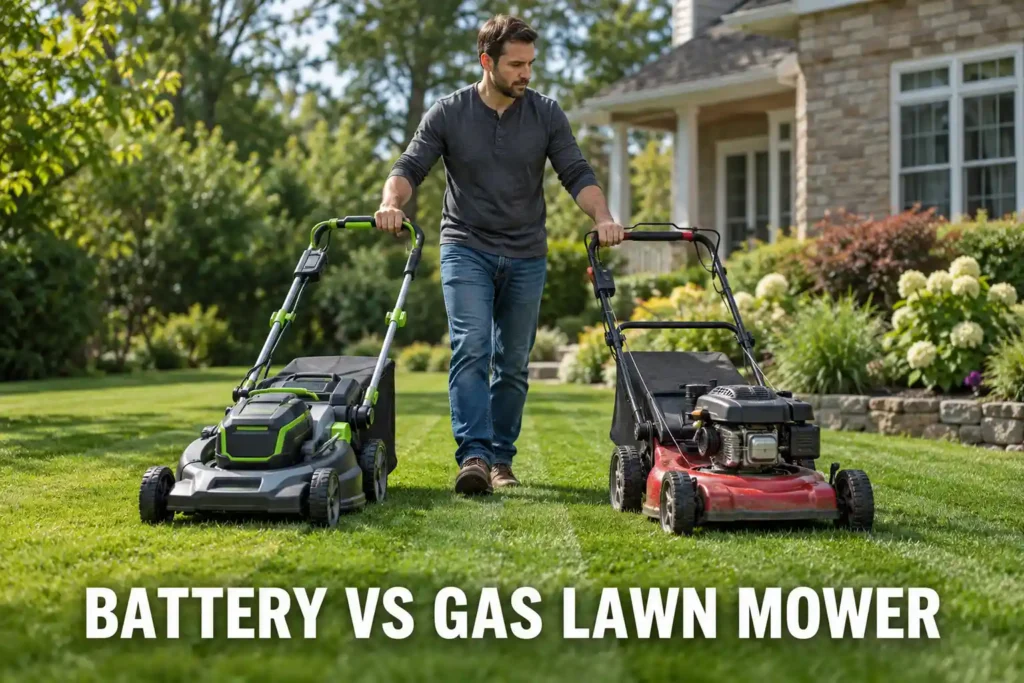
The battery vs gas lawn mower choice comes down to your lawn size and how much fuel handling you accept. Most battery mowers start without a pull cord, run quietly and need no fuel, which suits a small to mid-size lawn. A gas mower suits a large lawn, because it keeps going until the tank is empty, and you refuel after the engine stops and cools. I mow the house lawn and the alleys between my orchard rows, and I judge a mower by what it does at the end of a long alley. Below: run time, upkeep, noise, cost, safety and a simple way to choose.
Battery vs Gas Lawn Mower: The Short Answer
Pick battery if your lawn is small to mid-size, you mow often and you can charge a second pack. Pick gas if your lawn is large and spare packs or charging breaks will not fit your mowing. Both types cut a normal lawn well. The difference shows in how long the mower can run, what it asks of you before and after each mow, and what it costs to keep.
The core trade is time against effort. A gas mower runs as long as it has fuel, and you refuel only after it stops and cools. A battery mower runs for the minutes its pack holds, then stops until you swap or recharge the pack. In return, the battery mower takes fuel, oil, spark plugs and the pull cord out of your routine.
Key Takeaway
Time your lawn first, then compare it with the maker’s run time for the pack in the kit. If the pack covers the lawn with room to spare, battery is the easier mower to live with. If it does not, add a second pack or pick gas.
On my land the alleys between the tree rows are long and straight, so minutes of run time matter more there than they do on the house lawn. Riding mowers and zero-turns follow the same trade with larger packs and longer charging, which my battery riding mower vs gas riding mower guide covers, and this guide stays with walk-behind mowers.
How Each Type Works
Both types drive rotary cutting blades under a deck, and the blade count depends on the model. The difference is what turns it: a lithium-ion pack and a motor, or a small gas engine. Volts, amp-hours and engine cc measure different things, so you cannot compare them directly, and I explain the engine-size figure in my guide to cc on a lawn mower.
Battery Mowers: Volts, Amp-Hours and Watt-Hours
Volts do not tell you how long the mower runs, and they do not tell you which packs fit it. Fit depends on the brand’s battery platform, so confirm that the exact pack and charger are approved for the mower. Compare packs by watt-hours, which is volts times amp-hours. A 56 V pack rated 7.5 Ah holds about 420 Wh, and a 56 V pack rated 5.0 Ah holds about 280 Wh.
A battery mower has no gross horsepower rating, so a maker’s comparison with a gas engine size has no shared rating behind it. I judge a battery mower by three things: pack energy, the maker’s run time with that pack, and cutting width. My guide on the horsepower a mower needs explains how engine ratings translate to real cutting.
Gas Mowers: What cc and Horsepower Really Say
The cc figure is the swept volume of the cylinder. It is a size, and two engines of the same cc can deliver different power. Horsepower and torque come in two kinds. A gross rating is a bench figure taken without the air cleaner and muffler, and a net rating is taken with the production parts fitted. According to Briggs & Stratton, a gas engine will not develop its rated gross power when it is used in a given piece of equipment, so compare gross with gross and net with net.
| Point | Battery | Gas |
|---|---|---|
| Starting | Button or lever on most models, no pull cord | Pull cord on most models, with a primer on some |
| Energy | Charged pack, run time set by the pack | Fuel tank, run time set by the tank |
| Refill | Swap or recharge the pack, time set by the charger | Stop, let the engine cool, then pour fuel outdoors |
| Noise | Quieter | Louder, hearing protection needed |
| Exhaust | None at the mower | Exhaust with carbon monoxide |
| Routine upkeep | Blade, deck cleaning, pack care | Oil, air filter, spark plug, fuel care, blade |
| Weight | Check the maker’s figure, with or without the pack | Check the maker’s figure, with an empty tank |
Power in Thick and Wet Grass
A good battery mower and a good gas mower both cut a normal lawn well. Power only decides the outcome when the grass is tall, thick or wet, and for dense growth I compare options in my picks of mowers for thick grass. The cutting height range shows where the blade can sit, and it says nothing about how the mower holds up under load, so raise the deck and take less per pass when the grass is heavy.
The One-Third Rule Decides the Job
Remove no more than one third of the grass height in one mowing. A field study found that mowing by this rule cut the number of required mowing events by about 31 percent compared with mowing weekly (1). The rule also helps the mower, because a short bite is less load for the motor or the engine. If the lawn got ahead of you, raise the deck for the first pass and lower it over the next mowings.
Wet Grass Clogs Both Types
Mow when the grass is dry. Wet clippings pack the underside of the deck on a battery mower and a gas mower alike. Tall, wet or thick grass also shortens battery run time, because the motor works harder for every minute. I had a wet spring mow clog a deck, so I stopped the mower, waited for the blade to stop, took out the battery and then cleared the deck with a stick and a gloved hand.
Run Time and Refueling: A Worked Example
Run time is the battery mower’s weak point, so do the sum before you buy. The maker’s figure is a best case with a stated pack, and it drops in tall, wet or hilly grass or with the drive at high speed. My roundup of the best battery lawn mower options lists the pack and kit for each one.
- Time your lawn with the mower you use now. Say it takes 40 minutes.
- Find the maker’s run time for the pack in the kit. According to EGO, its LM2102SP 21-inch self-propelled mower lists up to 60 minutes on a single charge with the recommended 56 V 7.5 Ah battery, and the page gives no grass type, lawn size or cutting height for that claim.
- Subtract. A 60-minute rating against a 40-minute lawn leaves a nominal margin of 20 minutes.
- Treat that margin as a best case. An up-to rating cannot prove that one pack covers your lawn, and tall, wet or thick grass and a fast drive speed all use the pack faster.
- If finishing on one pack is uncertain, keep a compatible charged spare pack ready before you start.
A gas mower has no such sum. The limit moves to the tank, and you refill outdoors with the engine off and cool. I keep a second pack charging in the workshop while the first one works, which turns the pack limit into a short pause. The charger sets the charging time, and the manual gives it for your pack.
Cost Over the Seasons
Prices change every month, so compare the lines below at today’s shop prices. What matters here is where the money goes. A gas mower spends it on fuel and routine parts every season. A battery mower spends on packs and chargers and almost nothing on fuel, and the purchase price depends on the mower class, the kit and any packs you already own.
| Cost line | Battery | Gas |
|---|---|---|
| Energy | Electricity from your outlet | Gasoline every mowing |
| Extra pack or spare fuel can | Second pack if the lawn is large | Approved fuel container |
| Oil and filter | None | Yes, on the manual’s schedule |
| Spark plug | None | Yes, on the manual’s schedule |
| Fuel stabilizer | None | Yes, for storage |
| Blade | Sharpen or replace | Sharpen or replace |
| Battery replacement | Traction pack, plan for it during the mower’s life | Starter battery only on electric-start models |
Gas costs rise with every hour you mow, so a large lawn gives the battery mower more to save, and my picks of mowers for a large yard cover that size of lawn. On a small lawn the savings are small, and the pack becomes the biggest line. Packs belong to a brand’s battery platform, so check that the exact pack and charger are approved for the mower, and whether packs you already own fit. The pack’s life is not a fixed number, and the maker’s warranty is the figure I read before I buy.
Noise, Fumes and Emissions
This is where the gap is widest. Noise measurements of more than 600 lawn mowers found that electric mowers are significantly quieter than gas mowers, and that apart from electric mowers very little progress has been made in quieting mowers since 1973 (2). If the nearest house is close, that matters.
Hearing Protection
In a noise study of groundskeepers at North Carolina universities, riding mower use went with high daily noise exposure, and 82 percent of the maximum levels measured on equipment were above 85 dBA (3). That study measured occupational shifts across many tools, so it cannot tell you a homeowner’s exposure. I wear earmuffs and eye protection with a gas mower from the first minute.
Exhaust and Life Cycle
A life cycle study of 12 gasoline mowers, one battery mower and one corded mower found that, apart from lead emissions, the gasoline mowers emitted the most of every contaminant measured, up to 1,500 times more carbon monoxide (4). The study dates from 2004 and its battery mower used the lead-based pack of that era, so read it for direction and not for today’s exact ratios. The practical point stands: a gas mower puts out carbon monoxide, so it runs outdoors only, never inside a shed or garage even with the door open, and I refuel it outdoors.
Upkeep and Storage
Upkeep is the quiet cost of owning a gas engine. A battery mower trades that routine for pack care. Both need a sharp blade. I run the same battery and gas trade-offs for a saw in my battery versus gas chainsaw guide.
Gas Mower Upkeep
According to University of Florida extension, a gas mower tune-up should take place about every three months, or about every 25 hours of use. Fuel is the other chore. According to Briggs & Stratton, gas begins to degrade in as little as 30 days, so add stabilizer to fresh fuel before storage and run the engine for a few minutes. The same maker accepts gasoline with up to 10 percent ethanol and says E15 is not approved for small engines, and your manual decides. I add stabilizer to fresh fuel before the last mow of the season. I weigh the same fuel and upkeep trade for a saw on a pole in my comparison of battery and gas pole saws.
Battery Mower Upkeep
Use the maker’s charger only, and never use a damaged or swollen pack. According to OSHA, damage to lithium batteries can come from physical impact, high temperatures (above 130 F for all types) or improper charging, and charging lithium-ion batteries below freezing can leave permanent metallic lithium on the anode and raise the risk of failure (5).
Storing cells fully charged also speeds capacity loss, and heat makes it worse: pouch cells held at full charge for nine months lost about 10 percent of capacity at 95 F and about 43 percent at 140 F (6). Charge and store the pack within the temperature range in the battery and charger manual, and use its storage charge level. The 130 F figure is OSHA’s example of damaging heat, and it is not a limit for your pack. I keep my packs out of the cold shed in winter and charge them indoors.
The Blade Matters for Both
Check the blade by the cut, then by the clock. A ragged, brown-tipped leaf end means a dull blade. In a university field test a dull blade lowered turf quality, and the gasoline mower used 22 percent more fuel with it (7). Extension sources put sharpening between about every 10 and 25 hours of mowing, so follow the manual. I sharpen the blade before the spring mow and look at the cut afterward.
Safety Rules for Both Types
Lawn mowers injure a lot of people. A review of emergency department data for 2005 to 2015 estimated about 85,000 lawn mower injuries treated each year in the US, with the hand and fingers the most injured part (8). The rules below apply to a battery mower and a gas mower alike, and the manual’s version wins where it differs.
Blade Safety
Never reach under the deck or into the chute while the blade can turn. Stop the mower, wait for the blade to stop, then take out the key or the battery, or disconnect the spark plug wire on a gas mower. Wear heavy gloves on the blade. According to Ohio State University extension, mower blades may continue to spin after the engine is off.
- Thrown objects: walk the lawn first and pick up stones, sticks, toys and wire. According to Ohio State University extension, keep bystanders at least 50 feet away, and the manual may give a different distance. I pick up sticks and fallen fruit before the first pass.
- Discharge: never point it at people, windows or cars, and keep the chute guard, bag or mulch plug in place.
- Children and pets: keep children and pets out of the yard while you mow, and look behind you before and while you reverse.
- Slopes and edges: a walk-behind mower goes across a slope, within the limit in its manual. Avoid wet slopes, drop-offs, ditches and banks with the mower, and use my battery vs gas string trimmer guide to help choose a trimmer for those areas.
- Fuel: refuel a gas mower outdoors with the engine off and cool, and store fuel in an approved container away from the house.
- Controls: never disable the bail or any other operator-presence control, and never leave a running mower.
- Clothing: closed sturdy shoes and long trousers, plus eye and hearing protection for a gas mower.
Which Mower Fits Your Yard
Match the mower to the job with the two lists below.
Choose Battery If
- Your lawn is small to mid-size and one or two packs cover it with room to spare, and my guide on the mower size you need helps you choose the deck width and type.
- You mow often and prefer to skip fuel, oil and a pull cord.
- You want less noise, or the nearest house is close.
- You already own packs approved for the mower’s battery platform, and my guide on EGO vs Greenworks battery mowers compares two platforms.
Choose Gas If
- Your lawn is large and you want to mow for hours with short refuels.
- You cannot keep a spare pack charged or wait for one to charge.
- You accept the oil, plug and fuel routine and will handle fuel safely.
- You want a recoil-start mower with no battery to maintain.
My Rule for Choosing Your Mower
Four checks settle the choice. Time your lawn with your current mower. Read the maker’s run time for the exact pack in the kit, and treat it as a best case.
If one pack leaves any doubt, price a compatible spare pack, and check the charger’s temperature range for the place you will charge. My tip from the orchard alleys is to start every long mow with the spare pack charged. Once you know your power type, the next question is push or self-propelled, which I compare in my push or self-propelled mower guide, and your lawn’s size and your patience for fuel answer the battery vs gas lawn mower question.
Frequently Asked Questions
What are the disadvantages of a battery-powered lawn mower?
The main disadvantages of a battery-powered lawn mower are limited run time and the cost of a spare or replacement pack. The maker’s run time is a best case, and tall, wet or thick grass shortens it. Packs also belong to one brand’s battery platform.
Are gas lawn mowers being phased out?
Gas lawn mowers are being phased out in some places, not everywhere. According to the California Air Resources Board, its rule approved in December 2021 requires most new small off-road engines, mowers included, to be zero emission from model year 2024, applies to new equipment only and bans no one from using older or used gas models. Check your state’s current rules before you buy.
Is it worth getting a battery operated lawn mower?
A battery operated lawn mower is worth getting when one or two packs cover your lawn with room to spare. You skip fuel, oil and the pull cord, and you get a quieter mow. A large lawn or a lawn you mow in tall grass may suit a gas mower better.
How long will a battery operated lawn mower last?
A battery operated lawn mower lasts as long as its motor and body hold up, and the pack is a replaceable part that ages with use. Lithium-ion packs lose capacity with use and with time, and heat and long storage at full charge speed that up. A compatible replacement pack can extend the mower’s life, and a warranty covers a stated period, not a lifespan.
Does a gas push mower have a battery?
Some gas push mowers have a battery and some do not. According to Toro’s manual for its 30-inch TimeMaster, the electric-start version has a starter battery that you charge, and the standard version starts with a recoil handle only. Check your own manual for the type of start and the battery care it requires.
References
- Law QD, Bigelow CA, Patton AJ. Selecting Turfgrasses and Mowing Practices that Reduce Mowing Requirements. Crop Science. 2016;56(6):3318-3327. doi:10.2135/cropsci2015.09.0595
- Blomberg L, Trezza D. The evolution of quiet lawn mowers and their impact on community noise and hearing conservation. INTER-NOISE and NOISE-CON Congress and Conference Proceedings. 2021;263(2):4896-4902. doi:10.3397/in-2021-2877
- Balanay JAG, Kearney GD, Mannarino AJ. Assessment of Occupational Noise Exposure among Groundskeepers in North Carolina Public Universities. Environmental Health Insights. 2016;10:EHI.S39682. doi:10.4137/ehi.s39682
- Sivaraman D, Lindner AS. A Comparative Life Cycle Analysis of Gasoline-, Battery-, and Electricity-Powered Lawn Mowers. Environmental Engineering Science. 2004;21(6):768-785. doi:10.1089/ees.2004.21.768
- Occupational Safety and Health Administration. Preventing Fire and/or Explosion Injury from Small and Wearable Lithium Battery Powered Devices. Safety and Health Information Bulletin SHIB 06-20-2019. US Department of Labor; 2019.
- Mao Z, Farkhondeh M, Pritzker M, Fowler M, Chen Z. Calendar Aging and Gas Generation in Commercial Graphite/NMC-LMO Lithium-Ion Pouch Cell. J. Electrochem. Soc. 2017;164(14):A3469-A3483.
- Steinegger DH, Shearman RC, Riordan TP, Kinbacher EJ. Mower Blade Sharpness Effects on Turf1. Agronomy Journal. 1983;75(3):479-480. doi:10.2134/agronj1983.00021962007500030015x
- Harris C, Madonick J, Hartka TR. Lawn mower injuries presenting to the emergency department: 2005 to 2015. The American Journal of Emergency Medicine. 2018;36(9):1565-1569. doi:10.1016/j.ajem.2018.01.031
Safety Note: A mower blade can cut through a hand or foot and throw stones and sticks with force. Pick up debris before you mow, keep the discharge guard, bag or mulch plug in place, never point the discharge at people, windows or cars, and keep children and pets indoors while the mower runs; never let a child ride on a riding mower. Never disable the operator-presence control. Before you clear a clog, tip the mower or touch the blade, stop the engine or motor, wait until the blade has stopped, then remove the safety key or battery, or disconnect the spark plug wire on a gas model. Mow across slopes with a walk-behind mower and up and down with a riding mower, within the slope limit in your manual, and stay off wet slopes, drop-offs and ditch edges; on a rider with a rollover protection bar, keep it up and wear the seat belt as the manual says. Refuel only outdoors with the engine off and cool, wear closed shoes and eye and hearing protection, and read the manufacturer’s manual.