

The best lightweight string trimmer is the one that still feels light at the end of the edge, and a weight figure means little until you know what it counts. On my 3.7-acre orchard the lawn around the house, the beds and the row ends all ask me to carry a trimmer for long stretches, and I used the seven models below on that ground.
I rank seven, from cordless kits to a gas unit, led by the Makita XRU23SM1 18V LXT 13-Inch Brushless Trimmer Kit. After the reviews I explain how to read a weight figure, what each power type costs you and how to stay safe.
Best Lightweight String Trimmer Reviews 2026: 7 Models I Put to Work
These seven cover a small or medium lawn, a path edge and a few beds, with five cordless trimmers, one corded and one gas. The lightest cordless kit here is the WORX WG163 20V 12-Inch 2-in-1 String Trimmer and Edger, and the Makita XRU23SM1 18V LXT 13-Inch Brushless Trimmer Kit takes first place on the balance of weight and power. Every weight carries its basis.
1. Makita XRU23SM1 18V LXT 13-Inch Brushless Trimmer Kit Best Overall
The Makita XRU23SM1 is the cordless trimmer I recommend to most people who want low weight without giving up a real motor: it weighs 6.6 lb with the 4.0 Ah pack fitted, according to Makita, and it still has a brushless motor and two speeds. That balance makes it my best lightweight cordless string trimmer for a lawn of ordinary size, even though it does not carry the lowest weight figure on this page. It suits a buyer who trims the grass along a house lawn, a path and a few beds and wants a trimmer that stays comfortable at the end of the row. Makita says it is for grass and light weeds and is not for edging.

WHY I CHOSE THIS ✓
I put it first because it is the trimmer I reach for along the whole yard border, and it asks the least of my wrists. The balance of low weight, a brushless motor and two speeds is the reason, not any single figure. If your yard is mostly lawn and light weeds, nothing else on this page fits as comfortably.
Makita XRU23SM1 18V LXT 13-Inch Brushless Trimmer Kit Specs
Key Features:
- Brushless motor: The motor runs on the single 18V LXT pack, and the tool stops itself on overload, over-discharge or overheating before damage is done.
- High and Low speed: A tap on the power button switches between 6,000 and 4,500 rpm with no load, and the trigger stays variable inside each mode.
- Electric brake: The head stops quickly when you release the trigger, which matters when you step toward a path edge or a fence post.
- Soft start: The head builds speed as you squeeze the trigger, so the first touch near a plant is easier to control.
- Rapid Load head: You load line by aligning it, feeding it and twisting the head, so a respool does not mean winding a spool by hand.
- Folded two-piece pipes: The shaft pins together at a joint, so the trimmer ships in a shorter box and goes together without tools.
- Auto shutoff: The tool switches itself off after a period of no use, so a trimmer set down at the fence line does not sit live.
On the lawn edge beside the house path, it behaves the way a light trimmer should. I tap the power button once to settle on a speed, squeeze the trigger and walk the edge. Low is where I stay near the concrete work pad and the beds, and High is for the thicker growth where the fence meets the grass. The 13 in. swath is the limit: on the strip under the plum trees it needs more passes than a wider head would.
Weight is where it earns its place. Makita lists 5.2 lb without the battery and 6.6 lb with it, and I quote the with-battery figure because that is the weight your arms carry at the end of the row. What surprised me was how little the pack pulled the tool back toward my hip, so after a full lap of the lawn edge my wrists felt the loop handle before they felt the weight.
The hedgerow base showed me where it stops. Makita calls the tool intended for grass and light weeds, and the overload stop proved it: when tangled stems wrapped the head, the tool cut out and the light blinked green. I follow the manual’s order every time, switch off, wait for the head to stop, take the battery out, then clear the stems and start again, and anything woody belongs to a bladed tool. On plain grass edges the Rapid Load head loaded line without a fight, and the 0.08 in. line cut the strip along the gravel cleanly.

Rest the tool for 10 to 20 minutes every hour, as Makita’s manual asks, and switch off and take the battery out, then brush cut grass out of the vents after each job, because blocked vents let the tool overheat.
Charge and store the pack the way Makita’s manual says: charge between 50 and 104 F, let a hot pack cool first, and never leave it where it reaches 122 F.
The kit holds one pack, so a long job depends on Makita’s up-to-one-hour figure, which carries no stated conditions. A second 18V LXT pack, which fits Makita’s other 18V LXT tools, is the sensible add for a larger lawn. Makita publishes no noise or vibration figure, so I wear ear protection and eye protection every time, with long pants and boots. The kit ships with no shoulder harness.
Buy it if you trim the grass along a house lawn, a path and garden beds and want to carry the least weight that still feels like a quality tool. Skip it if your yard has brambles, thick weeds or tall grass, if you want a swath wider than 13 in., or if you want attachments.
FINAL VERDICT
The Makita XRU23SM1 is the trimmer for the buyer who values comfort over the longest reach. It is light, brushless and well protected, and it asks you to keep to grass and light weeds.
It is the light trimmer I take to every lawn border.
2. EGO Power+ ST1521S 15-Inch Carbon Shaft String Trimmer Best Premium
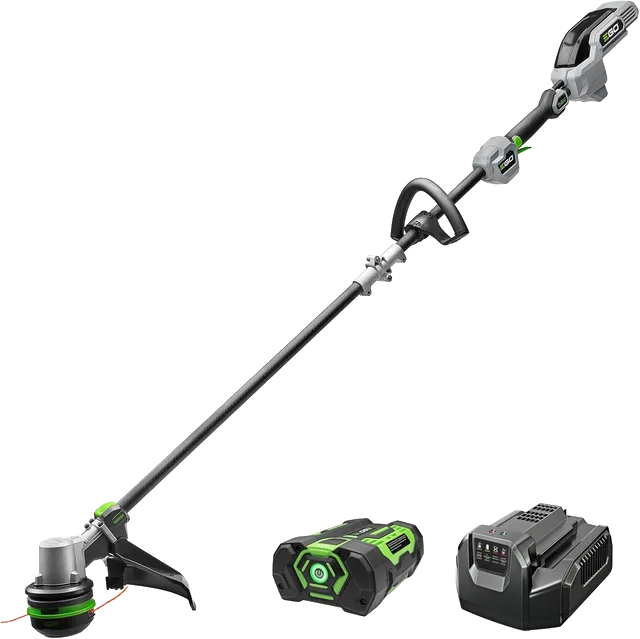
The EGO ST1521S is the trimmer I pick when build quality matters more than the last ounce, because a carbon fiber shaft and a push-button line loader sit on a 15 in. head. It is a premium kit for a buyer who wants the line loaded by the motor and a carbon fiber split shaft, and who accepts that it weighs more than the lightest picks here. EGO lists 7.28 lb for the tool without the battery.

WHY I CHOSE THIS ✓
I put it second because it is the best-built trimmer on the page, and the carbon fiber shaft and POWERLOAD justify the premium tier for a buyer who trims often. It gives up the lowest weight and the longest run for a trimmer that feels finished in the hand.
EGO Power+ ST1521S 15-Inch Carbon Shaft String Trimmer Specs
Key Features:
- POWERLOAD: Push a piece of line into the head, hold the button and the motor winds it, so a respool needs no hand winding. EGO’s manual gives about 12 seconds for a full spool.
- Carbon fiber shaft: The shaft is stiff and light for its length, and EGO says it carries a lifetime warranty when you register within 90 days.
- Variable-speed trigger: No-load speed runs from 4,000 to 5,800 rpm, so you ease off near a plant and open up on thicker growth.
- 15 in. swath: The wider head covers more ground per pass than the 12 in. and 13 in. class, which means fewer passes along a long edge.
- Hinged shaft: The shaft folds at a hinge and bolts shut, so the trimmer packs small and sets up with the supplied bolt.
- Quick-adjust front handle: The handle clamps in place, so you set the grip once and trim without hunting for the right reach.
- 56V platform: The pack and charger belong to EGO’s 56V ARC Lithium line, and the manual lists the packs and chargers this tool accepts.
Loading line is the first thing that sets this trimmer apart. I feed a piece of line into the head, hold the button and watch the spool fill itself, which beats winding by hand on a cold morning in the machinery shed. After that it is a bump head, so I tap it on bare ground at the edge of the gravel yard to release more line. EGO warns that tapping in tall grass can overheat the motor, so I keep that to bare soil.
At 7.28 lb without the pack, this is a trimmer you notice. EGO does not publish a weight with the 2.5 Ah battery fitted, so I count the pack on top. The carbon fiber shaft feels rigid in my hands, and the front handle clamps in place, so I set it once at the shed door before the first pass.
The 15 in. swath changes how I trim the long straight runs. Along the machinery shed wall, the wider head takes in the grass in fewer passes, and under the trees I keep the head away from the trunks because EGO warns that the line damages bark. The same width is no help near the drip lines, where I lift the line out of the way before I start. Run time is the compromise, since EGO’s figure is up to 30 minutes on the 2.5 Ah pack.
Load line at the bench before you walk out: switch off, wait for the head to stop and take the battery out, put the line in as EGO’s sequence asks, then fit the battery for the powered winding, so line trouble never costs you time at the far end of the yard.
Never fit heavy line, wire or rope. EGO’s manual limits line to 0.095 in. and warns that pieces of heavier line can break off and be thrown at you or a bystander.
EGO’s manual asks for eye protection marked ANSI Z87.1 and hearing protection, and it keeps bystanders and pets at least 100 ft away. I wear both every time, with long pants and boots. The guard carries a line-cutting blade that dulls over time, and EGO tells you to wear gloves when you file or replace it, after you switch off, wait for the head to stop and remove the battery. Keep the pack out of rain and charge it only with the charger from the kit.
Choose it when you trim often, want a carbon fiber shaft and prefer line that loads at a button, and a second pack for long jobs suits you. Skip it if low weight is your first rule, if you want automatic feed or an edger mode, or if you need a long run on one battery.
FINAL VERDICT
The EGO ST1521S is the premium trimmer for a buyer who values build and easy line loading over low weight. It is a first-class tool with an honest cost: weight and a short run on the single pack.
It is the premium trimmer I use when I want a stiff shaft.
3. WORX Nitro WG173 20V 13-Inch Brushless 3-in-1 Trimmer Best Value
The WORX Nitro WG173 gives you three jobs in one light kit: it trims, it edges on wheels and it works as a wheeled trimmer-mower on a 13 in. swath, with a 4.0 Ah pack in the box. It is the best value on this page for a buyer with a small or medium lawn who wants a brushless 20V tool, a push-button feed and an edger mode at a mid-range price. WORX lists 6.6 lb with the battery fitted.

WHY I CHOSE THIS ✓
I put it third because it gives the best mix of mode, pack and price. A brushless 20V tool with an edger mode and a 4.0 Ah pack is hard to match at this tier. For a small or medium lawn it does the whole job, and I ask nothing more of it.
WORX Nitro WG173 20V 13-Inch Brushless 3-in-1 Trimmer Specs
Key Features:
- Three modes: The wheels mount in three positions, so one tool trims, edges along a path or runs as a wheeled trimmer-mower.
- Command Feed: Press the button and the motor pauses while line comes out, so there is no bumping on the ground.
- Automatic advance at start: The head pushes out about 0.25 in. of line each time you start, which keeps the line at working length.
- Telescoping shaft: Slide the shaft to your height, and pull it up and turn it 90 degrees to switch to edging.
- 90-degree pivoting head: A locking knob holds the head at the angle you choose, which helps on a bed edge.
- Brushless motor, per the maker: WORX describes the 20V motor as brushless, with a 4.0 Ah pack that fits the maker’s PowerShare tools.
- Two-line head: Two lines of 16 ft share the work, so the head cuts a 13 in. circle.
The edger mode surprised me most. I pulled the shaft up, turned it 90 degrees and the head locked into edging with the wheels on the ground, so the line ran along the edge of the concrete path to the house door without me tilting the tool. In trimmer mode the Command Feed button replaced the tapping I used to do, and after each start I heard the clatter WORX says is normal for about five seconds while the line is cut to length.
WORX lists 5.18 lb for the tool without the battery and 6.6 lb with the 4.0 Ah pack fitted, so it carries a little more than the lightest cordless picks on this page. That is the cost of the larger pack and the 13 in. head. The telescoping shaft let me set the reach to my height before the first pass, and the pivoting head moved between trimming and edging without a change of grip.
The wheeled trimmer-mower mode earned its keep along the alley edges where the mower leaves a strip. With the wheels in the third position, the head rode on the ground and the strip of clippings and grass came off in a tidy pass. The limit shows at the fence line, where thick stems beat a single speed and a 0.065 in. line. Cut tall grass in stages as the manual says, and before you clear any wrap, switch off, wait for the head to stop, take the battery out, then touch the head.

Let the motor reach full speed before the line touches the grass, and make sure the line is fed out first, as WORX’s manual tells you.
Keep the pack and the charger to WORX’s own, charge within 0 to 40 C, and use and store the pack within 0 to 45 C, as the manual states.
WORX gives up to 33 minutes with the 4.0 Ah pack for medium yards, with no stated conditions, so a second PowerShare pack is worth having for a larger lawn. The manual calls for ear protection and eye protection, gloves and substantial footwear, and it asks you to switch the machine off, let the head stop and remove the battery before you change line, clear the head or store the tool, because the head keeps rotating after you switch off. This is the weakest point on the page: the weight with the pack is higher than the lightest cordless trimmers here.
It suits a small or medium lawn with a path to edge and a bed or two, where one tool has to switch between jobs. Skip it if you need the lowest weight on the page, a heavier line, a second speed or an attachment system.
FINAL VERDICT
The WORX Nitro WG173 is the best value for a lawn that needs trimming, edging and a quick mow of the strip beside it. It gives you the pack and the modes, and it asks you to accept some weight.
It is the value trimmer I pick for a lawn with paths.
4. WORX WG163 20V 12-Inch 2-in-1 String Trimmer and Edger Lightest Cordless
The WORX WG163 is the lightest cordless trimmer on this page: about 5.3 lb with a battery fitted, according to WORX, with a 12 in. head and two packs in the box. It is the lightweight cordless string trimmer for the buyer with a small, flat lawn, a few beds and a path to edge, who wants the least weight at the end of the arm. It also turns into a wheeled edger by pivoting the head.

WHY I CHOSE THIS ✓
I chose it as the lightest cordless trimmer because a small lawn does not need a bigger tool. Low weight, a wheel edger and a spare pack make a complete kit for a house lawn. It stays at the shed door for the quick edge.
WORX WG163 20V 12-Inch 2-in-1 String Trimmer and Edger Specs
Key Features:
- Command Feed: Press the button and the motor pauses while line comes out, so you never tap the head on the ground.
- Automatic advance at start: The tool feeds about 0.25 in. of line each time you start from rest.
- 2-in-1 edger: Turn the head 90 degrees and run the wheel along the guard to edge a lawn against a path.
- Flower guard: An adjustable spacer guard keeps the line off plants and lawn ornaments along a bed.
- Two packs in the kit: A spare 2.0 Ah pack swaps in when the first one runs down.
On the edge of the vegetable plot the flower guard did the work I wanted: it held the line back from the plants while the head cut the grass at the plot border. The Command Feed button meant I never tapped a head on the mulched path beside the plot, and the tool fed 0.25 in. of line on its own at each start.
Weight is the reason to buy it. WORX lists about 5.3 lb with a battery fitted, and I quote it with its basis because makers print weights on different bases. On a long edge the light head means my wrist tires later than it does with heavier tools, and the telescoping shaft sets the reach to my height.
Wind the spool neatly: WORX’s manual says a badly coiled spool impairs the automatic line feed.
The head keeps spinning after switch-off, so switch off, wait for the head to stop, remove the battery, then clear a tangle or change the spool.
WORX publishes no run time for this kit, and the charger is slow, so I charge the second pack while I work with the first. The 0.065 in. line is the heaviest the manual allows, and the head has one speed, so I leave the weedy fence line to a more powerful tool. Eye protection, ear protection, long pants and sturdy footwear are the minimum.
A small, flat lawn and a wish for the lightest cordless trimmer on the page, with a wheel edger for the path, point to this one. Skip it if you have a long fence line, thick weeds or a yard that needs a run time you can plan around. My WORX WG163 vs WG170 comparison shows how the two 20V trimmers differ.
FINAL VERDICT
The WORX WG163 fits a small lawn better than anything heavier. It is a light, simple kit, and it asks you to leave the heavy weeds to other tools.
It is the lightest trimmer by the shed door.
5. CRAFTSMAN V20 CMCST900D1 13-Inch Auto Feed Trimmer Best Cordless Auto Feed
The CRAFTSMAN CMCST900D1 is the cordless trimmer with the feed you can forget: its head senses a short line and feeds it itself, and the manual tells you not to bump it on the ground. It is the pick for a buyer with a small or medium lawn who wants a 13 in. swath, a 2.0 Ah pack and a charger in the box, and who may already own CRAFTSMAN V20 tools.

WHY I CHOSE THIS ✓
My reason is the feed, which removes the one chore I dislike on a trimmer. Automatic advance, two speeds and a V20 pack make it the easy choice for someone who does not want to think about line.
CRAFTSMAN V20 CMCST900D1 13-Inch Auto Feed Trimmer Specs
Key Features:
- Automatic line advance: The head senses when more line is needed, feeds it and trims it to length, so you never bump it on the ground.
- Two speeds: Push the switch to HI for heavier growth, or pull it back to LO for a longer run on a bigger job.
- Turn-to-edge: Turn the collar for edging mode, with a wire edge guide that works in edge mode only.
- Telescoping pole and auxiliary handle: The height collar and the adjustable handle let you set the reach to your height.
- V20 platform: The 2.0 Ah pack belongs to CRAFTSMAN’s V20 line, and the maker’s charger is the only one the manual allows.
The first thing I noticed was the missing ritual. On the gravel yard edge I kept reaching to tap the head on the ground, and the manual says not to, because the feed does the work. The line stayed at working length as I moved along the edge, and when it ran past the cutter I switched off, waited for the head to stop, took the battery out and cut it back, as the manual asks. Do not bump the head.
The speed switch is the other control I used all the time. CRAFTSMAN’s manual says HI shortens the run time, so I kept LO along the house lawn edge and the beds, and I switched to HI only where the grass thickened at the fence. CRAFTSMAN publishes no run time, so I judge the 2.0 Ah pack a short-job pack.

Keep the cutting angle low: the manual asks for 5 to 10 degrees, at least 24 in. between the guard and your feet, and the tip of the line doing the cutting.
Fences cost line. The manual says wire and picket fences wear it fast, so I check it after each fence run.
A clogged feeding hub jams the line, and the fix is the safe order: switch off, wait for the head to stop, take the battery out, then remove the spool cap and clear the sap. The manual asks for ANSI Z87.1 eye protection, hearing protection and long pants, and it keeps people and pets at least 100 ft (30 m) away. The motor is brushed and the line is 0.065 in. round only.
Pick it for a small to medium lawn if you want a trimmer you never have to tap. Skip it if you need a published run time or weight, a heavier line, brushless power or a speed readout.
FINAL VERDICT
The CRAFTSMAN CMCST900D1 is a good pick for a buyer who wants the simplest feed. It cuts lawns and light weeds with no tapping.
It is the trimmer I choose for a lawn with no fuss.
6. BLACK+DECKER BESTA510 14-Inch Corded String Trimmer Best Lightweight Corded
The BLACK+DECKER BESTA510 is the best lightweight electric string trimmer for a yard with an outlet in reach: it weighs 6.5 lb with no battery to carry, according to BLACK+DECKER, and it cuts a 14 in. path on a 6.5 amp motor. It suits a buyer who wants no charging and no fuel, and who trims a small or medium yard near the house. Its reach is the length of your extension cord.

WHY I CHOSE THIS ✓
My reason for including it is that a corded trimmer is the simplest way to trim near the house. It has no pack, no charger and no fuel, only a cord and a 14 in. path, and for a yard with an outlet in reach that is enough.
BLACK+DECKER BESTA510 14-Inch Corded String Trimmer Specs
Key Features:
- Automatic Feed Spool: The spool feeds line itself, and the manual says never to bump the trimmer on the ground.
- 14 in. cut path: A wide cut path means a lawn edge takes fewer passes than a 12 in. head would.
- Cord retainer: Double an extension cord, slot it into the retainer and hook it over the tab, so a tug does not unplug it.
- 2-in-1 edger: Turn the collar, rotate the lower housing 180 degrees and the edger wheel guides the line along a path edge.
- Adjustable shaft: Loosen the collar and slide the upper housing to set the length for your height.
The outlet decides where this trimmer works. In my case that is the strip behind the shed and the lawn edge near the house, with the extension cord doubled into the retainer so a tug never pulls the plug. Keep the cord behind you and away from the rotating line, which is the manual’s rule, and I check it each time I turn at the end of an edge.
With no battery, 6.5 lb is the whole tool, and it feels the same at the end of the edge as at the start. The weight does not change and the run never stops. The cost is the cord: on my first lap it caught on a fence post, and it taught me to route it behind me and clear of the fence line. My BESTA510 and CMEST900 comparison sets this corded trimmer beside a Craftsman corded model.
Use an outdoor-rated extension cord of adequate gauge and plug it into a GFCI-protected outlet, as the manual lists, and never trim in wet conditions.
Switch off the trimmer, wait for the head to stop, then unplug it before any adjustment or line change, and only then touch the head. The cord must never lie where the line can reach it.
Near the drip lines under the plum trees I lift the lines clear and keep the cord out of the rotating line. The manual asks for ANSI Z87.1 eye protection, gloves, heavy long pants and rubber-soled footwear, and in edging mode it keeps people and pets 100 ft (30 m) away, because the line throws stones. BLACK+DECKER publishes no noise or vibration figure. With the trimmer switched off and unplugged, blow the vents clean with dry air weekly and store the trimmer indoors and dry.
It fits a yard that sits within an extension cord of an outlet, for a buyer who wants no battery to manage. Skip it if you trim far from the house, along ditch banks or orchard rows, in wet ground, or where thick weeds need a heavier line. My BESTA510 review goes through the cord, the 14 inch head and the weight in more detail.
FINAL VERDICT
The BLACK+DECKER BESTA510 is the right trimmer for a lawn that sits next to an outlet. It is light and simple, and the cord decides how far it goes.
It is the corded trimmer I keep by the shed.
7. Husqvarna 122LK 17-Inch Detachable Gas String Trimmer Best Lightweight Gas
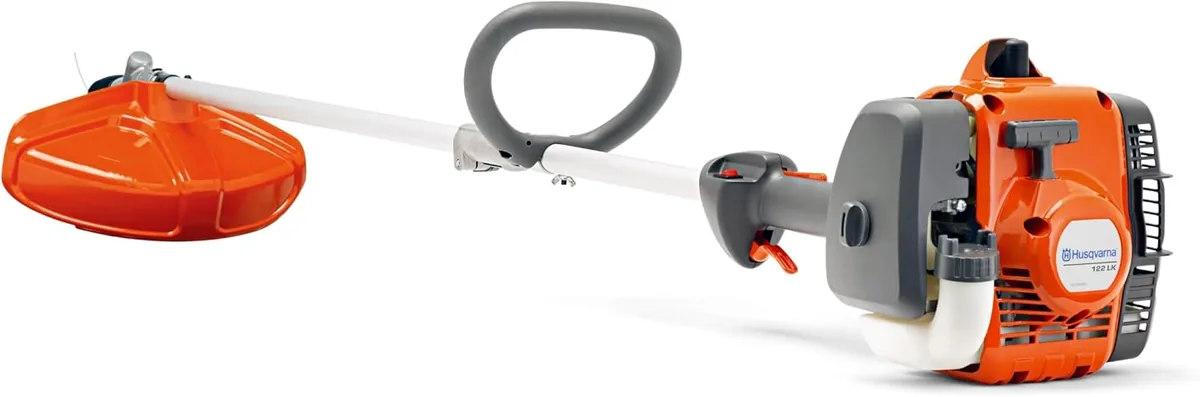
The Husqvarna 122LK is the light gas option on this page: its power unit weighs 10.6 lb dry, without fuel, cutting attachment and guard, according to Husqvarna’s manual, and it carries a 21.7 cc two-stroke engine. It is my best lightweight gas string trimmer for a buyer who wants fuel-powered reach and a detachable shaft for Husqvarna’s attachments. A yard where a battery would run out and a cord would not reach is its ground.
WHY I CHOSE THIS ✓
I keep it on the list for a light power unit and a way to grow. The detachable shaft takes attachments I might add later. I keep it for the work where a pack would give out.
Husqvarna 122LK 17-Inch Detachable Gas String Trimmer Specs
Key Features:
- Detachable straight shaft: Turn the knob, push the shaft into the coupling until it clicks and tighten the knob.
- Eleven listed attachments: The manual lists an edger, hedge trimmer, pole saw, cultivator, blower and others for this unit, all bought separately.
- Smart Start engine: Husqvarna’s start system uses a purge bulb, a choke and a starter rope.
- 17 in. T25 tap advance head: The head takes line from 0.080 to 0.095 in.
- Catalytic muffler: The engine is rated 0.6 kW at 7,800 rpm and carries a catalytic converter muffler for emissions.
The straight shaft was the first thing I liked. It reached under the hedgerow base and along the fence, where I could hold the head low and level, and the 17 in. tap advance head released more line with a tap on bare soil. The power unit sits in the arms like a gas tool should: Husqvarna lists 10.6 lb dry, without fuel, head and guard.
Taking the shaft apart at the coupling was the second thing I noticed. I stopped the engine, waited for the head to stop, let the machine cool and pulled the spark plug cap first, then I turned the knob three times, pushed and held the button and pulled the shaft out straight, and the two halves carried and stored more easily than one long tool. Husqvarna gives 0.3 L for the tank and no run time per tank, so on a long edge I stop to refuel. Refuel with the engine off and cool, outdoors, and move at least 10 ft from the fuel spot before you start.
Start it outdoors as the manual says: 10 pushes of the purge bulb, the choke set, then the rope. The mix is 2 percent, 2.5 fl oz of oil to a US gallon.
Husqvarna lists 90 dB(A) at the operator’s ear and a sound power of 108 dB(A), with vibration of 3.6 m/s2 at the left handle and 3.5 m/s2 at the right. I wear ear plugs and earmuffs together, and I rest when my hands feel the vibration.
Husqvarna rates it for occasional use and flexible cutting line only. The manual asks for approved eye and hearing protection, gloves, heavy slip-resistant boots, long pants and long sleeves, and it keeps people and animals 50 ft (15 m) away. Before you clear wound-up grass or change line, stop the engine, wait for the head to stop, let the machine cool and pull the spark plug cap, then touch the head. A gas trimmer never runs indoors, in a shed or in a garage, even with the door open, because of carbon monoxide.
This is the one for a yard too big for a cord, where you want a light gas unit and the option of Husqvarna’s attachments. Skip it if you want quiet, no fuel to mix, a blade for brush or a published run time.
FINAL VERDICT
The Husqvarna 122LK is the gas pick for a buyer who wants a light unit that can grow into other tools. It trades quiet and convenience for fuel and reach.
It is the gas trimmer I take where a cord cannot reach.
How to Choose a Lightweight String Trimmer
Seven checks sort the field. Suitability for the job comes first, then I compare weights on matching bases, because a wrong answer on weight makes the ranking pointless. If you want a wider field than lightweight models, my best string trimmer roundup covers every yard, budget and power type.
Weight With the Battery and Its Basis
A trimmer’s weight is what your shoulder carries, so read what the number includes. Compare weights on one basis: tool only, tool with battery, or a gas unit dry. The battery adds weight you feel at the end of the row, so I read what each printed figure counts and what it leaves out.
| Basis | What it counts | What to ask |
|---|---|---|
| Tool only | The bare tool, no battery | How much the pack in the kit adds |
| Tool with battery | The tool plus the pack in the kit | Which pack, and how many Ah |
| Gas, dry | The power unit without fuel, head or guard | What the head and a full tank add |
| Corded | The whole tool; the cord is extra | How long a cord you will drag |
- Read the footnote: a weight with no stated basis is not a number to rank by.
- Match the pack: a bigger pack means longer work and more weight.
- Weigh like with like: a bare-tool figure never sits beside a figure with the battery fitted.
Key Takeaway
Rank trimmers by the weight with the battery fitted, and treat a bare-tool figure as a starting point.
Cordless, Corded or Gas for Low Weight
A lightweight cordless string trimmer carries a pack, a corded one carries a cord and a gas one carries an engine and fuel. Each type moves the weight somewhere else. I pick the type by where I trim and how far from the house I go. A lightweight electric string trimmer on a cord suits the yard near the outlet. For a corded model, my best corded string trimmer picks compare five plug-in trimmers for small and mid lawns.
| Type | What you carry | The trade |
|---|---|---|
| Cordless | The tool and a battery pack | Run time depends on the pack and the speed |
| Corded | The tool and a trailing cord | Reach stops where the cord stops |
| Gas | An engine, a fuel mix and a tank | Noise, exhaust and fuel handling |
In NIOSH sampling of 80 landscaping workers, those who used fuel-powered string trimmers had significantly more noise and carbon monoxide exposure than they did with battery versions (1). That is a workplace finding, but I take it home: a lightweight gas string trimmer runs outdoors only, never in a shed or a garage, and I keep that in mind when I choose between a battery and a tank.
Swath Width Against Weight
The swath is the circle the line cuts. A wide swath covers more ground per pass, and a narrow one is easier to place beside a plant. Read the maker’s figure, because a listing’s cutting width can differ from it, and some trimmers let you move the line cut-off blade to change the swath.
- Narrow swath: easier near beds, trunks and drip lines.
- Wide swath: fewer passes along a long straight edge.
- Adjustable swath: useful if you move between a lawn and a fence line.
On the tilled strip under the plum trees I want a head that does not reach into the trunks, so I weigh swath against the strip width before I compare weights. The mistake I see most is buying the widest head and then trimming right beside plants with it. If your yard is small, my best string trimmer for small yard roundup lists nine easy-to-handle picks.
Balance, Shaft and Handle
Weight you can feel depends on where it sits. A shaft that adjusts to your height and a front handle that moves let your arms hang instead of reaching. In a study of 20 operators using a brushcutter, posture analysis showed asymmetry, with the trunk inclined about 34 degrees at work (2). That was a different tool, but it is why I check how a trimmer hangs from my body before I check the number on the box.
- Set the shaft so you hold the head just above the ground at the angle the manual shows, with your arms relaxed. Only a wheeled mode rests on the ground.
- Move the front handle until your hands sit under your chest, not far out.
- Walk the whole edge: the first lap shows balance, and the last lap shows weight. If the edge is your main job, my best string trimmer for edging roundup lists nine picks with a real edge mode or an edger kit.
Line Feed and Head Type
The feed system decides how often you stop. A bump head asks you to tap it on the ground, a push-button head feeds line when you press, and an automatic head senses a short line and feeds it. Use only the line diameter the manual allows, because heavier line can overload the motor.
| Head | How line comes out | What you do |
|---|---|---|
| Bump feed | Tap the head on the ground | Tap on bare ground, not in tall grass |
| Push button | Press a button on the handle | Hold the button until the line is out |
| Automatic | The head senses a short line | Never bump it; cut an overlong line back |
I stopped tapping heads on the gravel edge as soon as I tried a feed that did the job by itself, and on a small lawn I prefer one, though a bump head on a light, well-balanced tool still earns its place. Line wears fast along walls, curbs and fences, so I check the length after every fence run.
Run Time and Battery Platform
A maker’s run time is an “up to” figure with its own pack and conditions, so I treat it as a ceiling. A lightweight battery string trimmer is only as good as its pack, and a pack belongs to one maker’s platform, and the maker’s list of approved tools decides what it fits, so voltage alone tells you little. Names such as “20V Max” and “18V” can describe packs of the same kind, so read what the maker states. For a cordless model, my best battery string trimmer picks cover nine models for every yard and budget.
- Plan in sections: I split a long edge into jobs and swap a pack between them.
- Use the maker’s charger: the manual names the pack and charger that go together.
- Charge in range: each maker gives a temperature range for charging and storage.
Pro Tip
If you own tools from one battery maker, a trimmer on the same platform saves you buying packs twice.
Noise, Vibration and Safety Gear
Two gas grass-trimmer engines measured about 100 and 105 dB(A) at the operator in a field study, above recommended limits for an 8-hour day (3). A battery trimmer is quieter than a gas engine, yet every trimmer calls for hearing protection, and I wear it every time. A maker’s noise figure is a number on its own measure, so compare sound pressure with sound pressure and sound power with sound power. If a gas engine is on your list, my best gas string trimmer picks set five models against each other on power, weight and warranty.
A laboratory study measured gloved hand vibration of 3.5 to 5.8 m/s2 on a grass trimmer against 1.1 to 2.0 m/s2 on a backpack blower, and the trimmer gave the highest exposure (4). That test used particular gloves under set conditions, so I do not lean on gloves for vibration. I wear them as the manuals ask and rest my hands on a long edge.
US emergency departments treated an estimated 81,907 lawn trimmer injuries from 2000 to 2009, and the eye accounted for 42.5 percent of them (5). Most were due to foreign objects, which is why the authors call for adequate safety gear.
Safety Before You Start
Wear eye protection that meets ANSI Z87.1 or what the manual names, hearing protection, long pants, sturdy boots and gloves. Keep people and pets at the distance in the manual, commonly 50 ft (15 m), and stop when someone comes closer. Keep the guard on. Before you clear a wrapped head or change line, switch off, wait for the head to stop, then remove the battery (gas: pull the spark plug cap; corded: unplug), and only then touch the head.
My Overall Verdict
I ranked these seven on the weight each maker states, with its basis, plus power, build and what each one asks of your hands. The lightest cordless kit is the WORX WG163 20V 12-Inch 2-in-1 String Trimmer and Edger at about 5.3 lb with a battery, according to WORX, and the Makita XRU23SM1 18V LXT 13-Inch Brushless Trimmer Kit takes first place on the balance of weight and power. The top three suit three different yards. My review of the Makita XRU23SM1 goes further into the brushless motor and the small-lawn fit.

1. Makita XRU23SM1 18V LXT 13-Inch Brushless Trimmer Kit Best Overall
For trimming the grass along a house lawn, a path and a few beds, where comfort at the end of the row matters most.
2. EGO Power+ ST1521S 15-Inch Carbon Shaft String Trimmer Best Premium
For a buyer who wants a carbon fiber shaft and push-button line loading and accepts more weight.

3. WORX Nitro WG173 20V 13-Inch Brushless 3-in-1 Trimmer Best Value
For a small or medium lawn that needs trimming, edging and a wheeled pass at a mid-range price.
Weigh the kit with the battery fitted, then match the tool to your work: grass and light weeds suit all seven, and thick weeds need a stronger tool. Pick the lightest trimmer that still cuts your edge, and for most lawns the Makita XRU23SM1 18V LXT 13-Inch Brushless Trimmer Kit is the best lightweight string trimmer on this page.
Why Makita XRU23SM1 18V LXT 13-Inch Brushless Trimmer Kit Might Be the Best Choice
I put the Makita XRU23SM1 18V LXT 13-Inch Brushless Trimmer Kit first because it balances weight and power on a trimmer I can carry to the last row. It weighs 6.6 lb with the 4.0 Ah pack, according to Makita, and it adds a brushless motor, two speeds and an electric brake. My Makita XRU23SM1 and EGO ST1521S comparison sets its weight, reach and run time against an EGO trimmer.
The trade is that it is light-duty: Makita says it is for grass and light weeds, so I leave brambles and thick stems to a bladed tool.
What puts it first:
✓ Weight: 6.6 lb with the 4.0 Ah pack, per Makita.
✓ Motor: brushless, with High and Low speeds.
✓ Stopping: an electric brake and soft start.
✓ Protection: overload, overheat and over-discharge stops.
✓ Kit: one 4.0 Ah pack and a charger in the box.
Frequently Asked Questions
What is the best lightweight strimmer?
The best lightweight strimmer, called a string trimmer in the US, is the Makita XRU23SM1 for most lawns, because it weighs 6.6 lb with the battery fitted, according to Makita, and has a brushless motor. For a small, flat lawn, the WORX WG163 is lighter at about 5.3 lb with a battery, according to WORX.
What is the lightest weight weedeater?
The lightest weight weedeater on this page is the WORX WG163 at about 5.3 lb with a battery fitted, according to WORX. Corded and gas trimmers print weights on other bases, so compare a kit with its battery fitted only against another kit with its battery fitted, never against a bare-tool figure.
What is the easiest trimmer to use?
The easiest trimmer to use is one whose line feeds itself, that is light, and that needs no fuel to mix. On this page that points to the CRAFTSMAN CMCST900D1 for its automatic line advance, or to the WORX WG173 for its Command Feed button and its wheeled edger mode.
What is the best lightweight line trimmer?
The best lightweight line trimmer is the Makita XRU23SM1 for most yards, because it weighs 6.6 lb with the 4.0 Ah pack and has two speeds. A line trimmer is another name for a string trimmer, so every pick on this page applies, from corded to gas, each with its own weight basis.
What is the best lightweight cordless string trimmer?
The best lightweight cordless string trimmer for most lawns is the Makita XRU23SM1 at 6.6 lb with its pack, and for a small, flat lawn it is the WORX WG163 at about 5.3 lb. Both are the makers’ weights with a battery fitted, so you can compare them fairly with each other and with any kit weighed the same way.
References
- Alexander BM, Graydon PS, Pena M, Feng HA, Beamer BR. Hazardous exposures and engineering controls in the landscaping services industry. Journal of Occupational and Environmental Hygiene. 2025;22(3):189-202.
- Roggio F, Vitale E, Filetti V, Rapisarda V, Musumeci G, Romano E. Ergonomic evaluation of young agricultural operators using handle equipment through electromyography and vibrations analysis between the fingers. Saf Health Work. 2022;13(4):440-447. doi:10.1016/j.shaw.2022.07.003
- Mallick Z, Badruddin IA, Khaleed Hussain MT, Salman Ahmed NJ, Kanesan J. Noise characteristics of grass-trimming machine engines and their effect on operators. Noise Health. 2009;11(43):98-102. doi:10.4103/1463-1741.50694
- Oh J, Chen N, Boyd C. Laboratory evaluation of occupational exposure to hand-arm vibration (HAV) during grounds maintenance equipment operations. Ann Agric Environ Med. 2023;30(2):384-389.
- Leinert J, Griffin R, Blackburn J, McGwin G. The epidemiology of lawn trimmer injuries in the United States: 2000-2009. J Safety Res. 2012;43(2):137-139. doi:10.1016/j.jsr.2012.03.001
Safety Note: Read your manual first. A string trimmer or brush cutter throws debris with force, so clear stones, glass and wire from the area before you cut. Wear impact-rated eye protection with side coverage that meets ANSI Z87.1, hearing protection, gloves, heavy long pants, long sleeves and sturdy slip-resistant boots (steel-toe where your manual says so). Keep people and pets at least as far away as your manual says (50 feet in some manuals, 100 feet in others), and stop if anyone comes closer. Keep the correct guard fitted, use only the cutting attachments, handles and harness the maker approves for your exact tool, and never replace trimmer line with wire. A blade can kick sideways when it hits a stump or a thick stem, so fit the handlebar and harness your manual requires for blade work, hold both handles firmly and keep secure footing. Before you clear a jam, clean the tool or change line, a blade or an attachment, switch it off, wait for all movement to stop, then remove the battery, unplug the cord or disconnect the spark plug wire. Refuel a gas model outdoors with the engine off and cool, away from flames or sparks, and move away from the fueling spot before starting, as far as your manual says (often 10 to 30 feet); never run it in a garage, shed or other closed space. For a battery model, use only the maker’s battery and charger, charge it within the temperature range in your manual and never use a damaged or swollen pack. For a corded model, use a GFCI outlet, keep the cord clear of the cutting line and avoid wet conditions.