
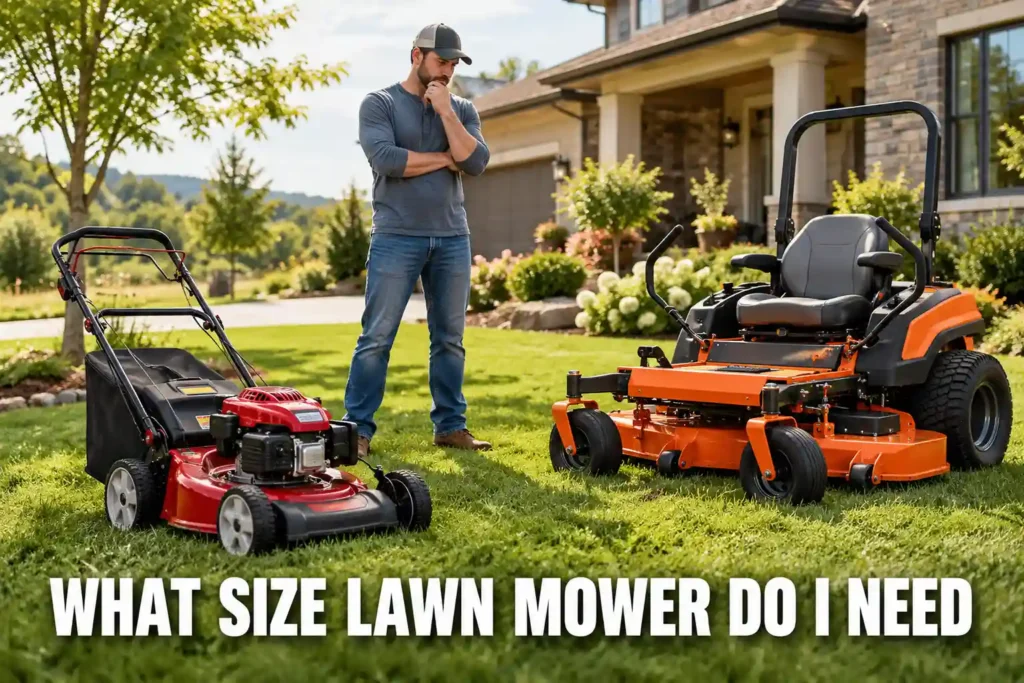
A lawn mower is sized by its cutting width, and the right size is the widest cut that still passes your gates, turns around your trees and fits your shed. Lawn area then sets the type: a walk-behind covers small and medium lawns, and a rider takes over somewhere past half to three-quarters of an acre. My own mowing runs from a level quarter-acre lawn to grass alleys between orchard rows, and those two jobs call for different machines. Below you get a size table by acreage, a mowing-time method with a worked example, the width checks that matter at home, the slope and safety limits, and a short checklist for buying.
What Size Lawn Mower Do I Need?
Pick the mower type from your lawn area, then pick the cutting width from your gates and obstacles. A mower has three sizes that people mix up: the cutting width in inches, the engine or battery that turns the blade, and the machine itself, which you have to store and move.
Ohio State University Extension puts small walk-behind mowers at cutting widths of usually up to approximately 22 inches, and says they suit smaller residential lots and trimming where larger mowers cannot go. Riding mowers have cutting widths up to 60 inches and wider, and they suit larger lawns where their size and maneuverability fit. Briggs & Stratton calls a walk-behind a good choice for yards of about three-quarters of an acre or less, and for a larger yard it suggests a rear-engine rider or a lawn and garden tractor.
| Lawn area | Mower type | Cutting width |
|---|---|---|
| Up to half an acre | Walk-behind, push or self-propelled | Usually up to about 22 inches |
| Half to three-quarters of an acre | A wide walk-behind, or a first rider if time or strength is short | 21 to 22 inches on a walk-behind |
| More than three-quarters of an acre | Rear-engine rider or lawn tractor | Riding decks of 28 to 42 inches in Briggs & Stratton’s range |
| Large open lawns | Rider with the widest deck your gates and trees allow | Up to 60 inches and wider |
Treat the table as a starting point. University of Florida extension tells owners of lawns larger than half an acre that a riding mower or lawn tractor brings ease and speed, while Briggs & Stratton keeps the walk-behind in play to three-quarters of an acre. The lines sit a quarter acre apart because the real limits are time, strength, slope and obstacles. A flat half acre with no trees suits a wide walk-behind, and the same half acre with a hill and a ditch can rule out a rider, a choice I weigh in my guide on a riding mower vs walk-behind mower.
On my quarter-acre house lawn I use a walk-behind, and I have never wanted more machine there. I compare nine wire-free options in my best robot lawn mower for 1/4 acre roundup.
Lawn Area and Mowing Time
Cutting width times speed decides how long a lawn takes, so area alone tells you little. Cornell turf guidance puts numbers on it: more than 2½ hours per acre with an 18 inch walk-behind, and about 30 minutes with a 60 inch riding mower. I answer the question “what does deck size mean on a lawn mower” in a separate guide.
A Worked Example in Minutes per Acre
Cornell publishes a short method by turf specialist Floyd Perry that works for any ride-on deck. Here it is for a 42 inch deck:
- Take 90 percent of the deck width, which allows for overlap between passes: 0.9 × 42 inches = 37.8 inches.
- Multiply by the mowing speed. Cornell gives 3.5 mph as the normal safe speed of a ride-on mower: 3.5 × 37.8 = 132.3.
- Divide 108.9 by that number. The constant carries the acres-per-hour conversion and a 10 percent allowance for turning at the end of each strip: 108.9 ÷ 132.3 = 0.82 hours.
- Multiply by 60 minutes. A 42 inch rider needs about 49 minutes per acre.
Cornell’s own example, a 38 inch deck, comes to 54 minutes. The 42 inch row is my calculation with the same method, and the other times are Cornell’s figures. Trees, beds and gates add time to every row, so read them as about numbers for open turf.
| Mower | Cutting width | Time per acre |
|---|---|---|
| Walk-behind | 18 inches | More than 2½ hours |
| Rider | 38 inches | About 54 minutes |
| Rider | 42 inches | About 49 minutes |
| Rider | 60 inches | About 30 minutes |
On my quarter-acre lawn, an 18 inch walk-behind would take more than 35 minutes of straight mowing, before any trimming around the shade trees. I accept that on a lawn I can walk without counting minutes. My picks of mowers for a small yard suit that kind of lawn.
Width matters more once you multiply by the number of mows. Say a lawn needs 20 mows a season, a made-up count for the sum. At 54 minutes per acre that is 18 hours of mowing, and at 30 minutes per acre it is 10 hours.
You also control the count. In a university field study, mowing by the one-third rule reduced the required mowing events by 31 percent, about eight a year, compared with mowing weekly (1). The one-third rule means you cut no more than a third of the grass height at one mowing, so grass that got away from you comes down over several mowings, with the deck raised for the first cut. A mower whose highest setting is too low for a tall lawn cannot make that first cut. That is why I check the highest cutting position, not only the widest cut.
Sizes for Common Lawn Areas
Lawn area sets the starting size, and your effort and your terrain move it up or down. Four common cases follow, with the decision each one adds.
Up to a Quarter Acre
A push walk-behind is enough on level ground. Small lawns have beds, trees and corners, and a narrower deck turns tighter around them. Self-propel is a comfort, and Briggs & Stratton advises a self-propelled model over a push model for bigger yards. For more on the drive, my push or self-propelled mower guide covers who needs one.
What Size Lawn Mower for 1/2 Acre
Half an acre is where the advice splits. An 18 inch walk-behind works out to more than an hour of mowing for half an acre by Cornell’s figure, and a 21 to 22 inch cut shortens that. I pick a wide, self-propelled walk-behind for half an acre of level, open ground. A hot summer or a bad back moves the answer to a rider, provided the ground and the rider’s manual allow one. At that size a robot is a real option too, and I list robot mowers for 1/2 acre that cover the ground without wires.
What Size Lawn Mower for 1 Acre
An acre is past Briggs & Stratton’s three-quarter-acre line for walk-behinds, so a rear-engine rider or a lawn tractor is the size to price first. The deck at the top of its 28 to 42 inch range saves minutes, and it also needs the widest gate and the most shed space, so check both before you commit. My picks of mowers for a large yard start at half an acre and run to open acreage.
Two Acres and More
Riding decks reach 60 inches and wider, according to Ohio State Extension, and the biggest decks pay off on long open runs. Past that point your gates, trees and slopes set the limit. A wider deck also means a bigger machine to store, so measure the shed before you shop.
Gates, Trees and Storage
A mower that does not fit the property is the wrong size, whatever the lawn area says. The cutting width is smaller than the machine’s overall width, and a wider deck is harder to turn around trees and obstacles. Measure first, buy second. My guide on mower deck width helps you match the cut to your gates.
| Measure | Compare it with |
|---|---|
| Narrowest gate | The mower’s overall width in the manual, which is wider than the cut |
| Shed door and floor space | The mower’s overall length and width, with the handle folded if it folds |
| Alley or bed width | The cutting width plus a small overlap |
| Space at row ends | The turn the mower needs, wider for a wider deck |
In the orchard I hold the deck width against the alley. A cut that fits the alley with a small overlap saves passes, and one that is too wide finds the tree rows. The drip lines lie on the soil near the rows, so I mow parallel to them and never across, because a low deck can catch a line.
Before I put any mower on the property I measure the shed door and the gaps it has to pass, with a tape, and I write the numbers down. The mower I buy is the one whose overall width, chute included, clears every gap by a small margin.
Slopes, Edges and Safety Limits
The manual’s slope limit and the edges on your land can overrule any size. Read them before you read a spec sheet, because a bigger mower makes each hazard here worse. My best lawn mower for hills ranking lists each pick’s drive and slope limit.
Slopes and Ditch Edges
On a walk-behind, mow across the slope. Drive a riding mower up and down, as Ohio State Extension and the CPSC both say. The limit is the figure in your manual, and you never exceed it.
A maximum slope of 15 degrees is commonly recommended for ride-on mowers, and many people cannot judge a slope by sight (2). Measure the slope instead of guessing.
Rollover is the most prominent type of fatal ride-on mower accident, and the usual injury is the machine’s weight pinning the operator (3). OSHA says to keep the drive wheels at least five feet from unprotected edges such as ditches and drop-offs, and to use a push mower or a trimmer there. A drainage ditch runs along one border of the orchard. A rider stays well back from that edge, and I work the bank with a push mower or a trimmer. For the trimmer side of that job, I wrote up the string trimmer size you need, from head width to power.
If your rider is built with a roll-over protective structure (ROPS), use it as the manual says. Keep it up and wear the seat belt while it is up, as OSHA advises, and lower it only for low clearance, without the belt, raising it again as soon as the clearance allows.
Slope Rule
Follow the slope limit printed in your own manual, avoid wet slopes, and slow down on the way down. If the ground is steeper than the limit, leave it to a trimmer or do not mow it.
Blade, Debris and Children
Walk the lawn first and pick up rocks, toys, sticks and wire, as the CPSC advises. Keep bystanders at least 50 feet away, the distance Ohio State Extension gives, and never point the discharge at people, windows or cars. About three quarters of lawnmower-related eye injuries seen in US emergency departments came from thrown projectiles, and only 2 percent of those cases documented eye protection (4). Keep the chute guard, bag or mulch plug in place, and never tie down or bypass the bail or the seat switch. Wear safety glasses, hearing protection and sturdy shoes.
Keep children out of the yard while you mow, and never let anyone ride on the mower. In a survey of 140 injured children, 69 percent were bystanders and 59 percent of the injuries happened while a riding mower was moving in reverse (5). Look behind you before and while you back up. Before the first pass I walk the lawn and the alley edges and pick up sticks, stones and fruit, and nobody but the operator is on the lawn while a blade is turning.
Never Reach Under the Deck
Never reach under the deck or into the chute while the blade can turn. Stop the engine, wait for the blade to stop, then remove the safety key or the battery, or disconnect the spark plug wire on a gas mower. Wear heavy gloves on the blade.
Mow when the grass is dry. University of Florida extension says the same, and wet grass clogs the deck and makes slopes slippery. In spring, when the grass grows fast and stays wet, I wait for a dry day.
Engine, Battery and Drive Size
Deck width sets how much grass you cut per pass, and the engine or the motor and blade set how much grass the mower can take at once. The battery pack sets how much lawn one charge covers. All three belong in the size decision, and the numbers on the box are easy to misread. My guide on the horsepower a mower needs shows how to read the engine side of the box.
On a gas mower, the cc figure is the swept volume of the cylinder. It is a size, and two engines of the same cc can differ in output. Check in the manual how the maker rates the engine, because ratings made on different bases cannot be compared.
On a battery mower, compare packs by watt-hours, which is volts times amp-hours. Watt-hours measure the energy stored, so they tell you how long a charge lasts, while cutting power comes from the motor and blade. Run time is the maker’s figure for a stated pack and mode, and an up-to figure is a best case that tall, wet grass shortens. I plan a battery mower job in minutes of real mowing, not in the run time on the box. My roundup of cordless battery mowers helps you size the pack to the lawn.
Use only the maker’s charger, charge and store the pack within the temperature range in the battery manual, and never charge or use a damaged or swollen pack.
Noise follows the power source. A study that measured more than 600 mowers found electric mowers significantly quieter than gas mowers (6). A gas mower still needs hearing protection from the first minute, and I wear it. My battery vs gas lawn mower guide sets noise beside run time and upkeep.
A Five-Step Check Before You Buy
Run these steps in order. They take an afternoon and they keep you from buying a mower that is a size too big or a size too small.
- Measure the mowable area, which excludes the house, beds and gravel, and write it in square feet or acres.
- Read the mower type off the size table: walk-behind below about half to three-quarters of an acre, a rider above it.
- Measure the narrowest gate, the shed door and the alley or bed width, and keep only mowers whose overall width, discharge chute included, clears each one.
- Run the minutes-per-acre sum for the cutting widths still in the running, and multiply by the mows a season needs.
- Find the slope and edge limits in the manual of each model, and check the highest cutting position against the tallest grass you will cut.
Pro Tip
Walk the mowing route with a tape measure before you pay for a wider deck. A deck that fits the narrowest gap saves more time than one that is wider on paper.
Pick the Size That Fits the Ground
Three things settle the size. Lawn area picks the type, your gates and trees pick the width, and the manual’s slope limit decides whether a rider belongs on the ground at all. I started with the walk-behind for the house lawn and added the width checks for the alleys, and the sums above confirmed what the tape had already told me. Measure before you shop, because a mower you cannot get through the gate saves no time. Measure the lawn, the gate and the slope, and the right mower size follows.
Frequently Asked Questions
How big is a normal lawn mower?
A normal walk-behind lawn mower cuts a swath of up to about 22 inches, according to Ohio State University Extension, and riding mowers cut from the high 20s of inches up to 60 inches and wider. Briggs & Stratton lists riding decks from 28 to 42 inches.
What size lawn mower for 1/4 acre?
A walk-behind mower is the right size for a quarter acre, and a cut of 21 to 22 inches, the width Briggs & Stratton suggests for larger yards, saves passes over a narrower deck. A narrower deck turns tighter around beds and trees, so pick by your obstacles.
What size push mower do I need?
The push mower you need cuts about 21 to 22 inches for a lawn up to three-quarters of an acre, and narrower if beds and trees crowd the lawn. Add self-propel if pushing tires you, as Briggs & Stratton advises for bigger yards.
What size lawn mower battery do I need?
The battery you need is the pack the maker lists for your mower, compared in watt-hours, which is volts times amp-hours. A 56 volt 7.5 Ah pack holds about 420 watt-hours of energy, so it sets how much lawn one charge covers, and the maker’s run time for it is a best case that tall, wet grass will shorten.
What size lawn mower do I need for 2 acres?
A riding mower is the usual size for 2 acres, because Briggs & Stratton points yards above three-quarters of an acre to a rear-engine rider or a lawn tractor. Wider decks save the most time, about 54 minutes per acre at 38 inches and about 30 at 60 inches by Cornell’s figures.
References
- Law QD, Bigelow CA, Patton AJ. Selecting Turfgrasses and Mowing Practices that Reduce Mowing Requirements. Crop Science. 2016;56(6):3318-3327. doi:10.2135/cropsci2015.09.0595
- Karnes EW, Leonard SD, Lenorovitz DR. Ride-on lawnmowers warnings: Slope measurements and safety-by-separation. WORK: A Journal of Prevention, Assessment & Rehabilitation. 2012;41(S1):3629-3632. doi:10.3233/wor-2012-0116-3629
- Sevart KB. Ride-On Mower Rollover Accidents: Study and Design Solutions. Volume 14: Emerging Technologies; Materials: Genetics to Structures; Safety Engineering and Risk Analysis. 2016. doi:10.1115/imece2016-67718
- Stange NR, Jennissen CA. Lawnmower-Related Eye Injuries in the U.S., 2004 to 2023. Am J Ophthalmol. 2025;277:7-16.
- Jennissen CA, Krupp TD, Vakkalanka JP, Hoogerwerf PJ. Pediatric lawn mower-related injuries and contributing factors for bystander injuries. Injury Epidemiology. 2023;10(S1). doi:10.1186/s40621-023-00468-z
- Blomberg L, Trezza D. The evolution of quiet lawn mowers and their impact on community noise and hearing conservation. INTER-NOISE and NOISE-CON Congress and Conference Proceedings. 2021;263(2):4896-4902. doi:10.3397/in-2021-2877
Safety Note: A mower blade can cut through a hand or foot and throw stones and sticks with force. Pick up debris before you mow, keep the discharge guard, bag or mulch plug in place, never point the discharge at people, windows or cars, and keep children and pets indoors while the mower runs; never let a child ride on a riding mower. Never disable the operator-presence control. Before you clear a clog, tip the mower or touch the blade, stop the engine or motor, wait until the blade has stopped, then remove the safety key or battery, or disconnect the spark plug wire on a gas model. Mow across slopes with a walk-behind mower and up and down with a riding mower, within the slope limit in your manual, and stay off wet slopes, drop-offs and ditch edges; on a rider with a rollover protection bar, keep it up and wear the seat belt as the manual says. Refuel only outdoors with the engine off and cool, wear closed shoes and eye and hearing protection, and read the manufacturer’s manual.