


The best robot lawn mower for uneven terrain climbs over low roots and bumps, keeps its grip on damp ground and stays out of the holes that trap it. I mow the lawns around my 3.7-acre orchard, and I read each manual for the obstacle height, the drive and the slope figure before I trust a mower on rough ground.
Below are seven robot mowers for bumpy ground, from the Dreame A3 AWD Pro 3500 Wire-Free Robot Mower at the top of my list to a tracked machine for acres. Each review gives the obstacle height, the drive and the slope figure, and says who should skip the mower.
Best Robot Lawn Mower for Uneven Terrain Reviews 2026: 7 Models for Bumps and Roots
These seven are my picks for lawns with bumps, roots and soft spots. The order weighs rough-ground handling together with what each mower asks of the lawn in setup, sky view and weight. Measure the worst spot on your lawn first, then match it to the obstacle figure in each review.
1. Dreame A3 AWD Pro 3500 Wire-Free Robot Mower Best Overall
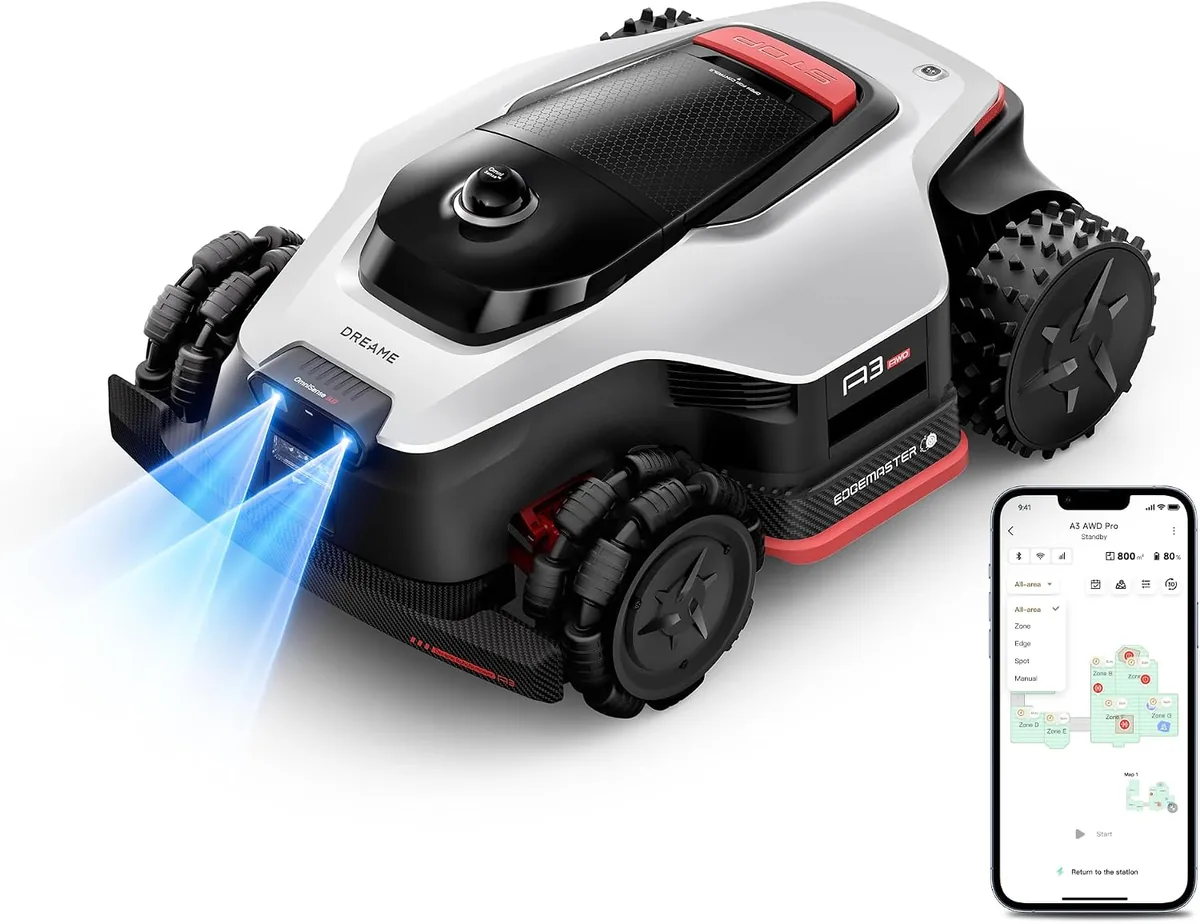
The Dreame A3 AWD Pro 3500 is the robot mower I send onto a lawn with bumps, dips and the odd low obstacle, because it needs no base station and still crosses objects up to the manual’s limit. It drives through hub motors in the wheels and rolls over objects up to 5.5 cm (2.2 in) high, according to the manual. It is my pick for a wire-free lawn of up to 0.87 acre where the ground is rough rather than steep.
WHY I CHOSE THIS ✓
I put it first because it asks the least of the lawn. No RTK station to place, a drive that works on bumps, and a cutting deck I can start high on a rough patch. It does not make a steep bank safe, and the maker says so itself.
Dreame A3 AWD Pro 3500 Wire-Free Robot Mower Specs
Key Features:
- Hub-motor all-wheel drive: The motors sit in the drive wheels and the front wheels are omni wheels, so the mower keeps pulling on ground that is not flat.
- 5.5 cm crossing height: The manual says it cannot cross anything higher, so a tape held against a stone or a root crown shows whether the object is over the limit.
- LiDAR plus two cameras: The mower finds its position from what it sees, so you place no RTK station and follow no sky-view rule.
- Motorized cutting height: The app moves the deck from 3 to 10 cm in 5 mm steps, so a tall bumpy patch can be cut high and the rest low.
- No-go shapes: You draw an exclusion shape in the app around a drip line or a trunk, and every mowing mode leaves it alone.
- Alarm and PIN: A lift alarm, an off-map alarm and a PIN lock stop a mower that someone carries away from the lawn.
- Frost and rain pauses: With rain protection on, the mower returns to the station when it rains, and frost protection pauses mowing below 6 C.
I treat the 5.5 cm figure as the first test of any lawn. The lip where the concrete work pad meets the grass is the spot I measure with a tape, and a stone or a raised paver edge higher than 5.5 cm ends the run with a fault. The figure is Dreame’s limit and not a promise, since the shape of the object, the approach and the holes around it still decide whether the mower passes. The front omni wheels turn sideways, which helps the mower slide off a small bump instead of digging in.
Holes are the bigger enemy. The manual’s “Robot trapped” fault names holes in the ground, grass taller than 10 cm and obstacles as the causes, and the cure is to fill the holes, mow first or draw a no-go zone. Before the first run I walk the lawn and fill every dip, then cut the grass to 10 cm with a push mower, as Dreame advises. That walk deals with the fault the manual names.
The slope numbers matter more on rough ground. The manual says the mower can navigate 80 percent (38 degrees), but Dreame itself recommends keeping work areas below 36 percent (20 degrees) for better results, so on a bumpy lawn that also tilts I plan around the lower one. A dirty LiDAR dome is the other check, since the manual lists “LiDAR is blocked” and “dirty” as faults that a lint-free cloth clears. Dreame publishes no run time per charge, so I read the 3,500 m2 rating as a ceiling.
Press STOP, switch the mower off as the manual says (hold the power button for 2 seconds), wait until the blades have stopped and put gloves on. Then fit the LiDAR protective cover before you turn the mower over, and keep the pressure washer and the detergent away from it, as the manual says. A hose and a soft brush do the job.
Stop the mower, switch it off, wait until the blade disc has stopped and put gloves on before you clear a blockage, wash the chassis or touch a blade, and keep children and pets off the lawn while it runs. The mower weighs 24.3 kg (53.6 lb) with the battery, so carry it by the rear handle with the disc turned away from your body.
Blades need changing every 6 to 8 weeks or sooner, and the app counts the time left; 18 spares come in the box. In the first weeks I wipe the front cameras and the LiDAR dome after a dusty alley run. The 4G link service has a free period that depends on the configuration you buy, so check the remaining time in the app. The mower trims to within about 3 cm (1.2 in) of an edge, which leaves a strip along walls that I cut with a trimmer.
Buy it if your lawn is bumpy, open to medium in layout and under 0.87 acre, and you want no wire and no base station. Skip it if your ground has steps, roots or stones higher than 5.5 cm that you cannot fill or fence off, if your bank sits near the 80 percent figure, or if you cannot lift 24 kg to carry it between lawns.
FINAL VERDICT
Pick the A3 AWD Pro 3500 when your lawn is rough but not steep and you want the simplest setup. It crosses objects up to its 5.5 cm limit, needs no RTK station and covers a large lawn. Fill the holes first and keep the bank below the maker’s 36 percent advice.
It is the robot mower I send onto bumpy ground first.
2. Mammotion LUBA 3 AWD 3000 Wire-Free Robot Mower Best Premium
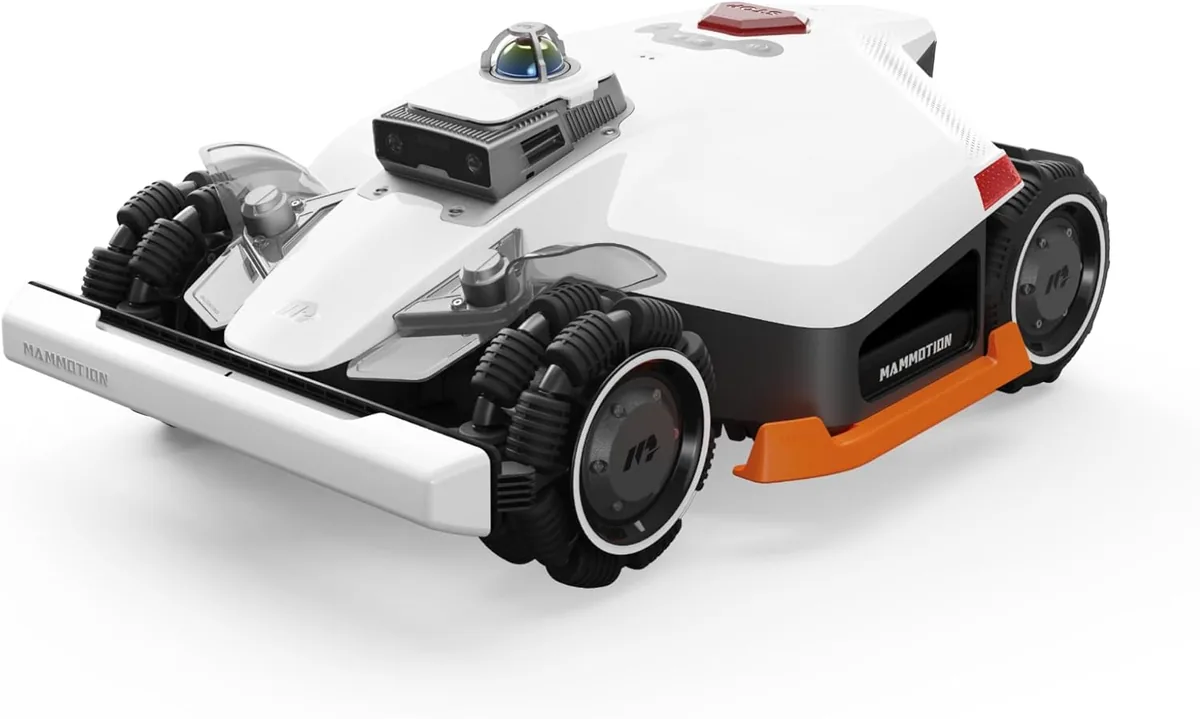
June fruit drop is when I check a robot mower against my own ground, and the Mammotion LUBA 3 AWD 3000 answers it with a 50 mm (2 in) vertical obstacle rating and three navigation systems working at once. It reads the yard through 360 degree LiDAR, AI vision and an RTK station, drives all four wheels and holds 80 percent inside the lawn and 40 percent at the edge. I name it the best premium choice for a wire-free lawn up to 0.75 acre with rough edges.
WHY I CHOSE THIS ✓
My second pick is this mower because it is the most complete mower here for the money. Three sensors, two slope figures and a three-year warranty on the parts that fail. Its weak spot is the 2.7 in top cutting height.
Mammotion LUBA 3 AWD 3000 Wire-Free Robot Mower Specs
Key Features:
- Three sensors in one mower: LiDAR maps the shape of the yard, vision identifies objects and RTK pins the position, so one sensor can cover for another where the ground or the trees confuse it.
- Two slope figures: The manual gives 80 percent inside the task area and 40 percent at the edge, so you can plan a rough border against the lower number.
- 50 mm obstacle passing: A low root crown or a paver edge up to 2 in high is within the stated limit, anything higher needs a no-go zone.
- Obstacle detection levels: Standard is the default, Sensitive treats pavement and gravel as non-grass, and Off is for controlled places only.
- No-go zones for low things: The manual lists flowerbeds under 20 cm, irrigation hoses, sprinklers and small low objects as uses.
- Wildlife Safety setting: Night mowing runs slowly or stops, which suits a daytime schedule.
- GPS tracking and geo-fence: The app sends a push alert if the mower leaves its task area by more than 50 m (164 ft).
Fruit drop is the test I give it. From June the plums and apricots on the first alley lie in the grass, and a ripe plum sits close to the 50 mm crossing figure. I pick up fruit before every run, because a squashed plum is sticky and a mower is no cleaner.
The edge number is the one that decides rough ground. The border of a lawn is where the ground drops, a bank rises or a ditch runs, and the manual rates the mower at 40 percent there, half of its inside figure. At 40 percent the grade is 21.8 degrees, steep enough that I keep the edge map away from the ditch along one border of the orchard. The manual asks for the charging station on a flat site with no bumps, slopes or rocks and 1.5 m (4.9 ft) clear on three sides.
The cutting deck is where this mower gives the least, since it runs from 25 to 70 mm (1 to 2.7 in) and stops at 2.7 in. On a lawn with mounds I set 70 mm for the first weeks and lower it as the grass settles. The RTK station needs open sky and at least 3 m (10 ft) from any wall or tree, and moving it after mapping means a new map. Where no good spot exists, NetRTK over 4G replaces it in select North American regions, so check coverage first.
Set Obstacle Detection to Sensitive on a complex lawn with gravel crossings, because that level reads pavement and gravel as non-grass.
Press STOP and switch the mower off, take out the security key, wait for the cutting disc to stop and put gloves on before you lift it or touch a blade. Never lift it while it is on, and keep children and pets off the lawn while it runs, as the manual orders.
Mammotion asks for new blades every 3 months or after 150 hours, with all blades and screws changed together. The mower weighs roughly 43 lb, so lifting it into the shed is a two-hand job. The battery is not a user-swap pack, and opening the compartment voids the warranty. The manual gives no edge-trim figure, so I plan a trimmer pass along the shed wall and the beds.
Choose it if your lawn has a rough border, you want the strongest sensor set on this page and you can give the RTK station open sky or live in a NetRTK area. Skip it if your lawn is under heavy canopy with no station spot, if your grass must stay above 2.7 in or if you want the lowest price.
FINAL VERDICT
Choose the LUBA 3 AWD 3000 when you want three navigation systems and an honest edge slope figure on a lawn up to 0.75 acre. You pay for LiDAR, a long warranty and 4G data. It suits the buyer who prefers one mower that copes with most things to one that excels at a single thing.
It is the three-sensor mower for a lawn with rough edges.
3. Segway Navimow i210 AWD Wire-Free Robot Mower Best Value
My house lawn is about a quarter acre, which is exactly what the Segway Navimow i210 AWD is rated for, and that is why I rate it the best value for a small lawn with rough patches. It drives all four wheels, adds a Traction Control System for wet and muddy ground and holds 45 percent at the lawn and at the boundary. It is the lowest-cost route to a wire-free mower with all-wheel drive on this page, for a lawn up to about 0.25 acre.

WHY I CHOSE THIS ✓
It takes third place because it is the cheapest way into all-wheel drive on a rough small lawn. The weight, the traction control and the 45 percent rating make it easy to live with. It is the weakest here on area, cutting width and published obstacle height.
Segway Navimow i210 AWD Wire-Free Robot Mower Specs
Key Features:
- Traction Control System: Switch it on in the app for damp or muddy ground, where it helps traction; the manual still advises against mowing wet slopes.
- All-wheel drive in a light body: The mower weighs 27.12 lb with the battery, which keeps lifting it over a step or into the shed manageable.
- Network RTK, no antenna: Corrections reach the mower over the mobile network where coverage exists, and an antenna ships in the box for places where it does not.
- Off-limit islands: You mark flower beds, ponds and sprinkler heads as islands, and the mower mows round them and leaves them alone.
- Weather adaptive settings: The app can stop or delay a task for rain, frost, heat, snow or strong wind.
- 4G anti-theft: A lift alarm, a geofence with an adjustable radius and a PIN protect the mower while the 4G service is active.
- Animal friendly mode: According to Navimow, VisionFence steers the mower away from pets and small animals, but detection is not assured and a sensor never replaces supervision, so keep children, pets and bystanders off the lawn while it runs.
Wet ground is where this mower earns its place. Grass and mud packed into the wheels cut traction on a bank, and the manual says to clean the wheels for exactly that reason. After a wet week, once the mower is locked and powered off, the blades have stopped and my gloves are on, I rinse the tyres with a garden hose, turn Traction Control on for the damp lawn and let the mower start from the station. The manual still advises against mowing wet slopes, because the system helps traction without making a wet bank safe.
The rated area is a ceiling. The maker lists about 0.25 acre and about 120 minutes on a full charge with a fresh-cut lawn at 25 C, and wet or long grass takes less. The cutting width is 7.1 in, the narrowest on this page, so the mower makes many more passes than a wide-deck robot on the same patch. Cutting heights run from 2 to 3.6 in, and the first mapping needs grass at 3.6 in or lower.
Setup depends on mobile coverage. The maker checks it by postcode on its site, and where there is none you place the antenna in open sky. I map a lawn like mine with the camera helping in a narrow channel, since the manual says channels must be wider than 1 m (3.3 ft) and clear of obstacles. An isolated zone is mowed one time only after you carry the mower there, and the warranty needs a purchase from an authorized Navimow dealer, so check the listing before you buy.
Draw off-limit islands around drip lines and young trunks before the first run instead of trusting the camera alone.
Lock the mower with MOW and HOME held for 3 seconds, power it off, wait for the blades to stop and wear gloves before you clean or turn it over. Never lift it while it runs, and keep children and pets off the lawn while it works.
Blades and screws need replacing every 1 to 2 months with regular use, and the screws are never reused. In winter the manual asks for a charge of at least 85 percent, hibernation from the app, blades removed with gloves on and indoor storage. The 4G service is free for the first year, and the fee after that is not published by the maker, while anti-theft only works with an active 4G plan. The manual gives no strip width at the edge, so I trim along the beds by hand.
It suits a lawn of a quarter acre or less where the ground is bumpy or damp in places, any slope is mowed dry and you have mobile coverage for Network RTK. Skip it if your lawn is larger, if you have no coverage and no open sky for an antenna, or if you want a published obstacle height.
FINAL VERDICT
Pick the i210 AWD when you want all-wheel drive on a small, rough, damp lawn without paying for the biggest machine. It is light, quiet and well covered by its warranty. It falls short where your lawn grows past a quarter acre.
It is the all-wheel-drive mower I recommend for a small rough lawn.
4. Lymow One Plus Tracked Robot Mower Best for Steep Slopes
The Lymow One Plus rides on rubber tracks instead of wheels, and Lymow rates it for slopes up to 45 degrees (100 percent incline), the steepest figure on this page. That makes it my pick for the best robot lawn mower for steep slopes here, and a serious option for rough ground. It suits an open lawn where the RTK reference station gets a clear sky.

WHY I CHOSE THIS ✓
Fourth place goes to the One Plus because no other mower here promises this much slope. It earns that with tracks and a deck that lifts to 4 in. It also asks a lot of the buyer: 77.6 lb of machine, an RTK station to site and a map made by driving.
Lymow One Plus Tracked Robot Mower Specs
Key Features:
- Tracked drive: The treads carry the mower over the 50 mm step the manual allows.
- 100 percent slope rating: The manual gives 45 degrees as the figure the machine can handle.
- Motorized deck: It lifts from 30 to 100 mm, with a channel height for thresholds.
- Edge settings: Perimeter laps and side discharge keep clippings in the lawn.
- PIN and geo-fence lock: A PIN and a virtual fence lock the mower if it leaves the lawn.
A wheel meets a hump with one small contact patch, and a track meets it with a long one, so the mower rides over rather than dips. On the soft first alley of the orchard after a wet spring, with tractor wheel marks in the grass, this is the ground where a track earns its weight. I cover the tracks, the mapping drive and the station setup in my Lymow One Plus mower review.
The 100 percent figure comes without conditions. The manual gives no working slope, no wet-slope figure and no edge figure, so I treat it as the most the machine can handle. You map by driving, with a phone within 20 m (66 ft), and every zone needs a channel to the dock.
Place the RTK station on open ground, away from trees and from the corner of an L-shaped building, because moving it later means rebuilding the map.
Switch the mower off, disconnect the battery from the mower and the charging station, remove the safety key, wait until the blades have stopped and put gloves on before you touch the deck. Never lift or move it while it runs.
The mower weighs 35.2 kg (77.6 lb), so I keep it where it works and do not carry it. After a wet mowing day I brush the grass out of the tracks and the deck underside before the mower goes back to the dock. The manual does not say whether the 10 A or the 5 A charger ships with it, so confirm that before you buy, and note that tracks and blades carry no warranty.
It fits rough or steep open ground where you will map by driving. Skip it if trees or tall walls hide the sky from the station, if you cannot lift 35 kg, or if you want a published noise figure.
FINAL VERDICT
Choose the One Plus when slope and rough ground matter more to you than weight, noise or a short setup. Check the warranty wording before you pay.
It is the tracked mower for open, steep and rough ground.
5. Sunseeker X5 AWD RTK Robot Mower Best for 1/2 Acre
A half-acre lawn with banks and lumps is what the Sunseeker X5 AWD is built for, and Sunseeker rates it for up to 0.5 acre with a 60 percent (30 degree) climb. It pairs all-wheel drive on hub motors with independent front suspension, a maker claim, and a local RTK base station that stands upright on open flat ground, or on a wall or roof for some layouts. I name it the best robot lawn mower for 1/2 acre among these picks.

WHY I CHOSE THIS ✓
The X5 is fifth because it is the one mower here rated for exactly half an acre, with a slope figure that suits a lumpy lawn of that size. It asks you to host a base station and mow in daylight.
Sunseeker X5 AWD RTK Robot Mower Specs
Key Features:
- Hub-motor all-wheel drive: Each drive wheel has its own motor, which helps on a bank and on soft ground.
- Independent front suspension: According to Sunseeker, the front wheels move separately over lumps.
- Floating cutting disc: The US page says the disc follows the contour of the ground.
- Local RTK plus camera: The base station needs no cellular service, and the camera keeps the position where trees block the sky, as the maker claims.
- PIN and bump sensor: A PIN, a lift and tilt sensor and a bump sensor protect the mower.
The suspension is the reason this mower is on a list for uneven ground. Independent front wheels move separately, which is the design answer to a lawn where one tyre meets a hump before the other, though the claim is Sunseeker’s. The manual publishes no obstacle height, so clear loose stones, keep roots and steps out of the mapped area with no-go zones, and ask Sunseeker about your worst spot before you buy. My Sunseeker X5 AWD review goes further into the suspension and the base station.
The RTK base station is the part to plan. It stands upright on open flat ground, more than 1.5 m (5 ft) from walls and trees, on home Wi-Fi near an outlet. On the shed wall its light stayed green, and at the gatepost it turned orange, so I moved it.
Grass and mud on the wheels reduce performance on slopes, so clean between the wheels before a run on a bank, with the device lock on LOCK, the mower on OFF, the blades stopped and gloves on.
Set the device lock to LOCK and the mower to OFF, wait for the blades to stop, and wear gloves and goggles for any maintenance before you lift it or clear a blockage. Never carry it while the motor runs, and keep children and pets off the lawn.
Blades and screws change every 1 to 2 months with frequent use. The manual advises against night mowing because the camera loses recognition in the dark, so I schedule runs for daylight, and after a wet week I set the first cut at the top of the 3.2 in range.
The X5 fits a lawn of about half an acre with banks and lumps and a clear spot for the base station. Skip it if your lawn is larger, if no spot gives the station a clear sky and Wi-Fi, or if you need a confirmed run time.
FINAL VERDICT
Pick the X5 AWD when your lawn is half an acre of uneven ground and you accept a base station and daytime mowing.
It is the half-acre mower for banks and lumps.
6. Mammotion LUBA 2 AWD 3000HX Wire-Free Robot Mower Best for Rough Terrain
The Mammotion LUBA 2 AWD 3000HX has the tallest obstacle rating on this page: 80 mm (3.2 in) of vertical passing, on four driven wheels with spring suspension. Mammotion’s manual calls it a four-wheel-drive mower with a suspension system, and that is the reason it is my pick for the best robot lawn mower for rough terrain. It suits a wire-free lawn up to 0.75 acre where lumps and roots matter more than a long list of sensors.

WHY I CHOSE THIS ✓
Sixth place goes to it because it holds the best obstacle figure of the seven and a suspension. Its RTK station needs open sky, and no edge slope is published. Those two demands are why it sits below mowers that ask less of a lawn.
Mammotion LUBA 2 AWD 3000HX Wire-Free Robot Mower Specs
Key Features:
- 80 mm obstacle passing: The H version steps over a root crown or raised edge up to 3.2 in high.
- Spring suspension: The four driven wheels sit on springs, which the manual lists as part of the chassis.
- Vision backup: When trees block satellites, vision holds the position for up to 300 m of travel.
- Tall cutting range: The deck runs from 2.2 to 4 in from the app, so you can start high on a lumpy lawn.
- Wildlife Safe Mode: Night speed drops below 0.3 m/s, or night tasks stop.
The 80 mm figure is for the H version only, and the H letter also gives the taller deck. A root crown or a heaved paver edge up to 3.2 in high is within its rating. I walk the alley beside the ditch with a tape for exactly those spots, since the manual keeps the robot at least 15 cm (6 in) from ditches and uneven paths. I describe the climb over roots and ridges in my LUBA 2 3000HX review.
Channels between lawn areas must be wider than 1 m (3.3 ft) and free from significant bumps, and the mower cannot dock without one. Mapping the alley with the app joystick, I kept the robot 15 cm off the ditch edge. The manual shows position quality as Good, Float, Single or None, and only Good enables automatic mowing. The station needs open sky at least 3 m (10 ft) from any wall or tree, and I check that the position status reads Good before I leave the mower to its schedule.
Leave obstacle detection on Standard, since Sensitive can leave dried-out patches unmowed.
Set the robot to OFF, remove the security key and wait until the cutting disc has stopped, then wear gloves before you inspect or clean it. Do not lift it while it is on, and keep children and pets out of the task area.
Blades and screws are replaced together every 3 months or after 150 hours. The robot weighs about 42 lb. Leave time for a trimmer pass.
It fits a lawn up to 0.75 acre with roots, ridges and edges and open sky for the RTK station. Skip it if trees shade most of the lawn, if you want an edge slope figure, or if you need a cut below 2.2 in.
FINAL VERDICT
Choose the 3000HX when obstacle height and suspension decide your buy, and your lawn can host an RTK station. Its 80 mm rating is the highest stated here.
It is the mower with the highest obstacle rating for rough ground.
7. Yarbo Y40 Core Tracked Robot Mower Pro Best for Large Lawns
The Yarbo Y40 Core with the Lawn Mower Pro module is my pick for the best robot lawn mower for large lawns where the ground is rough as well. It runs on rubber tracks, has a 20 in cutting width and, according to Yarbo, covers up to 6 acres mowing twice a week. It is built for a big, open and uneven property, and it is far too large for a small lawn.

WHY I CHOSE THIS ✓
It closes the list because it is the mower here rated for the most ground. It brings tracks, a wide cut and a 35 degree climb to a property that would take other mowers many days. It is also the heaviest and the most costly.
Yarbo Y40 Core Tracked Robot Mower Pro Specs
Key Features:
- Tracked drive: Rubber tracks suit rough, wet and overgrown ground, with a 5 cm threshold capability.
- Two 300 W cutting motors: Two discs carry five blades each.
- Motorized height: The controller or the app moves the deck from 0.8 to 4 in.
- Mapping by driving: You drive the mower round the edge once, and no-go zones handle the rest.
- Emergency stop and rain sensor: The sensor sends the machine back to base in rain.
Size sets the job here. The whole unit weighs 88.2 kg (about 194 lb), ships in four boxes and needs two adults to assemble. The tracks and the 35 degree climb figure aim it at ground where wheels struggle, and the 5 cm threshold means a low step is not a stop. The area is 6 acres twice a week, a schedule and not a one-pass figure, and beside my 3.7-acre orchard and the lawns around it that is far more machine than I need.
The tracks need regular care. The manual says to grease them about every two weeks in the mowing season, and debris and mud hurt the drive. I mapped the first alley by driving the mower once along its edge, and the system found the boundary itself. I grease the tracks on a two-week routine, and I draw a no-go zone around a drip line before the first run.
The listing asks for a 120 degree unobstructed view of the sky for the Data Center, so site it before you buy.
Press the emergency stop, check that every light is off, remove the battery, wait until the blades have stopped, and only then wear gloves and goggles for maintenance or clearing a blockage. Never place any part of your body near or under the machine while it turns or climbs.
Charge an unused pack for at least 15 minutes every three months, as the manual asks. I wipe the camera lenses after dusty alley work. Budget for a trimmer pass along walls and fences.
It fits a property of several acres of rough or wet ground, with open sky for the Data Center and room to store and service a heavy machine. Skip it if your lawn is under an acre, if you want to lift it yourself, or if trees and walls cover the sky.
FINAL VERDICT
Choose the Y40 Core when the property is large, rough and open, and you accept the weight, upkeep and cost.
It is the tracked machine for acres of rough ground.
How to Choose the Best Robot Lawn Mower for Uneven Terrain
Uneven ground and slopes stop a mower in different ways. A bump, a root crown or a hole traps it, while a slope tests its grip and its slope rating. Work through the seven factors below with a tape measure in your hand.
Obstacle Crossing Height
Every mower has a height it can climb. The manuals on this page give 50 mm (2 in) to 80 mm (3.2 in) where they publish one, and some publish none. A mower stops, or faults, at an object taller than its figure, and the figure is the maker’s limit, not a promise that every lower object passes. Measure the objects on your lawn before you read anything else.
| Spot on the lawn | How to measure it | What to compare it with |
|---|---|---|
| Stone or paver edge | Tape from the ground to the top | The maker’s obstacle-passing figure |
| Root crown | Tape from the grass to the top of the root | The same figure, at the highest point |
| Edge where the lawn meets gravel or a path | Tape from the grass to the surface beside it | The same figure, and the maker’s edge rule |
| Hole or dip | Depth with a ruler, then fill it | Fill it, since manuals list holes as a fault |
I measure the soft edge where my gravel yard meets the grass, because that is the first step a mower meets when it leaves the lawn.
Pro Tip
Measure the worst spot, not the average one. A mower that crosses 2 in at the stone edge but meets 3 in at a root crown will stop at the root.
Wheels, Tracks and Suspension
An all-wheel drive robot lawn mower drives every wheel, so more of the machine pulls when the ground is soft or uneven. Tracked machines use belts instead of wheels and are much heavier. Suspension takes the form of springs or independent front wheels, as the makers describe it. My comparison of the One Plus against Yarbo Y40 shows how two tracked mowers differ.
- All-wheel drive: every wheel is driven, often by a motor in the wheel itself.
- Tracks: a robotic lawn mower with tracks swaps wheels for belts, weighs far more and needs its tracks cleaned and greased.
- Suspension: springs or independent front wheels, as the makers describe them.
- Omni wheels: small free-turning front wheels that let the mower pivot.
I weigh a mower’s drive against the damp spots in the orchard alleys, where wheels spin first.
Holes, Roots and Ruts
Shallow roots and holes stop mowers. In a study of seven greenspaces run by autonomous mowers, some sites needed manual help because the mowers got stuck on shallow tree roots (1). The maker manuals list holes in the ground as a trap fault, so fill dips before the first run.
Clear the Lawn First
Remove stones, sticks, toys and fallen fruit before every run. A hose, a drip line or a cable on the lawn can be caught, so lay it away from the mowing area or draw a no-go zone around it.
I treat the soft ground near my drip lines and tree roots as the first place to look.
Cutting Height and Deck Clearance
The range here runs from 20 mm to 100 mm. Cutting height is how tall the grass is left, and it is not a clearance figure for humps, so start high on a lumpy lawn and lower it as the ground settles.
- Humps and mounds: start at a high setting and lower it as the grass settles.
- New or overgrown grass: the manuals ask you to cut tall grass first, to about 10 cm in one case.
- Motorized height: a deck that moves from the app saves a trip to the mower.
Slope Rating and Where It Applies
A slope rating is a maximum, and a maker may state it for the lawn, for the edge or for both. One manual here gives 80 percent inside the lawn and 40 percent at the edge, and another recommends work areas below 36 percent. Hills are a separate question from bumps, and the best robot lawn mower for hills is chosen mainly on those figures. I compare AWD and tracked models in my guide to the best robot lawn mower for hills.
Navigation Under Trees and Beside Walls
RTK positioning needs open sky. In a forest study, canopy cover cut the number of available satellites and made positions less accurate (2). A mower that adds LiDAR or cameras can keep its position where trees block the sky, according to its maker. My ranking of the best lidar robot lawn mower covers the models that keep working where trees block the sky.
| Navigation | Needs | Check on your lawn |
|---|---|---|
| RTK with a base station | Open sky at the station and at the mower | Clear sky, and the wall and tree clearance your model’s manual states |
| RTK with mobile corrections | Mobile coverage and satellite view at the mower | The maker’s coverage check, and open sky over the lawn |
| LiDAR and cameras | A clean sensor and a mapped lawn | Dust or dirt on the lens; the makers claim they hold position under trees |
I look at the sky over the alleys and beside the shed walls before I choose where a base station would sit.
Weight, Wet Ground and Night Mowing
Weight on this page runs from about 26 lb to about 194 lb, and a heavy mower is harder to carry out of a dip or into a shed. The manuals advise dry weather, because wet grass sticks and mowers slip. Repeated passes over soft ground wear it, and a test of three mowing patterns found that a random pattern gave the most passages and the lowest green cover, 64 percent, against 80 to 81 percent for the others (3).
Run the mower by day. In collision tests of 18 robotic mower models with hedgehog cadavers, none detected dependent juvenile hedgehogs under 200 g, and every model had to touch a hedgehog to detect it (4).
Fix the Lawn Before the First Run
A spade and a tape deal with the faults the manuals list. This is the walk I do on any lawn before a mower goes onto it.
- Cut the grass to the height the manual asks for before mapping.
- Fill every hole and dip, or draw a no-go zone around it.
- Pull stones, sticks, fallen fruit and toys off the lawn.
- Lay hoses and drip lines away from the mowing area, or draw no-go zones round them.
- Measure each raised edge and root crown against the maker’s obstacle figure.
- Set the schedule to daylight and keep children and pets off the lawn while it runs.
Before You Touch the Blades
Stop the mower, switch it off the way the manual states, wait until the blades have stopped and put on protective gloves. Never lift a mower that is running.
My Overall Verdict
Rough ground sorts the mowers that cross things from the ones that stop. My top three each handle bumps in a different way, and the right one depends on your lawn.

1. Dreame A3 AWD Pro 3500 Wire-Free Robot Mower Best Overall
The pick for an open to medium lawn with bumps that needs no base station.
2. Mammotion LUBA 3 AWD 3000 Wire-Free Robot Mower Best Premium
The choice for a lawn with a rough border where three sensors and an edge figure help.

3. Segway Navimow i210 AWD Wire-Free Robot Mower Best Value
The pick for a small, damp, rough lawn of about a quarter acre.
Whichever you pick, measure your worst root and fill your holes before the first run. The best robot lawn mower for uneven terrain is the one whose obstacle figure beats your worst spot. For a pick across every lawn size, my guide to robot mowers for any lawn ranks nine models.
Why Dreame A3 AWD Pro 3500 Wire-Free Robot Mower Might Be the Best Choice
I put it first because it asks the least of a rough lawn. It needs no base station, drives through hub motors and crosses objects up to 5.5 cm high, according to the manual.
The trade-off is the slope: the maker recommends keeping work areas below 36 percent even though it can navigate 80 percent. Fill the holes and cut the grass first, and it does the rest.
Here is what puts it first on rough ground:
✓ Hub-motor all-wheel drive with front omni wheels.
✓ Crosses objects up to 5.5 cm (2.2 in) high.
✓ LiDAR and cameras, with no RTK station to place.
✓ Motorized cutting height from 3 to 10 cm.
✓ Lift alarm, off-map alarm and PIN lock.
Frequently Asked Questions
Can a robot lawn mower go uphill?
A robot lawn mower can go uphill within the slope figure its maker states for that exact model, and the figures on this page run from 45 percent to 100 percent. Check whether the figure applies to the lawn or only to the edge, and keep wet slopes off the mowing schedule too.
Are AWD lawn mowers worth it?
All-wheel drive is worth paying for on a robot mower when your lawn has bumps, damp patches or banks, because every wheel pulls. It adds weight and cost, so a flat dry lawn may not need it, and it makes sense to compare the maker’s obstacle and slope figures first, as listed in each review.
Do robot mowers work on hills?
Robot mowers work on hills when the model is rated for the slope, and the ratings differ a lot by maker and by model. Treat the rating as a maximum, since one maker recommends keeping work areas below 36 percent, and the Segway manual advises against mowing wet slopes, so I keep slopes off the schedule in wet weather.
How long do robot mowers last?
How long a robot mower lasts depends on its battery, its blades and how well you look after it, and the makers publish warranties of two to three years instead of a lifespan. Blades are the quick wear item, and the manuals ask for a change every one to three months.
Where does the grass go with a robotic lawn mower?
The grass stays on the lawn, because a robot mower cuts a little every day and the fine clippings fall back into the turf as mulch. Some models can also discharge clippings to the side at the boundary, so that they do not land outside the lawn on the path or the beds.
References
- Sportelli M, Martelloni L, Orlandi A, et al. Autonomous Mower Management Systems Efficiency Improvement: Analysis of Greenspace Features and Planning Suggestions. Agriculture. 2019;9(6):115. doi:10.3390/agriculture9060115
- Lopatin E, Väätäinen K, Kukko A, et al. Unlocking Digitalization in Forest Operations with Viewshed Analysis to Improve GNSS Positioning Accuracy. Forests. 2023;14(4):689. doi:10.3390/f14040689
- Luglio SM, Frasconi C, Gagliardi L, et al. Modeling the Relationship Between Autonomous Mower Trampling Activity and Turfgrass Green Cover Percentage. Agronomy. 2025;15(12):2890. doi:10.3390/agronomy15122890
- Rasmussen SL, Schrøder A, Mathiesen R, Nielsen JL, Pertoldi C, Macdonald DW. Wildlife Conservation at a Garden Level: The Effect of Robotic Lawn Mowers on European Hedgehogs (Erinaceus europaeus). Animals. 2021;11(5):1191. doi:10.3390/ani11051191
Safety Note: A robot mower has sharp blades. Keep hands and feet away from them. Do not run it with children, other people or animals on the lawn; stop it and park it or switch it off if they come onto the lawn. Never ride on it or let children play with it. Clear toys, hoses, sticks, stones and fallen fruit before a run, and do not mow while sprinklers run. Never lift or tip it while it runs or while it sits in its charging station. Before you lift it, clean it or touch the blades, press STOP, switch it off exactly as your manual says, wait until every blade has stopped, and wear protective gloves. Daytime schedules reduce encounters with animals that come out at night, though animals can be on the lawn by day too. Plug the power supply into a covered outdoor GFCI outlet, keep its cable out of the mowing area, and charge only with the maker’s own charging station and power supply, within the charging and storage temperatures in your model’s manual, never charge a damaged or swollen battery, and follow your manual for installation, slopes and storage.