


My Mammotion LUBA mini 2 review ends on a clear yes for a small lawn with banks and borders: the 1500H maps with LiDAR and AI vision, holds an 80% slope rating inside the work area and needs no wire and no base station. I ran it on the house lawn and the yard edges of my family farm, next to the orchard rows. Below I cover the kit, mapping, slopes, edges, noise and upkeep, how it compares with two other mowers, and who should skip it.
My Mammotion LUBA Mini 2 Review: The Short Answer
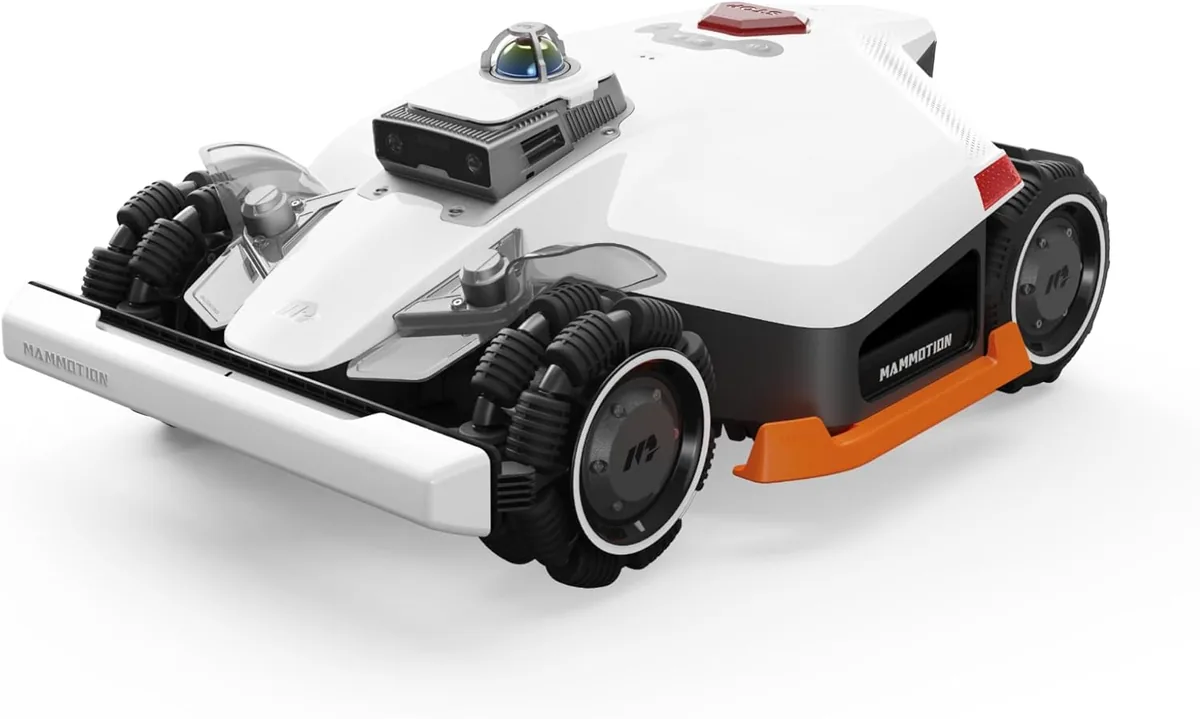
I recommend the Mammotion LUBA mini 2 AWD 1500H Robot Mower for a lawn up to 0.37 acre with banks, beds or borders, where a mower with no wire and no base station is the goal. Skip it for lawns over 0.37 acre and for any job where you want no trimming at all. It pairs 360 degree LiDAR with AI vision on an all-wheel-drive body of about 39 lb, and it carries a separate edge disc.
- Who it is for: a small lawn, up to 0.37 acre, with slopes, beds or a gravel border.
- What it does best: an 80% slope rating inside the task area with no wire to lay and no antenna to site.
- Main trade-off: a 0.37 acre recommended area, and an edge strip you still trim.

Specs and Which Kit This Review Covers
This review covers the 1500H, the taller-cutting High Version (model LM2H1) of the LUBA mini 2 AWD 1500 (model LM2S1); the 1500H has a main-disc cutting height of 55 to 100 mm against 20 to 65 mm on the standard 1500.
| Spec | Figure |
|---|---|
| Navigation | 360 degree LiDAR plus AI vision; no RTK station, no wire |
| Rated area | 1,500 m2 (0.37 acre) recommended mowing area |
| Slope rating | 80% (38.6 degrees) inside the task area; 40% (21.8 degrees) at the edge |
| Cutting width | 200 mm (7.8 in) main disc; 120 mm (4.7 in) edge disc |
| Cutting heights | 55 to 100 mm (2.2 to 4 in) main disc; 65 mm (2.6 in) edge disc |
| Drive | All-wheel drive; passes obstacles up to 75 mm (2.9 in) |
| Run and charge time | 150 min mowing per charge; 150 min charging |
| Noise | 64 dB(A) sound power; 56 dB(A) sound pressure |
| Connectivity | 4G, Bluetooth and Wi-Fi; Alexa and Google Home |
| Warranty | 3 years on battery, motor, LiDAR or vision module, circuit board, GPS kit and charging station |
The box holds the robot, the charging station, the power supply and a removable battery, with no RTK reference station. Weight is about 39 lb (17.5 kg).
Setup, Mapping and the Charging Station
Setup is an app job in three steps: link the mower, site the station and map the task area.
Why LiDAR Matters Here
The mower’s LiDAR scans the lawn with a laser, and the cameras add AI vision, so the mower does not rely on a satellite fix. RTK needs open sky: a study of RTK positioning under mature spruce canopy found that canopy cover increased inaccurate positions and dilution of precision (1). The apricot rows in leaf shade my alleys, and that is where I do not trust a satellite-only mower. The LiDAR dome and the camera lens still need a clean wipe, and the manual says to use a microfiber cloth. I rank this kind of mower, one that reads the lawn without a satellite fix, in my LiDAR robot mower list.
Mapping and the Station Spot
The station goes on flat ground with no trees or houses within 1.5 m (4.9 ft) to the left, right and front, and Mammotion advises a well-lit spot because good light helps the vision side. I placed the station on level ground a few steps out from the tool shed wall, with the 1.5 m clear on three sides. The charging station and the power supply must be the official ones, and the manual asks for a covered Class A GFCI receptacle in the US.
In the app you map a task area, a virtual fence, no-go zones and obstacle-free zones, and you choose a cutting path: Perimeter Laps Only, Zigzag, Chess Board or Adaptive Zigzag. The mower supports up to 20 zones. In the app I drew the task area first and the no-go zones second, so the 20-zone limit never came into play on a lawn this size. Other mowers that suit a lawn this size are ranked in my list of robot mowers for small yards.
Performance: Slopes, AWD, Edges and Cutting
An 80% slope rating and a separate edge disc are what set this mower apart on a small lawn.
Slopes and All-Wheel Drive
Mammotion rates the LUBA mini 2 AWD at 80% inside the task area and 40% at the edge. Those percentages are 38.6 and 21.8 degrees, and the two figures are different jobs: the lower one applies where the mower turns near the border. I read the 40% edge figure as the one that limits my borders, because a border is where the mower turns. The manual says to avoid wet slopes, because grass sticks and the robot can slip. I compare slope ratings in my list of robot mowers for steep slopes.
All four wheels drive the mower, and it passes obstacles up to 75 mm (2.9 in) high. That helps over low edging and roots. I keep it off the ditch bank on the orchard border, with or without all-wheel drive.
The Edge Disc and Cutting Height
The 1500H has two discs: a 200 mm main disc and a 120 mm edge disc with its own 65 mm cutting height. Mammotion claims the edge disc works within about 2.1 in of a wall. In a study of seven greenspaces, all seven needed manual finishing along curbs and walls even with autonomous mowers (2). Along the gravel yard I trimmed what the edge disc left, and the line was tidier than a central disc gives me.
The main disc cuts 55 to 100 mm (2.2 to 4 in). A robot cuts a little each day, which keeps the one-third rule easy. A trial on tall fescue found higher shoot density, 3.2 against 2.1 shoots per cm2, and higher turf quality under an autonomous mower than under a gasoline mulching mower (3). I set the height at the top of the range for the first cuts and stepped it down.
Run Time, Charging and Rain
Mammotion lists 150 minutes of mowing per charge and 150 minutes of charging, one figure each with no conditions. I treat the mowing figure as a best case. Charge only between 4 and 45 C (39 and 113 F). Rain Protection, when switched on, sends the mower back to the station when it detects rain, and the manual says not to mow in heavy rain, thunderstorms or snow.
Obstacles, No-Go Zones and DropMow
Obstacle detection has three levels: Sensitive, which also treats pavement and gravel as non-grass, Standard, the recommended default, and Off. I left detection on Standard and tried Sensitive at the gravel crossing between the lawn and the yard. Around the drip lines and young trunks I drew no-go zones in the app, because a hose on the lawn can be caught.
DropMow mows an unmapped or hard-to-reach patch once. Mammotion warns against using it near steps, drop-offs, ponds, ditches or pools, or in low light, so the ditch bank stays out.
Living With It: Noise, Rain, Security and Upkeep
The mower parks for rain when Rain Protection is switched on and asks for little beyond blade changes and a clean lens.
Noise and Wildlife
Mammotion lists 64 dB(A) sound power and 56 dB(A) sound pressure, two measures that I never mix. Noise measurements of more than 600 mowers found electric mowers significantly quieter than gas ones (4). From the house lawn I could hear it on the gravel, but it did not carry over the conversation on the terrace.
The Wildlife Safety setting runs night mowing slowly or stops it. In collision tests of 18 robotic mower models with dead hedgehogs, none detected juveniles under 200 g, and every model had to touch the hedgehog to detect it (5). A second set of tests on 19 models found that some injured the cadavers and others did not (6). Daytime schedules are the simplest precaution.
Security, 4G and the App
The mower has GPS theft tracking, a geofence that sends a notice to the app when the mower is more than 50 m (164 ft) from its task area, and a security key. The built-in SIM activates when you link the robot, and Mammotion lists three years of free 4G data.
Blades, Cleaning and Winter
Change the blades every 3 months or 150 hours, and only after you press STOP, hold the power button to switch the mower off, remove the key, wait until the cutting disc has stopped completely and put on protective gloves. I swap the blades on the calendar and replace every screw together, following that same order. Never use a pressure washer, and never turn the robot upside down to wash the chassis.
Below -10 C (14 F) the robot stays indoors, charged to at least 80%, and the charging station comes indoors below -20 C (-4 F). The manual’s storage range is -10 to 40 C (14 to 104 F), and its recommended operating range is 5 to 40 C (41 to 104 F). Recharge a stored pack every 90 days.
Blades and Lifting
Before you lift the mower, clean it or touch the blades, press the STOP button, hold the power button to switch it off, remove the security key, wait until the cutting disc has stopped completely and put on protective gloves. Never lift it while it is on. Keep children, pets and bystanders off the lawn while it runs.
Who Should Buy It and Who Should Skip It
I recommend the mower in these cases.
- You have a lawn up to 0.37 acre with banks, beds or a gravel border.
- You want a wire-free mower that needs no antenna and no sky view.
- You value an all-wheel-drive body of about 39 lb that one person can lift to store.
Skip it in these cases.
- Your lawn is larger than 0.37 acre, since Mammotion recommends 0.37 acre for this model.
- You want a mower that needs no trimmer pass at the borders.
Drawbacks to Know Before You Buy
- Small rated area: Mammotion recommends 0.37 acre. Keep your lawn well under it.
- An edge strip remains: plan a trimmer pass along stone and beds.
- Cleaning: the LiDAR and lens need a microfiber wipe, and the robot must not be turned over without the care the manual asks for.
- A new listing: the 1500H is a 2026 model, so long-run owner data is thin.
How It Compares With the LUBA 3 and the Navimow i210
Two mowers sit closest to this one. The tables line up the figures on one basis: the maker’s rated area, and the slope inside the work area. I compare this mower with the larger LUBA 3 in my mini 2 versus LUBA 3 comparison.
LUBA Mini 2 vs LUBA 3 AWD 3000
The LUBA 3 AWD 3000 shares the 80% slope figure and the LiDAR plus vision system, adds RTK and a 15.7 in cut, and is rated for 0.75 acre. It weighs about 43 lb.
| Spec | LUBA mini 2 1500H | LUBA 3 AWD 3000 |
|---|---|---|
| Rated area | 0.37 acre | 0.75 acre |
| Slope inside the area | 80% | 80% |
| Cutting width | 7.8 in main disc | 15.7 in |
| Navigation | LiDAR plus vision | LiDAR, vision and RTK |
| Run and charge | 150 and 150 min | 150 and 105 min |
| Main-disc cutting height | 2.2 to 4 in | 1 to 2.7 in |
Choose the LUBA 3 if your lawn is closer to three-quarters of an acre and you mow short, since its standard version cuts 1 to 2.7 in against 2.2 to 4 in here. Its RTK station sits in the yard, though in supported North American regions NetRTK can replace it. The mini 2 suits a smaller lawn that needs neither. My LUBA 3 AWD review covers that station and NetRTK in more detail.
Navimow i210 AWD
The Segway Navimow i210 AWD uses Network RTK plus a camera, is rated for about 0.25 acre and has a 45% slope limit. It weighs about 27 lb.

| Spec | LUBA mini 2 1500H | Navimow i210 AWD |
|---|---|---|
| Rated area | 0.37 acre | About 0.25 acre |
| Slope inside the area | 80% | 45% |
| Navigation | LiDAR plus vision | Network RTK plus camera |
| Noise, sound power | 64 dB(A) | 59 dB(A) |
| Warranty | 3 years, battery included | 3 years; battery pack and adapter 2 years |
The i210 suits a lawn of about a quarter acre with good mobile coverage and modest banks.
Common Problems and How to Prevent Them
| Problem | Likely cause and fix |
|---|---|
| Gravel or pavement read as lawn | Sensitive is the setting that also treats pavement and gravel as non-grass; use it where paths cross the lawn |
| The mower loses its way | Dirty lens or LiDAR; wipe with a microfiber cloth |
| It slips on a bank | Wet grass or grass-packed wheels; wait for dry grass and clean the wheels |
| It will not charge | Outside 4 to 45 C, or the wrong power supply; use the official parts |
| A trapped or lifted alarm | Objects under the chassis; clear toys, branches and wires before a run |
| DropMow near an edge | The manual warns against steps, ponds, ditches and pools; keep it away |
The manual also bars pop-up sprinklers during mowing, and it says never to open, repair or modify the battery, which only skilled or authorized people may replace. Never use or charge a damaged or swollen pack; contact authorized service.
My Final Verdict on the LUBA Mini 2 AWD 1500H
The 1500H is the small mower I recommend for a lawn with banks, beds and a gravel border: it climbs 80% inside the task area, cuts its borders with a disc of its own and needs no wire or base station; I compare other wire-free options in my roundup of robot mowers without perimeter wire. Keep your lawn under 0.37 acre and plan a trimmer pass at the edge. For a small lawn with banks and borders, the Mammotion LUBA mini 2 1500H is the mower I recommend you buy.
Frequently Asked Questions
Does luba 2 mini need rtk?
The LUBA mini 2 does not need RTK, because it navigates with 360 degree LiDAR and AI vision and has no reference station in the box. That also means no antenna to site and no sky view to protect, though the camera lens and the LiDAR dome need regular cleaning with a microfiber cloth.
Is the Luba 2 Mini better than the Luba 3?
The LUBA mini 2 is better for a small lawn, and the LUBA 3 is better for a larger one, since both share an 80% slope rating. The mini 2 is rated for 0.37 acre and weighs about 39 lb, while the LUBA 3 is rated for 0.75 acre and adds RTK.
Are mammotion mowers any good?
Mammotion mowers are good for wire-free mowing on slopes, according to the maker’s ratings: the LUBA mini 2 holds 80% inside the task area, and its warranty runs 3 years. Check the rated area against your own lawn, because each model lists its own recommended mowing area in the manual.
Can robot lawn mowers go uphill?
Robot lawn mowers go uphill only up to the maker’s rating, and the figure depends on where it applies. The LUBA mini 2 lists 80% inside the task area and 40% at the edge, and its manual says to avoid wet slopes, since grass sticks and the robot can slip.
Can you leave a robot lawn mower outside?
You can leave a robot lawn mower outside in season, parked on its station, within the 5 to 40 C (41 to 104 F) operating range, and the LUBA mini 2 has IPX6 water protection. Below -10 C (14 F) the manual says to bring the robot indoors, charged to at least 80%, and never to use a pressure washer.
References
- Lopatin E, Väätäinen K, Kukko A, et al. Unlocking Digitalization in Forest Operations with Viewshed Analysis to Improve GNSS Positioning Accuracy. Forests. 2023;14(4):689. doi:10.3390/f14040689
- Sportelli M, Martelloni L, Orlandi A, et al. Autonomous Mower Management Systems Efficiency Improvement: Analysis of Greenspace Features and Planning Suggestions. Agriculture. 2019;9(6):115. doi:10.3390/agriculture9060115
- Grossi N, Fontanelli M, Garramone E, et al. Autonomous Mower Saves Energy and Improves Quality of Tall Fescue Lawn. HortTechnology. 2016;26(6):825-830. doi:10.21273/horttech03483-16
- Blomberg L, Trezza D. The evolution of quiet lawn mowers and their impact on community noise and hearing conservation. INTER-NOISE and NOISE-CON Congress and Conference Proceedings. 2021;263(2):4896-4902. doi:10.3397/in-2021-2877
- Rasmussen SL, Schrøder A, Mathiesen R, Nielsen JL, Pertoldi C, Macdonald DW. Wildlife Conservation at a Garden Level: The Effect of Robotic Lawn Mowers on European Hedgehogs (Erinaceus europaeus). Animals. 2021;11(5):1191. doi:10.3390/ani11051191
- Rasmussen SL, Schrøder BT, Berger A, Sollmann R, Macdonald DW, Pertoldi C, Alstrup AKO. Testing the Impact of Robotic Lawn Mowers on European Hedgehogs (Erinaceus europaeus) and Designing a Safety Test. Animals. 2023;14(1):122. doi:10.3390/ani14010122
Safety Note: A robot mower has sharp blades. Keep hands and feet away from them. Do not run it with children, other people or animals on the lawn; stop it and park it or switch it off if they come onto the lawn. Never ride on it or let children play with it. Clear toys, hoses, sticks, stones and fallen fruit before a run, and do not mow while sprinklers run. Never lift or tip it while it runs or while it sits in its charging station. Before you lift it, clean it or touch the blades, press STOP, switch it off exactly as your manual says, wait until every blade has stopped, and wear protective gloves. Daytime schedules reduce encounters with animals that come out at night, though animals can be on the lawn by day too. Plug the power supply into a covered outdoor GFCI outlet, keep its cable out of the mowing area, and follow your manual for installation, slopes, charging and storage.