

The Sun Joe 24V-X2-DTS15 vs WORX WG855 decision goes to the WORX for most house lawns: buy it for the lower published weight and the longer warranty, and buy the Sun Joe if you want a charge time and a depth chart printed in the manual. Both are cordless 2-in-1 kits with two 4.0 Ah battery packs, both drums and a rear bag. I judge a cordless dethatcher on the quarter-acre lawn beside my house, where the shade trees, the walk from the machinery shed and the compost pile decide whether a tool earns its place. Below I compare the boxes, batteries, depth settings, weight and safety rules, and I name a buyer for each kit.
Sun Joe 24V-X2-DTS15 vs WORX WG855: The Short Answer
The WORX is the better cordless dethatcher for most house lawns, and the Sun Joe is the better pick when you want numbers to plan with. WORX lists 23.06 pounds as a bare tool and gives three years of warranty when you register within 30 days, while Sun Joe lists 33 pounds net and two years. Both kits put two 4.0 Ah packs, a charger, a rear bag and both drums in the box.
| Row | Sun Joe 24V-X2-DTS15 | WORX WG855 |
|---|---|---|
| Kit contents | Both drums, two 24V 4.0 Ah packs, charger, bag | Both reels, two 20V 4.0 Ah packs, charger, bag |
| Battery line | 24V IONMAX, two packs | 20V PowerShare, two packs |
| Voltage, maker’s name | 48V max, 21.6 V nominal per pack | 40V Max, 18 V nominal per pack |
| Charge time, maker’s figure | Up to 1 hr 50 min | Not published in the manual |
| Motor | 600 W brushless, 3,000 rpm no load | Brushless, 3,400 rpm no load |
| Working width | 14.2 in raking width on a 15 in deck | 14 in |
| Depth settings | 5 positions, a separate depth table for each drum | 4 levels on one lever |
| Drums, maker’s counts | 24 spring steel tines, 7 slicing blades | 24 tines, 16 angled blades |
| Collection bag | 10.6 gal (40 L) | 40 L (1.1 bushel) |
| Weight, maker’s figure | 33 lb net, packs not stated | 23.06 lb bare tool, no packs |
| Run time per charge | Not published | Not in the manual; WORX says up to 1/8 acre, no conditions |
| Warranty | 2 years from delivery, household use | 3 years if registered within 30 days, otherwise 24 months |
Two rows decide it for me: weight, and the charge and run-time information. Those are the rows I feel on the lawn and plan the day around, and every other row is close to a tie.
What Is in Each Box
Each box is a complete cordless dethatcher scarifier kit, but the two makers describe their kits in different detail, so read the contents line by line. My electric dethatcher picks list corded and cordless machines side by side.
The Sun Joe 24V-X2-DTS15 scarifier and dethatcher kit holds the machine, a pre-assembled scarifying cylinder and a dethatching cylinder, two 24V IONMAX packs, one charger, the rear bag and the handle parts. Sun Joe’s manual lists both packs in the carton.
The WORX kit holds the machine, a tine reel, a scarifying reel, the collection bag, two 20V 4.0 Ah batteries and a charger, according to WORX. Do not confuse it with the WG855.9, which is the same machine sold as a bare tool with no batteries and no charger.


Battery Platform, Voltage and Charging
Each kit runs on two packs from its own maker’s battery line, and both voltage names quote the peak.
Sun Joe’s manual says its 48V max comes from two 24V packs whose no-load voltage peaks at 24V, and that the nominal voltage under typical load is 21.6 V per pack. WORX sells the WG855 as 40V Max from two 20V Max packs, and its manual gives a nominal 18 V per pack. Compare the per-pack nominal numbers, not 48 against 40.
Each kit stays inside its maker’s battery line. Sun Joe’s manual says to charge only 24V IONMAX packs with the compatible charger, and it names no other tool that shares them. WORX says its PowerShare batteries run more than 140 tools, so a WORX cordless dethatcher makes the most sense for someone who already owns PowerShare tools. Compatibility belongs to the battery line the maker names, never to the voltage alone.
Both machines want two packs in place. Sun Joe’s manual says the machine can only be powered by both batteries together, and that one battery cannot give enough power. WORX’s manual says the machine runs only with batteries installed and advises two packs of the same Ah charged together; with two different capacities it runs only to the lower one. Sun Joe goes further and warns that packs of different capacity will damage the batteries.
Sun Joe prints a charge time of up to 1 hour 50 minutes for its packs, so I charge both the evening before and clip them in at the shed. WORX leaves the charge time to the charger’s own manual. On the Sun Joe packs I watch the charge lights at the end of each row. Three lights mean high, two mean stop work as soon as possible, and one means stop immediately. I cover that kit on its own in my review of Sun Joe 24V-X2-DTS15.
Neither maker publishes a run time in its manual. According to WORX, the kit covers up to 1/8 acre on one charge, with no conditions given, and Sun Joe gives no area or minutes at all. On the quarter-acre house lawn I treat the 1/8 acre as a prompt to plan a second charge, and I stop when the packs tell me to. On a lawn this size, my dethatcher picks for small lawns cover compact, light machines.
Temperature matters at both ends of the season. OSHA warns that lithium batteries can be damaged by temperatures above 130 F, and that charging lithium-ion batteries below freezing can cause permanent lithium plating on the anode (1). WORX’s manual allows charging from 0 to 40 C, which is 32 to 104 F, and Sun Joe’s manual warns that charging outside its specified range is a fire risk. In spring I charge indoors, and I never leave a pack in a hot shed.
Winner: none. Sun Joe prints its charge time, and WORX points to the charger’s own manual, so read the charger’s figure before you plan a work day around either kit.
Depth Settings and Drums
The Sun Joe prints a depth for each drum at every position, while the WORX gives four levels on one lever.
The Sun Joe has five positions and a table that gives a different depth for each drum. For scarifying the positions run from plus 0.2 inch (5 mm) down to minus 0.375 inch (9.5 mm), and for raking they run from plus 0.4 inch (10 mm) down to minus 0.18 inch (4.5 mm). You push in the knob lock and turn the knob until the indicator lines up with 1 to 5. My lawn scarifier picks rank corded and cordless machines for moss and matted turf.
The WORX has four levels on one lever. Level +1 sits 1/4 inch above the soil and is also the transport and storage level, then come 0, -1 and -2, which sit 1/8, 1/4 and 3/8 inch below it (3, 6 and 9 mm). According to WORX, levels +1 to -1 suit dethatching and levels -1 to -2 suit scarifying.
On the house lawn I start either machine at the lightest raking position and move one step down only if the first pass leaves the mat in place, with the machine off, the drum stopped and the packs out while I turn the knob or move the lever. The Sun Joe’s table let me pick a position for each drum without guessing, and the WORX’s level 0 gave me a gentle first pass.
Some grasses need extra care before you go deeper. Extension guidance warns against power rakes on St. Augustinegrass and centipedegrass, which grow stems above the ground, and says to work them in one direction only with wider blade spacing. Neither manual covers blade spacing for these grasses, so check your grass and the maker’s guidance before you pick a deeper position.
The drums differ more than the depth ranges do. The Sun Joe dethatching cylinder carries 24 spring steel tines, each 2 mm thick, and its scarifier cylinder carries 7 slicing blades. Sun Joe sells replacement parts as a whole cylinder, not as single tines. According to WORX, the WG855 tine reel carries 24 metal tines and its blade reel 16 angled blades. Machines with both drums in the box are ranked in my dethatcher and scarifier picks.
Cutting into the turf has a price, so go easy on the blade drum. In a four-year bermudagrass study, vertical mowing twice a year, a practice that slices into the thatch, cut thatch by only 8 percent and reduced shoot density (2). The tines lift loose thatch, and the blades cut into the soil to open it for seed.
Timing depends on the grass. Extension guidance puts cool-season turf in late summer to early fall, and warm-season grasses in the weeks when they grow actively. Sun Joe’s manual gives April to May as its general window for scarifying, so I check which grass I am working before I trust any calendar. Bermuda lawns have their own list in my dethatcher picks for Bermuda grass.
Winner: Sun Joe 24V-X2-DTS15, because its manual publishes a depth for each drum at every position.
Weight, Handling and Bag
WORX publishes a bare-tool weight and Sun Joe a net weight, and the two do not share a basis.
WORX lists 23.06 pounds for the WG855 as a bare tool, with no batteries. Sun Joe lists 33 pounds net, and its manual does not say whether the two packs are counted. Neither maker publishes a pack weight, so these are two published figures, not a measured gap, and one number should not be subtracted from the other.
On the turn at the end of each row the Sun Joe asked more of my forearms. I kept the push steady and the turn wide instead of lifting the front, because Sun Joe’s manual forbids lifting or tilting the machine while the drum turns.
The bags hold the same: 10.6 gallons (40 liters) on the Sun Joe and 40 liters, or 1.1 bushels, on the WORX. Sun Joe’s manual says to empty the bag at half full, because a full bag lowers performance, and WORX’s troubleshooting tells you to empty it more often when it is full. A dethatched lawn throws far more debris than a mowed one, so I empty each bag at about half full, after switching off, waiting for the drum to stop and taking the packs out, and then walk it to the compost pile.
Winner: WORX WG855 on the published figures, because its bare-tool weight is lower. The bag is a tie.
Safety and Care for a Battery Dethatcher
A battery dethatcher has no cord to trip over, but it throws debris and turns sharp tines, so the safety steps match those for any dethatcher.
Wear safety glasses with side shields, hearing protection, long pants, closed shoes and gloves every time. NIOSH recommends limiting noise to 85 dBA averaged over an eight-hour workday (3). Neither maker publishes a noise level for these kits, so I wear ear protection from the first pass.
Both makers warn that the drum throws stones, sticks and soil. In a study of US emergency department records, about three quarters of lawnmower-related eye injuries came from thrown grass, dirt and rocks, and only 2 percent of those injuries were documented with eye protection (4). Bystanders were hurt more severely than operators, so keep children, bystanders and pets away. Neither manual gives a distance beyond a safe distance, and I stop the machine when someone comes closer.
Before the first pass I walk the lawn and pick up stones, sticks, toys, wire and dog waste. Mark sprinkler heads, drip lines, low-voltage lighting wire and any buried pet fence wire before the first pass, because the tines can catch or cut them. WORX also says to hold the machine by its insulated gripping surfaces only, because the tines may touch hidden wiring.
Never run the Sun Joe without its bag securely fitted, because the manual warns of flying debris. Every adjustment, bag change and cleaning follows one order: switch off, wait for the drum to stop completely, remove both batteries, then touch the bag, tines or blades with gloves on. Sun Joe’s manual warns that the tines keep turning after the motor is switched off, and WORX’s safety symbol says to wait until all parts have stopped.
Packs Out First
Before you change depth, swap a drum, fit or empty the bag or clear a jam, switch off, wait for the drum to stop completely, then remove both batteries, and never lift, tilt or reach under the machine while the drum turns.
Neither kit goes on wet grass or into wet weather. Work across the face of a slope, never up and down, and skip a slope that makes you uneasy, since neither manual gives a degree limit. If the Sun Joe’s tines catch hard ground and push the machine forward, its manual says to let go of the handlebars and the starting lever and not to hold it back. Dethatching or scarifying at the wrong time, too deep or on stressed grass can badly damage a lawn, so set the lightest position that reaches the mat.
Store the packs as each manual says. Sun Joe keeps its packs best in a cool, dry place at 77 F, stored fully charged, and WORX allows use and storage from 0 to 45 C. Clean the underside and the drum after every use, because Sun Joe says clippings left on the cylinder cause overheating.
Choose the Sun Joe 24V-X2-DTS15 If
Choose the Sun Joe cordless dethatcher when you want numbers you can plan with: a charge time, a depth table for each drum and a 600 watt brushless motor stated in the manual.
- You plan around a charge time: Sun Joe prints up to 1 hour 50 minutes for the packs.
- You want a depth for each drum: five positions, with a separate table for scarifying and raking.
- You accept the weight: 33 pounds net, with the pack weight not stated.
- You want both drums and the 10.6 gallon bag in one box, with the batteries and charger.
I take the Sun Joe to an unfamiliar patch of the lawn, because the table tells me what each knob position does to each drum before I commit to a depth.
Choose the WORX WG855 If
Choose the WORX dethatcher when weight and warranty and the PowerShare battery line matter more to you than a printed charge time.
- You want the lower published weight: 23.06 pounds as a bare tool.
- You already own WORX PowerShare tools: WORX says the batteries run more than 140 tools.
- You want the longer warranty: three years when you register within 30 days.
- You want more blades on the scarifier reel: 16, against 7 on the Sun Joe, according to WORX.
I reach for the WORX when the job is a light first pass and a short walk back to the shed, and I clear grass wrapped round a reel with a stick, with the machine off, the drum stopped and the packs out, as the manual tells you to.
Which Cordless Kit I Pick for a House Lawn
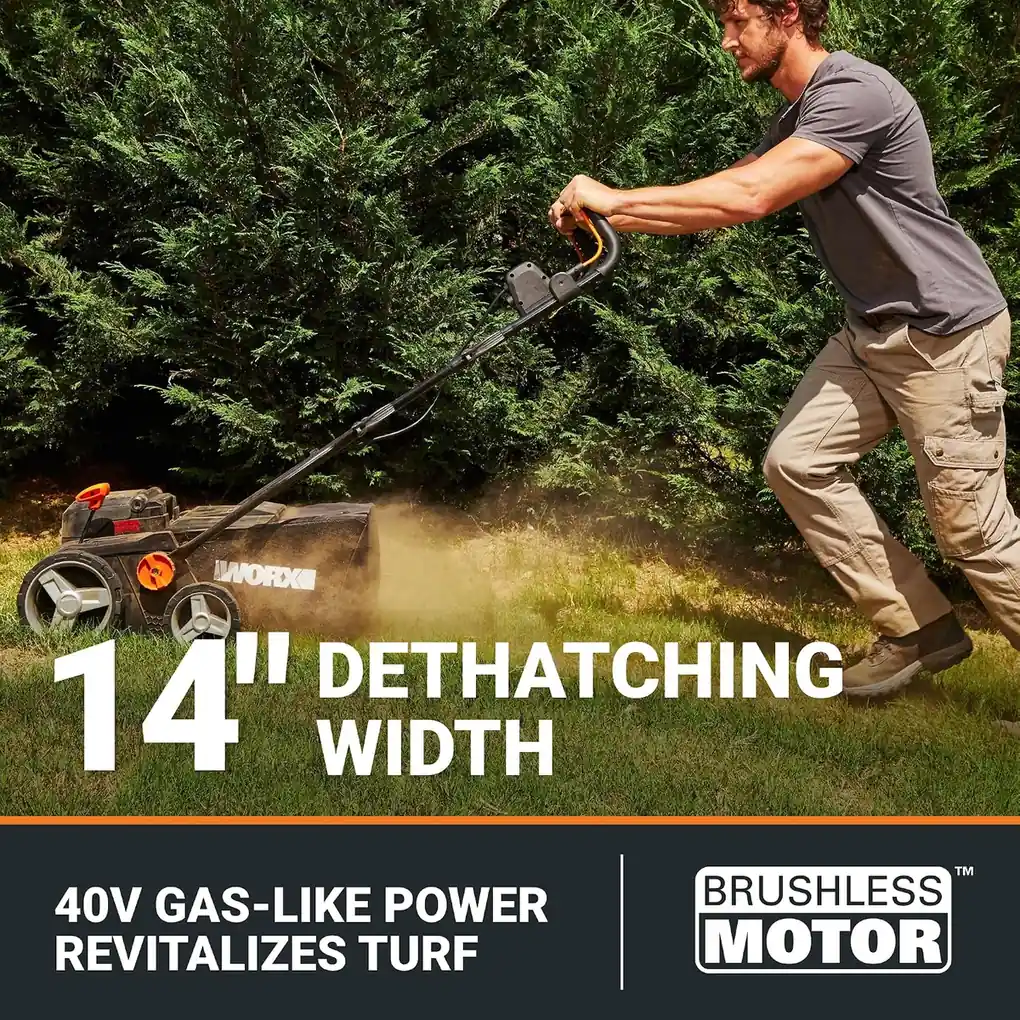
For the quarter-acre lawn beside my house, the WORX WG855 is my pick. It has the lower published weight, it carries the longer warranty, and its scarifier reel has 16 blades against the Sun Joe’s 7. The Sun Joe stays the choice for a buyer who wants a charge time and a depth chart in print. I compare options for different yard sizes and budgets in my ranking of the best lawn dethatcher models.
Whichever kit you order, check that the listing is the full kit with two packs and a charger, and wear glasses and hearing protection from the first pass. That is my answer to the Sun Joe 24V-X2-DTS15 vs WORX WG855 choice: the WORX for a house lawn like mine, and the Sun Joe for a buyer who wants the charge time and depth table in print. If you are still choosing between battery machines, my cordless dethatcher guide puts five of them side by side.
Frequently Asked Questions
Who makes the best cordless dethatcher?
Sun Joe and WORX both make a cordless dethatcher kit with two 4.0 Ah packs and both drums, and I pick the WORX for most house lawns because of its lighter published weight and three year warranty. Pick the Sun Joe instead when a printed charge time and a depth table for each drum matter more.
Is Worx a good brand?
Worx is a good brand for a cordless dethatcher when the model fits your lawn, and the WG855 brings a brushless motor, two 20V 4.0 Ah packs, both reels and a three year warranty when you register within 30 days. WORX also says its PowerShare batteries run more than 140 tools, which helps if you already own them.
What is a good scarifier for lawn care?
A good scarifier for lawn care has a blade drum you can set to a shallow depth, a bag that suits the lawn and a safety routine you follow every time. Both kits here carry a scarifying drum, with 7 slicing blades on the Sun Joe and 16 angled blades on the WORX, according to the makers.
What to do with lawn after dethatching with a small bag?
After dethatching with a small bag, empty the bag at half full, rake up the debris the machine leaves behind and water the lawn, then follow your grass’s extension advice for seeding and feeding. Both bags here hold 40 liters, so on a thick mat plan several trips to the compost pile.
What are the best dethatching systems for large properties?
For large properties the best dethatching system is usually a tow-behind or a corded machine, because neither battery kit here publishes a run time. These two kits suit a house lawn, and WORX says only that its kit covers up to 1/8 acre on one charge, with no conditions given, so plan extra charged packs.
References
- Occupational Safety and Health Administration. Preventing Fire and/or Explosion Injury from Small and Wearable Lithium Battery Powered Devices. Safety and Health Information Bulletin SHIB 06-20-2019. US Department of Labor; 2019.
- Carrow RN, Johnson BJ, Burns RE. Thatch and Quality of Tifway Bermudagrass Turf in Relation to Fertility and Cultivation. Agronomy Journal. 1987;79(3):524-530.
- National Institute for Occupational Safety and Health. Noise-Induced Hearing Loss. Noise and Hearing Loss. Centers for Disease Control and Prevention; 2024.
- Stange NR, Jennissen CA. Lawnmower-Related Eye Injuries in the U.S., 2004 to 2023. Am J Ophthalmol. 2025;277:7-16.
Safety Note: Read your manual first. A dethatcher or scarifier throws stones, sticks and other debris with force, so walk the lawn first and remove stones, sticks, toys, wire, hoses and pet waste. Mark sprinkler heads, irrigation and drip lines, low-voltage lighting wire and buried pet fence wire, keep the drum clear of them, and follow your manual’s limits near underground cables and pipes. Wear impact-rated eye protection with side coverage that meets ANSI Z87.1, hearing protection, gloves, long pants and sturdy non-slip closed shoes, plus a dust mask when the work raises dust. Keep people and pets as far away as your manual says, and stop at once if anyone comes closer. Never use a powered dethatcher on wet grass or in rain. The machine can jump up or forward when the tines hit hard or frozen ground, roots, stumps or buried rocks, so avoid those spots and hold the handle with both hands. Never lift or tilt the machine or reach under it while the drum turns. Before you clear a jam, empty or fit the collection bag, change the depth, clean, inspect or adjust the machine, turn it over, leave it, or touch the tines or blades, switch it off, wait for the drum to stop completely, then unplug the cord or remove every battery pack, and remove the safety key if it has one. Let hot tines cool before you handle them. If the machine starts to vibrate hard, switch it off, wait for the drum to stop completely, then unplug the cord or remove every battery pack and any safety key before you check it for damage. For a corded model, use an undamaged outdoor extension cord of the gauge and length your manual gives, plugged into a GFCI outlet, keep the cord behind you and clear of the drum, and never handle the plug with wet hands. For a battery model, use only the battery and charger approved for your tool, charge and store them within the temperature range in your manual, and never use a damaged or swollen pack. Stay off steep and wet slopes and work slopes only in the direction your manual gives. For a tow-behind dethatcher, follow both your tractor’s and your dethatcher’s manuals: tow it only behind a lawn tractor or riding mower that meets the maker’s requirements, never on public roads or behind a car or truck, keep a slow, steady speed, avoid sudden turns and stops, carry less weight on slopes and never more than the manual allows, never carry riders, and fit any tine safety wires the manual requires. Before you adjust or clear it, stop the tractor, set the parking brake, remove the key and disconnect the dethatcher as its manual describes. Dethatching at the wrong time of year, too deep or on stressed turf can badly damage a lawn, so match the timing and depth to your grass type.