
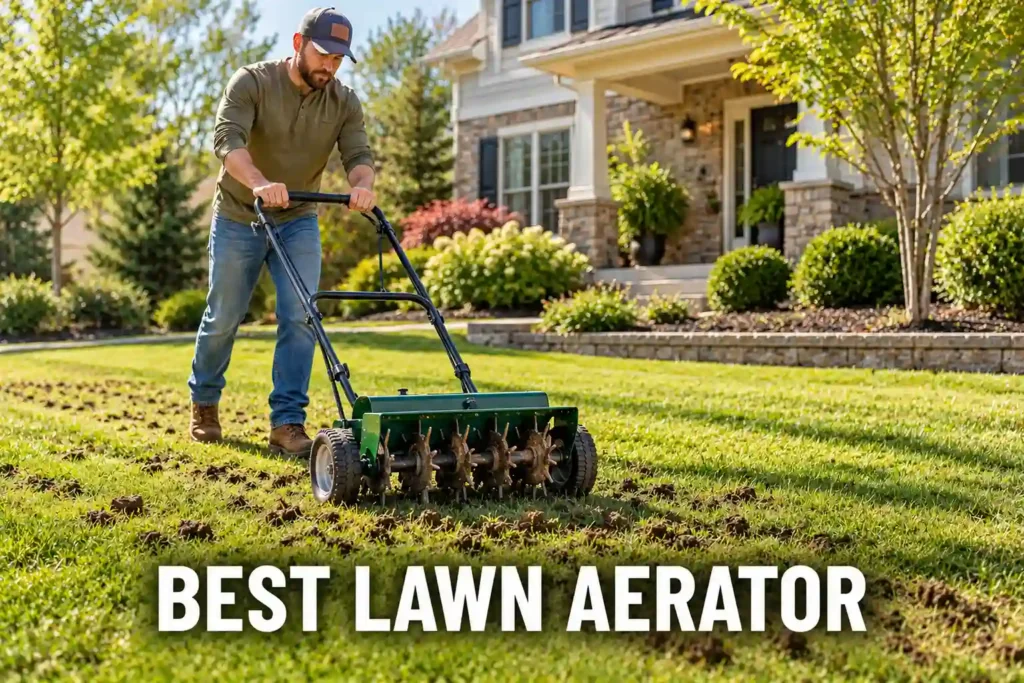
The best lawn aerator for most house lawns is a step-on core tool that pulls real soil plugs, and for a large lawn behind a tractor it is a tow-behind plug unit. I keep the lawns around a family farm and a 3.7-acre orchard, and I handled all nine of these aerators. Spike tools and a rolling drum are here too, with the limits extension services give them.
My top pick is the Yard Butler ID-6C Manual Lawn Coring Aerator. Below are the nine reviews, then how to choose, where a powered rental fits and the safety rules.
Best Lawn Aerator Reviews 2026: 9 Models I Put to Work
Five hand tools and four tow-behind units, ranked for a home lawn. Each review says what the tool does to the soil and where its limits sit, because a core tool and a spike tool do different jobs.
1. Yard Butler ID-6C Manual Lawn Coring Aerator Best Overall
The Yard Butler ID-6C is the best lawn aerator for most house lawns because it does the one job that matters, pulling real cores, with a tool you can use the day it arrives. It has two hollow tines, a foot bar and ejector tubes on a long handle, and the maker prints plain steps for using it. It pulls two small plugs per step, so it suits a small lawn or the worn spots on a bigger one.

WHY I CHOSE THIS ✓
I put it first because it is the simplest honest core aerator on this page. Two tines, a foot bar and ejector tubes, no assembly, and a guide that says how to use it. The cost is two small plugs per step, and for a house lawn I accept that.
Yard Butler ID-6C Manual Lawn Coring Aerator Specs
Key Features:
- Two hollow tines: They remove plugs of soil instead of poking holes, which is the method extension services recommend.
- Ejector tubes: Each new plug pushes the previous one out, so you keep stepping without stopping to clear the tines.
- Foot bar: It lets your body weight do the work, so your hands stay light on the grip.
- 37 in handle: According to Yard Butler it removes back strain, because you stay upright while you step.
- Cushioned grips: They spare your palms over a long session on a lawn.
- Powder-coated steel: The maker calls it heavy-duty and rust-resistant, and its warranty page says spot rust is cosmetic and can be brushed and painted.
- A published use guide: It says to water first, step firmly, pull straight up and space the steps 6 to 12 in apart, closer on compacted ground.
The method is simple: water the lawn thoroughly, set your foot on the bar, step down, pull straight up and move over 6 to 12 in. The tines leave plugs on the surface, and the maker says to leave them there to break down. Before I step anywhere I push a screwdriver into the lawn. University of Wisconsin Extension says ground is compacted if you cannot push a pen into dry soil, and a lawn that takes the probe easily may not need coring at all.
The plug figure depends on the document, since Yard Butler’s page says 3 in and its user guide says 3 1/2 in long and 1/2 in across. Either way that is plug length, not hole depth, and the depth you reach depends on soil moisture and the weight you put on the bar. Kansas State describes cores about 3/4 in across from powered machines, so these pencil-sized plugs are a smaller job. They are good for paths, worn spots and a small lawn.
I start with the worn lines. The 4 ft path to the house door and the edge where people step off the gravel pack down first, and the tool does its best work there. A whole quarter-acre lawn is a different matter: two plugs per step means a long job on the knees and ankles, so work in short sessions, keep your back straight and step down with the whole foot. Very dry, hard soil is where it struggles, and the answer is water the day before, not more force.

Water the lawn thoroughly before you start, as the maker says, and wait until the ground is damp, not wet. Leave the plugs on the lawn, where they break down.
Mark every sprinkler head, drip line, low-voltage lighting wire and buried pet fence wire before the first step, contact 811 and wait until every utility has responded. The plugs reach shallow lines, so never aerate where buried lines have not been located.
Yard Butler’s guide says to clean the ejector tubes after the last use or when one clogs, and I knock the soil out on the machinery shed bench. If a tube clogs, stop, stand the tool on the ground and only then clear it, with gloves on. Wear sturdy closed shoes with thick soles, because your foot takes the full push. The maker’s warranty page says to brush off rust spots once a year and coat the steel with non-rust spray paint.
Buy it if you have a small lawn or a set of worn spots and want real cores without buying a machine. Skip it if your lawn is large, if your knees or ankles complain, or if the soil stays rock-hard even after watering. For a wide pass over open ground, rent a powered unit instead.
FINAL VERDICT
Pick the ID-6C when you want real cores on a small to mid-sized lawn without a machine or an assembly session. It pulls two small plugs per step, and the maker’s pages say both “for life” and one year for the warranty, so read its warranty page before you rely on it.
It is the coring tool I recommend for most house lawns.
2. Landzie 42 in Hollow Tine Core Aerator Tool Best Premium
The Landzie 42 in is the premium step-on coring tool on this page: three stainless steel tines per push, tines you can take off for cleaning or replacing, and nothing to assemble. It is the best lawn aerator tool here for a buyer who wants more cores per step and a tool that arrives ready to use. Three cores per push means fewer steps for the same patch, at a premium price tier for a hand tool.

WHY I CHOSE THIS ✓
I put it second because it is the most refined hand coring tool here. Three tines, replaceable tines and no assembly make a lawn job easier. You pay for that, and the price is a premium tier and an unstated tine length.
Landzie 42 in Hollow Tine Core Aerator Tool Specs
Key Features:
- Three tines per push: Each step pulls three cores, so a worn patch needs fewer steps.
- Stainless steel tines: They sit on a powder-coated steel frame and resist the rust that bare steel picks up between seasons.
- Removable tines: According to Landzie they come off easily for cleaning and replacing, so a worn tine does not end the tool.
- Beveled tine ends: Landzie calls them clog-free, and I treat that as a claim, because wet, sticky soil clogs any hollow tine.
- No assembly: The tines arrive fitted to the frame, so the first step is the first use.
- Foot bar: You push with your body weight, and the cores drop out with each step.
- Maker’s directions: Water deeply the day before to soften the soil, then press the foot bar and let the cores drop.
The directions on the listing are short: water deeply the day before, place the tool, press the bar with your body weight and let the cores drop out. At 6.1 lb it is heavier than my old garden fork, and I feel that every time I lift it for the next step. The weight does not drive the tines on its own, so on hard ground the answer is more water, not more force. A hollow tine removes a plug, while a solid spike only makes a hole, and University of Wisconsin Extension says solid tines may increase compaction because the soil is pushed downward.
Landzie states no tine length, core size or hole depth, so judge the first plugs yourself and check how deep they come out. Real depth depends on soil moisture and your weight on the bar. Wet soil still smears and sticks to a hollow tine, so I wait for damp ground, not soaked ground. Kansas State says tines clog in wet soil and fail to enter dry soil, which is why the maker’s advice to water the day before matters.
The shaded spots under the trees are where I use it. Grass there thins, packs and holds moisture, and three cores per step cover a small patch quickly. Keep the tool away from a trunk, because feeder roots lie near the surface and a tine cuts them, and if you plan to overseed, University of Illinois Extension says the holes give the seed better contact with the soil. The limit is the coverage claim: the listing prints “Lifetime” on the product coverage row and gives no terms, so read what it covers before you count on it.

Water the shaded spots the evening before, and check the ground with a screwdriver in the morning. Dry ground bounces the tines out, so wait for rain or water first.
Before the first step, mark every sprinkler head, drip line, lighting wire and buried pet fence wire, contact 811 and wait until every utility has responded. Never aerate where buried lines have not been located.
Because the tines come off, cleaning is easy: stop, stand the tool on the ground, then take them off with gloves on and brush out the soil. Landzie’s page says to store it in a garage or shed, and I dry the tines before it goes on the shed wall. Sturdy closed shoes with thick soles matter here, since the bar takes your full weight and, over a whole lawn, the strain lands on the foot, ankle and knee, so work in short sessions with your back straight. Children never use or handle an aerator, and pets stay out of the work area.
It fits a reader with a small to mid-sized lawn or trouble spots who wants a no-assembly tool with three tines and replaceable tines and accepts a premium price. Skip it if you need a published core length before you buy, if the lawn is large or if your knees or ankles complain. Hard, dry soil needs watering first or a different tool, and the lifetime wording deserves a read of the fine print on the listing before you pay a premium for it.
FINAL VERDICT
Pick the Landzie when you want the most capable hand coring tool on this page and will pay for replaceable tines and no assembly. It publishes no core length, so check your first plugs against the extension depth for your grass.
It is the premium hand coring tool for small lawns and trouble spots.
3. Agri-Fab 45-0518 40 in Tow-Behind Plug Aerator Best Value
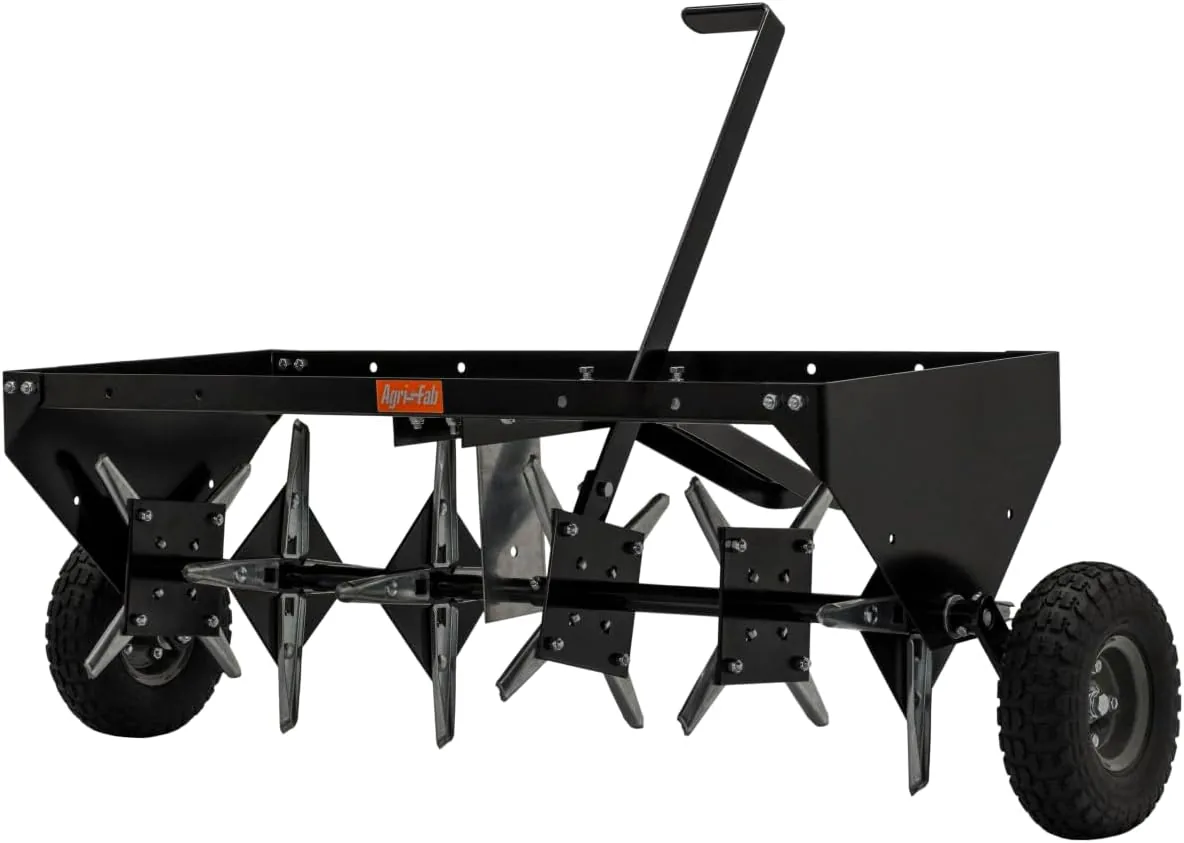
The Agri-Fab 45-0518 is the value pick among the tow-behind plug aerators here: a 40 in unit with 24 galvanized knives and a tray that takes up to 140 lb of added weight, at the lowest price tier of the tow-behind plug units. It suits a lawn tractor or riding mower owner with a small to mid-sized lawn who will add ballast and does not mind an assembly session. It has no motor and no handle, so without a tractor or rider it is no use to you.
WHY I CHOSE THIS ✓
Third place goes to this unit because it gives the most plug-pulling gear for the least money on this page. Twenty-four knives, a 140 lb tray and a 3-year warranty make it a sensible tow-behind plug unit. Its weak spot is wear-part coverage, since the maker excludes tires from the first day.
Agri-Fab 45-0518 40 in Tow-Behind Plug Aerator Specs
Key Features:
- 24 plug knives: Galvanized points pull small plugs up to 3 in long, according to the manual, and the maker says to sharpen them with a small grinder.
- 40 in working width: It fits more sheds and gates than a 48 in unit and suits a smaller tractor or riding mower.
- 140 lb weight tray: The manual says added weight increases penetration, and it names bags of sand or four concrete blocks as examples.
- Lift handle and lever: You raise the knives to the transport position before you cross a walk or a drive.
- Pneumatic tires: The maker page lists 10 in tires, and the manual lists a wheel only, so check what ships in your box.
- Universal hitch pin: The bracket takes a hitch pin and a hair cotter pin, so you hitch and unhitch without tools.
- 3-year limited warranty: It covers the original retail buyer and excludes tires and, from year 2, wheels and tines.
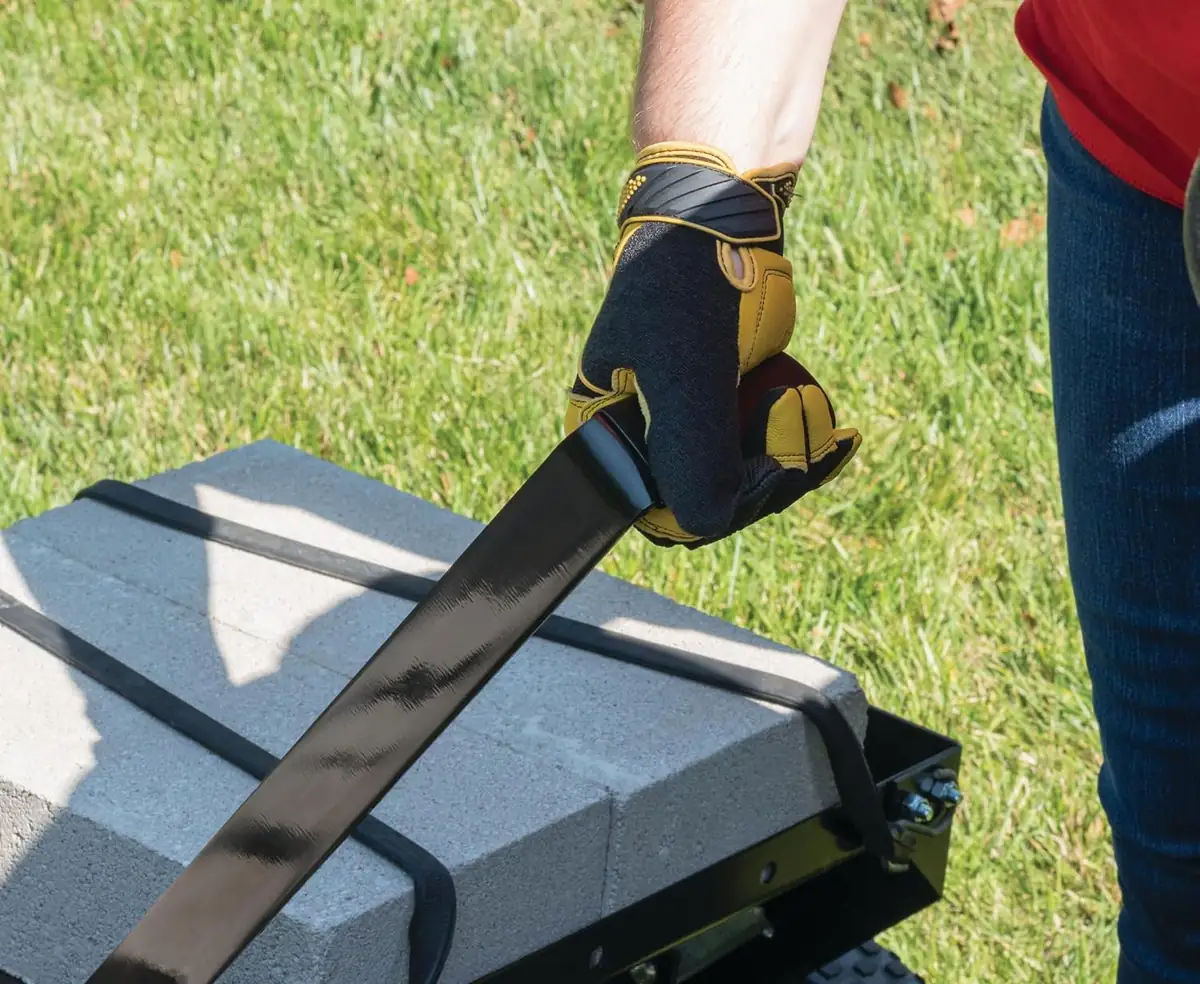
Weight is the lever on this machine. The manual says to add up to 140 lb to the tray to increase the depth of the knife points, and to strap the load so no strap reaches the rotating parts. I set four concrete blocks in the tray on the machinery shed floor to see how the straps run through the tray flanges, and the front and rear tie points are easy to reach. Add the weight in steps and look at the plugs after each pass.
The manual wants hard, dry ground watered for one to two hours first, and it says not to aerate if the ground is muddy. Make straight, overlapping passes, turn wide, and raise the unit to the transport position before a sharp turn or before you cross a walk or a drive. Slopes are a manual rule: work up and down, never across the face, and stay off steep ground and wet slopes, with less weight in the tray on a slope. On a quarter-acre lawn I pace out overlapping rows along a 40 in stick before I plan any pass.
The first job is assembly, and the manual lists four wrench sizes. Expect twelve line items in the carton, two wheel brackets, four spool assemblies and a hardware pack, and no weights or straps. The knife points are bare steel with no guard, so I handled them with gloves. Plugs from stony ground can carry small rocks, and the manual says to rake them because gravel can damage mower blades.
Pick up stones and sticks before the first pass, and mark every sprinkler head and drip line.
Mark all buried lines and contact 811 before you tow it, wait until every utility has responded and never assume 3 in knives cannot reach a line. Start in low gear at low engine speed, never put people in the tray as ballast and never allow anyone to ride on the frame or the towing vehicle.
After each use I clean the dirt off the knives, being careful of the sharp edges, and the manual says to check for loose fasteners before every use. Oil the spool assemblies, shaft and wheel hubs as needed, and store it clean and dry with a light coat of oil on the bare metal. The manual says to dismount before raising or lowering the unit with weight in the tray, and that rule is worth learning before the first pass. Stop the engine, remove the key, set the brake, unload the tray and wait until everything has come to rest before you touch the knives.
Pick it if you own a lawn tractor or riding mower, have a small to mid-sized lawn and want the lowest-cost route to real plugs. Skip it if you have only a push mower or if your lawn is steep. On hard, dry soil, wait for moisture before you add any ballast. Anyone who dislikes assembly should plan an afternoon for it.
FINAL VERDICT
Pick the 45-0518 when you have a tractor or riding mower and a modest lawn, and you want pulled plugs at the lowest tow-behind price tier. It asks for an assembly session and ballast you supply, and its wear-part coverage is thin.
It is the tow-behind plug unit I recommend on a budget.
4. Brinly PA-482BH-A2 48 in Tow-Behind Plug Aerator Best for Large Lawns
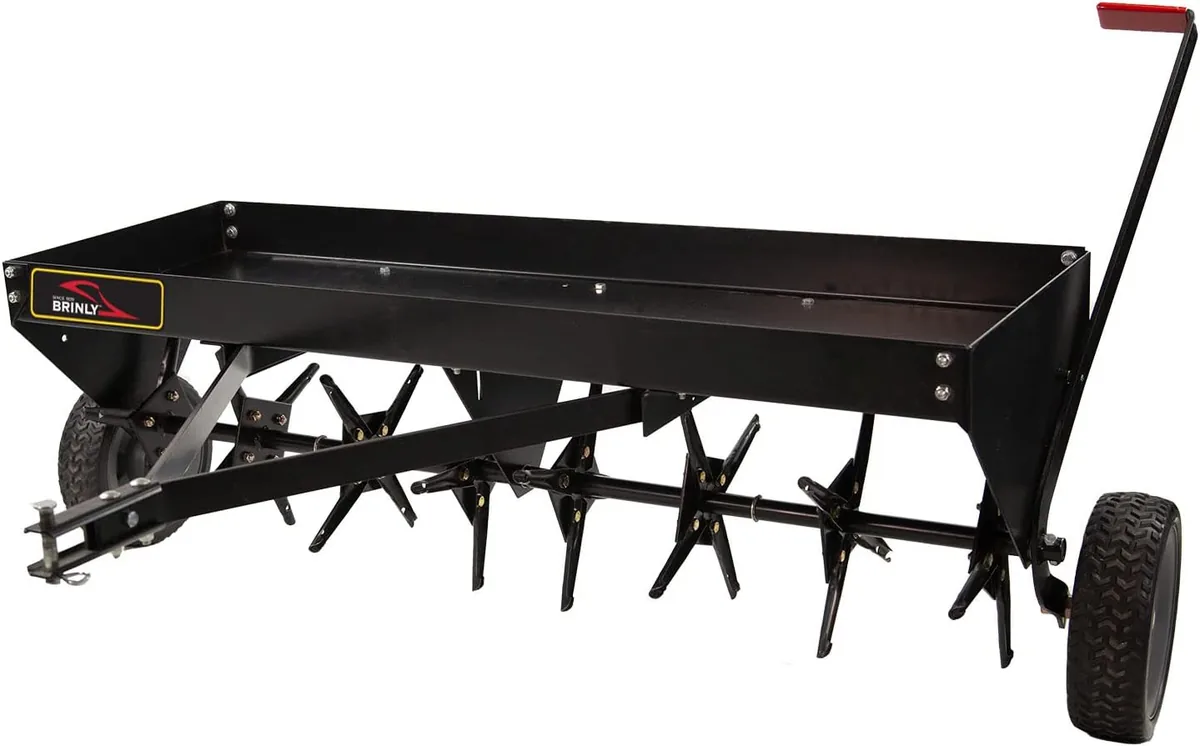
The Brinly PA-482BH-A2 is the widest tow-behind on this page, with a 48 in pass, 32 plugging spoons and a 200 lb weight tray. It is my pick when you want the best aerator for large lawns and own a garden tractor or a heavy rider. A wide pass means fewer rows, but the tow rules decide whether your machine can pull it.
WHY I CHOSE THIS ✓
It earns fourth place for large open lawns where width saves real time. Thirty-two spoons and a 200 lb tray do the work. Its limits are the tow rule and a long assembly.
Brinly PA-482BH-A2 48 in Tow-Behind Plug Aerator Specs
Key Features:
- 48 in pass with 32 spoons: Four rotating sections spread the spoons across the width, so a large lawn takes fewer rows.
- 200 lb tray: The weight needed for 2 to 3 in of penetration varies with soil, and the big tray leaves room.
- Replaceable spoons: You replace each spoon on its own.
- Published tow rules: The manual sets a 5 mph limit and a 290 lb maximum towed weight, empty unit plus load.
- Transport lever: It raises the spoons to cross concrete or asphalt.
The manual gives a test pass: drive about ten feet, look for a plug hole every 10 to 12 in, none deeper than 3 in, and adjust the weight. I held the 57 in overall width against the door of the tool shed, because the 48 in working width is not the width you park. I cover the 48-inch plug aerator and its 200 lb tray in my review of the PA-482BH-A2.
The tow rule is the catch. The manual says the tow vehicle plus the operator must weigh more than the maximum towed weight, which is 290 lb with a full tray. A small rider may not qualify, and the manual allows only riders and lawn and garden tractors.

Roll a ball of soil from 3 in down in your hand: powdery means too dry, and a ball that stays together means too wet. I check that way before I decide.
Do not use it on steep slopes, because a heavy load can cause loss of control or overturn the towing vehicle. Reduce the towed weight on a slope, and stop on level ground, set the brake and shut off the engine before you leave the seat.
Oil each nylon bearing and the axle before every use and put a light coat on the spoons afterward, with the engine off, the key out, the tray unloaded and the aerator disconnected, as the manual says for servicing. Striking sub-surface objects can break a spoon, so I walk the lawn for stones first and keep the aerator off the tilled strips under the young trees.
It suits an owner of a garden tractor or heavy rider with a rear hitch plate and a large open lawn. Skip it if you have a small rider, a push mower, a cluttered yard or steep ground.
FINAL VERDICT
Choose the PA-482BH-A2 when width is the problem and your tractor can carry 290 lb behind it. Check the box and the manual against the listing’s model suffix, and read the warranty seller terms before you order.
It is the wide pass for a large lawn behind a garden tractor.
5. Brinly PA-403BH-A3 40 in Tow-Behind Plug Aerator Best Lightweight Tow-Behind Plug Aerator
The Brinly PA-403BH-A3 is the lightest tow-behind plug aerator on this page at 66 lb empty, and it is the best pull behind lawn aerator here for a lighter rider or tractor. It carries 24 spoons across 40 in and a 150 lb tray. A lighter frame helps a smaller machine, but only when its manual and Brinly’s manual both allow the pairing.

WHY I CHOSE THIS ✓
I rank it here as the tow plug unit for a smaller tractor whose manual allows it. Sixty-six pounds empty and a 216 lb tow limit make it easy to check against your machine. It gives up width for that.
Brinly PA-403BH-A3 40 in Tow-Behind Plug Aerator Specs
Key Features:
- 66 lb empty weight: Brinly’s manual sets a 216 lb maximum towed weight to check against your tractor.
- 150 lb tray: The listing says the narrow, sharpened spoons need less weight to bite, and the manual says the needed weight varies with the soil.
- Replaceable spoons: Each spoon comes off on its own, so a bent spoon is a spare part.
- Three rotating sections: According to Brinly they follow uneven ground and tractor turns.
- Transport lever: It lifts the spoons off the ground for crossing walks and drives.
Light weight is a trade. The manual says dry soil means the spoons will not penetrate properly, and it suggests three concrete blocks as a start. At 66 lb empty it is a unit I can still tip up on its wheels at the shed door, which matters when you store it between seasons. I take a closer look at this 40-inch tow-behind plug aerator in my review of the PA-403BH-A3.
Brinly’s manual covers the PA-403BH family and the listing says A3, so check the box before you order. The manual allows only riders and lawn and garden tractors, in tow mode or under 5 mph, and the tow vehicle plus operator must outweigh the loaded unit without passing the tractor’s own towing capacity.
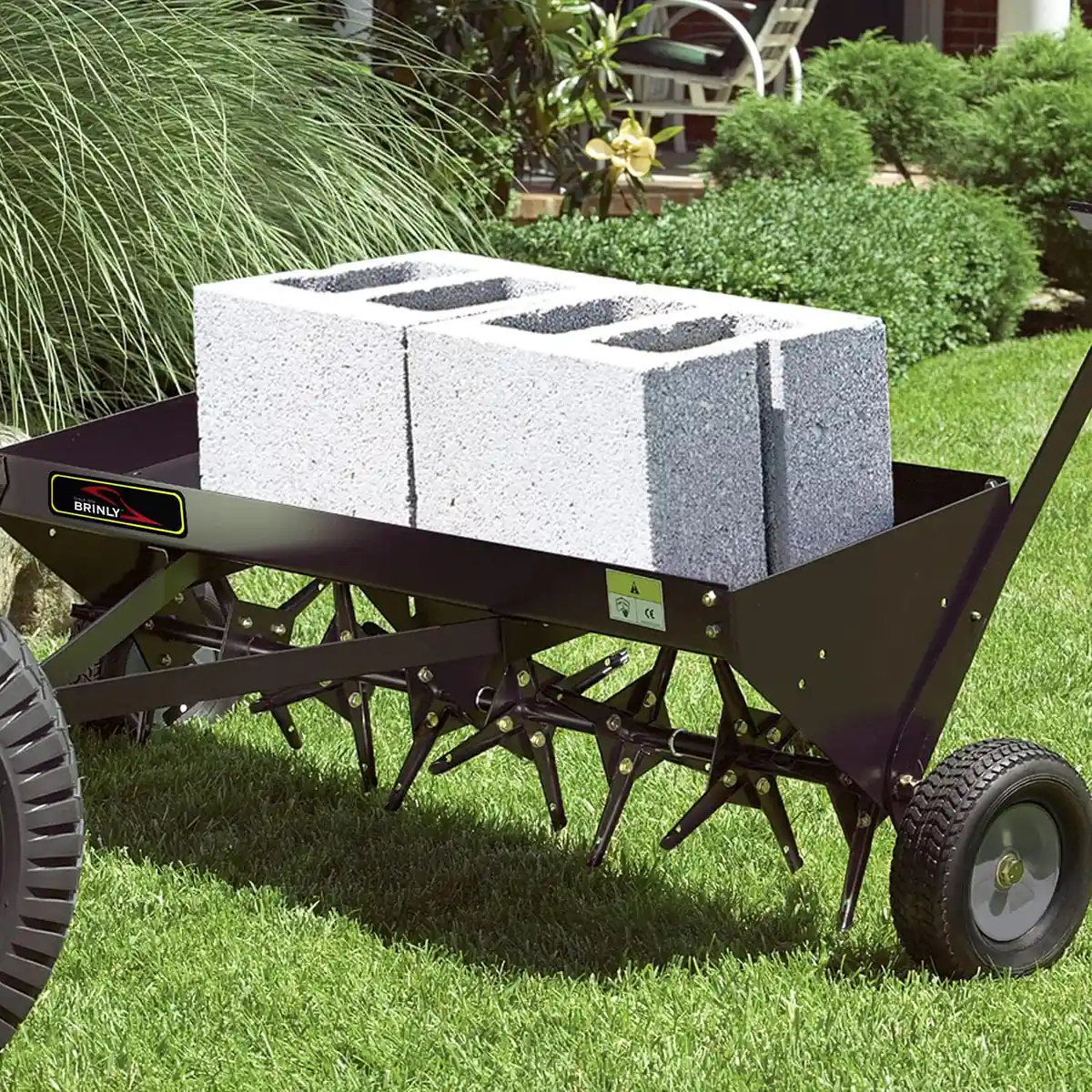
Tie the blocks through the tray flanges, because the manual says no tie-downs come in the box, and I check every strap before I move the unit.
Use wide turning angles, slow down before turns and keep it off steep slopes, because the manual warns a heavy load can overturn the towing vehicle. Never disconnect it with weight still in the tray, and stop the engine and remove the key before you clean or service it.
Oil the nylon bearings and the axle before every use. Before I store it I wipe the spoons with a light coat of oil, as the manual says, and I wear gloves, because the spoons stay sharp.
It fits a rider or a lighter garden tractor with a rear hitch plate, a manual that allows the pairing and a small to mid-sized lawn. Skip it if you have only a push mower or if the lawn is steep. On hard dry soil, wait for moisture before you add any ballast. A reader who wants a longer warranty should read the terms first.
FINAL VERDICT
Pick the PA-403BH-A3 when your tractor is small, both manuals allow the pairing and the tractor plus operator outweigh the loaded unit. It is narrower than the big units, and the spoons need ballast and moist soil to bite.
It is the light tow-behind plug unit for a smaller tractor.
6. CRAFTSMAN CMXGZBF7124336 36 in Tow-Behind Spike Aerator Best Tow-Behind Spike Aerator
The CRAFTSMAN CMXGZBF7124336 is the only tow-behind spike aerator on this page: nine galvanized spike discs on one axle, 36 in wide, built by Agri-Fab. It suits a tractor or riding mower owner who wants to open a lawn surface on a budget. It makes holes and removes no soil, and extension services rate that method below coring.

WHY I CHOSE THIS ✓
This is the budget tow-behind spike option. It costs little and the manual is clear. It does the lighter of the two jobs, and I say so.
CRAFTSMAN CMXGZBF7124336 36 in Tow-Behind Spike Aerator Specs
Key Features:
- Nine spike discs: The star-shaped points punch holes as the axle turns, and the discs sit on one axle with springs and spacers.
- 36 in width: It fits behind a tractor or riding mower and through a narrow gate.
- Frame ballast: Two 35 lb patio blocks fit on the frame, and the manual caps added weight at 90 lb.
- Adjustable hitch arms: You loosen the bolts on the arm brackets to level the aerator behind the towing vehicle.
- 3-year limited warranty: The manual covers faulty materials or workmanship, not normal wear or tool abuse.
Spiking is a short-term fix. University of Wisconsin Extension says solid tines may increase compaction because the soil is pushed downward, and Kansas State says spiking gives short-term effects. Wisconsin does allow spikers to open a soil surface before overseeding. I strapped two patio blocks onto the frame to see how the load sits, and the 90 lb cap leaves little room beyond them.
The manual says to mow first and remove loose clippings. Water hard, dry ground for one or two hours beforehand, and never aerate when the ground is muddy. Make straight, overlapping passes and avoid sharp turns, which tear the lawn.
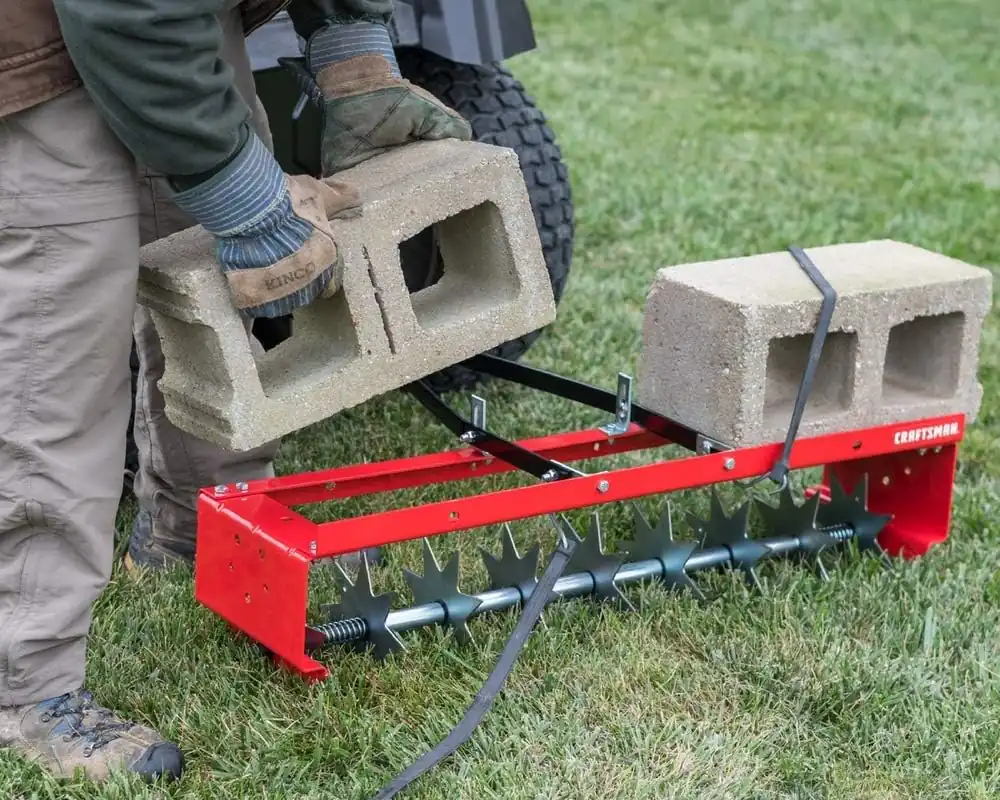
The discs have no wheels and no transport position, so keep it off drives and walks and never drag it across a hard surface.
Wear eye protection, substantial footwear and gloves, because the spike points are sharp. Work up and down a slope, never across its face, and stay off steep ground.
Check the fasteners before each use and lubricate the disc hubs at the start of each season. Stop the engine, remove the key and set the brake before you clean the spikes, and wear gloves, then clean the soil off the spikes afterward and store it dry with a light coat of oil. I turned the discs by hand on the shed floor and looked at how the springs and spacers sit on the axle. The listing’s tray, width and assembly lines disagree with the manual, so follow the manual.
Get it if you own a tractor or riding mower and want a cheap way to open a flat lawn before overseeding. Skip it if you need cores, if the soil is heavy or compacted, if you have no tractor or if the lawn has steep ground. Rent a powered core aerator for compaction.
FINAL VERDICT
Choose the CMXGZBF7124336 when you want a low-cost spike pass behind a mower and accept its limits. It does not pull plugs, and for compacted soil a core aerator does the job better.
It is the budget spike aerator for a flat lawn.
7. Colwelt C082 Manual Spike Lawn Aerator Best Hand Spike Aerator
The Colwelt C082 is the only step-on spike tool on this page, with four thick spikes of 3.5 in on a 38 in frame. It suits a tight spot or a small yard where you want holes, not cores. Four spikes per step is slow, so it is a spot tool, and Colwelt itself says spike aeration suits lawns that are not badly compacted.

WHY I CHOSE THIS ✓
I rank it as the hand spike tool for a small yard. The spikes are long and the tool is light. It does the lighter job, and it will not fix compacted soil.
Colwelt C082 Manual Spike Lawn Aerator Specs
Key Features:
- Four spikes of 3.5 in: According to Colwelt they are thicker than the thin spikes on cheaper tools, so each step makes bigger holes.
- Steel build: Colwelt lists steel construction, and the spikes are fixed to the frame.
- 38 in height: You stay upright, so the step does not need a bend.
- Cushioned T-handle: A T grip with soft padding spares your hands over several steps.
- Foot plate: A 6 in wide plate takes a work boot, and the load goes through your foot.
A spike pushes a hole and does not remove soil. University of Wisconsin Extension says solid tines are less effective than hollow tines and may increase compaction, and Kansas State says spiking gives only short-term effects. After a core tool the spike holes look small to me, and Colwelt’s own warning to avoid overly wet lawns agrees with extension on soil moisture.
The tool ships disassembled, with an instruction sheet, a wrench and the fixings. I put it together on the bench and tightened every bolt before the first step. Water the lawn first, as Colwelt advises, and clean and dry the spikes after use.

Use it on the corner by the shed and the path edge, not the whole lawn.
Mark every sprinkler head, drip line, lighting wire and pet fence wire before the first step, contact 811 and wait until every utility has responded. Wear sturdy closed shoes with thick soles and gloves, and keep children and pets away.
Stop, stand the tool on the ground and then clear the soil off the spikes, with gloves on. Colwelt tells you to keep the sharp spikes away from children and to dry the tool after cleaning. Over a whole lawn the strain lands on the foot and knee, so work in short sessions. Colwelt publishes no manual and no warranty term.
It suits a small yard or a few spots that need opening before seed. Skip it if the soil is badly compacted or heavy, if you want cores or if you have a large lawn. For a whole lawn, a core tool or a rented powered aerator does more.
FINAL VERDICT
Choose the C082 when you need a cheap, light step-on tool for tight spots and accept spike holes instead of cores. It will not relieve heavy compaction.
It is the light hand spike tool for tight spots.
8. Walensee 42-Spike Rolling Lawn Aerator Best Rolling Lawn Aerator
The Walensee rolling aerator is the best rolling lawn aerator on this page, and the only rolling one: you push a drum of 42 spikes across the lawn instead of stepping on every spot. According to Walensee the spikes come pre-installed and the drum can be filled with stones for more weight. It covers ground faster than a foot tool, but the spikes are short.

WHY I CHOSE THIS ✓
I rank it as the one rolling tool on this page. It trades depth for ground covered. On a small, moist lawn, rolling is easier on the knees than stepping.
Walensee 42-Spike Rolling Lawn Aerator Specs
Key Features:
- 42 spikes: Walensee says they are heat-treated and set around the drum, so a push leaves a pattern of holes across the lawn.
- Fillable roller: You can add stones for extra weight, and the listing says never to use sand.
- Adjustable handle: The handle poles are adjustable stainless steel, so you set the height to your stance.
- Rubber grip: It cushions the hands over a long push.
- Pre-installed spikes: You assemble only the handle, with the tools in the box.
A rolling drum gives you speed and not depth. University of Wisconsin Extension says spikers often poke holes less than 1 in deep and have limited effect on compaction. I filled the roller with stones from the gravel yard edge to give it weight, and I kept sand out, as the listing says. The listing also says to water first, because dry ground makes the drum skip.
The listing says to avoid hard ground, clay, root-covered areas and gravel or stony soil. The best use is a lawn on soft, moist, open ground, and I keep it off the root-covered ground under the shade trees. Walk the drum straight and keep the handle high on turns.

Probe the lawn with a screwdriver before you roll anything.
Walk the lawn and mark every sprinkler head, drip line, lighting wire and pet fence wire before the first pass, then contact 811 and wait until every utility has responded. Wear sturdy closed shoes and gloves, and keep children and pets away.
Clean the soil off the spikes after use and dry the drum, because plain steel spikes can rust. Empty the stones before you lift it into the shed, since a loaded drum is heavy. Walensee publishes no manual and no warranty term, so check the listing for returns. The four-part handle goes together with the tools in the box.
It suits a small, moist, open lawn where you want to open the surface before overseeding without stepping on every spot. Skip it if the soil is hard, clay, stony or full of roots, or if you want cores. A compacted lawn needs a core aerator.
FINAL VERDICT
Choose the Walensee when you want a push tool that covers ground and accept shallow spike holes. It does not pull cores, and the maker publishes few figures.
It is the push roller for a small, soft lawn.
9. Xuperace GD0001-02 Hollow Tine Core Aerator Tool Best Long-Tine Core Aerator
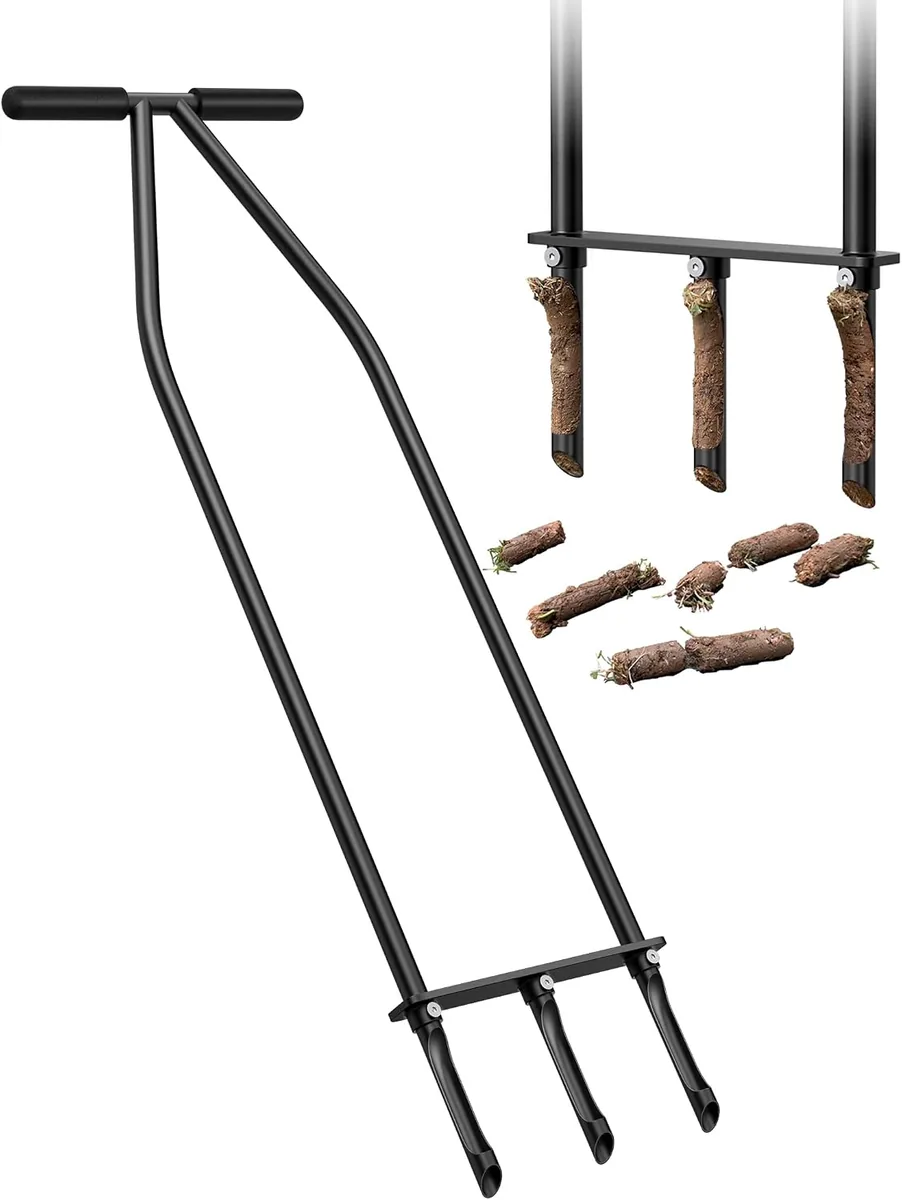
The Xuperace GD0001-02 is the best plug lawn aerator on this page for tine length: three hollow tines of 5.9 in according to Xuperace, with the plugs ejecting out of the side. That figure is tine length, not hole depth, and real depth depends on soil moisture and your weight. It suits a small yard or a set of trouble spots.
WHY I CHOSE THIS ✓
I rank it ninth for the longest published tine among the coring tools here. Three tines, side ejection and replaceable tines make it a capable hand tool. Its limits are an unstated warranty term and hole depth.
Xuperace GD0001-02 Hollow Tine Core Aerator Tool Specs
Key Features:
- Three hollow tines of 5.9 in: According to Xuperace they pull plugs, and the tine length is not the depth of the hole.
- Side ejection: The plugs leave through a ramp at the side of the tool.
- Screw-fixed tines: They are replaceable, and the listing says to tighten the screws firmly.
- Removable middle tine: The listing says you can take it out for harder ground, which cuts the cores per push from three to two.
- Moist-lawn tool: Xuperace says it works best on a moist lawn, so water first or use it after rain.
The maker says it works best on a moist lawn and suits small yards. I tightened the tine screws with a wrench before the first step, since the listing says they must be firm and loose screws were the first thing to check. Side ejection sends the plugs out to one side of the tool. I cover the GD0001-02 step-on tool for small lawns in my Xuperace aerator review.
A long tine does not mean a deep hole. Wet soil smears and sticks to hollow tines, and dry soil keeps them out, which is why Kansas State warns about both. Water the day before, use it after a long rain or wait for damp ground.

I leave the middle tine in unless the ground is hard, because taking it out means fewer cores per step.
Contact 811 and wait until every utility has responded, then mark every sprinkler head, drip line, lighting wire and pet fence wire before the first step. Wear sturdy closed shoes with thick soles, long pants and gloves.
Stop, stand the tool on the ground, then clear plugs or tighten screws. Clean the soil off the tines, dry them and keep the bare steel from rusting. The foot plate takes your full weight, and over a whole lawn the strain lands on the foot and knee, so work in short sessions. Xuperace publishes no manual and no warranty term.
It works for a small to mid-sized lawn or trouble spots where you want long tines with side ejection. Skip it if the lawn is near an acre, if the soil is rock-hard or if you want a published manual. Work a large lawn in sections.
FINAL VERDICT
Choose the GD0001-02 for small lawns where tine length and side ejection matter to you. Tighten the screws, water first and expect to judge the hole depth yourself.
It is the long-tine coring tool for small yards.
How to Choose the Best Lawn Aerator
Five checks sort these tools, and the first is the tine itself, because a hollow tine and a solid spike are different jobs. I run them in this order before I buy anything.
Choose Core Tines or Spikes
A core tool pulls a plug of soil out of the lawn and leaves it on the surface, and a spike tool pushes a hole and removes nothing. The two are not the same job. In a simulated-rainfall trial, runoff was lower on hollow-tine plots than on solid-tine plots, 55 percent lower two days after cultivation (1). Under simulated traffic on Kentucky bluegrass, hollow-tine plots lost the least green cover per traffic event (2).
| Type | What it does | What extension says |
|---|---|---|
| Core (hollow tine) | Pulls plugs of soil and leaves them on the lawn | The most effective type, with temporary relief from compaction (Wisconsin) |
| Spike (solid tine) | Pushes a hole and removes no soil | Short-term effect, and the soil pressed aside can pack again (Kansas State) |
| Rolling spike | Spikes on a push drum | Holes often under 1 in deep and limited effect on compaction (Wisconsin) |
| Aerator shoes | Spikes strapped to your boots | “Totally ineffective” for aerating turf (Wisconsin) |
I judge a core tool by its tine count and ejection, and a spike tool by whether it pretends to be something else. For the best core lawn aerator, look for hollow tines that clear their plugs, and expect step-on tools to pull plugs smaller than the 3/4 in cores Kansas State describes for powered machines. My best core aerator list compares seven hollow-tine tools for small and large lawns.
Key Takeaway
Choose hollow tines for compaction and thatch. Use a spike tool or a rolling drum only to open a surface for seed, and expect a short-term effect.
Check Whether Your Soil Is Compacted
Compaction presses soil particles together and squeezes the air out. In a field study, roller compaction reduced turf quality, cover and carbohydrate reserves in perennial ryegrass, Kentucky bluegrass and tall fescue (3). A greenhouse study of Kentucky bluegrass found that compacted soil kept oxygen low for 143 hours after wetting, against 26 hours in uncompacted soil, and it shifted the roots toward the surface (4). Hard ground has its own list in my best lawn aerator for compacted soil picks.
- The pen test: University of Wisconsin Extension says the ground is compacted if you cannot push a pen into dry soil.
- Where it builds: Kansas State says compaction mostly forms in the top 2 inches under activity on moist soil, with the worst spots under parked cars and worn paths.
- What it is not: Sandy soils rarely become compacted, and a lawn that drains well may not need aerating at all.
I push a screwdriver into the lawn along the path to the house door and at the edge of the gravel before I choose a tool, and I probe in the same spots each time.
Pro Tip
Probe three or four spots with the same downward force each time, because moisture changes how deep the probe goes.
Match the Tool to Your Lawn Size
A step-on tool is the best manual lawn aerator for a small lawn or the worn spots on a bigger one. A tow-behind unit suits a large lawn if you own a lawn tractor or rider. Lawn size sets the format, and the tool that is right for a quarter acre is a chore on two.
| Format | Best for | Limit |
|---|---|---|
| Step-on core tool | Small lawns and worn spots | Two or three plugs per step, so slow on a whole lawn |
| Rolling spike drum | Small, soft lawns where you want to open the surface | Shallow holes, and it skips on hard ground |
| Tow-behind plug | Large lawns behind a lawn tractor or rider | Needs ballast and a tow vehicle that meets the manual |
| Tow-behind spike | Flat lawns where you want a surface pass | Removes no cores |
- Tractor or rider: A tow-behind unit needs a machine the manual allows, and the tow vehicle plus operator must outweigh the loaded aerator.
- Storage: A 48 in unit is harder to park than a 40 in one, and a hand tool hangs on a shed wall.
- Assembly: Tow-behind units arrive in pieces, and some hand tools do too. The tow-behind units I rate for a tractor or mower are in my best tow-behind lawn aerator list.
I paced the width of a 40 in unit along the house lawn and counted how many overlapping rows a quarter acre needs. The best aerator for a small lawn is the one you will actually use, and for most house lawns that is a hand tool. Hand tools for a lawn this size are in my best lawn aerator for small yard picks.
Time the Job to Your Grass and Soil
Every extension source agrees on one point: aerate while the grass is actively growing, so it can fill the holes. Kansas State gives March, April and September for cool-season lawns, and late May through July for bermudagrass, buffalograss and zoysiagrass. Other states give other dates, so check your own extension office for your grass and region.
- Moisture: Wisconsin says slightly moist but not overly wet, and if the soil is dry, water thoroughly one to two days before.
- Spring caution: Spring hollow-tine cultivation did not significantly increase crabgrass cover in Kentucky bluegrass or tall fescue lawns in a New Jersey trial (5).
- Recovery: On a bermudagrass putting green, turf quality dropped for about 4 weeks after each coring (6), a far heavier schedule than a home lawn gets.
Lawn Health
Aerating at the wrong time, on dry hard soil, on waterlogged soil or on dormant or stressed grass can harm a lawn. Wait for damp ground and growing grass.
I water the lawn the evening before and probe again in the morning, and I wait when the soil sticks to my boots.
Read the Safety Rules Before the First Step
Tines and spikes cut or crush shallow lines, and a tow-behind unit is a heavy load. I follow the same order every time: mark, check, then work.
- Buried lines: Mark every sprinkler head, drip and irrigation line, low-voltage lighting wire and buried pet fence wire, contact 811, wait the required time and confirm every utility has responded. Short tines can still reach shallow lines, so never aerate where buried lines have not been located.
- Feet and hands: Wear sturdy closed shoes with thick soles, long pants and gloves when you handle tines or spikes.
- People and pets: Keep everyone else out of the work area, and children never use or handle an aerator.
- Tow-behind units: Follow the tractor’s manual and the aerator’s manual, allow no riders, never use a person as ballast, stay off public roads and never exceed the tray’s weight limit. Stay off wet and steep slopes, carry less weight on a slope, and raise the tines or use the transport position before a sharp turn or a hard surface. A unit with no transport position is never dragged over a hard surface.
- Clearing and adjusting: Stand a hand tool on the ground first. On a tow-behind unit, stop on level ground, set the brake, stop the engine, remove the key and wait until everything has stopped, then unload the tray and disconnect the aerator before you clear the tines or service it.
Before You Start
Check the manual of the tool you buy. Hitch rules, weight limits and slope rules differ by model.
Where Powered Lawn Aerators Fit and When to Rent
No gas or electric core aerator is on this page. A reader hoping for the best electric lawn aerator should rent a powered core aerator instead, which is the heavy machine extension services describe.
Kansas State says a professional is recommended for core aeration because it needs special heavy duty equipment to penetrate the soil, and University of Wisconsin Extension says drum units, the most common rental type, rarely penetrate more than 2 inches in dry soil while piston units pull 3 inch cores. Renting suits a large lawn without a tractor, and for that job I rent, follow the rental machine’s manual and keep the same marking and 811 steps. A gas core aerator is heavy and can pull forward, so hold the handle with both hands, wear eye and hearing protection and run it outdoors only. Stop the engine and disconnect the spark plug wire before you clear the tines, and refuel outdoors with the engine off and cool.
Liquid aerators are not tools. In a three-year bermudagrass trial, monthly liquid aeration did not reduce penetration resistance or raise infiltration the way sequential hollow-tine cultivation did (7). I keep my money for a tool that removes soil.
My Overall Verdict
The best tool for a house lawn pulls real cores, fits your lawn size and is safe to run, and the top three do that in different ways.

1. Yard Butler ID-6C Manual Lawn Coring Aerator Best Overall
For a small to mid-sized lawn or worn spots where you want real cores from a tool with no assembly.

2. Landzie 42 in Hollow Tine Core Aerator Tool Best Premium
For the same jobs when you want three tines per step and replaceable tines, and a premium price does not bother you.

3. Agri-Fab 45-0518 40 in Tow-Behind Plug Aerator Best Value
For a tractor or riding mower owner with a modest lawn who wants plugs at the lowest tow-behind price tier.
Probe the soil, mark the lines, wait for damp ground and growing grass, and wear closed shoes. For most house lawns the Yard Butler ID-6C is the best lawn aerator. I examine the ID-6C two-tine step-on tool in my Yard Butler aerator review.
Why Yard Butler ID-6C Manual Lawn Coring Aerator Might Be the Best Choice
I put the Yard Butler ID-6C Manual Lawn Coring Aerator first because it pulls real cores without a machine or an assembly session. Two hollow tines, a foot bar and ejector tubes do the job extension services recommend.
The trade is speed. Two plugs per step makes a whole lawn slow, so I start with the worn lines and work in short sessions.
What puts it first:
✓ Tines: two hollow tines that pull plugs.
✓ Ejector tubes: each plug pushes the last one out.
✓ No assembly: the maker describes no assembly step.
✓ Handle: 37 in tall, so you stay upright.
✓ Use guide: the maker publishes water-first steps and spacing.
Frequently Asked Questions
What kind of lawn aerator works best?
The kind of lawn aerator that works best is a core aerator, which pulls plugs of soil out of the lawn instead of poking holes. University of Wisconsin Extension calls hollow-tine units the most effective type, and a step-on tool fits a small lawn while a tow-behind plug unit fits a tractor owner.
What month is best to aerate a lawn?
The best month to aerate a lawn depends on your grass, because every extension source says to aerate while the grass is growing fast. Kansas State Extension gives March, April and September for cool-season lawns and late May through July for bermudagrass and zoysiagrass, so check your own state’s extension office.
Which is better, a spike or plug lawn aerator?
A plug aerator is better than a spike aerator for most lawns, because it removes plugs of soil while a spike tool pushes the soil aside and leaves it packed around each hole. Extension services say spiking gives short-term relief and can add compaction, though a spike tool can open a surface for seed.
Which lawn aerator is best?
The best lawn aerator depends on your lawn size and equipment: a step-on tool fits a small lawn, a rolling drum fits a small soft lawn, and a tow-behind unit fits a large lawn behind a lawn tractor. Whatever the format, choose hollow tines over spikes when compaction is the problem.
What is the best lawn aerator to buy?
The best lawn aerator to buy for most house lawns is the Yard Butler ID-6C, a step-on core tool with two hollow tines and no assembly. A lawn tractor owner with a large lawn gets through the job faster with a tow-behind plug unit, as long as the tractor’s manual and the aerator’s manual allow the pairing.
References
- Rice PJ, Horgan BP. Nutrient loss with runoff from fairway turf: an evaluation of core cultivation practices and their environmental impact. Environmental Toxicology and Chemistry. 2011;30(11):2473-2480.
- Dalsgaard TO, Thoms AW, Christians NE, Mertz I, Horton R. Comparison of Shockwave aerification and conventional aerification methods on athletic fields. Agronomy Journal. 2020;112(5):3470-3477.
- Carrow RN. Influence of soil compaction on three turfgrass species. Agronomy Journal. 1980;72(6):1038-1042.
- Agnew ML, Carrow RN. Soil compaction and moisture stress preconditioning in Kentucky bluegrass. I. Soil aeration, water use, and root responses. Agronomy Journal. 1985;77(6):872-878.
- Elmore MT, Tuck DP. Effect of hollow-tine cultivation on crabgrass infestation in cool-season turf. International Turfgrass Society Research Journal. 2022;14(1):770-775.
- Atkinson JL, McCarty LB, Bridges WC. Effect of core aerification frequency, area impacted, and topdressing rate on turf quality and soil physical properties. Agronomy Journal. 2012;104(6):1710-1715.
- Henry GM, Wang CJ, Begitschke EG, Tucker KA. Hybrid bermudagrass and soil response to liquid aeration compared with hollow-tine cultivation. Agronomy Journal. 2025;117(2):e70062.
Safety Note: Read your manual first. Before the first pass, walk the lawn and remove stones, sticks, toys, loose wire, hoses and pet waste. Locate and mark sprinkler heads, irrigation and drip lines, low-voltage lighting wire and buried pet fence wire, keep tines and spikes clear of them, and do not aerate any area where buried lines have not been located. Contact 811 before you aerate, wait the time your state requires and confirm that every utility has responded: never assume short tines cannot reach a buried line. Wear sturdy, slip-resistant closed shoes with thick soles and long pants whenever you aerate, and gloves when you handle tines or spikes. Keep everyone else and all pets out of the work area, keep the clearance your manual gives and stop if anyone comes closer. Never let children use or handle an aerator. With manual and rolling aerators, keep hands and feet clear of the points and the roller, and set the tool down securely before you clear cores or adjust it. On a step-on tool, step only on the foot bar or platform made for it, never on another part of the frame, and take breaks before your feet, knees or back start to hurt. Never aerate dry, rock-hard soil or waterlogged ground, and stay off steep and wet slopes. For a tow-behind aerator, follow both the tow vehicle’s and the aerator’s manuals for hitch, towing capacity, top speed, slope limits and direction of travel. Tow it only behind an approved lawn tractor or riding mower, never behind a car or truck and never on a public road. Start slowly, avoid sudden turns and stops, and raise the tines or use the transport position before sharp turns and hard surfaces. Carry less weight on slopes as your manual says, never more than it allows, and strap the weights so the straps stay clear of the tines. Never use people as weight and never carry riders. Before you clear, adjust, hitch or unhitch a tow-behind aerator, stop on level ground, turn the engine off, set the parking brake, remove the key and wait for all movement to stop. Block the wheels as the manual instructs before disconnecting, and keep hands and feet out from under the towbar. Get off the tractor before you raise or lower an aerator that carries added weight. For a gas core aerator, read the machine’s and the engine’s manuals and ask the rental shop to show you the controls. Wear safety glasses with side protection and hearing protection, keep both hands on the handle because the machine can pull forward, and raise or disengage the tines as the manual describes before turns and hard surfaces. Before you clear, clean, inspect or adjust it, stop the engine, wait for every moving part to stop and disconnect the spark plug wire. Exhaust contains carbon monoxide, which can kill: start and run the engine outdoors only, away from doors, windows and air intakes, and never in a garage, shed or other enclosed or partly enclosed space, even with doors or windows open. Refuel outdoors with the engine off and cool, away from flames and sparks. Aerating at the wrong time of year or on stressed or dormant grass can damage a lawn, so match the timing to your grass type.