

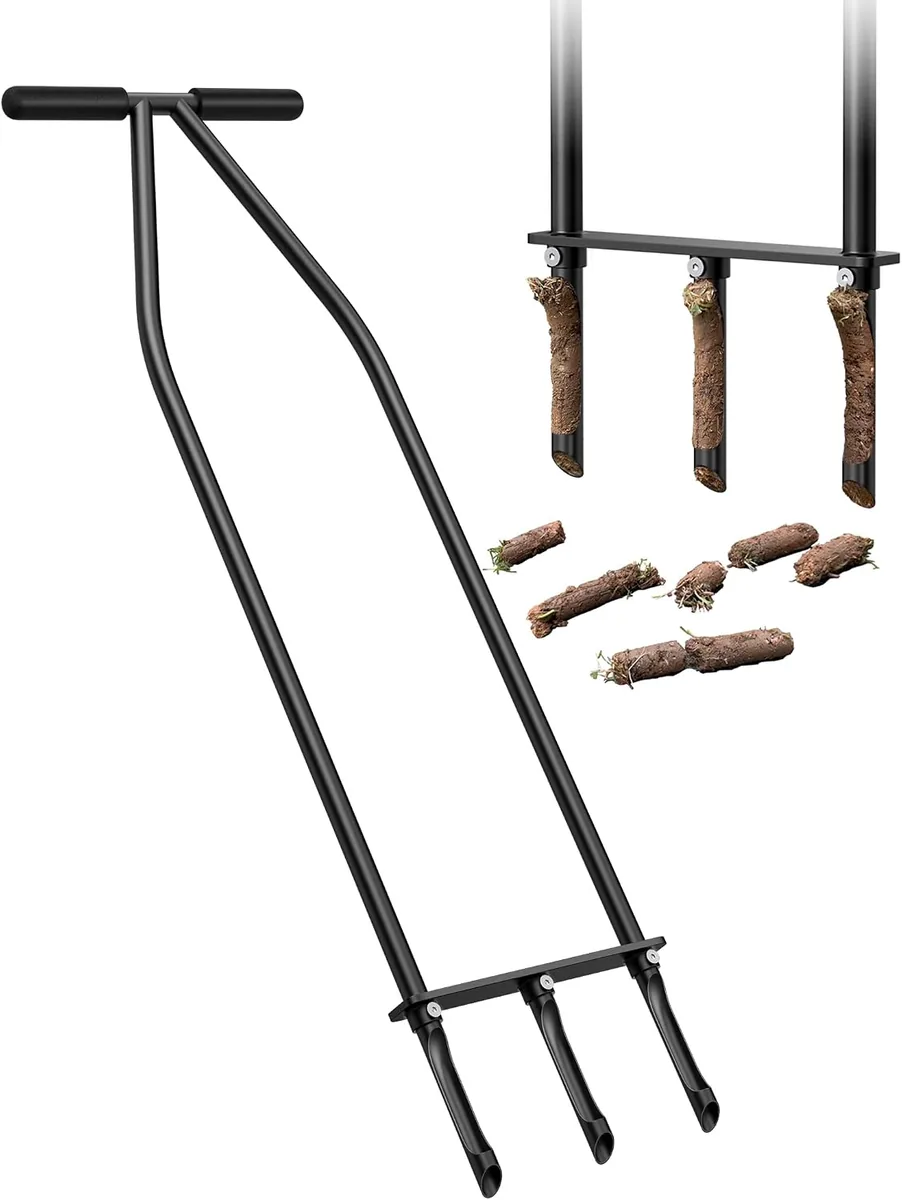
In my Xuperace core aerator review, the GD0001-02 earns a buy for a small lawn on moist soil and a skip for anything near an acre or for ground that stays rock hard. It is a step-on tool with three hollow tines, a side-eject ramp and a steel frame that weighs 5.91 pounds, according to Xuperace. I stepped it across the house lawn to settle two things: whether the cores come out clean and how fast my legs give out. The sections below cover the specs, the way it behaves, who it suits and where it falls short.
Xuperace Core Aerator Review and My Verdict on the GD0001-02
The GD0001-02 is a manual hollow tine lawn aerator that does one job well: it pulls cores from a small, moist lawn and sends them out the side instead of packing them into the tines. According to Xuperace, the three tines are 5.9 inches long. I recommend it as a small lawn aerator for a homeowner who wants real cores without renting a machine. I do not recommend it for a lawn near an acre, because each step makes three holes and you supply all the downward force. It is one of the hand tools in my picks of lawn aerators for small yards.
- Who it is for: owners of small lawns, worn paths and patches they can cover in short sessions.
- What it does best: pulls cores with three hollow tines and ejects them out the side through a ramp.
- Main trade-off: you supply all the force with your foot, so a big lawn is a long job and dry ground stops the tines.
Xuperace GD0001-02 Specs and What the Maker Publishes
The two rows that decide the purchase are the tine length and the weight. The table marks every figure the maker does not publish, so you can see what you are buying without a hole depth or a working width on paper.
| Spec | Xuperace GD0001-02 |
|---|---|
| Aerator type | Step-on manual core aerator (hollow tines) |
| Tines | 3 hollow tines, alloy steel, replaceable, fixed with screws |
| Tine length, maker’s figure | 5.9 inches (tine length, not hole depth) |
| Plug ejection | Out the side through a ramp |
| Working width | Not published by the maker |
| Core diameter and hole depth | Not published by the maker |
| Weight, maker’s figure | 5.91 pounds |
| Footplate | Knee-friendly foot plate, according to Xuperace |
| Assembly | Required; tighten the tine screws firmly |
| Warranty | Not published by the maker |
How the Three Hollow Tines and Side Ejection Work
A manual core aerator removes a plug of soil, while a solid spike only pushes a hole. The GD0001-02 is the first kind, and its side-eject ramp is the feature that sets it apart from other step-on tools I have looked at. I compare seven options for small and large lawns in my guide to top core aerators.
Each step drives three tines into the ground, and the plugs leave through the ramp on the side instead of stacking up inside the tine. According to Xuperace, the design works best on moist grass. On the house lawn after damp weather, the plugs landed beside each set of holes, and I could step again without stopping to clear the tines.
Tine Length Is Not Hole Depth
The maker lists the tines at 5.9 inches, and that is the length of the steel, not the depth of the hole. Real depth depends on how moist the soil is and how much of your weight goes through the foot plate. Extension guidance is to pull cores as deep as possible, usually about 3 inches. A 5.9 inch tine gives you room to reach that in soft ground, and no foot-powered tool can promise it in hard ground.
Why a Hollow Tine Beats a Spike
Extension sources agree that coring is the proven method and spiking gives short, limited relief. Solid tines may increase compaction because the soil is pushed downward instead of being removed, and Xuperace says spike tools can make compaction worse. In a two-year trial on Kentucky bluegrass, hollow-tine plots lost the least green cover under simulated traffic, ahead of solid-tine and untreated plots (1). A fairway trial also found less runoff from hollow-tine plots than from solid-tine plots (2).
Using a Step-On Lawn Aerator on a Small Lawn
A step on lawn aerator asks for four things before the first step: marked lines, damp soil, tight screws and a plan for your legs. I work in that order.
Mark Everything Before the First Pass
Tines cut and crush shallow lines. Before anything else, mark every sprinkler head, irrigation pipe, drip line, low-voltage lighting wire and buried pet fence wire, then walk the lawn for stones, sticks, toys and dog waste. On my own ground I mark the drip lines near the tree strips first, because 5.9 inch tines can reach them. Contact 811 before you aerate, wait the required time and confirm every utility has responded.
If lines sit less than 3 inches deep, the advice is to adjust the depth or avoid those areas, but with 5.9 inch tines never treat 3 inches as a safe clearance: keep the tines clear of every located line and skip any spot where you cannot tell how deep a line runs.
Wear sturdy closed shoes with thick soles, long pants and gloves when you handle the tines. Keep children and pets out of the work area, and never let a child use or handle the tool.
Soil Moisture and the Middle Tine Trick
Aim for soil that is damp, not wet and not dry. Tines in dry soil do not reach a sufficient depth, and in wet soil they clog and do not deposit the cores on the surface. If the ground is hard, water it a day or two before, and wait for rain rather than stomping harder. Timing follows the grass: cool-season lawns are cored in early autumn or spring growth, warm-season lawns in late spring or early summer, and the grass needs at least four weeks of good growing weather afterward to fill the holes.
Xuperace suggests removing the middle tine for harder ground. I tried that on the worn line along the path: with two tines each step took less push, and each step also pulled one core fewer.
Foot and Back Load Over a Session
A step-on tool puts the whole job on your foot, ankle, knee and back. At 5.91 pounds the frame is easy to carry, but that weight does nothing for the tines; your body does the pushing. I work in short sessions with my back straight and my whole boot on the foot plate, I take a break before my knees complain, and I stop if anything hurts. Never stand on the frame beyond the plate. I compare five hand tools that core, spike or roll in my guide to top manual lawn aerators.
When you clear cores from a tine or tighten a screw, follow one order: stop, set the tool on the ground at rest, then work on it with gloves on.

Cores, Tine Screws and Care After the Job
The work does not end with the last hole. Cores, screws and bare steel each need a few minutes.
Leave the core aeration plugs where they land. Cores take several days to a few weeks to fall apart, and mowing after they dry helps break them up. In a putting green trial, breaking up or recycling cores gave the same bulk density, porosity and infiltration as removing them (3). I leave them on the house lawn and mow once they dry.
The tines are fixed to the frame with screws, and Xuperace says to tighten them firmly. I check every screw before the first step and again partway through a session, since a loose tine wastes the push you give it.
Afterward I knock the soil off the tines, dry them and wipe a thin coat of oil on the bare steel before I store the tool off wet ground. The maker publishes no care steps, so this is my routine.
Who the Xuperace Aerator Suits
This manual core lawn aerator fits a narrow, honest job. Compaction is worth fixing when it is real: in a field study, compacted ryegrass, Kentucky bluegrass and tall fescue lost quality, cover and carbohydrate reserves, and the last two were still below normal eight months after compaction ended (4). I compare seven tools for hard ground in my picks of lawn aerators for compacted soil.
- Small lawns and patches: you can cover them in short sessions without a machine.
- Worn lines: paths, parking edges and the packed spots beside a plot take a few steps each.
- Owners who want cores, not spikes: the Xuperace lawn aerator pulls plugs, which is what extension sources recommend.
- Anyone short on storage space: a 5.91 pound steel frame hangs on a shed wall.
Who Should Skip the Xuperace GD0001-02
Skip it when the job is bigger than your legs or the soil is wrong. Four cases come up most.
- Lawns near an acre: each step makes three holes, and a large lawn means thousands of steps.
- Rock-hard dry soil or soaked soil: dry ground stops the tines and wet ground clogs them, so wait for damp soil.
- Buyers who need published figures: Xuperace does not publish a working width, a hole depth or a warranty term.
- Lawns that drain well: probe the soil first. If a screwdriver goes in easily, you may not need to core at all.
Drawbacks and Common Problems
Every core aerator tool has limits, and these are the ones to plan around. A freshly cored lawn looks rough for a while: in a bermudagrass field trial, every treatment gave unacceptable turf quality for 2 to 6 weeks, although hollow-tine aeration lowered surface hardness by 5 to 20 percent (5).
- No manual: the maker publishes no hazard or care text, so safety and upkeep come from general practice.
- Screw-fixed tines: check them often, because a loose tine bends the work out of line.
- Stones and roots: a tine that hits one can bend or stop, so walk the lawn first.
- Middle tine removal: it eases the push on hard ground and cuts the cores per step from three to two.
How It Compares With Other Ways to Aerate
As a hand core aerator, the GD0001-02 sits between a spike tool and a machine. The table shows where each option lands, and the three notes below say when to pick one over this tool. My head-to-head of Yard Butler against Xuperace GD0001-02 sets two step-on core tools side by side.
| Option | Removes cores | Best for | Effort |
|---|---|---|---|
| Xuperace GD0001-02 step-on | Yes, 3 per step | Small lawns and patches | All foot power |
| Spike tool | No, holes only | Light surface opening | Foot or roller |
| Tow-behind plug aerator | Yes | Large lawns with a tractor or mower | Towed, added weight per its manual |
| Rental core aerator | Yes | Whole lawns in one afternoon | Powered and heavy |
Against a Spike Tool
A spike tool makes holes without removing soil and gives limited relief. Pick the spike tool only for a quick surface opening before overseeding, and pick the Xuperace when compaction is the problem. My picks of lawn aerators for overseeding compare seven core and plug tools for better seed contact.
Against a Tow-Behind Plug Aerator
A tow-behind plug aerator is a maker’s product pulled by a tractor or riding mower and loaded with added weight as its manual allows. Pick one for a large lawn only with a tractor or mower that both manuals approve for towing it. Without that machine, a rental or a professional suits a large lawn, and the Xuperace stays the tool for small ones.
Against Renting a Core Aerator
Drum units are the most common rental and rarely penetrate more than 2 inches in dry soil, while piston types extract 3-inch cores, and heavy equipment is the reason extension advice often points to a professional. Pick a rental for a big lawn in one afternoon, and pick the Xuperace for a small one on your own schedule.
My Final Verdict on the Xuperace GD0001-02
The Xuperace GD0001-02 earns my recommendation for small lawns. It pulls real cores, ejects them out the side and costs nothing to run, with 5.9 inch tines for soft, moist soil. Its limits are just as clear: foot power only, and no mercy on dry ground. Probe the lawn, mark every line, wait for damp soil and work in short sessions. That is where my Xuperace core aerator review lands: a clear yes for a small lawn on moist soil, and a no for a large lawn or ground that stays hard. My list of the top lawn aerators shows where it sits among the hand and tow-behind models.
Frequently Asked Questions
What are the maintenance requirements for a manual lawn aerator?
A manual lawn aerator needs its tines cleaned of soil, dried and kept from rust, and any screw-fixed parts checked for tightness before each use. For the Xuperace GD0001-02 the maker says to tighten the tine screws firmly and publishes no other care steps, so keep the bare steel lightly oiled.
What is the depth of aeration for a manual lawn aerator?
The depth depends on tine length, soil moisture and how much of your weight goes through the tool, and extension sources aim for cores about 3 inches deep. The Xuperace GD0001-02 has 5.9 inch tines according to the maker, but Xuperace does not publish its hole depth or core diameter.
How often should a manual lawn aerator be used?
The interval depends on soil, traffic and thatch, and no single schedule fits every lawn or every season. Most lawns benefit from aeration every 1 to 5 years, while compacted or thatchy lawns may need it up to twice a year for a year or more, so check the soil first.
Is a core aerator worth it?
A core aerator is worth it on a lawn with compacted soil, heavy foot traffic or thatch, because pulling plugs is the method extension sources call most effective. It is not worth the effort on a lawn that drains well and takes a probe easily, since that lawn may not be compacted.
How effective are manual aerators?
Manual aerators are effective when they are hollow-tine core tools used on damp soil, because removing cores is the proven method, but each step treats only a small patch of lawn. A manual spike tool is the weak version, since solid tines can press the soil tighter instead of relieving it.
References
- Dalsgaard TO, Thoms AW, Christians NE, Mertz I, Horton R. Comparison of Shockwave aerification and conventional aerification methods on athletic fields. Agronomy Journal. 2020;112(5):3470-3477.
- Rice PJ, Horgan BP. Nutrient loss with runoff from fairway turf: an evaluation of core cultivation practices and their environmental impact. Environmental Toxicology and Chemistry. 2011;30(11):2473-2480.
- Lindsey AJ, Thoms AW, Christians NE, Pease BW. Evaluation of hollow-tine core aerification recycling on a sand-based putting green soil properties and playability. HortTechnology. 2022;32(6):529-533.
- Carrow RN. Influence of soil compaction on three turfgrass species. Agronomy Journal. 1980;72(6):1038-1042.
- McCauley RK, Pinnix GD, Miller GL, Heitman JL. Fraise mowing and hollow-tine aerification impact bermudagrass surfaces. Crop, Forage & Turfgrass Management. 2025;11(1):e70023.
Safety Note: Read your manual first. Before the first pass, walk the lawn and remove stones, sticks, toys, loose wire, hoses and pet waste. Locate and mark sprinkler heads, irrigation and drip lines, low-voltage lighting wire and buried pet fence wire, keep tines and spikes clear of them, and do not aerate any area where buried lines have not been located. Contact 811 before you aerate, wait the time your state requires and confirm that every utility has responded: never assume short tines cannot reach a buried line. Wear sturdy, slip-resistant closed shoes with thick soles and long pants whenever you aerate, and gloves when you handle tines or spikes. Keep everyone else and all pets out of the work area, keep the clearance your manual gives and stop if anyone comes closer. Never let children use or handle an aerator. With manual and rolling aerators, keep hands and feet clear of the points and the roller, and set the tool down securely before you clear cores or adjust it. On a step-on tool, step only on the foot bar or platform made for it, never on another part of the frame, and take breaks before your feet, knees or back start to hurt. Never aerate dry, rock-hard soil or waterlogged ground, and stay off steep and wet slopes. For a tow-behind aerator, follow both the tow vehicle’s and the aerator’s manuals for hitch, towing capacity, top speed, slope limits and direction of travel. Tow it only behind an approved lawn tractor or riding mower, never behind a car or truck and never on a public road. Start slowly, avoid sudden turns and stops, and raise the tines or use the transport position before sharp turns and hard surfaces. Carry less weight on slopes as your manual says, never more than it allows, and strap the weights so the straps stay clear of the tines. Never use people as weight and never carry riders. Before you clear, adjust, hitch or unhitch a tow-behind aerator, stop on level ground, turn the engine off, set the parking brake, remove the key and wait for all movement to stop. Block the wheels as the manual instructs before disconnecting, and keep hands and feet out from under the towbar. Get off the tractor before you raise or lower an aerator that carries added weight. For a gas core aerator, read the machine’s and the engine’s manuals and ask the rental shop to show you the controls. Wear safety glasses with side protection and hearing protection, keep both hands on the handle because the machine can pull forward, and raise or disengage the tines as the manual describes before turns and hard surfaces. Before you clear, clean, inspect or adjust it, stop the engine, wait for every moving part to stop and disconnect the spark plug wire. Exhaust contains carbon monoxide, which can kill: start and run the engine outdoors only, away from doors, windows and air intakes, and never in a garage, shed or other enclosed or partly enclosed space, even with doors or windows open. Refuel outdoors with the engine off and cool, away from flames and sparks. Aerating at the wrong time of year or on stressed or dormant grass can damage a lawn, so match the timing to your grass type.