


The Greenworks 60V vs 40V pole saw choice comes down to bar length and weight: pick the 40V PS40B210 for limbs you cut from the ground in a small yard or orchard, and pick the 60V PS60L211 only if you want its 10 in bar, brushless motor and four-year warranty. I prune apricot and plum limbs from the ground each dormant season, so the number I watch is what the saw weighs at the end of a 9 ft pole. Below I set the two kits side by side on bar, reach, weight, oiler, warranty and the safety text each manual prints.
Greenworks 60V vs 40V Pole Saw Verdict and Specs
The PS40B210 is the better buy for most ground-level pruning, because it weighs less by the manual, states its own limb limit and sits in a lower price tier. The PS60L211 earns its place when you want a longer bar, a brushless motor, a shoulder strap in the box and four years of warranty instead of three. Both are battery pole saws on a three-piece aluminum shaft, so neither one telescopes. My roundup of lightweight pole saw picks compares saws by weight.
| Spec | Greenworks PS60L211 (60V) | Greenworks PS40B210 (40V) |
|---|---|---|
| Saw type | Battery pole saw, three-piece shaft | Battery pole saw, three-piece shaft |
| Motor, maker’s description | Brushless, 1.0 kW | Brushed |
| Battery in the kit | One 60V 2.0 Ah and a charger | One 40V 2.0 Ah and a charger |
| Bar length | 10 in | 8 in |
| Chain pitch and gauge | 1/4 in LP, 0.050 in | 3/8 in LP, 0.050 in |
| Maximum limb size, manual | Not published by the maker | 6 in |
| Shaft length with extension fitted, maker page | 9 ft | 9 ft |
| Reach claim, maker’s figure (user height not stated) | 14 ft | 11 ft |
| Weight without battery, manual | 9.3 lb | 8.2 lb |
| Oiler | Automatic, 80 ml tank | Automatic, 80 ml tank |
| Warranty, manual | 4 years, tool and battery, personal use | 3 years, limited, household use |
| In the box with saw, battery and charger | Scabbard, shoulder strap, wrench | Scabbard, wrench |
Two rows decide it for most buyers: weight and the limb limit. The PS40B210 manual figure of 8.2 lb sits 1.1 lb under the 9.3 lb in the PS60L211 manual, and only the PS40B210 manual tells you the 6 in limit.
What Is Actually Different Between the PS60L211 and the PS40B210
These two saws differ in more than voltage: you are choosing a 10 in brushless saw or an 8 in brushed saw. Each runs on its own battery platform, and each manual names only its own battery and charger, so the voltage you already own can settle the question before anything else.
The model numbers confuse buyers. Greenworks now lists the 40V 8 in saw as the PS40L210, its specs match this PS40B210 kit on every row, and the manual cover prints only the code PSF303. The 60V kit is the PS60L211, and its manual cover also prints PS60L01, the tool-only number. Either one is a Greenworks battery powered pole saw built for pruning from the ground, not for felling a tree or cutting logs.
Bar, Chain and Cutting Capacity
The PS40B210 is the Greenworks 40V 8 inch cordless pole saw, and the PS60L211 carries a 10 in bar on the 60V platform. A longer bar gives a longer cutting length, but the 60V manual publishes no limb size, so I do not read the bigger bar as permission to take bigger limbs.
The chains do not swap. According to Greenworks, the 60V saw runs a 1/4 in LP pitch chain with 58 drive links, and the 40V saw runs a 3/8 in LP pitch chain with 33 drive links, both at 0.050 in gauge. Buy a replacement only to the pitch, gauge and drive link count your own manual approves.
The PS40B210 manual says the saw is designed for small branches and limbs up to 6 in. in diameter. Its cutting method starts with a shallow cut on the underside near the trunk, about a quarter of the limb’s diameter deep, then a second cut from the top outboard of the first, then a final cut just outside the branch collar and bark ridge, the swollen ring at the base of the limb, with no back-and-forth sawing. The manual also says to hold the front cutting guide against the limb. I make that underside cut first on every limb, so the bar does not pinch when the top cut comes through.
On either saw I start with the chain clear of everything and let it reach full speed before it touches wood. I cut one branch at a time with light, steady pressure, never start a cut with the tip of the bar and never make a plunge or bore cut, and keep control of the head as the branch separates and release the trigger as soon as the cut is done.
Winner: for capacity you can plan around, the PS40B210, because its manual states the 6 in limit. The PS60L211 wins only on bar length.
Oiler, Chain Tension and Care
Both saws have an automatic oiler with an 80 ml tank, and neither comes with oil in it. Neither kit includes bar and chain oil, so fill the tank before the first cut and never run the saw dry. The PS40B210 manual says to check the oil level after every 30 minutes of use, and the PS60L211 manual says a whole tank lasts approximately 20 to 40 minutes.
Every care job on these saws starts with the same order. Use it before you touch the chain, clear a jam, adjust tension, fill oil, sharpen, change the bar or chain, clean the saw, change the pole length, or join or separate pole sections.
- Release the trigger, switch the motor off and wait until the chain has stopped completely, because the chain keeps moving for a moment after the switch is off.
- Take the battery out of the saw.
- Lay the saw on a flat surface and put on gloves before you touch the chain.
- Do the job: fill the oil, adjust the tension or whatever the task is.
- Check every lock and coupling before the battery goes back in.
Tension is set the same way on both saws, with the wrench from the box. You loosen the bar nut or side cover lock nuts slightly, which needs no removal of the cover, then turn the tension screw behind the bar clockwise to tighten, retighten the nuts and check the tension before the battery goes back in. The PS40B210 manual gives the target, a 3 mm to 4 mm gap between a cutter and the bar, and both manuals warn that a new chain stretches after first use. Laboratory tests on gas chain saws found that proper chain tension is one of the factors that influence kickback (1).
The new chain on the PS40B210 slackened after the first few cuts, as its manual predicts. I ran the order above, turned the tension screw back to the 3 mm to 4 mm gap, retightened the nuts and checked the tension before the battery went back in.
For storage, the PS40B210 manual says oil seeps from the saw when it sits idle, so empty the tank after each use and then run the saw for one minute, as the manual says, to use up what remains; then stop it and take the battery out as in the order above. The PS60L211 manual says to remove all residual oil before storage. After the order above I emptied the PS60L211 tank before it went level onto the shelf of my tool shed, so no oil weeped onto the floor.
Winner: for care guidance, the PS40B210, because its manual gives the tension gap and the 30-minute oil check. The PS60L211 manual gives only the tank-life estimate.
Reach, Shaft and Weight
Reach figures on pole saws are claims, and these two are no exception. Greenworks gives 14 ft for the PS60L211 and 11 ft for the PS40B210, and neither maker page says which user height sits behind its figure. The tool itself is the same length on both: a three-piece aluminum shaft that reaches 9 ft with the extension pole fitted, according to Greenworks. The Greenworks pole saw extension is one pole section that goes between the handle and the head.
Weight is where the two part ways. The PS60L211 manual lists 9.3 lb without the battery and the PS40B210 manual lists 8.2 lb without the battery. Greenworks prints no weight with the 2.0 Ah battery fitted for either saw, so I compare only the figures that share a basis.
The weight at your hands grows with the pole. In a laboratory study of 18 workers, neck and shoulder muscle activity was significantly higher when an overhead task sat 20 cm above head height than 10 cm above it (2). On the PS40B210 the pole felt much heavier after ten minutes at full reach than it did on the first cut, so I rest the saw between limbs rather than hold it up.

The PS60L211 ships with a shoulder strap. I clip its carabiner to the carrying ring and set the length so the carabiner sits about a hand’s width below my right hip, as the manual shows, and the strap took some of the 9.3 lb off my arms. Both manuals ask you to check the collars that join the pole sections, so at each rest I ran the order above and then went over both collars by hand.

Winner: on weight, the PS40B210, 1.1 lb lighter without the battery. Reach is a draw, because the shaft is 9 ft on both and Greenworks gives no basis for either reach claim.
Battery, Charger and Platform
Each kit ships with one 2.0 Ah battery and a charger, so the platform matters more than the pack in the box. The Greenworks 40 volt cordless pole saw runs on the 40V platform, which Greenworks says powers more than 75 tools, and the PS60L211 runs on the Greenworks Pro 60V platform. Greenworks prints no runtime in minutes for either kit, so I do not rank them on runtime. My roundup of battery pole saws compares nine cordless options for pruning high branches from the ground.
The two manuals set different temperature limits, and the difference matters in dormant pruning season. The PS40B210 manual allows use from -4 F to 104 F, while the PS60L211 manual gives 32 F to 113 F. A winter morning below freezing is inside the 40V limit and outside the 60V one.
The rules for the pack are the same for both: use only the maker’s battery and charger for your saw, charge and store them within the temperatures your manual gives and never in rain or wet places, never use or charge a damaged, swollen or leaking pack, and keep loose batteries away from metal objects that could short the terminals.
Winner: for winter work, the PS40B210, because its manual allows use down to -4 F. The PS60L211 takes the strap in the box.
Motor, Warranty and Value Over Three Seasons
The Greenworks 60V pole saw has a brushless motor rated at 1.0 kW, according to Greenworks, and the PS40B210 has a brushed motor. Greenworks also gives a chain speed of 43 ft/s for the 60V saw and 31.2 ft/s for the current 40V saw. Those are maker figures from the product pages, not figures from the manuals, and neither maker states the load behind them. I cover the brushless saw in full in my Greenworks 60V saw review.
Warranty runs four years on the tool and battery of the PS60L211 and three years on the PS40B210. Both cover personal or household use only, and neither covers lubricants or blade sharpening. The PS60L211 sits in the mid-range tier and the PS40B210 in the budget tier. Over three seasons of ground-level pruning, I count the higher tier as paying off only if you will use the 10 in bar and the brushless motor on many cuts each year.
Winner: the PS60L211 on warranty and motor; the PS40B210 on value for a small orchard or yard. I compare nine options for yard pruning in my roundup of pole saws for homeowners.
Safety Rules Each Manual States
A pole saw puts a powered chain on a long pole, and these two manuals do not say the same things. The PS40B210 manual states a 50 ft power line and bystander distance, a 60 degree angle, a 6 in limb size and a no-ladder rule in words. The PS60L211 manual gives a power line warning without a distance and a 60 degree diagram label, and its text has no ladder sentence. Use the stricter set for both saws.
Power Lines
Before you start, look for every overhead wire, including wires hidden in leaves. Keep yourself, the saw, the pole and any branch you cut or that could fall or swing at least 50 feet (15 m) from every overhead line, the distance the EGO, Ryobi, DeWalt, Greenworks, Milwaukee, Remington and Echo manuals give, or farther if your own manual asks for more. The saw is not insulated, and electricity can jump through the air and travel through branches, especially wet ones. Treat every wire, including service drops and communication lines, and anything touching one, as live. If you cannot keep that distance the whole time, stop: a branch near or touching a line is a job for the utility and its qualified line-clearance crews, not for you and not for a general arborist.
Power line contact is the hazard that kills. Among 93 NIOSH and state reports on landscaping and tree care deaths, electrocution from power lines was the most common fatal incident, at 18.3 percent (3). A Massachusetts investigation found a landscaper was electrocuted when his pole saw touched an overhead line (4).
If the saw, the pole or a branch touches a wire, the saw, the branch, the wire and the ground around them can become live. Do not go to the saw or pick it up, touch nothing that is in contact with the line, keep everyone away, and call the utility at once, and 911 if anyone is hurt, a fire starts or a line comes down. Only the utility frees the saw.
Never stand under the branch you are cutting. Before you cut, look for loose, dead or hung branches above you and clear trip hazards from the ground; stand to the side, out of the branch’s path, plan where it will fall and keep a clear way back, and remember that a cut branch can bounce toward you when it lands. Loose, dead, broken or hung branches above you or above your way back are a job for a professional, so leave them alone before you start. Cut long branches in sections, lower branches first. If a branch falls or swings unexpectedly, get clear at once.
A New Jersey investigation found a ground worker was killed by a 38-pound cut branch and advised clearly marking the drop zone and keeping people out of it (5). I stand to the side of the limb and watch it come down.
Keep the pole low and the footing firm. Hold the saw with both hands, keep the pole at 60 degrees or less to the ground (the limit in the EGO, Ryobi, DeWalt, Greenworks and Milwaukee manuals; follow your own manual if it is stricter), keep your hands below shoulder height, and never overreach. Never use a pole saw from a ladder, a roof, a tree or any unstable support; work from the ground on firm, level footing. A branch you cannot reach from the ground is a job for a certified arborist (or the utility, if it is near a line).
A New Jersey investigation of a fatal case found a worker on an aluminum ladder was electrocuted when his extendable pole saw touched a 7,200-volt line (6).
A limb thicker than your saw’s limit, one under tension or hung up after a storm, a large limb over a house, car, fence or road, or any job that needs a ladder, climbing or a lift goes to a certified arborist. Anything near a power line goes to the utility and its qualified line-clearance crews.
If the tip of the bar touches a branch, a wire or anything else, the bar can be thrown up and back toward you (kickback). Wood pinching the chain on the top of the bar pushes the saw back toward you, and wood binding the chain on the bottom pulls it forward and away; any of these can make you lose control or balance. Keep both hands on the saw and firm footing, keep the tip clear, watch for branches behind the one you cut and for wood closing on the bar, and use only the reduced-kickback chain and bar your manual approves; no part of the saw removes this risk. The PS40B210 manual carries a kickback warning symbol, and the PS60L211 manual text has no kickback sentence.
Dress for falling debris. Wear safety glasses with side shields marked Z87.1, and a face shield over them where your manual asks for one; a hard hat or safety helmet rated for falling objects (DeWalt names ANSI Z89.1); hearing protection; work gloves; close-fitting long pants and long sleeves with no loose clothing or jewelry; non-slip boots; a dust mask when the work is dusty; and tie long hair up above shoulder level. Keep people and pets, helpers included, at least 50 feet (15 m) away, or farther if your manual asks for more, and out of the whole area where the branch can fall and bounce. If anyone comes closer, stop cutting until they are clear, and look behind you before you swing the pole.
Before each use, check the saw as your manual describes: a sharp, undamaged chain at the right tension, chain oil in the tank, locks, couplings and the head tight, the trigger lock-off and switch working, and the battery undamaged. If anything fails, do not use the saw until it is fixed. Never cut in rain, high wind, a storm or when lightning is possible, and cut only when the light lets you see the branch, every wire and your footing clearly. To carry or store either saw, stop it as in the order above, take the battery out, fit the scabbard, carry it by the handle with the bar pointing behind you and store it indoors and dry out of children’s reach.
Choose the PS60L211 If
Choose Greenworks Pro 60V 10 in Pole Saw Kit PS60L211 when its extra bar length and warranty matter more to you than the lowest weight. This Greenworks 60 volt pole saw suits a buyer who already owns Greenworks 60V batteries and prunes small limbs from the ground. I set the 60V saw beside another 10 in battery saw in my EGO PS1001 vs Greenworks PS60L211 comparison.
- You own Greenworks 60V batteries, so the saw costs far less than a new platform.
- You want a brushless motor and a four-year warranty on the tool and battery.
- You want a strap in the box to carry the weight off your arms at full reach.
- You will skip it if you need a documented limb size, a stated power line distance or the lowest weight.
It is much quieter than the old gas handheld blower I run in autumn, but I still wear eye and ear protection every time I use it.

Choose the PS40B210 If
Choose Greenworks 40V 8 in Pole Saw Kit PS40B210 when you want the saw whose manual documents the most and weighs the least. The Greenworks 40 volt pole saw suits an owner of a small yard or orchard who prunes from the ground and reads the limit before the cut. I go through this saw in full in my Greenworks 40V saw review.
- You prune limbs up to the 6 in the manual allows and want that limit in writing.
- You prune in cold weather, because the manual allows use down to -4 F.
- You want the lower price tier and a lighter saw by the manual figure.
- You will skip it if you want a brushless motor, a strap in the box or the fourth year of warranty.
Before I drop a limb with it, I move the drip line aside or lay the limb down in short pieces, so the cut wood does not crush an emitter line.
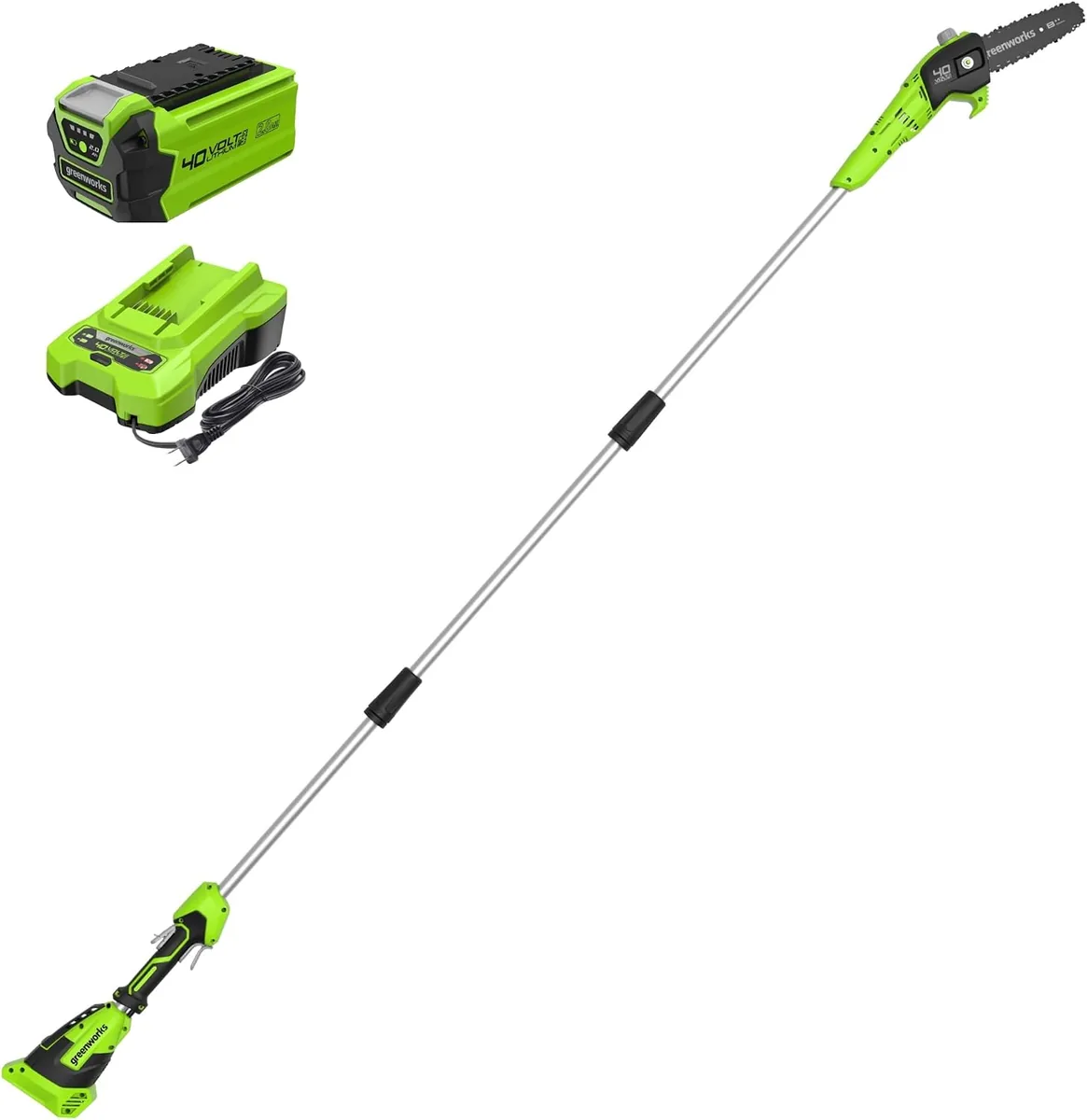
My Pick for Pruning From the Ground
For most readers the PS40B210 is the saw to buy: it is lighter by the manual, rated for limbs up to 6 in, allowed down to -4 F, and its manual states every distance. Pick the PS60L211 if you already own 60V batteries or want the brushless motor, the strap and the extra year of warranty. With either one, work from the ground, fill the oil tank before the first cut and keep 50 feet from every wire. In the Greenworks 60V vs 40V pole saw match-up I recommend the PS40B210 for small orchards and yards, and the PS60L211 for owners who value the longer bar and the four-year warranty over weight. If the CRAFTSMAN kit is also on your list, my Greenworks and Craftsman pole saw comparison sets the PS40B210 beside it.
Frequently Asked Questions
Can I use a 60V battery on a 40V tool?
You should not use a 60V battery on a 40V tool, because each Greenworks manual names only its own battery and charger. The 40V saw manual calls for the BAF series battery and a CAF series charger, so use only the pack and charger your own saw’s manual names for that exact tool.
What is the maximum reach of a cordless pole saw?
The maximum reach of a cordless pole saw is a maker’s claim, not a measured tool length, and the two Greenworks kits show it. Greenworks gives 11 ft for the 40V and 14 ft for the 60V, with no user height stated, while the shaft reaches 9 ft with the extension fitted.
Does a Greenworks pole saw need oil before use?
A Greenworks pole saw needs bar and chain oil in its tank before the first cut, because neither of these two kits ships with oil. The 40V manual says the saw leaves the factory with no oil added, the 60V manual says the same, and both tanks hold 80 ml.
Which Greenworks pole saw is lighter, the PS60L211 or the PS40B210?
The PS40B210 is the lighter Greenworks pole saw, at 8.2 lb without the battery in its manual against 9.3 lb for the PS60L211 in its manual. Greenworks prints no weight with the 2.0 Ah battery fitted for either saw, so the gap with a battery on is not documented anywhere.
Does the Greenworks 40V pole saw have a brushless motor?
The Greenworks 40V pole saw in this comparison has a brushed motor, according to the maker page for the PS40L210, the current number of the same saw. The 60V PS60L211 is the brushless one, with a 1.0 kW motor according to Greenworks, and neither page gives a runtime in minutes.
References
- Dąbrowski A. Reducing kickback of portable combustion chain saws and related injury risks: laboratory tests and deductions. Int J Occup Saf Ergon. 2012;18(3):399-417.
- Shin SJ, Yoo WG. Effects of overhead work involving different heights and distances on neck and shoulder muscle activity. Work. 2015;51(2):321-326.
- Kearney GD, Romano N, Doub A. Fatal injuries among landscaping and tree care workers: Insights from NIOSH and state-based FACE reports. Journal of Safety Research. 2024;91:393-400.
- Massachusetts Fatality Assessment and Control Evaluation (FACE) Program. Landscaper working from a raised portable work platform was electrocuted when a pole saw contacts overhead power line – Massachusetts. NIOSH FACE report 13MA019. National Institute for Occupational Safety and Health, Centers for Disease Control and Prevention; 2015.
- New Jersey Fatality Assessment and Control Evaluation (FACE) Program. Twenty-seven-year-old tree-care worker killed by falling branch. NIOSH FACE report 12NJ019. National Institute for Occupational Safety and Health, Centers for Disease Control and Prevention; 2013.
- New Jersey Fatality Assessment and Control Evaluation (FACE) Program. Tree-care worker electrocuted while trimming branch near power line. NIOSH FACE report 13NJ074. National Institute for Occupational Safety and Health, Centers for Disease Control and Prevention; 2016.
Safety Note: Only an adult who has read the manual and understands the controls should use a pole saw, never a child or anyone tired or impaired; practise first on small, low branches you can reach easily from the ground. A pole saw is made for cutting branches from the ground, never for felling trees, and never from a ladder, a roof, a tree or any unstable support. Power lines can kill. Before you start, look for every overhead wire, including wires hidden in leaves, and keep yourself, the saw, the pole and any branch you cut or that could fall or swing at least 50 feet (15 m) from every line, the distance many pole saw manuals give, or farther if your manual asks for more. The saw is not insulated, and electricity can jump through the air and travel through branches, especially wet ones. Treat every wire, and anything touching one, as live. A branch near or touching a line is a job for the utility and its qualified line-clearance crews, not for you and not for a general arborist. If the saw or a branch touches a wire, do not go to the saw or touch the saw, the branch or the wire, keep everyone away and call the utility, and 911 if anyone is hurt. Before you cut, look for loose, dead or hung branches above you and clear trip hazards from the ground. Never stand under the branch you are cutting: stand to the side, out of its path, plan where it will fall and keep a clear way back, because a cut branch can bounce toward you when it lands. Cut long branches in sections, and if a branch falls or swings unexpectedly, get clear at once. Hold the saw with both hands, keep the pole at 60 degrees or less to the ground, the limit several makers set, keep your hands below shoulder height, and never overreach. Let the chain reach full speed before it touches wood, and never start a cut with the tip of the bar. If the bar tip touches anything, the saw can kick up and back toward you, and wood pinching or binding the chain can push it back or pull it forward: keep the tip clear and use only the reduced-kickback chain and bar your manual approves. Wear safety glasses with side shields marked Z87.1 (and a face shield over them where your manual asks for one), a hard hat or safety helmet rated for falling objects, hearing protection, work gloves, close-fitting long pants and long sleeves with no loose clothing or jewelry, and non-slip boots, and tie long hair up. Keep people and pets, helpers included, at least 50 feet (15 m) away, or farther if your manual asks, and out of the whole area where the branch can fall and bounce; stop cutting if anyone comes closer. Never cut in rain, high wind, a storm or when lightning is possible, or in light too poor to see the branch, the wires and your footing. Before each use, check the chain, its tension and the oil, the telescoping locks and the switch as your manual describes, and do not use a saw that fails a check. Before you touch the chain, clear a jam, adjust the tension, fill the oil or change the pole length or head angle: release the trigger, switch the saw off and wait until the chain has stopped, then take the battery out, unplug a corded saw by the plug, or on a gas saw let the engine cool and pull the spark plug cap off; wear gloves. To carry or store the saw, release the trigger, switch it off and wait until the chain has stopped, then take out the battery or unplug it, collapse the pole and fit the chain cover. Use only the maker’s battery and charger, charge and store them within the temperatures your manual gives and never in the wet, never use or charge a damaged, swollen or leaking pack, and keep loose batteries away from metal objects that could short the terminals. Use a corded saw only with an outdoor-rated extension cord of the gauge your manual gives, plugged into GFCI-protected power, and never in rain or wet conditions: GFCI protection does not make that safe. Start a gas pole saw on the ground with the chain clear of everything, at least 10 feet from where you fuelled it; refuel outdoors with the engine off and cool, with no smoking, flames or sparks nearby, and never run it indoors or in a garage or shed, because the exhaust contains carbon monoxide. A branch thicker than your manual allows, a limb under tension or hung up after a storm, a large limb over a house, car or road, or anything you cannot reach from the ground is a job for a certified arborist. Stop when you are tired.