
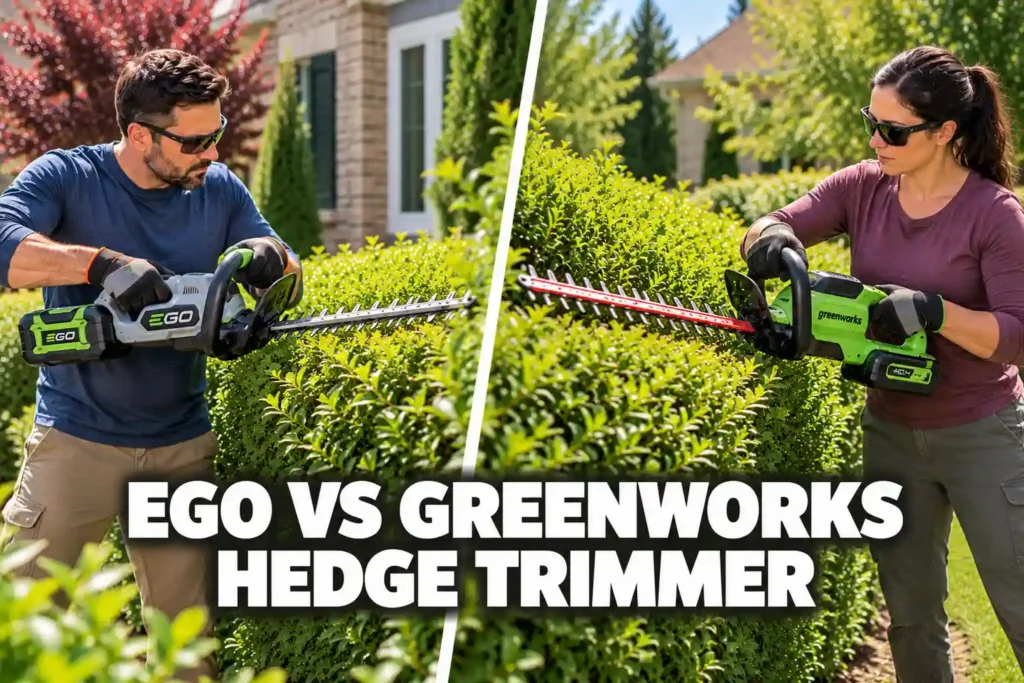
The EGO vs Greenworks hedge trimmer decision starts with the battery. EGO builds its trimmers on one 56V system, while Greenworks spreads its line over 24V, 40V and 80V platforms that each use their own packs. On low shrubs and a short yard hedge either brand does the job, and the Greenworks 24V is the lightest of the five models below before a battery is fitted. For a stem near an inch or a ladder ban spelled out in the manual, EGO says more.
I look after a hedgerow along the edge of my orchard, so I read the safety pages of a manual before the spec table. Below I compare platforms, cutting capacity, weight, safety rules, blade care and warranty.
EGO vs Greenworks Hedge Trimmer: Which Line Fits Which Hedge
The EGO HT2601 and HT2501 print the longest blades and the largest stated stem diameters in this comparison. The Greenworks 24V and 40V models are lighter before the battery goes on and sit in the budget and mid-range price tiers, and the EGO HT2400 is a plain 24 in bare tool. Pick the platform first and the model second, because the pack you already own often decides the brand. The table puts the five models side by side, with each weight on the basis the maker prints. EGO’s HT2601 also goes up against the Husqvarna 320iHD60 in my EGO against Husqvarna trimmer comparison.
| Model | Blade length | Weight, without battery | Price tier |
|---|---|---|---|
| EGO HT2400 (tool only, 56V) | 24 in (610 mm) | 6.24 lb (2.83 kg), without battery pack and blade guard | Mid-range |
| EGO HT2601 (kit, 56V) | 26 in (660 mm) | 6.92 lb (3.14 kg), without battery pack and blade guard | Premium |
| EGO HT2501 (kit, 56V) | 25 in (650 mm) | 8.38 lb (3.80 kg), without battery pack and blade guard | Premium |
| Greenworks 24V (kit) | 22 in (560 mm) | 5.7 lb (2.6 kg), without battery pack | Budget |
| Greenworks 40V (kit) | 24 in (610 mm) | 6.0 lb (2.7 kg), without battery pack | Mid-range |
Where EGO Is Stronger
The HT2601 and HT2501 manuals print the higher stem limits, and every EGO manual here prints a ladder ban. The HT2601 and HT2501 manuals add a rain ban and a lightning warning. The kits come with a 2.5 Ah battery and a standard charger, and the longest blade in the set is 26 in. The price is weight at arm’s length and a premium tier for the kits.
Where Greenworks Is Stronger
A Greenworks hedge trimmer in the 24V or 40V class is the lighter tool on the maker’s own no-battery basis, and the 24V kit sits in the budget tier. Both have a rotating rear handle with five positions. The cost is a lower printed capacity, with a kind Greenworks does not name, and manuals that say less about ladders, weather and technique.
For the long perimeter run along my orchard, weight at the end of the row and the stem limit matter more to me than any other line on the box. At the yard edge, where the shrubs are short, a light tool with a rotating handle is enough. For short shrubs like those, my picks of hedge trimmers for small bushes stay with light models.
Battery Platforms Compared
Greenworks vs EGO starts with the pack, because the pack decides what else you can buy later. EGO runs its trimmers on 56V packs, and Greenworks sells separate 24V, 40V and 80V systems with their own packs and chargers.
EGO’s Single 56V Platform
According to EGO, the HT2400 works with all EGO 56V ARC Lithium batteries. Its manual lists the BA1400, BA2800 and BA4200 packs and the T series, with chargers from the CH2100 to the CH7000. An EGO hedge trimmer therefore shares packs with the rest of the EGO line, which is the strongest argument for EGO if you already own the batteries. Two other battery lines face the same pack question in my guide to DeWalt against Milwaukee hedge trimmers.
The HT2601 and HT2501 are kits with a 2.5 Ah battery and a standard charger. The HT2400 is a bare tool, so the pack and the charger come on top of the tool price. I count the pack and the charger into the price before I compare anything.
EGO’s HT2601 manual gives an operating range of 32 to 104 °F (0 to 40 °C). On a cold morning I keep the pack indoors until I start.
Greenworks 24V, 40V and 80V Platforms
Each Greenworks cordless hedge trimmer here, the 24V 22 in model and the 40V 24 in model, is sold as a kit with a battery and a charger. The 24V manual names the BAG battery series and CAG chargers. The 40V manual names the BAF series and CAF chargers. Both tell you to recharge only with the charger the maker specifies. My Greenworks 40V trimmer review covers the 24 in kit with its charger on its own.
The Greenworks 80v hedge trimmer covered here is the pole model, which has its own section below. I keep one platform per shed where I can, because every extra charger is one more cable to trace on a dark morning. The same pack question comes up when I weigh EGO against Greenworks cultivators for bed work.
Battery Safety
Use only the maker’s battery and charger for your trimmer, charge and store them within the temperatures your manual gives and never in rain or wet places, never use or charge a damaged, swollen or leaking pack, and keep loose batteries away from metal objects such as keys, coins and nails that could short the terminals.
What Each Maker Prints as Cutting Capacity
Every hedge trimmer manual prints a cutting capacity, and the makers do not word it the same way. EGO names a stem or branch diameter. Greenworks prints a bare figure, and a capacity quoted without its kind is easy to misread. The types, parts and limits behind those figures are in my guide on what a hedge trimmer is.
| Model | Capacity as printed | What the figure measures |
|---|---|---|
| EGO HT2400 | Stems less than 3/4 in (19 mm) thick | Stem or branch diameter |
| EGO HT2601 | Stems less than 1.2 in (30.5 mm) thick | Stem or branch diameter |
| EGO HT2501 | Stems less than 1-1/4 in (33 mm) thick | Stem or branch diameter |
| Greenworks 24V | 3/4 in | Kind not stated |
| Greenworks 40V | 1.1 in (27 mm) in the manual, 1 in on the kit page | Kind not stated |
A One-Inch Stem as a Test
Take a one-inch stem. The EGO HT2601 and HT2501 state stems less than 1.2 in and less than 1-1/4 in, so that stem sits inside their stated range. The HT2400 states stems less than 3/4 in, which puts a one-inch stem 1/4 in over its limit. Greenworks prints 3/4 in for the 24V and 1.1 in for the 40V, with 1 in on the 40V kit page, and it does not say what kind of measurement either figure is, so the manual cannot tell me whether a one-inch stem fits. I cut a stem like that with loppers or a saw.
What Happens Above the Limit
EGO’s manual says to use a non-powered hand saw or pruning saw for large stems. It also warns against trimming too much at once, because that can make the blades bind and slow, and against forcing the trimmer through heavy shrubbery. Wood above the printed limit goes to loppers or a saw.
I cut the thick stems with loppers first and let the trimmer take the green growth, and my hedge trimmer against chainsaw guide covers which tool suits which branches. When the blade slows on a stem near the limit, I stop pushing and finish that stem by hand.
Do Not Force the Blade
Wood thicker than the stated capacity goes to loppers or a saw, never forced through the blade. Do not operate any trimmer with dull or damaged cutting blades, because EGO’s manual says that may cause overload.
Weight, Handles and Starting
Weight is where the Greenworks 24V and 40V models lead on paper, and the paper has one catch: every figure in the table above is printed without the battery. No manual in this comparison gives a weight with a pack fitted, so the tool in your hands weighs more than any of those numbers. EGO prints 8.38 lb for the 25 in HT2501 and 6.92 lb for the 26 in HT2601, so read each model’s own manual instead of guessing weight from blade length.
Arm Fatigue Over a Long Hedge
Weight at arm’s length matters most when the arms are raised. In a study of 120 Chinese garden workers, pruning high hedges with the arms above shoulder height gave the highest trapezius and biceps loads (1). The Greenworks 24V and 40V manuals say the trimmer is not intended for cutting above shoulder level, and that line fits what the study found. I put the 26 in kit and the 24 in kit head to head in my HT2601 against Greenworks 40V trimmer comparison.
By the end of a row the trimmer is heavier in my arms than it was at the start, whatever the spec sheet says. Weight at arm’s length builds up over a long hedge: take breaks and stop when you are tired or your grip weakens.
Rotating Handles and Starting
The EGO HT2601 and HT2501 have a rear handle with five positions: 0, plus or minus 45 and plus or minus 90 degrees. Before you pivot it, release the switches, switch the motor off, wait until the blade has stopped completely, take the battery pack out, put on gloves before you touch the blade, and check every lock and coupling before power goes back on. The Greenworks 24V and 40V have a five-position rear handle too, turned with a rotating button. The EGO HT2400 has a fixed D-style rear handle, and its front switch lever works from any of three sides.
The start sequences differ. The EGO HT2601 starts only when the front trigger, the lock-off button and the rear trigger are used together, and the HT2400 needs both switch levers. The Greenworks 24V needs the safety lock button and then the trigger. The 40V model needs a micro switch on the front handle held with one hand, with the trigger and the safety lock button worked by the other.
Two Hands, Always
Hold the trimmer with both hands on the handles, by the insulated gripping surfaces only because the blade can contact hidden wiring (the grips do not make the trimmer insulated or wire contact safe), whenever the blade is moving; one hand can cost you control of the tool. On a trimmer with two switches, both hands must be on the switches to start the blade, and the blade stops when you let go of either one. Keep your body parts clear of the blade and never remove cut material or hold the stem you are cutting while the blade moves.
What the Manuals Say About Safety
The safety pages are where the two brands differ most, and the Greenworks 24V and 40V manuals print less than EGO’s. Both agree on the core: blades keep moving after the switch is released, keep your body clear of the blade, use both hands, and hold the trimmer by the insulated grips because the blade may touch hidden wiring. A review of UK home and leisure accident records from 2000 to 2002 ranked hedge trimmers second only to circular saws as a cause of power tool hand injuries (2). That data does not separate petrol, corded and battery trimmers, so it shows the tool class, not one brand.
Ladders and Footing
EGO’s manual says to operate the hedge trimmer at ground level only and not to use it on a ladder, rooftop, tree or other unstable support. The Greenworks 24V and 40V manuals print no ladder rule, so the rule below applies to every trimmer as a category rule.
Never on a Ladder
Do not use a hedge trimmer on a ladder, a roof, a tree or any unstable support; the manuals of EGO, Ryobi, Milwaukee and Echo ban it, and Husqvarna bans work from any raised position that is not fully secured. For a tall hedge, stay on the ground and use a pole or long-reach hedge trimmer, or hire a professional.
Ladders are a home problem as much as a work problem. In a US study of ladder injuries treated in emergency departments from 1990 to 2005, nearly all of the injuries with a recorded location happened outside work, in settings such as homes and farms (3). A CDC report on US workplace data for 2011 found that ladder falls also caused deaths and many emergency department visits among workers (4).
On my own land the rule is both feet on the ground. A tall row gets a pole trimmer or a professional, never a ladder.
Wire, Cords and Jams
A hedge hides fence wire, cable and cords. Both brands tell you to hold the trimmer by insulated gripping surfaces only, and EGO’s manual says a blade jammed on a cord or line can become electrically live. Before the blade runs I walk the hedge and look through it for wire, stakes and drip line.
Wire in the Hedge
Before you cut, look through the hedge for fence wire, cable and cords. If the blade jams on a wire or a cord, do not touch the blade, the wire or the cord and do not try to free the trimmer: stopping the blade does not remove the electrical danger, so the electrical supply to the damaged line or cord must be disconnected first. Treat anything touching a wire as live, and if it is a utility line, never go back to the trimmer to switch it off or unplug it. If the trimmer, the pole or a branch touches a wire, the trimmer, the branch, the wire and the ground around them can become live. Do not go to the trimmer or pick it up, touch nothing that is in contact with the line, keep everyone away, and call the utility at once, and 911 if anyone is hurt, a fire starts or a line comes down. Only the utility frees the trimmer.
To clear an ordinary jam, follow the shutdown steps in the blade care section below.
Weather, Bystanders and Protective Gear
The HT2601 and HT2501 manuals say not to use the trimmer in rain or wet conditions, not in bad weather and especially not when lightning is a risk, and to trim only in daylight or good artificial light. The Greenworks manuals say not to expose the tool to rain or moist conditions. The HT2400 manual text has no rain ban or lightning line, so the category rule applies there.
Weather
Never trim in rain, dense fog, strong wind, a storm or when lightning is possible, and trim only when the light lets you see the stems, any wire in the hedge and your footing clearly.
Bystander rules differ in print. The Greenworks 24V and 40V manuals show a symbol that says to keep all bystanders at least 15 m (about 49 ft) away. EGO’s manual says to keep children and bystanders away and gives no distance. Only an adult who has read and understood the manual should run either trimmer, never a child and never anyone tired or impaired by alcohol, drugs or medication. EGO’s manual tells people with pacemakers to consult a physician first.
People and Pets
Keep people, pets and helpers away from the work area, at the distance your manual gives (Ryobi asks for 50 feet from a pole hedge trimmer), and stop trimming if anyone comes closer. Look behind you before you swing the tool.
Protective Gear
Wear safety glasses with side shields marked ANSI Z87.1, and a face shield over them where your manual asks for one; hearing protection; sturdy work gloves; long pants and long sleeves with no loose clothing or jewelry (Echo says never wear shorts); and closed, non-slip shoes or boots. Wear head protection when you operate a pole or long-reach trimmer overhead (the Ryobi RY40603, Husqvarna 520iHE3 and Echo DHCS and DHCA manuals require it). Wear a respirator when dust is present, as the DeWalt manual states. Head protection never permits overhead cutting where the manual forbids it: the Echo DHCA-2600 manual carries a ‘Do not cut branches overhead’ symbol beside its head protection text.
Before Every Use
Before each use, check the trimmer as your manual describes: the blades sharp, undamaged and lubricated, the operating guards fitted, the blade cover removed before you start (it is for carrying and storage only), the switches and the lock-off working, every handle and pole coupling tight, and the battery, cord or fuel system undamaged. If anything fails the check, do not use the trimmer until it is fixed.
I also look for nests before I cut and leave a hedge where birds are nesting.
Oiling, Cleaning and Sharpening the Blade
The two brands ask for different oiling routines, and a blade that runs dry gums up with sap and slows. EGO’s manual says to lubricate the blade with light machine oil before and after each use. For extended use it says to take a break and oil the blades, and before you do, release the switches, switch the motor off, wait until the blade has stopped completely, take the battery pack out, put on gloves before you touch the blade, and check every lock and coupling before power goes back on. It also gives a resin solvent for pitch, and it warns that dull or damaged blades may cause overload.
The Greenworks 24V and 40V manuals say to lubricate the blades carefully after each work session, with a light layer of oil along the top edge, and to use a non-polluting oil. They also say to keep the machine and motor free of leaves, branches and excess oil to prevent fire risks.
I stop and oil the blade when it begins to gum up on sappy growth, and I rake the clippings off the drip line before the blade is next switched on.
Clearing a Jam and Cleaning Safely
Shutdown Order for Jams and Cleaning
To clear a jam, remove cut material, clean, lubricate or touch the blade, release the switch, switch the motor or engine off and wait until the blade has stopped completely. Then on a battery trimmer take the battery pack out, on a corded trimmer pull the plug from the outlet by the plug, not the cord, and on a gas trimmer let the engine and muffler cool and pull the spark plug wire off. Put on gloves before you touch the blade, and check every lock and coupling before power goes back on. A gas engine can keep running after the blade stops in a jam, so never reach into the tool until it is off, cool and the spark plug wire is off. Exception: if the blade is jammed on a wire or a cord, do not use this order and follow the hidden wire steps in the safety section above.
EGO’s manual puts it in one line: never touch the blades or service the unit with the battery pack installed. Greenworks says the same about the blade and the battery. Neither prints a time for the blade to stop, so treat every blade as live until it has stopped.
Sharpening and Storage
EGO’s manual gives a filing method. Run the trimmer briefly until the blade and guard sit slightly offset, then release the switches, switch the motor off and wait until the blade has stopped completely. Take the battery pack out, put on gloves before you touch the blade, clamp the blade assembly in a vise, file each tooth, remove as little material as possible and keep the original tooth angle, and check every lock and coupling before power goes back on. The Greenworks manuals describe cleaning and oiling but give no filing method, so I do not file those blades.
Carry and Store
To carry or store the trimmer, release the switch, switch the motor or engine off and wait until the blade has stopped completely. Then take the battery pack out of a battery trimmer, pull the plug of a corded trimmer from the outlet by the plug, or on a gas trimmer let the engine and muffler cool and pull the spark plug wire off. Fit the blade cover, carry the trimmer by the handle with the blade pointing behind you, and store it indoors in a dry place out of children’s reach; keep gas fuel apart in an approved container.
Warranty and Cost Over Several Seasons
A hedge trimmer earns its price over years, so the warranty and the bare-tool trap count as much as the tier. According to EGO, the HT2601 carries a 5-year limited tool warranty and a 3-year limited battery warranty. The Greenworks 24V and 40V manuals give 3 years against defects in materials, parts or workmanship, to the original purchaser, for personal use only. My EGO HT2601 hedge trimmer review goes through the 26 in kit on its own.
The Greenworks warranty does not apply to a unit hired or rented out or used commercially, and the pole manual gives 4 years. Over five seasons the EGO tool is covered for all five and the Greenworks tools for three. That is a coverage difference only, and neither maker states how long its trimmers last.
- Greenworks 24V kit: budget tier, battery and charger in the box.
- Greenworks 40V kit: mid-range tier, battery and charger in the box.
- EGO HT2400: mid-range tier for the bare tool, with a 56V pack and charger bought separately.
- EGO HT2601 and HT2501 kits: premium tier, 2.5 Ah battery and standard charger included.
If you already own EGO packs, the bare HT2400 is a complete purchase. With none, add the pack and the charger before you compare it with a kit.
Pole Models and Tall Hedges
Neither brand’s handheld models solve a tall hedge, and a ladder is not the answer. A Greenworks pole hedge trimmer works from the ground, and the 80V model’s manual describes a 20 in blade, a cutting capacity of 1.2 in (30 mm) with no kind named, and a head that pivots through six locked positions over 112.5 degrees. According to Greenworks, its reach is up to 14 ft. That is a maker claim, Greenworks does not state the user height it assumes, and it must not be set against a tool length. How a pole model differs from a standard one is the subject of my guide on pole and standard hedge trimmers.
Power Lines
Before you start, look for every overhead wire, including wires hidden in leaves. Keep yourself, the trimmer, the pole and any branch you cut or that could fall or swing at least 50 feet (15 m) from every overhead line, the distance Ryobi and Echo print in their pole hedge trimmer manuals, or farther if your own manual asks for more. A pole hedge trimmer is not insulated, and electricity can jump through the air and travel through branches, especially wet ones. Treat every wire, including service drops and communication lines, and anything touching one, as live. If you cannot keep that distance the whole time, stop, and leave a hedge that has grown into or near a wire to the utility and its qualified line-clearance crews.
The Greenworks pole manual says never to use the trimmer near any electrical power lines and to use head protection when working overhead, because falling debris can cause serious injury. It prints no distance in feet or meters. In US fatality data for 1992 to 1999, work-related electrocution deaths were most common in construction, mining, and agriculture, forestry and fishing, and in the summer months (5).
For an EGO pole option, read that model’s own manual before you buy. A pole model is a ground tool, so a hedge that reaches a wire stays with the utility. My pole hedge trimmer picks list the models that reach tall hedges from the ground.
Choose EGO If, Choose Greenworks If
The choice follows four facts: the pack you own, the stem size, the weight you can hold at the end of a row and the safety detail you want in print. Here is how those facts sort the two brands.
Choose EGO If
- You already own EGO 56V packs: the HT2400 is a bare tool that uses them.
- Your stems reach an inch: the HT2601 and HT2501 state stems less than 1.2 in and less than 1-1/4 in.
- You want the ladder ban and weather rules in print: EGO’s manuals state them.
- You want a longer blade: the HT2601 runs 26 in.
Choose Greenworks If
- Weight before the battery counts most: the 24V is 5.7 lb and the 40V is 6.0 lb on the maker’s no-battery basis.
- The hedge is low and the stems are thin: the printed capacities are 3/4 in and 1.1 in, and Greenworks does not name the kind of measurement.
- You want the budget tier: the 24V kit sits there with a battery and charger in the box.
- You want a 15 m bystander symbol in the manual: Greenworks prints it.
Skip Both If
- Stems are thicker than the printed limit: use loppers or a saw.
- The hedge is taller than you can reach from the ground: use a pole model or a professional.
- The hedge touches a wire: leave it to the utility.
Three Things to Check Before You Buy
Start with the pack, since it follows you to every later tool. Then set the stem size against the printed capacity and its kind, and the height of the hedge against what you can reach with both feet on the ground. My tip is to charge the pack the night before and fit it only when you are ready to cut, after reading the manual’s safety page. Match the pack, the stem limit and the height, and the EGO vs Greenworks hedge trimmer choice settles itself.
Frequently Asked Questions
Is Greenworks as good as EGO?
Greenworks is as good as EGO for low shrubs and thin stems, and EGO is stronger when stems reach an inch or you want more safety rules in print. The Greenworks 24V and 40V are lighter without the battery, and the EGO HT2601 and HT2501 state stems less than 1.2 in and less than 1-1/4 in.
Are Greenworks hedge trimmers any good?
Greenworks hedge trimmers in the 24V and 40V classes suit low hedges and shrubs within their printed capacities of 3/4 in and 1.1 in, a kind of measurement Greenworks does not name. The manuals call them domestic-use tools, not for cutting above shoulder level, and thicker wood goes to loppers or a saw.
Are EGO and Greenworks the same brand?
EGO and Greenworks are separate brands, each with its own manuals, battery series, chargers and warranty terms. EGO’s trimmers use its 56V packs, and Greenworks uses a different pack series for each of its 24V, 40V and 80V platforms.
Can a Greenworks 40v hedge trimmer battery power a Greenworks 24v hedge trimmer?
The Greenworks 24V manual names the BAG battery series and the 40V manual names the BAF series, so the two platforms use different packs. Both manuals say to use only the battery and charger the maker specifies.
Does an EGO cordless hedge trimmer come with a battery?
An EGO cordless hedge trimmer comes with a battery only when you buy a kit. The HT2601 and HT2501 kits include a 2.5 Ah battery and a standard charger, while the HT2400 is sold as a tool only.
References
- Yang W, Li S, Li B, Liu W, Ning F, Gao S. Analysis of the effects of working position on muscle fatigue during hedge pruning: a cross-sectional study based on Chinese garden workers. J Mech Med Biol. 2023;23(2):2350027.
- Williams STB, Power D. Hand injuries from tools in domestic and leisure settings: relative incidence and patterns of initial management. J Hand Surg Eur Vol. 2011;36(5):408-412.
- D’Souza AL, Smith GA, Trifiletti LB. Ladder-Related Injuries Treated in Emergency Departments in the United States, 1990-2005. American Journal of Preventive Medicine. 2007;32(5):413-418.
- Socias CM, Chaumont Menendez CK, Collins JW, Simeonov P. Occupational Ladder Fall Injuries – United States, 2011. Morbidity and Mortality Weekly Report (MMWR), CDC/NIOSH. 2014.
- Taylor AJ, McGwin G, Valent F, Rue LW. Fatal occupational electrocutions in the United States. Inj Prev. 2002;8(4):306-312.
Safety Note: Only an adult who has read the manual and understands the controls should use a hedge trimmer, never a child or anyone tired or impaired. The blades are sharp, a hand that touches them is cut in a fraction of a second, and they keep moving for a moment after you release the switch. Hold the trimmer with both hands on the handles, by the insulated gripping surfaces only because the blades can contact hidden wiring (the grips do not make the trimmer insulated or wire contact safe), whenever the blades move; on a trimmer with two switches, both hands must be on the switches to start. Never hold a branch or reach toward the blades, through the hedge or into any opening while they move, and never reach into any opening of a gas trimmer while the engine is running, because a blade that stops in a jam does not stop the engine. Never overreach, and trim only what you can see. Before you start, look through the hedge for wire, fence wire, cords, posts, stakes, irrigation lines, nests, people and pets, and keep the cord or hose out of the blade’s path. If a blade jams on a wire or a cord, do not touch the blade, the wire or the cord: stopping the blade does not remove the electrical danger, so the electrical supply to the damaged line or cord must be disconnected first. Cut only stems up to the capacity your manual states, in the maker’s own wording, and leave thicker wood to loppers or a saw. Do not use a hedge trimmer from a ladder, a roof, a tree or any unstable support, so for a tall hedge stay on the ground and use a pole or long-reach hedge trimmer, or hire a professional. Power lines can kill. With a pole or long-reach hedge trimmer, look for every overhead wire, including wires hidden in leaves, and keep yourself, the trimmer, the pole and any branch that could fall or swing at least 50 feet (15 m) from every line, the distance Ryobi and Echo print in their pole hedge trimmer manuals, or farther if your manual asks for more. A pole hedge trimmer is not insulated, and electricity can jump through the air and travel through branches, especially wet ones. Treat every wire as live, and leave a hedge that has grown into or near a wire to the utility and its qualified line-clearance crews. If the trimmer, the pole or a branch touches a wire, treat the trimmer, the branch, the wire and anything touching them as live: do not go back to the trimmer to switch it off or unplug it, do not touch anything in contact with the line, keep everyone away and call the utility, which alone frees the trimmer, and 911 if anyone is hurt, a fire starts or a line comes down. Wear safety glasses with side shields marked Z87.1, a face shield over the glasses where your manual asks for one, hearing protection, sturdy gloves, long pants, long sleeves with no loose clothing or jewelry, and closed, non-slip shoes. Wear head protection when you work a pole or long-reach model overhead, as the Ryobi, Husqvarna and Echo pole manuals require, and a respirator when dust is present, as the DeWalt manual states; where a manual forbids cutting overhead, do not. Keep people and pets away at the distance your manual gives, and stop trimming if anyone comes closer. Never trim in rain, fog, strong wind, a storm or when lightning is possible, trim only in good light, and let the hedge dry first. Before each use, remove the blade cover (it is for carrying and storage only), and check the blades, the operating guards, the switches and every handle and pole coupling as your manual describes, and do not use a trimmer that fails a check. Before you clear a jam, remove cut material, clean, lubricate or touch the blades: release the switch, switch the motor or engine off and wait until the blades have stopped completely, then take the battery pack out, unplug a corded trimmer from the outlet by the plug, or on a gas trimmer let the engine and muffler cool and pull the spark plug wire off; put on gloves and check every lock and coupling before power goes back on. To carry or store the trimmer, release the switch, switch the motor or engine off and wait until the blades have stopped completely, then take the battery out, unplug a corded trimmer by the plug, or on a gas trimmer let the engine and muffler cool and pull the spark plug wire off; fit the blade cover, carry the trimmer by the handle with the blades pointing behind you, and keep it indoors, dry and out of children’s reach. Use only the maker’s battery and charger, charge and store them within the temperatures your manual gives and never in the wet, never use or charge a damaged, swollen or leaking pack, and keep loose batteries away from metal objects that could short the terminals. Use a corded trimmer only with an outdoor-rated extension cord of the gauge your manual gives, plugged into GFCI-protected power, with the cord behind you and away from the blades, and never in rain or wet conditions: GFCI protection does not make that safe; if the cord is cut or damaged, disconnect it at once by pulling the plug from the outlet by the plug, before you touch the cord or the blades. Refuel a gas trimmer outdoors with the engine off and cool, with no smoking, flames or sparks nearby, wipe up spills, move at least 10 feet from where you fuelled before you start it, wear hearing protection, and never run it indoors or in a garage or shed, because the exhaust contains carbon monoxide. Look for nests before you cut and leave a hedge where birds are nesting. Take breaks and stop when you are tired.