
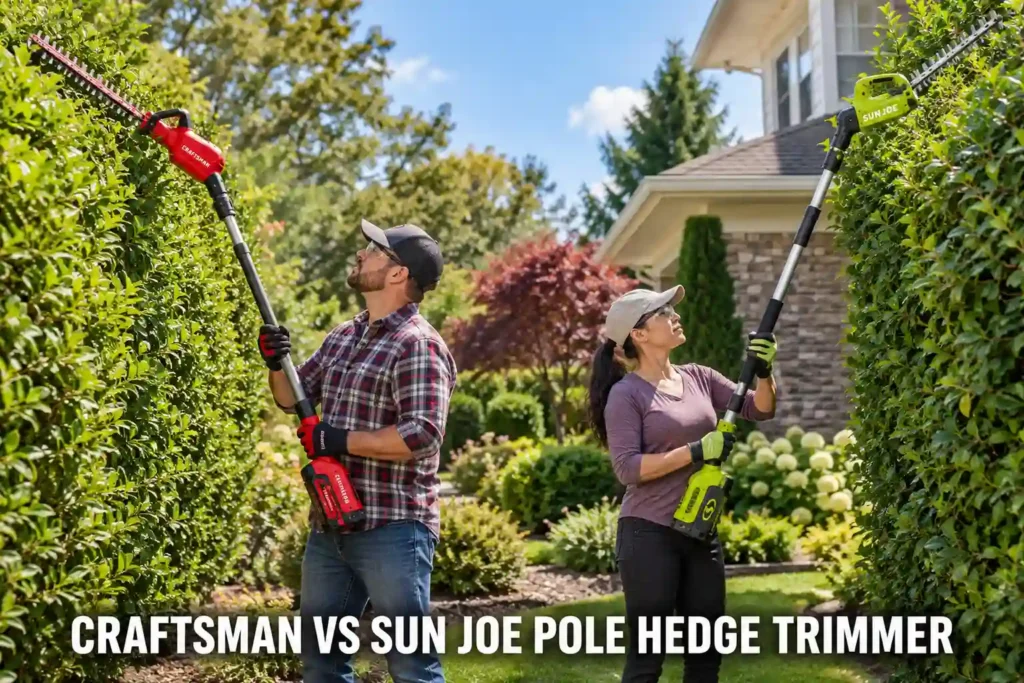

The CRAFTSMAN vs Sun Joe pole hedge trimmer choice comes down to a cord or a battery. Buy the Sun Joe SJH902E if an outlet sits within reach of an extension cord; buy the CRAFTSMAN CMCPHT818D1 if the hedge is too far from power. I ran both along the hedgerow at the edge of my orchard, and the power source shaped every pass more than any spec line did. Below I compare blade, pole, reach claims, weight, cutting limits and safety, so you can match one of them to your hedge.
CRAFTSMAN vs Sun Joe Pole Hedge Trimmer: The Short Answer
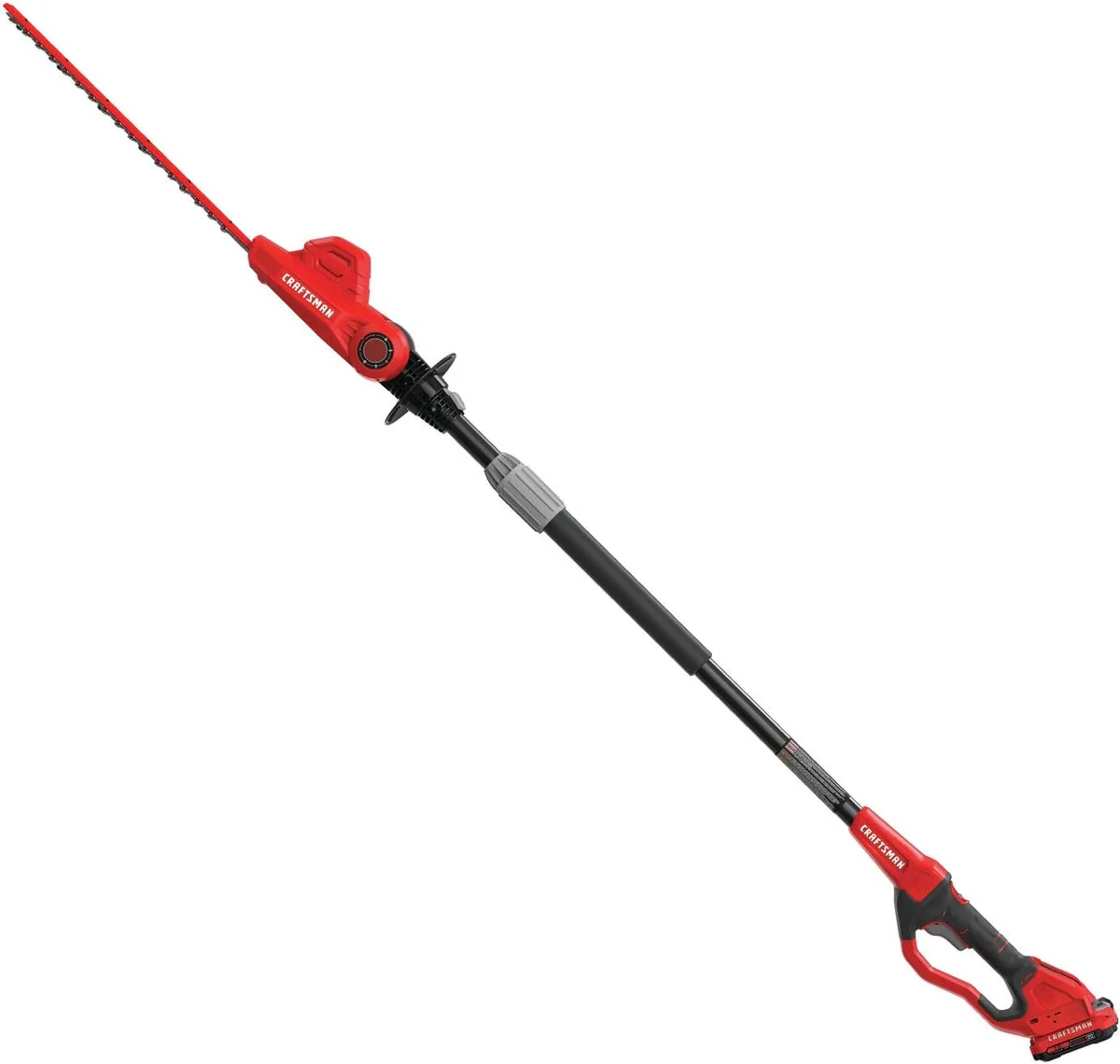
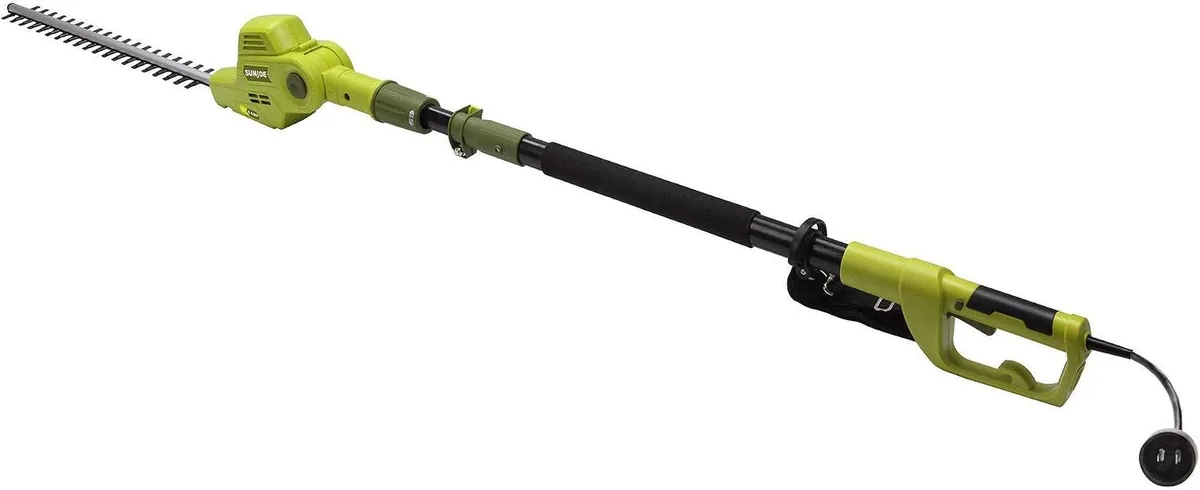
For most homeowners with a hedge near an outdoor outlet, I recommend the Sun Joe SJH902E 21-Inch Corded Telescoping Pole Hedge Trimmer: it has the longer 21 in blade, a pole that telescopes from 6.4 to 7.9 ft, a published weight and no battery to charge. The CRAFTSMAN V20 18-Inch Pole Hedge Trimmer Kit CMCPHT818D1 wins when the hedge sits far from power, because a V20 battery takes the cord out from behind a running blade. Both are mid-range tools built for the shrubs around a house, and both stop at a stem limit close to 3/4 in. Two rows of the table decide it: the power source and the reach.
| Row | CRAFTSMAN CMCPHT818D1 | Sun Joe SJH902E |
|---|---|---|
| Trimmer type | Battery pole hedge trimmer | Corded electric telescoping pole hedge trimmer |
| Power | V20 battery platform; the kit holds one 2.0 Ah battery and a charger | 120 V, 4 A, corded; no battery; no extension cord in the carton |
| Blade length, maker’s figure | 18 in | 21 in |
| Cutting capacity, manual’s stem limit | Stems up to 3/4 in (19 mm) | Stems up to 0.7 in (18 mm) |
| Blade action, as the maker states it | Dual action | Dual action |
| Pole length, a tool measurement | About 6 ft (1.8 m) when joined, per the manual; extended length not published by the maker | Telescoping, 6.4 to 7.9 ft (1.95 to 2.4 m) |
| Reach, maker’s claim | Up to 11 ft, for a 6 ft user holding the pole at shoulder height with arms outstretched, measured from the feet to the blade tip | 14 ft overhead; the user height behind it is not published by the maker |
| Weight | Not published by the maker | 8.8 lb net (corded, so no battery) |
| Head | Pivots 180 degrees and locks in 5 positions | Pivots to 6 angles (-90 to 60 degrees) with a button; cam-lock pole |
| Blade lubrication, from the manual | No step in the manual | Before and after each use, lightweight machine oil |
| In the kit | Tool, 2.0 Ah battery, charger, hard blade cover | Tool with telescoping pole, blade cover, shoulder strap |
| Tool warranty | 3 years | 2 years |
The CRAFTSMAN is the cordless choice and the Sun Joe is the plug-in choice, and the rest of the table follows from that split. I picture the CRAFTSMAN at the far end of the orchard hedgerow and the Sun Joe along the stretch behind the house, where a short run of cord is enough.
What Is Actually Different Between These Two Models
The model numbers hide three differences that change what you carry home. Each one is worth settling before you compare blade or reach.
- Kit or bare tool: the CMCPHT818D1 is the kit, with one 2.0 Ah V20 battery, a charger and a hard blade cover. Buying the CRAFTSMAN pole hedge trimmer tool only, the CMCPHT818B, is a separate purchase and makes sense only if you already own V20 batteries.
- Cord or battery: the Sun Joe SJH902E electric telescoping pole hedge trimmer takes power from the wall and has no battery, and the extension cord is yours to supply.
- Complete tool: neither one attaches to a pole saw or another power head. Each is a dedicated pole hedge trimmer that runs on its own.
V20 Battery Against a Corded Motor
The CRAFTSMAN V20 pole hedge trimmer runs on a battery, and its kit includes one 2.0 Ah pack with a three-LED gauge plus the charger. The Sun Joe runs on 120 V and 4 A from the wall. That one difference decides where each tool can work, and it changes your routine more than any blade spec.
Charge the CRAFTSMAN pack between 40 F and 104 F, and aim for 65 to 75 F; the charger holds off while a pack is too hot or too cold. The manual also warns against keeping the tool and battery anywhere that may reach 104 F, such as an outside shed in summer. A shed in summer is exactly that place, so on cold mornings and hot afternoons I carry the pack in from the house instead of leaving it with the tool.
Battery Safety
Use only the maker’s battery and charger for your trimmer, charge and store them within the temperatures your manual gives and never in rain or wet places, never use or charge a damaged, swollen or leaking pack, and keep loose batteries away from metal objects such as keys, coins and nails that could short the terminals.
Every Sun Joe corded pole hedge trimmer owner has to supply an outdoor all-weather extension cord, and the manual sets the limits: 16 AWG up to 50 ft, 14 AWG from 50 ft to 100 ft, and no cord longer than 100 ft. It also asks for GFCI protection on the outlet. On my property the house and sheds sit roughly 100 to 150 feet from the nearest row, so one cord may not reach the far end of a long run, and that is where the CRAFTSMAN earns its place.
The cord also decides how you walk the hedge. Before connecting, loop it through the handle hole and around the cord restraint hook, then keep it behind you, as the manual says. Over a long stretch the cord kept swinging toward the blade path until I set it up that way, and I never run the Sun Joe without that loop.
Cord Safety
Use an outdoor-rated extension cord of the gauge your manual gives for its length, plug into GFCI-protected power, keep the cord behind you and over your shoulder, away from the blade and your feet, and never use the trimmer in rain, in wet or damp conditions or with wet hands (GFCI protection does not make wet use safe). If the cord is cut or damaged, disconnect it at once: pull the plug from the outlet by the plug before you touch the cord or the blade. Before you clear a jam or touch the blade, release the switch, switch the motor off, wait until the blade has stopped completely, then pull the plug from the outlet by the plug, not the cord, and put on gloves.
A corded tool also means a dry hedge. The Sun Joe manual says not to expose power tools to rain or wet conditions, and the CRAFTSMAN manual forbids use in wet conditions and in rain. On dewy mornings I wait until the hedge has dried before either one comes out of the shed.
Winner: the CRAFTSMAN for hedges far from an outlet, because a battery keeps the cord out from behind the blade.
Reach and Pole Length in the CRAFTSMAN vs Sun Joe Pole Hedge Trimmer Match
Two kinds of number sit on these pages, and they do not compare. A pole length is a measurement of the tool; a reach figure adds a user’s height and arm to it, and each maker builds that claim on its own assumptions. Set one kind against the other and you learn nothing. My list of pole models for tall hedges covers seven trimmers that reach from the ground.
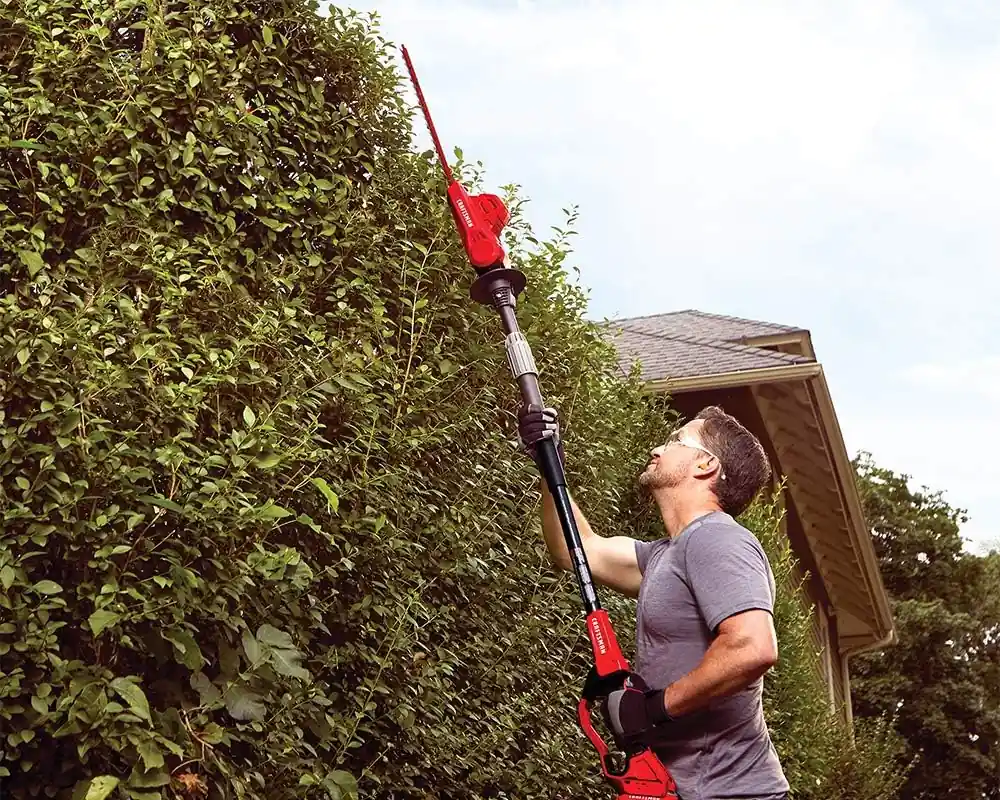
The Sun Joe telescoping pole hedge trimmer extends from 6.4 to 7.9 ft, which is a figure I can plan around, and the maker adds a claim of 14 ft overhead reach without saying how tall the user is. The CRAFTSMAN manual describes the joined handle and head modules as a pole of about 6 ft (1.8 m), and the maker claims up to 11 ft for a 6 ft user at shoulder height with arms outstretched. Because of those footnotes, 11 ft and 14 ft cannot be ranked against each other.
Length costs you steadiness. Extended to its full claimed reach, the CRAFTSMAN felt less steady in my hands than it did short, with only the foam gripper on the pole to guide it. The Sun Joe manual says to extend the pole only as far as the job needs, and to keep proper footing and balance at whatever length you use; I follow that on both tools, and I extend the Sun Joe cam-lock only until the top of the row is in reach from level ground. My long reach hedge trimmer picks cover seven pole models for tall hedges.
Both heads pivot and lock, which helps with a flat top and a vertical side. The CRAFTSMAN head turns 180 degrees into 5 positions and the Sun Joe head sets to 6 angles. Gloves matter at the pivot, because both manuals describe a pinch point, and the safety section below gives the full shutdown order before you touch the head.
For a tall hedge, stay on the ground and let the pole do the lifting. The shoulder and neck work of overhead cutting is real: a laboratory study found that raising an overhead task higher increased neck and shoulder muscle activity in young men, so a pole that keeps the blade up and your arms down earns its place (1). My top pole hedge trimmer picks cover nine models that reach tall hedges from the ground.
Winner: none on reach alone. The claims rest on different assumptions, and the Sun Joe pole’s documented range is 6.4 to 7.9 ft.
Cutting Limits and Blades
Both makers state a stem limit, and the two limits are close. The CRAFTSMAN manual says not to cut stems greater than 3/4 in (19 mm), which is a stem limit; the maker page words it as branches up to 3/4 in. The Sun Joe manual gives a maximum cutting diameter of 0.7 in (18 mm), also a stem limit, so I print 18 mm for the Sun Joe and 19 mm for the CRAFTSMAN.
The blade lengths differ more. The Sun Joe carries a 21 in dual-action blade, and the CRAFTSMAN an 18 in blade that the maker calls dual action, so the Sun Joe covers more hedge on each pass. A longer blade does not cut thicker wood, though. Wood above the limit goes to loppers or a saw, never through the blade. My hedge trimmers for thick branches list explains the cutting capacity of seven picks.
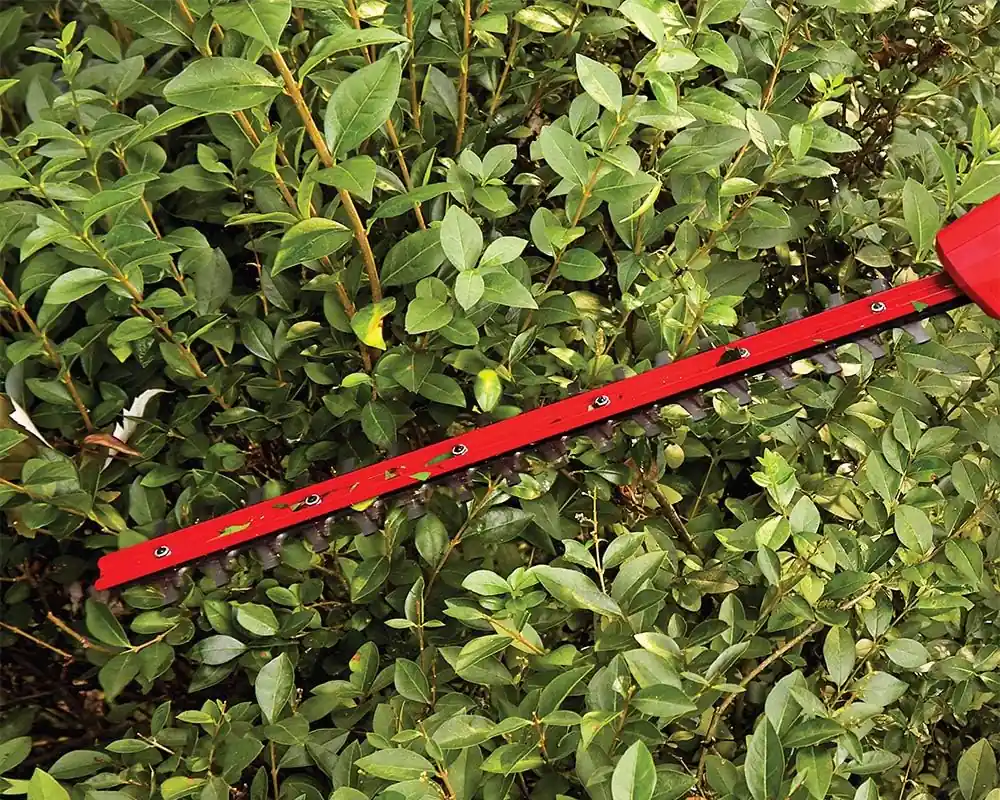
On a stem thicker than the manual’s limit the CRAFTSMAN blade stalled, so I cut the thick stems with loppers first and used the trimmer on the green growth. The CRAFTSMAN manual calls for a wide, sweeping motion that feeds the teeth through the twigs, with a slight downward tilt of the blade in the direction of travel. On the sides it says to begin at the bottom and sweep up.
In denser growth the Sun Joe asks for a back-and-forth sawing action and for a slower pace when the blades slow down; the manual says not to force it through heavy shrubbery. Before you oil it, release the switch, switch the motor off, wait until the blade has stopped completely, pull the plug from the outlet by the plug, not the cord, and put on gloves. Its blade also needs oil before and after each use, with lightweight machine oil along the top blade, so lubricating is a chore every session, not a seasonal job. The CRAFTSMAN manual gives no lubrication step, so I follow only what it prints. For a level top, I stretch a string along the hedge on either tool, as both manuals suggest.
Clippings from an overhead cut come down on you and on the ground. With the CRAFTSMAN I raked them off the drip lines under the hedgerow afterward, because a thick layer can bury an emitter line. Head protection matters for the same reason, and I cover it in the safety section.
Pro Tip
Do the thick stems first with loppers or a saw, then trim the soft growth. The blade stays sharper, and the motor is never asked to cut past its stated stem limit.
Winner: the Sun Joe, because the 21 in blade covers more hedge per pass at nearly the same stem limit.
Weight, Balance and Fatigue
The Sun Joe’s 8.8 lb net is the corded tool alone, with no battery to add. Here is how each carries on a pole.
By the end of a long row, the Sun Joe at its full 7.9 ft told me about its 8.8 lb in my shoulders. The manual provides a shoulder strap with a quick-release latch and says to attach it, which takes weight off the arms. The CRAFTSMAN manual says to hold the pole at its balance point when you carry it, blades to the rear. Before you carry it, release the switch, switch the motor off, wait until the blade has stopped completely, take the battery pack out and fit the blade cover. The same manual says to rest periodically and change working positions.
Posture adds to it. In a study of garden workers pruning hedges, high hedges put the arms above shoulder height and gave the highest shoulder and upper-arm loads, while low horizontal pruning gave the highest back load, and the authors link awkward postures to musculoskeletal problems (2). A field study of electricians found the shoulders and neck reported the highest peak discomfort during overhead work (3). Weight at arm’s length builds up over a long hedge: take breaks and stop when you are tired or your grip weakens. If your fingers go numb, stop.
Winner: none on weight alone; the table gives the Sun Joe figure, and I judge the CRAFTSMAN by how it carries. I compare nine lightweight hedge trimmer picks with attention to the basis of each weight figure.
Overhead Cuts, Power Lines and Hidden Wire Safety
A pole hedge trimmer is two sharp reciprocating blades on the end of a pole. Contact with the blade cuts a hand in a fraction of a second, and the blade keeps moving for a moment after you release the switch. The pole adds overhead debris and the power line hazard, so this section carries the full rules for both tools.
Power Lines and Overhead Wires
Before you start, look for every overhead wire, including wires hidden in leaves. Keep yourself, the trimmer, the pole and any branch you cut or that could fall or swing at least 50 feet (15 m) from every overhead line, the distance Ryobi and Echo print in their pole hedge trimmer manuals, or farther if your own manual asks for more. A pole hedge trimmer is not insulated, and electricity can jump through the air and travel through branches, especially wet ones. Treat every wire, including service drops and communication lines, and anything touching one, as live. If you cannot keep that distance the whole time, stop, and leave a hedge that has grown into or near a wire to the utility and its qualified line-clearance crews.
The CRAFTSMAN manual states that the unit is not designed to protect you from electric shock if it touches an overhead line. The Sun Joe is double-insulated for its own wiring, and that gives no protection near a wire. No pole, fiberglass or otherwise, and no insulated handle makes work near a wire safe. US occupational data tie electrocution deaths to outdoor industries such as agriculture, forestry and construction (4).
If the trimmer, the pole or a branch touches a wire, the trimmer, the branch, the wire and the ground around them can become live. Do not go to the trimmer or pick it up, touch nothing that is in contact with the line, keep everyone away, and call the utility at once, and 911 if anyone is hurt, a fire starts or a line comes down. Only the utility frees the trimmer.
Hidden Wire, Jams and Shutdown
Before you cut, look through the hedge for fence wire, cable and cords. If the blade jams on a wire or a cord, do not touch the blade, the wire or the cord and do not try to free the trimmer: stopping the blade does not remove the electrical danger, so the electrical supply to the damaged line or cord must be disconnected first. Treat anything touching a wire as live, and if it is a utility line, never go back to the trimmer to switch it off or unplug it: follow the line contact steps above.
The CRAFTSMAN manual says to check the hedge for foreign objects such as wire fences, and the Sun Joe manual says to clear cords, lights, wire and loose string from the area. I walk the row looking for exactly that.
Shutdown for Jams, Cleaning, Lubricating and Head Changes
If the jam is not on a wire or a cord, release the switch, switch the motor off and wait until the blade has stopped completely before you clear a jam, remove cut material, clean, lubricate, change the head angle, join or separate the pole or touch the blade. Then on the CRAFTSMAN take the battery pack out, and on the Sun Joe pull the plug from the outlet by the plug, not the cord. Put on gloves before you touch the blade, and check every lock and coupling before power goes back on.
Before each use, check the trimmer as your manual describes: the blades sharp, undamaged and lubricated, the operating guards fitted, the blade cover removed before you start (it is for carrying and storage only), the switches and the lock-off working, every handle and pole coupling tight, and the battery or cord undamaged. On the CRAFTSMAN the pole join matters: the manual says the sleeve must be threaded on completely, with no threads visible, or the modules can come apart. If anything fails the check, do not use the trimmer until it is fixed.
To carry or store the trimmer, release the switch, switch the motor off and wait until the blade has stopped completely. Then take the battery pack out of the CRAFTSMAN, or pull the plug of the Sun Joe from the outlet by the plug. Fit the blade cover, carry the trimmer by the handle with the blade pointing behind you, and store it indoors in a dry place out of children’s reach.
Ladders, Head Protection and Footing
Do not use a hedge trimmer on a ladder, a roof, a tree or any unstable support; the manuals of EGO, Ryobi, Milwaukee and Echo ban it, and Husqvarna bans work from any raised position that is not fully secured. For a tall hedge, stay on the ground and use a pole or long-reach hedge trimmer, or hire a professional. The CRAFTSMAN manual lists work in a tree or on a ladder under the places you must not operate it, and it adds that you should keep firm footing and not overreach.
Wear head protection when you operate a pole or long-reach trimmer overhead; the CRAFTSMAN manual asks for a hard hat that meets ANSI Z89.1. Also wear safety glasses with side shields marked ANSI Z87.1, and a face shield over them where your manual asks for one; hearing protection; sturdy work gloves; long pants and long sleeves with no loose clothing or jewelry; and closed, non-slip shoes or boots. Wear a respirator when dust is present.
Hold the trimmer with both hands on the handles, by the insulated gripping surfaces only because the blade can contact hidden wiring (the grips do not make the trimmer insulated or wire contact safe), whenever the blade is moving; one hand can cost you control of the tool. Keep your body parts clear of the blade and never remove cut material or hold the stem you are cutting while the blade moves. Never reach toward the blade, through the hedge or into any opening while the blade moves, do not overreach, and trim only what you can see.
Keep people, pets and helpers away from the work area and stop trimming if anyone comes closer. Look behind you before you swing the tool. Never trim in rain, dense fog, strong wind, a storm or when lightning is possible, and trim only when the light lets you see the stems, any wire in the hedge and your footing clearly. Look for nests before cutting and leave a hedge where birds are nesting.
Winner: the CRAFTSMAN, because there is no cord behind a running blade and its manual names head protection overhead.
Choose the CRAFTSMAN If
The CRAFTSMAN V20 CMCPHT818D1 suits the hedge that sits far from an outlet, or the buyer who wants no cord behind a running blade. It is a mid-range kit with a battery, a charger and a hard blade cover in the box, and a three-year warranty on the tool. I go through the V20 kit in full in my review of the CRAFTSMAN CMCPHT818D1 pole trimmer.
- The hedge is far from power: a battery covers the long run that no 100 ft cord can.
- You already own V20 batteries: the bare tool can then be bought separately.
- You want a cord-free pole: the Sun Joe manual warns that a cable can hide in shrubs and be cut by the blade.
- You read the safety lines: its manual names head protection overhead and bans work in a tree or on a ladder.
Skip it if you need a published weight or a longer blade, or if your hedge has old stems thicker than 3/4 in.
Choose the Sun Joe If
The Sun Joe electric pole hedge trimmer, the SJH902E, suits the hedge within reach of an outlet and a cord of the right gauge. It is a mid-range tool with a 21 in blade and a published weight, and it needs no battery to charge, store or replace. My review of the Sun Joe SJH902E pole trimmer covers the corded telescoping model in detail.
- An outlet is within reach: a cord of the right gauge, no longer than 100 ft, keeps you powered.
- You want a measured pole range: it telescopes from 6.4 to 7.9 ft.
- You want a strap: it ships with a shoulder strap and a quick-release latch.
- You prefer no battery: nothing to charge, and no pack to keep out of a hot shed.
Skip it if the hedge is damp, far from power or close to wires, or if you do not want a cord to manage behind you.
Which Pole Hedge Trimmer Fits Your Hedge
Pick by the walk from your nearest outlet to the far end of the hedge. If a cord of the right gauge reaches it and you want a measured pole range, a 21 in blade and a shoulder strap, the Sun Joe SJH902E is the better buy. If the run is long, or you would rather not manage a cord behind a running blade, the CRAFTSMAN CMCPHT818D1 and its V20 battery fit better. Both are mid-range tools for shrubs around a house, both stop at a stem limit close to 3/4 in, and both need the full safety routine every time. Keep every pass on the ground and far from any wire, and the CRAFTSMAN vs Sun Joe pole hedge trimmer decision stays simple: the nearest outlet decides. I also compare the CRAFTSMAN with a second battery model in my Makita and CRAFTSMAN pole trimmers comparison.
Frequently Asked Questions
Can you use the CRAFTSMAN pole hedge trimmer as a pole saw attachment?
The CRAFTSMAN pole hedge trimmer is a complete tool rather than an attachment, with its own 18 in blade, a battery and a charger in the kit. Its manual says to use no accessory or attachment that was not provided or named in it, so do not fit it to or take it from a pole saw.
Which has the longer blade, the CRAFTSMAN or the Sun Joe pole hedge trimmer?
The Sun Joe pole hedge trimmer has the longer blade at 21 in, against 18 in on the CRAFTSMAN. A longer blade does not cut thicker wood, because the stem limits are close, 3/4 in (19 mm) on the CRAFTSMAN and 0.7 in (18 mm) on the Sun Joe, and anything thicker belongs to loppers or a saw.
Which has the longer reach, the CRAFTSMAN or the Sun Joe pole hedge trimmer?
Neither the CRAFTSMAN nor the Sun Joe pole hedge trimmer can be ranked on reach, because the makers build their claims on different assumptions. CRAFTSMAN claims up to 11 ft for a 6 ft user at shoulder height, Sun Joe claims 14 ft overhead without a user height, and the Sun Joe pole itself telescopes from 6.4 to 7.9 ft.
Which cuts thicker stems, the CRAFTSMAN or the Sun Joe pole hedge trimmer?
The CRAFTSMAN and the Sun Joe pole hedge trimmer have nearly the same stem limit: 3/4 in (19 mm) for the CRAFTSMAN and 0.7 in (18 mm) for the Sun Joe. Anything thicker belongs to loppers or a saw, because both manuals set a limit above which you should not cut.
Which is heavier, the CRAFTSMAN or the Sun Joe pole hedge trimmer?
The Sun Joe pole hedge trimmer weighs 8.8 lb net, while the CRAFTSMAN weight is not published by the maker, so the two cannot be ranked. The Sun Joe figure is for the corded tool alone, with no battery, so compare the two by holding each at full length and judging how it carries before you buy.
References
- Shin SJ, Yoo WG. Effects of overhead work involving different heights and distances on neck and shoulder muscle activity. Work. 2015;51(2):321-326.
- Yang W, Li S, Li B, Liu W, Ning F, Gao S. Analysis of the effects of working position on muscle fatigue during hedge pruning: a cross-sectional study based on Chinese garden workers. J Mech Med Biol. 2023;23(2):2350027.
- Phelan D, O’Sullivan L. Shoulder muscle loading and task performance for overhead work on ladders versus Mobile Elevated Work Platforms. Appl Ergon. 2014;45(6):1384-1391.
- Taylor AJ, McGwin G, Valent F, Rue LW. Fatal occupational electrocutions in the United States. Inj Prev. 2002;8(4):306-312.
Safety Note: Only an adult who has read the manual and understands the controls should use a hedge trimmer, never a child or anyone tired or impaired. The blades are sharp, a hand that touches them is cut in a fraction of a second, and they keep moving for a moment after you release the switch. Hold the trimmer with both hands on the handles, by the insulated gripping surfaces only because the blades can contact hidden wiring (the grips do not make the trimmer insulated or wire contact safe), whenever the blades move; on a trimmer with two switches, both hands must be on the switches to start. Never hold a branch or reach toward the blades, through the hedge or into any opening while they move, and never reach into any opening of a gas trimmer while the engine is running, because a blade that stops in a jam does not stop the engine. Never overreach, and trim only what you can see. Before you start, look through the hedge for wire, fence wire, cords, posts, stakes, irrigation lines, nests, people and pets, and keep the cord or hose out of the blade’s path. If a blade jams on a wire or a cord, do not touch the blade, the wire or the cord: stopping the blade does not remove the electrical danger, so the electrical supply to the damaged line or cord must be disconnected first. Cut only stems up to the capacity your manual states, in the maker’s own wording, and leave thicker wood to loppers or a saw. Do not use a hedge trimmer from a ladder, a roof, a tree or any unstable support, so for a tall hedge stay on the ground and use a pole or long-reach hedge trimmer, or hire a professional. Power lines can kill. With a pole or long-reach hedge trimmer, look for every overhead wire, including wires hidden in leaves, and keep yourself, the trimmer, the pole and any branch that could fall or swing at least 50 feet (15 m) from every line, the distance Ryobi and Echo print in their pole hedge trimmer manuals, or farther if your manual asks for more. A pole hedge trimmer is not insulated, and electricity can jump through the air and travel through branches, especially wet ones. Treat every wire as live, and leave a hedge that has grown into or near a wire to the utility and its qualified line-clearance crews. If the trimmer, the pole or a branch touches a wire, treat the trimmer, the branch, the wire and anything touching them as live: do not go back to the trimmer to switch it off or unplug it, do not touch anything in contact with the line, keep everyone away and call the utility, which alone frees the trimmer, and 911 if anyone is hurt, a fire starts or a line comes down. Wear safety glasses with side shields marked Z87.1, a face shield over the glasses where your manual asks for one, hearing protection, sturdy gloves, long pants, long sleeves with no loose clothing or jewelry, and closed, non-slip shoes. Wear head protection when you work a pole or long-reach model overhead, as the Ryobi, Husqvarna and Echo pole manuals require, and a respirator when dust is present, as the DeWalt manual states; where a manual forbids cutting overhead, do not. Keep people and pets away at the distance your manual gives, and stop trimming if anyone comes closer. Never trim in rain, fog, strong wind, a storm or when lightning is possible, trim only in good light, and let the hedge dry first. Before each use, remove the blade cover (it is for carrying and storage only), and check the blades, the operating guards, the switches and every handle and pole coupling as your manual describes, and do not use a trimmer that fails a check. Before you clear a jam, remove cut material, clean, lubricate or touch the blades: release the switch, switch the motor or engine off and wait until the blades have stopped completely, then take the battery pack out, unplug a corded trimmer from the outlet by the plug, or on a gas trimmer let the engine and muffler cool and pull the spark plug wire off; put on gloves and check every lock and coupling before power goes back on. To carry or store the trimmer, release the switch, switch the motor or engine off and wait until the blades have stopped completely, then take the battery out, unplug a corded trimmer by the plug, or on a gas trimmer let the engine and muffler cool and pull the spark plug wire off; fit the blade cover, carry the trimmer by the handle with the blades pointing behind you, and keep it indoors, dry and out of children’s reach. Use only the maker’s battery and charger, charge and store them within the temperatures your manual gives and never in the wet, never use or charge a damaged, swollen or leaking pack, and keep loose batteries away from metal objects that could short the terminals. Use a corded trimmer only with an outdoor-rated extension cord of the gauge your manual gives, plugged into GFCI-protected power, with the cord behind you and away from the blades, and never in rain or wet conditions: GFCI protection does not make that safe; if the cord is cut or damaged, disconnect it at once by pulling the plug from the outlet by the plug, before you touch the cord or the blades. Refuel a gas trimmer outdoors with the engine off and cool, with no smoking, flames or sparks nearby, wipe up spills, move at least 10 feet from where you fuelled before you start it, wear hearing protection, and never run it indoors or in a garage or shed, because the exhaust contains carbon monoxide. Look for nests before you cut and leave a hedge where birds are nesting. Take breaks and stop when you are tired.