
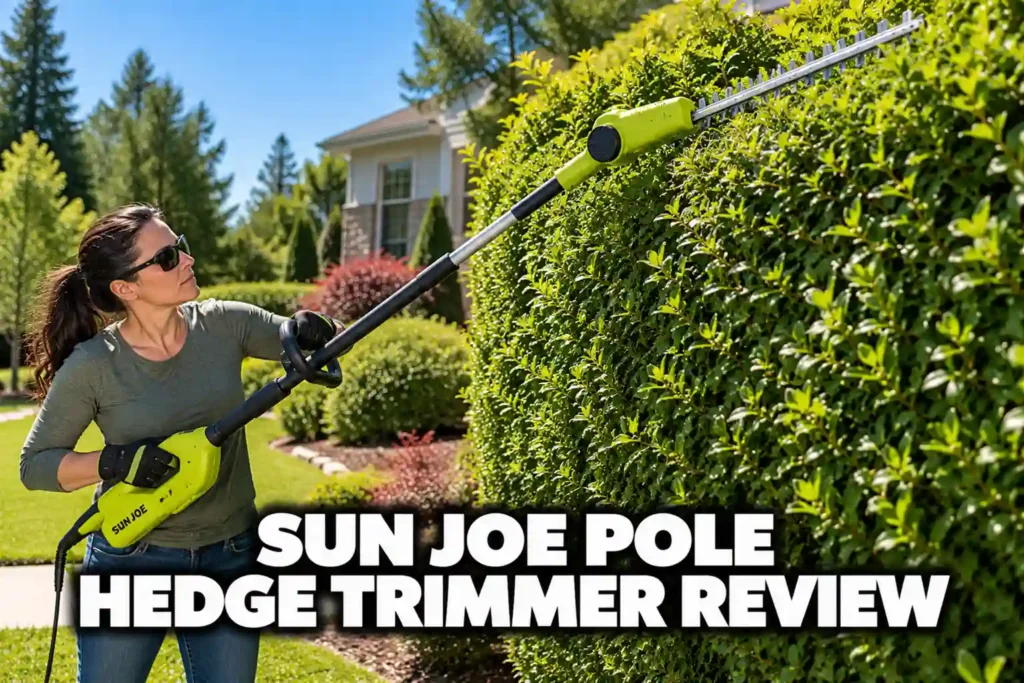

This Sun Joe pole hedge trimmer review comes to a plain verdict: the corded SJH902E suits soft hedge growth above shoulder height when an outlet is close, and it is the wrong tool for woody stems or a run far from the house. I used it along the hedgerow at the edge of the orchard with the cord kept behind me, and the cord shaped the job more than the blade did. Below I cover the specs, the pole and the six-angle head, the cord and wire rules, the drawbacks and three battery pole trimmers to compare.
Sun Joe Pole Hedge Trimmer Review: The Short Answer
Buy the Sun Joe SJH902E Corded Telescoping Pole Hedge Trimmer if your hedge has leafy, young growth that a handheld trimmer cannot reach from the ground and you have a GFCI-protected outlet within a cord run of 100 ft or less (Sun Joe’s chart: 16 AWG up to 50 ft, 14 AWG over 50 ft up to 100 ft). Skip it if the stems are thicker than 0.7 in (18 mm), if the ground stays wet, or if the nearest outlet is farther away than the cord limit allows. There is no battery to buy or charge, and the price of that is a cord you manage on every pass.
- Who it is for: a homeowner with soft, leafy hedges above shoulder height and an outlet nearby. To help you choose a hedge trimmer for tall hedges, I compare seven pole models that reach from the ground.
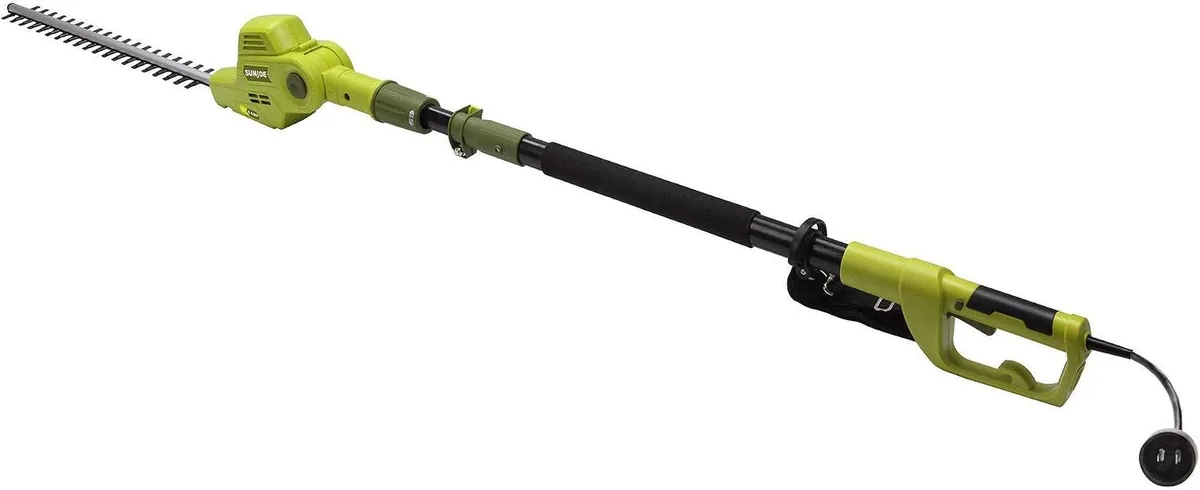
- What it does best: a telescoping pole from 6.4 to 7.9 ft and a head that locks at six angles, with no battery to buy.
- Main trade-off: the cord, which limits where you can work and must stay behind you and away from the blade.
Specs and What Comes in the Box
Two rows matter most: cutting capacity, because it is a stem limit, and the power row, because the box holds no extension cord.
| Spec | Value |
|---|---|
| Trimmer type | Corded electric pole hedge trimmer, telescoping pole, pivoting head |
| Power | 120 V, 4 A motor; no battery |
| Blade length, as called by the maker | 21 in (53.3 cm), dual-action |
| Cutting capacity, maker’s wording (stem diameter) | 0.7 in (18 mm) |
| Pole length, tool measurement | 6.4 to 7.9 ft (1.95 to 2.4 m) |
| Head angles | Six: -90, -60, -30, 0, 30 and 60 degrees |
| Weight, manual net weight (corded, no battery) | 8.8 lb (4 kg) |
| Blade stop | Not published by the maker |
| Warranty | 2 years |
The box holds the trimmer head, the rear handle with the telescoping pole, a blade cover, a shoulder strap and the manual. No extension cord comes with it, so plan on an outdoor-rated one. The full name is the Sun Joe SJH902E Electric Telescoping Pole Hedge Trimmer.
The manual prints 0.7 in (18 mm) in its technical data and its safety text, and that is the figure I work to, not 3/4 in. According to Sun Joe, the overhead reach is 14 ft. That claim rests on the height of the person holding the pole, so I plan around the pole’s own 6.4 to 7.9 ft. My roundup of long reach hedge trimmers lists seven pole models for tall hedges.
Using a Telescoping Hedge Trimmer: Pole, Head and Hold
The pole and the head decide how well the SJH902E works from the ground. I tried each setting before the first cut.
Setting the Pole Length
To change the pole length, release the switch, switch the motor off, wait until the blade has stopped completely, then pull the plug from the outlet by the plug, not the cord. Put on gloves before you touch the blade, and check every lock and coupling before power goes back on.
Then release the cam-lock, slide the pole out, close the lock and check that the pole does not slide. Sun Joe says to extend it only as far as the hedge requires, and I stop at the shortest setting that reaches the top of the row. At 7.9 ft the 8.8 lb tool felt unsteady in my arms in a way it did not at 6.4 ft, and that wobble is why I never add length for a few extra inches. If the pole slips, the manual tells you to tighten the cam-lock nut with a hex key, because a pole that will not lock can cause serious injury.
Two Hands, Always
Hold the trimmer with both hands on the handles, by the insulated gripping surfaces only because the blade can contact hidden wiring (the grips do not make the trimmer insulated or wire contact safe), whenever the blade is moving; one hand can cost you control of the tool. Keep your body parts clear of the blade and never remove cut material or hold the stem you are cutting while the blade moves. On the SJH902E the left hand goes on the pole and the right hand on the rear handle.
Changing the Head Angle
The head pivots to six angles, set with a pivot button, so the blade can lie flat across a hedge top while the pole points up and away from you. Before you press the button, release the switch, switch the motor off, wait until the blade has stopped completely, then pull the plug from the outlet by the plug, not the cord. Put on gloves before you touch the blade, and check every lock and coupling before power goes back on. So I set the angle before the first pass, not in the middle of a row. Check that the head has locked, never use it unlocked, and keep your hand out of the gap between the pivoting head and its locking base, which is a pinch point.
The Cutting Pace
Sun Joe describes a wide, slow sweep on new growth and a back-and-forth sawing action on denser growth. The blade slowed on a stem close to the limit, and I did what the manual says: I reduced the pace instead of forcing the pole through the hedge. Anything thicker than the stem limit goes to loppers or a pruning saw, never through the blade. For a level top, stretch a string along the hedge and cut just above it, with the sides slightly narrower at the top.
Reaching up has a physical cost. In a study of 120 Chinese garden workers, pruning high hedges with the arms above shoulder height gave the highest trapezius and biceps loads (1). That is why I attach the shoulder strap, as the manual says.
Weight at arm’s length builds up over a long hedge: take breaks and stop when you are tired or your grip weakens. My lightweight hedge trimmer roundup compares nine picks by their weight basis.
Cord, Outlet and Weather Rules
The Sun Joe corded pole hedge trimmer asks more of you than a battery model, and almost all of it concerns the cord. Sun Joe’s manual gives a gauge chart: 16 AWG up to 50 ft (15 m) and 14 AWG over 50 ft up to 100 ft (30 m), and it says never to use a cord longer than 100 ft. If in doubt, use the next heavier gauge.
Corded Rules
Use an outdoor-rated extension cord of the gauge your manual gives for its length, plug into GFCI-protected power, keep the cord behind you and over your shoulder, away from the blade and your feet, and never use the trimmer in rain, in wet or damp conditions or with wet hands (GFCI protection does not make wet use safe). If the cord is cut or damaged, disconnect it at once: pull the plug from the outlet by the plug before you touch the cord or the blade. Before you clear a jam or touch the blade, release the switch, switch the motor off, wait until the blade has stopped completely, then pull the plug from the outlet by the plug, not the cord, and put on gloves.
Before connecting, Sun Joe wants a loop of the cord pushed through the handle hole and around the cord restraint hook. On longer passes the cord kept wandering toward my feet, so I stopped between passes and set it behind me again, over my shoulder. At my place the house and sheds sit roughly 100 to 150 ft from the nearest row, so a 100 ft run from the house would not reach, and for a hedge that far out I would want an outlet nearer to it.
On dewy mornings I wait for the hedge to dry before I plug in.
Weather
Never trim in rain, dense fog, strong wind, a storm or when lightning is possible, and trim only when the light lets you see the stems, any wire in the hedge and your footing clearly.
Safety Around Wires, Ladders and People
A pole trimmer adds hazards a handheld one does not have: the overhead cut, overhead wires and the temptation to climb. Before every cut I look through the hedge for fence wire, cable and cords, and I check the work area for posts, stakes, hoses, drip lines and people.
Power Lines
Overhead Wires
Before you start, look for every overhead wire, including wires hidden in leaves. Keep yourself, the trimmer, the pole and any branch you cut or that could fall or swing at least 50 feet (15 m) from every overhead line, the distance Ryobi and Echo print in their pole hedge trimmer manuals, or farther if your own manual asks for more. A pole hedge trimmer is not insulated, and electricity can jump through the air and travel through branches, especially wet ones. Treat every wire, including service drops and communication lines, and anything touching one, as live. If you cannot keep that distance the whole time, stop, and leave a hedge that has grown into or near a wire to the utility and its qualified line-clearance crews.
The corded SJH902E is double-insulated for its own wiring, and nothing about that, or about a pole, makes work near a wire safe. Reviews of fatal incidents among landscaping and tree care workers found electrocution from power lines to be the most common cause (2).
If a Wire Is Touched
If the trimmer, the pole or a branch touches a wire, the trimmer, the branch, the wire and the ground around them can become live. Do not go to the trimmer or pick it up, touch nothing that is in contact with the line, keep everyone away, and call the utility at once, and 911 if anyone is hurt, a fire starts or a line comes down. Only the utility frees the trimmer.
Ladders and Footing
No Ladders
Do not use a hedge trimmer on a ladder, a roof, a tree or any unstable support; the manuals of EGO, Ryobi, Milwaukee and Echo ban it, and Husqvarna bans work from any raised position that is not fully secured. For a tall hedge, stay on the ground and use a pole or long-reach hedge trimmer, or hire a professional.
A study of ladder falls found that most happened because the ladder moved or the person slipped or misstepped (3).
Protective Gear and Bystanders
Wear the Gear
Wear safety glasses with side shields marked ANSI Z87.1, and a face shield over them where your manual asks for one; hearing protection; sturdy work gloves; long pants and long sleeves with no loose clothing or jewelry (Echo says never wear shorts); and closed, non-slip shoes or boots. Wear head protection when you operate a pole or long-reach trimmer overhead. Wear a respirator when dust is present, as the DeWalt manual states.
Sun Joe’s symbol table asks for eye and hearing protection, and its text asks for sturdy gloves, non-skid footwear and safety glasses. In a UK review of penetrating eye injuries at home, none of the patients hurt doing DIY or gardening had worn eye protection (4). A field study that mapped hedge trimmer noise around the operator concluded that a work regime and hearing protection were needed (5).
Bystanders
Keep people, pets and helpers away from the work area, at the distance your manual gives, and stop trimming if anyone comes closer. Look behind you before you swing the tool. Sun Joe says never to operate the trimmer while people, especially children, or pets are nearby.
Living With It: Oiling, Clearing Jams and Storage
Upkeep is short, but every step has an order, and the order protects your hands.
Oiling the Blade
Sun Joe says to lubricate the blade before and after every use with a lightweight machine oil along the top blade, and to keep solvents off the plastic parts. I oil it before the first cut and again when I finish, and that routine takes less time than any repair. Each time, release the switch, switch the motor off, wait until the blade has stopped completely, then pull the plug from the outlet by the plug, not the cord. Put on gloves before you touch the blade, and check every lock and coupling before power goes back on.
Clearing a Jam
Hidden Wire First
Before you cut, look through the hedge for fence wire, cable and cords. If the blade jams on a wire or a cord, do not touch the blade, the wire or the cord and do not try to free the trimmer: stopping the blade does not remove the electrical danger, so the electrical supply to the damaged line or cord must be disconnected first. Treat anything touching a wire as live, and if it is a utility line, never go back to the trimmer to switch it off or unplug it: follow the wire-contact steps above.
A jam on plain cut material is a different case. Release the switch, switch the motor off and wait until the blade has stopped completely, because the blades coast after you let go. Then pull the plug from the outlet by the plug, not the cord, and put on gloves before you touch the blade. Check every lock and coupling before power goes back on.
Carrying and Storage
To carry or store the trimmer, release the switch, switch the motor off and wait until the blade has stopped completely. Then pull the plug of the corded trimmer from the outlet by the plug, fit the blade cover, carry the trimmer by the handle with the blade pointing behind you, and store it indoors in a dry place out of children’s reach.
Who Should Buy the SJH902E and Who Should Skip It
Of the Sun Joe hedge trimmer range, the SJH902E is the corded telescoping pole model. My roundup of the top pole hedge trimmers covers nine picks for reaching tall hedges from the ground.
- Buy it if: your hedge is soft, leafy and above shoulder height, and a GFCI outlet sits within a cord run of 100 ft or less on 16 AWG up to 50 ft or 14 AWG beyond that.
- Buy it if: you do not want to buy or charge a battery for a pole trimmer.
- Skip it if: the stems are thicker than 0.7 in (18 mm), or the hedge sits far from any outlet.
- Skip it if: the hedge is often wet, or if you need a trimmer to work near overhead wires.
Drawbacks
The cord is the main drawback. It is a cut-and-trip hazard behind a running blade, and Sun Joe warns that the blade can cut a cord hidden in shrubs, so the cord must never touch the blade during use.
The second is capacity: at 0.7 in (18 mm) of stem, the SJH902E stops at soft growth, and anything woody belongs to a pruning saw. The third is 8.8 lb net weight on a pole that extends to 7.9 ft, which tires the shoulders. The blade also wants oil before and after each session. My picks for a hedge trimmer for thick branches explain the capacity figure model by model.
How It Compares With Battery Pole Trimmers
Among extension pole hedge trimmer options, the SJH902E is the corded one, so the real comparison is a cord against a battery. Capacity is a stem figure for some models and a branch figure for others, and the weights use different bases, so read each row on its own.
| Model | Power | Blade length, as called | Capacity, maker’s wording | Weight, with basis |
|---|---|---|---|---|
| Sun Joe SJH902E | Corded, 4 A | 21 in | 0.7 in stem | 8.8 lb net weight (corded) |
| Makita XNU01Z | 18V LXT, tool only | 20 in | 10 mm (3/8 in) branch | 8.6 to 9.3 lb with a battery |
| CRAFTSMAN CMCPHT818D1 | V20 kit, one 2.0Ah battery | 18 in | 3/4 in stem | Not published by the maker |
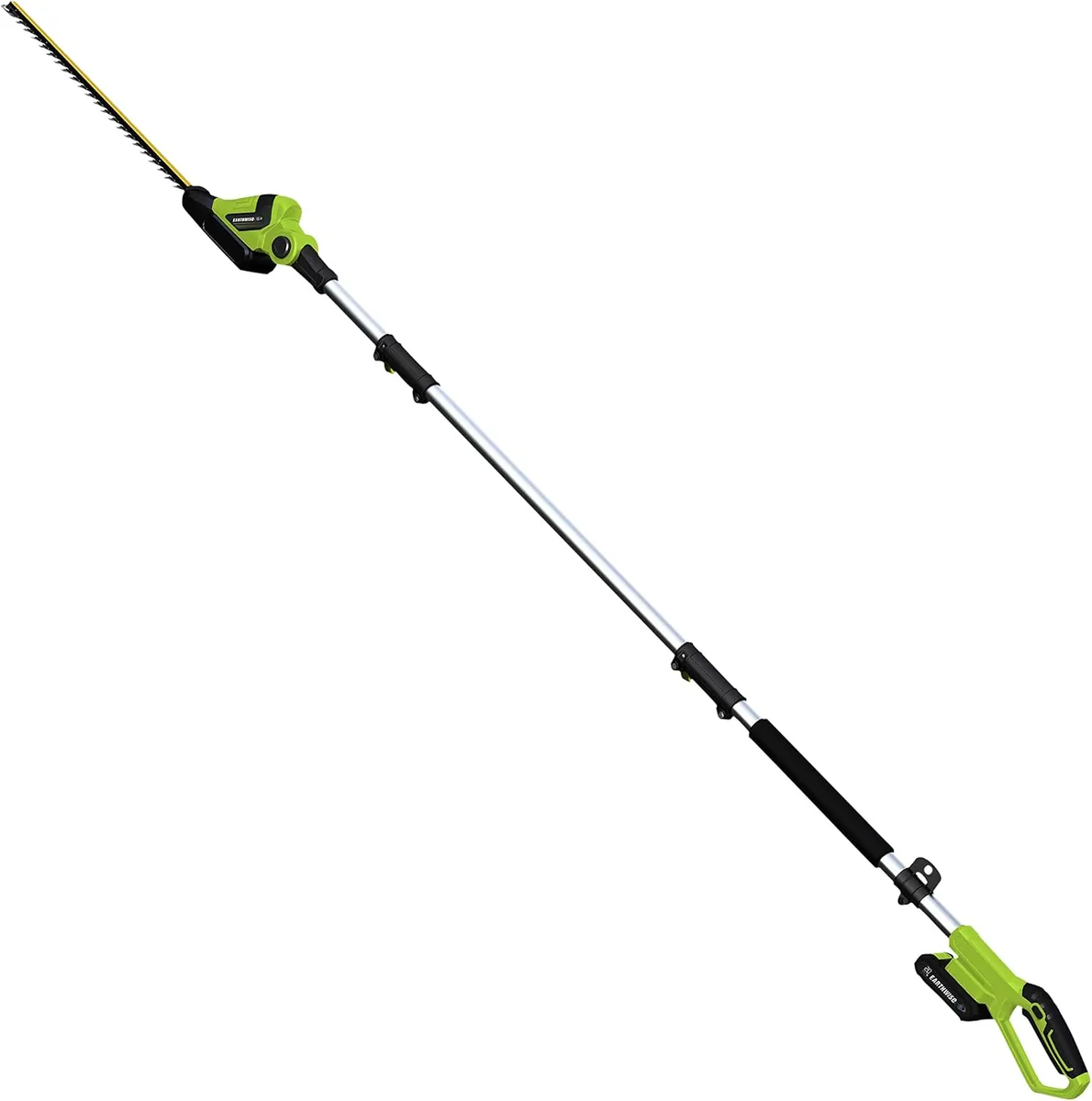
| Earthwise LPHT12022 | 20V kit, one 2.0Ah battery | 20 in | 5/8 in stem | 7.3 lb (basis not stated) |
Makita XNU01Z
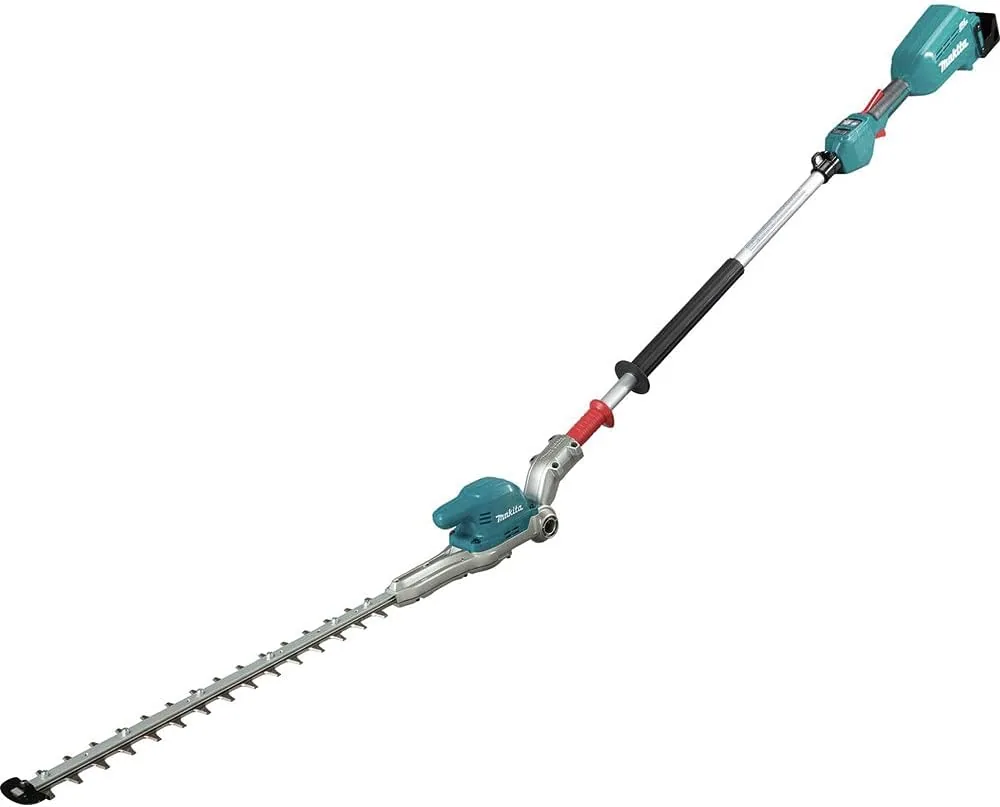
Pick the Makita XNU01Z 18V LXT Articulating Pole Hedge Trimmer if you already own 18V LXT batteries, because it is sold as a tool only, with no battery or charger. Makita’s manual gives its capacity as branches of 10 mm (3/8 in), a different kind of figure from the Sun Joe’s 0.7 in stem. Its weight includes a battery and the Sun Joe’s does not need one, so the two figures do not rank the tools. My full look at the Makita XNU01Z pole hedge trimmer covers its articulating head and 20 inch blade.
CRAFTSMAN CMCPHT818D1
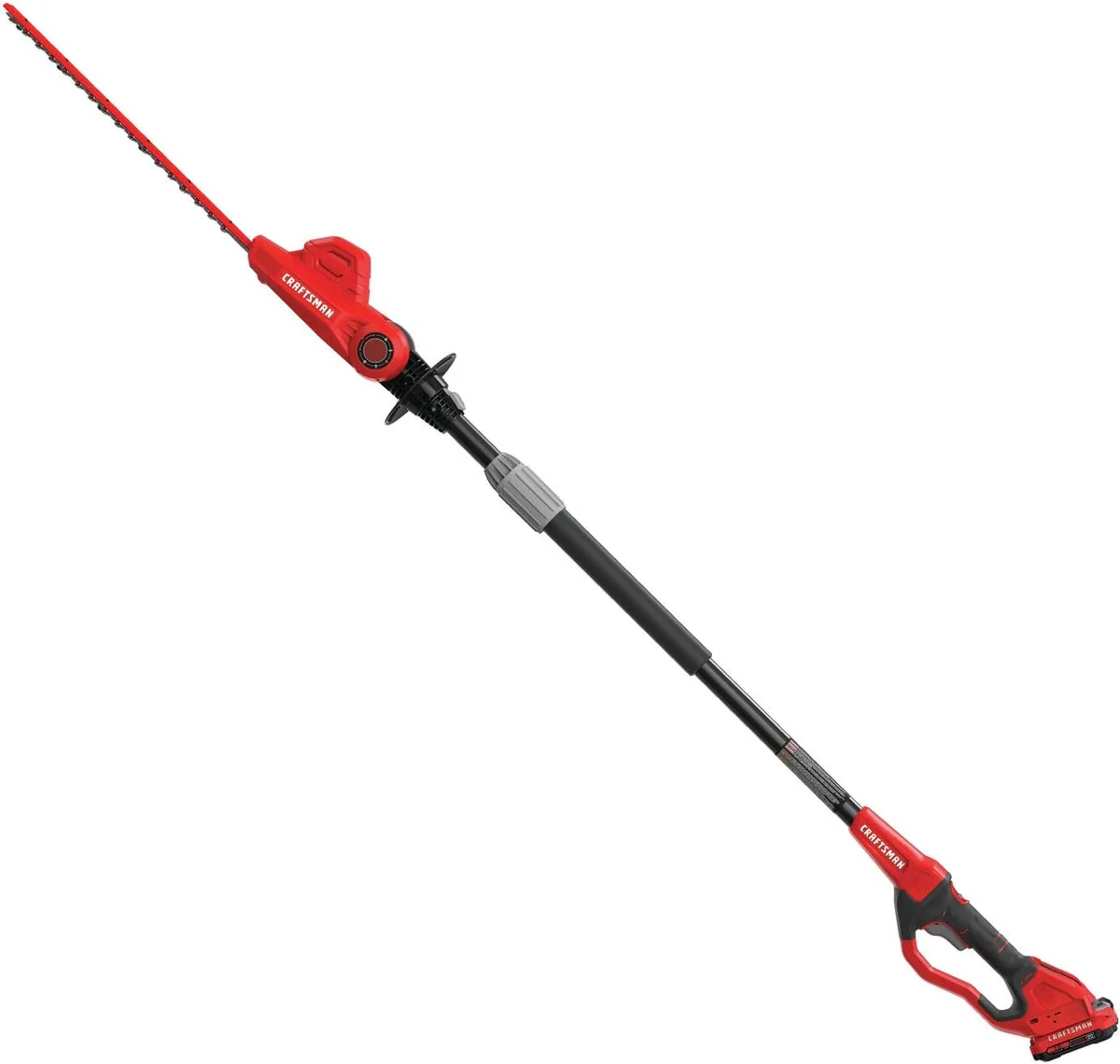
Pick the CRAFTSMAN CMCPHT818D1 V20 Cordless Pole Hedge Trimmer Kit if you want a battery kit with a charger in the box and an 18 in blade. The manual limits it to stems up to 3/4 in (19 mm), and the pole is about 6 ft. My comparison of the CRAFTSMAN and Sun Joe trimmers sets the V20 kit against this corded model.
Earthwise LPHT12022
Pick the Earthwise LPHT12022 20V Cordless Pole Hedge Trimmer Kit if you want a battery kit with a 20 in blade and no cord. Its manual limits it to stems of 5/8 in, and the warranty is two years on the tool.
Common Problems and How to Prevent Them
Every fix below starts the same way: release the switch, switch the motor off, wait until the blade has stopped completely, then pull the plug from the outlet by the plug, not the cord. Put on gloves before you touch the blade, and check every lock and coupling before power goes back on. A pole that slips needs the cam-lock closed fully and the cam-lock nut tightened with the hex key. A blade that binds means the pace is too fast or the stem too thick, so slow down or switch to a saw. Overheating comes from blocked vents, so clear debris from them after each session.
After any impact with a hard object, or an abnormal noise or vibration, do not carry on: follow the jam steps above, then inspect the blade, because a damaged blade must not be used again.
My Final Verdict on the Sun Joe SJH902E
The SJH902E is a sensible corded tool for one job: soft hedge growth that sits too high to cut from the ground with a handheld trimmer. The telescoping pole, the six head angles and the missing battery give it a clear place, and the 0.7 in stem limit and the cord keep that place small. Use it near an outlet, keep the cord behind you, stay far from every wire and leave woody stems to a saw. That is where my Sun Joe pole hedge trimmer review lands: the SJH902E is a clear yes for tall, soft hedges within reach of an outlet.
Frequently Asked Questions
Does the Sun Joe SJH902E pole hedge trimmer need an extension cord?
The Sun Joe SJH902E pole hedge trimmer needs an extension cord because it is corded and none comes in the box. Use an outdoor-rated cord of 16 AWG up to 50 ft or 14 AWG up to 100 ft, never longer than 100 ft, and plug it into GFCI-protected power.
Is Sun Joe a good brand?
Sun Joe is a reasonable brand for a corded pole hedge trimmer if you judge the SJH902E by what it offers. It has a telescoping pole from 6.4 to 7.9 ft, a head that locks at six angles and a two year warranty, with a 0.7 in stem limit that keeps it to soft growth.
How high can the Sun Joe SJH902E pole hedge trimmer reach?
The telescoping pole on the Sun Joe SJH902E pole hedge trimmer runs from 6.4 to 7.9 ft, and Sun Joe claims a 14 ft overhead reach for a user of an unstated height. Extend the pole only as far as the job needs, and never reach beyond a footing you can hold.
Can you sharpen a hedge trimmer blade?
You can sharpen a hedge trimmer blade only as your own manual allows, and the SJH902E manual gives no sharpening steps at all. It says to replace a worn or damaged blade with a new one, and to oil the blade before and after each use with a lightweight machine oil.
Can I use chainsaw oil on a hedge trimmer?
Chainsaw oil is not what the SJH902E manual names for the blade, which calls for a lightweight machine oil along the top blade before and after each use. Oil only after the full shutdown order in the safety section above, use the lubricant your manual names, and keep solvents off plastic parts.
References
- Yang W, Li S, Li B, Liu W, Ning F, Gao S. Analysis of the effects of working position on muscle fatigue during hedge pruning: a cross-sectional study based on Chinese garden workers. J Mech Med Biol. 2023;23(2):2350027.
- Kearney GD, Romano N, Doub A. Fatal injuries among landscaping and tree care workers: Insights from NIOSH and state-based FACE reports. Journal of Safety Research. 2024;91:393-400.
- Cabilan CJ, Vallmuur K, Eley R, et al. Impact of ladder-related falls on the emergency department and recommendations for ladder safety. Emerg Med Australas. 2018;30(1):95-102.
- Bhogal G, Tomlins PJ, Murray PI. Penetrating ocular injuries in the home. J Public Health. 2007;29(1):72-74.
- Silva MO, Yanagi Junior T, Schiassi L, Rossoni DF, Barbosa JA, Yanagi SNM. Spatial variability of the noise level of a hedge trimmer and backpack blower. Rev Bras Cienc Agrar. 2014;9(3):454-458.
Safety Note: Only an adult who has read the manual and understands the controls should use a hedge trimmer, never a child or anyone tired or impaired. The blades are sharp, a hand that touches them is cut in a fraction of a second, and they keep moving for a moment after you release the switch. Hold the trimmer with both hands on the handles, by the insulated gripping surfaces only because the blades can contact hidden wiring (the grips do not make the trimmer insulated or wire contact safe), whenever the blades move; on a trimmer with two switches, both hands must be on the switches to start. Never hold a branch or reach toward the blades, through the hedge or into any opening while they move, and never reach into any opening of a gas trimmer while the engine is running, because a blade that stops in a jam does not stop the engine. Never overreach, and trim only what you can see. Before you start, look through the hedge for wire, fence wire, cords, posts, stakes, irrigation lines, nests, people and pets, and keep the cord or hose out of the blade’s path. If a blade jams on a wire or a cord, do not touch the blade, the wire or the cord: stopping the blade does not remove the electrical danger, so the electrical supply to the damaged line or cord must be disconnected first. Cut only stems up to the capacity your manual states, in the maker’s own wording, and leave thicker wood to loppers or a saw. Do not use a hedge trimmer from a ladder, a roof, a tree or any unstable support, so for a tall hedge stay on the ground and use a pole or long-reach hedge trimmer, or hire a professional. Power lines can kill. With a pole or long-reach hedge trimmer, look for every overhead wire, including wires hidden in leaves, and keep yourself, the trimmer, the pole and any branch that could fall or swing at least 50 feet (15 m) from every line, the distance Ryobi and Echo print in their pole hedge trimmer manuals, or farther if your manual asks for more. A pole hedge trimmer is not insulated, and electricity can jump through the air and travel through branches, especially wet ones. Treat every wire as live, and leave a hedge that has grown into or near a wire to the utility and its qualified line-clearance crews. If the trimmer, the pole or a branch touches a wire, treat the trimmer, the branch, the wire and anything touching them as live: do not go back to the trimmer to switch it off or unplug it, do not touch anything in contact with the line, keep everyone away and call the utility, which alone frees the trimmer, and 911 if anyone is hurt, a fire starts or a line comes down. Wear safety glasses with side shields marked Z87.1, a face shield over the glasses where your manual asks for one, hearing protection, sturdy gloves, long pants, long sleeves with no loose clothing or jewelry, and closed, non-slip shoes. Wear head protection when you work a pole or long-reach model overhead, as the Ryobi, Husqvarna and Echo pole manuals require, and a respirator when dust is present, as the DeWalt manual states; where a manual forbids cutting overhead, do not. Keep people and pets away at the distance your manual gives, and stop trimming if anyone comes closer. Never trim in rain, fog, strong wind, a storm or when lightning is possible, trim only in good light, and let the hedge dry first. Before each use, remove the blade cover (it is for carrying and storage only), and check the blades, the operating guards, the switches and every handle and pole coupling as your manual describes, and do not use a trimmer that fails a check. Before you clear a jam, remove cut material, clean, lubricate or touch the blades: release the switch, switch the motor or engine off and wait until the blades have stopped completely, then take the battery pack out, unplug a corded trimmer from the outlet by the plug, or on a gas trimmer let the engine and muffler cool and pull the spark plug wire off; put on gloves and check every lock and coupling before power goes back on. To carry or store the trimmer, release the switch, switch the motor or engine off and wait until the blades have stopped completely, then take the battery out, unplug a corded trimmer by the plug, or on a gas trimmer let the engine and muffler cool and pull the spark plug wire off; fit the blade cover, carry the trimmer by the handle with the blades pointing behind you, and keep it indoors, dry and out of children’s reach. Use only the maker’s battery and charger, charge and store them within the temperatures your manual gives and never in the wet, never use or charge a damaged, swollen or leaking pack, and keep loose batteries away from metal objects that could short the terminals. Use a corded trimmer only with an outdoor-rated extension cord of the gauge your manual gives, plugged into GFCI-protected power, with the cord behind you and away from the blades, and never in rain or wet conditions: GFCI protection does not make that safe; if the cord is cut or damaged, disconnect it at once by pulling the plug from the outlet by the plug, before you touch the cord or the blades. Refuel a gas trimmer outdoors with the engine off and cool, with no smoking, flames or sparks nearby, wipe up spills, move at least 10 feet from where you fuelled before you start it, wear hearing protection, and never run it indoors or in a garage or shed, because the exhaust contains carbon monoxide. Look for nests before you cut and leave a hedge where birds are nesting. Take breaks and stop when you are tired.