
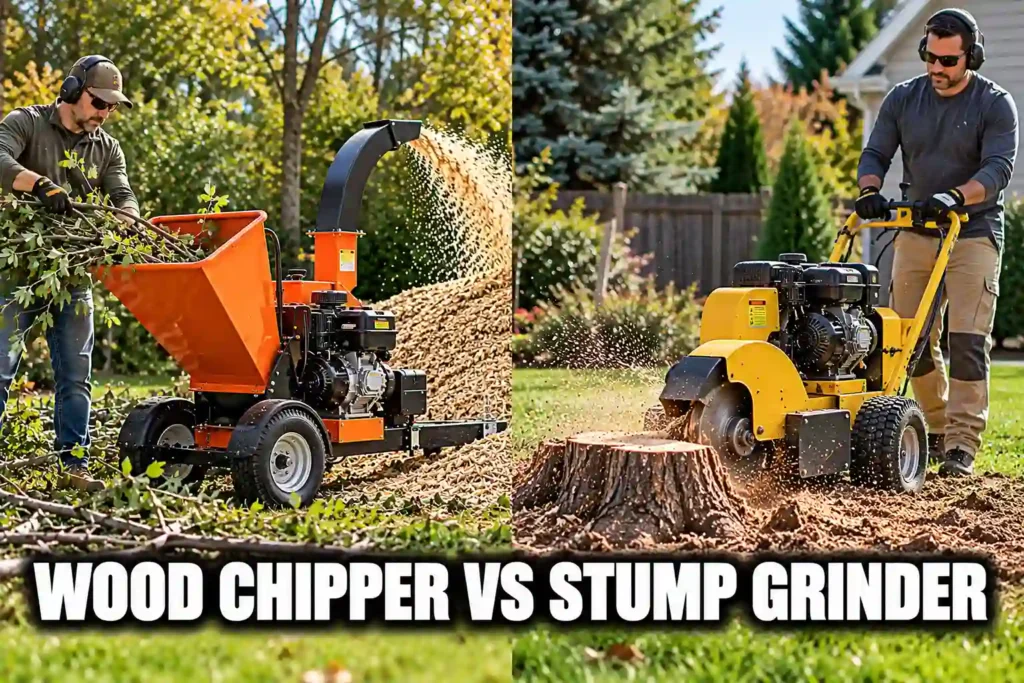
Wood chipper vs stump grinder comes down to where the cut happens: a wood chipper turns branches that are already cut into chips above the ground, and a stump grinder grinds a stump down into the soil. Neither machine can do the other’s job. When a tree comes out of my orchard I split the work the same way, limbs for one machine and the stump for the other, and I treat the stump as a job for a hired crew. This guide covers what each machine takes, what it leaves behind, how each one hurts people and the slower ways to deal with a stump.
Wood Chipper vs Stump Grinder: The Short Answer
Pick by the wood in front of you. Cut branches within the maker’s stated diameter go to a wood chipper. Each tool has one job, and the sections below show why the other tool fails at it. A stump with the roots at its edge goes to a stump grinder, or to one of the slower methods near the end.
- Prunings and cut limbs: a wood chipper, as long as every piece fits the opening and the diameter the maker prints.
- A stump in the ground: a stump grinder, or one of the slower methods covered near the end.
- A whole tree coming out: both machines in order. Limbs go through the chipper, and the stump goes to the grinder after the trunk is cut down to ground level.
According to Barreto, which makes a hydraulic track stump grinder, its machine “is designed to remove in-ground tree stumps and exposed roots” and “should not be used to cut any material other than wood stumps and the surface soil around the stumps or exposed roots.” Chipper makers set the opposite limit: they print a branch diameter for each opening and keep soil and stones out of the feed.
What Each Machine Does Side by Side
A wood chipper moves the wood to the cutter. You or the machine pushes a branch into a spinning rotor or drum fitted with knives, and the chips leave through a discharge chute or into a bag. A tree stump grinder works the other way round, because the cutter moves to the wood: the operator swings a toothed cutter wheel across the stump and takes it down in layers. The rotor, knives and feed are laid out step by step in my guide on how a wood chipper works.
| Question | Wood chipper | Stump grinder |
|---|---|---|
| What goes in | Cut branches within the maker’s diameter, clean wood | An in-ground stump and its exposed roots |
| Where the cutting happens | Inside the machine, above ground | At and below ground level |
| The cutter | Knives on a rotor, drum or disc | A toothed wheel swung across the stump |
| What comes out | Chips into a bag, bin or pile | Grindings left in the hole, mixed with soil |
| Size limit, as makers and extension services state it | Electric units about 1.5 to 1.75 inches, gas units about 3 inches, each at the opening the maker names | Professional grinders typically reach 8 to 12 inches below the surface (Iowa State); stump size depends on the machine class |
| Thrown debris | Chips, stones and metal from the inlet and discharge | Chips, rocks and debris around the machine |
| Who usually runs it | Home and farm owners | A hired crew or a rented machine |
Stump Grinder Classes
The University of California IPM program lists walk-behind grinders, drivable machines and backhoe attachments, and it notes that moderate slopes make positioning harder. A walk behind stump grinder is one of those classes, and the Barreto E30SGB is an example of a hydraulic track machine.
A Third Machine
A horizontal grinder or a tub grinder is a hammer-mill machine that land-clearing crews use on stumps, root balls and mixed debris. It is an industrial machine, not a yard tool, and this guide leaves it out.
Why a Wood Chipper Cannot Remove a Stump
A chipper fails on a stump for three reasons: the size limit, the soil and stones in the roots, and the simple fact that the stump sits at and below ground level where no chipper can reach. Any one of them is enough.
The Size Limit
Makers state chipper capacity as a branch diameter at a named opening. Sun Joe prints 1.73 inches for the CJ603E, and WEN prints 1-3/4 inches for the 41130, both electric hopper units. On the gas side, Earthquake prints “approx. 3 in” for its chipper chute, and Champion prints 3 inches. A stump is usually far thicker than any of those figures, and wood thicker than the stated capacity is cut up or left for a larger machine or a professional, never forced in. I put those two electric units head to head in my CJ603E and WEN 41130 comparison.
Soil, Stones and Roots
Sun Joe, WEN and Yardmax ban stones and metal from the feed. Yardmax also lists soil, sand and grit, which it says dull the knives, and Sun Joe and WEN allow roots only after the soil and stones are removed. A stump comes out of the ground with soil and stones packed into its roots, which is exactly what the feed rules forbid.
What Not to Feed
Feed only clean wood and plant material that your manual allows, into the opening it names and within that opening’s limit; a leaf mulcher such as the WORX WG430, Sun Joe SDJ616 or Flowtron takes no branches, sticks or brush. Never put in stones, soil, metal, nails, wire, glass, plastic, cans or bottles, and remove soil and stones from roots first. Leave out pressure-treated wood, painted wood and lumber unless your manual allows them; several manuals ban treated and kiln-dried lumber outright.
Why a Stump Grinder Cannot Chip Branches
A stump grinder has no hopper, no feed and no bag. Barreto’s manual describes a machine meant for stumps and the surface roots and soil around them, and it limits the machine to those jobs. A chipper has a feed system and a collection bag or chute for cut branches, and the grinder has neither.
How a Stump Gets Ground
In the Barreto manual the operator raises the cutter head, positions the machine so the head can swing across near the stump edge, starts the wheel and swings it slowly across the edge. The operator then lowers the wheel a few inches and repeats, adjusting cut depth and swing speed so the engine does not bog and the wheel does not stall. When the teeth cut below half the wheel radius, the machine moves forward to start a new edge. The University of California IPM program gives a similar rule of about three inches at a time unless the grinder’s manual says otherwise, and it asks for the hole to end at least 4 inches below ground.
The same page lists the limits: grinding works only on mature woody plants, needs an accessible site, and suits rock-free, dry ground, since rocks dull the cutters and throw chips. It also warns that species such as Tree of Heaven resprout from lateral roots, which a grinder does not stop.
How the Two Jobs Fit Into One Tree Removal
Taking the tree down is work for a professional tree service, and anything near a power line belongs to the utility and its qualified line-clearance crews. After that, the wood left on the ground splits into three groups, and each group goes to a different tool. The table below uses example sizes to show where each piece lands. How a saw and a chipper divide the branches is covered in my guide to wood chippers versus chainsaws.
| Piece | Example size | Where it goes |
|---|---|---|
| Twigs and thin limbs | 1 inch | Any chipper whose opening takes 1 inch, electric or gas |
| A medium limb | 2.5 inches | A gas chipper chute rated for 3 inches; over the limit of an electric unit rated about 1.75 inches |
| A trunk section | 8 inches | Over every homeowner chipper limit above, so it is cut up for firewood or left to a professional |
| The stump | Ground level and below | A stump grinder or a slower method |
The stump has its own arithmetic. If a grinder takes about three inches per pass and reaches the 8 to 12 inches that Iowa State gives as typical, the wheel works through the depth in roughly three to four layers on each part of the stump. Arborists price the job by stump size, measured at its widest point, according to Iowa State.
What I Do Beside My Own Trees
Before any machine works near a tree row, I stake the drip line so nobody drags a branch or swings a wheel across an emitter line. I sort the wood by thickness first: thin prunings go to the chipper pile and thick pieces go to the firewood pile. Cankered or diseased wood gets its own pile, apart from the clean wood, and it never goes into the mulch. My guide to wood chippers and log splitters looks at what the thick-wood pile needs.
For a stump near a row I book a crew, because I want someone else to answer for what is buried under it. A chain that touches soil dulls fast, so when I use a saw on a stump I stop at ground level and leave the rest to the grinder.
What Chips and Grindings Leave You With
The two machines leave different material in different places. Chips arrive in a pile or a bag that you place where you want it. Grindings land in the hole the stump leaves, mixed with the soil around it, and you deal with them where they are.
Chips From a Chipper
University advice on fresh chips differs, so I name the school.
Washington State University Extension says chips kept at a depth of 4 to 6 inches on the soil surface control weeds and do not cause a nitrogen shortage, and it advises against working chips into the soil. Oregon State University Extension agrees that chips mixed into soil tie up nitrogen more than chips left on top. The University of Georgia advises aging fresh chips for at least a few months, and Purdue University suggests composting new chips for a full year. In a three-year trial on a landscape perennial, wood chip mulch of every depth conserved soil water compared with bare soil, and layers of about 2 inches or more cut weed numbers more than a 1 inch layer (1).
Grindings From a Stump
University of Illinois Extension notes that the grindings get mixed in with the surrounding soil as the blade chews up the stump, and that this wood can tie up nitrogen as it breaks down. Its advice for turf is to haul off the chipped debris and fill the hole with quality topsoil. Iowa State describes a large pile of wood shavings left in the hole that arborists usually leave unless asked, and it prefers the shavings removed before new topsoil goes in and the area is replanted. On my own land the pruning chips are welcome on the raised paths of the vegetable plot, where they sit on the surface, and fresh grindings are not welcome anywhere near planting beds.
Safety Compared Between Rotor Knives and a Cutter Wheel
Both machines can take a hand, a sleeve or a leg in a moment, and both throw material. A case series of fatal incidents among tree care workers found that being caught or dragged into woodchippers and stump grinders was one of the main fatal incident types (2). Those are professional crews, not homeowners, but the mechanism is the same on a small unit.
CDC describes operators pulled into the rotating knives through the feed chute and people struck by a chipper hood opened while the knives were still turning (3). Feed wheel controls on hand-fed chippers do not reliably let a trapped worker rescue themselves, according to a review of worker deaths (4). A study of yard shredder and chipper machines describes severe hand injuries to their own operators, injuries that can need complex reconstruction (5).
Hands, Position and Clogs on a Wood Chipper
These are the points that matter before the first branch goes in, from who runs the machine to how it starts. Your own manual comes first, and it overrides anything here.
Hands Out
Never put your hands, feet or any part of your body into the hopper, the chute or the discharge while the machine is running or the rotor is still turning, and never reach past the rubber flap or the mouth of the chute. Push short pieces in only with the paddle or push tool your manual supplies, or with the next branch or a small stick as your manual describes, never with your hand or foot.
Feeding Position
Stand to the side of the hopper or chute, never directly in front of it, and feed branches butt end first. Hold the branch near its outer end with an open hand, never wrap your fingers tightly around it, and let it go as soon as the machine draws it in; never follow a branch into the chute. Feed only the material and the branch size your manual allows, into the opening it names.
Clothing and Protection
Wear safety glasses or goggles with side shields marked ANSI Z87.1, and a full face shield where your manual asks for one; hearing protection; gloves only as your manual directs, and where it asks for gloves, snug ones without loose cuffs or drawstrings; long pants and sturdy non-slip boots; and respiratory protection as your manual requires (WEN: NIOSH-approved dust masks or other respiratory protection during operation and cleaning; Woodland Mills: a dust mask in dusty conditions). Never wear loose clothing, scarves, jewelry or dangling drawstrings, and tie up long hair: anything that catches on a branch can be pulled toward the inlet.
Thrown Objects and Bystanders
The machine can throw chips, stones and metal out of the hopper and the discharge. Keep children, pets and other people out of the work area, at least the distance your manual prints (the Champion, MTD and Yardmax manuals ask for 75 feet), and stop the machine at once if anyone comes closer. No distance makes a work area safe on its own: keep watching it. Never point the discharge at people, animals, windows, cars or buildings, and never look into the hopper or chute while the machine runs.
Clogs and Jams
Never use your hand, foot or any body part to unclog the machine, even after it is shut down. On an electric hopper chipper, switch it off, unplug it from the outlet by the plug, and wait until the blades have stopped completely; on a leaf mulcher such as the WORX WG430 or Flowtron, switch it off, wait until all motion has stopped and unplug it by the plug; never open or clear any electric machine until it is unplugged and all motion has stopped. On a gas chipper, follow your manual’s own shutdown sequence and every wait it prints: the engine off, the rotor and every moving part stopped completely, the engine and muffler cooled, the key removed where fitted, and every spark plug wire pulled off and secured away from its plug, or grounded against the engine where your manual says so. Then follow your manual’s own clearing steps: open only the hopper or panel it names, remove the material only with the tool it names, and refit every guard and any required bag before you restart.
Who Runs It and Where
Only an adult who has read the manual and understands the controls should run a chipper, never a child and never anyone tired or impaired by alcohol, drugs or medication. One person feeds and runs the controls; a helper never touches the controls and stays outside the work area. Set the machine on firm, level earth or grass, never on a slope, on pavement, concrete or gravel, or close to a wall or building, where chips and stones ricochet. Clear the area of stones, wire, rope and other loose objects first, and work in daylight. Never work on wet or slippery footing, where you could slip toward the inlet, never run an electric chipper in rain or in damp or wet conditions, and stop any chipper and seek shelter if you hear thunder or see lightning.
Before You Start
Before every start, check that the guards, flaps, hoppers, discharge chute and any collection bag your manual requires are fitted and secured (Earthquake forbids running without its debris bag), and that knives, fasteners, the cord or the fuel system are undamaged. If the machine starts to vibrate abnormally, stop it at once, complete the full maintenance shutdown and have the cause fixed before you restart. Feeding branches is heavy, repetitive work: take breaks, and stop when you are tired or your attention slips.
Kickback
If a branch will not feed, kicks back or cannot be controlled, stop feeding and let go: never chase it into the chute or try to hold it back. Remove trapped material only after the full maintenance shutdown for your power type, with every extra step your manual adds. Keep the discharge area clear: chips that build up there can make new material kick back toward you.
Electric Chippers: Cord and Power
Use an outdoor-rated extension cord of the gauge your manual gives for its length (the Sun Joe manual allows no cord longer than 100 feet), plug into GFCI-protected power, keep the cord away from the hopper, the discharge and your feet, and never touch the machine or the plug with wet hands or while standing in water. Never carry the chipper by its cord or yank the cord to unplug it.
Gas Chippers: Fuel, Exhaust and Starting
Refuel a gas chipper outdoors with the engine off and cooled for at least two minutes, as the Champion and MTD manuals say, with no smoking, flames or sparks nearby; open the cap slowly, wipe spills and never start the engine where fuel spilled. Never run a gas chipper indoors or in a garage or shed, even with the doors open: the exhaust contains carbon monoxide, which you cannot see or smell. Before you start, with the engine off and cool, clear chips and dry leaves from the engine and muffler; if debris builds up during work, complete the full gas maintenance shutdown, spark plug wire off included, before you clean it away, and keep every cooling and combustible-material clearance your manual gives (Champion: 3 feet around the machine for cooling and 5 feet from combustible materials and dry vegetation; SuperHandy GUO148: 2 m, 6.5 ft, from flammable materials). Pull the starter cord slowly until you feel resistance, then pull rapidly, and never start the engine with material in the hopper or chute.
Cutter Wheel, Buried Utilities and Thrown Chips on a Stump Grinder
The stump grinder has its own hazards, and the points below come from the Barreto E30SGB manual, so read your own grinder’s manual for the rest. According to Barreto, the cutter wheel and other moving parts can cut off arms, legs or fingers, and the teeth are sharp even when the wheel is not moving. The operator stays at the controls while the wheel runs, keeps observers and helpers at a safe distance, and stops the wheel immediately if anyone gets too close. Keep onlookers clear of the work area for the whole time the wheel is turning.
Cutter Wheel and Thrown Debris
Barreto calls for a face shield and hard hat for the operator and for anyone watching, plus eye protection, hearing protection, safety boots, gloves, close-fitting clothing, contained long hair and no jewelry, because the wheel may throw chips, rocks and debris into the area around the machine.
Call 811 Before Cutting
Barreto’s manual says to call 811 before cutting, because buried electric cables or gas lines can cause serious injury or death if struck with the cutter wheel, and not to rely on manhole covers or electrical boxes as proof that nothing is buried. If a cable is cut, stop, keep everyone away, do not touch it and call 911. If a pipe is struck, stop cutting, shut off the engine, leave the area and call 911.
Noise needs its own line. Barreto declares 104 decibels of sound power for the machine and 85 decibels at the operator’s position, with an uncertainty of 4 decibels on the second figure. Those are two different measures, one for the machine and one for the ear. The National Institute for Occupational Safety and Health recommends limiting exposure to 85 A-weighted decibels averaged over an eight-hour workday (6), and hearing protection stays on for both machines.
Shutting Down the Barreto E30SGB
In that manual the machine is parked on level ground with the parking brake set, the cutter head is lowered to the ground, the throttle goes to idle, the key goes to off and is removed, and the fuel shutoff valve is closed. The engine, the muffler and the hydraulic fluid cool completely before any cleaning or maintenance. Other grinders follow their own manuals, so use the order your machine prints.
Rent, Hire or Buy for Occasional Work
I treat stump work as a hire job. Iowa State names cost as the drawback of grinding and says removing the shavings and filling the hole are separate services at extra cost. A stump grinder rental puts the cutter wheel in your own hands, and Barreto asks the operator to have studied the manual and, preferably, to have worked under an experienced operator first.
Chippers sit at the other end of the range, from plug-in units to gas units. For one large pruning pile or a storm clean-up, a wood chipper rental gives you the machine without owning it. Owners who prune every winter will weigh that against buying, and that comparison belongs to its own guide. If you are buying rather than renting, my guide to electric and gas wood chippers helps with the power type.
Other Ways to Deal With a Stump
Grinding is the fastest method, but it is not the only one. The extension services describe four others, and they disagree on the numbers, so I name each school.
- Natural decay: Iowa State calls it a cheap, easy and safe option that needs patience, with 10 or more years as the plain wait and one to three years if you drill holes, add fertilizer and cover the stump. Colorado State says five to 10 years.
- Digging: Iowa State sees it as practical for stumps under roughly 12 inches across and very labor-intensive, while an Illinois Extension author would not go much over a 6 inch trunk.
- Chemical removers: Colorado State describes drilling several holes, adding the product, waiting four to six weeks and repeating if needed. Oklahoma State Extension says these products can speed decay but typically do not break down the whole stump, and that they are toxic.
- Burning: Iowa State warns that stump fires can burn for days and are difficult to control and extinguish, so I do not recommend it.
Leaving the stump in place is also a choice. Iowa State notes that dead stumps shelter insects, birds and other wildlife, as long as you check them for structural risk.
Which One Do You Need for Your Yard?
A pile of prunings calls for a chipper, bought or rented, with every piece checked against the opening first. A stump calls for a crew or one of the slower methods above, and no chipper will do that work. A tree coming out calls for both. Before a crew starts, I check that 811 has been called and I stake the drip line. My list of top wood chipper picks covers the models I recommend if you are buying.
Your next steps are short. Sort the wood by thickness and set the thick pieces aside, book the stump work, and ask whether the crew hauls off the grindings or leaves them in the hole. With the pile sorted and the stump booked, the wood chipper vs stump grinder choice is already made for your yard. For the thick pieces you set aside, my log splitter vs wood chipper comparison shows which machine takes which wood.
Frequently Asked Questions
Are stump grinders effective?
Stump grinders are effective at taking a stump down below ground level, which is the job they are built for. Iowa State calls professional grinding the quickest, easiest and safest option, with the stump gone within hours, though it only reaches a typical 8 to 12 inches and leaves a pile of shavings in the hole. Species that resprout from lateral roots, such as Tree of Heaven, can grow back after grinding.
What is an alternative to a stump grinder?
Alternatives to a stump grinder are natural decay, digging out the stump and chemical stump removers. Colorado State puts natural decay at five to 10 years, and for chemical removers it describes a first wait of four to six weeks after drilling holes, with repeat applications sometimes needed. Iowa State sees digging as practical only for stumps under roughly 12 inches across.
Can you cut a tree stump with a chainsaw?
A chainsaw can cut a tree stump down to ground level, but it cannot remove the part below the soil. The University of California IPM program has the trunk cut to ground level with a chainsaw or hand saw before grinding starts. Dirt on the bark dulls a chain quickly, and the saw’s own manual sets the safety rules.
What is the difference between a stump grinder and a wood chipper?
The difference between a stump grinder and a wood chipper is the wood each one cuts and where it cuts it. A stump grinder swings a toothed wheel across an in-ground stump and leaves grindings in the hole, while a wood chipper pulls cut branches into knives and sends chips out of a chute.
What is a walk behind stump grinder?
A walk behind stump grinder is a stump grinder that the operator steers on foot, one of the classes the University of California IPM program lists beside drivable machines and backhoe attachments. It does the same job as the bigger classes, swinging a toothed cutter wheel across the stump a few inches at a time. Its own manual sets the shutdown order and the rules for buried utilities.
References
- van Donk SJ, Lindgren DT, Schaaf DM, Petersen JL, Tarkalson DD. Wood chip mulch thickness effects on soil water, soil temperature, weed growth and landscape plant growth. J Appl Hortic. 2011;13(2):91-95.
- Kearney GD, Imai S, Doub A, Langley R. Fatal incidents among tree care workers in the United States: A case series approach. J Occup Environ Hyg. 2024;21(9):629-637.
- Centers for Disease Control and Prevention. Fatal and nonfatal occupational injuries involving wood chippers–United States, 1992-2002. MMWR Morb Mortal Wkly Rep. 2004;53(48):1130-1131.
- Zhu J, Gelberg K. Occupational fatal injuries associated with mobile hand-fed wood chippers. Am J Ind Med. 2018;61(12):978-985.
- Hallock GG. Mutilating shredder/chipper hand injuries. Ann Plast Surg. 1994;33(1):6-8.
- National Institute for Occupational Safety and Health. Noise-Induced Hearing Loss. Noise and Hearing Loss. Centers for Disease Control and Prevention; 2024.
Safety Note: Only an adult who has read the manual and understands the controls should use a wood chipper or shredder, never a child or anyone tired or impaired. The rotor, knives, hammers or cutting line behind the inlet can draw in a hand, a sleeve or a glove faster than you can let go, and they keep turning after you switch the machine off. Never put your hands, feet or any part of your body into the hopper, the chute or the discharge while the machine runs or the rotor still turns, never reach past the rubber flap or the mouth of the chute, and push short pieces in only with the paddle or push tool your manual supplies, or with the next branch or a small stick as your manual describes. Stand to the side of the hopper, never in front of it, feed branches butt end first with an open hand near the outer end, and let go as soon as the machine draws the branch in; if a branch kicks back or will not feed, stop feeding and let go, never chase it into the chute. Feed only the clean material your manual allows, into the opening it names and within that opening’s limit (a chipper chute and a shredder hopper have different limits, and a leaf mulcher takes no branches, sticks or brush), and never stones, soil, metal, nails, wire, glass or plastic. The machine can throw chips, stones and metal: keep children, pets and other people out of the work area, at least the distance your manual prints (the Champion, MTD and Yardmax manuals ask for 75 feet), stop at once if anyone comes closer, and never point the discharge at people, animals, windows, cars or buildings. Set the machine on firm, level earth or grass, never on a slope, on pavement, concrete or gravel, or close to a wall, work in daylight, never work on wet or slippery footing where you could slip toward the inlet, never run an electric chipper in rain or in damp or wet conditions, and stop and seek shelter for thunder or lightning. Wear safety glasses or goggles with side shields marked ANSI Z87.1, a face shield where your manual asks for one, hearing protection, gloves only as your manual directs (snug ones without loose cuffs or drawstrings where it asks for them), long pants and sturdy non-slip boots, and respiratory protection as your manual requires (WEN asks for NIOSH-approved dust masks or other respiratory protection during operation and cleaning); never wear loose clothing, scarves, jewelry or dangling drawstrings, and tie up long hair. Before every start, check that the guards, flaps, hoppers, discharge chute and any collection bag your manual requires are fitted and secured, and stop at once if the machine starts to vibrate abnormally, complete the full shutdown below and have the cause fixed before you restart. Never use your hand, foot or any body part to unclog the machine, even after it is shut down. Before you clear a clog, open the hopper or a panel, touch the knives, empty the bag, move or tilt the machine or leave it: on an electric hopper chipper, switch it off, unplug it from the outlet by the plug and wait until the blades have stopped completely, and on a leaf mulcher switch it off, wait until all motion has stopped and unplug it by the plug, never opening any electric machine before it is unplugged and still; on a gas chipper, follow your manual’s own shutdown sequence and every wait it prints: the engine off, the rotor and every moving part stopped completely, the engine and muffler cooled, the key removed where fitted, and every spark plug wire pulled off and secured away from its plug or grounded where your manual says so; on a PTO chipper, throttle to idle, disengage the PTO, turn the tractor off, remove the key, set the parking brake, wait until all motion has stopped and disconnect the PTO shaft before any service. Complete every model-specific step and minimum wait in the order your manual prescribes before any access, clear the blockage only with the method and tool it names, and refit every guard and any required bag before you restart. Use an electric chipper only with an outdoor-rated extension cord of the gauge and length your manual gives, plugged into GFCI-protected power, and never touch it or the plug with wet hands. Refuel a gas chipper outdoors with the engine off and cooled for at least the time your manual gives (Champion and MTD: two minutes), open the cap slowly, keep smoking, flames and sparks away, wipe up spills and never start it where fuel spilled; clear chips and leaves from the engine and muffler only after the full shutdown, spark plug wire off included, keep every cooling and combustible-material clearance your manual gives (Champion: 3 feet around the machine for cooling, 5 feet from combustible materials and dry vegetation), and never run it indoors or in a garage or shed, even with the doors open, because the exhaust contains carbon monoxide. Take breaks and stop when you are tired.