
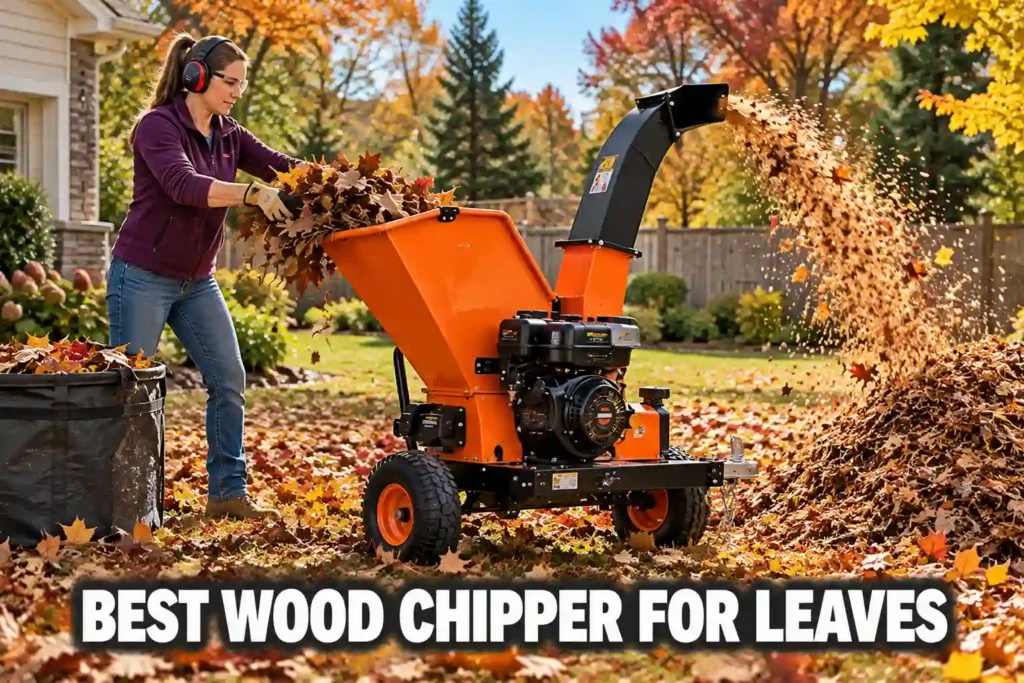
The best wood chipper for leaves depends on whether you also have branches to feed it. One kind of machine takes leaves, grass clippings and pine needles and nothing woody, while a chipper shredder adds a chute for branches. I clear the leaves from a quarter acre of lawn under shade trees and from a 3.7-acre apricot and plum orchard, and I put all seven machines below to work on that fall leaf drop.
My top pick is the Sun Joe SDJ616 Electric Leaf Mulcher, and I explain which opening on each machine takes leaves, which takes wood and where each one stops.
Best Wood Chipper for Leaves 2026 With 7 Machines I Put to Work
These seven cover the leaf machines a buyer meets: electric leaf mulchers, electric and gas chipper shredders and a handheld vacuum. I rank them by what each does with leaves and by the limit its maker states, so you see where a machine stops before you buy.
1. Sun Joe SDJ616 Electric Leaf Mulcher Best Overall
I rank the Sun Joe SDJ616 first as the best wood chipper for leaves, with one limit stated up front: Sun Joe says it takes leaves, grass clippings, thatch and pine needles and cannot shred branches, sticks or brush. Inside a wide funnel, a spinning head throws two cutting lines at the pile. The maker prints a 16:1 reduction ratio, and I find that a fine, even cut is the whole point of it.

WHY I CHOSE THIS ✓
I chose the SDJ616 because it pairs a fine cut with a control dial, an overload reset and a bag-or-container option in one light machine. It does leaves very well and nothing woody, and I prefer a machine with a plain limit to one that promises everything. For a yard of shade trees and a compost bay, it earns the top place.
Sun Joe SDJ616 Electric Leaf Mulcher Specs
Key Features:
- Control dial: COARSE, MEDIUM and FINE trade speed for particle size, with marks for wet leaves, grass and thatch, and dry leaves and pine needles, so the setting follows the material.
- Bladeless cutting line: two plastic lines on the spinning head do the cutting, so there is no blade to sharpen, and a worn pair is swapped for Sun Joe’s own replacement line.
- Overload cut-out: a clog cuts the power by itself, and you wait at least 1 minute before pressing reset and then the green ON button.
- Bag options: an elastic strap holds your own bag on the motor housing, or the legs come off and the bracket sits on a trash container lined with a leaf bag.
- Telescoping legs: a height knob sets the funnel to the bag or container below it, and the legs come off for storage.
- Wide funnel: at 18.9 in across, it takes double handfuls of dry leaves, which keeps the feeding steady.
- Two-year warranty: it covers ordinary household use, and Sun Joe says purchases from unauthorized sellers fall outside it.
The leaves from the shade trees by the house had matted into a dense carpet on the lawn. Fed through the SDJ616, they came out as a light layer that stayed loose where whole leaves had packed down. Sun Joe claims up to 16:1 at the FINE setting, and it prints a mulch rate of 55 gal/min as its own figure. Dry leaves work best, and the manual says so.
The manual says to feed double handfuls of dry leaves or single handfuls of wet ones, and to let the head regain speed before the next handful. I judge that rhythm by sound: when the whine drops, I stop feeding and wait. At COARSE the pile clears faster and the particles come out larger, and at FINE it is slower and the particles are the smallest. Feeding faster than the machine can handle may damage the motor, according to Sun Joe.
A second job is the grass clippings from the alley edge along the orchard, which the manual lists as an approved material. The dial mark for grass and thatch made the setting easy to find. The dust is the part a spec sheet hides: Sun Joe says not to stand in front of the motor ventilation slots, and it calls for glasses and a dust mask, so I stand to one side with both on. It is carried, never rolled, and the MR8 manual lists 14.5 lb net.

Set the dial by the material before you start. After the full shutdown for electric leaf mulchers in the shutdown box at the start of the How to Choose section, check the discharge area so shredded leaves do not clog the motor cooling vents.
The cutting line keeps turning for a few seconds after the switch is off, as the manual states. Complete the full shutdown for electric leaf mulchers in the shutdown box at the start of the How to Choose section before you put a hand near the funnel.
It needs an outdoor-rated extension cord on a GFCI circuit, and Sun Joe’s chart allows No. 14 AWG up to 50 ft and No. 12 AWG over 50 ft up to 100 ft, and no cord longer than 100 ft. The line is the wear part, and Sun Joe recommends only its own SDJ616L replacement line, saying a wrong line voids the warranty. After the full shutdown, clean it with a damp cloth and a soft brush and keep water off the motor bracket. I wear ear protection, as the manual advises, because the noise can contribute to hearing loss.
Buy it for autumn leaves, grass clippings and pine needles from a yard of shade trees, with an outlet inside the reach of the manual’s cord table, 14 AWG to 50 ft and 12 AWG beyond that to 100 ft. It suits a gardener who feeds a compost bay or mulches a vegetable plot. Skip it if prunings, twigs or hedge trimmings are on your list, if you want a bag in the box, or if most of your leaves arrive soaked.
FINAL VERDICT
The SDJ616 turns a leaf pile into a fine layer and states its limit plainly. Pick it when leaves, clippings and pine needles are the whole job and an outlet sits within the manual’s cord table of the pile.
It is the leaf mulcher I recommend for autumn piles.
2. Landworks 3-in-1 Gas Wood Chipper Shredder Best Premium
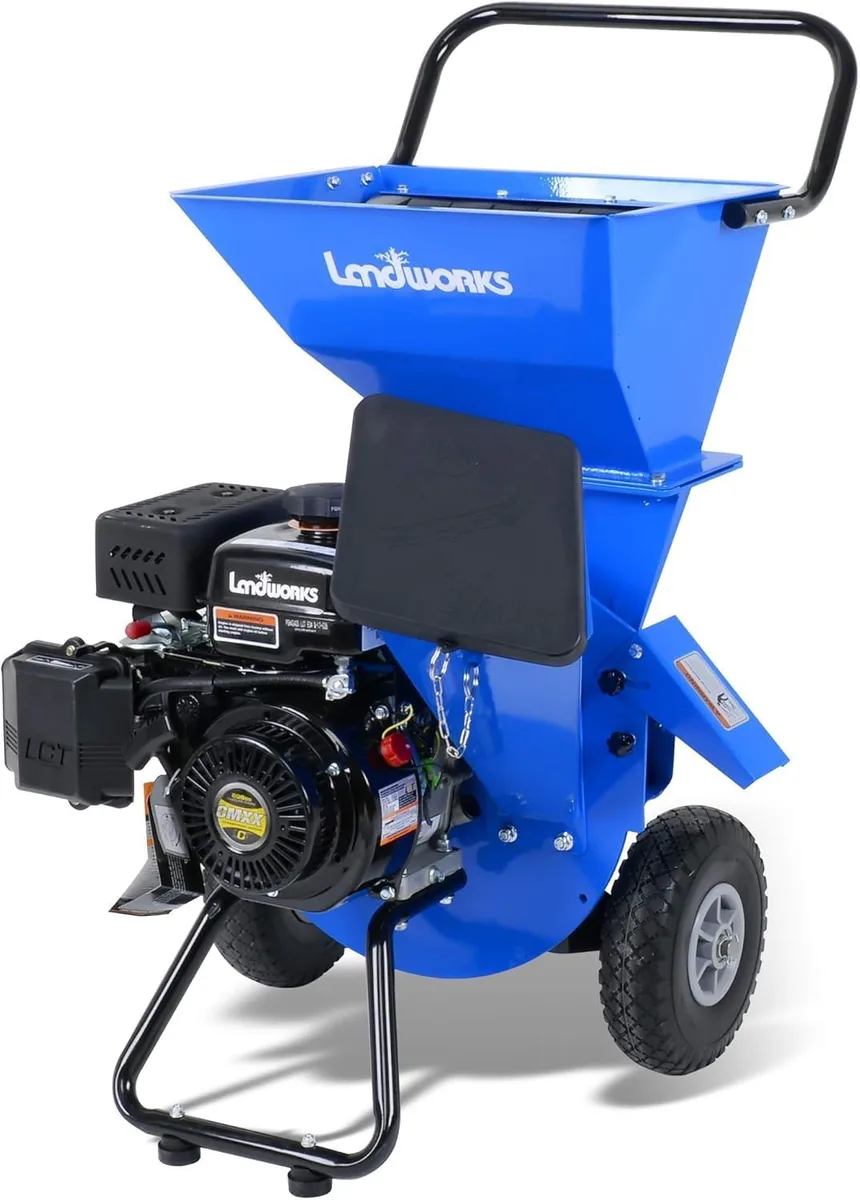
The Landworks 3-in-1 is the branch and leaf shredder for a yard that has both in the same week. Its top hopper takes leaves and light waste, and its side chute takes branches up to 3 in. I name it my best chipper shredder for leaves for the buyer who will spend more than an electric pick costs for that range, because a 7 HP gas engine works anywhere the leaves lie, with no outlet to find.
WHY I CHOSE THIS ✓
The Landworks takes second place because its hopper and its chute are two separate openings on one gas engine. It costs more than the electric picks on this page, and in return the engine goes where the leaves are and an optional vacuum kit rakes them in. That reach is what makes it my pick for a larger property.
Landworks 3-in-1 Gas Wood Chipper Shredder Specs
Key Features:
- Two openings: the side chute takes branches up to 3 in, and the top hopper takes leaves and light waste up to 1/2 in, so a pile is sorted by size before it is fed.
- Air-flow hopper: leaves are pulled into the path of the hammers by air flow, which means no push tool is needed at the hopper.
- Self-feeding chute: the manual says the unit’s own self-feeding action draws the sticks in, and the branch goes in large end first.
- Knives and hammers: the rotor carries 2 chipping knives and 4 Y-hammers, and the hammers can be flipped over once to use a fresh edge.
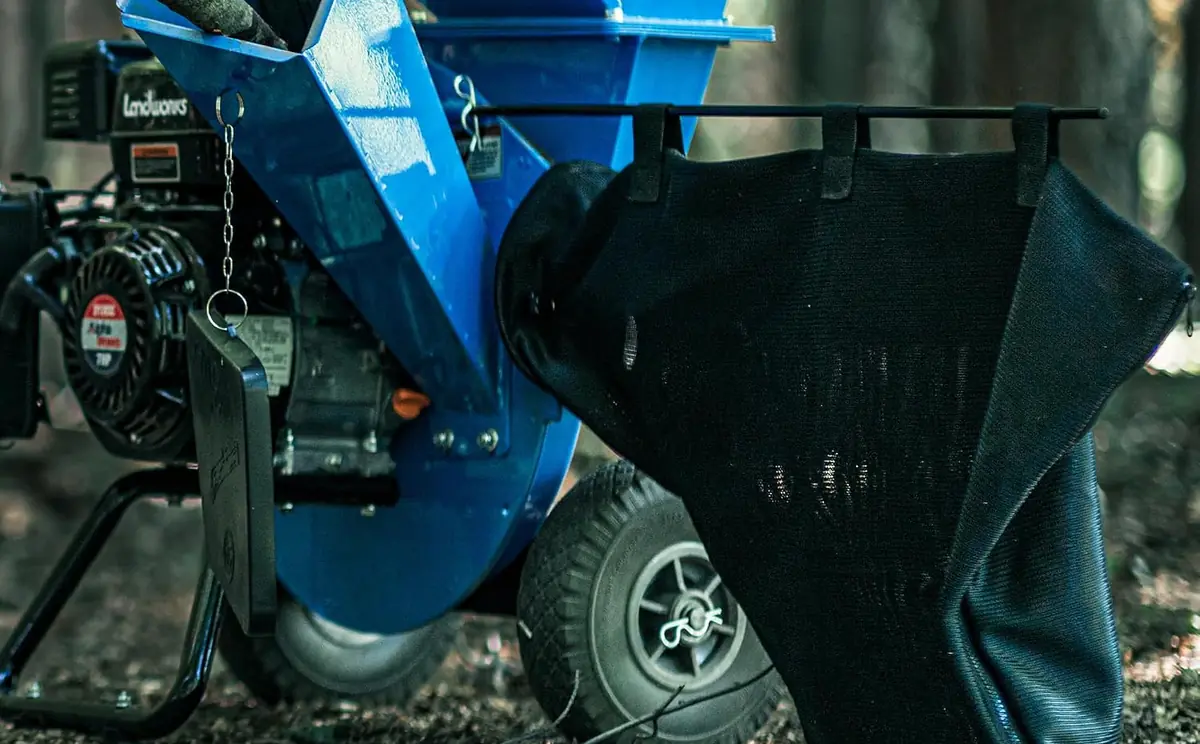
- Debris bag: a bag catches the output, and the manual says never to run the machine without it, because the unit discharges debris at high speed.
- Vacuum kit: sold separately with a 4 in x 10 ft hose, it lets you rake leaves into a tray, and a rotating sleeve changes the strength.
- Wheels and handle: two solid wheels and a hopper handle move it, and the manual says to use at least two people to lift it.
The hopper limit is the number that matters for a leaf buyer: 1/2 in diameter, as the manual prints it. Leaves and twigs up to 1/2 in go through it, and anything thicker goes to the side chute. I sorted the pruning pile first and set the thick limbs aside for firewood, then fed only the small wood. The leaves I fed through the hopper left the pile far smaller, and the maker prints a 15:1 ratio for the reduction.
A gas engine is the reason to pay more. The nearest row of the orchard is 100 to 150 feet from the sheds, which is beyond the longest cord run any of the electric manuals on this page allow, so the machine moves to the pile instead of the pile moving to an outlet. The engine runs at full throttle before chipping, and Landworks says overloading will shorten its life. The manual says to let the unit clear itself before you add more material.
Hedgerow renewal cuttings are the second job. The stems were soft and green, and the manual says extremely hard or dried-out material is not suitable for chipping, so I fed the soft stems in modest amounts and kept each branch within the 3 in limit. The limit I found is the hopper: it is no place for twigs thicker than 1/2 in, and the side chute is where thicker wood goes.
Make sure the chamber, hopper and cone are empty before every start, clearing any material only after the full gas shutdown, because material left inside can snap the starter cord back.
This is a gas machine with a spinning rotor, and it needs the full gas shutdown, spark plug wire off included. Follow the gas shutdown in the shutdown box at the start of the How to Choose section, and the engine manual, before you clear the hopper or the chute.
Living with it is mostly engine care. The manual says the engine ships without oil, and it lists a separate engine manual for oil and spark plug, with a clean-out of debris from the engine and chipper before each use. Knives and hammers are inspected or rotated every 25 hours or as necessary, and all of that service starts with the full gas shutdown. I keep everyone well clear of the work area, as the manual describes, and wear ear and eye protection.
It suits a property owner with leaves and branches up to 3 in who has room to run and store a gas machine. Skip it if leaves are your only job, if you cannot lift or roll 121 lb, or if you dislike engine upkeep.
FINAL VERDICT
The Landworks 3-in-1 covers leaves at the hopper and branches at the chute, with an engine that needs no outlet. Choose it for a larger yard with both jobs and the room to run a gas engine.
It is the gas machine that follows the leaves.
3. Yard Force YF8000 Electric Leaf Mulcher Best Value
The Yard Force YF8000 is the lowest-cost leaf mulcher on this page, so I call it the best budget leaf mulcher for ordinary yards. Yard Force says it shreds leaves, grass clippings and pine needles and cannot shred branches, sticks or brush. It is my pick for best value, for leaves and clippings only, with a 12:1 mulch ratio printed in the manual.

WHY I CHOSE THIS ✓
The YF8000 earns the value label because it gives the lowest price tier on the list with legs that level on uneven grass. It asks for dry leaves and a short cord, and it says so in plain words. For a first leaf mulcher on a modest yard, that honesty is worth the money.
Yard Force YF8000 Electric Leaf Mulcher Specs
Key Features:
- Material lever: COARSE, MEDIUM and FINE, with marks for wet leaves, grass and thatch, and dry leaves and pine needles, give a faster coarse cut or a slower fine one.
- Adjustable legs: each leg is set with a knob and locking pins, so the funnel can sit level on uneven grass, though the manual still wants a solid, level surface.
- Spinning cutting line: a rotor head with plastic line does the cutting, so there is no blade to sharpen, and a built-in cutter trims new line.
- Overload reset: if the unit stops, push the red button, wait 1 minute and press the circuit breaker.
- Parts stack for storage: the unit comes apart and stacks in its box, which suits a small shed.
- Elastic strap for a bag: you tie your own bag around the motor housing with the strap.
- Printed mulch ratio: 12:1 is the maker’s figure for how far the volume shrinks.
Wet leaves are where this mulcher showed its limit. A handful of soaked leaves from the gutter edge packed the funnel and stopped the motor, which the manual describes: feed single handfuls of wet leaves, and overloading may cause the motor to stop. I completed the full electric leaf mulcher shutdown in the shutdown box at the start of the How to Choose section, cleared the unshredded material from the funnel as the manual says, then restarted with the red button, a wait of 1 minute and the circuit breaker. After that I went back to dry leaves, which the machine took in double handfuls, as the manual allows.
The lever is where the money goes. At COARSE the leaves process faster and the particles come out larger, which is how I clear the house lawn. At FINE it is slower and the particles are the smallest, and Yard Force says best results come when the material is dry. Feeding faster than the machine can handle may cause permanent damage to the motor, according to the maker, so I wait for the head to regain speed before each handful.
Uneven ground is the second test, and the telescoping legs let me raise one side on the grass by the orchard edge until the funnel sat level, and I was surprised how steady it felt once the locking pins were in, though the manual says to use it on a solid, level surface. It is carried, never rolled, and the manual lists a weight of 13.45 lb with no stated basis. The manual also says not to move the shredder while the motor runs or with a finger on the switch, and not to stand in front of the motor ventilation slots, where dusty air leaves.

Fit a bag with the elastic strap before you start, with the machine unplugged and still, and check the discharge area only after the full shutdown in the shutdown box at the start of the How to Choose section, so processed material does not clog the motor cooling vents. Yard Force also asks for glasses, a mask and gloves while you load, and for no loose clothing or jewelry near the funnel.
Where it is weakest on this page: leaves and clippings are its whole range, the box holds no bag, and its cord limits are the hardest to read. Complete the full shutdown for electric leaf mulchers in the shutdown box at the start of the How to Choose section before you reach near the funnel.
Cord limits need a careful read. Yard Force’s text allows a 14 gauge cord up to 100 ft, while its table shows 14 AWG at 25 ft, 12 AWG at 26 to 50 ft and nothing recommended beyond that, so I follow the stricter table on a GFCI circuit and never run a longer cord. The motor housing is cleaned with a dry cloth only, since water can damage the motor for good. Replace the line when the cutting efficiency drops, and wear glasses, a mask, gloves and hearing protection as the manual’s symbols show.
It suits a homeowner with autumn leaves and grass clippings who wants the lowest-cost leaf mulcher on this page and will bring a bag. The two-year warranty is parts replacement or repair, with no refunds, and it is void for commercial, rental or industrial use. Skip it for twigs or brush, for a long cord run, for commercial or rental use, or when your leaves come in soaked.
FINAL VERDICT
The YF8000 is the budget way into a leaf mulcher with a printed 12:1 ratio and a clear limit. Buy it for dry leaves and clippings near an outlet, and plan the bag yourself.
It is the budget leaf mulcher for a modest yard.
4. Sun Joe CJ603E Electric Chipper Shredder Best Reverse Switch
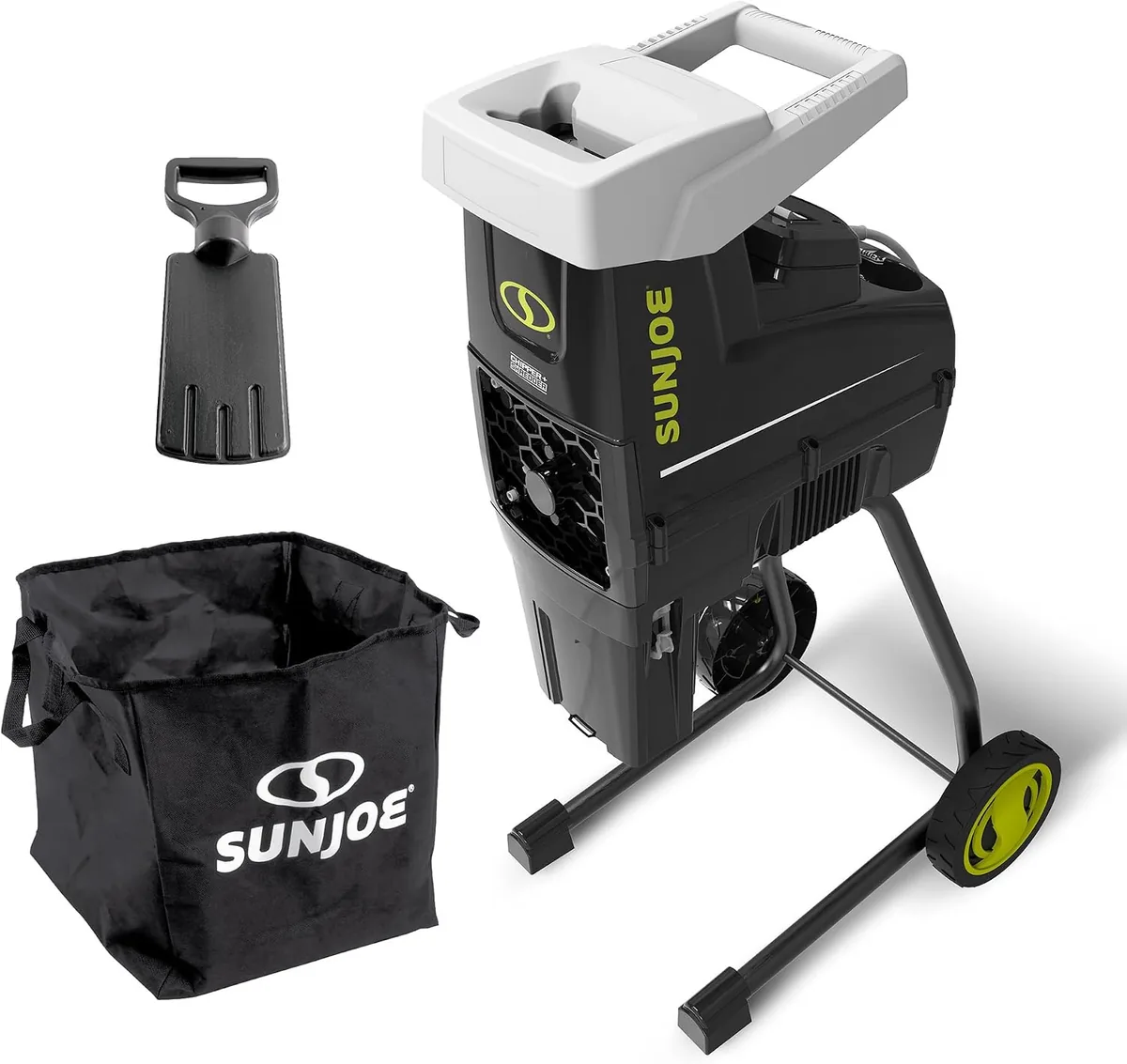
The Sun Joe CJ603E is the electric chipper shredder with a reverse switch, and that switch is why it fits a yard where leaves arrive mixed with twigs. After an overload cut-out, Sun Joe’s manual has you wait at least 1 minute, press reset, then push the reverse end of the switch and press On to back jammed branches out of the funnel. It takes wood up to 1.73 in through that one funnel.
WHY I CHOSE THIS ✓
The CJ603E is on the list because the reverse switch turns a jam into a short pause instead of a long one. It also has the highest reduction ratio any manual on this page prints, and a counterplate that restores the cut as the blade wears. That makes it the electric pick for mixed leaves and twigs.
Sun Joe CJ603E Electric Chipper Shredder Specs
Key Features:
- Forward and reverse switch: the reverse end pushes jammed branches back from the funnel after the overload reset.
- Adjustable counterplate: a knob on the housing restores the cut as the blade wears, and Sun Joe’s manual gives the adjustment procedure.
- Overload protection: a clog cuts the power, and Sun Joe says to wait at least 1 minute before restarting.
- Push paddle: it comes in the box, and the manual says to use it to push material into the hopper, never your hand.
- Fabric bag and wheels: the bag hangs on two hooks, and two 7 in wheels let you tip the unit back and roll it.
For leaves, the manual sets the terms: insert only as much as needed, alternate wilted, damp waste with dry branches, and chop branches with leaves completely before feeding more. I fed dry leaves with a handful of twigs to keep it moving, and it settled into a steady cadence. A forked twig hung at the funnel mouth and I turned it with the paddle, then used the reverse switch when the motor laboured. I look at the same machine as a chipper shredder in my Sun Joe CJ603E review.
The noise is the surprise. Sun Joe rates the unit at 94 dB, with no distance printed, and the manual calls for hearing protection. At the funnel it was louder than I expected even with ear protection on.

Keep a few dry branches for the end, as Sun Joe says.
Complete the full shutdown for electric chippers in the shutdown box at the start of the How to Choose section before you clear anything. Sun Joe adds that the blades keep turning for a few seconds after the switch is off.
Sun Joe’s chart allows No. 14 AWG up to 50 ft and No. 12 AWG over 50 ft up to 100 ft, and no cord longer than 100 ft, so the outlet decides where it works. At 38.6 lb it is tipped back to roll and lifted for stairs. After the full shutdown, clean it with a damp cloth and a soft brush, never water. The manual says not to run it on a paved or gravel surface, where ejected material could cause injury.
Choose it if your leaves come with twigs and small prunings up to 1.73 in, and you have an outlet within the manual’s cord table, 14 AWG to 50 ft and 12 AWG beyond that to 100 ft. Skip it if you need a light machine, if you shred wet or soft material in bulk, or if your work area sits far from power.
FINAL VERDICT
The CJ603E gives a leaf and twig job one machine with a reverse switch for jams. It is the electric choice when your pile mixes leaves with small wood.
It is the electric chipper shredder with a way out of a jam.
5. Earthquake K32 Gas Chipper Shredder Largest Wheels
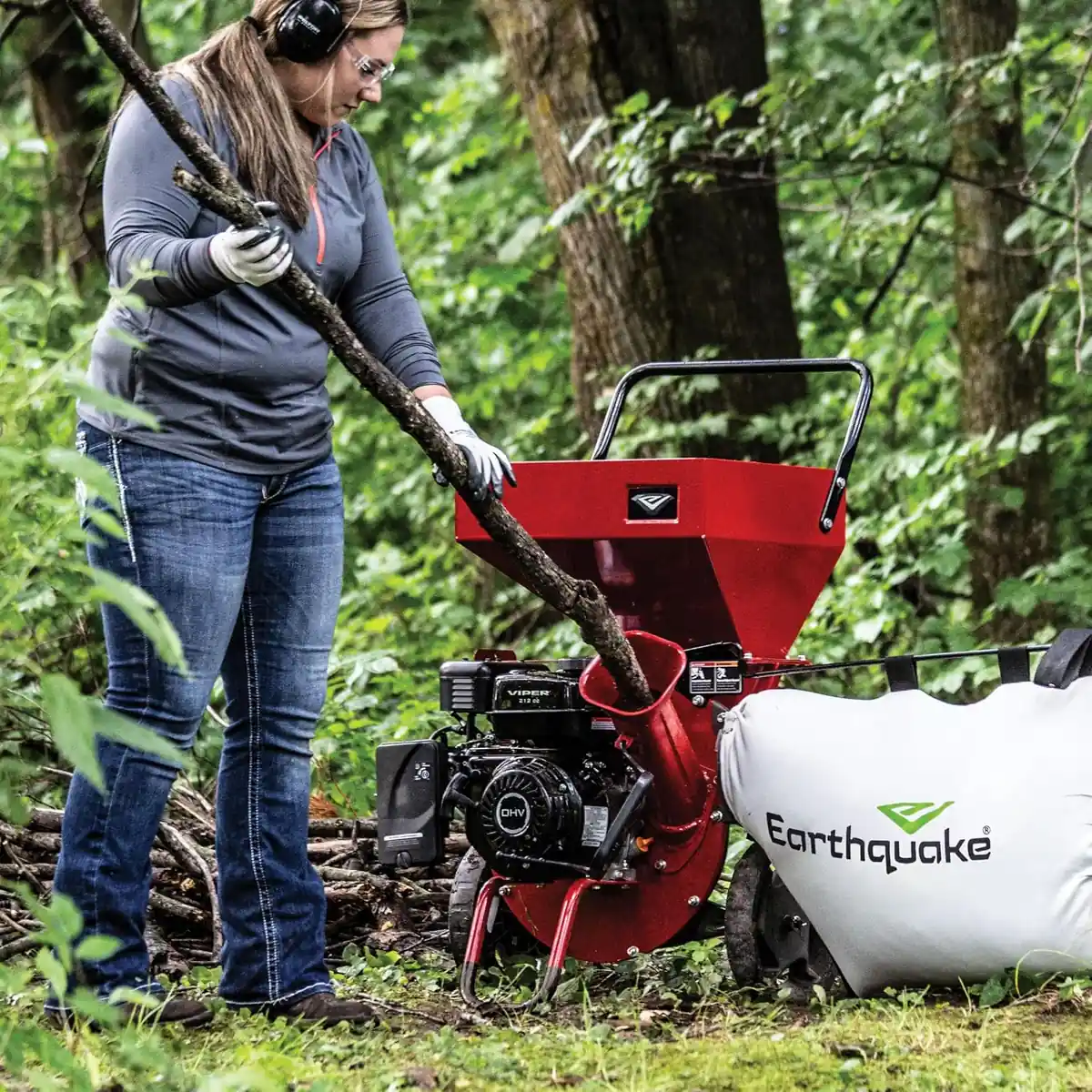
The Earthquake K32 is the gas leaf shredder on this page that rides on the largest wheels: two 11 in x 2 in non-pneumatic wheels, which the manual says will never go flat. It has two openings, a chipper cone for wood up to approximately 3 in and a top shredder hopper for light brush, leaves and soft, bulky waste. Earthquake prints a 20:1 reduction ratio and a 212 cc Viper engine.

WHY I CHOSE THIS ✓
The K32 earns its place with its roll-it-anywhere chassis and two-opening design. It earns its place here for the buyer with wood and leaves and a lawn to cross. The hopper is the leaf opening, the cone is for wood, and the wheels carry it between them.
Earthquake K32 Gas Chipper Shredder Specs
Key Features:
- Large non-pneumatic wheels: they cannot go flat, so the unit rolls from the shed to the leaf pile across lawn without a pump.
- Shredder hopper: a 1/2 in x 18 in limit is printed, and the opening measures 16.75 x 13.25 in for leaves and light brush.
- Chipper cone: approximately 3 in at the cone, self-feeding, with branches fed large end first.
- Rotatable hammers: two J-hammers and two triangle hammers can be turned and flipped to reach fresh edges.
- Dock-and-Lock bag: the 24 x 36 in debris bag is required by the manual, and it has a bottom zipper for emptying.
The leaf pile shrank far more than I expected after shredding, which fits the 20:1 ratio Earthquake prints. Earthquake’s own words for the hopper are light brush, leaves, and other soft but bulky organic waste. I keep wood at the cone and leaves at the hopper, and the manual says to alternate loads of wet and dry material so the discharge does not plug.
The wheels won me over. At 121 lb net the K32 is no unit to carry, and the large wheels roll it across grass. The manual says to lift with at least two people, by the front leg and hopper handle, and never by the fuel tank. The K32 has its own page, my Earthquake K32 shredder review.
Check that the shredding chamber, hopper and cone are empty before starting, clearing any material only after the full gas shutdown, because material left inside can stop the starter cord suddenly.
This is a gas machine that runs only outdoors on firm, level earth or grass. Complete the full gas shutdown in the shutdown box at the start of the How to Choose section, with the spark plug wire off, and every step Earthquake’s manual adds, before you clear the hopper or the cone.
Service starts with the full gas shutdown and is on a clock: loose hardware every 5 hours and each spring and fall, hammers and knives every 25 hours, and the engine air cleaner every 25 hours. Never run the unit without the debris bag, the manual says, and eye and hearing protection are required.
Buy it if you have wood up to approx. 3 in and a lot of leaves to cross a lawn for, and you accept gas engine upkeep. Skip it if you cannot store or lift 121 lb, if leaves are your only job, or if you want a published horsepower.
FINAL VERDICT
The K32 shreds leaves at its hopper and chips wood at its cone, and it rolls to the job on large wheels. Choose it when you have both jobs and a lawn between the shed and the pile.
It is the gas chipper shredder that rolls across the lawn.
6. WEN 41130 Electric Chipper Shredder Best Collection Bin
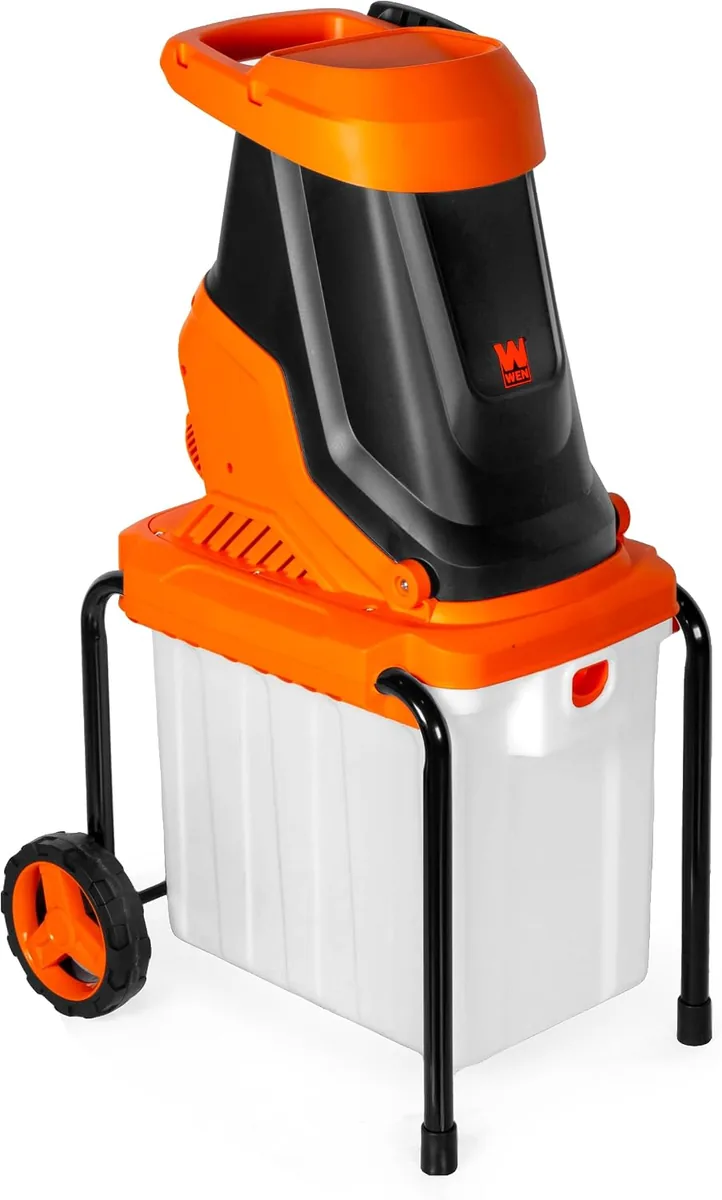
The WEN 41130 is the electric chipper shredder with a rigid collection bin instead of a bag, and its manual says the motor will only power on when the bin is installed. The bin holds 13 gal (50 L). It takes branches up to 1-3/4 in through one feeding chute, and WEN’s manual says to feed small twigs, leaves and other garden waste in with the supplied paddle.
WHY I CHOSE THIS ✓
The 41130 is on my list for the bin: a rigid bin is easier to carry to the compost than a hanging bag. It does fewer jobs than the larger gas units and says so. For a small yard with an outlet near the pile, it is the practical electric choice.
WEN 41130 Electric Chipper Shredder Specs
Key Features:
- Rigid 13 gal bin: it sits in brackets under the housing with a latch, and the unit powers on only with the bin installed.
- Paddle feed: WEN says always to use the paddle to push items into the hopper, never to put your hands in.
- Two-edge blades: each blade has two cutting edges, so a worn edge flips to the second before the pair is replaced.
- Overload protection: the motor stops when the load is too much, and you restart after it cools and the load is reduced.
- Wheels and handle: the manual says to use the wheels and handle to transport it.
For leaves, WEN’s manual says to feed wilted and damp material alternately with dry branches and to process branches with leaves completely before adding more. I used the paddle for leaves and small twigs, as the manual says, and the bin of shredded leaves looked small against the pile. The bin is where a leaf job meets the limit of this machine, so I emptied it more often than the pile suggested.
The cord decides the work area. The pile sat far from the shed outlet, and WEN’s table allows a 12 gauge cord to 50 ft, with 100 ft and 150 ft cords not recommended for this 15 amp tool. That means the leaves come to the machine. On the plus side, the maker says the shredder stops within 5 seconds of switching it off. I cover its bin, cord and feed limits in my WEN 41130 chipper review.

Keep a few dry branches to shred at the end, as WEN says, because they clean out the chute.
Complete the full shutdown for electric chippers in the shutdown box at the start of the How to Choose section before you open the housing or empty the bin. WEN says the blades keep turning for a few seconds after the unit is off.
WEN requires NIOSH-approved dust masks or other respiratory protection during operation and cleaning, plus ANSI Z87.1 goggles and hearing protection. After the full shutdown for electric chippers, blades are flipped and then replaced as a pair, and WEN does not cover them under warranty. The warranty is two years or 500 hours, whichever comes first, and it is void when bought from a third-party vendor. Store it dry, covered, between 41 and 86 degrees F.
This suits a small yard with an outlet within 50 ft of the pile and leaves with a few twigs under 1-3/4 in. Skip it if you need more than a 13 gal bin without stopping, a reverse switch, or a printed reduction ratio.
FINAL VERDICT
The 41130 is a budget electric chipper shredder with a bin that carries the leaves to the compost. Choose it for a small yard with power near the pile.
It is the budget electric shredder with a bin.
7. STIHL SHA 56 Battery Leaf Vacuum Shredder Best Leaf Vacuum Shredder
The STIHL SHA 56 is the best leaf vacuum shredder on this page, a handheld tool that sucks leaves up a tube, shreds them and drops them into a 40 l (10.6 US gal) catcher bag, and it converts into a blower for the same job. STIHL says to use it for leaves, grass clippings and similar swept material, and it takes no sticks or branches. The kit includes the AK 20 battery and AL 101 charger.

WHY I CHOSE THIS ✓
The SHA 56 makes the list because it is the only suction-fed machine here, and it blows as well. It is a light-duty household tool that does one yard job from a battery, with no cord and no engine. I reach for it along fences and beds where a stand-up mulcher cannot go.
STIHL SHA 56 Battery Leaf Vacuum Shredder Specs
Key Features:
- Suction feed: you aim the nozzle at the edges of the pile instead of lifting leaves into a funnel.
- Blower conversion: a blower tube and nozzle turn it into a blower, and the loop handle swings for the change.
- Trigger lock: the motor starts only when the retaining latch is pushed forward and the trigger is pressed together.
- Shoulder strap: adjusted so the control handle sits at hip height, with two-handed use in shredder mode.
- Battery indicators: four green lights show a full charge, and red lights show a hot or cold battery.
The suction fell off when the catcher bag filled, which is the first cause STIHL’s troubleshooting table lists, and emptying it brought it back. STIHL prints maximum air velocity of 125 mph and an air flow of 300 cubic feet a minute, as separate peaks. Aim at the edges of the pile, as the manual says. It handles leaves and swept material only.
On the strap, the control handle sits at hip height, and the tool is two-handed in shredder mode. The manual lists 9.3 lb without the battery, so the carried weight is higher once the AK 20 is on. I stopped to rest instead of working through a sore shoulder, as the manual says to take a break when tired.
Remove stones, wire and sticks from the area first, because STIHL says never to vacuum sharp or pointed objects that could be thrown through the bag fabric.
Release the trigger and remove the battery before you assemble, transport, adjust, inspect, clean, service, maintain or store it, as STIHL says. The full battery shutdown is in the shutdown box at the start of the How to Choose section.
STIHL asks that bystanders and pets stay at least 50 ft away while it runs, and it is a one-person machine. In dust it cannot keep near background levels, STIHL says to wear a respirator. A worn nozzle or housing wear mark means you stop using it and see a dealer. Store the battery at a 40 to 60 percent charge, never in the tool. I wear ear protection whenever it runs.
It suits a homeowner with leaves and grass clippings along fences and beds who wants no cord and no engine. Skip it if you have branches or hedge cuttings, want a printed shredding limit or run time, or want the lowest price tier.
FINAL VERDICT
The SHA 56 sucks up, shreds and bags leaves from a battery, and it blows as well. Choose it for light yard work where a stand-up machine cannot go.
It is the cordless leaf vacuum for beds and fences.
How to Choose a Wood Chipper for Leaves
Six things decide a leaf machine: the opening, the capacity of that opening, the power type, wet leaves, collection and weight, and noise and dust. Check them in that order, because the first two decide whether the machine takes your pile at all.
Shutdown Box, Part 1: Electric Machines
Shutdown before you clear a clog, open a hopper, chute or panel, touch knives, hammers or the cutting line, empty a bag or bin, move, tilt, store or leave the machine. Never use your hand, foot or any body part to unclog it, even after shutdown, and clear a blockage only with the method and tool your manual names. Electric chipper with a hopper: switch it off, unplug it from the outlet by the plug, and wait until the blades have stopped completely. Electric leaf mulcher: switch it off, wait until all motion has stopped, then unplug it by the plug. Never open any electric machine before it is unplugged and still.
Shutdown Box, Part 2: Gas Chippers
Gas chipper: turn the engine off, wait until the rotor and every moving part have stopped completely, let the engine and muffler cool, remove the key where fitted, and pull every spark plug wire off and secure it away from its plug. Then add your manual’s own steps in its order: Champion closes the fuel valve and runs the engine until fuel starvation stops it before a clog is cleared, and cools the unit and drains the fuel before the access panel is opened for a serious clog; MTD grounds the disconnected plug wire against the engine; Toro, Yardmax, Boss and SuperHandy GUO148 wait five minutes for the flywheel and every part to stop and cool.
Shutdown Box, Part 3: Battery Handheld
Battery handheld vacuum shredder: release the trigger and remove the battery before you assemble, transport, adjust, inspect, clean, service, maintain or store it, and whenever you leave it. Never leave it unattended with the battery inserted, and never store the battery in the tool. For every machine: never open a hood or access panel before every moving part has stopped, and refit every guard, flap, hopper, discharge chute and any collection bag your manual requires before you restart.
Match the Opening to What You Feed It
A machine takes leaves through an opening, and that opening decides what else it takes. A leaf mulcher has a wide funnel and a spinning cutting line, and its makers say it takes leaves, grass clippings and pine needles but never branches, sticks or brush. A chipper shredder has a hopper or funnel for leaves and light waste and, on some models, a separate chute for wood. Pick the opening for your pile. I sort my own pile first, leaves one way and twigs the other. My guide to two leaf mulchers compared sets the Sun Joe against the Yard Force.
| Opening | Takes | Does not take |
|---|---|---|
| Leaf mulcher funnel | Leaves, grass clippings, pine needles | Branches, sticks, brush |
| Electric chipper shredder, one funnel | Leaves with twigs, and wood up to 1.73 in or 1-3/4 in in the manuals I read | Kitchen waste and soft, damp material in bulk |
| Gas chipper shredder, hopper and chute | Leaves and light brush at the hopper, branches to about 3 in at the chute | Wood over 3 in, pressure-treated or kiln-dried lumber and building materials |
| Handheld vacuum shredder | Leaves, grass clippings and similar swept material | Sticks, branches, sharp objects |
Key Takeaway
A leaf-only machine is a leaf mulcher. If branches share your pile, you need a chute, and the capacity figure belongs to that opening alone.
Read Capacity as Opening Plus Limit
Capacity is a number that belongs to one opening. A maker prints one figure for the chipper chute and a far smaller one for the shredder hopper, and a leaf mulcher prints none because it takes no wood. Never read a hopper figure as a chute figure. Where a maker names a wood type, the figure belongs to that wood and no other.
- Chipper chute or cone: wood up to the stated diameter, fed butt end first.
- Shredder hopper: leaves and light brush, with a 1/2 in limit in the two gas manuals I read.
- Leaf funnel: leaves, clippings and pine needles, with no wood limit because it takes no wood.
- Reduction ratio: only as the maker prints it, and ratios from different makers do not compare.
Pro Tip
Wood thicker than the stated capacity goes to a saw or the firewood pile, never into the machine.
Choose Electric, Gas or Battery by Where the Leaves Lie
Electric machines run from an outlet, so the cord sets the work area. The manuals I read limit the cord by gauge and length, and they differ, so use the exact table in yours, with an outdoor-rated cord on a GFCI circuit. A gas machine goes anywhere outdoors but needs fuel and engine care, and a battery tool needs neither a cord nor fuel. A NIOSH study of landscaping workers found significantly more noise and carbon monoxide exposure with fuel-powered leaf blowers, string trimmers and chainsaws than with battery versions (1). The study covered those tools and not chippers, but it is a reason to ask what an engine adds to your day. The gas models I rank are in my top gas wood chipper picks.
My nearest orchard row is 100 to 150 feet from the sheds, so for the rows I look at gas, and for the lawn by the house an outlet is enough.
| Power type | Where it works | What to plan for |
|---|---|---|
| Corded electric | Within a cord run of an outlet | The gauge and length in your manual, GFCI power |
| Gas | Anywhere outdoors | Fuel, oil, engine upkeep, never indoors |
| Battery | Anywhere | Battery charge and the maker’s battery system |
Plan for Wet Leaves and Mixed Piles
Dry leaves shred best, and the makers say so. One says best results come when the material is dry, and the electric chipper manuals say to alternate wilted, damp waste with dry branches so the blades do not block. A machine that is overloaded stops or packs its discharge. Manuals also name kitchen waste and soft, damp material as things not to shred.
- Feed dry leaves first, in the handfuls the manual allows.
- Feed wet leaves in single handfuls, alternated with dry material.
- Keep a few dry twigs for the end, where the manual says they help clean out the machine.
- Stop feeding when the machine slows and let it recover.
Before You Clear a Clog
Never use your hand to clear a jam. Complete the full shutdown for your machine in the shutdown box at the start of the How to Choose section first.
Check Collection, Weight and Storage
Collection comes four ways on this page: no bag in the box, a fabric bag on hooks, a rigid bin and a catcher bag on a handheld. Count the bag you still have to buy. Weight only compares on one basis, and makers do not always say whether a figure includes the bin, the legs or fuel, so I use a weight to judge whether I can lift and store the unit, not to rank it.
- Bag or bin: see whether the box holds one or you buy it.
- Weight: note the basis it uses, and whether two people can lift the unit.
- Storage: indoors and dry for electric units, never with fuel in a building near a furnace, water heater or other flame for gas units.
Count the Noise, Dust and Upkeep
Hearing protection belongs with every machine here. NIOSH sets a recommended limit of 85 dBA averaged over an eight-hour workday and says to halve the exposure time for every 3 dBA increase (2). One maker prints 94 dB without saying where it was measured, so I treat a printed sound figure as a reason for protection, not a ranking. Makers ask for a dust mask or respiratory protection during operation and cleaning, and one asks for a NIOSH-approved type; another asks for a respirator when dust cannot be kept at or near background levels. Fit matters: a Cochrane review states that poor earplug fit may limit protection for about 40 percent of users (3).
I wear ear protection every time a motor or an engine runs, and a dust mask or respiratory protection whenever the machine runs or I clean it. Upkeep follows the machine: cutting line is replaced on a leaf mulcher, and knives and hammers on a gas unit are inspected or rotated on the manual’s interval.
Seven Leaf Machines Compared by Opening and Limit
The table sets the seven side by side by the opening that takes leaves and the limit for wood. Read it against your own pile, because no one opening covers every job.
| Machine | Leaves go in at | Wood limit | Collection |
|---|---|---|---|
| Sun Joe SDJ616 | Funnel | None | No bag in the box |
| Landworks 3-in-1 | Top hopper, 1/2 in limit | 3 in, side chute | Debris bag |
| Yard Force YF8000 | Funnel | None | No bag in the box |
| Sun Joe CJ603E | One funnel | 1.73 in, same funnel | Fabric bag |
| Earthquake K32 | Shredder hopper, 1/2 in x 18 in | Approx. 3 in, chipper cone | Debris bag, 24 x 36 in |
| WEN 41130 | One chute | 1-3/4 in, same chute | 13 gal bin |
| STIHL SHA 56 | Suction tube | None | 40 l catcher bag |
The best leaf shredder for a lawn of dry leaves is a leaf mulcher with a wide funnel, fed by the handful, and a chipper shredder earns its extra weight only when branches share the pile. A gas machine suits a large property, and the handheld suits beds and fences. For acreage, the seven gas machines I rank are in my large property wood chipper picks.
Safety Before You Feed Leaves Into Any Machine
A chipper or shredder has a fast-spinning rotor, flywheel, knives, hammers or cutting line behind the opening. A hand, sleeve or drawstring that reaches the opening can be drawn in faster than anyone can let go, and the same machine throws chips, stones and metal out of the opening and the discharge. The rotor keeps turning after the switch or engine is turned off.
Where the Shutdown Steps Are
The full shutdown steps for every power type on this page sit in the box above the product reviews. Complete the steps for your machine before you clear a clog, open a hopper, chute or panel, touch knives, hammers or the cutting line, empty a bag or bin, or move, tilt, store or leave the machine, and add every extra step your own manual prints.
Hands, Feet and the Opening
One person feeds and runs the controls. A helper never touches the controls and stays outside the work area. Only an adult who has read the manual and understands the controls runs the machine, never a child, and never anyone tired or impaired by alcohol, drugs or medication.
Never put your hands, feet or any part of your body into the hopper, the chute or the discharge while the machine is running or the rotor is still turning, and never reach past the rubber flap or the mouth of the chute. Push short pieces in only with the paddle or push tool your manual supplies, or with the next branch or a small stick as your manual describes, never with your hand or foot.
Stand to the side of the hopper or chute, never directly in front of it, and feed branches butt end first. Hold the branch near its outer end with an open hand, never wrap your fingers tightly around it, and let it go as soon as the machine draws it in; never follow a branch into the chute. Feed only the material and the branch size your manual allows, into the opening it names.
On a leaf mulcher, keep hands, loose clothing and every part of your body away from the funnel and the discharge area, and complete the electric leaf mulcher shutdown above before you reach in. CDC reports that wood chipper operators can be caught in the feed mechanism and pulled into the rotating knives (4), and a plastic surgery report describes severe self-inflicted hand injuries from yard shredder and chipper machines, mostly in fall and spring (5).
Eyes, Ears, Dust and Clothing
Wear safety glasses or goggles with side shields marked ANSI Z87.1, and a full face shield where your manual asks for one; hearing protection; gloves only as your manual directs, and where it asks for gloves, snug ones without loose cuffs or drawstrings; long pants and sturdy non-slip boots; and respiratory protection as your manual requires (WEN: NIOSH-approved dust masks or other respiratory protection during operation and cleaning; Woodland Mills: a dust mask in dusty conditions). Never wear loose clothing, scarves, jewelry or dangling drawstrings, and tie up long hair: anything that catches on a branch can be pulled toward the inlet.
The machine can throw chips, stones and metal out of the hopper and the discharge. Keep children, pets and other people out of the work area, at least the distance your manual prints (the Champion, MTD and Yardmax manuals ask for 75 feet), and stop the machine at once if anyone comes closer. No distance makes a work area safe on its own: keep watching it. Never point the discharge at people, animals, windows, cars or buildings, and never look into the hopper or chute while the machine runs.
Site, Cord and Weather
Set the machine on firm, level earth or grass, never on a slope, on pavement, concrete or gravel, or close to a wall or building, where chips and stones ricochet. Clear the area of stones, wire, rope and other loose objects first, and work in daylight. Never work on wet or slippery footing, where you could slip toward the inlet, never run an electric chipper in rain or in damp or wet conditions, and stop any chipper and seek shelter if you hear thunder or see lightning.
Use an outdoor-rated extension cord of the gauge your manual gives for its length (the Sun Joe manual allows no cord longer than 100 feet), plug into GFCI-protected power, keep the cord away from the hopper, the discharge and your feet, and never touch the machine or the plug with wet hands or while standing in water. Never carry the chipper by its cord or yank the cord to unplug it.
Before every start, check that the guards, flaps, hoppers, discharge chute and any collection bag your manual requires are fitted and secured (Earthquake forbids running without its debris bag), and that knives, fasteners, the cord or the fuel system are undamaged. If the machine starts to vibrate abnormally, stop it at once, complete the full maintenance shutdown and have the cause fixed before you restart. Feeding branches is heavy, repetitive work: take breaks, and stop when you are tired or your attention slips.
Gas, Fuel and Starting
Refuel a gas chipper outdoors with the engine off and cooled for at least two minutes, as the Champion and MTD manuals say, with no smoking, flames or sparks nearby; open the cap slowly, wipe spills and never start the engine where fuel spilled. Never run a gas chipper indoors or in a garage or shed, even with the doors open: the exhaust contains carbon monoxide, which you cannot see or smell.
Before you start, with the engine off and cool, clear chips and dry leaves from the engine and muffler; if debris builds up during work, complete the full gas maintenance shutdown, spark plug wire off included, before you clean it away, and keep every cooling and combustible-material clearance your manual gives (Champion: 3 feet around the machine for cooling and 5 feet from combustible materials and dry vegetation; SuperHandy GUO148: 2 m, 6.5 ft, from flammable materials).
Gas Means Outdoors Only
Run a gas chipper only in the open air. Its exhaust holds carbon monoxide, which you cannot see or smell.
Pull the starter cord slowly until you feel resistance, then pull rapidly, and never start the engine with material in the hopper or chute.
What Not to Feed and What to Do When It Jams
Feed only clean wood and plant material that your manual allows, into the opening it names and within that opening’s limit; a leaf mulcher such as the WORX WG430, Sun Joe SDJ616 or Flowtron takes no branches, sticks or brush. Never put in stones, soil, metal, nails, wire, glass, plastic, cans or bottles, and remove soil and stones from roots first. Leave out pressure-treated wood, painted wood and lumber unless your manual allows them; several manuals ban treated and kiln-dried lumber outright.
If a branch will not feed, kicks back or cannot be controlled, stop feeding and let go: never chase it into the chute or try to hold it back. Remove trapped material only after the full maintenance shutdown for your power type, with every extra step your manual adds. Keep the discharge area clear: chips that build up there can make new material kick back toward you.
Never use your hand, foot or any body part to unclog the machine, even after it is shut down. On an electric hopper chipper, switch it off, unplug it from the outlet by the plug, and wait until the blades have stopped completely; on a leaf mulcher such as the WORX WG430 or Flowtron, switch it off, wait until all motion has stopped and unplug it by the plug; never open or clear any electric machine until it is unplugged and all motion has stopped.
On a gas chipper, follow your manual’s own shutdown sequence and every wait it prints: the engine off, the rotor and every moving part stopped completely, the engine and muffler cooled, the key removed where fitted, and every spark plug wire pulled off and secured away from its plug, or grounded against the engine where your manual says so.
Then follow your manual’s own clearing steps: open only the hopper or panel it names, remove the material only with the tool it names, and refit every guard and any required bag before you restart.
If It Jams
Stop feeding, complete the full shutdown for your power type from the shutdown box at the start of the How to Choose section, then clear the blockage only with the method and tool your manual names.
When to Call a Professional
Hand these jobs to a professional: trees to cut down, limbs thicker than your machine’s capacity and large brush piles. Anything near a power line goes to the utility and its qualified line-clearance crews, never to a chipper job.
My Overall Verdict
Three machines stand out, and the order follows what your pile is made of. Pick the opening first, then the power.

1. Sun Joe SDJ616 Electric Leaf Mulcher Best Overall
The pick for leaves, grass clippings and pine needles, with a printed 16:1 ratio and no branch capacity.

2. Landworks 3-in-1 Gas Wood Chipper Shredder Best Premium
The pick for a larger property with leaves and branches up to 3 in, with a gas engine and an optional vacuum kit.

3. Yard Force YF8000 Electric Leaf Mulcher Best Value
The pick for a modest yard that wants a leaf mulcher in the lowest price tier, with dry leaves only.
The SDJ616 gets my vote because it states its limit plainly and does one job well. If twigs and prunings share your pile, move to a chipper shredder from my top wood chipper shredder list and read each opening’s limit first. For leaves alone, the best wood chipper for leaves is the machine that takes them in a wide funnel and cuts them fine.
Why Sun Joe SDJ616 Electric Leaf Mulcher Might Be the Best Choice
The Sun Joe SDJ616 Electric Leaf Mulcher is my top pick because it does one job and tells you its limit before you buy. Sun Joe says it takes leaves, thatch, grass clippings and pine needles, and it prints a 16:1 reduction ratio, a mulch rate of 55 gal/min and a two-year household warranty.
The trade-off is that it takes no branches, so I keep a saw for the pruning wood and a mulcher for the leaves, and each tool does its own job. My Sun Joe SDJ616 mulcher review goes through that machine in more detail.
Here is what puts it at the top:
✓ Printed ratio: 16:1 for a fine, even cut.
✓ Control dial: speed traded against particle size.
✓ Overload cut-out: power returns after at least 1 minute and a press of reset.
✓ Bag options: a strap-on bag, or a trash container lined with a leaf bag.
✓ Legs off for storage: the parts stack in the box.
Frequently Asked Questions
Are leaf mulchers worth it?
A leaf mulcher is worth it if leaves are your main job, because it turns a pile into a fine layer you can use as mulch or compost. Skip it if twigs or branches share the pile, since its maker says it takes leaves, grass clippings and pine needles only.
What is a leaf chipper shredder?
A leaf chipper shredder is a chipper shredder you use for leaves, with a hopper or funnel for leaves and light waste and, on some models, a separate chute for branches. Check the capacity for each opening, because a shredder hopper takes far less than the chipper chute, with 1/2 in on both gas models here.
How does an electric leaf shredder work?
An electric leaf shredder works by dropping leaves into a funnel where a motor spins a head fitted with cutting line, which cuts them into a fine mulch. On the Sun Joe SDJ616 that head turns at 8,000 rpm with no load, and the maker prints a 16:1 reduction ratio.
What is a leaf vacuum shredder?
A leaf vacuum shredder is a handheld tool that sucks leaves up a tube, shreds them and drops them into a catcher bag. The STIHL SHA 56 does this with a 40 l bag and converts into a blower, but its manual lists leaves, grass clippings and swept material only.
What is a leaf mulcher shredder?
A leaf mulcher shredder is the leaf-only machine, a wide funnel on legs that cuts leaves, grass clippings and pine needles with spinning line, which suits autumn clean-up under shade trees. The Sun Joe SDJ616 and the Yard Force YF8000 are examples, and both makers say plainly that they cannot shred branches, sticks or brush.
References
- Alexander BM, Graydon PS, Pena M, Feng HA, Beamer BR. Hazardous exposures and engineering controls in the landscaping services industry. Journal of Occupational and Environmental Hygiene. 2025;22(3):189-202.
- National Institute for Occupational Safety and Health. Noise-Induced Hearing Loss. Noise and Hearing Loss. Centers for Disease Control and Prevention; 2024.
- Morata TC, Gong W, Tikka C, Samelli AG, Verbeek JH. Hearing protection field attenuation estimation systems and associated training for reducing workers’ exposure to noise. Cochrane Database of Systematic Reviews. 2024;5(5):CD015066.
- Centers for Disease Control and Prevention. Fatal and nonfatal occupational injuries involving wood chippers–United States, 1992-2002. MMWR Morb Mortal Wkly Rep. 2004;53(48):1130-1131.
- Hallock GG. Mutilating shredder/chipper hand injuries. Ann Plast Surg. 1994;33(1):6-8.
Safety Note: Only an adult who has read the manual and understands the controls should use a wood chipper or shredder, never a child or anyone tired or impaired. The rotor, knives, hammers or cutting line behind the inlet can draw in a hand, a sleeve or a glove faster than you can let go, and they keep turning after you switch the machine off. Never put your hands, feet or any part of your body into the hopper, the chute or the discharge while the machine runs or the rotor still turns, never reach past the rubber flap or the mouth of the chute, and push short pieces in only with the paddle or push tool your manual supplies, or with the next branch or a small stick as your manual describes. Stand to the side of the hopper, never in front of it, feed branches butt end first with an open hand near the outer end, and let go as soon as the machine draws the branch in; if a branch kicks back or will not feed, stop feeding and let go, never chase it into the chute. Feed only the clean material your manual allows, into the opening it names and within that opening’s limit (a chipper chute and a shredder hopper have different limits, and a leaf mulcher takes no branches, sticks or brush), and never stones, soil, metal, nails, wire, glass or plastic. The machine can throw chips, stones and metal: keep children, pets and other people out of the work area, at least the distance your manual prints (the Champion, MTD and Yardmax manuals ask for 75 feet), stop at once if anyone comes closer, and never point the discharge at people, animals, windows, cars or buildings. Set the machine on firm, level earth or grass, never on a slope, on pavement, concrete or gravel, or close to a wall, work in daylight, never work on wet or slippery footing where you could slip toward the inlet, never run an electric chipper in rain or in damp or wet conditions, and stop and seek shelter for thunder or lightning. Wear safety glasses or goggles with side shields marked ANSI Z87.1, a face shield where your manual asks for one, hearing protection, gloves only as your manual directs (snug ones without loose cuffs or drawstrings where it asks for them), long pants and sturdy non-slip boots, and respiratory protection as your manual requires (WEN asks for NIOSH-approved dust masks or other respiratory protection during operation and cleaning); never wear loose clothing, scarves, jewelry or dangling drawstrings, and tie up long hair. Before every start, check that the guards, flaps, hoppers, discharge chute and any collection bag your manual requires are fitted and secured, and stop at once if the machine starts to vibrate abnormally, complete the full shutdown below and have the cause fixed before you restart. Never use your hand, foot or any body part to unclog the machine, even after it is shut down. Before you clear a clog, open the hopper or a panel, touch the knives, empty the bag, move or tilt the machine or leave it: on an electric hopper chipper, switch it off, unplug it from the outlet by the plug and wait until the blades have stopped completely, and on a leaf mulcher switch it off, wait until all motion has stopped and unplug it by the plug, never opening any electric machine before it is unplugged and still; on a gas chipper, follow your manual’s own shutdown sequence and every wait it prints: the engine off, the rotor and every moving part stopped completely, the engine and muffler cooled, the key removed where fitted, and every spark plug wire pulled off and secured away from its plug or grounded where your manual says so; on a PTO chipper, throttle to idle, disengage the PTO, turn the tractor off, remove the key, set the parking brake, wait until all motion has stopped and disconnect the PTO shaft before any service. Complete every model-specific step and minimum wait in the order your manual prescribes before any access, clear the blockage only with the method and tool it names, and refit every guard and any required bag before you restart. Use an electric chipper only with an outdoor-rated extension cord of the gauge and length your manual gives, plugged into GFCI-protected power, and never touch it or the plug with wet hands. Refuel a gas chipper outdoors with the engine off and cooled for at least the time your manual gives (Champion and MTD: two minutes), open the cap slowly, keep smoking, flames and sparks away, wipe up spills and never start it where fuel spilled; clear chips and leaves from the engine and muffler only after the full shutdown, spark plug wire off included, keep every cooling and combustible-material clearance your manual gives (Champion: 3 feet around the machine for cooling, 5 feet from combustible materials and dry vegetation), and never run it indoors or in a garage or shed, even with the doors open, because the exhaust contains carbon monoxide. Take breaks and stop when you are tired.