


In this KABIN kindling splitter review the verdict is simple: buy the Kindle Quick for stove kindling from small, straight pieces, and skip it if you want a printed wood-size limit or a tool that works without a mallet. I used it beside the tool shed on apricot and plum pruning limbs from the orchard, with the mallet in one hand and the cast handles doing the carrying. It is a cast steel frame with no motor, no cord and no fuel, so the whole job comes down to how it stands and where your hands are.
KABIN Kindling Splitter Review: Verdict at a Glance
The Kindle Quick is a manual kindling splitter that turns a small round into stove-sized sticks with a mallet and a firm base, the kind of job I cover in my best kindling splitter picks. It is a good buy when you have a stump or a heavy block to bolt it to, and a poor one when you expect it to take firewood rounds. Stand it on a base that cannot tip and keep your hand off the wood for every splitting strike.
- Who it is for: a homeowner who wants kindling from pruning limbs and small splits, near a stump or a heavy block.
- What it does best: it holds a piece upright on a toothed head, so a mallet strike drives the wood down onto the teeth.
- Main trade-off: KABIN prints no maximum wood size, so the upper blade ring decides what fits.

What the KABIN Kindle Quick Is Made Of
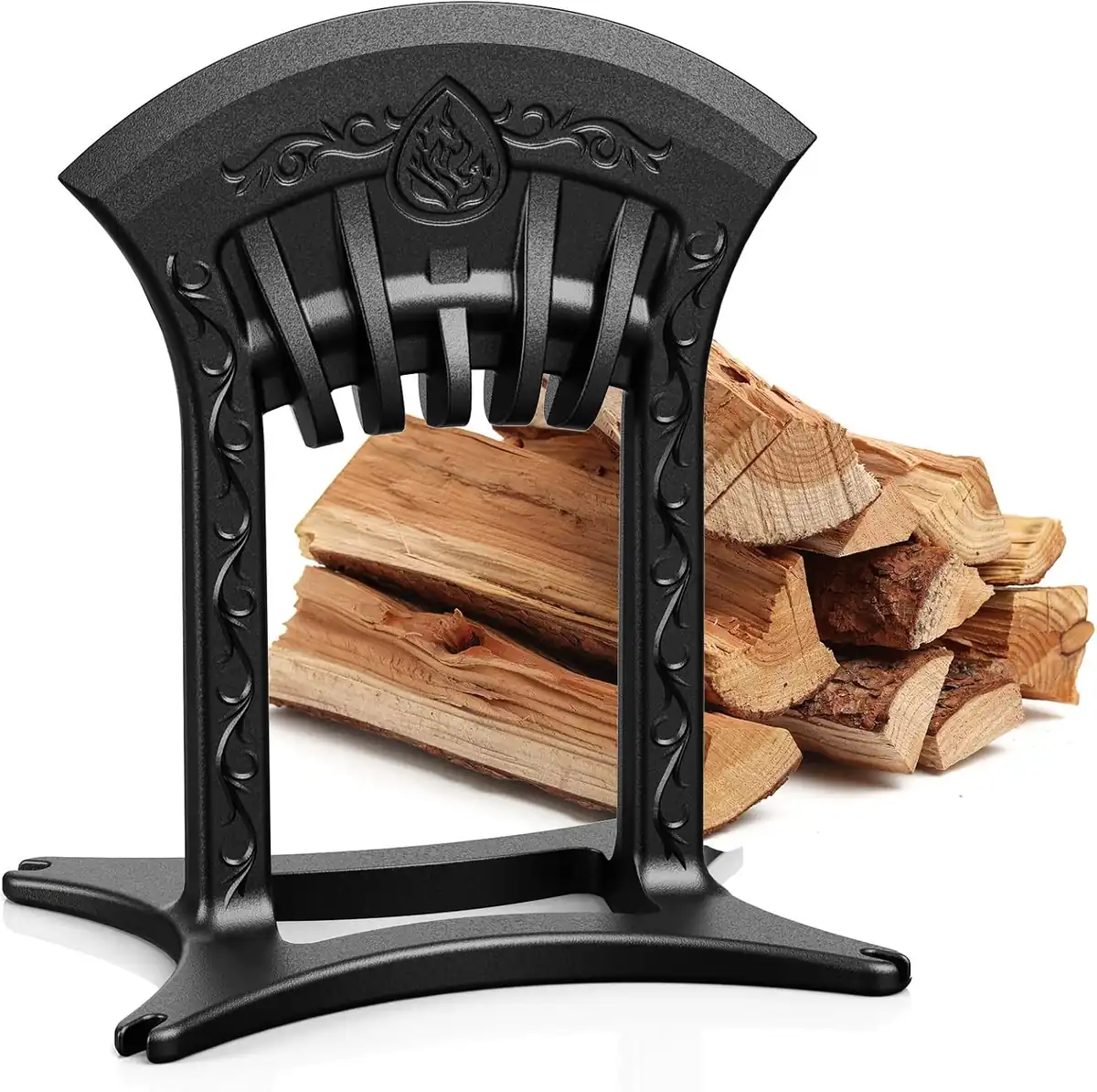
The frame is one piece of cast steel with an all-weather coating, an X-shaped base with handles cast in, and a head of slanted alternating teeth across the middle. According to KABIN, the extra wide mouth takes wider pieces than other tools, and the tall base allows longer ones. It is listed at 12 lb, and the whole tool measures about 10.25 by 9 by 15.5 in.
This kindling splitter tool is unpowered, so the table has nothing to say about tonnage, cycle time or fluid. The two rows that matter are the minimum wood size and the mounting.
| Spec | Value |
|---|---|
| Splitter type | Kindling splitter, cast steel frame, unpowered |
| Power source | None: you strike it with a mallet |
| Rated tonnage | Not applicable to a struck tool |
| Minimum wood diameter | 1 in, per KABIN’s instruction sheet |
| Maximum wood size | Not published by the maker; the piece must fit securely within the upper blade ring |
| Orientation | Upright: the piece stands vertically in the mouth |
| Head | Fixed head with slanted alternating teeth, as KABIN describes it |
| Weight, as listed | 12 lb |
| Mounting and carry | Free-standing on even ground or bolted on all 4 sides to a heavy base; handles cast into the frame |
| Warranty | 1 year limited, for defects in material and workmanship, per KABIN’s instruction sheet |
Setting Up the KABIN Kindle Quick
KABIN’s sheet gives two ways to stand the tool, and the first rule of both is a base that does not move. The tool may sit free on even ground, or it may be bolted to a base that is level, solid and heavy. The sheet says never to place it on another surface unless it is securely bolted. It recommends a stump.
Free-Standing on Even Ground
The gravel yard by my machinery shed has a slight crown, so I did not set the Kindle Quick down there. I used the packed work pad in front of the tool shed, which is the closest thing I have to even ground. The X-shaped base sits wide, and at 12 lb it stays put under a mallet strike on that pad.
Bolted to a Stump
The base has bolt holes, and KABIN says all 4 sides must be bolted down, with bolts suited to the base. The sheet names no bolt size, so that choice is yours. I bolted it to a heavy block beside the shed, and the difference showed in the first strikes: the frame did not creep across the surface, and I stopped thinking about the tool and watched the wood.
Splitting Kindling With the Kindle Quick in Real Work
This is a manual kindling splitter, and KABIN’s use steps are short enough to learn in one read. Before the first strike, put on the eye protection and gloves the sheet calls for, and keep a circle of 3 m clear around the tool, because the sheet warns about splintering debris. KABIN also says to stay an arm’s length from the splitter and never to look directly over the blade.
- Put the Kindle Quick on flat ground or bolt it to a raised surface.
- With gloves and eye protection on, stand a piece of firewood upright in the mouth.
- Tap the piece lightly with a mallet until it sets on the blade and stands on its own.
- Take your hand off the wood, then hit the piece with enough force to split it in two.
- Split the halves the same way until the kindling is the thickness you want.
KABIN notes that multiple strikes may be necessary and that excessive force is not needed and may cause injury. The order matters more than the swing: the piece stands alone first, and only then does the real strike come. The sheet also says the Kindle Quick is for adults only.
The Tap, Then the Strike
The light taps are the part I valued most. A small piece of plum wood wobbles on a blade when you first set it down, and a few gentle taps seat it until it holds itself upright. Once it stood on its own, my hand came away before I swung, as the sheet’s fourth step says.
Teeth, Knots and Pieces That Stay Put
KABIN says the slanted alternating teeth split the wood at an angle and prevent jams. On straight apricot limbs the halves dropped away on either side of the head. A forked plum piece with a knot behaved differently: it needed more than the first strikes, which fits the sheet’s note on multiple strikes.
Wood with interlocked grain is a known hard case: the USDA wood handbook describes it as exceedingly difficult to split radially (1). I leave such a piece for another day and never force it, because the sheet asks for sufficient force and warns that excessive force may cause injury.
Wood Size and the Upper Blade Ring
KABIN sets a 1 in minimum diameter and gives one test for the top end: the piece must fit securely within the upper blade ring. I follow that test and stop at it, so a round that does not seat in the ring waits for a saw cut or for another tool. Used as a firewood kindling splitter, it handles small pieces, and a powered log splitter is the machine for rounds; that comparison has its own article. For small rounds, branches and kindling stock on a machine, my log splitters for small logs list is the place to start.
Dry Wood Makes Clean Kindling
Kindling is only useful when it is dry. Properly seasoned firewood sits below 20 percent moisture, and green wood is normally above 60 percent, according to a University of Tennessee extension publication (2). Splitting, stacking and airflow do the drying; time alone does not.
Winter drying is slow. In a small trial in Bosnia, split oak pieces stacked outdoors under cover still held about 31 percent water after 62 days (3). That is why I split the pruning limbs early and stack the sticks where air moves through them.
Wet kindling costs you in the stove. A lab study found that moisture content changes both the burning rate and the emissions of a residential stove (4). Dry, small sticks light easily and burn clean, and the Kindle Quick makes the sticks.
Care, Rust and Storage
The Kindle Quick can be stored outside year-round, according to KABIN. Use and wear may fade the coating, and if rust starts to appear, KABIN suggests storing it under cover if that bothers you. The sheet adds that rust will not affect how well the tool works.
One care rule is firm: do not hit the blade with your hammer, which can damage it and strip the coating. I swing at the wood and aim for its top, never the head of the tool. KABIN backs the tool with a 1 year limited warranty against defects in material and workmanship from the date of purchase.
I carried the tool to the shed by its cast handles after each session. KABIN says the base also works as a crate for carrying wood, and a handful of splits fit in it, though a full armload does not.
Who Should Skip the Kindle Quick
The Kindle Quick fits stove kindling from small, dry pieces and nothing bigger.
- Buy it if you split kindling for a stove or fire pit and have a stump or heavy block to bolt it to.
- Buy it if you want a tool with no cord, fuel or maintenance beyond brushing off the bark.
- Skip it if you need a printed maximum wood size before you buy.
- Skip it if you split rounds for the woodpile, because that is a log splitter’s work.
- Skip it if you have no mallet, and no even ground or heavy base to stand it on.
Drawbacks to Know About
The biggest limit is the wood size: KABIN gives a 1 in minimum and the ring test, with no top figure. That makes it a tool you learn by feel, one piece at a time, and a piece that does not seat is not worth forcing. It also needs your own mallet, and KABIN prints no mallet weight. I set that missing top figure against the King XL ring in Kindling Cracker and KABIN compared.
The coating fades with use, and a bare tool can rust. KABIN says that does not affect how well it works, and a covered corner of the shed solves it. Keep it away from children: the sheet says it is for adult use only and unsafe for children.
How It Compares With Two Other Kindling Splitters
Two other kindling splitters sit in the same price tier, and each makes a different choice about hand protection and wood size. The table uses the figures as listed, so the weights share one basis.
| Feature | KABIN Kindle Quick | Kindling Cracker Original | Poffattr Kindling Splitter L |
|---|---|---|---|
| Material | Cast steel | Cast iron | Cast iron |
| Opening or ring | Upper blade ring, no size printed | 6.5 in ring opening | 8.27 in opening |
| Weight, as listed | 12 lb | About 10.6 lb | About 7 lb |
| Mounting | Free-standing or bolted on all 4 sides | Bolt holes in the base | Four mounting holes, four screws in the box |
| Hand protection | Arm’s length and a 3 m clear zone, per the sheet | Safety ring, per the maker | Safety cover over the arch edge, per the listing |
Kindling Cracker Original
The Kindling Cracker Original Cast Iron Kindling Splitter puts a cast iron safety ring around the piece, and the maker says the ring keeps hands away from the splitting wedge. Its opening is 6.5 in, a printed figure the KABIN does not give. Pick it if you want the ring around the wood and a stated opening. The cast iron ring gets a closer look in my Kindling Cracker Original review.

Poffattr Kindling Splitter L
The Poffattr Cast Iron Kindling Splitter L has an 8.27 in opening, five fins and a safety cover that shields the arch edge when you store it. Four screws come in the box, so mounting takes only a drill and a block. Pick it if you want the wider opening and a lighter tool to carry. I look at the fins, safety cover and screws in my Poffattr splitter review.
Common Problems and How to Avoid Them
A wobbling piece is the usual trouble: it will not stand on the blade, so the strike glances off. The fix is KABIN’s own step, light taps until it stands alone, and a piece that still leans gets a different seat or a different piece. A tool that creeps across the ground is the second trouble, and the sheet answers it with a level, solid, heavy base.
The third trouble is a hand that stays on the wood. KABIN allows the hand on the piece only for the light seating taps; once it stands on its own, the hand comes away, and it stays away for every splitting strike. I follow that order. If a piece stays wedged after the strikes the sheet allows, I stop and do not improvise a recovery near the blade.
My Final Verdict on the KABIN Kindle Quick
I recommend the Kindle Quick as a stump-mounted kindling tool for small, straight pieces of dry wood. It earns my recommendation on the bolt-down base, carry handles and head that holds a piece upright for mallet strikes, while my best manual log splitter picks compare hand-pump and kindling tools by size. Wear eye protection and gloves, keep the 3 m clear around it, and take your hand off the wood before every splitting strike. My KABIN kindling splitter review ends on a clear yes: the Kindle Quick is the kindling tool I recommend for small pruning pieces.
Frequently Asked Questions
What is the KABIN kindling splitter?
The KABIN kindling splitter is the Kindle Quick, a cast steel tool with an all-weather coating that splits small pieces of firewood into kindling. You stand a piece upright in its mouth and strike it with a mallet, so it needs no motor, power cord or fuel, and an adult can carry it by its handles.
How do you use the KABIN Kindle Quick kindling splitter?
To use the KABIN Kindle Quick kindling splitter, wear gloves and eye protection, set it on flat ground or bolt it down, and stand a piece of firewood upright in the mouth. Tap it lightly with a mallet until it stands alone, take your hand away, then strike until it splits and repeat on the halves.
Do you need to bolt down the KABIN Kindle Quick?
You do not need to bolt down the KABIN Kindle Quick on even ground, but KABIN recommends bolting it to a stump for the best and easiest use. Never place it on another surface or base unless it is securely bolted on all 4 sides to a level, solid, heavy base.
What do you hit the KABIN Kindle Quick with?
You hit the wood in the KABIN Kindle Quick with a mallet, and KABIN’s instructions call for light taps first, then a firm strike with the hand away. Never hit the blade of the tool with your hammer, because KABIN says that can damage the blade and remove its all-weather coating.
Can you leave the KABIN Kindle Quick outside?
You can leave the KABIN Kindle Quick outside year-round, because KABIN says its cast steel and all-weather coating suit outdoor storage. The coating may fade with use, and if rust starts to show you can store it under cover, though KABIN says rust does not affect how well it works.
References
- Ross RJ, ed. Wood Handbook: Wood as an Engineering Material. General Technical Report FPL-GTR-282. USDA Forest Service, Forest Products Laboratory; 2021.
- Taylor A. Moisture Content of “Seasoned” Firewood. W179. University of Tennessee Institute of Agriculture; 2014.
- Gačo A. Researching the change in the weight of split oak firewood due to different drying methods. IOP Conf Ser Mater Sci Eng. 2021;1208(1):012023.
- Price-Allison A, Lea-Langton A, Mitchell EJS, et al. Emissions performance of high moisture wood fuels burned in a residential stove. Fuel. 2019;239:1038-1045.
Safety Note: Only an adult who has read the manual and understands the controls should use a log splitter, never a child or anyone tired or impaired. The ram and wedge push with tons of force and can crush or cut off fingers, hands and feet: never put your hands or feet between the log and the wedge, the ram or any part of the splitter while it moves, keep your fingers out of cracks that open in the log, load each log by holding its sides, never its ends, and run the control only with your hand, never tying down, blocking or bypassing a two-hand control. Keep your hands clear during both the splitting stroke and the return stroke. Follow the manual’s unloading sequence; WEN 56207 requires the entire cycle to finish and the ram to retract fully before removing split wood. Never straddle or step over an operating splitter or reach or bend over it to retrieve a log. One person operates the control and also loads the log unless the exact manual explicitly permits a loading helper. Never let anyone hold the log while you operate the splitter. If a loading helper is permitted, wait until that helper has left the operating area and reached the manual’s required clearance before moving the control. Keep children, pets and other people out of the work area, at least the distance your manual prints for that exact model, and stop if anyone comes closer. No single distance is safe for every splitter. Set the splitter on firm, level, dry ground outdoors, never on a slope, ice, mud or slippery ground. Secure it against movement as the manual directs; Yardmax requires blocking the front and back of both wheels. Work in daylight or good artificial light as the manual permits, and keep split pieces cleared away from your feet. Never run an electric splitter in rain or damp conditions. Split one log at a time, with the grain and square-cut ends, within every size and weight limit your manual gives, including any minimum length. Check for nails, wire and other foreign objects. Reject knotted, curved or uneven logs where the manual forbids them; Boss ES7T20 forbids uneven logs, including knotted or curved logs. Stop at the manual’s splitting time limit and follow its procedure rather than forcing the log. Wear the eye protection your manual specifies: Champion calls for ANSI-approved safety glasses, and Boss calls for safety goggles or safety glasses with side shields. Also use a face shield where your manual asks for one, hearing protection with a gas engine or wherever your manual asks, sturdy boots (steel-toed where your manual asks), gloves exactly as your manual directs, and no loose clothing, jewelry, drawstrings or untied long hair. Pressurised hydraulic fluid can inject through your skin from a hole too small to see: never check for a leak with your hand, pass cardboard or wood over the spot instead, and see a doctor at once if fluid hits your skin, even if the wound looks small. Before freeing a stuck log, checking or adding fluid or oil, servicing, cleaning, sharpening, adjusting, moving, towing, storing or leaving the splitter, complete the shutdown for its power type. Electric: release the controls, switch the motor off, wait until every moving part has stopped completely, including the ram and any flywheel, then unplug it from the outlet by the plug. Gas: release the controls or return the hydraulic control lever to neutral as your manual directs, turn the engine off, wait until every moving part has stopped completely, including any flywheel, let the engine and muffler cool, then disconnect the spark plug wire and secure it away from the plug. Manual hydraulic: stop pumping and release the pressure exactly as your manual directs. On every hydraulic splitter, relieve hydraulic pressure as the manual describes before servicing or touching a hose, fitting, cap or the wedge area. Never remove the hydraulic oil cap or vent plug while the machine is running or hot, and never adjust pump or valve pressure settings. Before moving, towing or storing a gas splitter, close its fuel valve where fitted as the manual directs. Free a stuck log only by the manual’s procedure, including its instructions for any powered clearing step, never with your hands. Refit every guard before restarting. Use the grounded supply your manual requires and GFCI protection. If an extension cord is permitted, use a grounded three-wire outdoor-rated cord of the manual’s specified gauge and length. Keep connections away from water, keep the cord clear of moving parts and your feet, and never handle the plug with wet hands or disconnect it by pulling the cord. Refuel a gas splitter outdoors in a well-ventilated area with the engine off and cooled for several minutes, following any longer cooling period in its manual. Keep smoking, flames and sparks away, never overfill the tank, and wipe up spills before starting. Keep the manual’s clearances from surrounding objects and combustible materials. Never run it indoors or in a garage or shed, even with the doors open, because the exhaust contains carbon monoxide. Tow a towable splitter only as its manual describes, with towing chains attached exactly as the manual specifies, and never faster than the speed it prints. Store it dry and out of children’s reach, following the manual’s fuel-storage restrictions; Champion 100236 prohibits storing the unit indoors with fuel in its tank. Follow your manual’s lifting and handling instructions and every printed log-weight limit. Take breaks and stop when you are tired.