
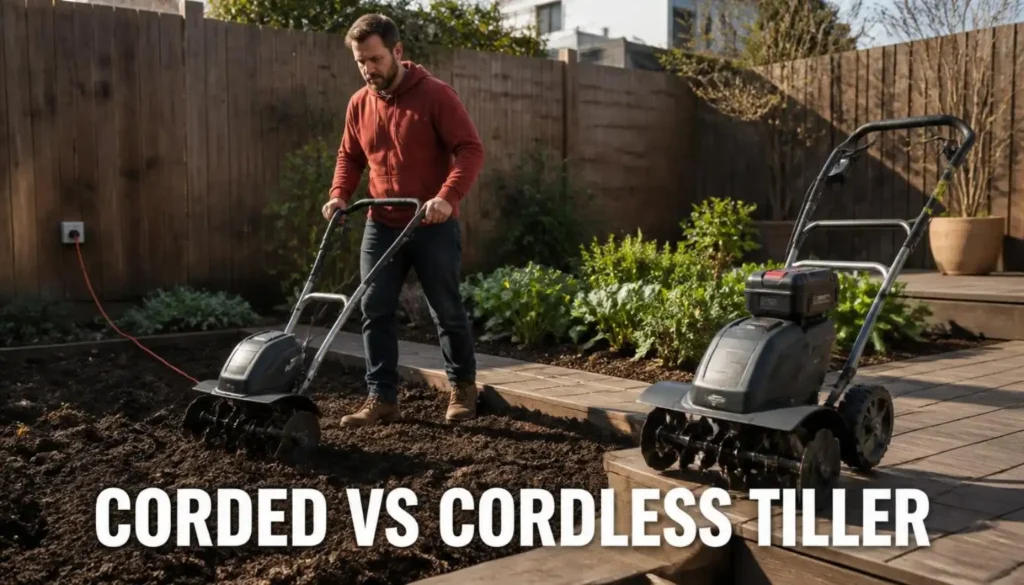
The corded vs cordless tiller choice comes down to two limits: how far a cord reaches from your outlet, and how much work one battery pack gives you in your soil. Both types are small-bed machines, and neither is a sod breaker. I read the printed limits before I read any marketing, and I walk the distance from my shed outlet to the vegetable plot before I think about a corded unit. Below I compare the figures makers print, the safety steps both types need, and when a bigger machine is the better call.
Corded vs Cordless Tiller for Small Garden Beds
A corded unit fits beds that sit within safe cord reach of an outlet, because it needs no charge level to watch. A cordless tiller fits beds that sit far from an outlet, because nothing trails behind it. Each maker prints its own width, depth and motor figures, and those figures say both types are built for small gardens and flower beds, not for hard sod or large plots. My tiller vs cultivator guide explains what each machine does before you pick a type.
Here is how I sort the two. Distance to the outlet decides it first, then bed size, then how much you want to carry and charge. When you cannot name the outlet you would use, a battery model is the practical start. With one in range, a corded model removes the battery, the charger and the spare pack from the shopping list.
The Short Version
Corded suits beds near an outlet and steady work. Cordless suits remote beds and short jobs. Both stay inside the maker’s printed width and depth ceilings, and both follow the same full shutdown before any clearing, adjusting or storing.
How Corded and Cordless Tillers Are Powered
A tiller is a motor, a gearbox and a shaft of steel tines. What differs is where the energy comes from, and that decides where the machine can work. My answer to “how does a garden tiller work” goes through the parts, tines, depth and soil action.
Corded Electric Tiller With Outlet, Amps and Cord
A corded electric tiller plugs into a 120 V outlet through an extension cord. Corded motors from Sun Joe, Earthwise and Scotts run from 6.5 A up to 13.5 A. According to Sun Joe, its TJ604E carries a 13.5 A motor on 120 V, turns six steel tines at 370 rpm with no load, and works a path up to 16 in wide and up to 8 in deep. Sun Joe describes it as designed for small gardens and flower beds and says it may not be used to till extremely dry or wet soil.
A 13.5 A motor draws most of a standard 15 A household circuit, so I keep the outlet free of other heavy loads while I work. Tine speed is a gearing choice, not a power ranking: one maker’s 370 rpm and another’s 200 rpm tell you how fast the tines turn, never which machine is stronger.
Cordless Tiller With Battery and Charger
A cordless electric tiller carries its energy in a lithium battery pack, and battery tillers and cultivators from Ryobi, Earthwise, BLACK+DECKER and Greenworks run on packs from 18 V to 40 V. According to Greenworks, its 27062 runs a 40 V DC motor at 200 rpm, works a path up to 10 1/4 in wide and up to 5 in deep, and weighs 29.3 lb with the battery installed. Greenworks calls it a cultivator, says it may be used with four tines or two, and says that tilling sod into the soil is not recommended. I cover the 27062 and its use in small beds in my Greenworks 40V tiller review.
The battery and charger are part of the machine, and the pack is what limits a work session. A cordless tiller with battery and charger in the box costs more at the start than a bare tool, which is why I price the kit and not the tool.
Safety Steps for Corded and Cordless Tillers
A tiller drives steel tines that cut soil, roots and anything else within reach. Cub Cadet and Troy-Bilt print that their machines are capable of amputating fingers, hands, toes and feet, and that is the standard I hold every tiller to, corded or cordless. The steps below apply to both types, and the shutdown box is the one I follow every time my hands go near the tines.
Full Shutdown Box
Shutdown before you clear the tines, free a root, rock or wrapped vine, adjust the depth or width, change tines, check or add oil or fuel, clean, load, move, store or leave the tiller. Never reach toward the tines while they turn, and never clear them with the machine running.
- Corded electric tiller: release the switch or bail, wait until the tines have stopped completely, then unplug the tiller from the outlet by the plug, not the cord. Before transport or storage, also let the motor cool.
- Battery tiller or cultivator: release the switch or bail, wait until the tines have stopped completely, then remove the battery, and the switch key where your model has one, and keep it away from the tiller.
- Then, for both: only then clear wrapped roots, vines or grass by hand in sturdy gloves, cutting them free only as your manual describes, and check the tines and guards for damage. Do not reverse the tines or run the engine to unwind material unless your manual says so. Add every step your manual gives, in its order, and refit every guard and shield before you restart.
Sun Joe adds a model rule for its TJ604E: after the tines strike a foreign object, switch the product off, disconnect it from the power supply, let it cool completely, and inspect it thoroughly for damage before you restart. It also says to stop the tiller and disconnect the cord before you leave the operating position behind the handles to adjust or inspect it, and to wait until the tines have come to a complete stop.
Operator, Gear and Work Area
Only an adult who has read the manual and understands the controls should run a tiller, and never a child or anyone tired or impaired. Champion says never to allow children under age 16 to operate its tiller. Wear safety glasses with side shields or goggles that meet ANSI Z87.1, or the eye protection your manual specifies, and a face shield where it asks for one; wear hearing protection with a gas engine or wherever your manual asks; wear long pants and the footwear and gloves your manual specifies for your model (Champion prohibits sandals, sneakers, light footwear and bare feet; YARDMAX specifies long, heavy pants, work boots and work gloves). Keep hair, clothing, jewelry, drawstrings and gloves away from moving parts.
Before you start, walk the bed and remove rocks, sticks, wire, hose, stakes and anything else the tines could catch or throw. Identify irrigation lines, drip lines, cables and sprinkler heads before you start, and take loose garden hoses out of the work area. Do not handle or move unidentified cables, pipes or utility lines: keep the tiller away from them and contact the utility if their location is uncertain. In my plot the drip lines come first, because I built that system myself and I know how shallow they run.
Buried Lines, Bystanders and Hidden Obstacles
Call 811, the free national call-before-you-dig number, before you till ground where you do not know what lies below, and always before any digging. According to PHMSA, the call is free and costs nothing for having the lines marked, and state law sets how much time the utilities have to mark them. Utilities can lie close to the surface, so a shallow pass is not a safe pass, and no manual or agency source gives a tilling depth that is safe over a buried line. Wait for the utilities to locate and mark their lines before you start. Identify your own irrigation lines and cables as well, and do not assume that utility markings identify every buried obstacle.
Follow your exact manual’s prohibition: Earthwise, Champion and Greenworks prohibit tilling near underground cables, pipes or hoses; YARDMAX, Tazz and Earthquake prohibit tilling above underground services; EGO requires you to ensure that no buried power cables are present. Marking a line does not make tilling over it safe, and no safe tilling depth above a buried line exists. Contact the utility if the location of its services is uncertain, and keep every tiller away from the ground until the lines are located and marked.
Keep children, pets and other people out of the work area and at least the distance specified for your exact model: Ryobi P2705, 50 ft; YARDMAX YT4565, 75 ft; Sun Joe TJ600E, TJ603E and TJ604E, 25 ft; BLACK+DECKER LGC120, 20 ft. Stop if anyone enters that area. If your manual gives no number, keep everyone well clear of the work area as it directs, and stop if anyone approaches. No distance makes a work area safe on its own: keep watching it.
Sun Joe also says not to allow anyone in front of a running machine, so I treat the space ahead of the tines as closed.
Hard-packed or frozen ground, buried stones, roots and stumps can make a tiller bounce upward or jump forward, and the tines can catch in the ground and pull a front-tine machine forward. Hold the handles firmly with both hands, keep your feet clear of the tines, take shallow passes, and if the tines strike a hard object, stop immediately, complete the full shutdown in the shutdown box, and inspect for damage before restarting. Do not till frozen ground (Champion, Earthwise, YARDMAX).
Soil, Wrapped Tines, Cord and Battery Rules
Do not till soil that is too wet. Squeeze a handful into a ball: if it crumbles under finger pressure it is ready, and if it holds its shape or sticks to the tines, wait a day or two (Kentucky and Iowa State Extension). Wet clay forms hard clods and compacts (Utah State). Do not till rock-hard dry or frozen ground, which makes the tiller bounce.
If roots, vines or grass wrap on the tines or the machine stalls, do not force it and do not reach for the tines. Complete the full shutdown in the shutdown box, then clear the material by hand in sturdy gloves, cutting it free only as your manual describes. Do not reverse the tines or run the engine to unwind it unless your manual says so.
For a corded unit: use an outdoor extension cord that meets your exact manual’s requirements for gauge, length, plug type and grounding. Keep the cord away from the tines, never carry the tiller by the cord, and never use it in the rain (Sun Joe). Follow your exact manual’s instructions for cord routing, disconnecting the plug, keeping connections dry and GFCI protection.
For a battery unit: use only the battery and charger your manual names. Before clearing, adjusting or cleaning, complete the full shutdown for your tiller in the shutdown box above. Store the battery as the manual directs.
Power, Width and Depth Compared
Amps and volts are different measures, so no corded motor figure beats a battery figure on paper. What you can compare are the width and depth ceilings the makers print, and those ceilings are for loose soil, never a promise for hard clay. I read each ceiling as the most the machine is allowed to do, not the amount it will do. I explain how to choose a machine for your garden in my mini tiller vs full size tiller comparison.
| Row | Sun Joe TJ604E (corded) | Greenworks 27062 (cordless) |
|---|---|---|
| Power, maker’s figure | 13.5 A on 120 V | 40 V DC motor, 40 V lithium battery |
| Tilling width, maker’s maximum | 16 in | 10 1/4 in |
| Tilling depth, maker’s maximum | 8 in | 5 in |
| Tines, maker’s figure | 6 steel tines, 370 rpm no load | 4 tines or 2 tines, 200 rpm |
| Depth control, as the maker describes it | Wheels with three positions | Wheel position on a spring-loaded knob |
| Sod, as the maker states it | Small gardens and flower beds; not extremely dry or wet soil | Tilling sod into the soil is not recommended |
What a Width Figure Means for a Bed
Take a bed 4 ft wide, which is 48 in. At a 16 in path that is at least three passes, and at a 10 1/4 in path it is at least five, before any overlap. Sun Joe says to till in slightly overlapping rows, so the real count runs higher. I plan the passes on paper first, because the width figure sets how many times I walk the bed and how many times I turn.
A Depth Ceiling Is Not a Depth Target
Illinois Extension says to dig a vegetable bed at least 6 to 10 inches deep and to add 2 to 4 inches of compost, and in the same page it says tilling destroys the structure of soil. A 5 in ceiling cannot reach the bottom of that range, and an 8 in ceiling reaches only part of it. Greenworks says it may take several passes over the same path to reach the depth you want, which fits a trial on a clay loam in Malaysia where repeated rotary passes lowered bulk density and penetration resistance compared with no tillage (1). That trial used a large machine in a rice paddy, so I take only the direction: several shallow passes loosen soil.
Iowa State says most lawn areas need a large rear-tine rototiller to break up sod, and Greenworks says tilling sod is not recommended, and Sun Joe limits its tiller to small gardens and flower beds. If your bed is sod or very hard soil, size up to a larger machine or hire one with its own manual.
Cord Reach Against Battery Limits
Reach and runtime are the two practical limits, and each has a number you can plan around only as far as the maker prints it. I treat every figure as a ceiling and plan for less.
How Far a Cord Can Reach
Sun Joe’s manual allows an outdoor extension cord of 14 AWG up to 50 ft, 12 AWG for 50 ft to 100 ft, and says not to use a cord longer than 100 ft. Sun Joe also lists GFCI protection for the circuit, and says to keep the cord away from the tines and to use the tiller only in dry conditions. Say your outlet sits 70 ft from the bed: that rules out the 14 AWG cord and calls for the 12 AWG one. Other makers print their own tables, so the gauge and length in your manual is the rule, not Sun Joe’s. I cover the 16-inch TJ604E in my Sun Joe corded tiller review.
On my plot the cord question is a short walk from the shed outlet, and I still lay the cord out along the edge of the bed before I start, so it sits behind me and away from the tines.
What a Battery Can Give You
A battery tiller removes the cord and adds a limit of its own. A runtime belongs to one model in one soil. Earthwise prints 30 minutes per charge for its 20 V TC70020 and 45 minutes for its 40 V TC70040, and those figures are for the soil Earthwise used, so they do not predict another model’s runtime or your soil. Soil, depth and how hard you push change it, so I plan every battery session as short and keep the work to a small bed. My ranking of nine cordless tiller models lists each battery machine by printed width, depth and kit.
The charger is the other half of the plan. A pack that has to cool and recharge before the next bed turns a morning job into a day job, and that is the point where I stop and look at a corded unit.
Weight, Handling and Vibration
Weight shows up at the turn at the end of a row and when you carry the tiller to the shed. Sun Joe lists the TJ604E at 27.1 lb, and Greenworks lists the 27062 at 29.3 lb with the battery installed. I read each number against its own machine and never against the other, because the lists are not built on the same basis. I put those two machines side by side in my Greenworks and Sun Joe tillers comparison.
Turning, Folding and Carrying
Both machines fold their handles, and both are meant to be turned by lifting the tines slightly and pivoting on the wheels. According to Sun Joe, you always carry the tiller by its transport handle and never by the cord, with the wheels in the transport position. Before you lift, load, carry or move a tiller, complete the full shutdown in the shutdown box above.
A corded tiller drags its cord at every turn, and a cordless one carries its pack in front of you. I find the cord the bigger nuisance at the end of a row, because I have to keep it on the correct side of me. Cordless handling is cleaner, According to Greenworks, never operate its 27062 on a slope, and Sun Joe says to work across slopes and never up and down. Follow only the slope rule in your own manual, and ask the maker for guidance when it gives none. My Sun Joe and Earthwise tillers comparison covers two corded alternatives.
Vibration and Fatigue
Tilling is heavy, jarring work. Take breaks, stop when you are tired or your attention slips, and use the gloves your manual recommends to reduce vibration in your hands (Tazz, Earthquake, Mantis).
A study of a power tiller, a larger two-wheel machine than a garden tiller, measured handle vibration in transport, cultivator tilling and rota-tilling, and found that handle intervention materials reduced it (2). A model of a 13 hp diesel power tiller placed its operators in the highest vibration-risk class (3). Those machines are bigger than any corded or cordless homeowner unit, so I use them for one practical point: breaks and good gloves.
Corded vs Cordless Tiller Pros and Cons
The honest comparison is a trade of reach for freedom. The lists below are written for a small bed of loose soil, which is the work both types are built for. If you are also considering gas power, I explain how garden size and soil affect the choice between an electric and a gas tiller.
Choose a Corded Electric Tiller If
- The bed is near an outlet. Within the cord rule of your manual, nothing needs charging.
- You want fewer parts to buy. No battery, no charger, no second pack.
- You work in longer sessions. The motor runs while it has power, inside the manual’s overload rules.
- You can keep a cord clear of the tines. That takes attention at every turn.
Choose a Cordless Tiller If
- The bed is far from an outlet. Nothing trails behind you.
- The job is a short, small bed. A pack covers a small job inside the maker’s figures.
- You want a cordless garden tiller for ease. The battery trades the cord for charging.
- You accept the weight with the pack. Greenworks lists 29.3 lb with the battery installed.
Who Should Skip Both
Skip both if your bed is sod, hard-packed soil or rocky ground. I also skip both when roots run through the bed, because roots wrap on the tines and stall the machine. My front tine vs rear tine tiller guide explains how to choose between those designs for your plot and soil.
When Neither Type Is Enough
A large garden or new ground asks for a larger machine, and the extension sources do not agree on whether to till at all. I give both views and leave the call to your soil.
Bigger Machines and Other Options
Iowa State says tilling quickly creates a turfgrass-free area for planting, and also that it can degrade soil structure and bring up weed seeds. Oregon State says mechanical tillage has its place for new beds with high compaction and low organic matter. For hard sod or rocky ground, Iowa State points to a large rear-tine machine, which means a rental with its own manual or a professional.
Tilling or Not Tilling
Maryland Extension says to aim for a no-till or minimum-till bed, and Illinois Extension says tilling destroys the structure of soil while it also helps break up heavy clay and compaction. A meta-analysis of US studies found that moving from moldboard ploughing to no-till raised surface wet aggregate stability (4), and a long-term trial on a Hungarian Chernozem found the most earthworms under no-till and the fewest under ploughing (5). Those were farm fields on named soils, so they show a direction and not a rule for your garden. My own preference is minimal tillage, in line with how I work the tree rows, and a machine only for the first loosening of a bed.
What to Remember Before You Choose
Three points carry this decision. First, distance to the outlet picks the type, and the maker’s width sets how many passes a bed takes. Second, run the full shutdown in the shutdown box every time your hands near the tines. Third, anything that is sod or hard ground needs a bigger machine. Before I buy any tool I pace the bed and the distance to the outlet, which tells me quickly whether the corded vs cordless tiller choice is even open. My ranking of nine electric tiller picks includes corded and battery models for garden beds and rows.
Frequently Asked Questions
Do cordless tillers work?
Cordless tillers work for small beds of loose soil, within the width and depth the maker prints. Greenworks lists its 27062 at 10 1/4 in wide and 5 in deep and says tilling sod is not recommended.
How long does a cordless tiller battery last?
A cordless tiller battery lasts as long as its model, soil and depth allow. Earthwise prints 30 minutes per charge for its TC70020 and 45 minutes for its TC70040 in its own test soil, and neither predicts another model’s runtime.
Do corded tillers have more power than cordless tillers?
Corded tillers do not automatically have more power than cordless tillers, because amps and volts are different measures and tine speed depends on gearing. Compare each maker’s printed width, depth and soil limits instead.
How long can an extension cord be for a corded tiller?
An extension cord for a corded tiller can be as long as your manual allows for its gauge. Sun Joe allows 14 AWG up to 50 ft and 12 AWG from 50 ft to 100 ft, and says never to use a cord over 100 ft; check the table in your own manual.
Can a cordless tiller handle a vegetable garden?
A cordless tiller can handle a small vegetable bed of loose soil within the maker’s width and depth. Illinois Extension says to dig a vegetable bed at least 6 to 10 inches deep, while Greenworks lists a 5 in ceiling for its 27062, so several shallow passes and battery breaks are part of the plan.
References
- Mairghany M, Yahya A, Adam NM, Su AS, Aimrun W, Elsoragaby S. Rotary tillage effects on some selected physical properties of fine textured soil in wetland rice cultivation in Malaysia. Soil Tillage Res. 2019;194:104318.
- Chaturvedi V, Kumar A, Singh JK. Power tiller: vibration magnitudes and intervention development for vibration reduction. Appl Ergon. 2012;43(5):891-901.
- Heidary B, Hassan-Beygi SR, Ghobadian B. Investigating operator vibration exposure time of 13 hp power tiller fuelled by diesel and biodiesel blends. Res Agric Eng. 2014;60(4):134-141.
- Nunes MR, Karlen DL, Moorman TB. Tillage intensity effects on soil structure indicators: a US meta-analysis. Sustainability. 2020;12(5):2071.
- Dekemati I, Simon B, Vinogradov S, Birkas M. The effects of various tillage treatments on soil physical properties, earthworm abundance and crop yield in Hungary. Soil Tillage Res. 2019;194:104334.
Safety Note: Only an adult who has read the manual and understands the controls should use a tiller or cultivator, never a child (Champion: never under age 16) or anyone tired or impaired. Rotating tines can cut off fingers, hands and feet, and can throw stones and debris. Never touch or clear the tines while they turn. Before you clear the tines, free a root, rock or wrapped vine, adjust the depth or width, change tines, check or add oil or fuel, clean, load, move, store or leave the tiller, complete the shutdown for its power type. Corded electric: release the switch or bail, wait until the tines have stopped completely, then unplug it from the outlet by the plug, not the cord; before transport or storage, also let the motor cool. Battery: release the switch or bail, wait until the tines have stopped completely, then remove the battery, and the switch key where the model has one. Gas: release the clutch, drive levers or bail, turn the engine off, wait until the tines and every moving part have stopped completely, then disconnect the spark plug wire and secure it away from the plug, and let the engine and muffler cool before touching the tines, engine, muffler or anything near the exhaust. EGO cultivator attachment on a compatible battery power head: release the trigger, wait until the blades have stopped completely, then remove the battery from the power head; for another attachment system, follow the shutdown instructions in both its attachment manual and its power-head manual. Then clear wrapped roots or vines by hand in sturdy gloves, only as your manual describes; do not reverse the tines or run the engine to unwind material unless your manual says so. Wear safety glasses with side shields or goggles meeting your manual’s specification, including ANSI Z87.1 where required, and add a face shield where the manual requires one. Wear hearing protection with a gas engine or wherever the manual requires it, long pants, and the footwear and gloves specified for your model. Champion prohibits sandals, sneakers, light footwear and bare feet; YARDMAX specifies long, heavy pants, work boots and work gloves. Keep hair, clothing, jewelry and gloves away from moving parts. Before you start, remove rocks, sticks, wire and loose hoses, and identify your irrigation lines and cables; do not handle or move unidentified cables, pipes or utility lines. Call 811 before tilling ground where you do not know what lies below, and always before digging. Wait for the utilities to locate and mark their lines before starting. Follow your manual’s prohibition on tilling near or above underground services; marking a line does not make tilling over it safe, and no safe tilling depth above a buried line is established in the sources reviewed. Keep children, pets and other people out of the work area and at least the distance specified for your exact model: Ryobi P2705, 50 ft; YARDMAX YT4565, 75 ft; Sun Joe TJ600E, TJ603E and TJ604E, 25 ft; BLACK+DECKER LGC120, 20 ft. Stop if anyone enters that area. If your manual gives no number, keep everyone well clear of the work area as it directs, and stop if anyone approaches. No single distance is safe for every tiller. Sun Joe also prohibits anyone from standing in front of a running machine; its distance figure does not replace that restriction. Hard-packed or frozen ground, buried stones, roots and stumps can make a tiller bounce upward or jump forward: hold the handles firmly with both hands, keep your feet clear of the tines, take shallow passes, and do not till frozen ground. If the tines strike a hard object, stop immediately, complete the applicable full shutdown described above, and inspect for damage before restarting. On a slope, slow down, keep firm footing and follow only your manual’s slope rule; makers disagree on the direction. Do not till soil that is too wet: squeeze a handful into a ball, and if it holds its shape or sticks to the tines, wait. Before refuelling, complete the full gas shutdown described above. Refuel outdoors on the ground, not in a truck or trailer, with the engine cooled. Follow your exact manual’s precautions for ignition sources, filling the tank and dealing with spilled fuel. Mix fuel only as the manual says. Never start or run a gas tiller indoors or in a garage or shed, even with the doors open. Start and run it outdoors: the exhaust contains deadly carbon monoxide. For a corded tiller use an outdoor extension cord that meets your exact manual’s requirements for gauge, length, plug type and grounding, keep the cord away from the tines and route it as your exact manual directs, never carry the tiller by the cord and never use it in the rain. Use only the battery and charger your manual names. Load and unload only as your manual describes, and store the tiller dry and out of children’s reach. Take breaks and stop when you are tired.