

My Agri-Fab 45-0462 review gives a plain verdict: buy this 130 lb push spreader for a large lawn if you want big pneumatic tires and a 3-year household warranty term, and skip it if you want a model the maker still lists as current. Agri-Fab’s own listing says the 45-0614 replaced it. In large-scale production I verified seed drill calibration on weighing trays, so I read a spreader against its manual before I trust its sales page. Below I cover the specs, the safety steps, the assembly, the gate lever, the care and who should look elsewhere.
Affiliate Disclosure: Garden Power Scout is a proud participant in the Amazon Services LLC Associates Program. As an Amazon Associate, we earn from qualifying purchases, at no extra cost to you.
Agri-Fab 45-0462 Review: My Verdict on the 130 lb Push Spreader
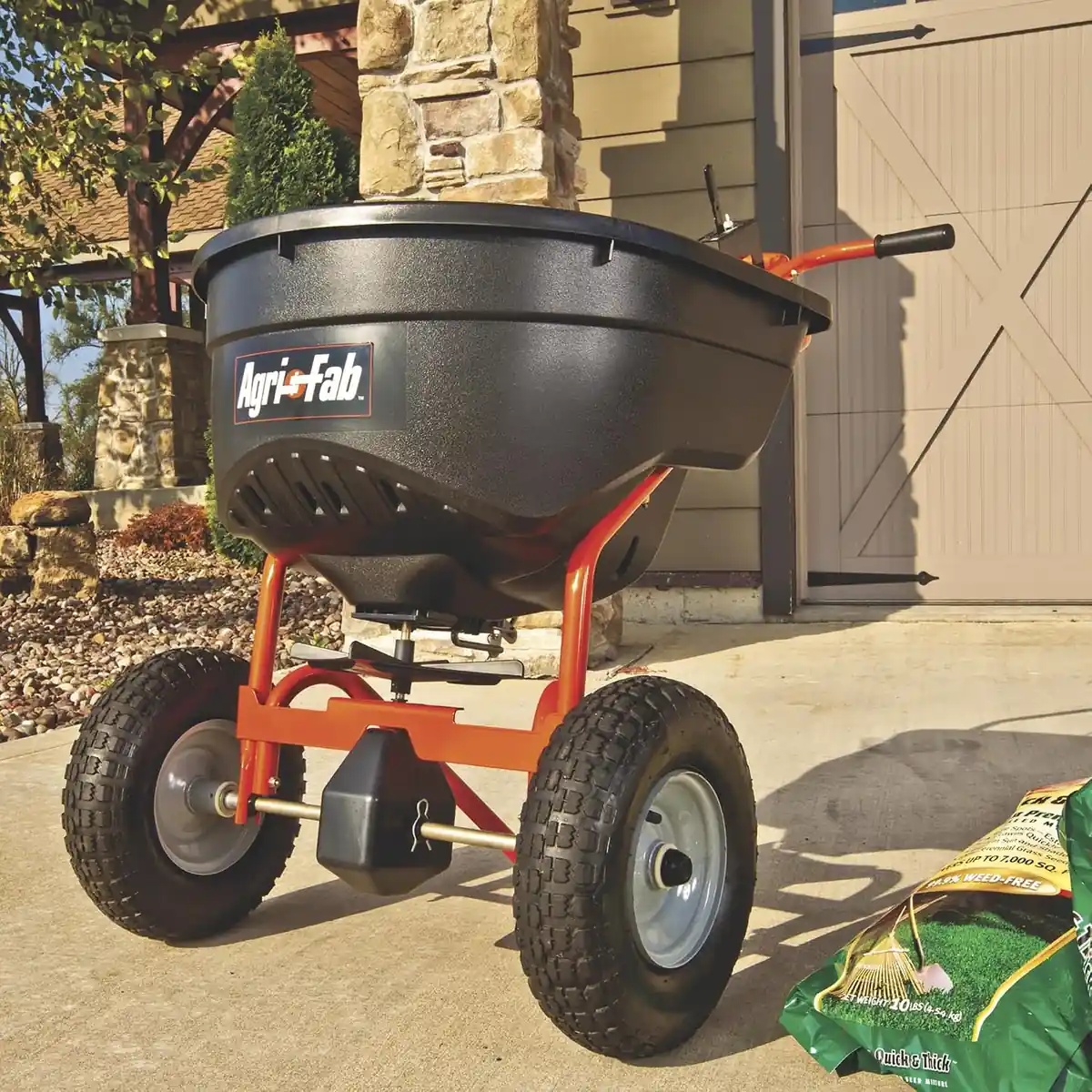
The 45-0462 is a walk-behind push broadcast spreader with a 130 lb hopper on two 13 in pneumatic tires, as Agri-Fab describes it. Agri-Fab 45-0462 130 lb Push Broadcast Spreader has no motor: the wheels turn a gearbox, the gearbox turns the spreader plate, and a lever on the handle opens and closes the gate. I recommend it for a lawn too big for a handheld, on one condition: read the product label and the manual first, because they decide how you use it. I compare seven walk-behind models by frame and wheels in my push spreader picks.
- Who it is for: a homeowner with a big lawn who wants a large printed hopper and 13 in pneumatic tires on a push frame.
- What it does best: it carries a 130 lb printed hopper, and Agri-Fab’s warranty sheet gives a 3-year household term. For a comparison of spreader types, my broadcast spreader picks cover push, tow-behind and handheld models.
- Main trade-off: the maker lists a newer model, and assembly takes sixteen steps with a hammer, pliers and two wrenches.

Agri-Fab 45-0462 Push Broadcast Spreader Specs and What Is in the Box
Two rows decide this purchase: the printed hopper capacity and the warranty term. Where Agri-Fab prints no figure, the table says Not listed.
| Spec | Agri-Fab 45-0462 |
|---|---|
| Spreader Type | Walk-behind push broadcast spreader, as Agri-Fab describes it |
| Hopper Capacity | 130 lb, as Agri-Fab’s description prints it; rated by the maker for up to 1/2 acre (25,000 sq ft) |
| Spread Method and Width | Broadcast; up to 12 ft, according to the maker |
| Gate and Rate Control | Control lever on the handle with an adjustable stop and a numbered gauge; flow plate in the hopper |
| Wheels and Frame | Two 13 in x 4 in pneumatic tires, as the listing prints them; T-handle with grips |
| Power Source | None: push, ground-driven |
| Weight | Not listed |
| Warranty | 3 years for household use and 90 days if used commercially, per Agri-Fab’s warranty sheet |
The kit arrives to assemble. Agri-Fab’s Quick Start Guide lists hardware packages A to BB and the tools: a hammer, pliers and two 7/16 in wrenches. The parts list names the flow plate, the spreader impeller, an agitator hairpin and a transmission assembly, and it marks the hopper cover as optional. According to Agri-Fab, the spreader suits fertilizer and grass seed in summer or ice melt in winter.
Safety First: Label, Manual and the Safe-State Box
Two documents govern this spreader: the product label for what goes in the hopper, and Agri-Fab’s manual for the machine. Read both before the first fill.
Read the product label before you open the bag. Follow its directions for the permitted use, the application amount, protective equipment, weather, watering in, access by people and pets, storage and disposal. Using a registered pesticide in a way its label does not allow is against federal law. Follow the spreader’s manual too. If the product’s instructions and the spreader’s instructions cannot both be followed, do not use that combination; ask the manufacturers for guidance.
Wear all the protective equipment the product label and your spreader’s manual require, and put it on before you open the bag. Wear it every time you fill the hopper, clean the spreader or clear a clog. Protective equipment lowers your exposure; it does not make handling a lawn product safe. Agri-Fab’s manual adds its own line: “Wear eye and hand protection when handling and when applying lawn or garden chemicals.”
For a product that contains a pesticide, such as a weed and feed, NPIC and EPA advise the following. Wash your hands before eating, drinking, smoking or using the restroom when you work with pesticides. Change your clothes and wash your hands immediately after you apply a product that contains a pesticide, and follow the label’s additional washing and clothing instructions.
The product label gives the application directions, so read it before you set the gate. A setting listed for your exact spreader and product is a starting point, not proof of the amount delivered: follow the spreader’s manual and calibrate for the product, the spreader and the person using it before you apply. Never exceed the label’s application rate. Kentucky Extension says the setting on the bag is a starting point because spreaders differ (1), and Clemson Extension adds that label settings are useful but not always accurate, so you calibrate for each user and each material (2).
The Safe-State Box
Stop and make safe before you fill or unload the hopper, reach into the hopper, clear a clog, clean or rinse the spreader, lubricate it, adjust the gate or the pattern, change a part, move it, store it or leave it. Keep your hands, feet, hair and loose clothing away from the impeller, the plate, the agitator, the gears and the wheels while anything can turn. During normal spreading, walk only as your manual and the product label permit; walking behind a push spreader at the pace its manual describes is operation, not transport. Walk-behind spreader: close the gate, then stop walking, and wait until the impeller, plate, agitator and wheels have stopped turning. Keep the gate closed while you fill. Wear all the protective equipment the product label and your manual require while you fill, clean or clear a jam. Clear a clog only with the method in your exact manual. Follow every applicable safety step in your manual, in the order it specifies. Refit every guard and cover, and check that the gate opens and closes before product goes back in.
Keep children, pets and other people away from the area while you fill and spread, and keep them off the treated area for as long as the label says. Store the bag and the filled spreader where they cannot reach them. Agri-Fab’s manual says: “Never allow children to operate the vehicle or spreader.”
If someone swallows or is exposed to a lawn product, follow the first-aid section of the product label and call Poison Control (America’s Poison Centers) at 1-800-222-1222, and keep the product label with you. Call 911 in an emergency.
Agri-Fab 45-0462 Push Broadcast Spreader Assembly in Sixteen Steps
Assembly needs a hammer, pliers and two 7/16 in wrenches, and it runs sixteen steps. Before you do this, complete the stop and make-safe steps for your spreader in the safe-state box above. The guide asks you to leave the early bolts loose on purpose.
I laid out hardware packages A to BB on the lawn before step one, and I left the early bolts loose, as the guide says, until the hopper support tubes, the cross brace and the stand tube sat square on the gearbox axle. The impeller goes on with a cotter pin, and the hopper then sits on the support tubes. I fitted the wheels with cotter pins and tapped each hub cap on with the hammer last, which is the guide’s order.
The guide’s flow control steps matter most. With the lever at OFF, you slide the control bracket along the control tube until the shut-off plate in the hopper is closed, then you check that the plate closes completely. I ran that check with the hopper empty, before any product went near it. A gate that does not close is a reason to stop, complete the safe-state steps and inspect, and to resume only when the manual’s conditions are met.
Gate Lever, Adjustable Stop and Gauge
The control lever works the flow plate through a rod, and the lever and its stop sit within reach of the grips. On the handle I found the numbered gauge between the grips and the adjustable stop beside it, so I could read the gauge from where I stood. Agri-Fab’s manual says to set the adjustable stop according to the chart on its page and the instructions on the packaging, and the chart is a starting point.
Agri-Fab’s manual gives the order for spreading: “Start the spreader in motion and then pull the control lever forward against the adjustable stop to the ‘ON’ position.” It also says: “Always move the control lever to the ‘OFF’ position before turning or stopping.” NC State Extension says the same for rotary spreaders: close the lever before slowing, turning or stopping, and do not spread while turning, because one wheel usually drives the impeller (3).
Close the gate before you stop, before you slow down to turn, and whenever you pause, and open it again only after you are walking or driving at the steady pace your manual describes. Do not spread while you turn. The manual also says each pass should slightly overlap the previous one, and I treat that as the maker’s line for the label and manual to settle, never as a number I carry from yard to yard.
Filling, Spills and Runoff
The fill opening is wide, and the listing photo of a hopper being filled shows a mesh across it. The wide opening makes spills easy, so the filling rules matter.
Before you fill or unload the hopper, complete the stop and make-safe steps for your spreader in the safe-state box above, and keep the gate closed. For fertilizer, fill on a hard surface where spilled granules can be swept up, away from drains and water, as UC IPM advises (4). Follow the product label’s handling and ventilation directions, and wear all the protective equipment the label and your manual require. Fill only to the level your manual allows, and secure the hopper cover or lid if your spreader has one. Keep children and pets away, and never leave a filled spreader where they can reach it.
Keep people and pets away from a spill. Follow the product label and its safety data sheet for collecting, reusing and disposing of spilled product, and wear the protective equipment they require. Never hose or wash granules into a street, a gutter, a drain, a ditch or water, and do not pile spilled product onto the lawn or return contaminated material to the bag. If you cannot manage the spill safely, stay away and call the emergency number on the label. Call Poison Control at 1-800-222-1222 if anyone is exposed, and call 911 for a fire or immediate danger.
Keep fertilizer off pavement and out of drains and surface water. If scattered plain fertilizer lands on a sidewalk, a driveway or a patio, sweep it back onto the lawn before you water, without going over the label rate; collect a concentrated spill instead. For pesticide granules, follow the label’s cleanup instructions. Follow any buffer requirement that applies and keep fertilizer out of those areas. EPA advises against fertilizing before windy or rainy days, and Purdue advises against fertilizing drought-stressed, dormant or frozen turf (5). Follow the product’s weather and watering directions too.
Tires, Handle and Moving It Around
Before you check the tires or move the spreader, complete the stop and make-safe steps in the safe-state box above. The listing prints 13 in x 4 in pneumatic tires, and air tires bring a pressure check into your routine. Agri-Fab’s manual says: “Make sure the tires are adequately inflated.” It adds: “Do not inflate beyond the maximum pressure printed on the tire.”
On the lawn and on the gravel path by the shed, the large tires gave the empty frame a steady roll. Empty, the hopper sat low and balanced between the grips. My spreader for uneven ground picks cover push, tow and handheld models for rough yards.
Cleaning, Gear Care and Storage
Cleaning and gear care both put hands near the gears, so before you do this, complete the stop and make-safe steps for your spreader in the safe-state box above. This is the part of the manual that sets the 45-0462 apart. The maker prints a method for the gearbox: remove the three clips, separate the housings, wipe dirt from the gears, lightly apply automotive grease as needed to the gears, lightly oil the top of the gearbox and the vertical spreader shaft, and fit the housings back with the clips.
I looked at the gearbox on the axle and its three clip housings, and I do not open it without the safe-state steps. The manual also says to oil the idler wheel and the axle bushings at least once a year or more often as needed, and to reassemble the axle, gears and washers in their original positions if you replace the gears. Spare parts are listed in the manual’s parts list, and that list is the place to start for any 45-0462 parts you need.
Before you clean the spreader, complete the stop and make-safe steps in the safe-state box, and wear the protective equipment the product label and your manual require. Handle leftover product, cleaning water and residues as the product label directs. Clean the spreader only by a method both the label and the manual permit, and rinse it only where they permit it, keeping product and contaminated wash water out of drains and water supplies. Dry the spreader completely, and lubricate it as its manual directs. If you change products, follow both products’ cleaning requirements: a rinse alone does not show that all residue is gone.
Agri-Fab’s manual says to empty the spreader after each use, storing leftover material in its original bag, to rinse the inside of the hopper and the outside of the spreader, to dry it off and to store it in a clean, dry area. NC State Extension gives the same advice: wash, dry completely to prevent rust, store empty and lubricate as the owner’s manual specifies (3). Looking into the empty hopper, I noted the flow plate and its corners as the place where product collects, so those corners are where the rinse and the check go.
Before you store the spreader, complete the stop and make-safe steps in the safe-state box. Store it empty, clean and dry, as your manual describes, with the gate closed. Keep products in their original labeled containers, securely closed, under the storage conditions their labels give, and away from children and pets. Lock pesticides away, apart from fertilizer, food and animal feed, and never put any product into a food or drink container.
Materials the Manual Lists and Forbids
Agri-Fab’s application chart lists granular and pelleted fertilizer, fine and coarse grass seed and ice melter. The manual forbids one class outright: “Do not use powdered lawn chemicals. They do not give a satisfactory or consistent broadcast pattern.” For weed control products it adds: “make sure the broadcast pattern does not hit evergreen trees, flowers or shrubs.”
Use ice melt or salt only when both the product’s directions and your spreader’s manual permit it. Salt-based deicers can damage metal, so follow your model’s cleaning instructions after use. K-State Research and Extension says sodium chloride can be especially harmful to plants, soils, metal and concrete surfaces. Before you clean the spreader, complete the stop and make-safe steps in the safe-state box. Rinse only if the manual permits it, and dry the spreader as the manual directs. Do not use lawn fertilizer to melt ice. Keep deicing products away from children and pets. My list of spreaders for ice melt covers seven spreaders for the job.
Warranty, the Replaced-By Line and Who Should Skip It
Agri-Fab’s warranty sheet gives three years from the date of purchase for household use and 90 days if the spreader is used commercially. In years 2 and 3 the sheet excludes the hopper bearing, the wheels and the bearings, and it excludes tires. The 45-0462 listing says the 45-0614 has replaced it, so I treat this as a model that may leave the shelf, and I buy it only when its price tier and today’s offer suit me.
- Buy it if: you spread on a large lawn, want a 130 lb printed hopper, and are happy to read the manual and assemble sixteen steps.
- Skip it if: you want a model the maker still lists as current.
Drawbacks to Know Before You Buy
The drawbacks of the 45-0462 are real, and each one has a workaround.
- A replaced model: the maker lists the 45-0614 as its replacement, so check today’s offer on the listing before you decide.
- A long assembly: sixteen steps with a hammer, pliers and two wrenches; lay the tools out before step one.
- Air tires: a low tire is a maintenance item, and the warranty excludes tires.
- A gearbox that wants care: the manual asks you to open it, grease the gears and oil the shaft, so keep the safe-state steps in front of you.
- A manual with short safety lines: read the product label and the safe-state box as the baseline.
How the Agri-Fab 45-0462 Compares
Three other models give the picture next to this Agri-Fab push broadcast spreader; each has a page of its own for the head-to-head.
| Model | Type | Hopper capacity | Wheels | Household warranty |
|---|---|---|---|---|
| Agri-Fab 45-0462 | Push broadcast | 130 lb | 13 in x 4 in pneumatic | 3 years |
| Agri-Fab 45-0463 | Tow-behind broadcast | 130 lb | 13 in x 4 in pneumatic | 3 years |
| Chapin 8400C | Push broadcast | 100 lb | 14 in pneumatic | Not listed |
| EarthWay 2600A-Plus | Push broadcast | 40 lb | 9 in pneumatic | 1 year (Feb 2025 manual) |
Agri-Fab 45-0463
Agri-Fab 45-0463 130 lb Tow-Behind Spreader prints the same 130 lb hopper but sits behind a vehicle. Pick that one if a lawn tractor or other towing vehicle is part of your setup. My Agri-Fab tow-behind against push spreader comparison puts the 45-0463 and the 45-0462 side by side.
Chapin 8400C
Chapin 8400C SureSpread Push Broadcast Spreader prints a 100 lb hopper and 14 in pneumatic tires, and its manual describes left and right gates for four patterns. Pick it if you want a gate that sets the two sides apart. My Agri-Fab against Chapin spreader comparison sets the 45-0462 next to the 8400C.
EarthWay 2600A-Plus
EarthWay 2600A-Plus 40 lb Estate Push Broadcast Spreader prints a 40 lb hopper on 9 in pneumatic wheels, with a lever that shuts off the left side. Pick it if you want a smaller hopper to fill. My review of the EarthWay 2600A-Plus covers that smaller model by itself.
Common Problems and Care
Most problems with a push spreader are routine ones, and the manual covers them. I stop before I fix anything, and the box comes first every time. Before you do this, complete the stop and make-safe steps for your spreader in the safe-state box above.
- Low tires: check the pressure against the maximum printed on the tire.
- A gate that will not close: stop, complete the safe-state steps, inspect, and resume only when the manual’s conditions are met.
- Dirty gears: open the gearbox only after the safe-state steps, and use the manual’s grease and oil lines.
- A poor pattern with powdered product: the manual says not to use powdered lawn chemicals.
- A clog or caked product: never push, kick or dig product out of the gate or off the plate while anything can turn. If product clumps or bridges in the hopper or the gate clogs, stop and complete the stop and make-safe steps in the safe-state box first, then clear it only with the method in your manual.
My Final Verdict on the Agri-Fab 45-0462
I recommend the 45-0462 for a large lawn when you want a printed 130 lb hopper, 13 in pneumatic tires and a gearbox method the manual prints. Skip it if you need a model the maker still lists as current. Whatever you spread, the product label and the manual decide the settings, the gear care and the cleanup. That is where my Agri-Fab 45-0462 review lands: a solid push frame for a big lawn, and a model to buy with its replacement in mind. For a bigger lawn, I compare push and tow-behind models by hopper size in my spreader for large lawn roundup.
Frequently Asked Questions
Has the Agri-Fab 45-0614 replaced the Agri-Fab 45-0462?
The Agri-Fab 45-0614 has replaced the Agri-Fab 45-0462, according to the first bullet of the maker’s listing for the 45-0462. Agri-Fab’s manual and warranty sheet for the 45-0462 remain the reference for this model, so read both, and read the product label, before you assemble it, fill it or order any part for it.
Do the Agri-Fab 45-0462 tires need air?
The Agri-Fab 45-0462 tires are pneumatic, so they need air, and Agri-Fab’s manual says to keep them adequately inflated at all times and never beyond the maximum pressure printed on the tire. Before you add air or move the spreader, complete the stop and make-safe steps in the safe-state box above.
What does the Agri-Fab 45-0462 gate lever do?
The Agri-Fab 45-0462 gate lever opens and closes the flow plate in the hopper through a rod. Agri-Fab’s manual says to start the spreader moving, pull the lever forward against the adjustable stop to ON, and always move it to OFF before turning or stopping, which keeps product from dropping while the spreader is still.
Can you use powdered lawn chemicals in the Agri-Fab 45-0462?
Agri-Fab’s manual says not to use powdered lawn chemicals in the 45-0462, because they do not give a satisfactory or consistent broadcast pattern. For any product, the label and the manual decide; if they cannot both be followed, do not use that combination, and ask the manufacturers for guidance before the first fill.
Does the Agri-Fab 45-0462 have a hopper cover?
The Agri-Fab 45-0462 parts list names a hopper cover and marks it as optional, so a cover is not a given with this spreader. Check what is in your box against the parts list before you assemble it, and secure a cover or lid only if your spreader has one.
References
- Munshaw G. Calibrating Fertilizer Spreaders for the Home Lawn. AGR-211. University of Kentucky Cooperative Extension Service; 2014.
- Ballew J. Calibrating Spreaders. HGIC 1657. Clemson Cooperative Extension; revised 2019.
- Miller G, Kerns JP, Billeisen T. Organic Lawn Care: Composting and Spreaders. AG-562. NC State Extension; 2026.
- UC Statewide Integrated Pest Management Program. How to apply fertilizer. In: UC Guide to Healthy Lawns. University of California Agriculture and Natural Resources; 2017.
- Bigelow CA, Tudor WT, Nemitz JR. Facts About Phosphorus and Lawns. AY-334. Purdue University Extension.
Safety Note: Read the product label and your spreader’s manual before handling product. Follow both; if their instructions cannot both be met, do not use that combination. Registered pesticide use must comply with its labeling. A listed spreader setting is a starting point; calibrate as the manual directs and never exceed the label rate. Wear all protective equipment required by the label and manual before opening the container and during filling, cleanup and jam clearing. Wash your hands before eating, drinking, smoking or using the restroom when working with pesticides. After application, change your clothes and wash your hands immediately, and follow the label’s additional washing and clothing instructions. Keep children, pets and other people away during handling and application and off treated areas for as long as the label requires. Emergency first: if a battery becomes unusually hot, swells, hisses, smells unusual or smokes, stop using the spreader without handling or removing the battery. Keep people away and follow the battery manual’s emergency instructions. If it smokes, burns or presents immediate danger, move away and call 911 or the fire department. Otherwise, complete the applicable stop and make-safe sequence before filling, unloading, reaching into the hopper, clearing a jam, cleaning, lubricating, adjusting, changing parts or batteries, hitching, unhitching, transporting, storing or leaving the spreader. Walk-behind or hand-crank: close the gate, stop walking or cranking, and wait for all moving parts to stop. Tow-behind: close the gate, stop the vehicle, set the parking brake, switch off the engine and remove the key as the vehicle manual directs, and wait for the wheels, impeller and agitator to stop before reaching into the hopper or touching the impeller. Battery spreader: release the trigger or close the gate, switch off, wait for moving parts to stop, then remove the battery as the manual directs and keep it away while working. Follow any additional isolation steps in the exact manual. Keep hands, feet, hair and loose clothing away from moving parts. Clear jams only by the manual’s method. Refit guards and covers and check the gate before refilling. With the spreader made safe and the gate closed, fill fertilizer on a hard surface where spills can be collected, away from drains and water. Follow the label’s handling and ventilation directions and the manual’s fill limit. Keep people and pets away from spills. Follow the label and safety data sheet for collection, reuse and disposal; do not spread concentrated spills onto the lawn or return contaminated product to its bag. Sweep scattered plain fertilizer from pavement onto the intended lawn before watering only without exceeding the label rate. Follow the label’s cleanup instructions for pesticide granules. Never wash product into streets, gutters, drains, ditches or water. Observe applicable buffers. EPA advises against fertilizing before windy or rainy days; Purdue advises against fertilizing drought-stressed, dormant or frozen turf. Close the gate before stopping or turning, as the manual directs. Follow both towing manuals for hitching, turning, slopes, speed and load limits; never ride on the spreader or carry passengers on it. Use only batteries specified for the model. Recharge rechargeable batteries only with a charger approved for them, as the manual directs; never recharge disposable cells. After completing the applicable shutdown, handle leftover product, cleaning water and residues according to the product label. Clean only by methods permitted by both label and manual, keeping contaminated water out of drains and water supplies. Rinse only if permitted, then dry and lubricate as directed. A rinse does not establish that all pesticide residue is gone. Use salt or ice melt only when the product directions and spreader manual permit it. Salt-based deicers can damage metal; follow the model’s cleaning instructions. Do not use lawn fertilizer to melt ice. Store the spreader empty, clean and dry as its manual directs. Keep products securely closed in their original labeled containers under their labels’ storage conditions, away from children and pets. Lock pesticides away, separate from fertilizer, food and feed; never use food or drink containers. For human exposure, follow the label’s first-aid instructions, call Poison Control at 1-800-222-1222 and keep the label available. Call 911 for immediate danger.