

My Black and Decker LST136 review verdict is short: buy this 40V MAX trimmer and edger kit for a small, flat lawn and tidy bed edges, and skip it for a big property or heavy weeds. I used it on the house lawn edge, the gravel yard and the strips under my orchard trees, which is where a 13 inch swath and a single line size show their limits. Below you get the specs, how the power dial and the feed head behave, the real drawbacks and who should pick something else.
Black and Decker LST136 Review and Verdict
The LST136 is a light-duty, mid-range cordless trimmer that turns into an edger in seconds, and it does its best work on short grass along paths, beds and a driveway. Its six-step POWERCOMMAND dial lets you trade power for run time, which most trimmers at this level do not offer. The limits are firm: one 0.065 inch line size, a 13 inch swath, no published run time and a 9.0 lb kit weight with the battery fitted, so I recommend it only where the job is small.
- Who it is for: owners of a small, flat lawn who also want a tool for edging beds, paths and a driveway.
- What it does best: it steps down to an edger without tools, and the dial matches power to the job.
- Main trade-off: the pack is small and the maker publishes no run time, so a long edge in one session is a gamble.

What Comes in the LST136 Kit
The kit that I reviewed, the BLACK+DECKER LST136 40V MAX 13-Inch Trimmer Edger Kit, is the Black and Decker LST136 string trimmer with 40V MAX lithium-ion battery, the fast charger with a wall-mount base, a spool, a guard and an auxiliary handle. The bare-tool version without battery and charger is a different listing, so check the box contents before you buy. The two rows that matter most in the table below are the line diameter and the weight, because they set what the tool can cut and how it feels at the end of an edge.
| Spec | LST136 kit |
|---|---|
| Power source | Battery, cordless |
| Voltage, as named by the maker | 40V MAX (nominal 36V) |
| Cutting swath | 13 in |
| Line | 0.065 in round nylon only |
| Feed | Automatic Feed Spool, no bumping |
| Weight, kit with battery (maker’s figure) | 9.0 lb |
| Run time | Not published by the maker |
| Charge time, fast charger | About 2 hours |
| Warranty | 3 years, home use only |
According to Black and Decker, the footnote on 40V MAX is that 40 volts is the maximum initial voltage measured without a workload, and the nominal voltage is 36. That is normal labeling for this platform, so judge the tool by its swath, line and dial, not by the number on the box.
How the LST136 Cuts and Edges
Most of what I learned about this trimmer came from three habits: choosing a dial setting for each job, feeding line the way the manual says, and watching what the head does when I swing it near trees, fences and gravel. Each one is below.
The POWERCOMMAND Dial in Real Work
The dial has six stops. According to the manual, setting 6 gives maximum power for thick weeds, setting 1 gives maximum run time, and 2 to 5 sit between them. On the house lawn edge I leave it at 1 and the grass comes off cleanly, which keeps the pack going longer. Where grass creeps into the gravel yard I turn it up to 6, and the head holds its speed better in the thicker blades.
The cost of the high settings is plain: the maker says the pack drains faster at 6, and it gives no minutes for any step. I plan a job around the lowest setting that works, and I stop when the head slows, not when a number says so.
Cutting Line and Automatic Feed
The manual allows one line only: 0.065 inch round nylon on the AF-100 spool. Serrated or heavier line overloads the motor and overheats it, so the thicker weeds along the fence are slow work with this tool. Cut long growth from the top down and keep it under 12 inches, as the manual says, or the head bogs down. My list of string trimmers for thick weeds covers tools built for that job.
The head feeds line on its own, so there is no bumping. I had to unlearn the habit from older tools, because the manual says plainly not to bump the feed head on the ground: it disrupts the feed mechanism. When the feed fails, the fix is in the troubleshooting list near the end. A Black and Decker LST136 replacement spool keeps the same AF-100 line, and a factory-wound spool tangles less than line you wind by hand.
Edging, Tree Rows and Fence Lines
Edge mode is the reason to buy this model. Release the trigger, wait for the head to stop, remove the battery, then press the head release button, turn the head counterclockwise and drop the edge guide until it clicks. With the Black and Decker LST136 edge guide down, the line runs vertical along a path or driveway edge, and I get a clean cut on the grass side of the gravel. I rank trimmers with a real edge mode in my list of string trimmers for edging.
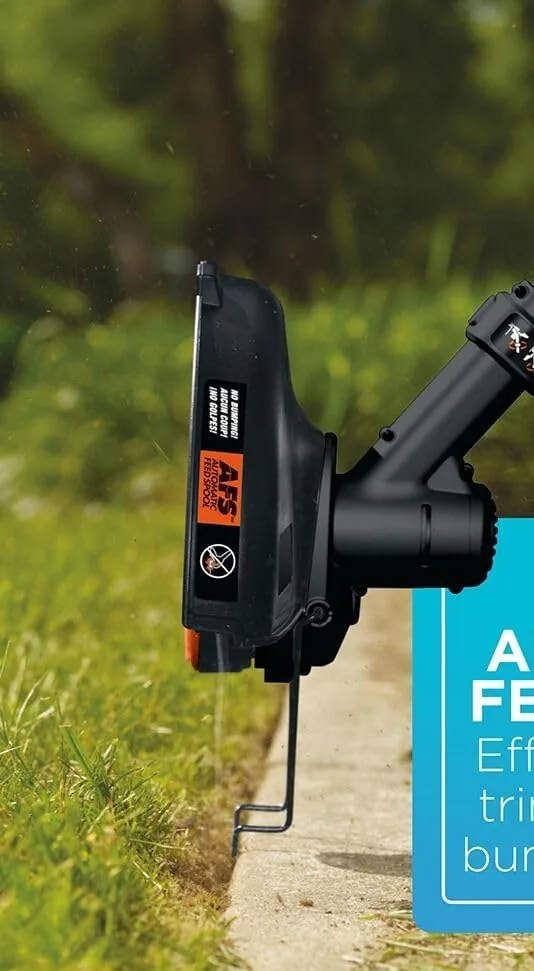
Edging is also where the hazards are. The manual says edging throws stones and metal pieces at high speed, so it wants ANSI Z87.1 eye protection and every other person and pet at least 100 ft away, and it tells you to work away from walls and steps. The numbers support the caution: an estimate of 81,907 lawn trimmer injuries treated in US emergency departments over ten years found that the eye accounted for 42.5% of them (1), and published eye trauma cases include bystanders as well as operators (2).
Near the trees I keep the head off the trunks. The manual warns that tree bark, siding and fence posts are easily damaged by the line, and my orchard trees from 2016 still have thin bark at the base. On a strip wider than the 13 inch swath, I plan overlapping passes before I start. Wire and picket fences wear or break the line, and stone, curbs and wood wear it fast.
Weight, Balance and the Battery Routine
The kit weighs 9.0 lb with the battery, according to Black and Decker. After a long edge along the lawn side of the yard I feel the weight in my forearm, and the telescoping pole helps only if I set its length to my height before I start. If weight matters more to you than edge mode, my list of lightweight string trimmers gives the stated weights side by side.
Set the pole so the guard stays at least 24 inches from your feet and hold a cutting angle of 5 to 10 degrees, as the manual requires. In the quiet corner by the house I notice the noise less than I would with a gas trimmer, and NIOSH sampling of landscaping workers found significantly more noise and carbon monoxide exposure with fuel-powered trimmers than with battery versions (3). I wear ear protection whenever it runs.
In a laboratory test with two participants, hand vibration on a grass trimmer in gloves ran from 3.5 to 5.8 m/s2, higher than on a backpack blower (4), and the maker gives no figure for the LST136, so I take breaks and change hands on a long edge.
The Black and Decker LST136 Battery and Charger
The Black and Decker LST136 battery has a button with four LEDs that show the charge level, and the fast charger takes about 2 hours from empty, according to the manual. Black and Decker publishes no run time for it. A spare pack is the practical answer for anything beyond a small lawn, and it costs extra. My list of battery string trimmers covers cordless models from other makers.
Charge between 40 F and 105 F, and best at 60 to 80 F, as the manual says. OSHA warns that charging a lithium-ion battery below freezing can cause permanent lithium plating on the anode (5), so I bring the pack indoors on a cold morning. In summer the machinery shed gets too hot, and the manual names a metal shed as a place not to leave the pack. Lab work on lithium-ion cells found that storing a pack at a high state of charge speeds capacity loss (6), so follow the maker’s storage guidance.
Before any line change, jam clearing or cleaning, follow the manual’s order: release the trigger, wait for the head to stop, remove the battery, then touch the head. Never lock the trigger on, and keep the guard in place, because the manual says running without it overheats the motor.
Who Should Buy the LST136 and Who Should Skip It
The LST136 suits a narrow job well and a broad one poorly, so the choice is easy once you know your yard. For a small lawn, my picks of string trimmers for small yards compare nine easy-to-handle models.
- Buy it if: your lawn is small and flat, you edge beds, paths or a driveway, and you want to change the power setting for the job.
- Buy it if: you want the charger in the box and a three-year home-use warranty.
- Skip it if: you trim long fence lines or a large property in one session, because the pack is small. For those jobs, see my picks of string trimmers for large yards.
- Skip it if: you cut heavy weeds, brambles or saplings, because it takes nylon line only.
- Skip it if: you want attachments or a wider swath.
Black and Decker LST136 Problems and Drawbacks
The 13 inch swath is on the small side, and the single 0.065 inch line leaves heavy growth to a stronger tool. The pack is small, so plan a spare for a long edge.
The feed head cannot be bumped to release more line. The warranty is three years, but it is for home use only.
How the LST136 Compares With Other Trimmers
The BESTA510 is a corded alternative and the WG163 is a lighter cordless one. They answer the LST136’s weak points and differ on power source, swath and weight. I weigh other plug-in models in my list of the best corded string trimmers.
BLACK+DECKER BESTA510 Corded
The BLACK+DECKER BESTA510 is a 120 V corded model with a 14 inch swath and a 6.5 lb weight, and it has no battery to run down. Pick it if the whole lawn is within cord reach and you want a lighter tool. My full BESTA510 review looks at this 14-inch corded alternative for small yards.
WORX WG163 20V
The WORX WG163 is a 20V Max cordless model with a 12 inch swath and about 5.3 lb with battery per the maker, and the kit comes with two 2.0 Ah packs. Pick it if you want less weight and a second pack in the box.
| Model | Power | Swath | Line | Weight |
|---|---|---|---|---|
| LST136 kit | 40V MAX battery | 13 in | 0.065 in | 9.0 lb with battery |
| BESTA510 | 120 V corded | 14 in | 0.065 in | 6.5 lb, no battery |
| WG163 | 20V Max battery | 12 in | 0.065 in | About 5.3 lb with battery |
Common Problems and How to Prevent Them
Most owner trouble comes from the head, the line and the pack, and the manual covers each cause.
- Line will not feed: crossed line on the spool, a damaged spool track, the wrong diameter or a stuck lever. Switch off, wait for the head to stop, remove the battery, then open the head and rewind.
- Line wears fast: wire fences, stone, curbs and wood chew through it, and the guard blade dulls. To touch it up with a file, switch off, wait for the head to stop, remove the battery, then wear gloves, because the blade is sharp.
- Motor runs hot: running without the guard or with heavier line overloads it.
- Dry spare line: store spare spools in a sealed bag with a tablespoon of water so the line does not dry out.
- Wet tool: do not hose it or use it in rain, and if it gets wet let it dry for at least 48 hours.
My Final Verdict on the LST136
My Black and Decker LST136 review ends with a short answer: buy it for a small, flat lawn with beds, paths and a driveway to edge, and skip it for a large yard or a fence line of tall weeds. For other models, my list of the string trimmers for any yard covers every power type.
Frequently Asked Questions
Are Black and Decker strimmers any good?
Black and Decker strimmers are good for small lawns and light everyday trimming jobs, and the LST136 comes with a three-year home-use warranty from the maker. They are not built for heavy weeds or commercial work, because the LST136 takes only 0.065 inch nylon line and its warranty excludes commercial use.
Are Black and Decker tools of good quality?
Black and Decker tools are made and sold for home use, and the LST136 shows what that means: a light-duty tool with a three-year warranty that excludes commercial work. Judge any model by its own manual, which limits the LST136 to 0.065 inch round line and long growth under 12 inches.
How long does a Black and Decker 40V battery last?
The maker does not publish a run time for the LST136 battery, so the maker gives no minute figure for this kit. According to Black and Decker, the POWERCOMMAND dial trades power for run time, with setting 1 lasting longest and setting 6 draining the pack fastest, so plan the job around the setting you choose.
Can you use a 20V battery in a 40V tool Black and Decker?
Do not fit a 20V battery to the LST136, because it is a 40V MAX tool made for the maker’s own 40V MAX battery and fast charger. Use only the battery and charger that your manual lists for this tool, since voltage alone does not make packs interchangeable between tools.
Which is better, a 40V or 18v trimmer?
Voltage alone does not decide whether a 40V or 18v trimmer is better, because pack capacity, motor and head matter as well. On the LST136, which Black and Decker rates at 40V MAX with a nominal 36V, the power dial and the 13 inch swath matter more to me than the voltage label.
References
- Leinert J, Griffin R, Blackburn J, McGwin G. The epidemiology of lawn trimmer injuries in the United States: 2000-2009. J Safety Res. 2012;43(2):137-139. doi:10.1016/j.jsr.2012.03.001
- Lubniewski AJ, Olk RJ, Grand MG. Ocular dangers in the garden. A new menace: nylon line lawn trimmers. Ophthalmology. 1988;95(7):906-910. doi:10.1016/s0161-6420(88)33076-9
- Alexander BM, Graydon PS, Pena M, Feng HA, Beamer BR. Hazardous exposures and engineering controls in the landscaping services industry. Journal of Occupational and Environmental Hygiene. 2025;22(3):189-202.
- Oh J, Chen N, Boyd C. Laboratory evaluation of occupational exposure to hand-arm vibration (HAV) during grounds maintenance equipment operations. Ann Agric Environ Med. 2023;30(2):384-389.
- Occupational Safety and Health Administration. Preventing Fire and/or Explosion Injury from Small and Wearable Lithium Battery Powered Devices. Safety and Health Information Bulletin SHIB 06-20-2019. US Department of Labor; 2019.
- Keil P, Schuster SF, Wilhelm J, et al. Calendar Aging of Lithium-Ion Batteries. J Electrochem Soc. 2016;163(9):A1872-A1880.
Safety Note: Read your manual first. A string trimmer or brush cutter throws debris with force, so clear stones, glass and wire from the area before you cut. Wear impact-rated eye protection with side coverage that meets ANSI Z87.1, hearing protection, gloves, heavy long pants, long sleeves and sturdy slip-resistant boots (steel-toe where your manual says so). Keep people and pets at least as far away as your manual says (50 feet in some manuals, 100 feet in others), and stop if anyone comes closer. Keep the correct guard fitted, use only the cutting attachments, handles and harness the maker approves for your exact tool, and never replace trimmer line with wire. A blade can kick sideways when it hits a stump or a thick stem, so fit the handlebar and harness your manual requires for blade work, hold both handles firmly and keep secure footing. Before you clear a jam, clean the tool or change line, a blade or an attachment, switch it off, wait for all movement to stop, then remove the battery, unplug the cord or disconnect the spark plug wire. Refuel a gas model outdoors with the engine off and cool, away from flames or sparks, and move away from the fueling spot before starting, as far as your manual says (often 10 to 30 feet); never run it in a garage, shed or other closed space. For a battery model, use only the maker’s battery and charger, charge it within the temperature range in your manual and never use a damaged or swollen pack. For a corded model, use a GFCI outlet, keep the cord clear of the cutting line and avoid wet conditions.