
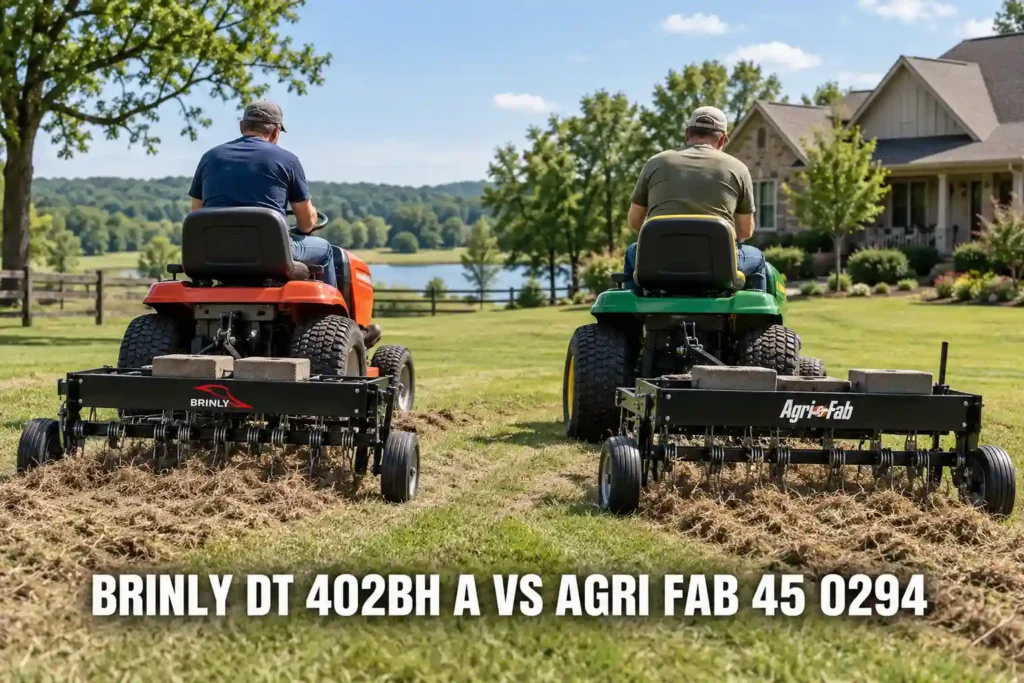
In the Brinly DT-402BH-A vs Agri-Fab 45-0294 choice, I pick the Brinly for most buyers: it gives you three named Lift Lock positions and printed hitch and weight limits. Pick the Agri-Fab when the lowest cost matters most, because it does the same basic job of combing out loose thatch with a lift handle and nothing else. Years of checking seed drills on weighing trays taught me to judge a tool by what its settings control, and these two differ most there. Below I compare tine height, towing rules, tines, tray weight, set-up and value, then say which lawn suits which tool.
Brinly DT-402BH-A vs Agri-Fab 45-0294: The Short Answer
Both are 40 in spring-tine trays that a lawn tractor or riding mower drags across the turf, with no motor, no bag and no blade drum. My roundup of tow-behind dethatchers picks five tools to pull behind your mower.
| Row | Brinly DT-402BH-A | Agri-Fab 45-0294 |
|---|---|---|
| Working width | 40 in | 40 in |
| Tine height control | 3 Lift Lock positions: Transport, Dethatch, Scarify | Lift handle raised for transport or lowered to work; tine shield leveled |
| Depth in inches | Dethatch height set on a 1/2 in shim; no range for the other two positions | Not published by the maker |
| Tine parts, as the manual counts them | 10 | 10 |
| Tine count, maker page figure | 20 | 20 |
| Empty weight, maker’s figure | 35 lb | 30 lb |
| Weight tray limit | 70 lb | 70 lb |
| Maximum towed weight | 105 lb | Not published by the maker |
| Hitch height range | 7 to 14 in | Not published by the maker |
| Towing speed | Best at 3 mph or less, never over 5 mph | First gear, low engine speed; no mph figure |
| Warranty | Frame 2 years, tines 90 days, residential use | See the warranty sheet in the box |
Two rows decide it: tine height control and the printed towing limits. Brinly documents both, while Agri-Fab leaves you to work them out with weight and driving speed.
What Is the Same and What Is Not
Both tools lift loose thatch to the surface and leave you to rake or sweep it up. Neither slices into the soil.
Both only earn their place on a lawn that has a thatch problem. Thatch is the layer of dead and living stems and roots between the green blades and the soil, and one golf green trial described a layer thicker than about half an inch (1.3 cm) as undesirable because it cuts water infiltration and raises dry spots and pest problems (1). Cut a plug with a spade and measure the brown layer before you buy either tool. If the plug confirms a problem, my lawn dethatcher roundup compares nine machines for different yard sizes and budgets.
Brinly’s manual is headed DT-402BH, and the -A on the listing is a variant code. The 24 tines in the text under the listing photos belong to the 48 in model, which I cover in my review of the Brinly DT-480BH. Agri-Fab’s design is also sold as the CRAFTSMAN tow behind dethatcher CMXGZBF7124315, a separate model with its own specifications and warranty.
Both manuals list 10 tine parts for the 40 in size, and both listings say 20 tines. I compare the two on the manuals’ basis, 10 parts each, so neither tool gets credit for a bigger number.
Tine Height and Depth Control
This is where the two tools part ways, because a tine tray works as deep as its tips sit below the sod.
According to Brinly, the DT-402BH has three Lift Lock positions that you pick with a handle that engages a notch. Position 1 is Transport, Position 2 is Dethatch and Position 3 is Scarify, where the tines drag along the ground to open a seed bed. Inside Dethatch you set the tines on a 1/2 in shim, and fine adjustments move by no more than 1/4 in at a time.
Setting Position 2
On a flat surface, put the handle in Position 2 and set the tine tips on a 1/2 in shim so they barely touch the ground when pushed rearward. Change the height by no more than 1/4 in at a time.
I set the Dethatch height on the concrete pad in front of the machinery shed. Two layers of packing cardboard make about the half inch the manual asks for, and with the handle in Position 2 the tine tips only just touched the floor when I pushed the tray back.
The Agri-Fab has no positions. According to Agri-Fab, the lift handle raises the tray for transport and lowers it to work, and you level the tine shield by loosening two nuts at the rear hitch mount arms until the front and rear tines both touch the ground. After that, added weight and driving speed decide how hard the tines bite, and Agri-Fab gives no depth in inches.
On the shed floor I leveled the shield until the front and rear tines met the concrete together. Once the nuts were tight, nothing on the tool showed how deep it would work on turf.
Handle positions let you return to a setting, but the real working depth still depends on the sod and the load. In a four-year trial on bermudagrass, vertical mowing twice a year cut thatch by only 8% and reduced shoot density (2). That machine is not a spring-tine tray, so I read it only as a reminder that hard cultivation costs shoot density, and I like a setting I can return to. My Bermuda grass dethatcher roundup covers machines for dense warm-season lawns.
Brinly describes Position 3 as dragging the tines to open a seed bed, which is not the cut of a blade drum. A trial that seeded dead putting-green turf found that two passes with a vertical mowing unit beat hollow-tine and solid-tine cultivation in the first year, with no significant difference in the second (3). Use Position 3 as a light seedbed aid and never as a stand-in for a blade scarifier.
Winner: Brinly DT-402BH-A, because you can set, repeat and lock the tine height, while the Agri-Fab leaves it to weight and speed.
Hitch, Transport and Towing Rules
Both tools need a tow vehicle with a rear hitch, and the towing rules are where the manuals differ most in detail.
According to Brinly, the clevis aligns with the hitch plate and takes a pin and a hairpin cotter. The tool works with hitch heights from 7 to 14 in, and the tow bars slide along the tray for different heights once four tray bolts are loosened. Tow it only in the vehicle’s tow mode or below 5 mph, with 3 mph or less as the best speed, and use Position 1 on concrete or asphalt so the tines stay off the ground, and make each pass in the same direction to protect grass roots.
The handle, spring and control rod of the Brinly form a pinch point, so I kept my fingers clear of them every time I tipped the tray, as the manual’s caution asks.
Like the Brinly, the Agri-Fab raises its tines with the lift handle for transport. According to Agri-Fab, the tool hitches with a 3/8 in pin and a 1/8 in hair cotter through two hitch brackets. You start in first gear with the engine at low speed and work in a crisscross pattern. Agri-Fab prints no hitch height and no mph figure, and it lists no tow vehicles.
I raised and lowered the Agri-Fab handle on the shed floor and noted that the raised position holds by side tension, so I checked the lock before every move of the tool.
Stay Off Steep Slopes
Both makers say to stay off steep slopes, and neither gives a slope limit in degrees. Agri-Fab adds that you work up and down a slope, never across its face, and Brinly says to reduce towed weight on slopes.
Rollovers are the most prominent type of fatal ride-on mower accident, and the usual injury is the machine’s weight pinning the operator (4), so a loaded tray on a hillside is a risk to take seriously.
Winner: Brinly DT-402BH-A, because it prints the hitch height and the speed limits, while the Agri-Fab prints neither number.
Tines, Replacement and Warranty
Spring tines are the working part of both tools, and each manual treats them as a wear item.
In the Brinly manual the tine is part R-616, and the tray carries two 40 in safety wires. To replace a tine you straighten the wire end, pry the tabs, fit the new tine, bend the tabs back and run the wire through every loop. Brinly says plainly not to run the dethatcher without the safety wires. Brinly dethatcher tines carry a 90 day warranty, while the frame and steel parts carry 2 years for residential use.
The tine points are sharp. I wore gloves every time I handled the tray, and I checked that the safety wire sat in every loop before I called the Brinly ready.
The Agri-Fab uses spring tine part 43783, ten to the 40 in tray. According to Agri-Fab, a little looseness in the tine seat is normal. Agri-Fab dethatcher tines are replaceable parts, so a bent tine does not retire the tool.
Brinly’s cover applies to residential use only, and commercial use drops every part to 90 days. Read the warranty sheet in your Agri-Fab box, because its term depends on the revision you receive.
Winner: Tie, because both manuals list 10 tine parts and both tools take replacement tines.
Weight Tray and Added Weight
Weight on the tray changes how either tool bites, so the limits matter.
According to Brinly, the empty DT-402BH weighs 35 lb, the tray takes up to 70 lb and the maximum towed weight is 105 lb. Brinly says normal conditions should not need added weight. If the tool jumps or walks, check the handle setting and the tine height first, then add weight only while it is hitched, secure it with rope or straps and recheck the tine height.
Agri-Fab takes the opposite view: in most conditions extra weight will be needed. It recommends concrete patio blocks tied to the holes in the flange of the tine shield, and Agri-Fab gives a 70 lb tray limit. It lists 30 lb empty, so the two tools weigh within a few pounds of each other.
The Agri-Fab’s strap holes are the detail I like most, because a block that is not tied down shifts on the first bump. The photos below show a block on the Brinly’s tray and blocks on the Agri-Fab’s tine shield.
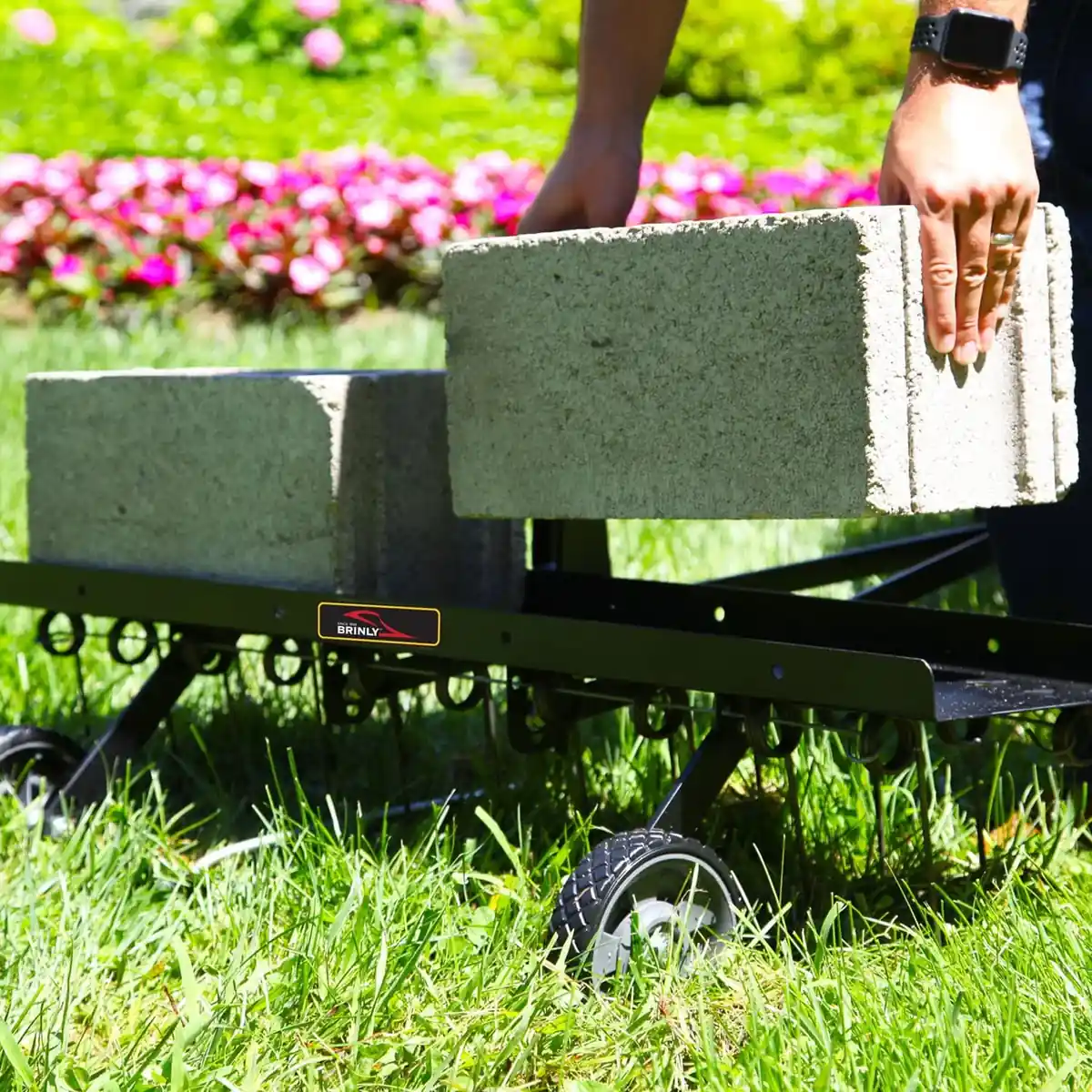

Keep to the limits for either tool. Never put people on the tray, never load it past its limit, and stay inside the tow vehicle’s own towing capacity. Brinly also requires the vehicle and operator together to outweigh the dethatcher with its load, which is limited to 105 lb towed. Brinly adds that you disconnect only after the tray weight is unloaded.
Winner: Brinly DT-402BH-A, because it sets a 105 lb towed limit and a step-by-step way to add weight, while the Agri-Fab gives no towed limit.
Assembly, Setup and Care
Set-up decides whether the tine height is right, and the care for both tools fits in a short session.
Brinly wants a smooth flat surface for set-up, such as a driveway or garage floor. After use, oil the tines, clear debris from between them and check the fasteners after the first 30 minutes.
Agri-Fab’s manual walks through about 24 assembly steps with two 1/2 in wrenches, a 9/16 in wrench, a 3/4 in or adjustable wrench and pliers. It tells you to check the nuts and bolts before each use, lubricate the wheels, sand rust lightly and store the tool dry with a light film of oil on exposed metal.
Safety and Timing Before the First Pass
A tine tray throws debris and tears turf that is not ready, so the work before the first pass matters as much as the tool.
Walk the lawn first and remove stones, sticks, toys, wire and dog waste. Mark sprinkler heads, irrigation and drip lines, low-voltage lighting wire and buried pet fence wire, because tines drag through whatever they meet. A study of lawn mower eye injuries found that 77% came from thrown projectiles such as grass, dirt and rocks, and only 2% of those cases involved eye protection (5).
Wear safety glasses with side coverage that meet ANSI Z87.1, hearing protection for the tow vehicle, long pants, closed shoes and gloves, every time. Neither manual gives a distance for bystanders, so keep people and pets off the lawn until the last pass is done.
Before you touch the tines, the Lift Lock or the tray, park the tow vehicle, set the parking brake, switch off the engine, wait until every part has stopped, take out the key, unload any tray weight and disconnect the dethatcher as its manual describes.
Timing depends on the grass. According to Penn State Extension, cool-season lawns are dethatched in late summer to early fall, and according to NC State Extension, warm-season lawns are dethatched while the grass grows actively in summer, never in hot, dry spells. Dethatching at the wrong time, too deep or on stressed grass can badly damage a lawn.
Value Over Several Seasons
Both tools cut the same 40 in swath, so the price tier is what separates them. If you want more width, my Brinly versus Agri-Fab 45-0294 comparison puts the 48 inch model against the same Agri-Fab.
- The tool: the Agri-Fab sits in the budget to mid-range tier of tow-behinds, and the Brinly sits higher.
- Tray weight: Agri-Fab says most conditions call for secured concrete blocks, while Brinly asks for added weight only if the tool jumps or walks after you check the handle and tine height.
The Brinly’s tier buys something real when you use the Transport and Scarify positions. A plain comb across the lawn once a season costs less with the Agri-Fab, whose 45-0294 manual goes back to 2001.
Winner: Agri-Fab 45-0294, because the same 40 in swath costs less.
Choose the Brinly DT-402BH-A If
Choose the Brinly tow-behind dethatcher if you want tine height set by a notch and the limits printed in the manual.
- You cross a driveway or path on the way to the lawn and want a named Transport position among three Lift Lock settings.
- You plan to overseed and want a Scarify position that drags the tines to open the ground.
- You want tray weight, towed weight, hitch height and speed in writing, and your hitch sits between 7 and 14 in.
- Skip it if the lowest cost matters most.
The Lift Lock is the feature that decides it for me: a notch gives a repeatable stop, and I trust a notch more than a loosened nut.

Choose the Agri-Fab 45-0294 If
Choose the Agri-Fab tow behind dethatcher, covered in my review of the Agri-Fab dethatcher, if a plain tool at a lower tier is all the job needs and you have a lawn tractor or riding mower with a compatible rear hitch, used under the towing rules in the manual.
- You own a lawn tractor or riding mower with a rear hitch and want the lowest-cost 40 in swath. My roundup of dethatchers for a large lawn picks seven machines that cover more ground per pass.
- You want a long-established model, with a manual that dates from 2001.
- You are happy to set weight with patio blocks and adjust by driving speed.
- Skip it if you have steep slopes, only a push mower, or want a measured depth setting.
The strap holes in the tine shield flange let a plain tray take weight safely, and leveling, weight and driving speed decide how it bites, as the manual describes it.

Which 40-Inch Tow-Behind to Hitch Behind Your Mower
Pick by the job. For overseeding after the pass or limits you can hold the manual to, buy the Brinly and set Position 2 on the shim. For the cheapest honest way to lift loose thatch from a lawn you already mow with a riding mower, buy the Agri-Fab and plan on patio blocks, since both are light combs for loose thatch and heavy thatch calls for your extension service’s advice. Check your hitch height and your tow vehicle’s rules before you order. On features and printed limits the Brinly DT-402BH-A vs Agri-Fab 45-0294 contest goes to the Brinly, and on cost it goes to the Agri-Fab. My comparison of the DT-402BH-A against the DT-480BH-A sets the two Brinly sizes side by side.
Frequently Asked Questions
Which is better, the Brinly DT-402BH-A or the Agri-Fab 45-0294?
The Brinly DT-402BH-A is the better tow-behind for most buyers, because it adds three named Lift Lock positions and printed hitch and weight limits. The Agri-Fab 45-0294 is the better choice when cost matters most and all you need is a plain 40 in tine tray, since it does the basic job for less.
Is the Brinly dethatcher any good?
The Brinly DT-402BH-A is a good fit for lawns that a tractor or riding mower can reach, with three Lift Lock positions and a transport setting for hard surfaces. Its spring tines comb out loose thatch and do not slice soil, so it suits loose thatch and light combing, and heavy thatch calls for your extension service’s advice.
Is the Agri-Fab dethatcher worth buying?
The Agri-Fab 45-0294 is worth buying when you already own a lawn tractor or riding mower with a rear hitch and want a low-cost 40 in way to lift loose thatch. It has no depth setting, so weight and speed decide how hard the tines bite, and it cannot open soil for seed.
Where can you find the Agri-Fab 45-0294 manual?
Agri-Fab posts the 45-0294 owner’s manual as a PDF on its own website, and the later 45-02941 revision has a separate manual there. Read the one that matches the model number on your tool before you level the tine shield, set the lift handle or tie down any weight on the tray.
Where can you find Brinly dethatcher parts?
Brinly sells replacement parts for its dethatchers through its own website, which has a parts page just for dethatchers. For the DT-402BH, use the parts sheet in its manual, which gives the tine part number R-616 and the safety wire part number R-1503 you need to match when you order spares.
References
- McCarty LB, Gregg MF, Toler JE, Camberato JJ, Hill HS. Minimizing Thatch and Mat Development in a Newly Seeded Creeping Bentgrass Golf Green. Crop Science. 2005;45(4):1529-1535.
- Carrow RN, Johnson BJ, Burns RE. Thatch and Quality of Tifway Bermudagrass Turf in Relation to Fertility and Cultivation. Agronomy Journal. 1987;79(3):524-530.
- Miltner ED, Stahnke GK, Rinehart GJ, Backman PA. Seeding of Creeping Bluegrass into Existing Golf Course Putting Greens. HortScience. 2005;40(2):457-459.
- Sevart KB. Ride-On Mower Rollover Accidents: Study and Design Solutions. Volume 14: Emerging Technologies; Materials: Genetics to Structures; Safety Engineering and Risk Analysis. 2016. doi:10.1115/imece2016-67718
- Stange NR, Jennissen CA. Lawnmower-Related Eye Injuries in the U.S., 2004 to 2023. Am J Ophthalmol. 2025;277:7-16.
Safety Note: Read your manual first. A dethatcher or scarifier throws stones, sticks and other debris with force, so walk the lawn first and remove stones, sticks, toys, wire, hoses and pet waste. Mark sprinkler heads, irrigation and drip lines, low-voltage lighting wire and buried pet fence wire, keep the drum clear of them, and follow your manual’s limits near underground cables and pipes. Wear impact-rated eye protection with side coverage that meets ANSI Z87.1, hearing protection, gloves, long pants and sturdy non-slip closed shoes, plus a dust mask when the work raises dust. Keep people and pets as far away as your manual says, and stop at once if anyone comes closer. Never use a powered dethatcher on wet grass or in rain. The machine can jump up or forward when the tines hit hard or frozen ground, roots, stumps or buried rocks, so avoid those spots and hold the handle with both hands. Never lift or tilt the machine or reach under it while the drum turns. Before you clear a jam, empty or fit the collection bag, change the depth, clean, inspect or adjust the machine, turn it over, leave it, or touch the tines or blades, switch it off, wait for the drum to stop completely, then unplug the cord or remove every battery pack, and remove the safety key if it has one. Let hot tines cool before you handle them. If the machine starts to vibrate hard, switch it off, wait for the drum to stop completely, then unplug the cord or remove every battery pack and any safety key before you check it for damage. For a corded model, use an undamaged outdoor extension cord of the gauge and length your manual gives, plugged into a GFCI outlet, keep the cord behind you and clear of the drum, and never handle the plug with wet hands. For a battery model, use only the battery and charger approved for your tool, charge and store them within the temperature range in your manual, and never use a damaged or swollen pack. Stay off steep and wet slopes and work slopes only in the direction your manual gives. For a tow-behind dethatcher, follow both your tractor’s and your dethatcher’s manuals: tow it only behind a lawn tractor or riding mower that meets the maker’s requirements, never on public roads or behind a car or truck, keep a slow, steady speed, avoid sudden turns and stops, carry less weight on slopes and never more than the manual allows, never carry riders, and fit any tine safety wires the manual requires. Before you adjust or clear it, stop the tractor, set the parking brake, remove the key and disconnect the dethatcher as its manual describes. Dethatching at the wrong time of year, too deep or on stressed turf can badly damage a lawn, so match the timing and depth to your grass type.