
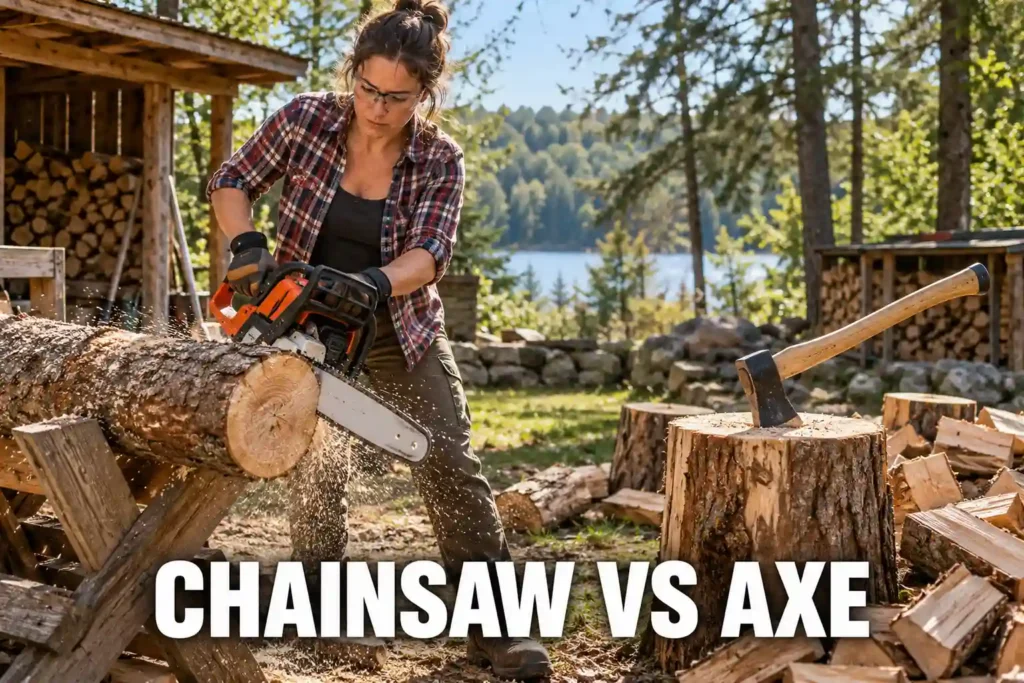
Chainsaw vs axe comes down to the cut: a chainsaw cuts through wood, and an axe or splitting maul pushes it apart along the grain. Most yards that handle real wood end up with both tools, and neither one is the safe shortcut. I sort a wood job the way I sort an orchard job, by what has to be cut to length, what has to be split and what is not a homeowner’s job at all. Below you get the split of jobs, the injury numbers, the safety floor for a saw, what a maul asks of you and a table for picking the tool.
Chainsaw vs Axe: The Short Answer
Use a chainsaw to cut and an axe or maul to split. According to Kentucky Extension, the best tool to turn trees or logs into firewood is a chainsaw, and it adds that proper training and safety equipment are a must. For splitting, the same publication says a large four or five pound axe works well and the best tool is a splitting maul, a combination of sledgehammer and axe.
Penn State Extension describes a maul as a heavy ax designed for splitting wood and says it is generally faster than a hammer and wedge. So the two tools do not compete for the same job. They hand the wood to each other, and the axe vs chainsaw question mostly asks which stage of the work you are at.
| Question | Chainsaw | Axe or maul |
|---|---|---|
| Built for | Cutting across the grain: limbs, logs cut to length | Splitting along the grain; a felling axe cuts with a thinner edge |
| What drives it | Gas engine, battery or cord | Your swing |
| Needs | Chain, bar oil, fuel mix or charge | A sharp edge, a handle that is sound and a stable block |
| Hazard the maker warns about | Kickback, a chain that keeps moving, noise, exhaust on gas models | A missed strike and flying splinters |
| Who should use it | Someone trained, with full protective gear | Someone with eye protection, boots and a block of the right height |
How Each Tool Removes Wood
A chainsaw is a loop of cutters running around a bar. Each cutter takes a small chip from across the grain, and a sharp chain throws chips while a dull one throws fine dust, according to the University of Georgia Extension. On a gas saw the loop is driven by a two-stroke engine that needs mixed fuel, and on a battery or corded saw by an electric motor. My guide on how a chainsaw works explains the engine, clutch, chain and brake.
An axe works on a different principle. The edge enters the wood, and the head then wedges the fibres apart. A felling axe has a shallow, acute edge angle for cutting, and a maul has a deeper, blunter angle that drives wood apart.
Cutting Logs, Limbs and Storm Wood
Cutting is the chainsaw’s side of the work. It does the felling and the cutting to length under the rules of a trained operator, and it does the larger limbs. Everything here assumes the saw’s own manual is read first and that you have had training from someone qualified. My explainer on what a chainsaw is lists the types, parts and safety basics.
Cutting Logs to Length
Penn State Extension gives 14 to 16 inches as the ideal firewood log length. I keep the log off the ground on a stand when I can, because a chain that touches soil or stones dulls fast, and the Makita manual lists cutting dirty wood as something to avoid. Kentucky Extension gives the same warning about an axe blade: do not let it meet the ground, rocks or metal.
Small Limbs Below Shoulder Height
Alabama Extension calls a saw with an 8 to 15 inch bar appropriate for light-duty work such as small limbs. Never cut at or above shoulder height, and never cut from a ladder or a roof. Clemson Extension explains that the operator loses control above that height and the upper body is unprotected; for overhead branches, Clemson says a pole saw is the right tool, and my chainsaw and pole saw comparison shows which one fits which job. On live fruit wood I reach for loppers and a hand saw first, since most of my pruning never needs power.
Storm Wood and Tension
Storms leave wood under tension, and Alabama Extension warns that downed trees can be under tremendous forces from bent and stretched fibres. A spring pole, a hung tree or a trunk resting on a structure is a job for a professional crew. I treat that as a hard line, and a saw or an axe does not change it.
Saw Safety Floor
Before each use, inspect the saw as its manual describes: test the chain brake by the manual’s method, and check the throttle trigger lockout, the stop switch, the chain catcher, the guards and the chain’s sharpness, tension and condition; on a gas saw the chain must not move at idle. If any check fails, do not use the saw until it is repaired, and never disable a safety device. Wear impact-rated safety glasses with side protection marked Z87+ (a mesh face screen adds to them but never replaces them), hearing protection, chainsaw chaps or chainsaw trousers used within their maker’s stated limits (some are not designed to stop a battery or corded saw’s chain, and no clothing guarantees protection), work gloves and sturdy boots with ankle support, plus a hard hat when you fell a tree or anything can fall from above.
Stopping and Maintenance Order
To stop any saw, release the trigger, engage the chain brake (on a battery or corded saw, if it has a brake lever), switch the engine or motor off and wait until the chain has stopped. Before touching the chain, clearing a jam, adjusting tension, sharpening or changing the bar or chain, stop as above, then on a gas saw let the engine and muffler cool and pull the spark plug cap off, on a battery saw take the battery out, and on a corded saw pull the plug from the outlet by the plug, not the cord. Put on gloves before touching the chain. Release the chain brake only when the exact manual’s procedure requires it (for example to remove the clutch cover or check that the chain moves freely), and never force a locked chain or cover.
Chainsaw vs Axe for Firewood
Firewood is where the two tools meet. A saw gets the log to length, and a splitting maul takes over from there. A splitting maul does not cut logs to length, although a felling axe can cut across the grain. My chainsaws for firewood guide ranks seven saws for bucking logs at home and the farm.
Kentucky Extension advises erring on the side of smaller rounds because they are easier to transport and dry faster, and it says split wood without the bark dries much faster than unsplit rounds. It puts the round on a platform, usually an old stump, high enough to get maximum impact from one swing, and not the ground. My look at a log splitter or splitting axe shows which tool fits a firewood pile of your size.
Setting Up the Block
Penn State Extension says the splitting block should be between 14 and 18 inches tall and warns that a block that is too short may force the splitter to overextend, which may lead to injuries. I split on a stump rather than on the soil for a second reason: it keeps the head clear of the gravel. Penn State also says wedges are best for logs with many knots or other defects.
Safety glasses, pants and boots should always be worn when splitting, according to Penn State, and Kentucky Extension says eye protection should always be worn when processing firewood.
Why Not Split With a Chainsaw
Splitting is not what a saw is made for. The EGO CS1800E manual lists its intended use as basic felling, limbing, pruning and woodcutting, and splitting is not on that list. A chain also meets dirt and stones when the saw runs through a round to the block, and Maine Extension, Oregon State and the Makita manual all warn against letting the chain touch the ground. I leave the splitting to the maul and keep the saw for cutting. If you want to see what a machine does for you here, my comparison of a log splitter and a chainsaw lays out what each tool does and when you need both.
Felling a Tree Is No Shortcut With Either Tool
Felling is the most dangerous job either tool does. Clemson Extension says the dangers of felling trees and cleaning up storm-damaged trees are more significant than the threat of being cut. Swapping the saw for an axe does not remove that danger, because the tree comes down with the same force whichever tool cut it.
A splitting axe is also the wrong shape for the job. Its blunt head is made to push wood apart along the grain, and a thinner edge is what cuts across it. For a homeowner the real answer is shorter: a large tree, a leaning or dead tree, a tree hung up in another tree, or any tree near a house or road goes to a certified arborist. NC State Extension recommends training before a chainsaw is used for tree work. Felling is the most dangerous chainsaw job, so never work alone, keep everyone at least two tree lengths away, and plan and clear two escape routes angled back from the direction of fall before any felling cut.
Power Lines
Treat every downed power line, and anything touching it, as live: stay well away and call the utility. Before any work near a power line, contact the utility and leave that work to its qualified line-clearance crews; a general arborist is not automatically qualified for it. Alabama Extension gives 10 feet from distribution lines and 33 feet from energized trees as the minimum distances.
Safety, Noise and Fatigue Compared
Both tools injure people, and the numbers show where. A US emergency department study of 18,250 nonfatal power saw and axe injuries from 2006 to 2016 found that power saws caused 89 percent of them, lacerations were the most common injury, about half involved the fingers and hand, and most happened at home (1). That leaves about 10 percent for axes by my arithmetic. The study counts injuries and not hours of use, so it cannot tell you which tool is safer per hour.
A series of 185 rural patients with non-occupational chainsaw injuries found more leg injuries than arm injuries, but the arm injuries cost more lost work time, 75 days against 60 (2). The authors conclude that protective gear and simple precautions can prevent such injuries. According to Rutgers Cooperative Extension, the CDC estimates about 36,000 emergency department visits a year for chainsaw injuries.
Kickback, Brake and Grip
An axe has no kickback, and a saw does. According to Husqvarna, kickback occurs when the kickback zone of the guide bar touches an object, and it can throw the saw toward the operator. If the upper part of the bar tip touches wood or another object, the bar can kick back up and toward you (rotational kickback). Wood pinching the chain on the top of the bar pushes the saw straight back at you (pushback), and wood pinching the bottom pulls it forward, away from you (pull-in). A low-kickback chain, a chain brake and a correct grip reduce these risks; none removes them.
Hold the saw with both hands, right hand on the rear handle and left hand on the front handle, thumbs and fingers wrapped around the handles, with your body to the left of the chain line and firm footing.
Noise, Vibration and Tired Arms
A swung axe makes no engine noise and no exhaust. A gas saw makes both, while a battery or corded saw has no exhaust and still calls for hearing protection. NIOSH sampling of landscaping workers found 94 of 119 eight-hour noise results at or above the 85 dBA limit, and workers had significantly more noise and carbon monoxide exposure when using fuel-powered leaf blowers, string trimmers and chainsaws than with battery versions (3).
Groundskeepers who run these tools carry a lifetime hand-arm vibration dose far above that of office workers, and the chainsaw read highest of the tools measured, at 8.0 m/s2 on the right hand (4). Use hearing protection with any saw, take breaks, and stop when your hands tingle.
Tiredness is a risk with either tool. In 40 loggers, felling was the most demanding task, workers underestimated their own load and heart rate rose as the saw got heavier (5). Alabama Extension adds that a bigger saw tires you faster, so I match the saw to the job rather than to the biggest log I might cut. Choosing what size chainsaw you need comes down to bar length, and I cover that for homeowners in a separate guide.
Cost, Fuel and Upkeep
An axe or maul needs no fuel, bar oil, battery or cord. It needs a sharp edge, a sound handle and a stable block. According to Rutgers Cooperative Extension, work only with a sharp, well-maintained ax or chain saw, which is the same rule for both.
A gas saw adds a fuel mix that follows its own manual. Alabama Extension says the majority of saws use 50:1, and the ratio, the octane and the ethanol limit differ by maker, so never mix from memory. Mixed fuel goes stale, and a stale mix is a common reason a gas saw will not start.
A battery saw swaps the fuel for a charge, and Alabama Extension puts the run time of a battery near 30 minutes in storm cleanup, which is why a second pack matters on a long job. Every saw needs bar oil and a sharp chain, and Clemson Extension advises having the chain professionally sharpened if you are unsure how. My battery vs gas chainsaw comparison sets power, upkeep, noise and safety side by side.
Chainsaw vs Axe by Job
The table below turns the sections above into a choice. The right column is the point where the job leaves the homeowner’s hands.
| Job | Reach for | Hand it over when |
|---|---|---|
| Small limbs below shoulder height | Loppers, a hand saw or a small saw | The limb is at or above shoulder height: pole saw or a professional |
| Cut a log to firewood length | A chainsaw, with training and full gear | You have no training or no helper nearby |
| Split rounds | A maul or splitting axe on a block | The wood is knotty: use wedges, as Penn State advises |
| Storm wood under tension or a hung tree | Neither tool | Always: a professional crew |
| Fell a tree | Trained people only | The tree is large, leaning, dead or hung up, or stands near a house or road |
| Anything near a power line | Neither tool | Always: stay well away and call the utility |
What I Reach for on the Orchard
Most of my wood work is small. Pruning live apricot and plum wood belongs to loppers and a hand saw, and I save a power saw for the occasional limb that is too thick for them. When a tree has to come out, I want the stem and main limbs cut into carry-size pieces by a trained hand with a saw, and the rounds split on a stump with a maul. I compare five cordless pruning saws for occasional branch cutting in my mini chainsaw picks.
Gum bleeds from cut stone-fruit wood, and it builds up on the bar and near the brake area, so I clean the saw after the cutting and before the next job. I also keep drip lines in mind: before any stump work near a tree row, I mark where the line runs. And wood from a tree taken out for disease leaves the orchard instead of being stacked beside the rows, because that lowers the risk of carrying the problem forward.
Pick the Tool That Matches the Wood You Have
Remember three things. A saw cuts and a maul splits. Neither tool makes felling or storm wood a homeowner job, and eye protection, boots and a block of the right height matter for the axe as much as the full kit matters for the saw. My guide to the best chainsaw for homeowners compares nine saws with a chain brake for yard cleanup.
My tip is to cut the logs to length first, stack the rounds near the block, and split in one sitting, so the saw is stopped before anyone swings: trigger released, chain brake engaged where the saw has one, engine or motor off and the chain still. Next, read the manual of any saw you own and book a training course. Once you know whether the job is cutting or splitting, the chainsaw vs axe choice settles itself.
Frequently Asked Questions
Why use an axe instead of a chainsaw?
An axe or maul beats a chainsaw for splitting rounds, because Kentucky Extension names the splitting maul as the best tool for that job. It needs no fuel, battery or cord, and it makes no engine noise or exhaust, but it still demands eye protection, boots and a stable block.
What are the key differences between a saw and an axe?
A chainsaw cuts across the grain with a loop of cutters driven by an engine, a battery or a cord, and an axe splits or cuts with a wedge-shaped head driven by your swing. A saw cuts logs to length and a splitting maul splits the rounds, and the saw adds kickback, upkeep and, on gas models, noise and exhaust, while the axe has no engine and needs a sharp edge and a steady block.
Can you use a splitting axe to fell a tree?
A splitting axe is the wrong shape for felling a tree, because its blunt head is made to push wood apart along the grain and not to cut across it. Felling is the most dangerous job with any tool, so a large, leaning, dead or hung-up tree, or a trunk under tension after a storm, goes to a certified arborist. Treat every downed power line as live, stay well away and call the utility.
When to use an axe vs chainsaw?
Use a chainsaw to cut limbs and logs to length, and use an axe or maul to split the rounds. Leave felling and storm wood under tension to a certified arborist, and for anything near a power line stay well away and call the utility.
Do lumberjacks use chainsaws?
Lumberjacks, today’s professional loggers, use chainsaws to fell trees, delimb them and cut logs to length. A firewood cutter safety sheet that Illinois Extension distributes still lists an ax or hammer and felling wedges as helpers kept beside the saw, used as the saw’s manual and a safety course teach.
References
- Sritharen Y, Hernandez MC, Zielinski MD, Aho JM. Weekend woodsmen: overview and comparison of injury patterns associated with power saw and axe utilization in the United States. Am J Emerg Med. 2018;36(5):846-850.
- Özdeş HU, Ergen E, Köroğlu M, et al. Chainsaw-related extremity injuries. Medicina (Kaunas). 2025;61(4):759.
- Alexander BM, Graydon PS, Pena M, Feng HA, Beamer BR. Hazardous exposures and engineering controls in the landscaping services industry. Journal of Occupational and Environmental Hygiene. 2025;22(3):189-202.
- Chen N, Yang S, Oh J. Evaluation of hand-arm vibration (HAV) exposure among groundskeepers in the southeastern United States. Annals of Work Exposures and Health. 2025;69(1):81-95.
- Masci F, Spatari G, Bortolotti S, et al. Assessing the impact of work activities on the physiological load in a sample of loggers in Sicily (Italy). Int J Environ Res Public Health. 2022;19(13):7695.
Safety Note: Read your saw’s manual first and get hands-on training before your first cut. A chainsaw can react faster than you can: if the upper part of the bar tip touches wood or another object, the bar can kick back up and toward you; wood pinching the top of the chain can push the saw straight back at you, and wood pinching the bottom can pull it forward. Keep the bar tip out of contact and watch for wood closing on the bar. A low-kickback chain and a chain brake reduce these risks but never remove them. Before each use, inspect the saw as your manual describes: test the chain brake, and check the throttle lockout, the stop switch, the chain catcher, the guards and the chain. On a gas saw the chain must not move at idle. If any check fails or a part is missing or damaged, do not use the saw until it is repaired, and never disable a safety device. Wear impact-rated safety glasses with side protection marked Z87+ (a mesh face screen adds to them but does not replace them), hearing protection, chainsaw chaps or chainsaw trousers, work gloves and sturdy boots with ankle support, and a hard hat when you fell a tree or when anything can fall from above. Use leg protection within its maker’s stated limits: some chaps are not designed to stop the chain of a battery or corded saw, and no clothing guarantees protection. Hold the saw with both hands, right hand on the rear handle and left hand on the front handle, thumbs and fingers wrapped around the handles, and keep your body to the left of the chain line with firm footing. Never cut one-handed with a rear-handle saw, never cut at or above shoulder height, and never cut from a ladder or a roof. Top-handle saws are made for trained tree workers: follow that saw’s manual. Keep children, bystanders and pets well away while you cut. Never work alone. Start a gas saw with the chain brake engaged, on the ground or held firmly as the manual shows, never by drop-starting it, and at least 10 feet from where you fuelled it. Refuel outdoors with the engine off and cool, with no smoking, flames or sparks nearby, wipe up spills, and use only the fuel mix and ethanol content your manual allows. Exhaust contains carbon monoxide, which can kill: never run a gas saw indoors or in a garage, shed or other enclosed space. Before you touch the chain, clear a jam, adjust the tension or sharpen: release the trigger, engage the chain brake, stop the engine or motor and wait until the chain has stopped. Then, on a gas saw, let the engine and muffler cool and pull the spark plug cap off; on a battery saw, take the battery out; on a corded saw, unplug it by the plug. Put on gloves before you touch the chain, and release the chain brake only when your manual’s procedure calls for it. To carry the saw, stop it, take out the battery or unplug it, keep the chain brake engaged and the bar pointing behind you, and fit the bar cover for transport. Use a corded saw only with an outdoor-rated extension cord of the gauge your manual gives, plugged into GFCI-protected power. Never use it in rain or wet conditions: GFCI protection does not make that safe. Keep the cord away from the chain. Use only the chains and bars your manual approves. Felling trees is the most dangerous chainsaw job. Before any felling cut, keep everyone at least two tree lengths away, and plan and clear two escape routes angled back from the direction of fall; when the tree starts to fall, follow your manual’s retreat steps (release the trigger, stop the saw and set it down as it describes) and move away along that route; never delay escape to cool, unplug or cover the saw. A large, leaning, dead or hung-up tree, a trunk or limb under tension after a storm, and any tree near a house or a road are jobs for a certified arborist. Power lines are a separate danger: treat every downed line, and anything touching it, as live, stay well away and call the utility; before any work near a power line, contact the utility and leave that work to its qualified line-clearance crews. Stop when you are tired, and take breaks if your hands tingle or go numb.